Month: January 2014

  • Gretsch’s “Golden” Tenors

    Gretsch’s “Golden” Tenors

    In the 1950s and early ’60s, the electric guitar was establishing itself as a key part of the new voice of popular music. Amplification provided its volume, and innovative artists were pushing the envelope of sound that could be offered by six strings. So it’s interesting that in a time referred to in retrospect as the “Golden Era” of the electric guitar, major manufacturers were also producing similar electrified instruments with only four strings.

    Tenor guitars initially became popular in the 1920s when musical tastes motivated a move by many musicians away from the banjo, toward the guitar. The four-string tenor made for an easy transition, as it could be tuned like a tenor banjo – CGDA fifths. Into the early ’30s, the guitar was primarily a rhythm instrument. Sonically challenged within the ensemble format of a large band, it was typically relegated to the percussive accompaniment of other lead instruments. However, even before the mid-decade advent of amplification, guitars were being pushed into a greater role with virtuoso artists such as Eddie Lang, Lonnie Johnson, and Django Reinhardt mastering the complexities of the acoustic. Likewise, the Delmore Brothers, a pioneering country music duo comprised of Alton on an acoustic six-string and Rabon on a Martin O-18T, were lead instrumentalists in that genre, introducing a country-boogie beat and inspired acoustic solo work that ultimately earned them induction into the Country Music Hall of Fame in 2001.

    01 GRETSCH TENORS

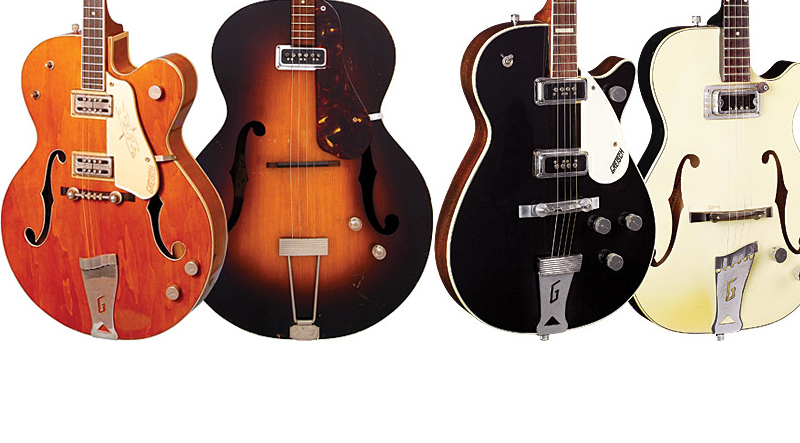
    1) A bit of a surprise that Gretsch made Chet Atkins 6120 hollowbody in four-string tenor format. Perhaps the only one of its kind, this ’58 example was the first guitar in the 100-unit 6120 model batch #284xx. The four-pole Filter’Tron pickups were specifically made to accommodate the format. The dot fretboard markers are pedestrian compared to the neo-classic markers on the standard 6120, and the G tailpiece and modified space-control bridge were practical departures from the six-string. Photo courtesy of George Gruhn.

    2) Replacing the 6185 model late in 1953, the 6182 model (ultimately named “Corvette”) was almost identical. This early example belongs to the last batch (#126xx) produced before the advent of the adjustable truss rod (with headstock-located cover). This is also the last batch labeled with the dual model stamp. This specimen’s model stamp shows the typical designation of 6182-3 stamped in ink, but also has a “T” suffix written in pencil. It has a standard six-pole DeArmond Dynasonic pickup, and all the other features are consistent with the conventional six-string Corvette. Several of these have surfaced in the four-string tenor orientation, likely one-off custom orders. Photo courtesy of Steve Wilson.

    By the ’30s, many major guitar manufacturers had started producing standard and custom-order tenor versions of their popular six-string acoustic guitars. When Gretsch introduced a line of self-branded acoustic archtops in 1933, it included a four-string tenor (Model 240) in its American Orchestra lineup. Not big sellers, they nonetheless filled a relevant niche. Interestingly, in a circa-1936 Gretsch brochure is a notation that pledges, “Any standard model of Gretsch guitar can be duplicated in tenor style… at no increase in price.” This explains why some Gretsch tenor acoustics from the ’30s have surfaced with different features than the standard Model 240. Even more impressively, the brochure promises “…delivery in three weeks from the date of order.”

    06 Gretsch Tenors

    6) This example is from the latest documented mini-batch of Duo-Jet tenors residing in the #156xx batch, from 1955. It displays the arrow-top control knobs and teardrop-style pickguard. The tailpiece and bridge are not original. Not all tenor Duo-Jets have four-pole DeArmond Dynasonic pickups like this. It’s unclear why some electric tenors had these pickups while others had the standard six-pole variety. Photo courtesy of Fred Gretsch.

    7) This 6115 Rambler from the #379xx batch is an interesting example of the four-string tenor adaptation of an uncommon Gretsch model, with four-pole Hi-Lo’Tron pickup. The red truss rod cover is original, and this model typically displays a matching red G on the tailpiece. The pickguard is missing. Photo courtesy of Fred Gretsch.

    As the ’40s loomed, Gretsch upgraded its guitar offerings, debuting the Synchromatic line of acoustic archtops in 1939. Unlike the previous product line, comprised of midrange variations on the Gibson L-5 archtop, the Synchromatic guitars were distinct, with the higher-end models sporting exotic “cats-eye” soundholes and art deco design motifs. Though the tenor was by then fading in popularity, Gretsch continued to produce the periodic Synchromatic-based tenor. On page 61 of Tony Bacon’s The History of the American Guitar is a photograph of a natural-finished 17″ Synchromatic tenor with cats-eye soundholes. Manufactured in 1953, it was part of 50-unit group (batch #112xx) of six-string Constellation archtops (model 6030-1), all featuring conventional f-holes, confirming this cats-eye tenor as a special-order instrument. This guitar, electrically enabled by the addition of a DeArmond floating pickup, is also a rare example of a Gretsch cats-eye acoustic archtop possessing the single-cutaway body.

    One notable jazz artist who by 1940 had embraced the electric tenor was Lloyd “Tiny” Grimes. Known for backing up Art Tatum, Charlie Parker, Billy Holiday, and others, Grimes was influenced by the great Charlie Christian and is remembered for developing a swinging approach to the instrument. This characteristic sound, along with his inclusion as a co-headliner at Alan Freed’s Moondog Coronation Ball in 1952, resulted in some attributing him credit for the invention of an early rock-and-roll sound.

    By the ’50s, popular music had evolved and four-string tenor guitars were no longer a standard catalog item. However, the latter decade saw a resurgence of interest in the four-string format as a result of the emergence of Nick Reynolds, guitarist for The Kingston Trio and devotee of Martin tenor acoustics. Reynolds played in DGBE (baritone ukulele) tuning, typically with a capo. And others followed as folk gained popularity.

    The mid ’50s represented the heart of the Gretsch electric guitar legacy, and the company would contribute innovation, style, and unique sonic attributes with the guitar models it introduced over the next 10 years. Simultaneously, the six-string electric guitar was rapidly maturing into the most important musical instrument of the 20th century. So it’s a bit ironic that, considering the expansion of its electric guitar line to include some of the most distinctive models of the day, Gretsch was still willing to produce the periodic four-string deviant.

    Interestingly, the competition was doing the same; Gibson had been producing the ETG-150 model as a standard tenor electric archtop option since 1937, but other well-known Gibson electrics have surfaced in the tenor format, including anomalous specimens based on the ES-175, ES-5, and ES-330. Gibson solidbody tenor examples of the Les Paul Special and SG-Standard have also been documented. Epiphone and Guild were likewise reported to have created four-string tenor examples of some of their stalwart electric six-string models, as well.

    The Gretsch factory is known to have applied the four-string tenor format to a number of its early Electromatic guitar models of the 1950s. Examples of tenor counterparts to the models 6185 (Electromatic), 6182 (Corvette) and 6189 (two-tone finished Streamliner) have all been documented. Likewise, the Anniversary models have been used in the creation of four-string versions of the instruments. In each case, it appears the resulting guitar was a special order, or one-off production example. Gretsch tenor models are usually associated with a typical batch (50 or 100 units) of standard six-strings of the same model, not in conjunction with other tenors.

    The exception to that rule appears to be with the application of the tenor format to the Duo-Jet electric solidbody. In this case, research confirms that several small “mini-batches” of four-string Duo-Jets (sometimes with the model designation of 6127, other times with the standard 6128 stamp on the label) were manufactured in the 1954/’55 model years, each in a larger batch of six-string Jet guitars. An educated guess might be that these mini-batches were on the order of 10 guitars each. It is not clear why Gretsch produced multiple Duo-Jet tenor guitars, but they are present in the March, 1954, price list at a suggested retail price of $230, consistent with their six-string counterparts. Other Duo-Jet tenors have surfaced from subsequent model years, including from batches #294xx (’58), 305xx (’59), and 399xx (’60). On page 150 of Akira Tsumura’s Guitars, The Tsumura Collection is a photo of a ’61 (or later) Duo-Jet tenor with the double-cut body the Jet line inherited that year. Each of these post-’55 tenor examples appears to be a custom order or one-off rather than from a mini batch.

    One special-order tenor described by Dan Duffy, Gretsch quality manager from 1957 to 1970, is a late-’50s four-string tenor Duo-Jet requested by musician Remo Palmari for presentation to radio/TV talk-show host Arthur Godfrey, who was known for playing a four-string baritone uke.

    As the mid ’60s were irrevocably impacted by the British invasion and the Beatles, the rock and roll train was at full throttle. George Harrison’s high-profile use of several Gretsch electric six-string models resulted in an explosion in the popularity of Gretsch electric guitars, and the four-string tenor format was overshadowed, if not abandoned altogether by the company, and Gretsch was sold to the Baldwin Piano Company in the summer of 1967. There have been tenor electric examples documented from that era, but they are exceedingly rare, and almost certainly custom orders. No examples of Gretsch electric tenor guitars have surfaced from the ’70s.

    More than a half-century after Gretsch’s golden era (1953 to ’65) began and the electric tenor guitar was popularized, these quirky instruments are found in the collections of musicians and vintage-guitar enthusiasts who play music in a style that accommodates the tenor. Not many contemporary musicians play them, though there has been a minor resurgence of interest over the past few years.

    Most Gretsch electric tenors were apparently special-order items, so it’s impossible to determine exactly how many were produced in Gretsch’s Brooklyn factory. This dilemma is compounded by the fact Gretsch records were lost to fires in the ’70s, leaving the precious few surviving electric tenors as the only evidence of their creation.


    Edward Ball is the author of  Gretsch 6120The History of a Legendary Guitar (Schiffer Books). For more on the style, visit vintagetenorguitars.com.


    This article originally appeared in VG July 2010 issue. All copyrights are by the author and Vintage Guitar magazine. Unauthorized replication or use is strictly prohibited.
  • Robert Shaw and Peter Szego

    Robert Shaw and Peter Szego

    Inventing the American GuitarTo start with the conclusion, this is hands-down one of the all-around best books on guitars ever published. From the scope of the coverage to the quality of the text and photos, the elegant design to the overall packaging, it’s simply glorious – an example all others guitar books should aspire to.

    Now, back to the beginning. This is the essential book-end to your collection of the many titles available on 20th-century guitars. Subtitled “The Pre-Civil War Innovations of C.F. Martin and His Contemporaries,” it is the first to delve deep into the story of the evolution of early American guitar design. While the era from the 1930s through the ’50s has often been considered the golden era of guitars, the authors make a solid case that the 1830s through 1900 was actually the most groundbreaking, creative, and critical.

    That story centers around C.F. Martin, who has long been recognized as the godfather of American guitar design. The authors further cement his position here. As other early American luthiers went under, Martin proved himself both an astute businessman and a wily innovator, responding to opportunities in a market that he himself was key in creating.

    Martin almost sacrilegiously abandoned the Austro-German style of lateral bracing of the guitar soundboard that he first learned. In its place, he adopted Spanish-style fan bracing, which he then adapted into the X-bracing that soon became the hallmark of Martins – and many other modern guitars. As early as the late 1840s, he was crafting guitars that bore all the main attributes of today’s Martin guitars, except for their size.

    The book largely begins in 1833, tracing the various strains of influences from Johann Georg Stauffer’s Viennese guitars, Martin’s German-styled guitars, Spanish guitars, Cadiz guitars, and more. Along the way, the authors also touch on “Renaissance”shape guitars, harp guitars, mandolins, and others instruments.

    The authors chronicle the development of body sizes, bracing styles, neck and especially headstock designs, neck-body joins, labels, and more – all in the kind of detail fans dream of. There are even glorious large photos of the wooden coffin-style cases, which are in themselves works of art.

    The history is spiced by profiles of 44 individual guitars each run across two-page spreads. These profiles include gorgeous images, detail photographs, bracing-configuration drawings, and measurements. Among the most fascinating is the 10-string two-neck Martin harp guitar from 1859’60
    and several James Ashborn guitars from the 1840s through the 1860s.

    At the back of the book, along with a two-page spread of marquetry designs and detailed notes, there are a handful of measured scale drawings of milestone Martins on dramatic foldout pages.

    Creation of the book was headed by Pete Szego, a collector and player of 19th-century American banjos. Well-known historians Richard Johnston, David Gansz, James Westbrook, Arian Sheets, and David LaPlante all contribute chapters compiled into this large volume. Most of the photography was by John Sterling Ruth, who deserves special kudos.

    Publication of the book is tied into a forthcoming, year-long exhibition of Martin guitars at New York City’s Metropolitan Museum of Art entitled “Early American Guitars: The Instruments of C.F. Martin.”

    This article originally appeared in VG‘s March ’14 issue. All copyrights are by the author and Vintage Guitar magazine. Unauthorized replication or use is strictly prohibited.

  • Fender’s J Mascis

    Fender’s J Mascis

    Fender J Mascis JazzmasterIntroduced in the late 1950s as Fender’s “jazz guitar,” the Jazzmaster was also supposed to compete in the market with Gibson’s semi-hollow ES line. But despite its very specific moniker, the guitar never caught on with the jazz crowd.

    Lucky for Leo, the Jazzmaster was hijacked by many of the top surf and instrumental bands of the late 1950s and ’60s (i.e. the Ventures) and in the 1970s and ’80s by punk/alternative rock bands and artists (i.e. Elvis Costello.

    Along the way, it also occasionally gained favor with harder-edged rock players. One prime example is J. Mascis, lead guitarist for Dinosaur Jr., the indie rock guitar icon credited with keeping guitar leads in rock music.

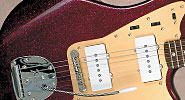
    At last month’s NAMM show, Fender debuted the J. Mascis Jazzmaster, an interesting derivative based on Mascis’ personal guitar. Not only does it boast a cool metallic purple finish with matching headstock, but it offers a handful of new features like jumbo fret wire, a flatter (9.5” radius) fretboard, satin poly-finished neck, and Fender’s Adjusto-Matic bridge. Otherwise, the guitar is classic Jazzmaster with its offset-waist body, gold-anodized pickguard, dual Vintage Reissue single-coil pickups, vintage-style floating vibrato, three-way pickup toggle, master Volume and Tone controls with separate “rhythm” circuit, as well as a 25.5”-scale bolt on maple neck with a rosewood fretboard.

    For the uninitiated, the Jazzmaster’s electronics have always employed the “rhythm circuit” in the cluster of controls on the upper bass bout portion of the pickguard. Engaged via a slide switch, it switches the guitar’s output from being controlled by the three-way toggle and volume/tone controls to run only the neck pickup with its own volume and tone controls (the two thumbwheels next to the slider switch). This allows the player to go from a darker, softer pre-set “jazz” sound with neck pickup, to a brighter, hotter lead sound with any pickup combination simply by flicking the slide switch.

    If you’re familiar with the Jazzmaster’s bridge, you’ll likely appreciate the Adjusto-Matic unit the Mascis models gets in place of the original pivoting version. This floating bridge pivots on two pointed set screws inside a concentric bottom socket that allows the bridge to move side to side when using the vibrato. This ensures tuning stability. The problem with the original system is when you play the guitar hard (a la Mascis) the bridge is subject to forces that can move it to one side or the other, which affects intonation. Plus, with aggressive playing, strings were prone to jumping out of the old-style threaded-rod saddles, monkeying up string spacing and causing tuning problems.

    With typical use, the solid-pinned Adjusto-Matic bridge stays in tune, and doesn’t affect the stability of the vibrato even with aggressive playing.

    Upgraded hardware aside, the most impressive feature of the JMJ versus a standard reissue Jazzmaster is its playability; the combination of jumbo frets, flatter-radius fretboard, lower action and satin-finished neck make it a breeze to play. And per Leo’s original intent, the ’60s-style C-shape neck and body contours are very comfortable whether sitting down or with the guitar strapped on. And a tight neck joint along with Kluson-style tuning machines make for very little touch-up tuning.

    Through a Chicago Blues Box Roadhouse head (12AX7/5881/6L6/EL34) and a Hard Truckers Fatty 2×12” cabinet, the JMJ’s bridge pickup produced a strong, bright spanky tone with fair amount of low-end punch, excellent for picking clean lead lines, while the middle switch position (which is humbucking) had a thick lush planky sound, ideal for chording and palm-muting. The neck pickup produced a darker, fatter, very usable jazz tone.

    Using this guitar in a jazz situation would likely mean using its “rhythm” circuit, which would prove handy to pre-set dark soft-chording sound, then let a player pop into a full, round, lead sound.

    Through the overdrive channel of a 6L6-powered Crate Blue VooDoo, the JMJ’s bridge pickup produced crunchy, cutting single-coil sounds with plenty of attack and sustain, while the middle position produced a rounder, higher-output sound good for rhythm work (especially considering the setting is humbucking), but still cutting enough for solos. The neck pickup gave a solid overwound-neck-pickup sound that was full without being muddy. Under high gain with the Volume control all the way up, the pickups can become a bit microphonic, squealing slightly to let you know you’re too close to the amp. But it never becomes uncontrollable.

    Workmanship is typical Fender Japan, with a flawless finish, clean/level frets, and tight-fitting components.

    In all, the J. Mascis Jazzmaster is fun and offers killer looks and playability, whether drenched in reverby surf tune or cranked through a half-stack.


    Fender J Mascis Jazzmaster
    Price: $1,199.99 (retail)
    Contact: Fender Musical Instrument Corp., 18860 E. Chaparral
    Road, Suite 100
    Scottsdale AZ 85250-2610;
    www.fender.com.


    This article originally appeared in VG October 2007 issue. All copyrights are by the author and Vintage Guitar magazine. Unauthorized replication or use is strictly prohibited.

  • Gibson ES-335 Joe Bonamassa Signature Model

    Gibson ES-335 Joe Bonamassa Signature Model

    Gibson ES-335 Joe Bonamassa Signature Model

    Gibson ES-335 Joe Bonamassa Signature Model
    Price: $3,335 (street)
    Contact: gibson.com.

    The collaboration of Gibson and blues-rocker Joe Bonamassa began with a limited run of goldtop Les Paul’s in 2009, followed by a more-affordable Studio version and another Custom Shop version, the latter sporting a beautiful flamed-maple top.

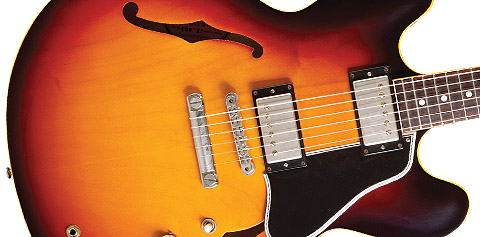
    Gibson and Bonamassa have teamed up again to debut a tribute to his treasured ’61 ES-335. With his guitar in-hand, the builders at Gibson whipped out their calipers and did their best to mine the magic of Joe’s original.

    The Bonamassa ES-335 has the standard maple/poplar/maple three-ply body, but like Joe’s original ’61, sports a center seam like the two-piece maple top on a Les Paul. Additionally, the Vintage Original Spec (VOS) sunburst finish on it was carefully matched to follow that of his original guitar. The neck is mahogany with a nicely streaked rosewood board and a neck that is .050″ smaller than Gibson’s current 1959 profile. The edges of the fretboard have a very nice rolled feel, and the binding throughout is aged cream. The headstock carries tulip-buttoned TonePros tuners, a holly veneer, and a nylon nut. The aged hardware includes an ABR-1 bridge, and Gibson’s deluxe lightweight aluminum stop bar. The volume and tone controls are from CTS, and the accompanying knobs are period-correct gold with silver-top knobs and a single gold “top hat” knob for the neck pickup’s tone control. Like most current production ES guitars, Joe’s features ’57 Classic humbuckers, but with the addition of aged covers. The Joe Bonamassa ES-335 is only available in sunburst and includes both a custom shop case and certificate of authenticity. For our review, we chose a Dr. Z RX ES amp and a Fender Deluxe Reverb.

    Picking up the sunburst beauty, we immediately noted the pleasing neck shape of the JB. For those that are Gibson savvy, it is a nice compromise between the larger ’59 profile, and the thin ’60s profile used on Gibson Custom instruments. Another comfort feature is the rolled edges of the fingerboard. Because of this, the frets go to the edge of the board, and there is not the standard binding nibs you see on new Gibson instruments. The action and playability of the instrument were superb with a nice medium/low action that allowed both heavy chording, and extended bending.

    Plugged into a vintage Fender Deluxe, the Bonamassa responded with classic tones; fat, clear lows, with bell-like highs on the neck pickup, the characteristic ping of both pickups together, and the strong, vibrant ring of the bridge – all very pleasing to the ears. Though we have heard ’57 Classic pickups from many guitars, they seem sound especially sweet in the JB. Turning the amp up to breakup, the guitar handled all positions well – no squealing, even at high volume – yet it was easy to get controlled, feedback-enhanced once the amp’s Volume contraol moved past 5.

    The Volume and Tone knobs have a very nice taper, handy for controlling the amp from the guitar. Kudos to Gibson and Joe for their attention to this often overlooked area. Also, the strings go both through and over the stop bar. This helps create a slinkier feel, though it effects on tone are open to debate. We liked it well enough, but it could certainly be changed with little fuss.

    In all, the Joe Bonamassa ES-335 proved a fantastic instrument. Out of the case, the guitar had a broken-in feel and wonderfully round tone. Modern instruments too often fail to deliver clear treble notes without some degree of harshness. But, like a good vintage 335, the Bonamassa proffers clear, round highs. Besides that, this guitar handles superbly, and has both the look and tone that say “Play me.”


    This article originally appeared in VG November 2012 issue. All copyrights are by the author and Vintage Guitar magazine. Unauthorized replication or use is strictly prohibited.


  • Folk Legend Pete Seeger Passes

    seegerRenowned folk singer/songwriter, musicologist, organizer, and political activist Pete Seeger died January 27 at a hospital in New York City. He was 94 and passed from natural causes.

    Seeger was born in 1919 to Charles Seeger, Jr. and his wife, Constance. Charles Seeger is credited with helping found the academic discipline of ethnomusicology in his work for the University of California. Constance was a concert violinist who also taught at the Julliard School. After his parents divorced in the mid 1920s, Charles married Ruth Crawford, a music student and composer who later contributed to Carl Sandburg’s influential folk-music anthology, The American Songbag.

    Pete Seeger began playing the ukulele as a schoolboy, and at 17 discovered the five-string banjo when the family, while researching rural American folk music, attended  the Mountain Dance and Folk Festival in North Carolina. Enthralled, Pete asked his father to arrange for him to learn basic strokes on a five-string banjo from festival organizer Bascom Lamaar Lunsford. He then spent the next several years focused on learning the instrument.

    After finishing prep school, Seeger attended Harvard, studying to be journalist. There, he started a political newspaper and joined the Young Communist League. He left college after two years and moved to New York City, where he helped Alan Lomax catalog and transcribe music at the Archive of American Folk Song at the Library of Congress.

    Pete Seeger in 1944
    Pete Seeger with his banjo at the opening of the Washington labor canteen in 1944. First lady Eleanor Roosevelt sits at the center.
    Photo: Joseph A. Horne/Library of Congress.

    Seeger’s life was always immersed in folk music and the socioeconomic realities of those who created it. As a result, he became a political figurehead who performed songs for the grass-roots audiences at labor rallies, anti-war rallies, civil rights marches, colleges, and folk festivals. He typically played banjo or guitar during these performances, and was known for adapting spirituals and other traditional songs and encouraging the audiences to sing along with him.

    In 1942, he was drafted to the U.S. Army and trained as an airplane mechanic, but then assigned to a unit of performers in the Pacific Theater. After the war, he resumed performing and in ’49 helped form The Weavers, a folk group that also included Lee Hays, Ronnie Gilbert, and Fred Hellerman. By the early ’50s, the band had sold some four million singles and albums, but Seeger’s membership in the Communist Party (which he had disavowed prior to forming the band) came back to haunt him when a pamphlet was published listing performers with known Communist ties. It essentially blacklisted the group, which then broke up. Seeger was subsequently called to testify before the U.S. House of Representatives and, after refusing to answer questions about his political beliefs, was charged with contempt, indicted, and sentenced to a year in prison. The indictment, however, was overturned.

    His discography ultimately included more than 100 albums and several hit songs, mostly via his time with The Weavers.  The ’60s saw a new generation of performers find inspiration in Seeger’s life and work. Among them were Bob Dylan, Don McLean, and others involved in the “folk boom,” including the Byrds, who in ’65 scored a major hit with “Turn, Turn, Turn,” which was written by Seeger.

    Seeger remained very active, professionally and politically, throughout his career. A co-founder of the Newport Folk Festival, he was integral to the folk-music revival of the ’60s. By the mid ’60s, he began to call attention to environmental issues, which he championed through the remainder of his life. In 1996, he was inducted to the Rock and Roll Hall of Fame. In ’97, he won a Grammy Award for best traditional folk album. He won the award again in 2009, and then in 2011 won in the children’s music category. Vega and Martin have both issued instruments that carry his name; Vega the Pete Seeger Longneck banjo, Martin the JSO and J12SO Sing Out Pete Seeger model guitars.

    He is survived by a son, two daughters, a half-sister, and six grandchildren.

  • Dave Hunter

    Dave Hunter

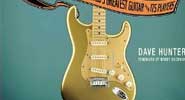
    Fender StratocasterThe title of this new book is not hyperbole. The book truly covers not only the origin and history of the iconic guitar, but also includes short features on guitar players who make their living with, or are associated with, the Fender Stratocaster. In between there’s plenty of text to let you know what made and makes the Strat a truly unique and groundbreaking guitar. As Randy Bachman writes in the foreword here, “The Strat was and still is the most recognizable image, sound, and pioneering guitar to make music.”

    If you’re into the history, there’s plenty here to keep you busy. Some of it you may know, some you may not, but VG writer Dave Hunter’s text is a fascinating read. The book walks you through Leo Fender’s ideas and how we ended up with the guitar we all know and love. We meet all the main players in the company’s lore. We learn what contributions they made and get quotes from them to back up the story. The book is well researched and the sources used are impeccable.

    If you’re a gear geek, you’ll be engrossed by explanations of how Fender developed all the aspects that would give the guitar its unique sound. Small facts make their way into the text that grab you by surprise, such as finding out the placement of the volume knob was intentional to be used for volume swells and not just a fortunate accident. Schematics and copyright papers show the construction of the guitar.

    Features on various players explain their contribution to the history of Strats. The story starts way back with Eldon Shamblin, Pee Wee Crayton, and Mary Kaye, and covers a lot of ground through the bios. They stretch from Buddy Holly to Eric Clapton to Rory Gallagher, but don’t ignore other styles of music, like Iron Maiden’s Dave Murray and shredder Yngwie Malmsteen. A picture of Malmsteen’s guitar collection spread across his lawn is one of the many amazing photos in the book.

    Photos help this book stand out. Great pics of old guitars mix with various signature guitars and some oddities like the Playboy Strat. They are all gorgeous images, and you’ll spend a lot of time poring over them. At least one photo supplies some humor: Jimi Hendrix plays his Strat while a scantily clad blonde talks to him. The caption hints that she is questioning him about the guitar. Probably not.

    You’ve probably heard a lot of the stories here, but to have them in one source with a treasure trove of pictures to boot makes this a must-have for anyone with an interest in guitars or rock and roll. This new book will quickly make it onto the coffeetables of guitar players everywhere.

    This article originally appeared in VG‘s March ’14 issue. All copyrights are by the author and Vintage Guitar magazine. Unauthorized replication or use is strictly prohibited.

  • Gibson  Super 400 PN

    Gibson Super 400 PN

    01_GIBSON_SUPER_400

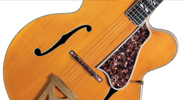
    The Gibson Super 400 Premiere cutaway acoustic first appeared in Gibson literature in the 1940 catalog, on a page showing it and the L-5 Premiere in clear “natural” finish. The photo shows the Super 400 PN held by George Smith (described as “Paramount staff guitarist”) and the L-5PN held by Eddie Skrivanek (“radio and studio star”).

    The Super 400 Premiere model was listed at $425 including case and zipper cover, which made it the most expensive guitar in the Gibson catalog at the time. Natural finish (N designation) and sunburst were available for the same price. By contrast, a Martin D-28 cost $100 in 1940, while a Martin D-45 or Gibson SJ-200 cost $200.

    Expensive in their day, these instruments required a high degree of hand work. The economy had not yet recovered from the Great Depression and few musicians were in a position to buy them. The late Julius Belson, who worked at Gibson in the 1930s and ’40s, compiled production records showing Super 400P sunburst-finish guitars production as six in 1939, 10 in 1940, and 13 in ’41, while production of the Super 400 PN natural-finish version, according to Belson, was 13 in 1940 and five in ’41. By contrast, Martin made a total of 91 D-45 guitars from 1933 through ’42, making the Super 400 Premiere not only more expensive when new, but considerably more scarce.

    The earliest Super 400P shipping ledger found by noted Gibson researcher/VG contributor Lynn Wheelwright is for a Super 400P taken as a sample by Doc Caldwell on January 25, 1940. It’s reasonable to assume production of this instrument started in 1939. While some Super 400 Premiere models were shipped as late as ’42, it appears Gibson was shipping from stock of already manufactured guitars rather than actually producing them that year. Production resumed after World War II, but the model name was changed to Super 400C (indicating cutaway) in ’48. The non-cutaway Super 400 was introduced in ’35. Annual production of the non-cutaway Super 400 was greater than the Premiere model cutaway until after World War II. The non-cutaway Super 400 was discontinued in ’55 while production of acoustic cutaway Super 400C models continued until ’82.

    The Super 400P and L-5P were the first cutaway models offered by Gibson; European makers such as Luigi Mozzani (mentor to Mario Maccafferi) were producing cutaway guitars in the ’20s, and Maccaferri and Selmer were producing cutaway guitars in the ’30s that today remain highly prized by players interested in emulating the style of Django Reinhardt and other gypsy-jazz musicians.

    The earliest Super 400P and L-5P models made in ’39 have a fingerboard extension over the body which is glued flush on the top rather than elevated, as the non-cutaway L-5 and Super 400 models were given. The flush fingerboard had the effect of slightly dampening volume and was not conducive to installation of a floating pickup. In 1940, the Premiere models were altered to feature an elevated fingerboard. Any pre-war Premiere Super 400 or L-5 is a greatly sought after collector’s item, but most musicians prefer the 1940 model (with the elevated fingerboard).

    George Smith and Eddie Skrivanek in the 1940 Gibson catalog, debuting the Super 400 Premiere and L-5 Premiere.
    George Smith and Eddie Skrivanek in the 1940 Gibson catalog, debuting the Super 400 Premiere and L-5 Premiere.

    Research by Joe Spann, author of Spann’s Guide to Gibson 1902-1941, indicates Super 400PN (with serial number 96654/ factory work order number 1484F-2) was shipped from the factory three times and mentioned in the shipping ledgers a total of four times. The model designation on the label of this guitar is simply “Super 400.” However, the shipping ledgers show it shipped the first time on April 10, 1941, as a Super 400 PN to Salak Brother Piano Company of Racine, Wisconsin, in a #400 case and was later returned to the factory, probably on a dealer exchange, and shipped a second time June 30, 1941, simply as a model Super 400 along with a large batch of other instruments to a Gibson display at Niagara Falls, New York. After being returned from the special exhibit the guitar remained at the factory in inventory for almost a year and was then taken out by Gibson salesman Jack Blanchette as a sample on April 14, 1942, without a case. At the time, it was noted in the shipping ledgers as a model Super 400PN, and Blanchette placed the guitar with Hiltbrunner Music of Cedar Rapids, Iowa, on April 24, 1942. At that time the shipping ledgers record the guitar as a Super 400PN. Spann’s research indicates that the first Super 400PN was shipped March 10, 1941, and the final unit left the factory November 17, 1942. 

    The label in this guitar also features the handwritten fraction 11/8″ which indicates the recommended setting for the height of the bridge measured from the top of the guitar to the top of the bridge saddle. This was commonly handwritten on pre-war Super 400 labels.

    During the Great Depression, Gibson had a very generous exchange program designed to make dealers more comfortable ordering expensive instruments which might prove difficult to sell in hard times. If a dealer was dissatisfied with an instrument or if it remained unsold for too long, they could exchange it for other new Gibson merchandise of equal value. As a result, shipping totals and the actual number of instruments manufactured are not the same. If instruments were returned in less-than-pristine condition, many were refurbished, often using parts typical of the time rather than per original specs, therefore it is not uncommon to find instruments with some features out of sync with what would be expected from the work order and serial number. It should also be noted that the factory work order numbers were applied prior to completion of the instrument, whereas labels with serial numbers were typically not applied until the company received an order to ship it to a dealer, at which time final set up work would be done and a label would be applied. As a result, some serial numbers are out of sync with the factory work order numbers by well over a year.

    The Super 400 Premiere is among the rarest and most-sought historically significant collectible archtop guitars, ranking with some of the finest instruments produced by luthiers such as John D’Angelico and Elmer Stromberg.


    You can receive more great articles like this in our twice-monthly e-mail newsletter, Vintage Guitar Overdrive, FREE from your friends at Vintage Guitar magazine. VG Overdrive also keeps you up-to-date on VG’s exclusive product giveaways! CLICK HERE to receive the FREE Vintage Guitar Overdrive.


    This article originally appeared in VG October 2013 issue. All copyrights are by the author and Vintage Guitar magazine. Unauthorized replication or use is strictly prohibited.


  • Steve Wariner’s ’62 Fender Jazz Bass

    Steve Wariner’s ’62 Fender Jazz Bass

    Wariner treasures the ’62 Jazz as a personal icon from his early days as a professional musician. Wariner with bass: Willie G. Moseley.
    Wariner treasures the ’62 Jazz as a personal icon from his early days as a professional musician.
    Photo: Willie G. Moseley.

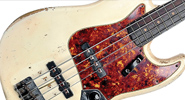
    An eye-popping collectible in its own right, this Olympic White ’62 Fender Jazz Bass scores a few points higher on the scale not only because it has been in the same family for decades, but mostly because it’s owned by star country picker/singer Steve Wariner.

    Wariner grew up in Fishers, Indiana, then a semi-rural small town near Indianapolis, and this instrument helped pave his way into the music business. It all started with family.

    Steve Wariner’s ’62 Jazz Bass: Rick Malkin.
     Wariner’s ’62 Jazz Bass. Photo by Rick Malkin.

    “My uncle, Jimmy Wariner, was the coolest guy!” he said. “He lived in south central Kentucky, but visited us often. He played lead guitar in a four-piece country band called Jay Hammond and the DJs. They wore matching show clothes, and I thought it was awesome that they had 45s on jukeboxes!”

    On one visit, Warner recalls Jimmy bringing a new Olympic White Fender Jaguar, this matching bass, and “…a new Fender Showman amp; I was amazed when he pulled back those metal legs on that Showman and let it tilt slightly back. I had never seen anything like it!”

    Inspired by the uncle he so admired, Wariner began playing guitar and, by his later teens, had the good fortune to join the DJs as co-guitarist for a summer. “That time, playing and traveling with uncle Jimmy – in the baddest ’66 Chevelle SS ever – is something I will never forget,” he said. “We played on a live TV show out of Bowling Green that aired every Saturday night. Years later, I realized other young teens who performed on it were Ricky Skaggs and Keith Whitley.”

    Fast-forward to 1973. Wariner, by then a senior in high school, got his “big break.”

    “I met Dottie West at the Nashville Country Club, in Indianapolis, which was a country-music club where I occasionally played. She heard me play; her bass guy was leaving, and she offered me a road job that night! I was a guitar player, but Dottie had a killer guitarist in Jimmy Johnson. She wanted a bass player who could sing, and I jumped at the chance – and Uncle Jimmy gave me the Jazz for the gig.”

    Wariner worked with West for three years, after which he took a gig with singer Bob Luman.
    “He grabbed me backstage at the Opry one night and asked me to go to Texas for the weekend, since his bass player had just left. I wound up staying with him two years.”

    The young guitarist-turned-bassist used the Jazz on recordings with West and Luman, and recalled its first traumatic experience.
    “After playing a funky little club in North Carolina, I forgot that I had left the bass at the edge of the stage. When I finally remembered, I sat bolt-upright in my bunk on the bus. We were halfway to Nashville!

    “I called the club every day for two weeks and finally got the manager. Days later, he found it and put it on a Greyhound to Nashville. I met the bus coming in, and, as the driver opened the luggage bay, I asked if he had an instrument. He dug it out and asked, ‘Is this it?’”

    Wariner also used the bass when he played in Chet Atkins’ band and feels fortunate the instrument wasn’t damaged in those travels, especially.

    “We flew all over… Europe several times. The bass was tossed into cargo holds over and over, in its original case. Now, I look back and say, ‘What was I thinking?’”

    Wariner can be heard playing the instrument on Chet’s Live album from Paris and Nashville, and Neck and Neck, on which Atkins swapped licks with Mark Knopfler.

    The instrument is missing its handrest, mutes, and the dust covers for its bridge and pickup, but otherwise has just one interesting modification.

    “While I worked for Dottie, I talked to Steve Shafer, who was a top session bass guy of the day, about a slight hum it was making,” Wariner remembered. “He put a drop of epoxy on the pickup poles. It worked! Looking back, though, I wonder if the hum wasn’t simply from the studio.”

    The epoxy remains in place, and though he has been ensconced for decades as a top-flight singer and guitarist, Wariner still uses the instrument to record, even with its 20-year-old flatwound strings.

    “I love it,” he enthused. “When I pick it up, it brings back great memories.”


    You can receive more great articles like this in our twice-monthly e-mail newsletter, Vintage Guitar Overdrive, FREE from your friends at Vintage Guitar magazine. VG Overdrive also keeps you up-to-date on VG’s exclusive product giveaways! CLICK HERE to receive the FREE Vintage Guitar Overdrive.


    This article originally appeared in VG October 2013 issue. All copyrights are by the author and Vintage Guitar magazine. Unauthorized replication or use is strictly prohibited.


  • NAMM 2014 Photo Gallery

    NAMM 2014 Photo Gallery

  • MXR Slash Octave Fuzz SF01 and Slash Cry Baby Classic SC-95

    MXR Slash Octave Fuzz SF01 and Slash Cry Baby Classic SC-95

    MXR Slash Octave Fuzz SF01

    MXR SF01 Slash Octae Fuzz
    Price: $129 (street)
    Contact: jimdunlop.com

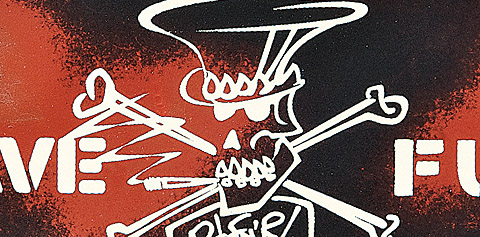
    MXR’s new Slash Octave Fuzz pedal employs three fuzz “flavors” – Sub-Octave, Fuzz, and Octave Up – that offer a palette of distinctive, utilizable sounds. The pedal, built with analog circuitry, true-bypass switching, and a heavy-duty housing, sports custom artwork with Slash’s famed tophatted-skull-and-crossbones motif. In developing the Octave Fuzz, Slash worked with MXR’s design team, and while few may associate Slash with the octave-fuzz effect, he uses it on occasion to color his sound, not overpower it. One place you can definitely hear it is on his latest studio album, Apocalyptic Love, where Slash provided input to the Dunlop design team while they tweaked prototypes.

    The layout incorporates five knobs and the push switch. The unit’s Volume control dials in the volume of dry signal when the Sub Into Fuzz button is disengaged, and controls volume of the main fuzz when Sub Into Fuzz is engaged. The Tone knob shapes overall EQ of the main fuzz, and the Fuzz knob controls the intensity of the main fuzz. Sub Octave controls the volume of the sub-octave voice, while the Octave Up knob controls the volume of octave-up fuzz. The primary function of the Sub Into Fuzz switch is to swap the fuzz on or off; the sub-octave effect functions in both modes, but its presence is dependent on the level of sub-octave mix set with the Sub Octave knob.

    There are two footswitches on the pedal; the left one (On) engages the pedal, while the right (Up) engages the octave-up fuzz in addition to whatever mode the user has configured. Internal trim pots control intensity and overall EQ of the octave-up effect. Given its many options, it does take time and experimentation to understand the controls and how the effects interact. To test the pedal, we used a Gibson Les Paul (with humbuckers) and a 120-watt/EL34-driven amp, which provided an excellent platform to hear the pedal with minimal coloration.

    You can use the pedal’s Sub Octave function without adding fuzz, which is how we started; in order for the clean signal to roughly equal the signal coming out of the pedal in this mode, the pedal’s Volume knob must be turned up all the way. Used this way, the effect sounds very good and tracks quite well, providing hefty tones when mixed with the clean signal. When you engage the Sub Into Fuzz, the pedal bumps output significantly, so you have to roll off the Volume knob before doing so (with the Sub Into Fuzz circuit engaged, the Volume knob becomes the primary output-level control).

    In designing this pedal, one of Dunlop’s goals was to develop a more-predictable version of the ’70s MXR Blue Box fuzz pedal, and the Slash achieves that. By blending its fuzz with the sub-octave effect, it can generate prime razor-cut-speaker tones, oozing with sludge and perfect for whipping out cool Deep-Purple-type keyboard riffs.

    To continue our orange-shag-carpet trip, we bypassed the sub-octave effect and used the pedal as a straight fuzz unit, which rendered some hairy, mind-bending tones. No doubt, though, the pedal’s strong suit is the ability to utilize the Sub Octave and Octave Up features, individually or together. The Octave Up effect is conjoined with its own fuzz sound that is blended using an internal gain trim. Turned all the way down, it adds just a touch of fuzz that sounds unique. In that context or in combination with the Sub Octave and the main fuzz, the pedal steps into Hendrix-like territory; particularly when a Strat is used to launch those familiar riffs.

    One feature we found particularly cool was the ability to bypass the fuzz. If you’re looking for a different sort of overdrive or distortion along with a sub-octave effect, this unit can deliver. Again, you can’t separate the Octave Up from its associated fuzz, but you can control the blend of the effect in the overall mix. We gave it a try through a 100-watt Marshall head, where the amp’s natural overdrive, blended with the Sub Octave, created a monolithic sound while retaining the amp’s natural overdrive. Awesome!

    There are a multitude of tones waiting to be discovered with this unit. Numerous voicings are accessible by experimenting with the interaction of different controls and switches. Whether you want to use the effect subtly to thicken up your tone, or in copious amounts to shake the collective innards of your audience, the MXR Slash Octave Fuzz has some great sounds awaiting discovery.


    Slash Cry Baby Classic SC-95

    Slash Cry Baby Classic SC95 Wah
    Price: $129 (street)
    Contact: jimdunlop.com

    The wah is an iconic and enduring guitar effect – steady favorite tool of expression for players of all genres. In recent years, many high-profile players have tied their names to “signature” wah pedals that tweak the output or some mechanical nuance. The new Cry Baby Classic SC-95 was conceived with input from the cat in the hat himself, who has thrown down a notable wah passage a time or two.

    The pedal has a true-bypass switch, custom-wound resonance inductor, die-cast housing with custom artwork (rust-and-black-color scheme matched on the PCB board, Slash’s tophat-skull logo molded into the treadle’s rubber pad), and dual side-mounted blue LEDs which display the unit’s on/off status.

    If you’re going to test-run a pedal with Slash’s name and imagery attached, logic would dictate you use his guitar of choice – a Les Paul with humbuckers. So we did, plugged into a 100-watt Marshall head and 4×12 cab… cranked. Immediately, the pedal proffered familiar rock-and-roll wah sounds the likes of which have been heard by millions over the years. The first distinctive attribute was the Slash wah’s wide sweep – a rich, vocal-like sound that maintained the fundamental tone of our rig. Dunlop tuned the pedal’s EQ sweep to a lower frequency, which helps give it a warm, thick sound devoid of harshness at any point. Not too dark, not too bright.

    Through a 15-watt/EL84-based combo, we were happy to hear how the pedal produced the same characteristics as through the arena-sized rig. With a single-coil Strat running clean through a 2×12 cab and playing the obligatory “Shaft”-style funk/rhythm, it performed admirably.

    The LED indicators are great a feature, especially when playing live, and the graphics (inside and out) look pretty cool, too. If you’re needing a wah that delivers a unique tone, looks sharp, and is well-built, the Slash Crybaby Classic is worthy of consideration.


    This article originally appeared in VG December 2012 issue. All copyrights are by the author and Vintage Guitar magazine. Unauthorized replication or use is strictly prohibited.