Month: September 2013

  • Budda Verbmaster 112

    Budda Verbmaster 112

    Budda Verbmaster 112

    Budda Verbmaster 112
    Price: $1,800 (street)
    Contact: budda.com

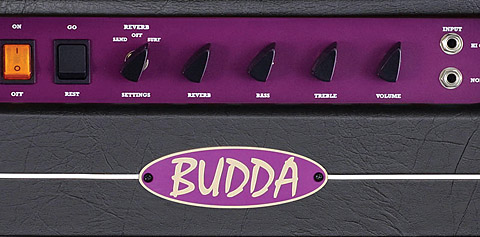
    As part of its Hand-Wired series, Budda has reissued the tube-rectified Verbmaster 1×12 combo that differs from similarly powered amps because it’s a two-channel with reverb and a second (hotter) input.

    The Verbmaster uses the same A/B high-gain, low-wattage circuit as Budda’s Twinmaster, but with a three-spring Accutronics reverb tank and a Phat 12 speaker. Impedance is switchable for four or eight ohms, and the amp uses a 5U4 rectifier, two EL84 power tubes and three 12AX7 preamp tubes.

    We tested the amp with three guitars; a Gibson ’59 reissue Les Paul, a ’55 Les Paul TV Special, and a ’58 Fender Stratocaster, and there were two big surprises with the Verbmaster – neither having anything to do with reverb. The first revelation was the usability of the amp’s Normal input. With the volume at 12 o’clock, its tone stayed relatively clean, with a nice amount of tube sag that would make it very capable of funky rhythm flavors. Things can then be dirtied up a bit by turning the knob to 3 o’clock, which adds volume sufficient to keep up with most drummers while retaining the integrity of chord notes. Even using the old Stratocaster, there’s more wallop and gain than one would need for blues or Stonesy rock and roll. All three guitars sounded very punchy using this setting and even offered a liquid, B.B. King-like lead tone.

    The other big surprise was the amount of overdrive delivered via the Gain input, which is made hotter by a cascading preamp design. In the lower settings, the Gain input takes over where the cranked Normal input leaves off, adding a nice harmonic crunchiness and a singing lead tone with plenty of sustain, reminiscent of early Billy Gibbons. As you turn up, gain and saturation move from the hard rock to heavy metal to pure insanity; past 4 o’clock, all three guitars started to squeal until you either turned down the guitars’ Volume, or the amp’s Gain was backed down a bit. No big deal, though, as there’s more than enough distortion at a lower setting.

    The Verbmaster’s Bass, Treble and Volume controls make it easy to dial in sweet spots, clean or dirty, bright or dark. Being an open-backed cabinet, low-end response is present, but not butt-shaking. Hooked to an 8-ohm closed-back cab, however, the amp produced staggering low-end for an 18-watt amp.

    The Verbmaster has great-sounding 12AT7-driven reverb. In its Sand mode, verb is understated and mellow, with less high-end response – great for bluesy stuff. The Surf setting gives a bit more presence on the high end, as well as a deeper wetness, but slightly more background noise. Both are controllable from either the faceplate or the included footswitch. Most importantly, both settings let the notes take precedence over the effect, as opposed to the effect swallowing the notes; it’s a nice level of effect that will work well for stage or studio. There’s also an effects loop, a feature not typically associated with low-watt amps.

    For a heavy-rock player in a live setting, simply plugging into the Gain input, setting the lead tone, and rolling back the guitar’s Volume will render a cleaner-but-chunky rhythm tone. Turn up the guitar’s Volume and you’ll have a solo tone with ample sustain and rich, creamy saturation. A blues or blues-rock player could take the same approach on the Normal input and be happy with the amount of control they have from the guitar’s Volume control. Gain or Normal input, this method works great, as the Verbmaster’s preamp is very responsive to your guitar’s Volume pots.

    The Budda Verbmaster has great clean tone, tons of gain, sweet reverb, and a lot of back-panel options.


    This article originally appeared in VG October 2012 issue. All copyrights are by the author and Vintage Guitar magazine. Unauthorized replication or use is strictly prohibited.


  • Tony Furtado

    Tony Furtado

    If you had picked up Golden without hearing one of Tony Furtado’s previous 14 albums, you’d never guess he was once a banjo prodigy. After winning the National Bluegrass Banjo competition at 19, he was on his way when he made a left turn into blues, learning slide guitar and lap steel. Then he detoured into songwriting.

    For his 15th album, Furtado serves up a rock/pop/folk soufflé that combines songwriting, picking, and vocals into one tasty entree.

    Furtado has been writing good songs for some time, but the latest batch is among his best. The instrumental “Portlandia” has a bluesy melody that curls around itself in a banjo backstep. Furtado combines this percussive banjo line with an ethereal electric slide guitar part that floats above the beat like clouds on a sunny day. Another hypnotic blues stomp, “Can’t Lie Down” has a snappy chorus
    that surges with second-line rhythms hung around the banjo riff.

    Early in his career, Furtado was known more for his picking than his vocals, but on Golden he has elevated his singing to a level equal to his playing. On some tunes, Furtado’s voice sounds a bit like Paul Simon. They have similar harmonic timbres and, at times, phrasing. This is not a bad thing.

    Co-producer and engineer Rob Stroup’s recording of Paul Brainard (pedal steel), Scott Law (mandolin), Tye North (bass), and Anders Bergstrom (drums) gives the album a relaxed, down-home quality. The playing is more about making the ensemble mesh than stringing together hot licks.

    This article originally appeared in VG‘s June ’11 issue. All copyrights are by the author and Vintage Guitar magazine. Unauthorized replication or use is strictly prohibited.

  • ZT Amplifiers’ Lunchbox Junior

    ZT Amplifiers’ Lunchbox Junior

    ZTAMPSLUNCHBOX01

    ZT Amplifiers Lunchbox Junior
    Price: $149 (street)
    Info: www.ztamplifiers.com
    .

    ZT Amplifiers is known for producing compact amps that generate sounds which defy their size. Their latest, the 35-watt ZT Lunchbox Junior, is the pint-sized version of the ZT Lunchbox (though even the larger model is very conveniently sized).

    The ZT Junior is about half the weight of the original Lunchbox, tipping the scale at five pounds. Physically, it resembles the lunchbox you recall from grade school. For those of you who don’t remember those little food-packing means of self-expression, the ZT Junior measures 61/2″ x 73/4 ” x 51/2″ – “compact,” to say the least. Its build is sturdy and professional – the MDF composite housing is finished in a stylish silver metal-sparkle, while the front sports a diamond-pattern metal grille protecting the 5″ speaker. The back-panel switches are safeguarded by a protector extending from the back. It all adds up to an amp built to withstand the rigors of being ported to gig or buddy’s house.

    The Junior’s top-mounted controls include Volume, Tone, and Gain, all of which function as implied. The back panel offers some cool features like a 1/8″ headphone/line level output for those times that call for jamming in privacy. (The output can also be used for recording.) A toggle switch allows the user to engage or disengage the speaker.

    ZTAMPSLUNCHBOX03

    Another handy feature is a 9-volt DC output jack that can be used to power pedals and eliminate the need for wall warts or other power supplies. ZT claims this feature will power one or two pedals, but in testing it was used successfully to run a tuner pedal which in turn supplied juice to multiple 9-volt pedals on a tester pedalboard.

    The Junior also runs on an optional 12-volt battery pack or can take power from a 12-volt car adapter. Topping the back panel features are a 1/8″ auxiliary input that is great for honing chops along with favorite tunes, a drum machine, or a metronome. When using the auxiliary input, the Gain function is appropriately disengaged, with only the Volume knob controlling output.

    ZTAMPSLUNCHBOX02

    To put the Lunchbox Junior through its paces, a Fender Strat was employed to test clean sounds. With the gain set around 9 o’clock and volume at noon, the Junior produces a spanky clean tone, while transparently maintaining the sound of the guitar. With volume bumped up to around 3 o’clock, the Junior preserves its nice, clean sound while offering impressive volume. The snappish, warm tones are maintained at both subdued and loud volumes.

    The amp exhibits a useful amount of touch sensitivity and relays nuances in one’s playing. The interplay between the gain and volume is dynamic – rolling up the Gain knob will significantly increase volume while adding hair. For a strictly clean sound, dial the Gain down to around 9 o’clock. With the Gain knob dimed, the Junior yields a fuzz-based, slightly snarling tone, but no matter where the Gain is set, the amp renders usable “situational” tones. To be clear, the ZT Junior will not kick out medium/heavy saturated rock tones without some front-end help. Rather, it’s partial to clean and vintage overdrive voicings. But, this amp takes to pedals like a champ (no pun intended). When a Gibson Les Paul was run through a pedalboard loaded with distortion/overdrive, modulation, filter, and time-based pedals and into the Junior, the amp turned out an abundance of tones with aplomb, from thumping metal chunk riffs to sustaining, searing solos to subdued chorus-laden passages, while accurately relaying each pedal’s attribute. With a clean boost pedal, it’s possible to coax even more volume, clean or dirty, from this little box. The amount of sound pushed from the Junior’s pocket-sized speaker, all while retaining an element of warmth, is quite impressive.


    This article originally appeared in VG May 2013 issue. All copyrights are by the author and Vintage Guitar magazine. Unauthorized replication or use is strictly prohibited.


  • Happy Traum

    Happy Traum

    Resurrected from Stefan Grossman’s Kicking Mule label of the ’70s (1977, to be exact), Stranger was the followup to Traum’s solo debut, Relax Your Mind. In lieu of beefing up the 30-minute set with bonus tracks, the album is paired with a 13-song DVD of Traum in concert in ’81. Also, the CD includes a PDF tab booklet of the album’s arrangements.

    Traum’s eclectic repertoire subtly showcases the versatility necessary to ricochet from Travis fingerpicking (“I Am A Pilgrim”) to flatpicking a fiddle tune (“Eighth Of January” – better known as “Battle Of New Orleans”) or combining the two on the title track
    (a.k.a. “Plains Of Amerikee”).

    Performances are either solo or small acoustic ensembles featuring the likes of John Sebastian (harmonica), Eric Weissberg (fiddle), and Roly Salley (bass), and the program closes in hootenanny fashion with a gospel sing-along, “I’ll Fly Away.”

    The DVD presents Traum alone before an intimate audience. Roughly half of the tunes come from American Stranger, so it’s interesting to compare versions five years apart, played solo versus band.

    A narrative segment offers a mini tour of Woodstock, where Traum and the instructional Homespun Tapes company he founded 44 years ago are based. Homespun is probably what Traum is best known for, but he is also an extremely engaging performer. The camera work offers an up-close glimpse of Happy’s playing, which, if anything, is more impressive than on the CD. When Traum dips into blues, like Charlie Patton’s “Dark Road Blues” or John Hurt’s “Monday Morning Blues,” he gives Geoff Muldaur a run for his money.

    Following the live set, Traum offers a clawhammer banjo version of “Golden Bird.” One of his few originals, it’s perfectly home alongside Merle Travis’ “Sixteen Tons” and Bob Dylan’s “Buckets Of Rain.”

    This article originally appeared in VG‘s June ’11 issue. All copyrights are by the author and Vintage Guitar magazine. Unauthorized replication or use is strictly prohibited.

  • The Selmer Zodiac 50

    The Selmer Zodiac 50

    An amp maker at the very heart of the British guitar boom of the late ’50s and early ’60s, Selmer was, for a time, the leader in the field, though it’s all too easy to forget. Briefly ahead of Vox, certainly ahead of the fledgling Marshall, this was a company that had it all to lose as the new decade dawned… and gradually did.

    By the mid ’60s, Selmer was struggling for position against a pair of strong rivals with growing international reputations, while releasing what would be its most recognized and most collectible models – the short-lived crock-skin combos of 1963 to ’65. The most popular of these, the Zodiac Twin 30 and Zodiac Twin 50, were most likely released in direct response to the Vox AC30 and Marshall Model 1962 (a.k.a. “Bluesbreaker”) respectively. Good efforts they were, too. But while they made some waves at the time, they ultimately failed to blow either rival out of the water and did little across the pond, to boot. In the wake of this “defeat,” Selmer amps, though still great by any standard, slid into B-list status and started down the slippery road toward demise.

    Regardless, models of all eras have continued to appeal to players and collectors for five decades, but fans are likely to drool most profusely over the combos like this 1964 Zodiac Twin 50. Owned by ex-Iron Maiden and Praying Mantis guitarist Rob “Angelo” Sawyer, this is a fairly rare example, certainly in this condition. More often seen is the Zodiac 30, a combo based around a pair of cathode-biased EL34s, nominally what we refer to as “class A,” as famously used by Jack White to record the White Stripe’s Elephant album. Changing the output stage from cathode-biased to grid-biased (a.k.a. “fixed-biased”) earned the Zodiac Twin 50, introduced in the early part of 1964, a few more watts than its class-A sibling. While this increase in power might not have been tremendously obvious to the naked ear, the change in feel due to the firmer output stage and slightly increased headroom made it a different amp.

    As often as these amps are compared to their above-named “rivals,” they have circuits that are all their own, being products of a company that prided itself on originality, was still aiming to be a leader in the field, and was nowhere near to putting out “copies” of other British makers’ products. Largely similar other than these differences in output tube bias, both Zodiac Twins have circuits that might appear quite unusual to players more familiar with the Vox, Marshall, or indeed Fender topologies, and that’s a big part of their appeal. Preamp and power amp are built on separate chassis, mounted in the top and bottom of the 2×12 cab, respectively. Each of two channels opens the gambit with a single ECC83 (12AX7) gain stage, without any cathode bypass cap, which keeps the tone a little tighter and lighter at this point, but the two differ considerably from there. Channel one, intended for a mic or a second instrument, runs through a treble-bleed tone control that’s a little more involved than the average, then a volume control, then through a second gain stage comprising an EF86 pentode preamp tube, before scooting on to the octal plug that takes it south to the PI and the output stage. Channel two, though, is where things really get wild. After the first gain stage, the signal hits a six-pushbutton tone section that offers, in addition to a Rotary Control option that routes it to another treble-bleed tone pot, buttons for High Treble, Treble, Medium, Bass, and Contra Bass. These are achieved by tapping a network of tone caps that shape the voice between gain stages, a circuit not unlike that of some large Gibson amps before it, or indeed the six-position rotary Tone control on the lead channel of the Matchless DC30 several decades later. From here, the signal hits another EF86 pentode, then a tremolo circuit with Speed and Depth controls, then on to the bottom chassis via the octal plug.

    In the bottom chassis, the octal plug ferried the signal to a rather unusual split-phase inverter that employed another ECC83, then on to a pair of EL34s that were pushing around 445 volts DC at the plates – not a ton for these output tubes to handle, but pretty hot for the cathode-biased Zodiac Twin 30, which ran everything about the same as the 50. The alnico Celestion 12s of the Twin 30 were changed to more robust Goodmans ceramic 12s in the 50, but that’s about the only other difference between the two models. Later models, however, dropped both the tube rectifier (for solid state) and the EF86 preamp tubes (for more ECC83), making them more conventional in many respects.

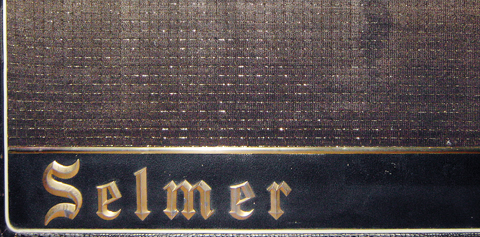
    Obviously, these mid-’60s Zodiacs looked very different from anything before, or after, too. Their blend of mock-crocodile and black vinyl covering gave them an extremely outré look, further accentuated by the spacey green “magic eye” tremolo speed indicator on the front, which pulsed in time to the trem rate. Even if the large gold metal Selmer badge on the bottom panel tied the amp to ubiquitous and less-than-hip trombone-case cosmetics, these were pretty outrageous packages, in an age and industry that was ramping up for plenty of outrage.

    In addition to digging the looks (as he does those of some eight other Selmers in his collection), Sawyer admits to an unabashed fondness for the tone of the Zodiac Twin 50. “It has a feel and character all of its own,” he says. “The whole vibe is ‘warm,’ and I just love those pushbutton tones. The tremolo effect is great fun – pure Duane Eddy! It’s not an amp that I would gig with, because it’s too precious and beautiful, and because it doesn’t have the heavy rock/blues tone my band sound needs. But I really enjoy playing the Zodiac.”

    As cool as these amps are – and as much as you might want one now – their prices have escalated significantly over the past decade to the point they rival vintage AC30s. A difficult situation for the would-be buyer of a nifty Zodiac Twin 50, but it brings some measure of justice to round out the history of these exquisite and unique “also-rans.”


    This article originally appeared in VG September 2011 issue. All copyrights are by the author and Vintage Guitar magazine. Unauthorized replication or use is strictly prohibited.


  • It was 27 years ago today

    27ANNHEADER_01

    27 years ago today the first issue of your favorite guitar mag came off the presses of a weekly newspaper in New Salem, North Dakota, a town 25 miles west of Vintage Guitar’s world headquarters in Bismarck. Publisher Alan Greenwood drove out late that Friday afternoon, after finishing up at his regular full-time job, and loaded the whole 3,000 piece print run in the trunk of his car. At 8 pages, the debut issue didn’t take up a lot of room! With no subscribers and very little advertising, that first issue (then called The Music Trader) was distributed at a handful of music stores in North Dakota, South Dakota, Minnesota, and Iowa.

    CLICK HERE to view the complete first issue of The Music Trader.

  • Line 6 Offers POD HD Pro X

    Line 6 has introduced the POD HD Pro X to replace its POD HD Pro, which uses the same collection of HD amps as its predecessor, from vintage classics to modern powerhouses, with Dynamic DSP  effects. It also offers a variety of analog and digital connections. Learn mor eat http://line6.com.POD_HD_PROs


  • Rockn Stompn Offers Foot-Activated Sequential Power Strip/Surge Protector

    ROCKN STOMPN RS-4The Rockn Stompn RS–4 foot-activated  power strip is housed in a welded stainless-steel enclosure and is designed to power up/down a set of equipment in proper sequence with the tap of a foot. It conforms to UL standard UL1363 and UL1449-3, and provides 1,935 joules of surge protection, includes EMI/RFI noise filtering, power conditioning, and over-voltage/over-current protection. It has an adjustable four-step delay for both sequences. Go to www.rocknstompn.com.


  • Source Audio Launches Soundblox Effects

    Source Audio OFD Guitar_Source Audio’s Soundblox 2 OFD (Overdrive/Fuzz/Distortion) Guitar and Bass microModeler pedals offer 12 tones voiced to accommodate the frequency range of guitar or bass, with models of Marshall and Mesa Boogie amps, as well as iconic pedals including the Big Muff, Fuzz Face, and Tube Screamer. See more at sourceaudio.net.

  • Traveler Guitar Offers AG-105EQ

    Traveler Guitar AG-105Traveler Guitar’s AG-105EQ is a portable acoustic guitar with full scale length, a custom-designed EQ with tuner and headphone amp, 1/8” auxiliary input, and the company’s new Streamline Tuning System, which incorporates a headless design with locking string retainers at the nut and a right-hand tuning system mounted to the endblock. For more, visit travelerguitar.com.