Month: August 2013

  • The DoleSonic Vintage 108 Woody

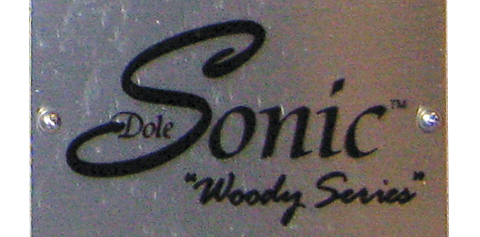
    The DoleSonic Vintage 108 Woody

    The guitarist’s greatest quests is most often that of the tone that resides within their heads. That quest drove guitarist Ken Doles to design his own amplifier.

    The tone in his head was a mix of vintage sound with new ideas, and the result is the DoleSonic Vintage 108. A hand-wired, Class A combo in a deftly crafted pine cabinet, it’s aesthetically reminiscent of an antique radio or armoire, with an amber-tinted finish and hand-assembled internal bracing that denotes a commitment to detail. A 3/4″ birch baffleboard, leather handles, and vintage-inspired grillecloth further enhance its class.

    The Vintage 108 is set apart in another way – speaker configuration. At first glance, it looks like a single-speaker combo, but inside are two Jensen Vintage Series speakers – a C10Q in an unusual combination with a C8R. The amp can be used with both on or, due to the angle in which they fit in the cab, you can disengage either for a low-watt fiesta.

    The cathode-biased, 8-watt R.M.S. amp treads into more new territory with its use of tubes. The stock model uses a pair of JJ 6V6s, a single JJ 12AX7, and a 5Y3 N.O.S. rectifier. Tube selection, alone, would serve most playing styles, but the customization options on the Vintage 108 allow for the use of a single 6L6, single 6V6, or a single EL34 with minor modifications from a qualified technician. While these features may seem complex, in some ways, the Vintage 108 is a straightforward amp; controls include a single Volume and Tone, and components are high-grade throughout, with point-to-point construction and a two-way switch for choosing between 4 and 8 ohms output.

    Live and in the studio, the Vintage 108 rendered a surprising variety of tones given that it has only two knobs. Plus, its combination of 8″ and 10″ speakers give it a different voice – warm, full-range, and useful for a variety of styles. Its diversity goes even further when one experiments by unplugging either speaker. Using the 10″ speaker alone produces a robust low-end; changing the impedance and running the 8″ alone makes the amp sound a Fender Champ on steroids.

    At the end of the day, the Vintage 108 achieves Doles’ goal – it’s an amp made with vintage inspiration, but is ready for a variety of musical situations and genres.


    DoleSonic Vintage 108 Woody
    Price: $1,299 list
    Contact: tremcaster.com


    This article originally appeared in VG September 2011 issue. All copyrights are by the author and Vintage Guitar magazine. Unauthorized replication or use is strictly prohibited.


  • Shaw, Connolly, and Lowery Talk Gear on VGTV

    Shaw, Connolly and Lowery open VG's "In HD" video interview seriesStyx guitarist Tommy Shaw and Sevendust axemen John Connolly and Clint Lowery recently sat for the first two interviews in VG‘s “…In High-Def” video series. All three guys (along with Shaw’s guitar/amp tech, Jimmy Johnson) dug into the minutiae of the guitars, amps, and effects they use in the studio and onstage. See both interviews at VGTV.

  • Allen Lanier, Co-Founder of Blue Oyster Cult, Passes

    Allen Lanier passes
    Lanier onstage with BOC in 2006.

    Allen Lanier, a founding member/guitarist/keyboardist in Blue Oyster Cult, died August 14. He was 66 and had been hospitalized with chronic obstructive pulmonary disease (COPD). Lanier was with the band from its inception in 1967 until his retirement in 2006 and co-wrote several of its most-noted songs, and contributed to music by The Clash, Patti Smith, Jim Carroll, and others. In November of 2012, he joined BOC in New York at a concert commemorating its 40th anniversary and the release of The Complete Columbia Albums Collection box set.

  • Vai Sets Broadcast of “The Story of Light” Concert

    Vai "Story of Light" broadcast.Guitarist Steve Vai is preparing a live video-broadcast performance of  “The Story Of Light Live.” The concert will happen August 25 in Los Angeles and be broadcast on AXS TV at 8 p.m. ET with an encore August 26 at 12:10 am ET. It will feature songs from his latest solo record, The Story of Light. Vai played more than 90 shows last year in support of the disc and on  October 16 will kick off another U.S. run. For more, visit vai.com.

  • Coconut Grove Marks 25 Years

    Coconut Grove Music marks 25 years.
    Harry Koizumi giving a uke lesson at Coconut Grove Music.

    Coconut Grove Music, Kailua, Hawaii, is marking its 25th anniversary. The store got its start in 1987, when Luke Yamashiro began selling guitars out Hungry Ear Records, which he had opened a few years earlier. After the city’s only dedicated musical-instrument store closed, in ’88 Yamashiro founded Coconut Grove with partners Mark Tamashiro and Kimo Leong. Yamashiro passed away in 2005, leaving his share of the store to his sister, Roxanne, and her husband, Mark Scrufari.

    The store initially focused  on vintage gear and filled it inventory with instruments from the owners’ personal collections.

    “Luke would scour want ads for vintage guitars, and was friends with most of the pawn shop owners from here to Honolulu and all over the island,” said Scrufari, who has served as store manager since 2005. “Once, he flew to a neighboring island to pursue what was described as ‘an old guitar in a brown case.’ He came back with a ’59 Gibson ES-335!”

    The store is marking the anniversary with promotional events in September. Learn more at www.coconutgrovemusic.com.


  • Effector 13 Improbability Drive

    Effector 13 Improbability Drive

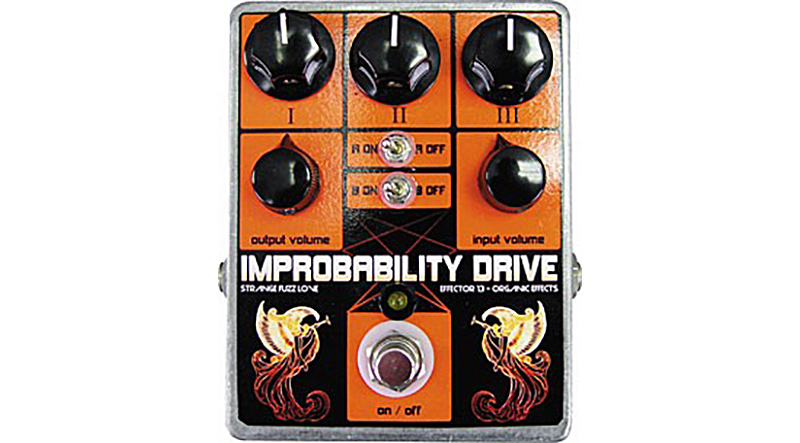
    Features: Hand wiring, input/output volume control, true-bypass on/off switch with LED indicator, Switchcraft input and output jacks, cast-aluminum casing.
    Price: $255
    Contact: www.effector13.com

    We understand how you might react. “Another drive pedal?” There are so many… a lot of them similar, or nearly identical? But then again, some are different…

    (Cue Captain Kirk voiceover…)

    Prepare, then, gearhead followers, to embark on a journey of drive, fuzz, and distortion unlike anything you’ve experienced before! Just step aboard (okay, on) the Improbability Drive by Effector 13…

    (Okay, Kirk, go home.)

    Part guitar effect, part physics experiment, the Improbability Drive is the product of the active imagination of Ever Was, the 24-year-old proprietor of Effector 13, a company he founded after becoming enamored with the great fuzz players of the late ’60s through the early ’90s, everyone from Jimi Hendrix to Billy Corgan.

    After earning a degree from Arlyn Studios in Austin, Texas, Was fired up the Guitar Pedal Archive website, and shortly thereafter began experimenting, building pedals from parts purchased at Radio Shack. After many hours, the Krackle Fuzz was born. That pedal would evolve to become the Truly Beautiful Disaster pedal, his first market-ready unit.

    Then, feeling there was something missing in the fuzz world, Was began working on the Improbability Drive (which gets its name from The Hitch Hiker’s Guide to the Galaxy). An over-the-top, Hendrix-inspired pedal, it’s offered in the same free-spirited manner that was epitomized by Jimi. While most gear is shipped with an instruction manual/sheet, because the Improbability Drive was so new, Was’s instructions to us were handwritten in red and green marker on a piece of 81/2″ x 11″ paper.

    “I suggest giving it to try out, to someone with a long coffee break who likes to experiment!” it says. “There are lots of ‘sweet spots,’ so move the knobs gently.”

    “Well, we can do that,” we thought, grabbing our ’72 Fender Stratocaster with stock pickups and mid-’80s Peavey Butcher head with 2×12″ cab.

    The top of the hand-wired Improbability Drive has five knobs, two mini-toggle “mode” switches, and a true-bypass on/off stompswitch. The keys to piloting the unit are in the three knobs along the top edge, labeled simply I, II, and III. A few minutes of experimentation had us hearing knob I manipulating the tone and adding a bit of boost, while II and III are gain controls. Mode switch A adds a bit of darkness to the signal. And Mode B? Well, we couldn’t tell what it was doing, so we turned back to knob I, which, when set between 0 and 9 o’clock, produced a very dark, muffled sound. After 9 o’clock it added a bit of boost/drive, and a touch more treble. The effect of control II was more obvious. Past 9 o’clock, we got very fat gain with a meaty low-midrange boost. The gain peaked at about 2 o’clock, and past 3 o’clock, it tapered off.

    At 10 o’clock, control III adds the same meaty low-mid gain, peaking at 12 o’clock. Playing with controls II and III yielded a variety of gain structures with several sweet spots. With control I dialed back, we heard a muffled, ultra-smooth vintage fuzz tone. The low, meaty, midrange was prevalent throughout all settings and pickup positions. With the gains at max, single notes jumped and screamed; definite Hendrix tones, especially in the neck and middle pickup positions.

    The overdrive/fuzz was notably smooth in all settings, as well. We set the input and output volumes very low, to balance with the bypass mode, then pushed the Peavey into overdrive to get a lot more gain. The pedal retained its unique, fat tone.

    Pushing the input volume to full revealed the pedal’s true ability to produce gain. Simultaneously pushing the output volume to full sent our signal clean over the top, like mixing fuzz with overdrive. It was noisy, but that much gain can’t be any other way. So we backed off the input gain, and keeping the output gain to full, we got a crystalline enhanced tone, which was pure, but again somewhat noisy. Noodling with the two volumes, we dialed in a host of in-between gain/fuzz tones.

    Backing off the Butcher’s gain, and pushing the input volume revealed a gritty, obnoxious – but very usable – fuzz. A person could play with this pedal for days and not tap all the possibilities. Better yet, go Gibbons on it and line up a half-dozen of them!

    The Improbability Drive is the most unique drive/fuzz/distortion pedal we’ve tried. It requires time to unlock its potential. The more we played with it, the more we loved it. If your signal chain is in need of a shot of something new, the ID may be what it’s looking for.


    This article originally appeared in VG‘s January 2005 issue. All copyrights are by the author and Vintage Guitar magazine. Unauthorized replication or use is strictly prohibited.


  • Joey DeFrancesco with Larry Coryell and Jimmy Cobb

    Joey DeFrancesco with Larry Coryell and Jimmy Cobb

    Jerry DeFrancescoWonderful is right! This organ trio, featuring guitarist Larry Coryell, is pure joy with its bright and lively charge through a songlist of jazz classics and originals.

    The ensemble is led by Joey DeFrancesco, a Miles Davis alum who almost singlehandedly led today’s resurgence of love for the Hammond B3 in jazz with his 1989 debut, All of Me. Jimmy Cobb, another Davis sideman, holds down the drum chair, adding both a rock solid rhythm and rollicking fills.

    DeFrancesco and Coryell trade licks like Jimmy Smith and Wes Montgomery on their classic series of duet platters. They weave lines through each other, echoing melodies, and improvising with dash and élan.

    On the title track, DeFrancesco’s tone is gorgeous, his solo effusive and spirited. When Coryell steps in, his vibe is mellow, building in intensity and energy to a stellar denouement. Even his chord vamps behind the Hammond are striking. Seven minutes of jamming is not enough!

    On Coryell’s original, “Joey D,” the trio stretches out on a freer-form, almost spacey jam. DeFrancesco obviously enjoys the opportunity to experiment and explore. Behind him, Coryell’s chord solo makes the song absolutely dance.

    Benny Golson’s “Five Spot After Dark” becomes a noir swing tune. Coryell’s funky arpeggios add a cool modern counterpoint to the vintage vibe, the Hammond accenting his lines with a swampy undertone.

    If you’re a fan of bopping jazz guitar or a Hammond B3 aficionado, you owe yourself a listen. Wonderful indeed.

    This article originally appeared in VG‘s Jan. ’13 issue. All copyrights are by the author and Vintage Guitar magazine. Unauthorized replication or use is strictly prohibited.

  • MOD Kits DIY Offers Persuader Deluxe Kit

    MOD Kits Persuader DeluxeMOD Kits DIY’s Persuader Deluxe tube overdrive pedal kit uses a Darlington preamp to push cascaded triode vacuum tubes into distortion. Four dual-triode tubes are included  – JJ 5751, 12AX7B, JJ 12AU7 and an NOS U.S.-made 12AT7 – which can be swapped to create a range of tones. A Boost switch enhances control over gain and low-end.  An LED indicator lights up when the Persuader Deluxe is engaged and not in true-bypass mode. Read more at www.modkitsdiy.com.


  • Lava Cable Hosting Guitar Class with Brent Mason

    Lava Cable hosting Brent Mason guitar class.Lava Cable will hosting a guitar master-level class with Brent Mason, September 28 at its facility in Owasso, Oklahoma. Mason will discuss studio techniques, styles, and his approach to guitar, tone, gear, and will answer questions. Clinic will include performance of solo pieces, prizes will be given, and there will be a jam with Mason. Registration fees include a meal catered by a local BBQ. Learn more at www.lavacable.com/index.php?id=184.

     

  • Waylon Jennings

    Waylon Jennings

    Waylon JenningsWaylon was one of the first country music “outlaws” to rebel against the Nashville machine, and one of the ways it showed was that he never abandoned his guitar onstage – unlike many other country artists of the 1970s and ’80s. Even though most of the heavy lifting went to guitarist Reggie Young and steel player Robby Turner, Waylon’s guitar was never just a prop.

    In 1999, Waylon took an acoustic guitar and laid down the bare bones tracks for what would become this album. You can hear his guitar in the mix clearly, and it sounds great even though he was having trouble with his hands by that time and forming chords was increasingly painful.

    Turner was given carte blanche to finish the product and 10 years after Jennings’ passing, he’s brought us a spectacular album that’s a living memorial to his old friend and hero.

    Sometimes, as on the title cut with swamp rock king Tony Joe White adding guitar and harmonica, it’s hard to believe you’re listening to a man with less than three years of life left in him. Turner says Waylon never told his band what to play; they just got into a Waylon state of mind and played accordingly. So, to make this one sound like a Waylon record, all they had to do was play like themselves.

    That’s a good thing because if you want someone to play like Reggie Young and Robby Turner you’d better go get Reggie Young and Robby Turner. It takes a special kind of player to complement a singer who isn’t even alive, which Turner does in “Sad Songs And Waltzes.” And few souls can wrangle a Telecaster like Young does working off Turner in “If My Harley Was Runnin’.”

    An unadorned version of this album with just Waylon and his acoustic and Turner on bass is available as an i-tunes exclusive. But get this one and that one. If they were on old-fashioned vinyl, you’d end up wearing out both of them.

    This article originally appeared in VG‘s Jan. ’13 issue. All copyrights are by the author and Vintage Guitar magazine. Unauthorized replication or use is strictly prohibited.