Month: November 2006

  • C.C. Adcock

    The Future of Swamp Rock

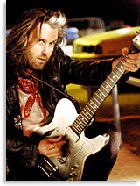
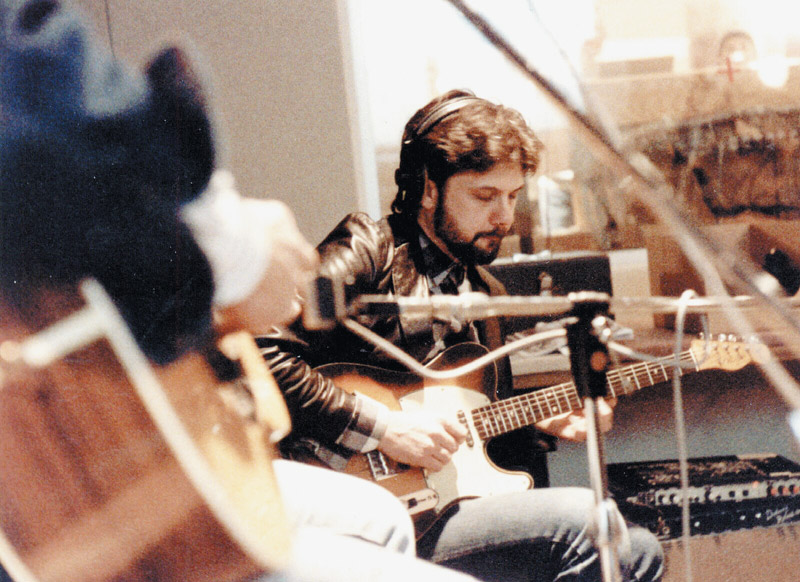
    C.C. Adcock hunches over his Telecaster like a tiger ready to pounce. He stands on one foot, the other leg twisting like an unmanned fire hose – one leg wrapping and unwrapping around the other uncontrollably, while he precariously keeps his balance. He stands on tiptoes and backpedals as if it will help him reach a bend on his B string. He runs forward a few steps, thinks better of it, stops, and jumps straight into the air like a scared cat – his guitar squalling and shrieking accordingly.

    And this is in the recording studio. Doing an overdub. On somebody else’s album.

    Louisiana’s Charles “C.C.” Adcock is the musical/cultural equivalent of blackened redfish: a well-to-do white boy rolled in spices, dipped in grease, then fried. His it-ain’t-the-heat-it’s-the-humidity “swamp rock” occupies the space where R.L. Burnside and Doug Kershaw meet at the crossroads and sell their collective soul to Keith Richards.

    Ten years ago, the singer/guitarist/songwriter released a self-titled debut on Island Records that charted the past, present, and future of Louisiana music. Already a veteran sideman to Buckwheat Zydeco and Bo Diddley, Adcock revealed a style that was authentic and imaginative, and seemed remarkably formed for someone in his mid 20s.

    After producing two CDs by Cajun accordion master Steve Riley and one by the swamp pop super group Li’l Band Of Gold (which includes Adcock, Riley, and singer/drummer Warren Storm), Adcock recently released his solo followup, Lafayette Marquis on Yep Roc. Alongside collaborations with Mike Napolitano, Doyle Bramhall II, Mike Elizondo, and Tarka Cordell, who produced C.C.’s first effort, the envelope-pushing set includes one track produced by the late Jack Nitzsche, from what turned out to be the Oscar-winning producer’s last project. On that cut, “Stealin’ All Day,” Nitzsche, Phil Spector’s former arranger and right-hand man, turns the trio of Adcock, bassist Jason Burns, and drummer Chris Hunter into a bigger wall of sound than Spector could ever dream of.

    Why the 10-year gap between CDs?

    “Have you heard what’s been going on in the past 10 years?” the guitarist asks. “It wasn’t exactly a party I wanted to go to. When I heard Nirvana, I thought, ‘It’s not my thing, but it’s cool; everything’s getting ready to open up wide.’ A couple of months later, I heard Pearl Jam, and I pretty much knew we were going to be in for at least 10 years of locust plague – getting really bad. Not only did I not care to have any of those flavors in me, even a lot of the roots cats that we dig got so mediocre and forgettable. It got to the point where I couldn’t even listen to my favorite blues records, because they reminded me of somebody I’d seen recently just dumbing it down. But I was making music the whole time, working with different people and learning a lot, especially from Jack Nitzsche, and this record is an amalgamation of all that.”

    Nitzsche was the second legendary producer Adcock had an association with, the first being the late Denny Cordell, whose credits include Joe Cocker, Moody Blues, and Leon Russell. “Denny gave me my first big break, vis-à-vis his son, Tarka. Thanks to his dad, Tarka had grown up with all these great rock and roll and blues records, and he had a real good understanding of American music – especially the Southern variety, including my hometown. He looked me up when he was in New Orleans, and I showed him some stuff I’d been working on, and he took it back to show his dad – who turned out to be Denny Cordell. Denny was actually one of the last of that old school, before A&R guys were just over-promoted Tower Records executives.

    “I actually feel kind of slighted when I don’t have that sort of guidance around me – mentors of that stature. And that also comes from growing up in Lafayette, on a musical level – being around people like Li’l Buck [guitarist Paul Sinegal] and players of that ilk and generation. I also met Doyle Bramhall (Sr.) at an early age, and he’s always been a guiding hand – both in music and in being a human being. He and Denny and Jack all instilled what it was to be a musician and have a heart – what making music and making art is about.”

    Prior to working with Adcock, Jack Nitzsche’s most recent rock album was Graham Parker’s Squeezing Out Sparks, in 1979.

    “I knew Jack’s name from the Stones and Phil Spector stuff,” Adcock admits. “But I had no idea how heavy this cat was and how deep it was going to get – that there were people on this planet who took rock and roll to that level. It was good to see that first-hand – that rock and roll is a cool art form and not just greasy kid’s stuff. Jack’s idea of producing certainly was not like it is today – like, ‘I’ve got some cool effects.’ His idea was, ‘Let me pump you up and play on all your strengths and help you recognize how to make greater your best assets.’ And then just knock you down to the most infantile, embryonic, heartless level, and build you back up again – and do that about 5,000 dozen times. Then you might be ready to sing a vocal. It was outrageous and grandiose – but that’s one the greatest qualities of my favorite rock and roll. He was one part Mozart and one part Fred Sanford.”

    Being a product of both his time and geography, Adcock straddled commercial rock and regional traditions from his first band at age 12. “Zydeco and Cajun music and swamp pop were just always in the air. In Lafayette back then, you were into AC/DC, 13 years old, wearing the T-shirt at the mall – but ZZ Top sounded really good. And you could go to a festival and see Clifton Chenier, or go to Grant Street and hear the T-Birds. In Lafayette, you want to make people dance. We did Rolling Stones, along with hand-me-down blues records by Johnny Winter and Muddy Waters, and local Cajun and honky-tonk records. We were definitely into making music that made people dance, not music that made people sit around and think. So you’ve got to have a shuffle or a swing or a little zydeco rhythm. They’re not going to dance to ‘Back In Black’ or Rush. But some ’80s stuff was really about dancing, too. I mean, ‘Yall’d Think She’d Be Good 2 Me’ on the new CD – I’m sorry, that’s the Adam Ant, ‘Don’t drink, don’t smoke, what do you do?’ beat [“Goody Two Shoes”]. But it’s also a great parade beat that I heard in New Orleans when I was a kid. Same damn beat.”

    “Swamp pop” is probably a more parochial style than even zydeco or Cajun, which have become universally popular over the past couple of decades.

    “Warren Storm, who’s a founding member of that, will tell you that swamp pop is nothing but rhythm and blues,” Adcock points out. “I think it’s subconsciously more complex than that. It’s dance music, which it has in common with Cajun and zydeco, but it was the Cajun/Creole take on rock and roll and R&B. In the Deep South, things were a lot more integrated than even the history books understand. Blacks and whites lived amongst each other. No matter what the political situation was, there was a lot of interaction.

    “So in that way, the food and the music, the culture, is borrowed back and forth and heavily influenced by one another. And I think it’s fair to say in that tradeoff, white people got a pretty good deal because black folks have great music and great food,” he laughs. “But after several generations of that tradeoff, it’s all one and the same. Swamp pop, like a lot of things down here, was a pretty color-blind trading of licks and styles. The rock and roll made down here is slightly more laid-back, and the singers are a lot more soulful. I’m not saying they don’t have good music and food in other places; it just don’t quite sound or taste the same. Swamp pop has more of a loping beat. A lot of people say it was based pretty strictly on Fats Domino, because he was, and still is, such an influential figure. His sound and style, and the whole essence of Fats, is about a good time. It’s a 6/8 triplet thing. But besides the rhythmic part, really sweet melodies are what swamp pop is all about, no matter how tough of a rock and roll song it is.”

    Adcock’s debut CD included a stinging version of Bo Diddley’s “Bo’s Bounce” – or “Beaux’s Bounce,” as Adcock spells it. He reveals, “All that is is an Echoplex and a wooden Guyatone guitar that Bo gave me – then made me buy the case, for $75 – after he’d embarrassed me in front of a crowd of people because I’d been begging him to teach me what the trick was on ‘Bo’s Bounce.’ He tells me he doesn’t remember, then does it as the encore, with the drumstick trick [cranking the Echoplex and hitting the strings on the neck with a drumstick], and then hands me the stick. And I ain’t got no Echoplex. So I sit there and beat the **** out of a gorgeous Strat in the heat of the moment, trying to make it do what he just did, and having people chuckle and snicker. Then I hand it back to him and he does dibba-dibba-dibba-dibba with the stick, real fast, hands it back to me and I go whack-whack, doot-doot, swack-swack, really lame. Back and forth.

    “Finally, I pulled something out – something that wasn’t ‘Bo’s Bounce’ – just to turn the audience my way eventually. It was like Bo Diddley had watched ‘Crossroads’ and wanted to mess my head up. But the joke was on him, because in those couple of minutes of me sweating it in front of a packed house, I got the gist of what he’d done. The next morning, by sun-up, I had it. And now I use it all the time; it’s such a great rhythmic thing to do. So thank you, Bo Diddley.”

    Bo is just one of Adcock’s rootsy guitar influences.

    “I start with the local guys, because I was able to see them at an early age,” he details. “There’s no way that listening to something on record comes close to being able to hear a record and then go see it, night after night. When you’re in those formative years, it leaves such a lasting impression on you. In that sense, I went to see Paul Sinegal, who played with Clifton and Rockin’ Dopsie. I saw him in clubs, at festivals, playing in the street at Mardi Gras, and we later had a band with him and me and Sonny Landreth, Cowboy Stew. Hearing Sonny early on – not so much trying to cop his style, because it was already ‘uncoppable,’ but the fact that he was playing something completely different made me think that was something to strive for. Then Gatemouth Brown, who played Grant Street it seemed every Saturday one summer when I was about 14. Seeing him play with his fingers, and the way he’d work a chromatic blues scale and make it so lyrical – I learned a lot about playing lead guitar by watching him.

    “I got to see Earl King a lot, and I got the fact that he was a ‘bluesman’ but wasn’t playing blues; he was playing music – like Jimmy Reed. He was playing hits, not styles. And when he’d solo, he’d have that watery Strat sound, which always reminded me of New Orleans – that wet sound. He’d play solos by moving chords around, a half-step up or down; not lick-oriented things, but very musical. And getting to see Jimmie Vaughan with the Fabulous Thunderbirds – as a dance band. They didn’t have hits and weren’t on the radio, but they played Lafayette fairly often. Whereas Sonny was a Gibson guy at that time and had his Firebird – that warm, buttery sound – Jimmie was all about that big twang. I recognized that twang – that’s pretty much what an electric guitar was invented to do, unless you’re playing a supper club.”

    Part and parcel of the big twang is Adcock’s penchant for tremolo and vibrato. “Sometimes I use a Magnatone M-15 with two 10s, and an M-13. When you get that Magnatone stereo vibrato going, that’s my favorite sound. I actually got the amp after I made the first record, so I could get the sound I got with an MXR phase-shifter and a blue Boss chorus. And any tremolo is good – whether it’s Ricky Martin or Britney Spears’ new record. When I put [masking] tape down on a mixing board, getting ready to track, around channel 21 or 22 I always put ‘trem.’ I know eventually there’ll be at least one tremolo pass. It just makes stuff sound better. It’s like the genesis of electric guitar effects. It never gets old; it’s always good. What sounds better than ‘Rumble’ by Link Wray or whoever was playing guitar on Isaac Hayes stuff like ‘Walk On By’? I actually like the tremolo that cuts off. I like front-porch tremolo, that’s got a nice peak and valley to it, but I also like to just get the old machine-gun tremolo going, too – where it actually stops, like a delay almost. Max intensity, but with no peak and valley – literally like a cut.”

    But his technique probably accounts for his tone more than his choice of equipment. “There’s distortion always,” he begins, “just because it’s amplifiers turned up loud. Everything I own is sort of broken. I need at least two or three of everything just to equal one. So a lot of times, things will short out on a gig, and I’ll just bypass everything and go straight to the amp. A lot of it is the way you pick, using your fingers, playing back by the bridge, the attack. That’s something I picked up from the different guitar players I was listening to – how varied everyone’s approach was. I’d play Li’l Buck’s guitar, and he had, like, .008s on there – super light, but a huge sound. Then Sonny obviously running his hand up behind the slide; and Gatemouth playing with his finger, just finessing it; and Jimmie, who sounded like a wall-of-twang orchestra in, basically, a three-piece band. He was so deliberately playing simple. His left and right hands were very deliberate gestures. The way he’d play Jimmy Reed was like, ‘Check it out, dude; I’m playing Jimmy Reed.’ And doing nothing but Jimmy Reed – and listen how good it sounds. Subtlety, when you’ve got a pompadour, wearing flashy clothes.

    “I was watching people evoke various tones out of instruments, no matter what the instrument or amp was. I use the tone knob on my guitar a lot. No matter what guitar I’m playing, I find you can really make them sound better usually by rolling the tone off a little bit, and then using the tone as a dynamic like you use a volume knob.

    “The way Nitzsche would arrange was based on frequency as much as volume or thickness. He’d figure out a part not based on what notes needed to be there as much as what frequency of sound needed to be there. You can put an amazing amount of things in one place without it sounding cluttered or overdone, and still have it sound real simple, and really groove, as long as you don’t have a lot of overlapping frequencies. Even in a three-piece, if you’re playing rhythm and you’ve got your tone wide open, and you jump into a solo, you can still have a bunch of volume, but turn your tone all the way down and make a real muddy sound. Invite people to come into you and listen. Then later on in the solo, when you need to sting it, you can jack up that tone, and it sounds like you just brought it big-time. And it certainly helps with distortion.

    “Even if you don’t have the right ****, no matter how rank the distortion is, if you turn the tone down to zero, it sort of sounds like Hendrix,” he adds, laughing.
    In addition to Teles and his ’66 Strat, some of the guitars Adcock is most associated with are James Trussart’s metal-bodied electrics.

    “James is making great guitars. It’s pretty hard to improve on what Fender and Gibson and Danelectro did along the way, but his guitars all have that great intersection of being completely stylish and cool and different, without compromising sound or the way they play. I love his guitars. I outfit them with different things, based on whether they’re hollowbodies or semi-hollow, or if I want them to sound more like Teles or Gibsons.”

    On the other hand, Adcock says, “I personally like Mexican Fenders. It’s kind of like what CDs have done for reissues. They’re stamping out guitars now that play, look, sound, and are set up great, and they’re getting it right. The best new guitar I’ve played in a while was one of those Jimmie Vaughan Fender Strats.”

    Adcock’s overriding philosophy and objective is something he learned from his guitar heroes, although he views it as something bigger than the instrument.

    “I got to play with Hubert Sumlin several times, after years of listening to those records with Howlin’ Wolf,” he smiles. “And whether it’s Hubert or Bo or Sonny or Hendrix, it’s all about trying to use the guitar as an instrument of making music, not as playing guitar – approaching a solo as an outlet for emotion. How to get sounds out of the guitar, and whatever works for the song, not what licks can I play here. When I’m really playing good, and my mind is opened up and I’m having a great night, I feel like the whole guitar and the effects pedals and the volume and the sound and rhythm – it’s just like putty in your hand, and you can do whatever you want to with it. There’s zero rules – no matter how goofy you want to get. Just get some sound out of this box, right now, and make some people feel that that sound has something to do with your interpretation of the vibe you’re trying to get across.”


    Photo: Terri Fensel, courtesy of Yep Roc.

    This article originally appeared in VG‘s Feb. ’05 issue. All copyrights are by the author and Vintage Guitar magazine. Unauthorized replication or use is strictly prohibited.
  • Bob Brozman – Blues Reflex

    Blues Reflex

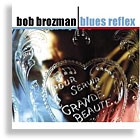
    Bob Brozman has made his name playing everything from the blues to Hawaiian music, old-timey Americana to Hot Club sounds. But above all, Brozman is a performer. His concerts are rowdy and alive – a musical pastiche highlighted by incredible musicianship.

    Much of Brozman’s musical interests have been focused on National resonator guitars and the traditions they have either sparked or been a central part of.

    Yet now, as he approaches 50, Brozman writes in the liner notes to Blues Reflex that he’s hearing all of his favorite music anew, with a deeper respect and more maturity. Hence, this new album.

    The 13 tunes here are largely Brozman originals peppered with traditionals and a handful of blues by the likes of Charley Patton and Skip James. No matter – Brozman makes them all his own.

    He plays an arsenal of guitars that reads like a dream list of cool; National tricone and baritone tricone, Weissenborn Hawaiian, Bear Creek baritone seven-string Hawaiian, Bear Creek Kona Rocket Hawaiian, Michael Dunn “Mystery Pacific” Selmer-style guitar, and much more. Layered atop each other, the tracks resonate with numerous exotic voices and gorgeous tone.


    This article originally appeared in VG‘s May ’06 issue. All copyrights are by the author and Vintage Guitar magazine. Unauthorized replication or use is strictly prohibited.
  • Tiny Moore & Jethro Burns – Back To Back

    Back To Back

    The original 1979 Kaleidoscope edition of this album is labeled “country” on allmusic.com. Which should come as no surprise; musicians have been stereotyped by their resumes (or in this case part of their resumes) probably since cavemen were beating on logs. But despite the fact that this session teamed an alumnus of the Texas Playboys and one-half of the country comedy/musical duo Homer & Jethro, both mandolinists were exceptional swingers, as this double-sized jazz CD reissue proves.

    It was that type of ignorance and stereotyping that mandolinist David Grisman was trying to combat – regarding both the music and the instrument – in the mid/late ’70s when he invented “dawg music” with his David Grisman Quintet. Producing this album was part of the same campaign, but also simply a void that needed to be filled, and if Grisman did nothing else, this would have been plenty.

    I realize this is Vintage Guitar magazine, not Vintage Mandolin , but Moore’s playing (on Bigsby electric five-string mandolin) owes more to Charlie Christian than to Bill Monroe, and Burns’ acoustic picking (on his Gibson A-5) recalls Django Reinhardt. Also, Grisman enlisted the perfect rhythm guitarist for the date, Eldon Shamblin – yes, playing his Stratocaster as he had with Bob Wills – along with jazz/studio legends Ray Brown and Shelly Manne on bass and drums respectively. Sadly, all of these giants are now gone; like I said, Grisman deserves a special place in mandolin heaven – which, come to think of it, is no doubt already waiting for him.

    The songs here range from Wes Montgomery’s boppin’ title track to Duke Eillington’s swinging “In A Mellotone” to fine originals by both leaders. Even when the pair pays respect to bluegrass mandolin king Bill Monroe, with Grisman joining in on “Moonlight Waltz,” they give it an uptown slant.

    A tape box of live-to-2-track alternate takes was discovered in October, and Grisman wisely included a second disc with different versions of all of the songs in the same running order. On second thought, this is mandolin heaven.


    This article originally appeared in VG‘s June ’05 issue. All copyrights are by the author and Vintage Guitar magazine. Unauthorized replication or use is strictly prohibited.

  • Pete Anderson

    Pete Anderson

    Photo courtesy Little Dog Records.

    Despite prevailing trends and “industry wisdom” – an oxymoron Pete Anderson has disproved several times over – the 20-year association of this guitarist/producer/label-head and country star Dwight Yoakam has been one of the most fruitful in country music history.

    Based in Los Angeles instead of Nashville, with a guitarist doubling as producer, using their seasoned bar band instead of session musicians, and daring to actually play rootsy country music (even proudly calling it “hillbilly music”) instead of some homogenized substitute, Yoakam and company reached #3 on Billboard‘s country chart in 1986 with a kick-ass remake of Johnny Horton’s “Honky Tonk Man” – which had created a buzz as part of their self-released EP before signing with Warner/Reprise. The first two Yoakam albums yielded six Top 10 country hits, and the boys were mainstays on the rock circuit long before the third release, Buenas Noches From a Lonely Room, scored two #1 country singles.

    The term “neo-traditionalist” was often applied to Yoakam, often in the same reviews that credited him with pushing the envelope of country music. Deftly making sense of this seeming incongruity was Anderson, in the control room and on the Telecaster. His arrangements and solos refused to settle into a comfortable rut, preferring to take chances and explore new sounds. The best of the pair’s Reprise output (spanning 15 albums), is compiled on Rhino’s four-CD box, Reprise Please Baby: The Warner Bros. Years – from the Bakersfield shuffle of “Little Ways” (featuring an Anderson baritone solo) to the ethereal “A Thousand Miles From Nowhere” (with Pete’s slide recalling Duane Allman).

    Anderson became an in-demand producer, working with Michelle Shocked, Rosie Flores, the Meat Puppets, and k.d. lang and Roy Orbison. In 1993, he founded Little Dog Records, and released his eclectic solo debut, Working Class (with the ad campaign, “It ain’t country, Homer!”), in ’94. He followed with 1997’s Dogs In Heaven and a live CD, and was mixing a new solo CD, tentatively titled Daredevil, at press time.

    In 2003, he helmed Yoakam’s Population: Me but didn’t tour with the singer for the first time in many years. Having co-produced the compilation A Town South of Bakersfield album and its sequel (Another Town South of Bakersfield), he showcased another fine crop of unsigned country talent on Little Dog’s A Country West of Nashville and was spotted gigging with new signee Moot Davis, who just might become the next Dwight Yoakam.

    Photo courtesy Little Dog Records.

    Vintage Guitar:You’re working on another solo CD?
    Pete Anderson: I was asked to do some instrumental cues for CMT – 45 seconds or a minute each, for shows like “Rockin’ Country,” “Gig Bag,” “The Morning Show.” I played all the instruments, and when I went back and reviewed the cues, there were 10 that I decided to make into songs.

    I know some people would like me to make a country record with a lot of fast picking, but that’s not what I do; I’m of the Steve Cropper/James Burton, economical school. Compositions interest me more than guitaristic exercises. I consider myself a musician first, rather than a guitarist. I learned a long time ago, when I first started recording with Dwight, that I was going to subjugate what I did to make the songs better.

    The hook seems paramount in your mind…
    Always. I’m going to get eight bars, or 16, in a song to play something, and the watermark is [Amos Garrett’s solo on] “Midnight At The Oasis.” But what happens prior to and post is equally important, because it has to be subservient to the song. I’ll do it on the acoustic guitar, on the electric, the rhythm, up-chunka-chunks, whatever.

    None of that is random in my mind; it’s all purposely patterned out to contribute to some texture of the song. Should it be tuned down to D; should it be a six-string; should it be with soapbars? It’s not about Pete; it’s about the song. In most cases I’m almost making the painting. Dwight will give me an outline, and I have to choose the colors.

    Who were your earliest influences?
    In retrospect, my earliest influence, unbeknownst to me, had to be Scotty Moore and also the guy who played with Bill Haley, because that music attracted me to the guitar. Who was the Italian guy with Bill Haley (hums Danny Cedrone’s solo on “Rock Around the Clock”)? What a player! Just the coolest ever. Nobody can play like that.

    Those guys got me into guitar, but then I got into Dylan as a folk singer, and the folk guys like Dave Van Ronk and Koerner, Ray & Glover, Tom Rush. My buddies and I had a jug band. I played harmonica on a rack and had a brand-new ’65 Gibson LG-1. I drilled an extra hole in it and put a seventh string on it, doubling up the A string, because Spider John Koerner had a nine-string Stella. We played a coffee house on Detroit’s West Side, and I saw Paul Butterfield play there in early ’66, with Mike Bloomfield and Elvin Bishop.

    When you got into playing country, did you still draw on your blues influences?
    All the time. My right-hand technique was an extension of that, because when I started playing, I used my fingers. I had to learn to use a pick. Then I got into country and learned the hybrid picking technique, and I would palm my pick sometimes and go back to my blues-type fingerpicking to get different sounds – the downstroke, the upstroke, the pluck, the pop.
    Growing up in Detroit, I sort of realized that if you learned to play blues really well, you could play anything – meaning that to be a good blues player, you’ve got to have good feel. And Muddy’s stuff is symphonic. That stuff was played that way every time; it wasn’t a jam. It wasn’t like these drummers you want to shoot, who go, “It’s just a shuffle.” There’s no “just a shuffle.” This one’s called “Trouble No More” – learn it!

    When I later started playing country bars, I was still playing blues pretty much – minor pents. To get by, I chicken-picked, but a la Hubert Sumlin on Howlin’ Wolf records. I applied blues knowledge, and then mentally slid the minor pentatonics into major pentatonics and back-doored it, a la Jesse Ed Davis. He was pretty much the first guy who I thought was playing cool steel licks. I mean, you’re listening to Taj Mahal and one day he does “Six Days on the Road,” with Jesse Ed on guitar (Giant Step). That was definitely a turning point.

    With Dwight, on Guitars, Cadillacs…, I played something that was a little more me, and I made a conscious effort to not go down the road of (in order of my favorites) Ray Flacke, Albert Lee, Vince Gill, and five other guys who were playing like Albert Lee. I would have just been in their wake. So I remember specifically thinking, “What would Freddie King do?” I was channeling all that “Hide Away” kind of stuff.

    When you moved to Arizona, did your musical tastes change?
    I went back and forth to Phoenix each winter from ’68 to ’72, and I was just bombarded by country music. I was a Dylan fan, so that led me to the Band. And I was into the Byrds, and that led to the Burrito Brothers.

    When I moved to L.A., by ’79 I joined a group called Rick Tucker & the Good-Time Band, with Pete Gavin, who was the drummer with Head, Hands & Feet. We worked constantly, especially after Urban Cowboy hit. So my playing just leaped, and I really formed a style.

    It’s ironic that you had this on-the-job training thanks, in part, to the Urban Cowboy explosion, because when you and Dwight hit the scene, you were flying in the face of that whole trend.
    We were coming out of the post-Urban explosion. As it was dying, the Hollywood cowpunk scene was emerging. We were just trying to play ****hole clubs in the Valley and make 30 bucks each, and somebody said, “Hey, you should play the Lingerie and Madam Wong’s and all these cool rock clubs.” So we went and saw them, and all these bands were really bad, trying to play country music, bless their hearts. We said, “Let’s get in on this scene.”

    So we got sharkskin jackets and tight pants, and went down there and just hurt people. Because we could really play. You can imagine a bunch of guys 25-and-under who had been in punk bands and now wanted to learn George Jones. God bless ’em, but they were pretty horrible. The band was me, Dwight, Jeff Donavan, J.D. Foster, and Brantley Kearns [the Babylonian Cowboys] – it was pretty overpowering. Before the first record, we were already doing “I Sang Dixie,” “I’ll Be Gone,” “It Won’t Hurt.”
    We didn’t make a dime, but we’d get press because we’d open for Maria McKee and Lone Justice, and everybody came down to see her. They’d go, “Who the hell are these guys?”

    Anderson with a Fender Esquire Custom.

    How aware were you that you were bucking everything that was country radio and Nashville?
    We were so naive of Nashville and the radio and Billboard and how it worked, it didn’t even cross our minds. Dwight was still thinking, “Maybe we can get a record deal.” We were too stupid to know that people from Nashville didn’t even come out to L.A. We did get an offer from IRS. Miles Copeland came and saw us at the Palomino, and told Dwight, “I think we can do something, and maybe my brother can help you produce the record.” The drummer guy [Stewart Copeland of the Police], right? Dwight and I looked at each other and said, “We don’t think so.”

    We had a young manager, Sherman Halsey, and I’d talked to some friends and told him, “Here’s what you need to do: say $100,000, complete creative control, and 12 points.” They’d just kind of rolled their eyes. I told Dwight, “This is a punk scene, and all these kids are cowpunk this and that, but when all the smoke clears, you’re a country artist. You’ve got longevity. You’re going to need to be on a country label.” If we’d been on IRS, they might have made a record or two; we never would have gotten on country radio. We just got lucky because Warner was in Nashville, and they were artist-friendly.

    Once you got signed, was the creative control ever a sticking point?
    No. I was old enough to know that if those things I told Sherman didn’t happen, we were not going to have success. I was looking out for the longevity of the career. Because when I met Dwight, he had 21 great songs. I specifically said, “Let’s put seven songs on each record and do three covers. Now you’ve got three albums’ worth of material. Let’s not put ‘I Sang Dixie’ on the first record, because you’re probably not going to have a #1 on the first record. Let’s knock down some doors.” So we saved “I Sang Dixie” for the third record, and it was our first legitimate #1 Billboard hit.

    We had a meeting with Jim Halsey, Sherman’s father, because the Blasters offered to have us open on their tour. We asked Jim if he could get us the money to fly to New York. He said, “Well, what about the record?” I said, “Listen, you should call everyone that you’ve pitched this record to and ask them to send it back, and then do not call anyone. If you allow us to do these gigs, the press alone – all you’re going to have to do is pick up the phone.” He thought for a moment and told Sherman, “Call and get the records back.” He was cool, and would roll the dice.

    We went to New York and The Village Voice was beating on our door right after our set.

    After the first Dwight album or two, you must have started hearing records where the guitar players weren’t playing like James Burton or Albert Lee, but were playing like you.
    People pointed that out to me, and I didn’t really notice it, to be honest. I remember going to Nashville, and who do I meet, but Bruce Bowden and Ray Flacke. They were going, “Do you know what you did?” What? “The guitar in Guitars, Cadillacs… Do you know what you did?” No. “You don’t have any chorus on it. And you’re not using a Stratocaster.”
    The only time I was aware of it was on Radney Foster’s album, Del Rio, Texas. I remember listening to some song off there that was a video, and thinking, “Did I play on that?” For whatever reasons, the guitar player wasn’t playing my licks, but he was playing what I would have played.

    You play especially economically and hook-oriented on A Country West of Nashville.
    On Dwight’s records I’m expected to do a certain thing. I’m not saying that negatively; I’ve got a wide latitude. But I just play differently with different people and try to be sensitive to the situation. In the case of the compilation, I think the first rule of producing is that you shouldn’t have any preconceived rules or ideas; you just want to wrap the present as best you can. I had all these different artists, and I just wanted to play exactly what was necessary to fit the song.

    Pete Anderson strikes a live pose, country-style, in 2001.

    Will you make more records and tour with Dwight again, down the road?
    I would think that it’s probably over. From my perspective, I’m very proud of Population:Me, but after the box set would have been a good time to say, “We’ve had a hell of a run; look what we’ve done. God bless you.” Once I looked back on it, I went, “Wow! I’m very proud of our legacy.” Every record has one or two songs that I hate, but the ones I like… I mean, I was on tour in 2002, 54 years old, standing onstage playing “I Sang Dixie,” and it does not embarrass me. It’s like being in Muddy’s band; I would never be embarrassed. It’s still relevant; it’s not like I’ve got to put makeup on.

    But I don’t know what more I can bring to the party. Obviously, there are things I can bring to the party, but everyone has to grow to do that.

    What made you start your own label?
    Little Dog started around ’93, with Anthony Crawford. I thought, “This will be easy. I’m Pete Anderson, multi-platinum, Grammy Award-winning producer. I can talk to the head of every company in the world. I’ll get this guy a deal in a minute.”

    Wrong. They played me bad music, and I was just like, “Screw these people. I know I’m on the wrong side of the desk.” When I started doing this, I walked into the room like a guitar player. These guys had a desk and a nice car and expensive shoes, and they made money. I figured they knew more than me. Then, after they played me some godawful crap, I figured they couldn’t write poetry, they didn’t study literature, they didn’t have a record collection, and they couldn’t play an instrument to save their lives. Most of them knew less than people who didn’t do that, because at least they were music fans; these guys were music snobs. I said, “I’m going to start my own label.”

    Since you started Little Dog, major labels have experienced a huge drop-off, and the Internet has changed everything.
    Major corporations bought into the entertainment business in the ’60s. If you think back, record companies were owned by musicians – producers, songwriters, whatever. There were basically no corporate guys running record companies in ’59, ’60 to ’65, ’66. Babyboomers came in with disposable funds, and when I was a teenager I could buy beer, go to a movie, or buy a record; there weren’t a lot of other options. So my disposable money went to entertainment.

    And that’s when bottom-line people, corporations that buy “things” bought into entertainment. And it’s taken 30 years for them to destroy it.
    The first guy to blink was Seagram’s buying MCA and then buying Polygram. One day, they looked at their ledger sheet and said, “Our stock has fallen; what are we doing here? Why are we in entertainment? Sell it.” They sold Polygram for $10 billion.

    That was Day One – and it’s not going to stop. It will continue until every record company is probably music-person-owned. Epitath and Sugar Hill/Vanguard will be considered large record companies in the future, because they’re privately owned.

    So this is a good thing.
    It’s an excellent thing. I’m excited. It’s better for me every day. My company is growing very slowly, but consistently. But with everything collapsing around it, it looks like I’m on a skyrocket here – because I’m dealing in reality and these other people aren’t. And anybody who’s like, “Oh, the business ebbs and flows… Dude, there’s only ebb; it will never be flow, because you cracked the dike over the Internet. We communicate; we can hear music; we can talk. I get orders from all over the world. And you know how you use your computer… If I need the words to a song, I go online. I heard about this hot guitar player, Jimmy Herring. “Who is that guy?” Go on the computer. Most of my time and energy is spent creating my infrastructure on the web.

    When I picked up the guitar and my romance and love affair with the instrument started, it didn’t have a dollar sign attached to it. I have to play the guitar; I love to play the guitar; and I feel fortunate that I’ve made money by playing the guitar. I get to do all this and have fun every day? I win!

    The stereotype is that artists don’t have any business sense.
    Well, if you have above-average intelligence, are not overly self-centered, not a drug addict or an alcoholic, you learn. I mean, how did you learn not to touch the stove? Your mom told you not to touch the stove, so you touched the ****ing stove! Some people keep touching the damn thing; I didn’t.

    But it wasn’t cheap, and it wasn’t easy. I was just wandering through life. But I just got on the guitar and have flown around the world with it. I’ve been fortunate and lucky, but I had to learn a lot of stuff.


    Dog toys

    Pete Anderson’s (Signal) Chain

    Pete Anderson’s primary guitars are two custom-built Tom Anderson Hollow T Classic models and when it’s time to strum a little acoustic, Anderson grabs a Martin HD-28 or this Larrivee.

    In the early days with Dwight Yoakam, Pete Anderson’s trademark guitar was a sunburst ’59 Telecaster Custom (with binding, rosewood board, and stock pickups). For the slide work on songs like “Takes a Lot To Rock You” and “A Thousand Miles From Nowhere,” he played a ’59 hard-tail Strat, using a Mighty Mite brass slide on the former and a slide made of titanium on the latter. “It’s the hardest metal ever, so it’s real fast,” he says.

    He later built a guitar specifically dedicated for slide, which he dubbed the “Muddycaster.”

    “I wanted the action high, heavy strings, big neck – using the lap steel idea of taking a powerful pickup and putting it as far back to the bridge, completely disregarding where the harmonics are on the strings. So I put a Seymour Duncan humbucker on it. It was right around that time the Muddy Waters postage stamp came out, so I got out my woodburning kit and burned a frame and put the stamp on there with the dates of his birth and death, and I put a little sun over Muddy – like, ‘The sun’s gonna shine in my back door someday.’ Then I put a Hipshot tuner on, but reconfigured it so I could drop the high E instead of the low E, to switch to Muddy’s tuning (open G) on the top four strings.”

    These days, Pete’s main guitar is a Tom Anderson Hollow T Classic.
    “His craftsmanship is incredible. I ended up getting one of his tremolo Teles with a middle pickup, so I could play all my country stuff on the Tele; switch to the middle pickup and get all my Strat sounds – when I use a Stratocaster, I only use the middle pickup – and then do all my whammy stuff. The last piece of the puzzle was when DiMarzio came out with their vintage Tele pickup with no hum.”

    Pete’s main acoustics have been a Martin HD-28 or a Larrivee, but recently he’s been working with Robbie Brown, of Legend, designing “…the ultimate Pete Anderson acoustic guitar,” which is going to be called the Delta Bomber. “It’s like an OM, with a bigger butt and a narrower waist. I’m very excited about it.”

    The story of Pete’s succession of amps includes many tales of the mods he had done, and who did them.

    “By the time I got to Dwight, my main amp was a blackface Deluxe with an Electro-Voice speaker, 6L6 Groove Tubes, and a solidstate rectifier. I was using a Goodrich volume pedal and an old tube Echoplex in the effects loop. When we began playing bigger places, I started making the Deluxes as powerful as possible, and I ended up with two of them. I had them maxed-out, power-wise, with an EV in each, and with two of them, I had a wet cab/dry cab setup with spring reverb in both cabinets and a link that would start the tremolo and make them identical when I used it. On the left side, I had the Echoplex and a Boss Chorus Ensemble, on the completely slowest mode, which I’d sometimes use for steel licks.

    Pete Anderson’s dedicated slide guitar, which he calls the “Muddycaster.”

    “Only one guy modified that amp, and his name is Jim Williams. He told me that Deluxes had a middle control, but it was a value that Fender shorted-out on the chasis where they didn’t use a knob. It’s like a preset middle control that helps shape the amp. He said, ‘What I do is take this middle control value and put it on 10, because it’s on 3 or 4.’ I asked him to do that, because I think the guitars live in midrange. Once Jim gave me this middle control, I put the treble on 5, the bass on 21/2 or 3, reverb on 21/2, and the volume somewhere between 31/2 and 51/2. After 5 or 6, the Deluxe just flattens out and keeps compressing. That was the sweet spot on the amp.

    “The next step was to increase the power. So I got the biggest transformer that would power a two-tube amp, and it scoped to maybe 60 watts.

    “I have no idea what Cesar Diaz did to Stevie Ray’s amps, but I know I figured out a long time ago that my personal sound came from preamp distortion. I didn’t want power amp distortion or tube distortion or speaker distortion. Hence, 6L6s versus 6V6s, an EV versus a Jensen, and the biggest transformer I could get. That goes back to the days of me playing bars and trying to imitate a steel guitar. I figured out that steel guitar amps really don’t distort; they’re clean as all get-out, but the pickups are really powerful. The pickups hit the front end of the amp really hot, and if there’s any distortion or grind, it comes from preamp distortion – the preamp getting hit hard. That’s what I was going for.

    “So I asked Jim why a Twin didn’t sound like a big Deluxe. He explained that the bright switch values were wrong. Deluxes had bright switches, but they were shorted-out on the chasis; they didn’t really have a switch, but there was a value in there creating whatever the sound was. So he changed the value of the bright switch on a blackface Twin, so that when you pushed it down it was the value of the shorted-out ‘bright switch’ that’s in the Deluxe that you don’t know about, and when I pushed it up it was the bright switch of a Super.

    “I used the Twin for a while, but I lost my wet/dry cab gag. Then Bob Bradshaw created this reamplification thing, where you reamplify your effects. I talked to him about how I could get my wet/dry cab thing, and he built this switching system and a dummy load thing, so you could have various amp heads and switch between them, and have two cabinets onstage. So I’d reamplify the effects through a power amp and send them to the wet cab, which would mix the effects in with the sound of the amplifier, reamplified, and then the dry cab would have the original amp in it, and I would use various amp heads. I had a Matchless 80-watt head that I used on ‘A Thousand Miles From Nowhere,’ a Vox AC-30; I wasn’t just using blackface Fenders on the Dwight records – it started to expand. I bought the Groove Tubes Solo 75, which was very much like a Deluxe, and then I got the new models from Fender like the Vibro King and the Dual Professional.

    “The Dual Pro was like a big brown Twin head, and that was my main clean amp. I used the Solo 75 to simulate the early Dwight stuff on the Deluxes, and for kind of bluesy stuff like ‘Long White Cadillac’ I used the Matchless. I could switch them with the Bradshaw, and I had a small rack of effects, including a Korg digital delay I had modified so the return signal came back browner than it went in. With the Korg and the click track, I could dial in the BPMs for every song, and have my slap set exactly to the beat of the music. And, I had a [Fender] Tonemaster so that I could switch from channel A to channel B and get more drive, and it became my massive rock amp, with the Dual Professional as my clean, basic country amp, and I still had my Solo 75 for the Deluxe sound.

    “That existed until I hooked up with Line 6. Remember when Amp Farm came out? I beta-tested the software. They brought over the very first Flextone and said, ‘Check this out; it’s like your Deluxes.’ I played it and said, ‘Well, yeah, it sounds real good, but I can’t tell if it’s like my Deluxes.’ I A/B’ed it with my Deluxes, but they were hyped up, different amps. I think of it as cloning, so I asked them to get me the amp that was the mother of this amp, the one they cloned it from. They brought over this pre-CBS blackface, and I A/B’ed the mother, the organic clone, and the software clone. I recorded an instrumental on all three amps, and had the engineer switch between the three without me looking, to see if I could pick out which one was which. I could always tell which one was the organic amplifer; there was something missing. But between the mother amp and the software, I could not tell the difference. So I figured, I’m not stupid; I’ll just start using the software. So I started recording in Amp Farm.

    “Then the Vetta came out, and I’ve got every amplifier I’ve ever wanted in that digital box. With the Vetta, I can adjust the amps so in the course of 22 songs, at least 15 would be a blackface Twin, but maybe some would just be rhythm. So I could tune the amplifier to give me the ultimate sound to play rhythm, then tune it to get steel licks, then tune it for baritone. Instead of having to adjust my amplifer, I hit a button, and it changes the reverb, the delay, the tone, everything. And it has a post-EQ section, where I can notch frequencies instead of just relying on tone knobs. Once I did that, I could dial these things in unbelievably.”


    Photos courtesy Little Dog Records.
    This article originally appeared in VG‘s Jan. ’04 issue. All copyrights are by the author and Vintage Guitar magazine. Unauthorized replication or use is strictly prohibited.

  • Big Al Anderson – After Hours

    After Hours

    This is the first solo album by the former lead guitarist for NRBQ in almost a decade, and he uses it to cover lots of ground.

    Anderson writes good ballads that fall between jazz and nightclub tunes. “Love Makes a Fool of Me” is one; its changes and laid-back vocal are highlighted by fine fills. There’s also very nice jazzy steel guitar from Paul Franklin, who makes an appearance on several tunes. “Two Survivors” is similar, with a great lyric about love and fine jazz comping by Anderson. Between those cuts there are songs that could easily make their way to the country charts if a popular artist would cover them. “It’s Only Natural” is one example, driven by the dobro of Russ Pahl. “Trip Around the Sun” is about the wonders of life, with fine guitar help from Bryan Sutton. The gospel of “Right On Time” is a nod to soul music and features one of the album’s best solos, on acoustic.

    More flavor comes from backup vocals by Bekka Bramlett and Crystal Talifero. And just for fun is a great western swing tune, “Blues About You Baby,” which sounds like a number the “Q” could’ve jammed.

    Anderson’s work in NRBQ solidified his ability and reputation as a player, but here he showcases his songwriting, and it’s easy to see why other artists value that enough to record his songs. There’s plenty of guitar to go around, but the song’s the thing on After Hours.


    This article originally appeared in VG‘s Aug. ’06 issue. All copyrights are by the author and Vintage Guitar magazine. Unauthorized replication or use is strictly prohibited.

  • Dave Biller & Jazz Pharaohs – LeRoy’s Swing & Old Man Time

    LeRoy's Swing & Old Man Time

    The connection between these two albums is one Dave Biller, a multi-talented Austin guitar man who plays it all – Hot Club swing to straight-ahead jazz – with a fine dose of rockabilly added when the night’s right.

    LeRoy’s Swing is a stylish collection of Djangocentric music played with a Texas twist. Biller’s backing band is modeled after Django’s wartime Nouveau Quintette, with clarinet (played here by Ben Saffer) replacing the early violin. Rhythm comes from guitarists Anthony Locke and Jeff Seaver, supported by bassist Ryan Gould.

    Biller plays Django with cool sophistication and laidback charm. His song list is classic Hot Club, from Gusti Malha’s “La Valse des Niglos” to Al Jolson’s “Anniversary Song” to Django’s little-played “12th Year.” But the freshest numbers are Biller’s own, and he swings with sure grace.

    The Jazz Pharaohs jokingly refer to themselves as “Austin’s Best Wedding Band” – and they may well have fans crashing wedding parties just for the music. They’re a more traditional American jazz band, kissing kin of Austin’s Asylum Street Spankers.

    On Old Man Time, Biller trades hot guitar licks with clarinetist/vocalist Stanley Smith and Freddie Mendoza on trombone. The repertoire is pure standards as well as the band’s theme, “The Pharaohs Stomp.”


    This article originally appeared in VG‘s June ’05 issue. All copyrights are by the author and Vintage Guitar magazine. Unauthorized replication or use is strictly prohibited.

  • The Fender Telecaster

    Simplicity. You can sum up the success of Fender’s venerable Telecaster model with one word. A cross-cultural phenomenon right down to its name – in a bind, the company essentially named it after the television – its many intuitive features revert to that one word, and players in every genre have used it to create some of history’s most recognized pop music.

    Given the simplicity of its design, it’s remarkable that the Telecaster stayed not only viable, but predominant in the 51 years since it was introduced as a single-pickup, slab-bodied piece of innovation. Its profile was nontraditional – a neck that’s bolted on, with frets pounded into it (no laminated fretboard), and a couple of dinky pickups. Nevertheless, the Telecaster has always been ready to boogie.

    The Road to the Telecaster
    While the Telecaster was not the first solidbody electric guitar, it was groundbreaking in that it succeeded. American guitar manufacturers began playing with the notion of an electric guitar as early as the 1920s; Lloyd Loar was experimenting at Gibson as early as 1924.

    Kay (Stromberg-Voisinet) became the first company to put an electric guitar into production, in 1928. It was greeted with much ballyhoo in the trade press and immediately picked up by Chicago radio performers. But interest quickly faded due to technical problems, the Depression, or both.

    From the mid 1930s through late ’40s, guitarists’ choices in the electric realm were basically limited to acoustic and archtop instruments with pickups mounted to their tops or in their soundholes. While these certainly furthered the state of music, they were often crude or, in the case of the upscale archtops, prohibitively expensive.

    Then came Leo Fender. A radio repairman who, perhaps after seeing Merle Travis play a solidbody Spanish-style electric guitar built by Paul Bigsby, drummed up his own design.

    And unlike the unduly sophisticated electric attempts that pre-dated it, Leo’s guitar was meant to be simple; it had to have a solid body (feedback was a huge problem for electric instruments of the day), one pickup, and a bolt-on neck (for easy removal and servicing). Nothing fancy. These factors had as much to do with the fact that Leo intended it to be easy to service/maintain as the fact that Leo’s factory didn’t have the machinery or the money to do anything too sophisticated. This Spanish-style guitar had to be made using the same tools and machines that were making Fender’s lap steels.

    Rolling…
    So it was that in the winter of 1949-’50, design began in earnest. The shape was created by George Fullerton, who Le hired to help repair amps and lap steels in his shop. Fullerton’s original concept, devised after playing a lap steel-like instrument Leo built to help test a pickup, has been maintained since its inception; a simple shape, with the trademark single cutaway on the treble side.

    A prototype made in 1949 looks very much like a Tele of 2002, save for one key feature – the headstock. Though Leo would quickly come to favor six-on-a-side tuners, the proto retained its precedent lap steel headstock, with three Kluson tuners on each side.

    With the prototype complete, Leo and Fullerton forged on, and by early 1950 had a guitar ready for distribution by the Radio and Television Equipment Company (RTEC), which distributed Leo’s lap steels and amplifiers. Though Leo wanted the guitar to have two pickups for the sake of tonal versatility, RTEC had a catalog to produce, and wanted the guitar pictured in it.

    So it was that RTEC’s Spring catalog carried the Esquire, a Spanish guitar made by Fender Fine Line Instruments and boasting features like “The new adjustable Fender bridge…” Within weeks, the guitar was on also display at the July NAMM show, billed as “Fender’s electric guitar with solid body” or “Spanish guitar,” and with a list price of $139.95.

    In a marketing move quarterbacked by Don Randall, RTEC held off on the two-pickup variant, seemingly to test the waters.

    Broad… caster
    Though response to the Esquire wasn’t tremendous (or even all that good), feedback from players led to the introduction of a steel truss rod for the neck of the guitar (despite Leo’s contention it wasn’t necessary), and the second pickup.

    By the end of the Summer of 1950, the guitar was officially introduced to the mass market as the “Broadcaster,” in tribute to the radio – the means by which most of its notes would supposedly be heard. It listed for $169.95.

    But not long after, a letter from the Fred Gretsch Manufacturing company politely requested that Fender drop the Broadcaster name because Gretsch had already received a trademark for use on its drums. Not wanting to stir any pots, Fender and RTEC quickly abided, and from February until August of ’51, finishers simply clipped off the “Broadcaster” part of the headstock decals before applying them. Thus was born the “Nocaster,” a name never adopted by Fender but quite well-known amongst vintage guitar enthusiasts.

    By April of ’51, a new name had been chosen – and this time trademark researched prior to being introduced. “Telecaster” was selected because of the growing popularity of the television in American culture, and the fact it implied burgeoning technology.

    Despite the lukewarm reception to the model, it sold well enough in its first few years.

    Then, with the end of the Korean War in sight, demand for fretted instruments took an unexpected jump in early 1953, and Leo, confident that the popularity of the Telecaster and his other instruments would bloom, bought a few acres of land and constructed three new manufacturing buildings. He also developed a sales division for his company and effectively ended his relationship with RTEC.

    Sure enough, the solidbody electric guitar took flight, as other companies jumped into the fray, most notably Gibson and Valco.

    Wood and Guts
    The classic Telecaster image has always been a maple body (with natural finish, of course), maple neck, two pickups, and a pickguard in black. But there have also always been deviations – including the first Esquire that appeared at NAMM, which was finished in an enigmatic black, either to differentiate it from other instruments, or maybe even because its body wasn’t maple, but some other wood that just didn’t look good in blond!

    By the Fall of ’54, the black Bakelite pickguard had been replaced with a singe-ply white plastic guard, the brass bridge saddles had been replaced with steel, and the “butterscotch” blond finish changed to an off-white.

    In ’55, staggered polepieces were introduced to the bridge pickup and the V-shaped neck became the norm. Also, the dome-top knobs were replaced by lighter-weight knobs with flat tops.

    Fender began offering custom colors on its instruments in 1956/’57, though they never proved overly popular – especially to Telecaster buyers/players.
    By 1959, the Tele form was approaching its tenth birthday, and other guitars were posing stiff competition. Changes were, perhaps, inevitable.

    Family Tree Branches
    In 1959, the first significant change was introduced to the Telecaster with the introduction of the Custom, a three-tone sunburst model with binding (arguably “inspired” by Gibson’s top-line guitars), a three-ply pickguard, and a new rosewood fretboard (which all of Fender’s electrics acquired that year). Maple-capped necks remained an option until ’69, when one-piece necks were reintroduced.

    But as the guitar boom of the early/mid ’60s blossomed, Fender saw little need to further change the Tele because the model was successfully filling a niche with country, pop, blues, and R&B guitarists. Other Fender instruments did likewise with other genres, and the company as a whole saw fantastic growth.

    In fact, because his health wasn’t perfect, and business was so good, Leo decided to sell the company. In a deal finalized in the early days of 1965, media giant CBS became Fender’s parent company. Leo was retained as a consultant, but felt his input wasn’t highly regarded by CBS.

    New Era, New Models
    Seen as a turning point in the Fender saga, the sale to CBS inarguably marked a change. With corporate ownership came a new way of doing things, and for the most part, the late 1960s and ’70s are not viewed by electric guitar aficionados as the “good times” at Fender.
    Quality control suffered as the corporate mind set moved more toward profitability than instrument functionality. There were also some “innovations” that did not stand the test of time, most notably a thick polyester finish that gave the instruments a plastic-looking aesthetic, and Leo’s own “Tilt Neck” adjustment feature (characterized by what became known as the “bullet” truss rod and three-bolt neck).

    Nonetheless, the company carried on successfully, and in 1968, the biggest changes yet to hit the Tele was introduced.

    Gettin’ Thin
    The Telecaster Thinline was developed by Fender R&D man Roger Rossmeisl and body carver Virgilio Simoni to address a sign-of-the-times issue: weight.

    Rossmeisl had Simoni carve cavities into a Tele body, and (on the upper bass bout) an f-hole into the top to add flair and show it that it was indeed hollow! Grab hold of one, and the difference is obvious; it weighs about half what a standard Tele does.

    Originally, the Thinline’s neck, hardware, and electronics were identical to the standard model, but in late 1971 the model was used to launch Seth Lover’s newly developed 12-cunife, high-output humbucker.

    Custom la Vista… Kinda
    In ’69, lagging sales meant the end of the Esquire, and by ’72, the Custom (along with a short-lived variant made entirely of rosewood) was deleted from the catalog. Taste trends of the times pretty much spelled the end of custom colors, as natural-finished instruments became the flavor of the day.

    The next variation arrived in 1972, when the Custom was redesigned with Lover’s humbucker in the neck position, and a Gibsonesque two-volume/two-tone control knob arrangement with three-way selector in a decidedly Les Paul-type position.

    Variations of the Thinline and Custom (called the Deluxe) that used two humbuckers were issued in ’71 and ’73, respectively. The Thinline remained in production through 1979, while the Custom and Deluxe lasted until ’81.

    As the ’70s drew to a close, the effects of CBS’ neglect of the highly profitable Fender company began to show. Dealer complaints about quality control grew more common, and sales began to slow as guitarists more readily opted for “old” (a.k.a. pre-CBS) Fender guitars.

    Modern Variants
    Fender’s first foray into the reissue market started with a Tele; the 1981 Vintage Telecaster was, in theory, a clone of the ’52 model. But given the halfhearted attempt by the corporately shackled company, the first version bore only a slight resemblance to the real deal; glaring errors included an improper body shape and finish color. Fortunately, it was in production only briefly before the inaccuracies were corrected by newly appointed director of marketing, Dan Smith.

    Thus began Fender’s participation in what was quickly becoming a significant trend – building new guitars to “old guitar” specifications. And since issuing the first ’52 re-make, Fender has reissued many of the “classics,” including the Nocaster and the Thinline, as well as the short-lived paisley and floral finishes, and the all-rosewood model.

    Fender’s standard guitar line now includes dozens of Telecaster variations, including reissues of the ’52 and the ’62 Custom, while the company’s Custom Shop offers its “Time Machine” series ’51 Nocaster and the ’63 Tele in custom colors.

    Today, the Telecaster is rightfully revered as the Alpha Male of the solidbody guitar world. It was the first solidbody guitar to be mass-produced and mass-marketed, and its design has left its mark as an icon not only in guitardom, but in the industrial world.


    Teleretrospect
    Why is the Telecaster such an icon?

    – – – – – – – – – – –
    It’s the simplicity, and the beauty in that simplicity, that makes the Telecaster such an icon. It’s extemely basic, and everything about it is functional. Plus, it’s unique in its sound and feel.

    The first time I played one was in ’63, when I walked into a music store where they had a second-hand one with a rosewood fingerboard. It was beaten up, but quite cheap, so I bought it with visions of James Burton in my mind.

    When I plugged it in, it felt so alive – it really does sound like an electric guitar. And every time you play one, it shapes the way you play because of the way it sounds and feels. – Albert Lee, guitar legend

    – – – – – – – – – – –
    The Tele started as an icon 50 years ago, and has transcended time, through all of the artists who’ve played it, all the wanna-bes, and all the collectors, as the icon of the industry. And we have continuously worked on design and manufacturing processes to keep it there! – Bill Schultz, CEO, Fender

    The Fender Telecaster is one of the finest and most enduring of all electric guitar designs. The model is, for all practical purposes, the first Fender solidbody, since it is virtually identical to the early-1950 double-pickup Esquire and the Broadcaster.

    The Telecaster has remained virtually identical in its specifications since its introduction. The design is a classic which has withstood the test of time. It was a modernistic guitar when it was introduced and even today the lines flow so smoothly that it is an ageless classic which does not in any way appear out of place.

    While feel is a matter of personal preference, most players agree that the Telecaster has as good a feel as any electric guitar on the market. Tone is also a matter of personal, subjective preference, but few would deny that the lead pickup of a vintage Telecaster has one of the truly classic sounds in the electric guitar world. The rhythm pickup of a Telecaster works well but is not, in the opinion of most, what this guitar is all about. In my opinion, the lead pickup sound of the early black-guard Telecasters is as fine as any electric guitar on earth. I personally prefer early Telecasters over any Stratocaster, although I am well aware that there are plenty of folks out there who feel differently. There is no question that a Stratocaster can give more different tones than a Telecaster, but the Telecaster lead pickup is nothing short of phenomenal.

    The Telecaster is one of the great archetypes in the electric guitar world, and as the direct descendant of the Broadcaster, may rightfully be considered the first commercially successful solidbody guitar made in quantity by a major manufacturer. This model is without a doubt one of the best designs in the history of musical instruments and industrial design. – George Gruhn, proprietor, Gruhn’s Guitars, and co-author of Gruhn’s Guide to Vintage Guitars

    – – – – – – – – – – –
    The Telecaster became an icon for two reasons.

    First, it was the right product at the right time. Although changes to pop and country music in the early 1950s may not seem so radical compared to music today, they were most certainly radical in comparison to pop music coming out of the ’40s. The guitar really was on the verge of becoming the out-front solo voice in pop music. The Tele wasn’t just radical-looking in comparison to what guitarist’s had been using, it was louder and had a bell-like, cutting quality.

    When it first hit the streets in 1950 (as the Esquire/Broadcaster/Nocaster), there was nothing quite like it. For the guitarists who started to use it, it made quite a statement. Hey! Stop, look, and listen – I’m different!

    Second, it became an icon because even though it’s not as graceful-looking as the Strat and some other guitars, the sound was right from the beginning. Clear as a bell – a tone that rocks your heart. Pure and honest – if the player hasn’t got it, there’s no hiding the fact. If you can play – well, then everyone’s going to know it, because the Telecaster let’s the player’s own voice come through. The fact that the list of first- couple-of-notes identifiable great Tele players is a long one pays testament to that. – Dan Smith, V.P. of Guitar Research and Development, Fender

    – – – – – – – – – – –
    The Telecaster is one of the most innovative, versatile and durable guitar designs ever created. When I think of the Tele, the lights come on in the guitarists hall of fame, and the music starts to play; I hear the blazing country-rock licks of Albert Lee, Ray Flacke, Jerry Donahue, and Danny Gatton, Keith Richard’s crunchy rock riffs, the inimitable twang of Roy Buchanan, Andy Summers’ atmospheric guitar work with The Police, the mind-boggling shred of Steve Morse, Steve Cropper’s funky R&B comping, the mellow jazz chords of Ed Bickert and Ted Greene, Jimmy Bryant’s virtuosic country bop, the down-and-dirty Chicago blues of Muddy Waters and the bone-chilling Texas blues of Albert Collins. And that’s the short list. The Telecaster crossed international and stylistic boundaries early on when it was essential to the sound of early Jeff Beck, early Pink Floyd, early Led Zeppelin and late Beatles, and countless others.

    The Tele is also pure Americana-from the rolling rockabilly of Paul Burlison and Carl Perkins to the hitmaking guitar hooks of James Burton, Roy Nichols, and Don Rich, and the power chords of Bruce Springsteen. It reaches back as far as 1950s Western swing, with Jimmy Wyble, and is as current as today’s guitar greats like Brent Mason and Jonny Lang.

    By any estimate, the Tele will be fueling guitar music into the 21st century and beyond. Long live the Telecaster! – Wolf Marshall, guitar teaching/method guru

    – – – – – – – – – – –
    Leo Fender had a plainspoken compliment he used to describe something he admired: “It’s built the way it oughta be built.” As the first commercially viable solidbody, the Telecaster revolutionized an industry and defined a whole genre of electric guitars. Because it was the first, and arguably the best, it became the yardstick for measuring everything that followed.

    The Telecaster embodies the pure essence of the solidbody electric guitar; the tone, the look, and the character. It’s an icon because of what the electric guitar has come to mean in our lives and our culture. And because as Leo would say, “It’s built the way it oughta be built.” – Richard Smith, author, Fender: The Sound Heard ‘Round The World

    – – – – – – – – – – –
    The enduring success of the Telecaster seems so obvious: Simple is better. Ever notice how the souped-up versions of the Tele aren’t nearly as popular as the stripped-down original? Same with the Les Paul’s later, jazzier variations. To me, when a guitar (or amp) tries to be an “all-encompassing, please-everybody hybrid,” it fails. In fact, I don’t even like Teles with a middle Strat pickup added; it somehow cheapens its integrity.

    Leo Fender’s idea was to make an electric Hawaiian guitar that you could play like a Spanish, fretted guitar, and he did it in about the simplest, most obvious way imaginable. Don’t forget: this is the same mind who decided that the upright bass player should be freed up to do dance steps with the rest of the band, and so invented the Fender Precision bass.

    What Leo couldn’t have envisioned was that by placing the volume knob so it was easy to reach, he was supplying the tool for the volume swells that would become one of the building blocks of Roy Buchanan’s style. Or that the location of the upper strap button and the thickness of the Tele’s body would provide Clarence White and Gene Parsons a workbench to invent their “B-bender” to emulate pedal steel licks.

    Maybe it’s a “chicken or the egg” question – if the Strat or Les Paul had come first and made its way into country music, would that be the sound we’d associate with Don Rich and James Burton? – but I think the Tele’s tonal range is what carved its way into people’s collective consciousness. When you hear someone chicken pickin’, with that clear, piercing tone that doesn’t quite hurt (or when Johnny Guitar Watson yanks the strings with the treble on 11, and the tone does hurt), you just know it’s got to be a Telecaster.

    The same as the first one that rolled off the assembly line, it’s never been improved upon. – Dan Forte, guitar journalist

    – – – – – – – – – – –
    The Telecaster was the first of a new breed of solid electric guitars with replaceable necks that could be serviced. And when you’re first, that leaves a heck of an impression!

    The Telecaster’s penetrating sound defined Fender’s signature guitar tone. In an era of soft, warm guitar tones, the Telecaster offered a penetrating-yet-musical sound that could carry a room. It’s truly a player’s guitar, and not a very forgiving instrument. It responds incredibly to the nuances of one’s technique; as such they are able to define a unique voice or signature style. As a result, players with totally diverse musical backgrounds have chosen the Telecaster to make their mark; Muddy Waters, Roy Buchanan, James Burton, Keith Richards, Jimmy Page, Jeff Beck, and Danny Gatton have all used Telecasters. And when an instrument has such a diverse body of work behind it, it is validated musically and culturally.

    It’s hard to deny the Telecaster’s role in helping define contemporary music. – Richard McDonald, V.P., Fender Guitars and Amplifiers

    – – – – – – – – – – –
    It’s the bicycle of guitars – the most efficient way to get from point A to point B. It has an extremely high style-to-material ratio; just a plank and a stick, some bolts and wires. But it looks cooler than anything. It sounds okay, too, if you like perfect. It’s on a very short list, along with the Coke bottle and the New Holland hay rake (drawn by my father-in-law C.H. Prout about the same time as the Tele) of designs that have endured virtually unchanged for over half a century. I’ve had mine for a third of a century and it’s still my favorite electric, the one I play every day. I like everything about it, from the six-in-line pegs on the skinny head to the brass bridge under the heel of my hand. I’ll bet they were looking at a Tele when they designed the Sputnik. Leo and the guys got it right the first time, didn’t they? – Bill Kirchen, Tele legend


    Finish Flights of Fancy

    The iconoclastic Telecaster, legendary as it may be, has also been subject to the many whims of its creator as the company experimented with ways to keep the guitar as marketable as possible.

    So it is that the Tele has seen its share of design changes, and just as interestingly, finish changes. What started out as a very simple, plainly finished workingman’s tool has, in fact, been subjected to some of Fender’s more dramatic flights of fancy.

    With the advent of Fender’s custom color options in 1957, the gate was opened, though few Tele players – being of a traditional mind set – ordered Teles in anything but traditional blond or sunburst. Nonetheless, custom-colored Teles are out there – just not in great numbers.

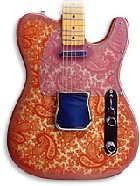
    But beyond sunburst paint and some binding, Fender’s most garish attempts at dressing up (and updating) the Tele came in 1968, with the introduction of the Paisley Red and Blue Flower finishes.

    Meant as a direct shot to the hippy/psychedelic “market” of the era, both guitars were standard maple-board instruments with what self-adhesive wallpaper under a polyester clearcoat. Marketed at psychedelic rock music players, it’s no small irony that the paisley guitar became an early-’70s trademark instrument for James Burton, who had moved from playing pop/rockabilly to proto country rock, in addition to his duties as Elvis Presley’s sideman. Lately, the trademark has been carried on by country singer/songwriter/pickin’ hotshot Brad Paisley, who broke into the big time while strumming a ’68 (what other guitar could he possibly have used?!).

    An equally esoteric variant was the 1984-only marble finish, a.k.a. the “bowling ball.” A concept conceived and executed as a limited-run; there were three color variants, and only 25 of each color were made (and you got a matching t-shirt free with purchase!).

    Probably the rarest-of-rare custom-color Telecasters is a 1968 that was recently scooped up by Rick King, proprietor of Guitar Maniacs, in Seattle. It was reportedly one of a Tele/Strat set made up for a NAMM show that year. After the show, a Fender rep sold them to a dealer in Olathe, Kansas. It sold, and years later resurfaced in a pawn shop in Olathe. King bought it from a man in the area.

    Though it has no known “official” name, it has come to be known as a “ghost finish.” Never heard of it? You’re not alone, because like its namesake, it is seldom seen.

    Under normal light, the “ghost” Tele looks like any natural-finish instrument from its era. But under black light, the picture changes. Not-so-eerie images emerge on its body, neck, and headstock – flowers, paisleys, and orbs. Obviously hand-painted with a brush, the designs are simple, even a little crude – but prototypical ’60s psychedelic, all the way, baby!


    photo: Michael Tamborrino/VG Archive.

    This article originally appeared in VG‘s Sep. ’02 issue. All copyrights are by the author and Vintage Guitar magazine. Unauthorized replication or use is strictly prohibited.

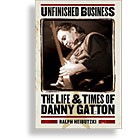
  • Ralph Heibutzki – Unfinished Business: The Life and Times of Danny G

    Ralph Heibutzki

    If it’s true that an artist suffers for his music, then some guitar players suffer more than others.

    We can never know exactly what demons torment some of our favorite players, or why some choose to leave before their time, but Danny Gatton was a truly talented guitar player who never understood the level of his skill or the breadth of his talent. Here, author Ralph Heibutzki traces Gatton’s life and places his work in context of the times, drawing from interviews with friends, family members, and musical peers.

    This is an excellent book, even as it tells a tragic story. Fortunately, Gatton left a number of recordings that capture his personal talent, and also some amazing video footage which documents his unquestioned skill on guitar. Who could forget his “Austin City Limits” appearance, where he blazes up and down the neck of his Fender Telecaster, then casually opens a beer and uses it for a slide, disregarding the foam and mess. What to do? Why, clean it up, naturally. Gatton grabs a towel to “clean” the fretboard and proceeds to make everyone’s jaw drop as he cleanly frets notes on top of the towel (he can’t even see the fingerboard) then uses it as a sort of glove to finish out the tune. Simply amazing!

    This book is fully indexed and includes a bibliography, discography, lists of awards, and more.


    Backbeat Books 2003, Softbound 290 pages, ISBN 0-87930-748-X, $17.95

    This article originally appeared in VG‘s March ’04 issue. All copyrights are by the author and Vintage Guitar magazine. Unauthorized replication or use is strictly prohibited.

  • Sam Bush and David Grisman – King of My World

    If you see Sam Bush perform live, the first thing you’ll notice is what a wonderful time he has on stage. Few performers enjoy playing music as much as Sam, and it shows. On his latest CD, King of My World, Sam brings his particular joie de vivre to the studio.

    Joined by Jon Randall Stewart and Brad Davis on guitar, Chris Brown and Larry Atamanuik on drums, Byron House on bass, Reese Wynans on piano, and Andrea Zonn on fiddle, Sam handles all mandolin parts in addition to the occasional fiddle, slide guitar, guitar, and vocals. The material displays Bush’s usual eclectic bent, including songs by Keb Mo, Grandpa Jones, a pair by Jeff Black, Johnny Clegg, and Ed Snodderly, as well as five written or co-written by Sam himself. His rousing rendition of the Grandpa Jones standard “Eight More Miles to Louisville” contrast nicely with Jeff Black’s pensive “King of the World.” Both display Bush’s trademark instrumental virtuosity coupled with heartfelt vocals and articulate arrangements. Jam bands take note; a song doesn’t have to be long to be musically powerful and effective.

    Sonic virtuosity on King of the World equals the musicianship. Dave Sinko recording and mixing captures every nuance of Sam’s performances. I admire Sinko’s ability to mix purely acoustic instruments with drums and amplified instruments in a way that keeps the acoustic feel while allowing the louder instruments to maintain their dynamic power.

    King of the World proves that Sam Bush has every right to the title of “Mandolin Prince” whether he wears a bowling shirt or an ermine robe.


    This article originally appeared in VG‘s July ’04 issue. All copyrights are by the author and Vintage Guitar magazine. Unauthorized replication or use is strictly prohibited.
  • November 2006

    FEATURES

    TOM PETTY & MIKE CAMPBELL
    Guitars at Heart for 30 Years
    Through 30 years and 50 million records, their guitar-inspired music has never pandered to fans, managers, or record labels. And their guitar collection includes some of the most-heard instruments in rock. By Ward Meeker

    JEREMY SPENCER
    Return of Fleetwood Mac’s Original Slide Master
    The former member of Fleetwood Mac and interpreter of the late, great Elmore James just released his first album in 27 years, marking a return to the blues and rock he played 35 years ago. By Dan Forte

    MARTIN 000-30
    When a guitarmaker introduces a new feature at the same time an existing feature is being discontinued, the result can be a rare configuration of specifications. This Martin 000-30 from 1919 is one good example. By George Gruhn and Walter Carter

    GUILD THUNDERBIRD S-200
    Introduced just after Gibson’s radical Flying V and Explorer designs were deemed failures, and several years before babyboomers started getting high (and thus would’ve found it “cool”), the Guild Thunderbird nonetheless is a bona fide American guitar classic!By Michael Wright

    ICON CORNER
    Mosrite Joe Maphis model
    Mosrite was a pioneer in its band/brand association with the Ventures and rapid-fire picker Joe Maphis, whose signature model was distinguished by a semi-hollow body and walnut back and sides. By Willie G. Moseley

    THE DIFFERENT STRUMMER
    Engineering Art: German Guitars, Part Two
    Many of the first guitarmakers in the U.S. emigrated from Germany, including C.F. Martin. Here’s a look at the key builders who stayed in Germany, and exported guitars around the world. By Michael Wright

    DEPARTMENTS

    Vintage Guitar Price Guide

    Builder Profile
    Phantom Guitar Works

    Upcoming Events

    Vintage Guitar Classified Ads

    Dealer Directory

    The Great VG 20th Anniversary Giveaway
    Register to win your share of $35,000 in prizes!

    Readers Gallery

    FIRST FRET

    News and Notes
    Carvin marks 60 years, Seattle Parks honor Hendrix, Blind Pig turns 30, Dick Dale catalog reissues, “In Memoriam,” more!

    John Wetton
    Back In Asia
    By Willie G. Moseley

    Casher Update
    Checking In With the L.A. Studio Stalwart
    By Oscar Jordan

    Sugar Hill Set Marks 25 Years
    By Steven Stone

    Ask Zac
    By Zac Childs

    Anne McCue
    Comes Into Her Own
    By Dan Forte

    Walter Jr.
    A Taste of (and from) Louisiana
    By John Heidt

    Phil Brown
    A Different Kind of Jimi
    By John Heidt

    Surf All Day, Race All Night
    Sundazed Reissues ’60s Surf and Hotrod
    By Dan Forte

    COLUMNS

    “401K” Guitars
    Emerging Markets
    By Gil Hembree

    Q&A With George Gruhn

    Acousticville
    A Curmudgeon Goes on Vacation
    By Steven Stone

    Fretprints
    Angus Young
    By Wolf Marshall

    TECH

    Dan’s Guitar Rx
    Gas Attack!
    By Dan Erlewine

    Guitar Shop
    Goin’ Nuts
    By Tony Nobles

    Amps
    Building a Tube Amp
    By Gerald Weber

    Ask Gerald
    By Gerald Weber

    REVIEWS

    The VG Hit List
    Music and Video Reviews: Tom Petty, Los Lobos, Ronnie Earl, Omar & the Howlers, plus Led Zep and Muddy Waters on DVD, more!

    Check This Action
    Blues, Ballads, A Pop Song, Some New Age…By Dan Forte

    Vintage Guitar Gear Reviews
    Collings I-35, Zemaitis GZ-3200DF, Gomez “G” Reverb, Marshall EH-1, RG-1, RF-1

    Gearin’ Up!
    The latest cool new stuff!