Growing up in a small Kansas town, 38-year-old Aaron Moreland took up guitar at 15, and his first garage band played classic-rock throwbacks like “Tush” and “China Grove,” occasionally getting more contemporary with R.E.M. and the Black Crowes. By 2001, when he met singer/harpist Dustin Arbuckle at an open mic, he’d immersed himself in acoustic blues.
Originally an acoustic duo, Moreland & Arbuckle had added amplification but ridded themselves of bassists by the time they signed with Telarc, releasing Flood in 2010.
“I was scared,” Moreland says of going with just guitar/harp/drums, “but after going through a few bass players, Dustin said, ‘I think we should go for it like the Jelly Roll Kings.’ After we did, I realized I could cover the low-end and nobody even notices.”
Their follow-up, Just A Dream, boasted a sound huge and raw enough to make Morphine (to whom they’re often compared) sound like Josh Groban. “We’d just grip it and rip it,” Moreland explains. “I learned a lot listening to [guitarist] Brewer Phillips with Hound Dog Taylor.”
The latest offering, 7 Cities, used an outside producer, Matt Bayles (Mastodon, Minus The Bear, Isis), for the first time. The pair’s eight originals and even a cover of Tears For Fears’ “Everybody Wants To Rule The World” retain A&B’s blues roots, in feel if not necessarily structure – what many roots acts attempt but seldom achieve.
What music first attracted you?
The first stuff I remember really grabbing me was Kiss 8-tracks, when I was about five. In such an isolated town, the radio was my influence. I was never exposed to MTV, which is unheard of for a musician my age. I’m kind of proud of it, actually. So I grew up on classic rock, and then I discovered some blues. My step-dad was a big B.B. King fan.
The first time I heard “Smells Like Teen Spirit” by Nirvana was at a high school dance, and I knew nothing about them or the grunge movement. It starts with such a clean sound, I thought it was some Kinks song. Then the drums come in, and Curt Kobain kicks the distortion up. Totally blew my mind. It completely changed my grip on reality and what music I wanted to play.
Besides just learning a repertoire of hits, were there any guitarists who specifically influenced you then?
Jimmy Page, for sure. There’s probably no band that was more influential to me than Zeppelin, and Page just covered so many bases; he could do anything. Whether it was acoustic or slide or straight-ahead lead, writing great riffs, playing real pretty, I could go to that well and get some inspiration.
A college friend had a bunch of Library Of Congress recordings, and then I heard the ’60s, rediscovery stuff of Son House, like that kick-ass version of “Death Letter.” It just stopped me in my tracks. I probably played that thing 40 times in a row. And my life literally has never been the same since. It took me years to figure out how to play that. So when Dustin and I started playing together, it was just pre-war blues stuff. I hadn’t played an electric guitar in about seven years.
Explain your cigar-box guitar.
The way the guy built the cigar-box guitar, the bass string is completely independent and goes to a bass amp. It’s ingenious. We were at the King Biscuit Festival in Helena, Arkansas, and a guy asked me to sign a cigar-box guitar he had. It was super-cool, and I asked him if he’d build me one. He’s a Fed Ex airplane mechanic who’s built a handful of these. Prior to getting that, I’d been playing guitar with just my fingers, no picks, so there was almost no learning curve to playing the cigar-box thing.
What’s your basic setup for touring America.
I like the Gibson model called The Paul, made out of walnut. They sound fantastic, and they’re much lighter than a Les Paul. I’ve had mine since I was 16, and recently I bought another one.
I have a bunch of guitar amps, but my main one is a custom-made 25-watt Blue Pepper, [made in] Wichita, with a couple of 6L6s. I run it through a single-12 Fender cabinet with an Alnico Gold. We tour in a Suburban, so space is an issue. I don’t use any distortion pedals; that’s 100 percent from the amp.
On the new CD, we wanted to push our boundaries and push the producer’s, but still capture the energy of the band live. I think that’s missing in too many records.
This article originally appeared in VG November 2013 issue. All copyrights are by the author and Vintage Guitar magazine. Unauthorized replication or use is strictly prohibited.
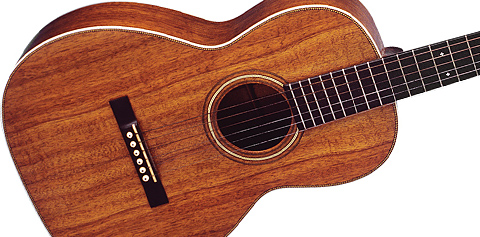
1927 Martin 0-28K Photo credit: Robert Parks, courtesy George Gruhn.The exotic figuration of Hawaiian koa wood on this Martin 0-28K from 1923 has a visual appeal that matched the exotic sound of Hawaiian music in the 1920s, and koa guitars accounted for a significant part of Martin’s sales through that period.
Koa guitars played a larger role in Martin history, introducing steel strings to the line and changing the company’s market from classical guitars and mandolins to modern steel-stringed guitars.
Most guitar histories cite the Panama Pacific Exposition in San Francisco in 1915 as the beginning of a Hawaiian music craze that swept the nation, but American audiences and American guitar makers had been aware of Hawaiian instruments and musicians for 20 years before the movement took off. Recordings of Hawaiian musicians were made as early as 1899, and Hawaiian performers appeared at a number of fairs and expositions prior to the Pan-Pacific, including Chicago (1895), Buffalo (1901), Portland (1905) and Seattle (1909).
Awareness of koa guitars with steel strings goes back even farther. American instrument makers had steel-string instruments thrust upon them with the mandolin craze that began in 1880, but they resisted the idea of steel-string guitars. The prevailing belief, as expressed in the 1894 Sears Roebuck catalog, was that a spruce top simply could not withstand the extra tension of steel strings. That same catalog noted how the Hawaiians had found a solution; their koa-topped instruments were in fact strong enough to handle steel strings.
Not all makers subscribed to the belief that steel and spruce couldn’t work together. Separate from the influence of Hawaiian music, in Chicago, the Larson Brothers were making Maurer-brand steel-string flat-tops with spruce tops by the turn of the century. They solved the problem of extra tension with stronger bracing rather than stronger wood. Not far away, in Kalamazoo, Michigan, Orville Gibson made guitars with a self-supporting arched top and strung them with steel.
Through 1915, in an era dominated by the mandolin, Martin was well on its way to becoming a mandolin company. From 1898 to 1915, mandolin production slightly surpassed guitars (4,408 mandolins compared with 4,209 guitars). In 1915, the company made 302 mandolins and only 162 guitars.
Thanks to performances by Hawaiian musicians at the Pan-Pacific Exhibition, the market for guitars surged in 1915, but the new style of Hawaiian playing, with a steel bar, simply would not work with gut strings; a Hawaiian guitarist had to have a steel-stringed guitar.
At that point, it was clear to Frank Henry Martin, grandson of the founder and great-grandfather of the current CEO, that the classical-guitar market could no longer support Martin, and the company gave Hawaiian music its undivided attention. Within a year of the Pan-Pacific Exhibition, Martin had ukuleles on the market. Also in 1916, Martin began producing steel-string guitars under contract with the Ditson company and all-koa Hawaiian models for Southern California Music. It would be 15 years before Martin incorporated one of the special Ditson models – the dreadnought – into the regular Martin line, but the koa guitars were a different matter. It took only one year from the first SCM koas for Martin to offer a koa model under the Martin brand.
To make the biggest splash with its entry into the Hawaiian guitar market, Martin chose its most popular size, the 131/2″-wide Size 0, and trimmed it with Style 28 ornamentation including the distinctive herringbone border around the top.
After making six 0-28Ks in 1917, Martin temporarily abandoned the model and introduced the plainer, less expensive (and thus more likely to sell) 0-18K. A 00-size in Style 18 was added a year later, and a 000-28K a year after that. In 1921, the 0-28K rejoined the line.
This 1927 example has a standard nut and standard frets. Like virtually all Martins before 1929, the saddle is aligned perpendicular to the strings, so this model could easily be converted to Hawaiian-style by simply replacing the standard nut with a high nut to raise the strings off the fingerboard. By 1925, Martin was listing a Hawaiian version, with a flat fingerboard, flush frets, and a high nut as an option. When Martin replaced the pyramid-end bridge in ’29, the standard models had the bridge slightly angled.
Martin’s koa models jump-started overall interest in Martin guitars, as the company’s production immediately tripled from 181 in 1916 to 598 in 1917. In 1919, production topped 1,000. The first non-Hawaiian Martin steel-string, the all-mahogany 2-17, debuted in ’22, and Martin’s annual guitar production topped 2,000 that year. The koas remained strong through the ’20s; from 1927 to ’29, the 0-28K outsold the regular 0-28.
Steel strings began working their way across the Martin line, starting with the mahogany-body Styles 17 and 18. By the end of the ’20s, the standard bracing on a Martin was strong enough for steel strings. With the larger dreadnought body waiting in the wings, Martin was ready to take advantage of the guitar’s rise to prominence in the 1930s. However, the koa models that had brought the company to that point were not faring so well. Resonator guitars, introduced by the National company in 1927, were significantly louder than koa instruments, and they quickly dominated the Hawaiian market. With the advent of electric guitars in 1932, most Hawaiian guitarists went electric, making acoustic Hawaiian guitars obsolete.
With no demand from Hawaiian players and with larger-bodied instruments beginning to dominate the guitar market, Martin stopped production of the 0-28K after 1931; total production of the model was 641 (including one straggler in ’35). The 0-18K lasted through ’35, with total production of 3,132.
The pleasing tone of koa wood has given the 0-18K and 0-28K an appeal beyond Hawaiian music, and some owners have converted Hawaiian models to standard setup. Installing a nut, radiusing the fingerboard, re-setting the neck, and rerouting the saddle slot typically does not increase the value beyond the cost of the repair work, but it does make the guitar more versatile. As a display piece, a nicely figured 0-28K continues to be one of the most beautiful of Martin’s standard guitar models.
Special thanks to Richard Johnston.
This article originally appeared in VG July 2010 issue. All copyrights are by the author and Vintage Guitar magazine. Unauthorized replication or use is strictly prohibited.
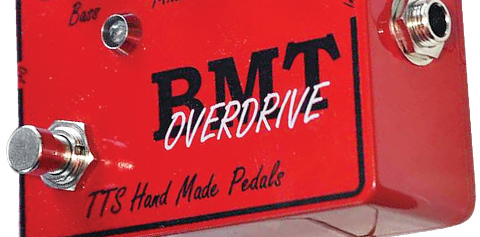
No, the “BMT” in the name of TTS Music’s overdrive pedal does not stand for a “bacon, mayo, and tomato.” The initials simply indicate Bass, Middle, and Treble, which are all this pedal needs to be interesting. No groovy, ironic hipster name – just a nice dark-red finish and plenty of internal stuff to grab the attention of pedalheads.
For starters, the BMT sports the JRC4558D op-amp, the circuit of Ibanez Tube Screamer legend (notably the TS808 and TS9 pedals that Stevie Ray Vaughan made famous). The folks at TTS Music also put a combination of silicone and germanium diodes in there to create unique tonal flavors. On top, there’s a Drive knob, plus Volume, Bass, Middle, and Treble controls, as well as a rugged on/off footswitch. Quarter-inch in/out jacks and a DC jack, are on the sides, and underneath there are rubber feet and adhesive Velcro for mounting to a pedalboard.
Running through a few tube and solidstate amps, the BMT Overdrive proved a treat. Keep in mind that this pedal, like all good overdrives (and as opposed to distortion pedals), reacts uniquely with each particular guitar, amp, and speaker array. One overdrive can sound completely different from one amp to the next. In testing with an array of amps, the BMT’s Drive knob provided a range of the crunchy stuff that could be completely tweaked with the pedal’s triple-stack tone knobs.
With guitar in hand (a ’62 Gibson SG Junior and a newer Strat), the EQ on each frequency was very dynamic, providing gobs of room to play with the knobs. Treble response went from softly muted to a screaming razor tone; leaving it around 10 or 11 o’clock while boosting the Bass and Middle knobs will help the player find the sweet spot. The Middle knob was especially tuneful, conjuring all sorts of tones depending on where it was set (it’s really cool dimed out all the way with the Treble knob turned down). A very cool effect, but once again, the BMT Overdrive will interact uniquely with the amplifier.
Best of all, the BMT Overdrive really provides some powerful gain. Sure, there’s a place for soft overdrive pedals, but when you find a good pedal that packs a dirty punch, it can make the hairs on your arm stand up. The BMT Overdrive is an excellent pedal that will suit players who like to fine-tune their crunchy blues and hard-rockin’ tones to perfection.
This article originally appeared in VG June 2014 issue. All copyrights are by the author and Vintage Guitar magazine. Unauthorized replication or use is strictly prohibited.
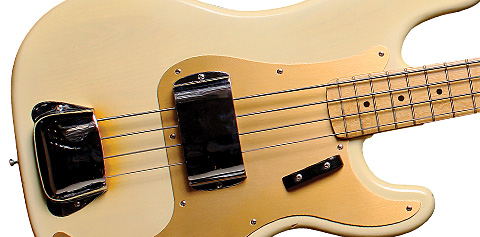
(LEFT) 1960 Precision Bass. Photo courtesy of Mike Gutierrez. (RIGHT) 1959 Precision Bass. Photo courtesy of Norm Harris.
The Fender Precision Bass was the first commercially successful solidbody electric bass. Played somewhat like a guitar and sporting a fretted neck, the “P-Bass” won over players in almost every genre who previously had to contend with the cumbersome upright bass.
In its original configuration, the instrument, introduced in 1952, had a maple neck with a Telecaster-like headstock, 34″ scale, non-beveled ash body in a blond/butterscotch finish with a black Bakelite pickguard that covered most of the upper body (including both cutaway horns), a strings-through-the-body bridge, and a single-coil pickup. The Volume and Tone controls were mounted on a small chrome plate (also like the Telecaster) and the jack was on the side of the body.
In ’54, Fender beveled the body of the P-Bass, following in the footsteps of the then-new Stratocaster guitar. The contours – forearm bevel on the front of the body, “belly cut” in the back – accompanied a new yellow-to-dark-brown sunburst finish, and a white pickguard. The bass could still be ordered in blond (a lighter tint than the original from ’52), and Dupont colors became an option two years later.
In mid 1957, Fender gave the Precision a dramatic makeover, turning it into what became the final configuration of the standard model. It debuted with a headstock shape that was more Strat-like, and a smaller pickguard made of gold-anodized aluminum and extended to house the controls knobs along with its new top-mounted input jack. Strings were now routed through the bridge/tailpiece instead of through the body, and the chrome pickup and bridge covers had been restyled. Finally, the pickup became the famed split unit with two polepieces for each string, wired to eliminate hum.
The front cover of Fender’s 1957 catalog displayed the rework with a line drawing rather than a photo, and the instrument shown inside was the transition/1954-’57 variant!
The late ’50s beget other changes to the standard P-Bass; a year after the restyled model debuted, the two-tone sunburst finish became a three-tone with a reddish tint between the yellow and brown. In ’59 it (along with most instruments in the Fender line) was given a thick rosewood (“slab”) fingerboard with pearl-dot fret markers, and the anodized-aluminum pickguard was replaced by one made of plastic tortoiseshell. The 1960 Precision shown here not only exhibits these updates, but was once owned by Bill Black (1926-1965), a Memphis musician who backed Elvis Presley along with guitarist Scotty Moore early in the King’s career. Black’s exuberant, percussive slap style on upright was critical to the advent of rockabilly, but once drummer D.J. Fontana became a member of Presley’s band, Black also began to play a Precision.
Black and Moore left Presley in September of 1957, and the bassist assembled Bill Black’s Combo, in which he used newer-style Precision basses. That band garnered an instrumental hit with “Smokie, Part 2,” had eight tunes in the Top 40 between 1959 and ’62, and served as an opening act on the Beatles’ first tour of the U.S. Black did not participate, however, as he was battling a brain tumor; he died during surgery to remove it.
In the decades since its introduction, the Precision has been through many variants – two-pickup models, active circuitry, signature models, etc. But, improvements in hardware, electronics, and manufacturing techniques aside, today it still looks and sounds much like it did in 1957, and remains a definitive example of an “if it ain’t broke, don’t fix it” instrument.
This article originally appeared in VG December 2011 issue. All copyrights are by the author and Vintage Guitar magazine. Unauthorized replication or use is strictly prohibited.
Grover Jackson is a name forever associated with classic metal and custom “superstrats,” thanks to Randy Rhoads and iconic bands like Iron Maiden, Megadeth, Def Leppard, and Anthrax. Grover has moved on from the original Jackson brand (now owned by Fender), and is producing his own solidbodies under the GJ2 moniker, all from a small shop located in Orange County, California. These axes sport meticulous builds and premium materials, and the first to roll our way is the Arete. So let’s crank up the gain and see what the noise is all about.
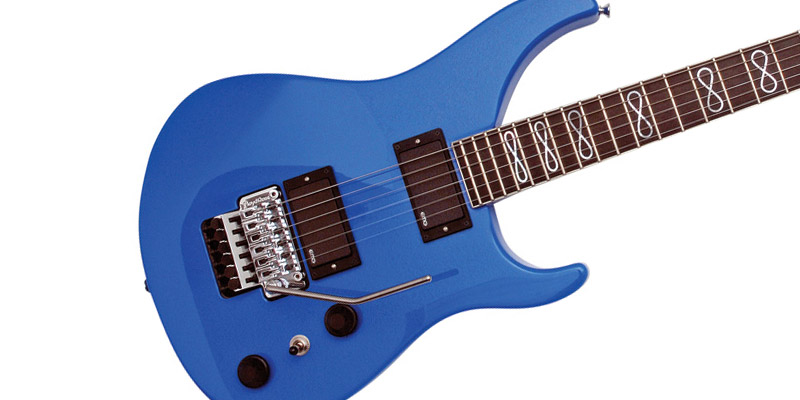
The Arete speaks to a specific lineage in guitar design, starting over 30 years ago when luthiers and hot-rodders in southern California started modding Stratocasters with humbuckers, flatter fingerboards, and the then-revolutionary Floyd Rose locking tremolo system. These may seem like common, everyday guitar features today, but back then, this was cutting-edge innovation. Now fast-forward to today’s GJ2 Arete 5-Star. The test model we looked at came with a basswood neck and body, rosewood fingerboard, 251/2″ neck scale, two Habanero humbuckers, master Volume and Tone, and the company’s Infinity fret markers. For hardware, there’s the all-important Floyd and locking nut, Gotoh tuners, three-way toggle, and aluminum pickup surrounds. Other decorative nuances include an unusual (but interesting) border on the headstock and cool, modern knobs right out of the sci-fi age. On the back, look for two covers over the electronics cavity and tremolo system. FYI, the company is also coming out with a hardtail version and offers various tonewood options for the body, such as korina, walnut and rosewood. There are even non-locking tremolo versions, for guitarists who don’t like the bother or perceived tone-sucking properties of locking nuts.
A few other notes: GJ2 makes their own pickups. These Habaneros are mid-output, meaning they let more of the body tone through, but they also offer high-output ones for those who want that ’80s metal scream. Also look for three-piece neck-through contruction, which offers a lot of rigidity and sustain, since this center section runs the length of the instrument. Picking up the Arete, one immediately notices its beefy neck profile, especially above the 12th fret, where the fingerboard gets expansive. This would be an issue on a blues-bending axe, but for a metal machine, it’s perfect for fretboard acrobatics, from tapping to shredding to sweeping. More than that, it’s a highly comfortable neck, despite the size. We became acclimated to it after just a few minutes of playing time, but if you’re looking for a skinny PRS or Fender-style neck, this isn’t it.
Plugged in, the Arete is clearly a high-performance guitar, allowing for the kind of daredevil stunt playing that put the shred generation on the map. One might expect an ’80s-style guitar to have a 24-fret neck, but actually many of them back in the day were 22-fretters and that works for this guitar, too. Moreover, with the big double cutaway, smooth heel, and wide, flat fingerboard you can unleash fast, legato runs all the way up the neck without any hindrance. Also note that the body is very comfortable to hold; even with its Jackson-styled squared edges, there’s a big contour cut in the back that makes the guitar easy on your midriff.
Tonally, the Arete 5-Star sounds stellar. Even going through a 1×12 digital-modeling amp, the guitar just roared to life with big, chunky riffs and screaming solos. From your best George Lynch or Yngwie shreddage, the guitar was right on the mark with a bright tone full of fire. We particularly liked the middle setting with both pickups on, which was balanced and had a little dash of out-of-phase quack. Even with heavy gain ladled on, the tone was crisp and clear, even for chords. You could imagine leaving it on this setting for the bulk of a live set and getting the best of both worlds: crunchy chords and liquid, supple leads. The Floyd, of course, performed like a charm, adding to the stunt-guitar magic.
A big surprise was how great the Arete sounded clean, especially when apply classic ’80s effects like chorus, reverb, and echo. With those settings applied, the guitar delivered massive, shimmering chords and sparkling arpeggios. Kudos to Grover Jackson for these excellent Habanero pickups – they’re perfectly balanced for all kinds of rock, clean to dirty, and all colors in between. Add to that a custom leather guitar strap, a signed certificate of authenticity from Grover himself, and a knock-out hardshell case (the Tolex on our review model’s case matched the guitar’s sky-blue finish), and you have a pretty luxorious metal machine. Granted, the Arete 5-Star is priced as a high-end guitar, but for the classic metal-era rocker who wants nothing but the best, GJ2 is a cut far above its mass-produced counterparts.
This article originally appeared in VG September 2012 issue. All copyrights are by the author and Vintage Guitar magazine. Unauthorized replication or use is strictly prohibited.
Trends come and trends go, but tradition stands the test of time. And while Carvin’s designs stand quite well on their own, thank you, face it: There are those other more “familiar-shaped objects” out there that players naturally gravitate toward. Carvin’s PB basses are intended to accommodate these folks.
While Carvin PB basses are an obvious nod to the classic Precision Basses that have been around since the 1950s, these are not your grandfathers’ P Basses. Carvin has expertly crafted a traditionally inspired instrument while making it their own with plenty of modern functionality. Like all Carvin instruments, PB basses are customizable to accommodate the player’s wishes. Custom tops, finishes, and wood choices are all part of Carvin’s standard operating procedure (the PB basses come in both four- and five-string models).
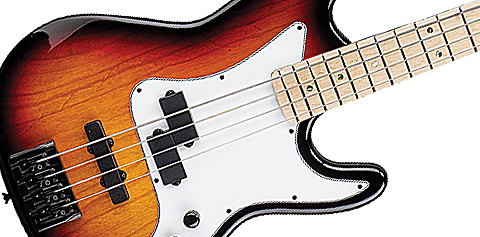
The four-string PB4 offers a blend of vintage and modern specifications. In standard form, it’s constructed with an alder body of decent weight and is available in a choice of eight solid-color finishes (along with dozens of optional color upgrades). The tung-oiled maple neck has a very comfortable 14″ radius fingerboard. Rosewood and dot inlays are standard, but, again, Carvin offers an array of options, including maple fingerboard and block markers. The PB4 has a nice, blended neck profile to accommodate fans of vintage-style P necks, but is still fast enough for fans of Jazz Bass necks. The PB4 also keeps with tradition with its 20-fret neck and Carvin SB-style headstock. A sculpted heel adds to the overall comfort of the PB4, which balances extremely well.
The PB4’s electronics also present a world of options. PB models come standard with a traditional layout of single Volume and single Tone controls with an SCP split-coil Alnico pickup that gives the PB series a tone most will find familiar. The tester had an additional J-style Alnico pickup, as well as Carvin’s active preamp designed for the series. The layout for this configuration is very well thought out, with a separate Volume control for each pickup and a master Tone control that traditionalists will love. From there, additional active Bass and Treble controls are added to tailor the overall sound. Finally, a push/pull on the front Volume knob adds a defeat function for the active EQ, allowing the player to quickly change between vintage and modern sounds. There’s even an internal trim pot to help tweak the output levels of these two settings.
For testing purposes, the PB4 was used heavily both live and in the studio. It was immediately apparent that Carvin had done their homework. Starting with a passive setting (active EQ defeated) in the neck position, the PB4 had that throaty midrange that players have used for decades. The classic characteristics that need to be there for a bass of this styling were all present and accounted for, but there was also a pleasant surprise in that Carvin opened up the fidelity of the pickups – there is an added presence to the Alnico split-coil that players should enjoy. The same characteristic was found in Carvin’s J-style bridge pickup, though the neck pickup was more closely scrutinized, being Carvin’s newer item.
Experimenting with all of the PB4’s settings yielded very usable and musical options for virtually any style. The midrange that again needed to be there for a bass of this style was there. But the active EQ really brought the PB4 to life. Though this bass offers plenty of traditional touches, Carvin added some sizzle with their EQ voicing to make the PB4 a modern workhorse. Slap tones were through the roof, and there was a very pleasing piano-like quality that retained enough frequency response to sit nicely in the mix. There was also plenty of headroom to the preamp to be heard regardless of the situation.
The Carvin PB4 is a spectacular instrument capable of being any gigging bassist’s main workhorse. It can cover virtually any musical style with ease and still leave room to expand. The tone is traditional and then some, and the craftsmanship is on par with Carvin’s historical best.
This article originally appeared in VG June 2014 issue. All copyrights are by the author and Vintage Guitar magazine. Unauthorized replication or use is strictly prohibited.
One question frequently asked by guitar players is how to set up effects and arrange them in a proper signal path. While there isn’t any “one and only” correct setup for effects, there are certain configurations that can produce better results in achieving specific types of sounds. Some work better than others, but anything is legal. Essentially, your own ideal setup depends on what you are trying to accomplish with the effects, and what sounds best to your own ears.
Many modern amplifiers include send and return jacks for an effects loop, but back in the old days there was no choice and if you used effects, everything went directly to the front end of the amp. There are certain effects that sound and function best when plugged into the front of the amp, particularly preamps and overdrives, and analog effects like flangers, phasers, and delays. Most vintage and vintage-style stompboxes were designed to be used in front of the amp. On the other hand, more modern digital effects often operate more quietly when placed in the amp’s effects loop.
If you use a lot of boxes or rackmount multi-effects processors, use them where they will function best. You can (and should) split up your boxes, directing them to the appropriate input.
Order Of Things
Let’s look at the full range of effects and discuss where they are usually positioned in a signal chain. Think about it logically: How does each effect change the sound, and how do you want them to function when used together? The idea is to use things that boost the signal in the front of the chain, then add the things that color the sound toward the end of the chain. Equalizers and volume pedals can be placed in front or back, depending on what you need them to do. Again, your ear will make the final call.
Typically, the first stop after your guitar is a preamp, which is used to boost a low-level signal, if you need one. Many players also place equalizers and volume pedals in the front of the line. Wah pedals and envelope filters should go next, then your compressor/limiters – devices that condense the dynamic range of the original signal to produce a more consistent range. Always place compressors in front of distortion and overdrive boxes for more sustain, which is what you would place next in the signal chain.
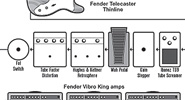
If you have two or more boxes for gain, place them from cleanest to dirtiest. Some like to mix different types of gain devices for different effects when playing rhythm and lead. Next in line, I’d suggest placing modulation effects (chorus, phaser, flanger, respectively). Then place your time effects, like analog and digital delay, and reverb at the end. Last in line is where you should use a noise gate or noise suppressor, if necessary. Noise gates can also be placed in front of reverb to decrease the noise of other effects. Many players also like to use an equalizer as a final tweak at the very end of the chain and/or a volume pedal as a master control before the amp. (Shown here are a few ways other players configure their pedalboards.
Cables, Cables, Cables…
I’ve said it before in this column, but I can’t say enough about the importance of using good cables. Think of your cable as the lifeline between your guitar and amp and how each break along the line will affect the sound coming out of your amp. If you are using any gear between your guitar and amp, you should be using good-quality cable in order to get the clearest, most powerful signal. Try to use the shortest lengths of cable possible between your effects (boxes and rackmount units) to avoid unwanted noise and signal loss. Every break in the signal path between the guitar and amp will create some degree of signal loss from the original signal. Using high-quality cables really does help maintain as much of the original, true signal as possible from your guitar.
Use this information as a guideline, and experiment with your tonal toys. Try variations and listen to the subtle differences between each organization to find out which works best.
This article originally appeared in VG July 2000 issue. All copyrights are by the author and Vintage Guitar magazine. Unauthorized replication or use is strictly prohibited.
When news of the passing of Les Paul spread through the guitar community August 13, 2009, reaction was swift and heartfelt. Claimed by complications of severe pneumonia at a hospital in White Plain, New York, Paul was 94. His name is synonymous with Gibson’s early solidbody electric guitars, and for a time he was one of America’s most popular and accomplished electric guitarists.
Born Lester William Polsfuss on June 9, 1915, in Waukesha, Wisconsin, as a very young boy he would listen to his divorcée mother play the piano while he sat in the kitchen conducting an imaginary orchestra made up of pots and pans. The first instrument he played was a harmonica given to him by a worker repairing the street in front of their house; on lunch break, the man would play, and the sound caught the boy’s ear. Seeing the kid stare at him every time he made it sing, the worker eventually handed over the instrument.
At age 11, Lester was given his first guitar – a Troubador flat-top from Sears and Roebuck. At first, he couldn’t reach his fingers across all the strings, so he removed the low E then spent most of his spare time learning chords from a book. At the time, the guitar was far from being predominant in popular music, bowing to the tenor banjo, plectrum banjo, ukulele, piano, mandolin, and violin, but he happily whiled away countless hours practicing and keeping an ear tuned to famous guitarists of the day. Within a year, he was playing guitar and accompanying himself on harmonica, and he took to playing anywhere in Waukesha that would have him; his first paying gig happened when he was 13, with a group that billed itself as “Red Hot Red.” At 16, he played his first radio show, on WRJN in Racine, Wisconsin, and at 17 was playing in Sunny Joe Wolverton’s Radio Band in St. Louis.
(LEFT TO RIGHT) One of Les’ Gibson L-5s, his early Les Paul goldtop, and the famed “Log” as it appeared in 1981. Guitar photos: Neil Zlozower.In the following years he would expand his musical undertakings and begin to experiment with ways to amplify his guitar. His first foray into experimenting with the construction of a guitar happened in 1934. While working at a radio station in Chicago, he learned that the Larson Brothers’ operation was also located in the city.
Les Paul at his first gig after coming out of retirement in the mid ’70s, playing what he called a prototype Les Paul fitted with a microphone and the famous “Les Paulverizer.” Photos: Jon Sievert.“I went to see them, and [we talked about making] a guitar with no f-holes,” Paul told VG in a 2002 interview. “I tried to explain that I was going to put pickups on it.”
But the Larson Brothers weren’t interested.
In the late ’30s, Paul moved to New York City and began to experiment further with building a solidbody guitar. He played guitar on nationwide radio with Fred Waring’s Pennsylvanians, one of the most popular dance orchestras of the day. After being severely shocked while experimenting in his Queens apartment in 1940, Paul was forced to quit the Pennsylvanians and, while undergoing rehab, earned a living producing music for radio.
In ’41, he approached nearby Epiphone, asking to use their shop to construct a “concept” electric guitar he described as “…just a 4″ x 4″ piece of wood with a pickup and an Epiphone neck.” Dubbed “the log,” Paul built it over three Sundays (so as not to disrupt the workforce), and recalled its debut in front of an audience.
“I took it to a tavern in Queens, and people looked at me like I was nuts. The sound and everything was there, but I found out that people hear with their eyes, so what you’re playing has got to look like a guitar. So I thought, ‘I’m going to put wings on it, and make it look like a guitar, and see if that makes any difference.’ Geez, they went crazy!”
Paul subsequently built three similar guitars using Epiphone parts. The first of them, called “the clunker,” was an experiment in progress. “I started thinking, ‘I’m going to do more than pickups here,” he said. “I’m going to change this and that,’ and the guitar became an experiment. Next thing you know, it’s the best damn guitar I’ve got.” Other changed elements included re-bracing its body with a 3/8″ steel bar and pickups he wound himself. The end result was a very playable, good-sounding instrument.
Shortly after, he moved to Hollywood and was drafted into the Army during World War II. Permitted to stay in California, he played for the Armed Forces Radio Service and by ’43 assembled a trio that performed live, on the radio, and on V-Discs. In ’44 he began filling in for Oscar Moore alongside Nat King Cole, Illinois Jacquet, and other stars at the first Jazz at the Philharmonic concerts. Then, in the Les Paul Trio, he translated the dizzying runs and unusual harmonies found on Jazz at the Philharmonic into a slower, subtler, more commercial approach that included novelty instrumentals wherein he developed a trademark sound. The Trio’s popularity grew and the act became regulars on Bing Crosby’s hit radio show.
“I had the clunker and [was] making records with Bing, and Gibson was going nuts,” Paul recalled. “They said, ‘We’ll give you a gold-plated L-5… whatever you want.’ I told them, ‘If you can beat this one, okay.’
“The surgery I did on the clunker was severe. And it just so happens I recorded ‘How High The Moon,’ ‘Bye Bye Blues,’ and everything from that period with it.”
Paul recalls approaching Gibson’s Guy Hart with the idea to build a solidbody electric, and for 10 years trying to convince the company to develop it. In the early ’50s, Gibson elected to design its first solidbody, and Paul was asked to give input – and his name – to it. The late Ted McCarty, president of Gibson at the time, drove to deliver the first model to Paul and Ford, who were honeymooning in the Pennsylvania mountains. “Les played it, and his eyes lighted up,” McCarty recalled. Shortly thereafter, Paul signed on as the namesake of Gibson’s first electric solidbody, with design privileges.
“Everything about the looks of the first Gibson solidbody was discussed with Maurice Berlin and myself,” Paul said. “And when we were finished he said, ‘What color are we going to make it?’ Without really thinking, because it never entered my mind that anybody would ask, I said, ‘Gold,’ and there were two other people in the room, another manager and Mr. Berlin’s right-hand man, Mark Carlucci. One guy said, ‘It’s a terrible color to work with.’ But M.H [Berlin] said, ‘Gold it is.’
Les with some of his recording gear. In the foreground is the first sound-on-sound Ampex recorder. The guitar is Les’ second Epiphone “clunker,” modified with a steel bar to mount pickups. It also has a hand-made vibrato. The amp is a Gibson EH-150.“Then they said, ‘What about the other guitar?’ I said, ‘Black.’ They asked why, and I said, ‘I like to see the player’s hands move…’
“Mr. Berlin and I talked about maple and mahogany bodies, and the Gibson people got them backward; the black guitar, which was the most expensive, was all mahogany, and the cheap guitar, with the maple top, cost the most to make.
“When I got my hands on the prototype, I found quite a few errors. I said, ‘Why don’t you… just make them all with a maple top and mahogany on the sides?’”
By 1946, Paul was doing nine “sustainer” radio shows each week for NBC radio in Los Angeles, playing jazz and pop. One day, Harry Brubeck, the station’s program director, asked if he knew anyone who did a different style of music and could handle the workload. Remembering his days with his first groups, Paul offered to do the shows. Needing a “cowgirl singer,” he asked Gene Autry (who was working for CBS radio at the time) whether he knew anyone. Autry suggested Paul give a listen to one of the ladies in Autry’s Sunshine Girls trio. That girl was Colleen Summers, and when Paul called to gauge her interest, she admitted to being a fan of his music. The two connected and began working on material for the show.
Beyond his reputation as a brilliant jazz/country/pop guitarist, Paul also was experimenting with dubbing live tracks over recorded tracks, and altering playback speed. One result was his 1947 instrumental hit, “Lover (When You’re Near Me),” which featured Paul playing eight guitar parts.
In January of 1948, Paul and Summers, whom Paul had given the stage name Mary Ford, were driving from Wisconsin to California when they encountered a storm as they passed through Oklahoma. Paul, who was ill with a fever, was lying in the front seat while Ford drove. On an overpass between Davenport and Chandler, the car hit a patch of ice and plunged 20 feet into a ravine. Ford and Paul were ejected through the convertible’s cloth top while the car came to rest upside down in the river below. There was virtually no traffic passing by and the couple was discovered hours later, and only because they had knocked down a utility pole, which forced crews to search for a break in the electrical line.
PLAYERS WEIGH IN
Les’ Heavy Influence
“When the sad news came of Les Paul’s passing, we got to thinking. It’s because of Les that we’re able to do what we do. There’s a line, from his innovative spirit to the birth of an art form, an entire industry, a new form of entertainment, a new means of expression, none of which would have been possible if Les had not done what he did.
“It’s kind of like the big bang theory applied, in both a literal and figurative sense, to music. No Les Paul, no electric blues, no rock and roll, no ZZ Top. Les has been a life force in music for as long as any of us can remember.
“The idea that Les is not around anymore will take some getting used to but maybe we don’t have to. We like to look at it this way: even though he’s not here, there’s more Les than ever in the world. You don’t really have to try hard all that hard to ‘pick-up,’ so to speak, on this concept to get it.” – Billy F Gibbons
“Les Paul gave me one of the best days of my life. I was on tour with Marilyn Manson in 2001, doing Ozzfest in New York. I was invited to see Les play at the Iridium. Jim Marshall was going to be there, too, and I said to myself “I can’t pass this up.” So when I got offstage I headed to the club. I looked a little out of the ordinary in the nice jazz club, still wearing the smeared makeup, and felt a little uncomfortable walking in. But I got to meet Les backstage before he went on, and we talked a bit. I then watched this genius of a man play jazz standards and old songs I didn’t know, and loved every second of it. He was bringing people onstage, introducing them. Everyone knew these jazz standards and I was thinking, “Oh no… I hope he doesn’t pull me up onstage,” because every song someone did was amazing, and he still told them to keep practicing! Sure enough, about halfway through the set, Les said into the mic, “We have an unusual looking fellow here tonight and he goes by the name John 5. Let’s get him up here and see what he can do.” I felt like running out because I didn’t know any of the songs. To make it worse, I had a Telecaster with me. The first thing he said to me was “Oh, you got one of those, huh? What do you want to play, young fellow?” All I said in a very quiet voice was, “How about some blues in E?” Everyone was skeptical, wondering how soon I’d be getting offstage. I started to play, and was so nervous, but somehow, the planets aligned and everything turned out. I played better than I ever had before. Les just stopped playing and watched me while I thought, “He’s going to rip me apart.” But when I stopped, the crowd went crazy and Les got on the mic. “Son, I’ve played with a lot of people and I don’t get impressed easily, but you impressed me tonight,” he said. “The world should hear you play guitar like that.” I bowed down and kissed his feet – no joke! My father had died a few days before this happened, and I was having one of the worst days of my life. But that night, Les gave me one of the greatest nights of my life. His passing is such a sad thing, but what a great life he had.” – John 5
Les Paul onstage with Del Casher (center) and Skunk Baxter during his 80th party at the Gene Autry Museum. Photo by Rick Gould.“Nobody in the modern music business would be where they are if it weren’t for Les Paul. He invented the technology that propelled us all. I had the honor of seeing Les four times at the Iridium in New York City. It was always like watching American history unfold in real time. We as a nation don’t produce people like Les anymore. He was an inventor, musical genius, husband, TV personality, rags-to-riches hero, and icon all in one. I am honored to be a small blip on the radar in the scope of Les’ history. I have Les and the Gibson guitar company to thank for that ultimate bestowment. Rest in peace, Les Paul, for you are and always will be the supreme pride of American achievement and more importantly the hero of Waukesha, Wisconsin.” – Joe Bonamassa
“Les Paul was an exceptionally talented man, one of the few individuals who was an amazing musician as well as an amazing technician, and used one to help the other in a unique combination that revolutionized the music industry like no one before him. I was fortunate to know him and humbled to play with him numerous times. I appreciated his company and his friendship. We could all learn a thing or two from his example of a fantastic, full life, endless accomplishments in his 94 years, and the fact he was never once afraid to go for it.” – Slash
“I used to go to Les’ NYC shows all the time. What an inspiration he was – always entertaining! He helped create the best guitar ever made, the Gibson Les Paul model. It was the first guitar I ever bought, and it’s the guitar I still use to this day. He will be missed by many.” – Gilby Clarke
“My first really great guitar was a new ’72 Les Paul Deluxe my dad bought for me at Guitar Center, Hollywood, instead of buying something he was saving for. I owe him everything for that purchase, and I still have that guitar and would never part with it. It plays like a dream. I had the great honor of meeting Les, playing at all three of his tribute shows in the last few years and a photo I will cherish forever is Les giving me a high five in Cleveland a year ago. He gave so much to all of us and to recording and music and most of all, his heart. God bless him.” – Steve Lukather
“In the last 20 years of his life, I got to meet Les Paul at various industry and charity gatherings, and he was just about the sweetest human being I’ve ever come across. Not once did he chide me for smashing guitars.” – Pete Townshend
“Les Paul was an incredibly innovative guitar player. There is no one as important when it comes to guitar playing and multi-track recording! Oh yes, but that’s just the man. Then, there is his other amazing legacy – the Les Paul guitar! It’s truly a sad day to hear we have lost this giant of the music world, with his huge heart and wonderful sense of humor. I really don’t know how he had the time to do all the things he achieved in one lifetime. Still playing shows ’til recently shows us how his passion for the guitar and music kept him the youngest 94-year-old musician ever born. I will miss that beaming smile and those encouraging words he always had for us players. Les, what an honor it is to have known you.” – Peter Frampton
“What a wonderfully historical figure he was. A genius innovator. I feel so fortunate to have performed with him twice. He was charming, funny, and loved the instrument with a deep passion. Most people do not understand the tremendous contribution he made to the electric guitar and contemporary recording techniques. If it was not for Les Paul, we may all be playing acoustic guitars and recording in mono.” – Steve Vai
“Les was a true legend. A unique guitarist and the inventor of unique effects that are such a huge part of the music we all love stand as testament to his importance in the music world. Of course we can never forget the solidbody electric guitar with his name on the headstock! He loved playing music, and respected the great musicians who used the instrument he made iconic. Les, you will be missed, and never forgotten.” – Bruce Kulick
“Les Paul was by far the most influential guitarist in the last 100 years. His contribution, both musically and technically, to the world have driven modern music for decades. He created the tools of the trade for players of all ages and inspired millions with dreams of one day owning a Les Paul guitar. His gifts will reverberate for centuries to come in the hands of the players of the future. May God bless and rest Les Paul.” – Don Felder
“The contributions Les Paul has given to the guitar and the recording industry will live on forever in the hearts of musicians, young and old, forever.” – Dave Amato
“The Wizard of Waukesha – inventor, innovator, inspiration – Les Paul was one of a kind; killer guitar player, originator of many of the tricks we all do. One of the first people to overdub, Les had 12 tracks of guitar on “How High The Moon,” as well as 12 tracks of vocals by Mary Ford. He invented the 8-track recorder, and pioneered multi-track technology. Then you get to the guitar, a true classic, that will remain part of his legacy for years to come. I was in New York recently with Bad Company, and had a Monday off. I walked to the Iridium to make reservations, and I was informed Les wouldn’t be playing that night, as he wasn’t feeling well. He will be missed.” – Howard Leese
“Having known Les Paul since 1972, when we did our first interview, I had the privilege to spend a lot of time with him whenever he was in California. It was an honor and truly great life experience to share so many wonderful times with him. Lester, you influenced countless guitarists with your magnificent playing, and truly changed the sonic soundscape of music by your electronic innovations. May you rest in peace on earth as your spirit joins the greatest musicians in the sky. Play on, Les! – Robb Lawrence, author of The Les Paul Legacy
“My very first electric guitar was a Gibson Les Paul. I played it so much that I wore the frets out, and probably altered the shape of my spine from rehearsing so many hours with it. My preference for fixed bridges and out-of-the-way volume controls are directly influenced by my time playing a Les Paul. What a fantastic person, musician, and inventor to have on this earth. Thanks for spending some time here, Les! – Paul Gilbert
Ford was not seriously injured in the crash, but Paul broke his collarbone, shoulder, six ribs, and some vertebrae. He also fractured his pelvis, punctured his spleen, and smashed his nose. Most critically for his career, his right elbow was shattered.
Doctors debated amputating Paul’s right arm – the normal course of treatment for a limb in that condition at the time – but one of the first doctors to see him knew of his music, and knew he needed that arm. After a couple of surgeries to fix it (including setting the shattered elbow in a position that would allow Paul to play guitar), Paul underwent 18 months of rehab and recovery.
While laid up, he acquired an Ampex tape recorder from Bing Crosby, and added a fourth head to the machine that allowed him to create sound-on-sound recordings. In December, 1949, Paul and Ford were married, and soon after, Paul came up with the concept of tape delay. These tricks, along with his innovative close mic’ing of vocals, were integrated for the first time on their 1950 hit duo, “How High the Moon.” The couple had a string of hits for Capitol Records that not only included some of the most popular recordings of the early ’50s, but established standards in contemporary studio production; the harmonic layering of guitars and vocals, along with Ford’s voice and Paul’s guitar effects, produced distinct recordings with unprecedented sonic qualities.
After getting back in the groove, he continued to play jazz shows on NBC radio while fronting a trio that included Ford. Their first gig was in Milwaukee, helping open a tavern for Paul’s brother-in-law. Wanting to add another gig or two in the city, Paul drove down Milwaukee Avenue and spotted a club whose marquee advertised live music.
“I approached the owner and said, ‘I’d like to play in your club.’ He said, ‘I’ve lost a lot of money on everything I’ve tried.’ I said, ‘We’ll play for nothing,’ and he said, ‘Come on in!’ So we went in, and three months later they were lined up around the block. I said, ‘Mary, I think this thing is going to work.’”
Aside from their rising status as a live and recording act, Paul and Ford were also pioneers in the field of advertising, starting with a very successful radio/print campaign for Rheingold Beer and culminating with “Les Paul and Mary Ford At Home,” a television program produced and sponsored by Listerine mouthwash and broadcast out of their home/studio in upstate New Jersey from 1953 to 1960. For five minutes every day, the two would act out a skit, perform a song, then go to commercial break for Listerine mouthwash or some other product. After the break, the show would resume with a second song, often an instrumental by Les. Each five-minute show was broadcast five times each weekday, and the audio portion of each show was broadcast on the NBC radio network.
A guitar rack in Les Paul’s home studio in Mahwah, New Jersey, in 1977 included a Gibson L-5, his first Gibson Les Paul, a Gibson L-style, and an instrument made of aluminum by Les and used to record “Caravan” and “Brazil.” The guitar was susceptible to tuning issues under hot stage lights. The photo is Les as Rhubarb Red in the early ‘30s.When rock and roll became the predominant form of pop music in the mid ’50s, Paul and Ford’s popularity began to wane with younger listeners, though Paul had a massive influence on a generation of guitarists. The couple divorced in 1964, after which Paul recorded for London Records before poor health forced him to take time off.
In 1977, Paul resurfaced with a Grammy-winning Chet Atkins collaboration, Chester and Lester. Then the ailing guitarist, who’d already suffered arthritis and permanent hearing loss, had a heart attack, followed by bypass surgery. After recovering, he returned to live performance in the late ’80s and recorded right up until 2005, when he released the double-Grammy-winning Les Paul & Friends: American Made World Played, featuring collaborations with a veritable who’s who of the electric guitar, including dozens of illustrious fans like Keith Richards, Buddy Guy, Billy Gibbons, Jeff Beck, Eric Clapton, and Joe Perry. In 2008, The Rock and Roll Hall of Fame paid tribute to Paul in a week-long celebration of his life which culminated with a live performance by Les himself. Until early this summer, he continued to perform two weekly New York shows at The Iridium Jazz Club in New York City.
Paul has since become the only individual to share membership into the Grammy Hall of Fame, the Rock and Roll Hall of Fame, the National Inventors Hall of Fame, the National Broadcasters Hall of Fame, and the Vintage Guitar magazine Hall of Fame, where he is also the only person inducted as both an innovator and a player.
He is survived by his three sons, Lester (Rusty) G. Paul, Gene W. Paul, and Robert (Bobby) R. Paul, daughter Colleen Wess, son-in-law Gary Wess, longtime friend Arlene Palmer, five grandchildren, and five great grandchildren.
This article originally appeared in VG November 2009 issue. All copyrights are by the author and Vintage Guitar magazine. Unauthorized replication or use is strictly prohibited.
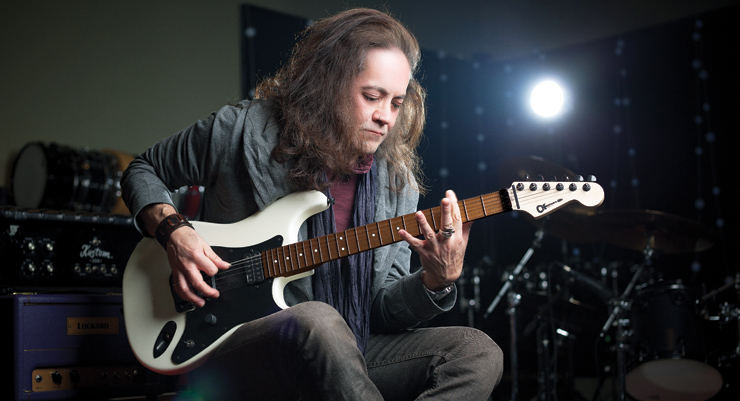
Jake E. Lee found fame replacing Randy Rhoads to co-write two of Ozzy Osborne’s most popular albums – Bark At The Moon and Ultimate Sin. It cemented his place in metal history as he brought a refreshing blues-based edginess and dynamic stage presence.
Lee went on to form Badlands, releasing three critically acclaimed blues-rock albums, then faded into obscurity. Fifteen years later, he has returned with the band Red Dragon Cartel, and its self-titled album is full of Lee’s signature guitar flourishes, infectious songs, and guests galore.
How did Red Dragon Cartel come about?
I hadn’t done anything in a long time, and I was content with that; I don’t feel the need to be in the spotlight and I don’t like being the center of attention. I had a good run with Ozzy and Badlands, and felt I’d made my mark as far as contributing something to music.
The only reason this album came out was because I moved to Las Vegas and reconnected with Ron Mancuso, who I’d known back in L.A. in the ’80s. He had a Beggars & Thieves video they were going to shoot, and wanted to know if I would do a cameo. A week later, it was on YouTube and Ron said I should check out the comments. It was so much about me being in it, still being alive, and not being fat and bald (laughs)! After all these years, it was surprising to me that so many people would even care if I did anything else again. It was heart warming.
Ron got together with Kevin Churko, who has a studio and had worked with Ozzy, and the two of them came up with a game plan. I’d been writing the whole time I was gone – I had a hundred ideas. Ron picked the ones he found most interesting, and we started writing songs.
The first song we finished writing was “Feeder.” It dawned on me that Robin Zander (Cheap Trick) would sound awesome on this. Ron knew Tom Petersson (Cheap Trick), and called him to find out if Robin would do it. Robin said he would love to sing on it. I was so excited and thrilled, and probably the most alive I had felt in 20 years. I forgot how exciting it could be to make music. I was in. “Let’s keep writing and get other singers! Let’s make a f***ing record (laughs)!”
Are you surprised that your fan base was still so strong?
It’s surprising. I only do this because it makes me feel good. I don’t try to do anything to please fans. It’s an awakening, being onstage and looking at the audience, making eye contact with somebody, and them going, “I love you!”
What was your relationship with the guitar while you were on hiatus?
Pretty off-and-on. I’d have periods where I would write a lot of stuff based on guitars, then I’d go six months without picking one up; with Cubase and sampling, you don’t really need to play. It was a new way of doing it. Then I’d pick up the guitar again and say, “Hey this is fun!”
The opening guitars on “Big Mouth” is from my computer from 17 years ago. I didn’t even remember how I got that sound. “Wasted” with Paul Di’Anno singing is at least 10 years old. I just transferred the guitar tracks to start the song. The other parts were recorded the old fashioned way.
You’re playing through an EVH 5150 III head.
It’s a really good, consistent amp. Old Marshalls and Laneys can sound God-like one day, and the next day be crap. The 5150 is always there for me. It’s versatile, with three channels.
Charvel reproduced your old guitar…
The old one is pretty beat up – not roadworthy. Charvel made a new one and will eventually put it on the market. It’s a swamp-ash body with a Gibson scale length, mahogany neck, and ebony fingerboard. It has Gibson frets to the 12th, and Fender frets from there on up. It has the single coils I like (DiMarzio SDS-1), angled to get more bite out of the bass strings. The bridge humbucker (Duncan JB) is positioned a little closer toward the neck than most guitars – I like a fatter sound.
What’s next for Red Dragon Cartel?
We’re doing the Monsters Of Rock Cruise, which sounds like a disaster (laughs)! I’m very appreciative of the fact that so many people care. It’s been good for my soul.
This article originally appeared in VG April 2014 issue. All copyrights are by the author and Vintage Guitar magazine. Unauthorized replication or use is strictly prohibited.
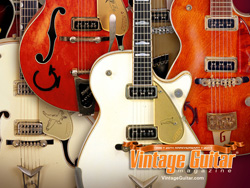
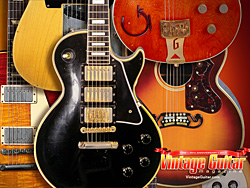
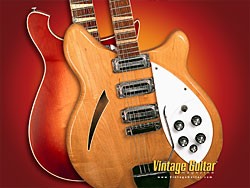
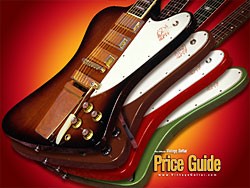
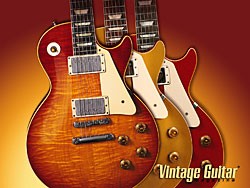
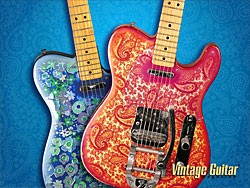
Time to give your computer, tablet, or phone a new look?
VG offers different classic images, each downloadable in a variety of screen sizes and resolutions for any computer or handheld device!
Choose the FREE background you want!
CHECK YOUR SCREEN RESOLUTION and click the proper size. After it has finished loading, do one of the following; PC: Right-click the wallpaper and select “Set As Background”. MAC: Hold down “Control” key and click and hold the image. Select “Use Image as Desktop Picture”.
If you have suggestions for future VG backgrounds, let us know. Email: Doug@vintageguitar.com










 When news of the passing of Les Paul spread through the guitar community August 13, 2009, reaction was swift and heartfelt. Claimed by complications of severe pneumonia at a hospital in White Plain, New York, Paul was 94. His name is synonymous with Gibson’s early solidbody electric guitars, and for a time he was one of America’s most popular and accomplished electric guitarists.