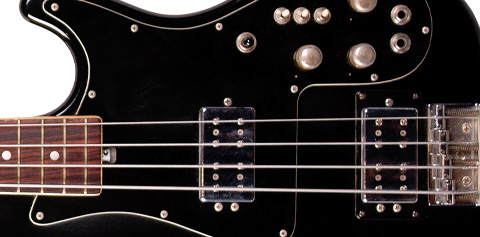
When a Carvin instrument has been featured in this space over the years, it was a either a doubleneck or an unusual custom instrument. And while the 1977 LB70 featured this month was a production bass, it was still unique.
Carvin was founded in the mid ’40s by musician Lowell Kiesel (1915-2009). Known for its direct-to-customer marketing of made-to-order instruments, the company originally made pickups and lap steels, then delved into Spanish-style electric guitars in the mid ’50s. From the early ’60s through the late ’70s, it used bodies and necks made by Höfner, the German instrument maker.Carvin’s early basses were short-scale instruments, and the LB70 (introduced in ’76) was the company’s first with a 34″ scale (its prefix denotes “long bass”).
Its overall length was 45 3/4″, and the ’77 catalog touted its weight at 10 1/2 pounds.Its Höfner-made neck was maple with a bound rosewood fretboard, mother-of-pearl dot markers, and an adjustable truss rod. According to catalog text, the neck measured “…1 9/16″ wide at the nut, 2 3/8″ wide at heel, 7/8″ thick at fifth fret…” Its maple body was made by Carvin and measured 12 1/2″ inches wide by 15/8″ deep.
The body had a laminated black-celluloid pickguard (also Höfner-made) and a “hand-rubbed, durable polyester finish” that came in black only on the standard version, but in two finishes for the stereo version – black (LB70SB) or clear (LB70SC). The headstocks on all sported Schaller M4SL tuning machines.The LB70 was initially given Carvin’s open-coil APH-4N humbucking pickups, but in ’77 they were dressed up with chrome covers and a given new designation – APH-8. The intonatable bridge’s plate and saddles were made of brass; note the close proximity of the treble pickup to the bridge, which was unusual at the time. The LB70B had Gibson-like controls – Volume and Tone for each pickup, a three-way pickup toggle, and a phase switch. One electronic option was dual-coil to single-coil switching. The input jack was also on the top of the pickguard.
The controls on the stereo-wired LB70SB and LB70SC were more complex; the three-way toggle was still there, but a bit further up the pickguard. They also used three mini-toggles consisting of two coil-splitters (one of each pickup) and a phase switch. Because of their plethora of knobs and switches, the SB and SC have individual Volume controls, and a master Tone. Curiously, this incongruity is not mentioned in the catalog.The presence of two input jacks tags the LB70SB as a stereo instrument, but the wiring of the inputs was similar to Rickenbacker’s “Ric-O-Sound” configuration; plugging into one jack with a regular cord allows both pickups to be utilized in mono. In the catalog, the LB70 listed with a manufacturer-direct price of $259. The stereo LB70SB was $299.
While the LB70 was a respectable instrument, the writing was on the wall for Carvin bolt-neck basses. The ’78 catalog listed only one bass, the CB100 – an un-Fender-like single-cut with a two-tuners-per-side headstock and the new M22B pickups. Soon afterward, the company turned to set-neck models, followed in the ’80s by neck-through designs.
“The late ’70s were a transitional period for Carvin,” said Kevin Wright, who runs carvinmuseum.com. “The company began moving away from assembling Höfner-supplied bodies and necks equipped with Carvin electronics to designing and building their own guitars and basses completely in-house. The LB70 disappeared from catalogs for several years, but the model number was resurrected in ’88, in a configuration that Wright called “…the cornerstone of Carvin’s neck-through basses. It’s still a popular model today, and has been supplemented with five-string and six-string versions.”
This article originally appeared in VG July 2011 issue. All copyrights are by the author and Vintage Guitar magazine. Unauthorized replication or use is strictly prohibited.
Despite the vast possibilities of electronic guitar effects, boutique pedal builders perhaps sometimes focus their effort in the cheeky names to evoke a vibe. Sitori Sonics is no exception, with offerings such as the Doob Dreamer, Tidal Phase, and Reel Repeat. However, Sitori’s hand-wired effects pedals – including this trio – are also aesthetically pleasing and well built, featuring true bypass circuitry.
Festooned with no shortage of cannabis references, the Doob Dreamer is among the (shall we say) thickest and smoothest overdrives imaginable. Three knobs (Size, Haze, and Tone) stand in for the more familiar Level, Drive, and, well, Tone. The Doob Dreamer gets interesting with its dual (roach?) clipping sections, which allow for a slight overdrive with some nice sustain in the Pinner mode, and increases the amount of overdrive and boosts the mid and bottom end when toggled to Fatty, giving up a Van Halenesque “brown sound.” The other toggle, labeled Norml/Thick (natch), offers an additional tone circuit that further beefs up the bottom end in Thick mode.
For effects of a more aquatic nature, there’s the attractive purple Tidal Phase, a lush-sounding phase shifter that ranges from a slow, liquid Steve Hunter/Dick Wagner swirl to a fast, Leslie cabinet warble. The Tidal Phase has just two controls: Sink (intensity) and Swim (speed). With the Sink function turned up all the way and Swim set to low, the Tidal Phase gives a very lush sweep. As Swim is increased, it makes sense to lower the Sink (i.e., Sink or Swim) to reduce the resultant helicopter effect. Compared to an MXR Phase 90, the Tidal Phase offers a wider variation of both speed and intensity, resulting in more tonal options.
Of these three Sitori pedals, the Reel Repeat is perhaps the most fun to mess around with, summoning many of the same effects as a vintage Echoplex, including similar levels of warmth. With this hybrid analog/digital delay pedal, Sitori does a great job of mimicking the attributes of a tape echo, including a round tone and the degradation of the high end as the repeat fades. And with only three knobs (Speed, Repeat, and Level), the learning curve is shallow. The Speed control lets the user go from ’50s-rockabilly slapback to David Gilmourish space echo. Turn the repeat up to the 4 o’clock position and the effect is instant Brian May, allowing the user to riff over their own phrases. The maximum delay time on the box tested was 600 milliseconds, but the Reel Repeat is also available in a 300-millisecond version for the same price.
The Doob Dreamer, Tidal Phase, and Reel Repeat are all well-built and offer no-nonsense user interfaces. Notably, when not engaged, the true bypass ensures that none of the three pedals corrupts the original signal. This is a case in which stompboxes are as fun as their names suggest, and useful, too, producing a wide variety of tones which guitarists across genres will find useful.
This article originally appeared in VG March 2013 issue. All copyrights are by the author and Vintage Guitar magazine. Unauthorized replication or use is strictly prohibited.
Why aren’t we guitarists ever happy to have our guitars sound like guitars? We wanted to emulate a trumpet’s blare, so we invented the wah pedal. We had to have an organ’s warbling vibrato, so we cobbled together bizarre tremolo effects and rotating-speaker systems. And we wanted a pedal steel guitar’s weeping moan, so in 1967 Gene Parsons and Clarence White of The Byrds gouged and drilled out a Tele and bolted it back together as a Rube Goldberg-like contraption that they christened the “B-bender.”
There’s been many a variation on that complex creation. Paul Bigsby developed a mechanical, cable-controlled B-bender with a foot actuator, as well as his simpler Palm Pedal. Then there are adapted Scruggs banjo tuners and other detuners, Hipshots, various double-benders, and more clones, copycats, and contrivances.
Seems we can’t bend those strings far or wide or high or often enough.
Enter Jim Alday. His new B-Blender adds B- or G-string-bending capabilities to most any Bigsby tailpiece, while still allowing you to use the full vibrato effect. Talk about having your cake and still keeping your svelte waistline too.
Alday is a retired engineer from Remington Arms, Xerox, and Bausch + Lomb – all important credentials that explain the quality of his creation. He’s also an amateur guitarist who, like a couple million others, fell in love with picking after hearing Chet Atkins in the ’50s. Alday says he’s been playing the same songs for 40 years now and that his wife hates them both, so he decided to add some tricks to his bag.
Enamored with the Bigsby vibrato, he sought a way to add a B-bender effect to the tailpiece. In classic hero-overcomes-all-odds style, everyone said it couldn’t be done. So he did it. The result is a beautiful piece of kit. Especially considering how little it costs.
Alday’s invention fits onto any type of Bigsby, from a B5 to a B6 and on. (The kit also includes an adaptor for imported Bigsbys like the B50 and B60.) The unit replaces just the original handle and requires no machining, adaptions, or gouging with a wood chisel. Simply attach the E, A, D, G, and E strings to the original Bigsby shaft, then run the B string through the adaptor. Tighten a set screw at the rear to set the lateral position of the handle, then another setscrew at the side to fine-tune the side-to-side pull of the handle up to a C#. Yes, it’s that simple.
With the B-Blender in place, you can move the handle up or down for full six-string vibrato, move it laterally for the B-bender effect, or do both simultaneously to create a pretty wacked-out sound.
But that’s not all. Alday’s setup comes with an adaptor plate that changes it to a G-Blender, lifting your G string to G# or A (no, it’s not set up to let you do both B and G strings, either together or separately).
Now get this; Alday makes all the stainless-steel components by hand and has the aluminum handle bracket CNC-machined by a local shop here in the U.S. of A. The precision and beauty are astounding. As Alday jokes, the quality is so good, the B-Blender will probably outlast your guitar.
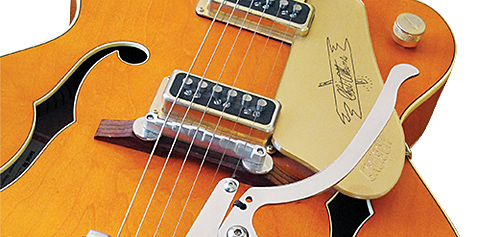
We added the B-Blender to a reissue 1955 Gretsch 6120 with the idea of making it an ideal country and rockabilly machine. The sleek styling wasn’t quite right for the Gretsch’s vintage chic, but the sound sure was. Leon McAuliffe, eat your heart out.
With a typical .012-diameter B string, the lateral force required for the bender is less than one pound. The motion is easy to pick up, although practice is necessary to add the bends slickly, mid-phrase. This is one place – perhaps the only place – where a Parsons-White B-bender might have it over Alday’s creation, as pulling down on a strap-button actuator doesn’t require a third hand. Then again, we also didn’t have to gut the Gretsch to set it up.
If you ever dreamed of being Speedy West, Jim Alday’s B-Blender probably won’t quite get you there. But the simplicity, cost, quality, and sound will have you throwing in Drifting Cowboys – or even Hellecaster – licks with a near-magical sleight of hand.
This article originally appeared in VG February 2015 issue. All copyrights are by the author and Vintage Guitar magazine. Unauthorized replication or use is strictly prohibited.
Most people remember Bill Nelson as the front man/guitar hero in the English band Be Bop Deluxe. Since folding that outfit 35 years ago, he has led a fertile solo career, releasing dozens of solo albums ranging from guitar rock to pop electronica. His latest, Blip!, showcases his hot playing with lush pop.
Who were some of your key guitar influences?
My first was Duane Eddy. I heard “Because They’re Young” on the radio in the late ’50s and loved the sound of his guitar. I then got into the Shadows and the Ventures. In my early teens, I bought records by all kinds of instrumental groups, some obscure like the Spotnicks, the String-A-Longs, the Cougars, the Fireballs, and Johnny & the Hurricanes. I also discovered Chet Atkins and Les Paul. My English Lit teacher loaned me a Django Reinhardt album, which led me to Wes Montgomery, Jim Hall, and Joe Pass. Later, I was inspired by Clapton, Beck, and Hendrix.
Still, your solos use chord-tension notes normally found in jazz.
The jazzy element comes from being exposed to jazz and swing music as a kid. My father was a saxophonist and in the ’60s, I picked up on the contemporary jazz scene – not just guitar players, but Miles Davis, John Coltrane, Charlie Parker, Gil Evans, Thelonious Monk, Sun Ra, and Ornette Coleman. I have no academic knowledge of music theory; I play by ear – I’m what my father used to disparagingly refer to as a “busker.”
What guitars did you use on Blip!?
The main guitars were a Gretsch White Falcon, a Fender Custom Shop ’59 Strat, my Campbell Nelsonic signature model, an Eastwood Wandre Tri-Lam, a Peerless Deep Blue Custom, and a Gibson Custom Shop Les Paul Black Beauty. I recently got a Hallmark Stradette and an Eastwood California Rebel I’ve been recording with. I do have a lust for unusual guitars. They can put an entirely different spin on things.
Do you record guitars direct?
Yes, without any mic’ing of amps or cabs. I mostly use a Line 6 Pod 2; for some reason, I prefer the sound of the early ones. I also have an old Zoom 2050 rack processor and a Digitech Valve FX rack processor I add to my rig for live performances. I also have a Line 6 Pod HD500 I use in the studio when I need a more-abrasive rock sound. In conjunction with the Pod 2, I’ve also recently been using a Line 6 M5 stompbox modeler that Reeves Gabrels gave me. Some of the filters and sequenced tremolo effects in the M5 are interesting. Reeves and I are recording an album together, too.
Do you still own the Gibson ES-345 and Yamaha SG2000 guitars from the Be Bop Deluxe era?
My ES-345 is still with me and I’d never sell it. My dad bought it for me in the early ’60s and it’s a wonderful guitar, but I rarely take it out of the house. The musical memories it contains are very special. I’ve kept the second of the two Yamaha SGs – the cherry sunburst one I played toward the end of Be Bop Deluxe was sold in the early ’90s, but I still have the dark green one I played in the ’80s. It’s a little road-worn and needs new knobs and a switch tip, but it still has a great action.
Blip! tracks like “Whirlwind Winters” and “Painting Your Sky” have some great guitar work.
I still get a thrill from kicking in the retro-rockets and going for the widescreen guitar solo. But I also love the more subtle, reflective, jazzier approach. The electric guitar is capable of so many beautiful moods and textures – I’m rather greedy and enjoy it all. I’ve always had broad tastes in music and tried to incorporate the sound and style of early electric guitar alongside a more-contemporary approach to the instrument. It’s an evolving process.
What are your recollections of Be Bop Deluxe? That music still sounds fresh.
Personally, I can be a little ambivalent about Be Bop Deluxe. Those few years in the ’70s represent a fraction of my career, but because of the era and the more-commercial nature of the music I recorded back then, the band has become the main signifier of my work. I’ve never stopped making music and never felt I’ve reached my goal, whatever that might be. I’m still looking to make an album which will satisfy me. For me, Be Bop Deluxe was just a starting point in an ongoing adventure. I have fond memories from that time but I don’t feel particularly defined by it. Nevertheless, I’m more inclined to look at the world through a vehicle’s front windshield rather than its rearview mirror. The future, I hope, will always be more magnetic than the past.
This article originally appeared in VG Febuary 2014 issue. All copyrights are by the author and Vintage Guitar magazine. Unauthorized replication or use is strictly prohibited.
The latest record from Marty Stuart, Ghost Train: The Studio B Sessions, is a tour de force of country music styles that celebrates the past while pushing firmly into the future. And that’s what renaissance man Stuart was aiming for…
“Well, traditional country music is what interests me the most,” he said. “Sometimes, I miss the weight in my checkbook from lack of airplay, but that’s all I miss. I’ve got enough years behind me to know the only thing that lasts is what you do from your heart. It’s kind of become a cultural mission, because for years I’ve tried to preserve and re-stage the photos and memorabilia. Then one day I woke up and the music was slipping away. I thought we needed to do our part to hang on to it, but write a new chapter. Not a retro thing – a new chapter. I think Ghost Train may have moved it in that direction.”
Recorded in RCA’s legendary Studio B, in Nashville, where plenty of country hits were recorded, Stuart says it was a different experience. “It’s owned and controlled by Belmont University. So we had students on one side of the glass watching us record while learning. Then, friends and neighbors on the other side. So it was kind of strange and wonderful to have all that going on in a time that’s usually private. It was alright because it all kind of became a part of the atmosphere.”
Keeping Stuart’s music fresh, both live and on record, is his band, the Fabulous Superlatives. Guitarist Kenny Vaughan (VG, Dec. ’06) is the perfect foil for Stuart. Harry Stinson on drums and Paul Martin on bass are as skilled at the kind of music Stuart is making as any musicians on the planet. “We’ve been together almost a decade now, which is almost 50 years in Hillbilly time. I’ve been in bands since I was nine years old and absolutely, this is the band of a lifetime. My legacy band, as I see it. It’s the first and only band I’ve ever had where I save every recording, every photograph, every document, because it’s going to be studied when it’s all done. It’s one of those divinely ordered bands. They’re not only master musicians, they’re master people.”
Fans of Stuart and the band can get a weekly fix by tuning into his RFD-TV show, which is an amazing display of musical talent seldom seen on any kind of television these days. In the space of 30 minutes, he squeezes in performances by the Superlatives, songs by guests who are often royalty in country music, a song from his wife, Connie Smith, and a musical interlude from Leroy Troy. In-between are heavy doses of Stuart’s humor and good-natured personality. The show is reminiscent of the program Porter Wagoner served up in the late ’60s and early ’70s.
The show is just one part of his mission to keep the public exposed to traditional country music, ensuring it sees and hears more than the pop/country that dominates the radio. He also has a program on XM/Sirius radio celebrating the same thing. And he’s a fine photographer who has compiled several decades of photos featuring country artists into a book, along with DVDs of the show and some music that can’t be purchased in stores.
The TV show also was the catalyst for the only change in equipment he’s made in many years. “My guitars have pretty much stayed the same, but with amps I’ve been all over the place. For the show, someone suggested Kenny and I go to a silverface Fender Princeton. I did, and I add a little boost on top, and that’s it. We use them on the show, and that’s all I used on the record. I’ve found the true tone of my guitar in that Princeton. It’s the way to go for what I’m up to. It rings like a bell and in the control room, it’s tight and bigger than the world. I’ll use it on gigs, too, unless the room is too big. Then I’ll go back to a couple of Fender Twins.”
Stuart is an amazing guitarist and mandolinist, playing with an ease that reflects his years at his craft. He doesn’t practice much, but says for inspiration he still goes back to the guys he’s always appreciated. “Luther Perkins still makes me smile. Ralph Mooney always makes me go away shaking my head wondering how he was doing what he was doing. I love the quirkiness of Roy Nichols. And I love the Mississippi man, Muddy Waters. He can do more damage with one note than most guys can do with an entire fretboard. I do love to watch young guys come along, but the old masters are still the ones.”
As for the future, Stuart says it happens as it happens, like Ghost Train, which actually took about six years to put together. “It all starts with a song, and this one began with “Hangman,” the song I wrote with John (Cash). I thought ‘This could be the start of something deep, but it’s gonna take time.’ I started living and writing songs, re-writing them, and one day there were that many that held together. I have book upon book, album titles, album concepts that came and went. But I entertained them all. One day it all found its mark and became Ghost Train.”
His current situation nicely suits a man involved in so much. “I’ve always thought Andy Warhol had the right idea where he had the whole factory going. At the beginning of the decade, I turned my office into the fun factory. It starts with the band and the music, and it has been amazing. Photographs, books, movie scores, saving buildings… it’s the most wonderful thing to be able to say the sky’s the limit. I move with my heart but it all works under one roof now, and that’s a wonderful thing.”
This article originally appeared in VG January 2011 issue. All copyrights are by the author and Vintage Guitar magazine. Unauthorized replication or use is strictly prohibited.
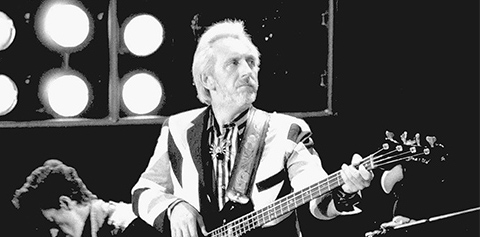
John Entwistle with a Stratus Graphite bass. Photo by Frank Melfi.
John Entwistle Ode to the Ox 1944-2002 By Ward Meeker
Pop music lovers – especially those with an ear tuned to gear and how it’s used – know that John Entwistle ranks as one of the most influential bassists in the history of rock and roll. Some would argue there is none higher.
Before Entwistle, the role of the bassist was nebulous; the average listener didn’t pay much mind to bass notes or their placement. But Entwistle changed that situation dramatically, developing not only a unique style and establishing the stereotype of the rock-solid, unmoving bassist, but also evolving a tapping multi-hand approach to bass playing.
A musically curious young man, John Alex Entwistle was born in Chiswick, London, in 1944, and as a schoolboy, learned to play piano and French Horn (which he would use throughout his time in the Who). Yet another member of his generation swept up in the skiffle revival of the 1950s, Entwistle was smart enough to see that guitar players in his hometown were a dime a dozen. But few of them were willing to take on the newfangled electric bass guitar, not only because the role was deemed secondary, but also because in England at the time, decent-quality basses were nearly impossible to come by.
Despite being just 14 years old, Entwistle quickly took on double duty as bass player and bass builder, not bothering to learn guitar first.
One day, as he strode down the street, homemade bass under his arm, he was approached by a neighborhood chap named Roger Daltrey, who invited him to join a band. Guitarist Pete Townshend joined soon thereafter, then drummer Keith Moon, and the band evolved from The Detours to The High Numbers and finally The Who, and they started recording in 1964.
From early on, The Who, being a single-guitar band, relied heavily on Entwistle to keep the music rolling. For many reasons (like keeping up with Townshend’s taste for 100-watt amp stacks) he tended to play extremely loud and complex parts to compensate for the absence of a rhythm guitar. The Who was unique in that way: Townshend’s guitar was often the base that Moon and Entwistle would “solo” over.
And amid the pandemonium that was a Who concert – Townshend’s windmilling and power-posing, Moon’s run-amock drumming style, and Daltrey’s frontman posturing – Entwistle developed a trademark standstill style that contrasted visually as he laid down complex fills and countermelodies that fit perfectly.
Entwistle also wrote many noteworthy Who songs. Where Townshend proved to be the cynic, the rebel, the conceptualist, Entwistle’s bizarre, often dark sense of humor lent further contrast. Two cases in point are “Boris the Spider,” from the band’s second album (A Quick One) and “My Wife,” from Who’s Next.
From 1971 to 1973, Entwistle, discouraged by certain bandmates’ falling victim to the trappings of rock stardom, released three solo albums and toured with his band, Ox. Though his solo career never garnered much interest in the U.S., it helped him focus on music despite the fact that the Who was on shakey ground; Townshend had suffered a nervous breakdown early in the decade, Daltrey pursued acting and a solo career, and Moon moved into the party fast lane that would claim his life in 1978.
Despite a uniform feeling that the band wouldn’t really exist after’s Moon’s passing, the Who toured in support of Who Are You, which was released just a few months before the drummer’s death. The wind, however, was knocked out of the band’s sails early in the tour, when 11 fans were trampled to death before a concert in Cincinnati in December, 1979.
The Who kicked out two albums in the early ’80s (1981’s Face Dances and 1982’s It’s Hard). Entwistle, meanwhile, recorded another solo album, Too Late The Hero, which reached number 71 on the U.S. album charts.
The band was to have retired following a farewell tour in 1982, but demand for a reunion led to another tour in ’89.
In the mid ’90s, Entwistle assembled the John Entwistle Band, with producer Steve Luongo on drums, guitarist Godfrey Townsend, and keyboardist Gordon Cotton.
In late June ’02, The Who had regrouped and was set to begin a tour of North America, when Entwistle died on June 27.
By all accounts, Entwistle’s personality was that of one of the most grounded, humble rock superstars ever. As a player, he respected peers like Paul McCartney and Jack Bruce (though he wouldn’t necessarily say he liked their tone), though his own style shared little with either of them. But like them, it defined itself.
Goodbye, John Alec Entwistle We Hardly Knew Ya By Steve Patt and Rick Pascual
“Kid, can ya lend me a hand here?” emanated from a hairy individual in a British accent so thick I could barely understand it’s meaning.
Without thinking twice, I grabbed a guitar case from the gent and followed him down the long hallway. This was my first encounter with John “The Ox” Entwistle, in grungy downtown Baltimore, and I got used to helping him over the years.
In the old days, access to bands was a lot easier, and being a 16-year-old Who fan, I had hoped to meet the group by scoping out their hotel. I got more than I bargained for, because the group’s head roadie, a hobbit-like sandy-haired Bob Pridden, pressed me into service, and I was a fixture for the tour.
The Who, all included, were fun to be around, and got along like family. But John was the avuncular older brother to me, giving me tips on wine, women, and (of course) song – though not necessarily in that order. I graduated from the Who to Procol Harum, and eventually left roadying to be a musician with the Chambers Brothers, but never forgot the kindness of Peter, Keith, Roger, and John… who urged me to “forget about the music life, kid – it’s all flash. Go back to school!” Which, of course, I ignored at the time.
John was a scholar – very serious about his music – but had an easy perspective on the Who and its role in the world of popular music.
The group took the stage June 29 in Los Angeles, without its linchpin, John Entwistle. “John would have wanted us to go on,” Pete Townshend and Roger Daltrey, the remaining original bandmates issued in a statement after John’s untimely death at 57, and I couldn’t agree more. The extended family of Peter, Roger, and crew will be playing their hearts out in honor of John Alec Entwistle and his legacy, and all of us music lovers will be there in spirit. – Steve Patt
Photo by Ken Settle.
As you entered the original Manny’s Music on 48th Street in New York City, you walked straight ahead to the stairs that led you down to the main selling floor. That’s where the guitars were, behind sliding locked glass doors above your head. Amplifiers of all the most soughtafter brands formed a small island in the center. The yellow Danelectro that everyone used to test amps was sitting in its usual spot on top of a Standel (or maybe Fender) amp.
I bought my first Precision Bass at Manny’s on August 7, 1968. I still play it to this day. John Entwistle and Pete Townshend entered the store right behind me and my brother, Frankee Lee.
The two guitar players of the Who walked passed us and we acted as cool as we could, but I was delirious. I really was a fan, and that summer I was in love with The Who Sell Out LP.
Entwistle also came to buy a Precision Bass. Henry, Manny’s sales guy, called upstairs to stock and told them to bring down two Fender Precision Basses in sunburst. Henry turned to me and asked if I was buying the case as well figuring that perhaps I could only afford the bass. He didn’t know that I had $225 burning a hole in my pocket. I’d accumulated this money during a summer job at my mother’s office, an aircraft parts distributor. She was my boss that summer and told me if I wanted a really good bass, I’d have to buy it myself. She gave me the job so I could earn it. I really wanted a Precision Bass.
When they finally brought the basses down, Mr. Entwistle opened one of the cases and wearily brushed at the strings as it laid in its orange-lined case. I took the other out and caressed and stroked it like the new lover it was about to become.
I turned to Entwistle who was standing a foot or two away talking to Henry and asked if these weren’t the greatest basses we were buying and he simply said, “The best.” He was so right.
Later that night The Who played the Shaefer Festival in Central Park’s Wollman Rink where I caught Townshend’s pickup cover from his completely smashed Gibson SG. Entwistle did not play the bass that he had bought that evening and I often wondered if he ever did play it or perhaps he made a lamp out of it at a later date.
He was the best rock bass player period. He changed the role and sound of the electric bass like Hendrix changed the sound of the electric guitar. I don’t think he was unappreciated. His fans, myself one for 37 years, are many and varied and devoted. The greatest pleasure in going to see him play was watching him stand so casually still and fly so high into the heavens simultaneously.
He knew he astonished other bass players, after all he was our Jeff Beck. We worshipped and applauded and let it be known that he was the hero of another subspecies of Who fanatics. Anyone who was really listening when they first heard the thunderous solos he blasts off in “My Generation” knew from that day forward the bass was coming out of the shadows. Live at Leeds. Left channel. Case Closed. – Rick Pascual
The Ox’s Axes
As The Who gained prominence, John Entwistle’s tastes developed and he made the de rigeur progression through various makes and models of bass guitars. By the mid ’70s he’d developed a liking for the Fender bass feel, but favored the low-end tone of Gibson’s Thunderbird through Hi-Watt and Sunn amps. Ever one to resolve a quandry, he had Fender Precision necks fitted to Thunderbird bodies – creating what he called his “Fenderbirds.”
By the late ’70s he had taken to custom-made (and often elaborate) Alembic basses. Through two decades he was often seen in concert and video playing an Alembic with an Explorer-shaped body. By the late ’90s, though, he was playing Status basses with all-graphite necks.
But his personal collection of guitars consisted mostly of six-strings, including some fantastic rarities, like a matched set of 1958 Gibsons – a Flying V and an Explorer – a late-’60s Fender Stratocaster in Paisley Red, and a double-cutaway Gretsch White Penguin made for Mary Ford, and believed to be the only one of its kind. Among the basses in the collection were several early-’50s Fender Precisions, Ampeg Horizontal basses, including a an ASB-1 “Devil Bass,” and a Rickenbacker 4005L “lightshow” bass.
Entwistle collected more than “just guitars.” An avid deep-sea fisherman, he had nearly 300 fish mounted and hanging in his bar at home, to go with a guitar collection that numbered well over 200. He also had a fondness, at varying times, for Star Trek episodes on videotape, brass instruments, and antique synthesizers. He even tried his hand at breeding purebred chickens. He was also an avid drawer, and on a few occasions, toured with his artwork.
Fender Paisley Red Stratocaster, the only one made. A double-cutaway Gretsch White Penguin, made for Mary Ford. Rickenbacker Lightshow bass. Photos by Geoff Dann.One of Entwistle’s “Fenderbird” basses. It sports a P-Bass neck and an Explorer body. Alembic bass with inlaid silver spiderweb. A mid-’50s Fender Precision Bass. Photos by Geoff Dann.
This article originally appeared in VG October 2002 issue. All copyrights are by the author and Vintage Guitar magazine. Unauthorized replication or use is strictly prohibited.
Riff rockers Crobot have been promoting their first album, Something Supernatural, with a live show offering full-bombast rock, contagious funk, and science fiction. The band’s success is owed in part to the sonic interludes of guitarist Chris Bishop, who has discovered the missing link between crashing power chords, funky riffs, and hallucinogenic guitar effects,
Your sound has hints of Clutch and Queens Of The Stone Age. How did you discover your own “voice?”
It wasn’t one of those things we had to develop much. We just started jamming. When the tap tempo broke on my Vox delay pedal, I started trying to manipulate delay times with my foot while we were playing, and it started making these crazy sounds. Sometimes, I’d accidently smack the wrong knob, and I’d use the sound to ramp songs and parts into each other. Once I started doing that, I knew I wanted to utilize low-octave effects and abrasive delay. “Legend Of The Spaceborne Killer,” was the first song where we said, “That’s our sound.”
Your playing has a Southern funkiness.
Skynyrd. I’m from Tennessee, and I remember playing guitar with my dad and his cousins. They would literally sit around and drink beer and play every Lynyrd Skynyrd song all night. So, I would learn all these songs. Having that funkiness is important. Really, I’m just trying to fill frequencies within the band. One of my favorite guitar players is Audley Freed, and his playing is similar to mine because I remember learning Cry of Love songs when I was 10 or 11. It really stuck with me. Even with all the effects, you still get an organic guitar tone, and that’s important, especially if you want a raw feel. If you want to sound like Nickelback, you use a big wall of sound. That’s great, but I like people to hear the character in my playing. I’m somewhat of a sloppy player. I want people to be able to hear the string noise and not just hear a big wall of distortion.
Which amp are you using?
I’ve played Orange amps for years. I use the Dual Terror and I have the Tiny Terror for a backup or to play a small room. If it’s a decent-size room where I can crank it up a little bit, I’ll use the Dual Terror. They’re both awesome, and it’s vital that I have that because the way I run the crazy delay stuff, I need a bit of head room so I’m not working with straight feedback. The Duals are pretty good for that. I don’t have to run it too hot, but I still have a good, solid tube sound.
What’s on your pedalboard?
I’ve got a Morley Bad Horsie Wah, which is one of the first they ever made. I use it more as a filter effect. I also have a Way Huge Swollen Pickle and a Z-Vex Fuzz Factory. Then I have an Electro-Harmonix Micro POG and a POG 2. The Micro POG is set for one octave down, while the POG 2 I use strictly for my octave up. I stack them. That’s the holy grail of kick-you-in-your-face tone. When I want to get heavy and knock someone’s balls off, I put that Fuzz Factory on with that sub-octave from my POG.
I also have a Vox Time Machine Delay that was modded. That’s my abrasive, super-crazy delay. My other delay is an Ibanez Echo Shifter. It has a really big knob in the middle that you can use with your foot to move up and down. That’s how I get that whirly psychedelic sound.
What’s your main guitar?
For years, I’ve been playing a Fender ’72 FSR Telecaster. It’s sunburnt orange and has a Bare Knuckle P90. It’s got a standard Tele neck, so it feels nice. I recorded the whole album with it. I use the low-octave pedal on a lot of my single-note riffs to compensate for the Tele sound, which is very high-end and piercing, sometimes. The low octave gives a huge, unique sound. You still get the attack and the metallic-ness of the strings, but you get all that low-end. It’s really awesome.
This article originally appeared in VG‘s March 2015 issue. All copyrights are by the author and Vintage Guitar magazine. Unauthorized replication or use is strictly prohibited.
Mike Stern made his name playing with Blood, Sweat & Tears, Jaco Pastorius, Miles Davis, and others, carving a notable solo career while constantly seeking to broaden his musical voice. On his latest album, Eclectic, Stern pairs with rock guitarist Eric Johnson; the former engaging his rock side while the latter explores his jazz influences.
How did you and Eric Johnson get together?
We played on my Big Neighborhood record. I loved the experience, and for years we talked about doing more together. I went to a couple of his gigs, and we’d occasionally meet and say, “Hey, one of these days we gotta do something together.”
It went so well on Big Neighborhood that we fell into this tour a couple years later. It went well, and we said, “Let’s just record.” This was with Anton Fig on drums and Eric’s bass player, Chris Maresh. We did the record and it went very good. It was kind of live, but not overly worked.
The idea was to play what we were playing live and use the studio for touching up stuff, adding a rhythm part here or there, or fixing a couple things. We left in a lot of the rough edges, which is what I always try to do. I’ve always done records where everybody’s there, playing live. We were inspiring each other to do that. Eric sounds beautiful.
How did you choose songs?
We had a good feeling about playing together live, so when we went into the studio, we felt we could experiment. I brought some tunes, Eric brought some tunes, and we wrote a couple specifically for the project. I wrote lyrics for the first time on a record. It’s called “Roll With It,” and I recorded it as an instrumental first, then wrote words. Singer Malford Milligan was available and it worked out.
Your wife, guitarist Leni Stern, sings on the record, as well, and sounds great.
She’s awesome. She inspires me so much. She’s always trying different things and she’s very adventurous with music. She got a Malian instrument called a ngoni (banjo-guitar), and started playing it. Eric is a big fan of hers and said, “Let’s record some stuff.” We were very happy with it and they were all first takes.
What gear are you currently using?
I’m using a Fender ’65 reissue Twin Reverb, which I also used on the recording. I use an old Yamaha SPX90 for a chorus sound; I use it for one patch. I’m also using a signature guitar Yamaha made for me. It’s a copy of a copy of my original Telecaster, which I got from Danny Gatton. Before that it was Roy Buchanan’s. It was a great guitar that was stolen when somebody pulled a gun on me in Boston. I started using a spare made by Yamaha. They make really good guitars.
What’s next?
I’m going to do more recording. I don’t know when. I have a bunch of new tunes, so I’ll figure out something. I just want to keep it happening.
This article originally appeared in VG‘s March 2015 issue. All copyrights are by the author and Vintage Guitar magazine. Unauthorized replication or use is strictly prohibited.
The Mu-FX
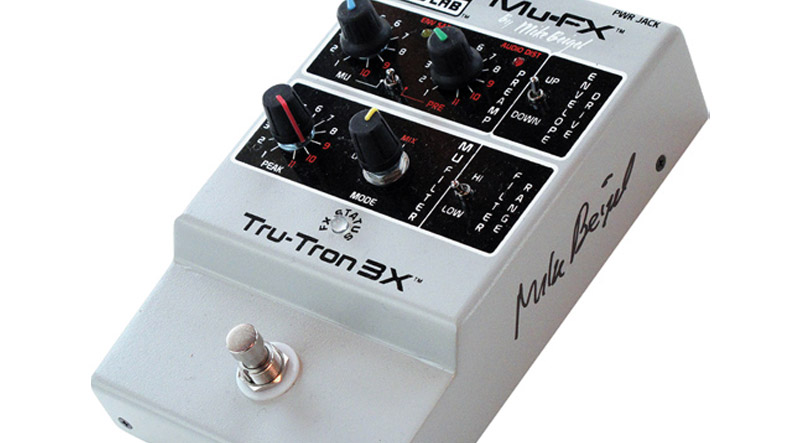
Tru-Tron 3X
Price: $369.63
Contact: www.mu-fx.com.
Think funk. Think Bootsy Collins’ wacked-out Parliament Funkadelic Space Bass lines. Think Stevie Wonder’s wah’d Clavinet on his ’73 hit “Higher Ground.” Think Mu-Tron III.
The secret mastermind behind that sound was engineer Mike Beigel, creator of the original Musitronics Corporation Mu-Tron. When that pedal hit the market way back in 1972, it was the music world’s first envelope-controlled filter, establishing a whole new category of guitar effect that we didn’t know we had to have. Some called it an “auto wah.” But thanks to guys like Bootsy and Stevie, the Mu-Tron became known more fondly as “funk-in-a-box.”
By 1979/’80, the original Mu-Tron was history. Despite several clones, copycats, and other attempts to bring it back in the interceding years, nothing since has sounded quite like the real deal. Today, originals sell for as much as that bejeweled necklace your sweetheart’s been hinting about. If you can even find a vintage Mu-Tron, that is.
Happily, Beigel is back. With his new Mu-FX company he’s offering the Tru-Tron 3X, a modernized and miniaturized version of the famed Mu-Tron III. Attention, shoppers: This is not a reissue. The Tru-Tron does everything the Mu-Tron did – and a whole lot more.
Beigel says he used the original Mu-Tron circuitry “mojo” and paid careful attention to keeping the authentic sound and response of the vintage units. The Tru-Tron can be operated exactly like the original, if you wish. But it also has added features and extra range capability that provide more intense effects than a Mu-Tron.
To feel what Beigel is feeling, we plugged a ’56 Strat into a Tru-Tron (just the 58th one built) and then into a tweed Deluxe 5E3. With just a little effect dialed in, the Tru-Tron acts like a compressor, increasing the subtle “pop” to each note and enhancing the “tube sound” quality of even such a vaunted amp as a tweed Deluxe. But there’s more.
Via its Envelope Drive section, the Tru-Tron allows you to shape both the up-sweep of notes (which was what made the Mu-Tron famous) and now the down-sweep as well. And by choosing between the unit’s Hi and Low settings in the Filter Range section, you can select which range of the notes are peaked and tweaked. The possibilities, as they say, are near endless.
Fiddling with the settings, you can produce deep, warm tones and then swing the sound to aggressive and harsh. Indeed, the Tru-Tron offers much more gain than the original. The gain is “redlined” at 9 – like a car’s tachometer – but it goes to 11. This extra gain allows the aggressive player to drive the signal into almost constant overload. Nigel Tufnel would be happy.
A few technical notes: the Tru-Tron is smaller and more robust than a Mu-Tron, but it’s still big and will require extra space in a pedal board. Second, the Tru-Tron runs on a 12-volt power supply (which Beigel says aids tone quality), so it won’t hook into your typical 9-volt chain. Also, the 12-volt adaptor itself needs to be set either flat or upright; it doesn’t seem to work properly when laid over on its side.
Comparing a Mu-Tron and Tru-Tron side by side, the new pedal simply offers more. The sounds range from subtle to funkified to absolutely psychedelic. Jerry Garcia fans will be, well, grateful. In engineer-speak, the Tru-Tron makes more “mu,” as Beigel terms that special sound for which the envelope filter is famous. Dial in your sound, strike a 7#9 chord, and you can taste the funk – and it tastes good.
This article originally appeared in VG May 2014 issue. All copyrights are by the author and Vintage Guitar magazine. Unauthorized replication or use is strictly prohibited.
When Brian Setzer kickstarted the Stray Cats into action in 1979, his gear lineup was a hodgepodge of orthodox rockabilly ware along with the bizarre. His ’59 Gretsch 6120 and his pomade were the real deal. But he played through a Vox AC50 Royal Guardsman because the band was first recording in England.
To get that all-important slap-back to emulate the Sun Studios sound, he eventually settled on a Japanese-built Roland Space Echo.
Setzer’s search for proper slapback was a long, winding road. He never bothered with an Ecco-Fonic; even back then, they were vintage units and a chore to keep functioning. He tinkered with Echoplexes, but was always frustrated.
“The Echoplex is just so damn unreliable,” he says. “I mean, if you give it a dirty look, it’ll say, ‘Screw it, I’m not working for you today.’ They’re just so timid. You’d bring it to a gig and it wouldn’t work.”
He also experimented with analog stompboxes, but the tone was lacking. The lesson from all his trials was that he realized, “I love the tape sound.”
“Then I discovered the Roland,” he says. “The Space Echoes are sturdy and they sound exactly the same as the Echoplex – and you actually have more of a choice in the echo, if you want it. The Roland has always done me well.”
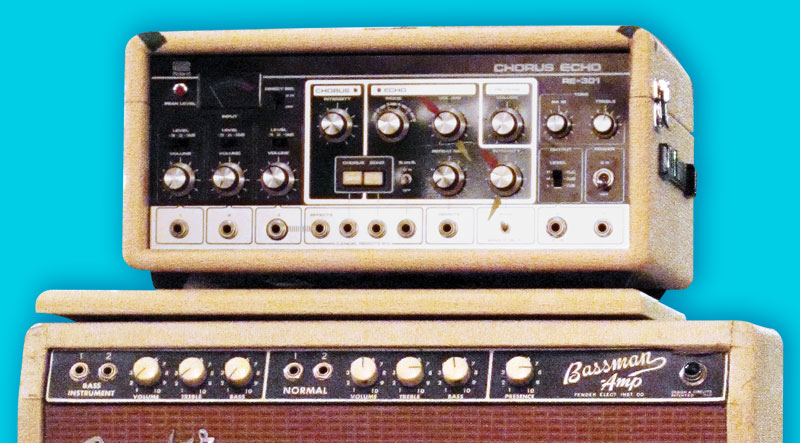
Even now, when analog and digital delays are prolific, reliable, and inexpensive, Setzer tours the world with a pair of vintage Roland RE-301 units sitting proudly atop his blond piggyback Bassmans.
Roland’s best-selling unit was the RE-201 Space Echo, in production from 1973 through 1990.
The Space Echo was the creation of Ikutaro Kakehashi. A self-taught watch repairman who progressed to radio servicing and eventually, electrical engineering. Through it all, he was fascinated by music; he even titled his autobiography, I Believe in Music.
Kakehashi took a classically Japanese approach to refining the tape-echo effect. He didn’t invent tape echo – no one knows for certain who did – perhaps Les Paul, perhaps Sam Philips at Sun, perhaps some other mad sonic scientist. But Kakehashi did take a delicate, untrustworthy technology and refined it into an effect that was reliable, robust, and roadworthy.
The roots of the Space Echo stretch back to Ace Electronic Industries, founded in 1960 by Kakehashi. In the late ’60s, the firm offered the solidstate Ace Tone EC-1 Echo Chamber, followed by various subsequent models. The EC-1 was basically similar to its famed predecessors, the Ecco-Fonic and Echoplex, albeit with more-modern controls – and simply more of them.
But like the Ecco-Fonic and other early echo units such as the English Watkins Copicat, the short-lived Ace Tone used just a basic, short 1/4″ tape loop. It didn’t even borrow the updated (and much more reliable) tape-cartridge concept of the Echoplex.
In 1972, Kakehashi launched the Roland Corporation, and in ’73 introduced the Roland Echo Chamber RE-100 and RE-200 (with added spring reverb). As with the Ace Tone, those first Rolands still used that short tape loop. And, the design of the controls and housing were dead-ringers.
Brian Setzer’s current touring rig, a Roland RE-301 Chorus Echo atop his piggyback Fender Bassman.
Just a year later, Roland unveiled replacement models with a key revision; instead of the short tape loop, the new RE-101 and RE-201 Space Echoes had a free-running tape-transport system. The longer tape loop spooled freely within a chamber, with no reels of any kind, just a capstan drive protected by a plastic cover. The loose-spool/low-tension design resulted in less tape wear and minimized noise, wow, and flutter.
Compared with the bare-bones controls of an Ecco-Fonic or Echoplex, the control panel of an RE-201 looked like a jet-airplane cockpit. It had inputs for multiple sound sources – two mics and an instrument (each with independent level controls; the instrument input offering a standby on-off toggle switch), and a mixer or P.A.
Roland’s brochure for the RE-101 and RE-201; the 201 added spring reverb to the basic machine.
Controls included Bass and Treble to EQ the effect output (not the dry signal), Repeat Rate (echo length), Intensity (number of echo repeats), and separate Volume knobs for echo and reverb that determine the mix level of dry and effect signal.
In the panel center, the Rolands had a trademark Mode Selector rotary knob with multiple presets. The RE-201 had 11 presets – four for Repeat, seven for Reverb Echo, plus a preset for spring-reverb only. This knob controlled the unit’s single record head, three separate playback heads, and variable-speed motor.
The Space Echo was an instant, runaway hit. Unlike any previous tape echo, it was reliable and sturdy enough to travel. Musicians like Setzer could dial in a simple slapback, whereas Bob Marley’s band used it for deep, throbbing echoes. Either way, the sound was warm, rich, and organic. Portishead and Radiohead would take Space Echoes to new extremes; by juggling the controls and tape speed as well as looping recordings, musicians could create pitch-shifting and oscillated effects.
The RE-101 and RE-201 were followed by the RE-150, which differed from the RE-101 in having two playback heads, different controls, and two outputs. The RE-301 Chorus Echo was added in 1977 with sound-on-sound loop recording and Roland’s famous analog chorus circuitry. The RE-501 and rackmount SRE-555 arrived in 1980 with new livery, chorus, and dual outputs.
Still, the RE-201 was such a popular workhorse it remained in production until 1990, even while these newer, updated models were introduced. In 2010, Roland’s guitar-effects subsidiary, Boss, created a digital-modeling version of the Space Echo called the RE-20.
This article originally appeared in VG‘s December 2014 issue. All copyrights are by the author and Vintage Guitar magazine. Unauthorized replication or use is strictly prohibited.

 When a Carvin instrument has been featured in this space over the years, it was a either a doubleneck or an unusual custom instrument. And while the 1977 LB70 featured this month was a production bass, it was still unique.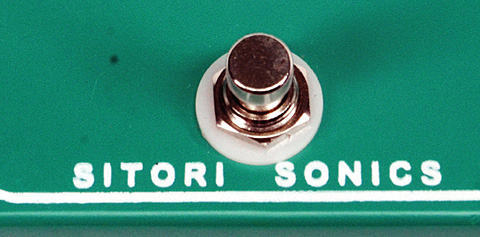


 We added the B-Blender to a reissue 1955 Gretsch 6120 with the idea of making it an ideal country and rockabilly machine. The sleek styling wasn’t quite right for the Gretsch’s vintage chic, but the sound sure was. Leon McAuliffe, eat your heart out.


 The latest record from Marty Stuart, Ghost Train: The Studio B Sessions, is a tour de force of country music styles that celebrates the past while pushing firmly into the future. And that’s what renaissance man Stuart was aiming for…
 The TV show also was the catalyst for the only change in equipment he’s made in many years. “My guitars have pretty much stayed the same, but with amps I’ve been all over the place. For the show, someone suggested Kenny and I go to a silverface Fender Princeton. I did, and I add a little boost on top, and that’s it. We use them on the show, and that’s all I used on the record. I’ve found the true tone of my guitar in that Princeton. It’s the way to go for what I’m up to. It rings like a bell and in the control room, it’s tight and bigger than the world. I’ll use it on gigs, too, unless the room is too big. Then I’ll go back to a couple of Fender Twins.”