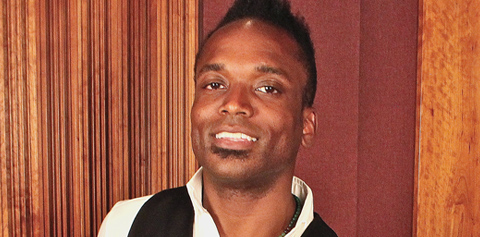
As guitarist on “The Tonight Show With Jimmy Fallon,” “Captain” Kirk Douglas has an enviable gig. He also performs on albums and stages around the world while backing everyone from Bruce Springsteen to Christina Aguilera. His love of heavy rock and funk has given him the chops to hold down guitar duties in one of the most exciting bands on the scene.
You perform on “The Tonight Show” during the week, then fly to other gigs on weekends. Are you constantly cramming to learn new songs?
We learn new music every day, a lot of it on the way to work. Sometimes, I’ll get a song in my mind two nights before the guest’s performance, [but] some music, we’ll learn right before we play it on the show. We use in-ear monitors, and if a guest mentions a song, Questlove will sometimes pull it up on YouTube. Then we’ll hear it in our ears and learn it while the interview is going on.
On Monday, we go over music for the week, record it on Pro Tools, then get little reminders in our ears about what we did in rehearsals. When Springsteen was on, we found out the day before, so I was really cramming.
What was your life like before The Roots?
I played in 11 bands in New York, so I’m no stranger to having a lot of things going on in my head. During the day, I taught pre-school, then at night I played in bands that did hip-hop, hard rock, acid jazz, psychedelic music with poets, and ’70s Miles-Davis-influenced bands.
You sound like a perfect fit.
Roots music is funk- and soul-inspired. You’re playing guitar hooks and funk breaks from James Brown or Mandrill. When I do my own thing, it tends to be more guitar-centric. Heavy guitar takes up a lot more real estate in the stuff that I do apart from The Roots.
Who were your early influences?
I was heavily inspired by Van Halen, Kiss, and the reggae and soul my parents played. Further on, I got into Living Colour – Vernon Reid was a huge inspiration. Later, I rediscovered Parliament Funkadelic and Marvin Gaye. In Manhattan, I played Stevie Wonder and soul covers. In ’97 or ’98, when The Roots played five nights at The Knitting Factory, I saw them and was like, “That’s the band I could see myself in.” It was music in a blender joining all kinds of influences. My first opportunity to play with them was in Japan, and I remember being onstage thinking, “I so do not want to go back to teaching school.” (laughs)
What gear are you using?
For Fallon, a Mesa Boogie Stiletto, Royal Atlantic, and a Lone Star Special. For my own thing, I like Divided By 13; I like dynamics. For pedals, I use a Suhr Riot, a Durham Sex Drive and Zia Drive, the Empress Nebulous, and a Strymon blueSky. My Gibson signature SG has become my number one guitar. When I play it in combination with my Divided By 13, I get really excited.
This article originally appeared in VG January 2015 issue. All copyrights are by the author and Vintage Guitar magazine. Unauthorized replication or use is strictly prohibited.
Having teenage metal-shredders at home makes one appreciate that a little overdrive can go a long, long way. Note to sons – not all songs benefit from being played “at 11.” In the real world, bandmates expect you to sit back in the mix from time to time (like, most of the time). But when it’s your turn to rip into a lead, kicking up the OD a few notches can be just the ticket.
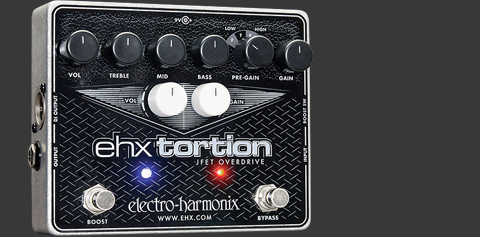
One problem with many OD and distortion pedals is that they’re either “on” or they’re not – great big tone when you stomp… and then they just disappear. That’s not the case with Electro-Harmonix’s flagship distortion, the Tortion. EHX uses JFET analog technology to reproduce the overdriven and distorted character of a tube amplifier. It may be one of the most versatile, best-sounding OD and distortion pedals available.
The Tortion has a buffered Bypass stomp switch, but the whole idea is to keep this pedal on all the time. In its “normal” mode, there are EQ controls (bass, mid, and treble), a Gain knob that controls the amount of input gain, and a four-way Pre-Gain switch that controls the level and tone of the initial input signal. Think of “normal” mode as the tone you want when you’re playing in the mix. The Pre-Gain taps lower input level, for vintage plexi tones, and higher gain for a hotter metallic sound. Each Pre-Gain setting has two tone selections – “F” and “T” for “full” and “tight” – for shaping the bass distortion.
The Tortion’s Boost footswitch takes things to another level (even to “11,” my sons). The boost Volume and Gain knobs are completely independent of the “normal” settings, allowing the two modes to function like separate channels on a tube amplifier. This is very cool, especially when it’s time to step out front for that well-practiced signature riff. The boost settings get your signal hotter and more compressed, but it still sounds like it’s coming from the same amplifier and not some digitally clipped alien monstrosity. Could you get this by using two OD pedals in series? Probably, but you would likely be wrestling with a whole lotta extraneous noise, compounded by the double gain-staging. The EHX Tortion is shockingly quiet for an OD.
The EHX Tortion proved a great pedal in front of both a tube and a solid-state amp. It allowed the overdriven character of the tube amp to transparently come out at practice-level volumes. It even tricked an old Peavey Renown into thinking it was a black-faced Deluxe (almost).
This article originally appeared in VG January 2015 issue. All copyrights are by the author and Vintage Guitar magazine. Unauthorized replication or use is strictly prohibited.
Taste was a criminally short-lived Irish blues-rock trio in the late ’60s, featuring bassist Richard McCracken, drummer John Wilson, and the extraordinary guitar and vocals of Rory Gallagher. They played 1970’s infamous Isle Of Wight Festival, in front of 600,000 people, immediately after deciding to break up.
Murray Lerner’s documentary centers around that set, and mercifully the band’s songs are shown in their entirety – as opposed to Lerner’s maddening Festival, about the 1963-’65 Newport Folk Festivals, in which nearly every performance is truncated.
The concert is fleshed out with informative background from Rory’s brother, Donal, and archival interviews with Gallagher himself. Accompanying them are interviews with The Edge, Bob Geldof, and Larry Coryell, singing the Irishman’s praises. Brian May declares, “It was Rory who gave me my sound,” after the future Queen guitarist asked about his setup (a Vox AC30 with a Dallas Rangemaster treble booster).
Bonus features include music videos of three songs and the trio playing live on Germany’s Beat Club, including “It’s Happened Before, It’ll Happen Again,” with Gallagher displaying credible jazz chops on guitar as well as alto sax.
There’s a CD counterpart that includes three songs Lerner apparently didn’t capture, although inexplicably the sequencing doesn’t match. A small quibble compared to generous footage illustrating Gallagher’s trademark finger vibrato and impressive slide.
This article originally appeared in VG‘s February ’16 issue. All copyrights are by the author and Vintage Guitar magazine. Unauthorized replication or use is strictly prohibited.
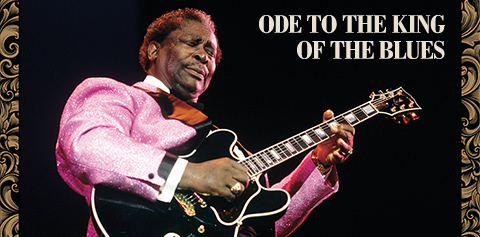
B.B. King was truly peerless. Beyond his ability to pull an audience up via a single long, vibratoed note, he exhibited an incomparable charisma and style, and his influence carried far beyond the way he plucked a guitar.
Fans ranging from simple listeners to world-class guitarists display a reverence for King that is reserved for nobody else. An exemplary human being, those with whom he shared even a moment will tell you of his kind, generous nature. And, if you had the good fortune to see King onstage in his decades-long prime, you certainly recall the moments before he began to play; the band laying down a fantastic jump groove while King greeted the audience and made his way to center stage. Then, with a single pluck and his left index finger applying that famed vibrato, the crowd would explode. Those who had remained politely seated would literally jump from their chairs, joining those already standing, and the room would fill with a rush of give-and-take energy that carried throughout the evening.
In this spirit, we asked noted guitarists and VG contributors to tell us their thoughts on King, who passed away May 14, 2015 after suffering a series of strokes relating to diabetes. Read more comments from players and contributors.
“This is the headstock of my ’62 Strat, which I played when I was honored to do a show with B.B. in the ’80s. B.B. taught us when not to play. He lived every note and so did we. His life was a lesson well-taught, and we receive it with gratitude and respect.” – Steve Sechler
“I loved his playing so much. The first time he did the ‘The Tonight Show,’ his roadie asked if I had a spare high E string. I said, ‘Tell B.B. I have whatever he needs.’ He said, ‘He just wants one E string.’ The next time he was on, I saw him coming and had it in my hand – one E string – and I said, ‘Here it is.’ It was like a tradition; every time he’d do the show, this guy would ask me for that high E. And I mean every time. He’d change that string before the rehearsal, every time he was on.
“At first, I didn’t go back to talk to B.B., because (producer) Freddy DeCordova didn’t like the musicians mixing with the guests and I didn’t know B.B. all that well. Later, though, I’d hand him an E string and we’d laugh. His playing was so brilliantly simple, and he could make just four notes count so much.” – Bob Bain
“B.B. King was the most beloved musician of our time. From the moment I first met him, it was like meeting royalty and I knew we would be friends for life. He was the most gracious person I’ve ever known in the world of music.” – George Benson
“I first met B.B. in San Francisco in the ’60s. We played on a bill at the Fillmore and he invited me to his room at the Fairmont the next day. When I got there, there was sheet music all over. Here was the greatest bluesman in the world – someone I thought really had it made – practicing. The lesson I took from that was just because you have success doesn’t mean you should stop improving. He’s gone, but we’ll be hearing his licks forever.” – Elvin Bishop
“He was the ambassador and emissary for a sound that was forged in the flames of tradition and manifested itself in the American South. And he spread his testimony from Beale Street to the British Isles, from the Delta to Dizzy’s Club and far, far beyond. He said, ‘The blues is everyone’s music.’ Like so many musical geniuses, his virtuosity was immediately recognizable whether he was playing with the sweetness of a lover’s embrace or the ferocity of an underfed grizzly. Styles may change, but style does not. B.B. King personified style and his music will forever endure utterly unaffected by time or trend.” – Jim Carlton
“Blues is deceptively simple music, and B.B.’s guitar playing was that way, too. Any beginning guitarist can put his fingers where B.B.’s fingers went on ‘The Thrill Is Gone’ – hell, the entire first bar is just one note. But no matter how hard you try, no matter how technically accurate you get, you’re only going to sound like somebody trying to sound like B.B. The emotional power B.B. channeled into his guitar lines made his playing far more than simple. It was the simple truth.” – Walter Carter
Steve Cropper (top) with John Hahn (left), B.B. King, and Shemekia Copeland.
“The numerous times I had the pleasure of being with B.B. were always special, but none compare to the afternoon in Las Vegas when he and Shemekia Copeland performed on my album Dedicated. The session was as much fun for John Tiven and I as it was business, but the thing that made it so special was after the recording, B.B. invited John Hahn, Shemekia, Tiven, and myself over to his house. We sat around his dining table and listened to stories about the pictures on his wall. The one I most remember was B.B. giving the Pope one of his Lucille guitars. When asked about it, he beamed and said it was one of his special moments. He said, ‘If there was anybody who could bless my music, it would be the Pope.’
“The world has lost a friend – one of God’s most beautiful people, and an inspiration to everyone.” – Steve Cropper
“B.B. was a consummate artist. He rose to the challenge of his increasing notoriety by developing his sound more – it was deeper – and his ideas sounded stronger; which was no mean feat because he always played with authority. I visited him in the mid ’70s, and I played a recording of some far-out stuff I had worked out on a synthesizer, with dissonances and glisses, etc. B.B. dug it – said it reminded him of Stan Kenton. He was nothin’ if not hip! He was also a sweet man with a ‘harm no one’ approach to life, grateful for his good fortune. Some years back, I took my daughter, Allegra, to hear him, and we got invited to his bus after the show. Allegra was thrilled; we had a blast, hangin’ out, talking about the blues. It’s a golden memory, and when B.B. died, I found out from her.
“I will remember B.B. as the string-bending, vibrato-shaking blues master leading my generation of guitarists to soulfulness. Rest in peace, dear beloved Blues Boy. We will always love and revere you. Thank you for your heartfelt brilliance. In heaven that night, I think the man in charge may have announced, ‘Knock off the ukuleles, string players. B.B. King is here!’” – Larry Coryell
“B.B. was one of the most gracious, humble, genuinely nice guys. Nobody has a bad B.B. story! He took time to encourage everyone he met, and I never saw him without that big smile. I worked with him a few times prior to recording Riding With The King. That album, and the time spent with him in the studio, was such an amazing time full of great music, great people, and a fun project. B.B. held court, telling stories about his life and other musicians.
“There was a point in recording where his guitar would slip out of tune. Simon Climie, our producer, said, ‘Lee would you ask B.B. if you can take a look at his guitar tonight?’ B.B. asked what was wrong, and I said we wanted to get her re-strung and check some levels. Whoever strung it had put too much wrap on the post, so I re-strung her, checked a few things, and we were good to go. B.B. thanked me, and I said, ‘Sorry to have parted you and Lucille for the evening,’ to which he replied, ‘That’s okay. Sometimes she likes being in the arms of a younger man, and she’s playing better.’
“At Crossroads in 2013, I was sad to see him in a wheelchair, but he was as charming as ever. It’s still a massive shock to hear of his passing. He could say more with one note than most other blues players could say in a solo. A unique gentleman who gave us so much. R.I.P., sir. ’Twas a great pleasure and honor to have worked with you, and to have had your music in my life. You were and always will be King of the Blues.” – Lee Dickson
“Who wasn’t influenced by B.B. in some way – and may not even know it? His impact was so great. His passing marks the end of an era, but his influence will live on.” – Michael Dregni
“This is so sad. We’ve lost the king of jazz guitar – Django; the king of soul – James Brown; the king of pop – Michael Jackson; the king of rock and roll – Elvis; and now the king of the blues. I owe so much to B.B., as does every blues-oriented guitarist in the world. He was a hero and things just won’t be the same without him.” – Les Dudek
Billy Gibbons and B.B. King.
“It’s difficult to fathom a world without B.B. King. He’s been with me literally since the dawn of my musical consciousness. I first encountered him as a youngster, when my Dad, an entertainer, would take me around to recording studios in Houston. We met B.B. at ACA Studios when I was six or seven. He made a huge impression on me, and that encounter continues with a special resonation.
“Over the ensuing years, we were privileged to spend time in B.B.’s presence on numerous occasions. He was warm-hearted, generous, and giving. B.B. was a hero early on, and continues as a hero. His passing saddens us, yet we take solace in the fact that we still hold him in absolutely the highest regard as both a transcendentally talented guitarist and entertainer, as well as a truly wonderful human being whose spirt will always be with us.” – Billy F Gibbons
“For years, people have asked me if I played the blues, and I would reluctantly answer, ‘No, I’m too happy, I guess.’ Truth is, you couldn’t listen to four bars of B.B. King and not get a smile on your face. To me, that’s remarkable!”– Doyle Dykes
“My first guitar hero was Mike Bloomfield. In the jazz world, Jim Hall. And B.B. King is definitely the King! It’s hard to be sad because his life was an utter triumph and his effect on the world so magnificent. My reaction is to celebrate his life as I would think he might prefer. I mean, B.B. King… Wow!” – Robben Ford
“B.B was such a huge inspiration to me. He was a wonderful musician, but he was even more a beautiful human being – the last guy to leave the venue, signing autographs and addressing friends and fans. I met him when I was 16 at a club in Dallas. He sat me down and made me feel like I was the only person in the room, talking about guitars and music. Not only was he a major influence on my guitar playing, but he was just as big an influence on how I conduct myself and treat people. I can’t say enough wonderful things about the man. It’s a sad day.” – Anson Funderburgh
“There is really only one guitar player that you could hear play just one or two notes and be able to positively identify – B.B. King. Sure, there’s a million guys who can play a lot faster, but B.B. could say it all with just one note, and for me that says it all about him. And, he was very gracious. I was lucky enough to have heard him live on several occasions, once in the 1970s where he was the second-tier act in a small club in Las Vegas. Wonderful! I once played on a variety show where B.B. was one of the featured performers, and on a break he chatted with me and the other guitarist. B.B. was cool, telling us, ‘Hey, I don’t play any of the fancy stuff like you guys do.’ Of course, we said, ‘Don’t even think about it, B.B. Don’t change a thing!’ He just smiled that Cheshire Cat grin of his. They don’t make many like B.B. King.” – Grant Geissman
“B.B. King’s signature playing has influenced guitarists that play almost any style. He could get more feeling out of a simple blues lick, and, in his prime, played lines that were unreal! I remember hanging out with Ted Greene one day in the ’70s, and Ted played a B.B. lick that floored me! I wish I’d written it out, as it was the best blues lick I have ever heard. And, how about his singing! Such feeling, and a great vocal sound! When most singers age, their voice typically loses power, and pitch can suffer – not the case regarding B.B.! He still had a great vocal command all the way to the end of his life!
“The good news is his many recordings document his incredible talent, so that all may hear it. His influence will shape young guitarists forever!”– Jay Graydon
Will Lee with King in 1996.
“B.B. King will always be seen as an American original. He was a guitar hero to players from all walks. I had numerous encounters with him with Paul Shaffer and the band [from “The Late Show with David Letterman”], including the 1996 Summer Olympics closing ceremony, where we spent a lot of time in the hot sun, exchanging thoughts and philosophies. I really admired the fact he would stay up late after concerts on the bus, answering fan mail.
“I had the great honor of producing Mr. King on two tracks of vibraphonist Gary Burton’s 1996 6 Pack LP; Gary had to be away and B.B. was available for a tiny window of time due to his touring schedule. Not only did he set aside the only free afternoon of his year to play on the project, he gave way more of himself than he needed to, out of respect for Gary. I’ll never forget his kindness.” – Will Lee
“What a loss in the passing of B.B. How many musicians have there ever been that three quarters of the people on planet Earth can identify after hearing only one note? A wonderful legacy that will live on in the centuries to come. RIP, B.B. King.” – Mitch Holder
“What a sad day. This is the blues. When I was very young, I would improvise with B.B. King records; he was such an influence on me and my playing. In my opinion, there is only one King – B.B. King.” – John 5
“I met B.B. twice, and found him to be a down-to-earth, good man who genuinely loved what he did. When I was a kid picking up guitar, I was drawn to the blues. Soon after, I discovered B.B. King and his stand-alone style of playing. Not only was he a unique bluesman with a sound you could pick out after two notes, he was an incredible singer with a style going from smooth melodic lines to all-out growling in effortless transition. He influenced other bluesmen, an enormous amount of rock guitarists, and even jazz players, with pushes, bends, and pulls that were all unique to his playing as he let Lucille do the talking. He had touch, timing, and above all, feeling!
“Everyone lost a true legend today, and all of us who play guitar owe a debt of gratitude to the King of the Blues.” – Tom Johnston
“A massive loss to the music and guitar community. The gifts B.B. gave us will be with us forever – a legacy of class, style, and a bagful of blue notes that will be played every day, but never quite as soulful as when he played them. God Bless B.B. and respect to his family.” – Steve Lukather
“B.B. King’s playing has been a constant influence over the years. Whenever I get lost, I go back and listen to the Blues Is King LP. What have I learned from B.B. King? I play way too much and that the space is just as important as the notes we play. His vibrato and phrasing was beautiful – a B.B. King solo was like getting a letter from home.
“When I finally got to see B.B. live in 1985, he turned my head around. His records were great, but seeing him live was another experience altogether. There was something about him in concert – so much sweetness and love in every note he played and sang. In 1990, Kentucky Headhunters were asked to present the Gibson Guitar award to Eric Johnson at the NYC Hard Rock Cafe. In the audience was B.B., and immediately afterward, we went to Mr. King to shake his hand. He was so gracious and kind, and had some wonderful things to say about our band and our Grammy win that week. The next night, we traveled to a gig (at Toad’s Place in New Haven, Connecticut) a day early to catch B.B. in concert. At the end of the night, he dedicated ‘You Know I Love You’ to the Headhunters.
“The last time we saw B.B. perform was at the 2010 King Biscuit Blues Festival, in Arkansas. We could see that his health and stamina was on the decline, but his love for the blues and his fans hadn’t wavered. I will spend the rest of the my life practicing the restraint B.B. exhibited in his playing. It saddens us deeply to hear of his passing.” – Greg Martin
“B.B. King’s playing and singing cut to the essence of the music. His guitar fills and solos were beautiful examples of truly heartfelt music. He was one of those players gifted with fantastic musical intuition that made him sound so good! Also, having had such an appealing and unique sound and style, he joined that elite group of players whose name became synonymous with a specific style. It’s not uncommon to see ‘a la B.B. King or a la Freddie Green (or Wes Montgomery, etc.)’ on lead sheets. Their names define a style! He was truly one of the greats, and lives on through the many, many players he influenced.” – Tim May
King in 1968. Photo: Steven Stone.
“I saw B.B. King for the first time in 1968, at the Wollman Memorial Skating Rink in NYC’s Central Park as part of Ron Delsener’s concert series, where B.B. shared the bill with Fats Domino. It was an outdoor concert that began around 6 p.m. and B.B. wore a black tuxedo and a shirt with French cuffs. I was impressed by how every note B.B. played mattered and also by how slickly professional his show was, especially compared to the do-your-thing rock acts of the time.” – Steven Stone
“I was noodling on my guitar between passes, rehearsing for B.B. King’s ‘Late Show’ performance, when he spun around to ask, ‘Could you play that again?’ I did, then he played his version of it, with that great smile. This man, in his 80s at the time, could have stopped listening to new ideas years before, but I learned that day – there’s never time to rest on your laurels. I miss Freddie, Albert, and B.B.” – Sid McGinnis
“One of the greatest opportunities I’ve had in writing for Vintage Guitar was the in-person interview with B.B. King in 1995. Mr. King put me at ease from the outset, and was eloquent and enthusiastic about his craft. I have been sober since February of 1979, but was as high as a kite – in a special and non-dangerous way – following my interview with Mr. King.” – Willie G. Moseley
“I did a few shows with B.B. over the years; he was always gracious and always played like no other. The first time I saw him perform was at a small club on Long Island called My Father’s Place. He tore it up that night; his guitar tone was ripping, the amp distorting and heaving with every phrase he threw at us. That show is my favorite memory of B.B. King, King of the Blues.” – Joe Satriani
“B.B. was by far the most influential blues guitar master of our era. I used to play his records by the hour, trying to imitate the soulful guitar licks and string bends, along with the vibrato he added to the ends of phrases. He could make Lucille cry or laugh, and his big, warm voice was instantly recognizable. I got to talk with him a few years ago; his warmth and hospitality were everything I could have hoped, and I felt so fortunate to have that wonderful opportunity. He will be missed. A true original, there will never be another like him.” – Pat Simmons
“If it wasn’t for B.B. King, we might all be playing acoustic folk music right now.” – Steve Vai
“At 17, I saw B.B. on a TV show called ‘The Beat.’ I’d been reading about him in quotes from Mike Bloomfield and others. At first, I didn’t get why they thought this guy, who didn’t play that fast, was so good. But, I found a bunch of his old LPs in a bargain bin and started listening. I then started to understand more of the soul of the real B.B. and why he deserved praise.
“A short while later, he appeared on the local TV show, and we went to see him. We made such a fuss at his performance that after his segment, B.B. came over to say thank you! He was humble and regal at the same time, and let me carry Lucille to their van.
“There have been few times since when taking a blues solo that I have not been mindful to use the attentiveness I think B.B. would have exercised in choosing my notes carefully, building my solo, getting the best tone, and performing the tune to get the best reaction from the audience. He was always there in the back of my mind, and now that he has left us, I realize he was more of an influence to me than perhaps any other one guitarist. I can only say, ‘Thank you for everything, B.B. Well Done!’” – Rick Vito
Buddy Whittington looks on admiringly as B.B. King signs his ’67 Gibson ES-335.
“B.B. was a great, real man. We won’t see his like again. In 1994, I took my ’67 ES-335 to a B.B. show in hopes of having an audience with him. Thanks to my friend, Derek Spigener, my wife, Cathy, and I got to meet him. B.B. said, ‘I’ve gotta sign this one, it’s a Gibson!’” – Buddy Whittington
“All of us mourn the loss of one of the true giants of roots music. In a sense, B.B. King was the musical bridge that rural American blues crossed from the deep south into the big city and then spread throughout the country and the world. He was a shining example of what it means to be committed to a life of music, and as an inspiration to us all.” – John Oates
“B.B. King was the quintessential blues guitarist of the 20th century. His influence was worldwide and affected all blues guitarists and many others who followed. His music was the essence of honesty and personal soul, which connected him to the minds and hearts of people everywhere. My admiration for his music is deeply felt and my friendship with this beautiful and spiritual man is something I’ll always treasure.” – Kenny Burrell
“B.B.’s still the king of blues – always will be. I call him the king of the one note. With that incredible vibrato he could make one note sing forever and when he did he said so much with it. We we all loved him and he was inspiration for all of us guitarists. A couple years ago, Steven Seagal and I opened his Nashville club. B.B. was 86 and it was his birthday. A lot of guests wanted to pay tribute, and it was a real thrill; we all played together and he loved all the music. He kept loving music and playing all his life. We all miss him.” – James Burton
“B.B. King was an American treasure who truly deserved the moniker ‘King of the Blues.’ He generously shared his knowledge of music and tales of the road with younger generations of musicians, encouraging them to play from the heart and keep the true spirit of the blues alive. His inspiration is carried on by countless players. One of his most valuable lessons was that less really can be more. He could say far more with just one soulful note than most could say with a million. His music will continue to inspire and educate for years to come. Rest in peace!” – Lisa Sharken
Wolf Marshall chats with B.B. King in 1986.
“B.B. was a huge influence and an inspiration throughout my formative years on guitar, and afterwards, in life. I was fortunate to spend quality time with him over the last 30 years. He was always gracious and welcoming. We hung backstage at the Hollywood Bowl when he and Ray Charles were honored in 1986. In 2002, I wrote B.B.King: the Definitive Collection, and presented it to him a little later. He was very pleased with it, to know his legacy of blues guitar was officially part of music education. The thrill of my life was sharing the show with B.B. King, Kenny Burrell, Dee Dee Bridgewater, and surprise guest Stevie Wonder in 2011.” – Wolf Marshall
“I was very sad to hear of B.B. King’s passing; I learned about the blues and B.B. while in high school, when I did odd jobs and radio repairs. A local juke-box operator asked if I could fix his jukeboxes. I had never worked one, but I’d worked on audio amplifiers for my father’s music store. These jukeboxes were filled with blues and R&B records which this guy would change every two or three months, and he’d give the old ones to me. By the time I graduated from high school, I had 1,000 old R&B/Blues 78s, and had repeatedly listened to them all including the early Blues Boy King records on the RPM label. I was trying hard to be a guitar player, so B.B.’s music was a huge influence. I heard him live in 1961; me and my two buddies were the only white guys in the Ellis Auditorium, and I’ll never forget the moment B.B. started playing. I got goosebumps! I got to meet B.B. years later, and when the B.B. King Museum opened in Indianola, Mississippi, they were looking for old records. I still had 13 of the old Blues Boy 78s, and they are now hanging on the walls of the museum.
“He will be sincerely missed and there will never be another like him. He’s in a better place, still playing Lucille.” – Hartley Peavey
“He was not only a charming man, but he embodied an elegance that the rest of us don’t even know we’re missing.” – Jim Stafford
“B.B. is one of the giants inspiring in me the belief that playing the guitar is a worthy endeavor. The first time I saw him live was in the mid ’70s at Paul’s Mall, in Boston. I was inches from the stage. The band came out and sounded incredible. Then, he walked on, and with his first note – one note – stunned! He brought the level up about a thousand notches. I’d never heard that kind of power. The beautiful kind. James Cotton showed up that night, joined in, and they had a ball. So did everyone else. What a night. I’ll never forget it.
“As soon as my daughter learned to walk, she found a cassette with B.B. King and Bobby Bland, and played it until the machine wore out. He touched everyone. How could I ever thank him? We are blessed.” – Bill Frisell
This article originally appeared in VG August 2015 issue. All copyrights are by the author and Vintage Guitar magazine. Unauthorized replication or use is strictly prohibited.
If there was a time machine handy to scoot us back to 1964, where we would naturally stock up on new guitars and amps, a blue-and-silver Supro would be at the top of most guitarists’ must-grab lists.
Happily, time travel isn’t necessary. Fifty years on, new Supros are available with all of that vintage ’64 vibe.
While the most famous Supro these days may be the bassman’s Thunderbolt – granted, it is famous among guitarists – back in the day, both Jimi Hendrix and Jimmy Page used Supro models that were built for guitar players and offered features beyond the one-trick-pony Thunderbolt.
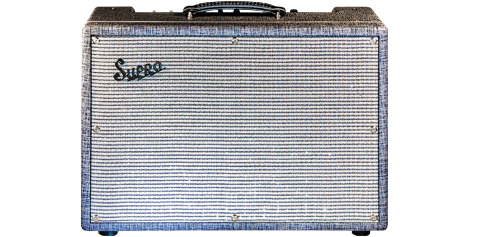
The all-tube 1624T Dual-Tone 1×12 is Supro’s all-rounder. It’s got the wattage to play small clubs, tube-powered tremolo, an affordable price, and it’s made right here in the U.S. of A.
Need a little more oomph? The 2×10 1690T Coronado boasts 35 watts of Class A power and is Supro’s top-of-the-line amp.
But these are not simple reissues or replicas. Instead, they are based on a “vintage design by Valco” that’s “re-engineered and modified” by mastermind Bruce Zinky (former Fender amp designer, responsible for the stellar Custom Shop Vibro-King, and builder of Smokey Amps) and David Koltai (Pigtronix). Since their debut in 2014, the Supros have been the talk of the industry.
To take any guesswork out of the equation, we plugged in a suitable vintage guitar: a ’64 Rickenbacker 365.
The Dual-Tone offers 24 watts via a pair of 6973 power tubes plus a quartet of 12AX7EHs through a specially designed 12″ speaker. The Rick sounded beautifully clear, chords ringing out like chimes.
The Coronado provides more wattage in a Class A design, all delivered via a dual 6L6 output stage, 5U4 tube rectifier, and dual 10″ speakers.
Both amps feature two channels, both sporting tremolo. Switching over to channel IN1+2 on either amp provides two preamp channels in one, with double the input signal and double the gain. This was an original ’64 concept, and Mr. Page utilized it well on the solo in “Stairway To Heaven,” which gives Supro a dictionary-perfect definition of the term “street cred.”
Plugged into the Coronado’s IN1+2 jack, the Rick sang like a full choir. The sound was rich and thick. While the Dual-Tone had a distinctive wide-ranging boom to its big 12″ speaker, the extra horsepower and smaller 10 speakers of the Coronado allowed the Rick to overdrive that amp at lower volumes. The result was a creamy-smooth sound that had more bite the further the loud knob was twisted northward.
Still, even at higher volumes, both of these amps remained amazingly articulate. Their voice had punch but was still clear, and their tone had an edge but was still warm. Think Vibro-King.
The net result is that you want to play these amps – and keep on playing them. We logged many an hour with them, and they proved rock-solid reliable, which can’t always be said for their vintage brethren.
The cabinets and baffle boards of original ’64 Supros couldn’t always handle a roadie’s thoughtless abuse. These new amps weigh more than a vintage Coronado we compared them to, and happily a good portion of that weight is in sturdier cabinet construction.
Now brace yourself: these new Supros are arguably better amps than the ’64 originals. True, they use printed circuit boards, but the tradeoff is that the amps are affordable – especially given their specs and the Zinky pedigree.
Finally, with their baby-blue rhino-hide tolex and silver grille facing, they just might be the coolest-looking amps out there. Whether you’re playing the blues in a juke joint, classic country in a roadhouse, or rock and roll in a club, these amps will get noticed, both for their style and their tone.
Forget building that time machine out in your garage. Go for the modern Supro time warp instead.
This article originally appeared in VG August 2015 issue. All copyrights are by the author and Vintage Guitar magazine. Unauthorized replication or use is strictly prohibited.
Bad Cat Amplifiers’ Unleash V2 Re-Amplifier/Attenuator has a reactive load input, two foot-switchable channels, output variable from 1/10 watt to 100 watt, input impedance (4/8/16 ohm), and headphone and direct outs.
Aside from witty asides on social issues, natural disasters, and Renaissance history, Adrian Legg’s formidable fingerstyle and deep musicality remain his calling card. His latest album, Dead Bankers, continues the bedazzlement.
On “Marco’s Bounce,” you put a piece of foam under the strings to create a percussive effect.
I owe the foam trick to [Brazilian guitarist] Marco Pereira. It’s a great idea for practicing on an acoustic because it allows a player to pick as soft or hard as they like without upsetting neighbors or getting chucked out of a hotel. I use a piece of old packing foam and squash it against the bridge on the playing side.
What guitar do you use on “Toot Toot?”
My main guitar, made in 1995 by Bill Puplett. The pickup was made by Steve Blucher, at DiMarzio. I needed a pickup no more than six millimeters deep so I wouldn’t have to cut into the guitar’s box. It’s stuck with carpet tape, and a mounting ring stops it from sliding about on its tack. For most of these recordings, I ran the signal though my pedalboard and into a stereo recorder on my elderly laptop, so all the shaping, gain structure, and delay is done with my pedals.
“Hacked Off Boogie” is reminiscent of your younger days as an electric guitarist.
I had a Gretsch for a while, but it got stolen. Then I had a Tele I traded in for a Martin-016NY. On electric, I played country music, at first, which fired me up with the discovery of guitar life outside the pentatonic scale, and introduced me to steel guitar. I sometimes played in Irish pub/function bands, where either you played something or you didn’t get paid. After the Tele, I used cheap electrics for pub gigs, then started getting work at the BBC with the acoustic.
Describe the guitar sounds you heard in Britain, before the Beatles.
When I was a boy, the guitar was strictly forbidden, so guitar music was an illicit affair involving a crystal-radio set under the bed clothes. I wasn’t a part of the skiffle scene – it didn’t attract me. But, when I heard the Shadows… oh boy, what a sound! Clear and shiny, full of tone, and that little twist in the echo trail. There were snippets of others – The Ventures and Lonnie Mack – that infrequently came through on Radio Luxembourg and imprinted on my psyche.
When did you hear Merle Travis and Chet Atkins?
What little I did get was second- or third-hand, mostly by seeing other guitarists around the working men’s clubs in Liverpool. That was enough to get the bare bones of alternating-thumb bass notes and the banjo roll.
What kind of compressor do you use?
I did a tour with Joe Satriani that was engineered by Randy Lane, and I picked his brain as much as I could. He liked big Avalon tube compressors in a rack, which gave me the idea to seek tube compression in something smaller. Eventually, I found Phil Taylor of Effectrode and, after some discussions and suggestions, got to try his prototypes with the sub-miniature tubes. He refined the design into the PC-2A, and its compression is very high-quality – beautifully smooth and transparent. And, thanks to the nature of tubes, it helps get rid of that nasty piezo-pickup spike.
What gear are you using on tour?
It’ll be the Bill Puplett guitar and a small pedalboard. I also have a little ZT Junior lunchbox amp, which gives me consistent monitoring without heavy lifting. Pedals are the Effectrode Helios tube fuzz, the PC-2A, a JAM Dyna-ssor compressor; an old Boss GE-7B bass EQ recently restored by Pedalmods U.Kl, the rare Boss VB-2, a Cusack Tap-A-Whirl tap tremolo and Sweet Verb, and a Wampler Tape Echo.
What’s your take on the trend of playing percussion on the body of the guitar?
I think that what makes American guitar so special is that it adapts across divergent cultures and disciplines to its users’ needs. The rhythmic thing isn’t actually new; it was always used in flamenco and now and again, an old film surfaces showing an old American guitarist doing the same thing.
Guitarists must constantly ask you for tips. What’s the first tip you give them?
Throw away that nasty bit of plastic and see all the things you can do without it!
This article originally appeared in VG January 2015 issue. All copyrights are by the author and Vintage Guitar magazine. Unauthorized replication or use is strictly prohibited.
AmpRX BrownBox Voltage-Reduction Unit
Price: $269.00 (list)
Contact: www.amprx.net
Amplifier repairman and builder Patrick Geraghty was frustrated with the sound of his own vintage-styled builds. They seemed to lack the vintage tones of the ’60s and ’70s. In addition to examining components, he also began to look at the disparity between the wall voltages of yesteryear and today. While most classic amps were built in the days of 110 volts, modern-day wall voltages are generally in the 120-129 range. When Geraghty lowered those voltages, he found that the amps opened up with more harmonic content, earlier compression, and a sweeter overall tone. With this revelation, he set out to create an easy-to-use device that would give gigging players lower era-correct voltages for their vintage and vintage-styled amps.
The AmpRX BrownBox is a voltage-reduction unit that features a simple two-knob design comprising a Primary Voltage Select knob and a Reduction Level knob, and an LCD backlit meter to display voltage and amperage levels. The sturdy powder-coated unit housing has a front-mounted 5-amp circuit breaker and a lighted On/Off switch.
We tested the BrownBox with a 1965 Vox AC30 and a 1974 Marshall JMP 50. Operation is fairly simple. Plug your amp into the BrownBox’s AC input, turn on the BrownBox, and check the readout. Then dial in the Primary Voltage Select knob to match the readout as closely as possible. The Reduction Level knob allows you to lower the voltage by a percentage of 3, 4, 6, 10, or 0 (for bypass). It is also possible to “brown out” your amp by setting the Primary Voltage knob to a voltage higher than reality and then using a high Reduction Level setting to starve the circuit.
Dropping the voltage down to 110 with the AC30 seemed to sweeten it, smooth it out, and give it a bit more compression compared to what the amp sounds like at 120 volts. Although it sounded nice before the voltage drop, the BrownBox certainly improved the sound at 110. The change was most dramatic with the Marshall, however. The tone seemed to fill out, “bark” more, and be less strident. With both amps, we loved their sound at 120 volts, but loved them even more at 110 and had no desire to go back.
If you are a vintage-amp connoisseur, experiment with yours at voltages in the range of 110 to 115. If you like what you hear, the AmpRX BrownBox is an ideal and handy solution for providing lower voltages to those prized vintage amps.
This article originally appeared in VG January 2015 issue. All copyrights are by the author and Vintage Guitar magazine. Unauthorized replication or use is strictly prohibited.
Joe Bonamassa may not be pushing the blues genre forward, but his fans don’t care. His latest opus features 75 minutes of blistering blues-rock.
The CD comes with a DVD and features both his acoustic and electric bands. They contain the kind of rootsy imagery that has made Bonamassa a blues-fan’s favorite.
A fleet of Les Pauls through high-end amplifiers offsets the band’s unique chemistry. This top-tier ensemble provides exemplary accompaniment to Bonamassa’s impassioned singing and pitch-perfect vocabulary of licks.
Willy Dixon’s “Hidden Charms” and Muddy Waters’ “I Can’t Be Satisfied” mingle with Bonamassa’s “Dust Bowl,” and “Black Lung Heartache.” Bonamassa sings like an American Idol and plays guitar with the soul of Paul Kossoff – all proving that the blues is many things to many people.
This article originally appeared in VG‘s February ’16 issue. All copyrights are by the author and Vintage Guitar magazine. Unauthorized replication or use is strictly prohibited.
EVH Gear is set to offer of a 20-piece run of custom-built EVH Wolfgang USA Tour Relic Replica guitars. Given a detailed relic treatment with a coat of black paint showing through an Ivory top coat, they also have an ebony fingerboard, block fretboard inlays, “kill” switch, custom high-friction Tone pot and High Performance Upgrade (HPU) low-friction Volume pot. They ship with with a custom Anvil case with the Van Halen logo, certificate of authenticity autographed by Eddie Van Halen, and more.





 “This is the headstock of my ’62 Strat, which I played when I was honored to do a show with B.B. in the ’80s. B.B. taught us when not to play. He lived every note and so did we. His life was a lesson well-taught, and we receive it with gratitude and respect.” – Steve Sechler



 Still, even at higher volumes, both of these amps remained amazingly articulate. Their voice had punch but was still clear, and their tone had an edge but was still warm. Think Vibro-King.
 Bad Cat Amplifiers’ Unleash V2 Re-Amplifier/Attenuator has a reactive load input, two foot-switchable channels, output variable from 1/10 watt to 100 watt, input impedance (4/8/16 ohm), and headphone and direct outs.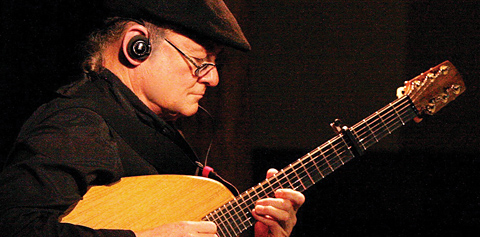
 Aside from witty asides on social issues, natural disasters, and Renaissance history, Adrian Legg’s formidable fingerstyle and deep musicality remain his calling card. His latest album, Dead Bankers, continues the bedazzlement.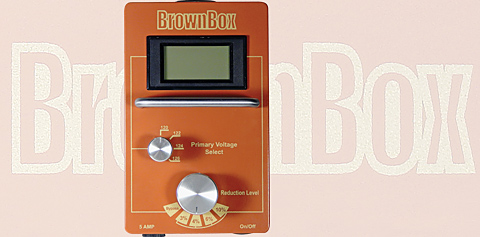


 EVH Gear is set to offer of a 20-piece run of custom-built EVH Wolfgang USA Tour Relic Replica guitars. Given a detailed relic treatment with a coat of black paint showing through an Ivory top coat, they also have an ebony fingerboard, block fretboard inlays, “kill” switch, custom high-friction Tone pot and High Performance Upgrade (HPU) low-friction Volume pot. They ship with with a custom Anvil case with the Van Halen logo, certificate of authenticity autographed by Eddie Van Halen, and more.