 The Ogre Tubeholic overdrive pedal utilizes PCB construction, is wired true-bypass, has controls for Level, Tone, and Gain, LED on/off indicator, and a sliding cover to protect settings during use. For more, visit www.ogreusa.com.

The Ogre Tubeholic overdrive pedal utilizes PCB construction, is wired true-bypass, has controls for Level, Tone, and Gain, LED on/off indicator, and a sliding cover to protect settings during use. For more, visit www.ogreusa.com.
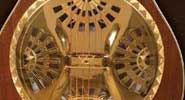

Hallelujah! At long last, a book on the Dobro.
No, Steve Toth’s Dobro Roots may not be the complete, encyclopedic history unraveling the tangled tale of the Dobro concern from its contentious National spinoff through its Regal association, later retwining with National, and then its various postwar strands. And no, there’s not a scrapbook of images of famed dobroists at work: Cliff Carlisle, Josh Graves, Bashful Brother Oswald, and kin. Leave that all for another book, sometime in the future – maybe.
Instead, Toth has focused on the guitars – and the guitars that are the most sought after, Dobro’s prewar wood-bodied resonator instruments. And he’s done things right, with simple yet stylish photography. As the subtitle emphasizes, this is “A Photo Tour,” and a solid, organized one at that.
Toth makes sense of Dobro’s curious model numbers that have long bewildered and beguiled enthusiasts. He separates the book into chapters based on the companies’ catalog lines and series, starting in 1929 and running through 1941. The development and variations of models are well explained: for example, the difference between Model 27s built in California versus in Chicago by Regal, and then later National-Dobro developments. And he touches on Dobro’s “badge-engineered” resonators, such as the Magno-Tone made for Montgomery Ward and others.
The collection of guitars that Toth has photographed is wondrous. He has a healthy respect for the lower-priced base models – the Model 27s and 37s, which are often some of the best-sounding Dobros despite their less-exalted appointments. At the same time, he has also amassed a fine selection of the flagship models and custom guitars, such as the Model 65/66/60 with its sandblasted scroll designs and the fancy black walnut-bodied 156 with gold-plated and engraved metalwork.


The selection, though, highlights Toth’s personal interests, and unfortunately there are no ukes, mandolins, tenors, tenortropes, banjos, or any of the metal-bodied Dobros built at the same time. Nor does he get into Dobro’s fascinating and little-known early experiments with electric amplification. But the book’s subtitle makes no false promises – and again, that’s all ripe material for a thorough history.
There are some technical details, however, that would have been good to elucidate on here. The photo tour ideally would have visited the build and design details of the spun versus stamped aluminum resonator cones, long versus short spider bridges, and the wooden soundwells with either round or parallelogram holes. But that’s a minor quibble.
Toth also includes a CD entitled Sounds of the Prewar Dobros with 15 tracks played on guitars illustrated in the book – many of which, however, are fitted with later cones, mostly John Quarterman replacements.
Dobro Roots is well worth the wait. With a foreword by Jerry Douglas, this is a beautifully published volume that does these guitars justice.
This article originally appeared in VG‘s August 2014 issue. All copyrights are by the author and Vintage Guitar magazine. Unauthorized replication or use is strictly prohibited.
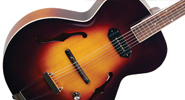

Loar LH-309 VS Archtop
Price: $569.99 (street)
Contact: theloar.com
As the retro craze delves deeper into six-string history, a spate of non-cutaway archtops have hit the market, celebrating an era when giants like Eddie Lang, Lonnie Johnson, Charlie Christian, George Barnes, Eddie Durham, Carl Kress, and Oscar Moore laid down cool chords, sultry bends, and horn-like single note lines on Gibsons and Epiphones.
Loar recently began offing the LH-309 VS archtop, a straightforward instrument that fully exudes a vintage vibe, thanks to a vintage sunburst. The guitar has a solid, hand-carved spruce top, maple two-piece back and sides, a mahogany neck and bound rosewood fingerboard with 19 frets. The lower bout has a 16″ span, while the upper bout is 111/2″; the body’s depth is 33/4″, which is well balanced in the lap. The neck scale is 243/4″ and there’s a two-way truss rod. Loar’s Vintage V neck profile is unusual, but fits very comfortably in the hand. There’s a compensated ebony bridge and simple trapeze tail. The Grover tuners have “butterbean” keys and open gears. A fleur-de-lis inlay adorns the headstock. Again, the finish is very attractive on the front, sides, and back; a dark ’burst that ranges from black to deep amber. We’d note that there are a few minor flaws in the finish, but in this price range they’re of little concern.
Electronics on the LH-309 are nice and simple – just a single Loar P90 pickup with a master Volume and Tone, each with a vintage-style knob. Obviously, the name of the game is jazz and blues, but the guitar covers a nice range of styles, from swing to country to vintage rock and roll – it all depends on how you set it up and what you play.
The LH-309 ships with medium-gauge roundwound strings that sound a bit brash and clanky when the guitar isn’t amplified. Speaking of, the guitar has good projection unplugged, which is the acid text for any archtop.
Plugged into a small amp, the LH-309 turns into an elegant World War II jazz box, perfect for those fat swing and early bebop lines that put Charlie Christian and his generation on the map. Roll back the tone knob to find the shading of your choice, but the Loar P90 does a good job conjuring classic, single-coil-snappy jazz tones. Sure, humbuckers are quieter, but the single-coil jazz tone is iconic, and can’t be duplicated without the proper pickup. The LH-309 gets it right with this simple (but accurate) electronic setup.
In terms of playability, the Loar’s neck is very likeable, with a fast and comfy V profile. With the quick action on the fretboard and access to the 16th fret, there’s not much to dislike. To those who dismiss non-cutaway guitars like the LH-309, we’d note that they are a singular experience, both in terms of playing and sound. Sonically, a non-cutaway provides a fuller acoustic sound, which is simple physics – there’s a bigger volume inside the body to generate tone. And as for those who say that the non-cuts deprive them of frets for upper-note playing – you shouldn’t be playing jazz that high, anyway! The thick, buttery tones of jazz and blues guitar are generated below the 12th fret; so why even go to high-and-thin territory?
After you play the LH-309 for a bit, you get it. It simply sounds better for certain genres and performances. If you want to bend strings at the 20th fret, get a Strat.
Ultimately, the LH-309 is eminently likeable in terms of feel and sound – and in sheer historical vibe. Again, we’d recommended switching to flatwound strings, but for swingin’ mid-century jazz and blues, the LH-309 is one cool cat.
This article originally appeared in VG August 2012 issue. All copyrights are by the author and Vintage Guitar magazine. Unauthorized replication or use is strictly prohibited.
 Congrats to Steve Tepper, New York, the grand-prize winner of the Collings 290 in this year’s Team Josie Relay For Life raffle presented by Vintage Guitar magazine. Congrats, also, to runners-up Ken Vogel (also from New York) and Chris Keledjian (California), who will each receive an autographed box set of Joe Bonamassa’s Tour De Force in London on Blu-Ray!
This year, VG raised more than $10,000 for Team Josie, all of which goes to the American Cancer Society. VG would like to thank everyone who purchased a raffle ticket, as well as sponsors Collings Guitars, Joe Bonamassa, Dave’s Guitar Shop, and Gruhn Guitars.
 JHS Pedals Colour Box is designed to re-create guitar “direct-to-console” tones, using dual Neve 1073 preamp topologies and a tuned Baxandall EQ. Its components include a custom Lundahl transformer, all-analog circuitry, parallel 1/4″ and XLR outputs, while its functional elements include a five-step Gain Stage selector, three-band EQ (Treble, Middle, Bass) with +/- 17dB of EQ boost/cut control, and a selectable Hi-Pass Filter. For more, visit www.jhspedals.com.


When you build guitars for a living, you might unwind with another hobby – say, beer-can collecting or crochet. Not Jeff Senn, mastermind behind Original Senn Guitars. He started a band.
Call it R&D or just plain fun, but Senn’s band, Crazy Aces, is a funky, kitschy ensemble that plays an amalgam of hard-driving surf, Japanese eleki, mod, Spaghetti Western, pyschedelia, and noir instrumentals. And Senn sculpted the sounds with an equally eclectic range of guitars.
He assembled Crazy Aces from friends and fellow pro musicians in Nashville – which Senn says was not an easy task. It seems counter-intuitive, but Music City is not an ideal place to start a band.
“Nashville is a music business city,” Senn explains. “As such, most musicians here play for a living – or are trying to. It can be difficult to find like-minded musicians who are interested in being part of a project that is if it doesn’t pay. A lot of musicians here play in touring bands, which keeps them gone too often to rehearse or book local shows.
“I believe a lot of players here feel they have to be on top of their game – you never know who’s watching and listening – and there’s a lot of truth to that thought process. But I also think that many of those same players don’t fully comprehend [playing] music for joy or fun anymore.”
But this band understands. Crazy Aces features Senn on guitars, drummer Tom Hoey, and bassist Justin “Oscar” Cary. Their combined résumé includes stints with John Fogerty, Lucinda Williams, Trisha Yearwood, Jewel, Counting Crows, Wynonna, and Paul Brandt.
Senn himself has worn many a hat in the biz. As a teen, he apprenticed repairing and building at Zon Guitars in Buffalo, New York, before moving to Nashville with sideman dreams. He was soon managing Gibson’s repair shop, before a decade-long stint on the road as a backing musician and guitar tech. In 2004, he established Original Senn Guitars, and has built instruments for everyone from Fogerty to Bruce Springsteen.
Now it was time to have some fun.
Crazy Ace’s debut CD brings them back to their musical roots – ’60s faves from the Ventures to the Astronauts, Duane Eddy to Link Wray. The result is their first album, cheekily named Greatest Hits Volume 2.
“I still wanted to play, but had a desire to take things back to the original reasons I played in the first place – love of the instrument, love of music, and just plain fun,” he said. “I asked myself, ‘What is it about guitar and guitar music that I want to express? What would be relevant to the sounds and tones that I loved to hear and make?’ At 46 years old, I wasn’t trying to prove anything to anyone or seek approval. I just wanted to have fun and experience that pure joy you get when making music you love. This thought process is what created Crazy Aces.”
To craft the new album’s wild sounds, Senn drew on his collection of wild guitars. Included are a suitably vast array of Teiscos, including a ’67 Teisco EP-200, ’66 W2-GL, and ’65 TG-64.
“My Teiscos have been dear to me for years. I’ve re-fretted some of them and done some work to make them more reliable,” he enthuses. “The Teiscos are perfect for this music with their clarity and twang and vibrato bars.”
In addition, Senn employed a ’64 Harmony Stratotone and highly modified ’58 Danelectro/Silvertone U1, plus a ’53 Gibson CF-100 for all the acoustic tracking. A 2010 Gretsch White Falcon LTV and ’09 Jerry Jones electric 12- string rounded out the tones.

Not surprisingly, Senn also used one of his own handmade guitars, his 2011 JazzGuar.
“I really wanted a Jag, but I like the longer scale length of the Jazzmaster for more-authoritative, piano-like twang. So I built a 25.5″ scale Jag with steeper neck angle, special pickup placement, and an ABR-style Tune-O-Matic for more bridge-to-body contact instead of the bridge-to-metal contact of the originals.
“The bridge pickup is positioned slightly closer to the neck and therefore is a bit fuller and richer than a stock model. The neck pickup is directly under the second octave harmonic and because of this, highlights those overtones in a nice way. This positioning combined with the Jason Lollar pickups makes for a wonderful ‘old’ sounding guitar.”
He used the JazzGuar to create the Duane Eddy-style twang on Ennio Morricone-inspired “Eastwood Outlaw,” the ratty, fuzzed-out leads on “Arigato Terauchi,” and on “The Last Song” to get the Hank Marvin meets Santo and Johnny sounds.
“This was the MVP guitar of the record. It appears everywhere,” Senn says. “That guitar came through, and continues to inspire me.”
This article originally appeared in VG November 2013 issue. All copyrights are by the author and Vintage Guitar magazine. Unauthorized replication or use is strictly prohibited.

 The name of producer Gregg Miner’s label says it all: Harp Guitar Music. He is a leading practitioner and promoter of the multi-stringed beast and a big reason it’s currently enjoying such a renaissance. That renewed popularity is on full display here, beginning with Brad Hoyt – although it’s just one of the dozen or so instruments he plays.
Joining him are no less than 29 other musicians, eight of them also playing various models of harp guitar, including Miner. Normally, such variance from cut to cut can border on cluster-pluck, and even though Hoyt composed all 14 instrumentals, it’s as much a compilation as solo outing. And an excellent compilation it is; the only drawback is in the pacing.
The CD opens with the melodic noir jazz of “The Relative Sea,” carried by Howard Levy’s harmonica and Jeff Coffin’s soprano sax, with Hoyt on piano. Then we plunge into lively Gypsy swing featuring Miner and Joscha Stephan on guitars. Next, the waltz “Impossible Liaison” features Tomas Mach’s violin, before guitarist Phil Keaggy gently coaxes melodies from the spare “Look Inside.”
These shifts in tempo and texture lend a cinematic, soundtrack feel to the proceedings, somehow avoiding gratuitous jarring. Muriel Anderson, Stephen Bennett, Mike Doolin, Andy Wahlberg, and other harp guitarists take turns, but “Ricochet,” with just Hoyt overdubbing plucked and bowed piano, cimbalom, and a 30-string arpa viola caipira, is especially impressive. Unfortunately, about two-thirds into the program the repertoire gets bogged down in sleepy new-age. Pretty stuff, but one longs for the Gypsies to return.
Every musician is pictured in the liner notes, but with such exotic and one-of-a-kind instruments as a bazantar, lute harpsichord, Knutsen harp mandolin, 7-string bass zither banjo, and nyckelharpa, it’s a shame there aren’t more detailed pictures and descriptions of the instruments, à la David Grisman’s Tone Poems series.
This article originally appeared in VG‘s July ’14 issue. All copyrights are by the author and Vintage Guitar magazine. Unauthorized replication or use is strictly prohibited.
Seymour Duncan is now offering its Nazgûl, Sentient and Pegasus pickups in six-string configurations. Each is hand-wound in California with a black bobbin, black screws, and a black logo. Specifications include: Pegasus DCR – 12.5k, Res Peak – 5.18kHz; Nazgul DCR – 13.6k, Res Peak – 4.75kHz;Sentient DCR – 7.74k, Res Peak – 6.53kHz. Check them out at www.seymourduncan.com.
 Bedell Guitars’ Revere series are available in dreadnought, orchestra, and parlor body shapes. They pair Brazilian rosewood back and sides with an Adirondack spruce top and K&K Sound’s PowerMix Pure XT system, which uses bridge plate transducers, an under-saddle piezo, and an external preamp. All have mahogany necks, ebony fretboards, Waverly tuners with ebony buttons, and an aged gloss-nitro finish. Visit bedellguitars.com.
 Cort’s MR600F acoustic has a dreadnought body with a Venetian cutaway, mahogany back and sides, spruce top, and scalloped X bracing. Its 25.3″ mahogany neck has traditional three-and-three headstock, rosewood fretboard, and dot inlays. Its Fishman Isys preamp is a small, unobtrusive system with controls for Volume, Bass, and Treble along with a phase switch, built-in tuner with LED display, a low-battery indicator, low-profile knobs, and easy-access battery compartment. Visit www.cortguitars.com.