
 Larry Alan Guitars’ The Harlot drive pedal uses a discreet transistor circuit wired for true-bypass operation. It has controls for Level and Gain, and uses polyfilm capacitors, metal film resistors, and Nuetrik connectors. It operates on a 9-volt battery or with a 9/18-volt DC adapter. See more at www.larryalanguitars.com.
Year: 2014
-
Larry Alan Guitars Offers The Harlot Drive Pedal
-
Chris Robinson Brotherhood

If you’ve lost touch with Chris Robinson since the Black Crowes’ slow down, his latest effort with the CRB is an opportune time to catch up on what’s become a most satisfying second act. This new album, the band’s third studio release, is a snapshot of a group growing securely into itself as a fine modern classic-rock unit.The dudes are in a less jammy headspace here than previously. Taut, tuneful rockers and wistful ruminations get equal time. “Shore Power” is catchy Cali space-boogie and a highlight, as is “About A Stranger,” a little jewel laced with a Jerry Garcia vibe. When the band eases into the melancholy grooves of “Burn Slow,” “Clear Blue Sky,” and “Star Crossed Lonely Sailor” (a bonus track with the LP version and possibly the diamond among the entire bunch), things really shimmer.
Keyboardist Adam MacDougall adds bits of garage and new wave Farfisa here, Floydian synth fills there, and shines throughout. Neal Casal, who in the ’90s established himself as a gifted singer-songwriter and who co-wrote most of this album with Robinson, reaches tasty new heights in his newfound role as lead guitarist.
Meanwhile, the de facto face of Hippie 2.0, a true psychedelic achiever, Robinson delights as a leading minstrel of our times. Phosphorescent Harvest is a strong testament to that.
This article originally appeared in VG‘s September ’14 issue. All copyrights are by the author and Vintage Guitar magazine. Unauthorized replication or use is strictly prohibited.
-
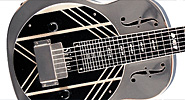
The National Silvo Electric Hawaiian
 One of the most innovative companies of the pre-World-War-II era, National found out quickly that innovation was a double-edged sword. Just as their resonator guitars of the late 1920s made the acoustic Hawaiian guitars of Hermann Weissenborn obsolete, electric guitars of the mid 1930s – some of them made of National’s own making – threatened to deal a similar fate to National’s resonator guitars within a decade of their introduction.
This National Silvo guitar represents not only an effort to present a beautiful, upscale electric Hawaiian model, it also features an innovative feature designed to salvage a waning demand for National’s acoustic resonator guitars.
Though the electric guitar era was barely five years old when National introduced the Silvo in 1937, this guitar would have been seen as a throwback to an earlier time. From the beginning of the electric era – Rickenbacker’s cast aluminum “Frying Pan” of 1932 – electric Hawaiian guitars had been functionally, if not literally, solidbody instruments. The Silvo’s fully hollow metal body was more closely related to the acoustic tri-cone resonator guitars National introduced in ’27 and the single-cone, nickel-plated Style N of 1930 than to any of the electric Hawaiians on the market in the mid ’30s. In fact, the Silvo body appears to be the same as that of a National Style 1 tenor guitar, so one of the reasons for the design may have been to use up surplus tenor bodies.
National was an early player in the electric-guitar market, introducing an electrified Dobro in ’33. But despite the popularity of National’s metalbody tri-cone and single-cone models, when it came to electrics under the National brand, the company opted for more -traditional wood-bodied instruments (furnished by other makers), in which National installed its electronics. Consequently, the Silvo didn’t look like any electric guitar – Spanish or Hawaiian – in the National lineup or anywhere else in the market.
From metal guitar bodies in the late ’20s to molded fiberglass solidbody guitars in the early ’60s, National was always trying new materials. In the ’30s, it was “ebonoid” – black-colored celluloid that company literature referred to as “National’s exclusive beautifier.” National used ebonoid as a substitute for ebony fingerboards (on Hawaiian models) and headstock veneers. On the Silvo, the ebonoid trim extended to the circular plate that held the bridge, pickup, and control knobs. The Roman numeral fingerboard markers, headstock logo, and the designs in the circular plate were achieved by etching through a top layer of ebonoid to reveal a light-colored celluloid layer underneath.
The Silvo, according to catalog copy, “offers everything to a conservative buyer,” but the only conservative aspect of the model was its price. Though it looks as if it would be the top model, it was really mid-line – at $60, it was between the flashy black-and-white New Yorker at $75 and the plain wood-body Supro Hawaiian at $35. It occupied middle ground in the market, as well; Gibson’s EH-150 was available (without the matching amp) for $70, and Gibson’s EH-100 was $44. Rickenbacker’s Bakelite Model B was $62.50, and their chrome-plated, stamped-steel Silver Hawaiian model was $37.50 (these prices are for six-string models without case).
 Along with the Hawaiian Silvo, National offered a metalbody tenor guitar and a metalbody mandolin fitted with the Silvo control plate. Both were priced same as the Hawaiian, $60. Curiously, National did not offer a standard six-string Spanish-neck Silvo.
The circular plate on the body was the Silvo’s most innovative feature, but ironically, it did nothing to advance the design of electric Hawaiian guitars, because it was intended for a different purpose on an entirely different guitar – to convert National’s single-cone acoustic resonators to electrics. The plate fit National’s single-cone models such as the Duolian, Triolian, and Style O, and National offered the unit, with the “res-o-lectric” pickup, for just that purpose. The price of $25 included installation. In fact, National would not deliver the unit alone; the buyer had to send his guitar to the factory for installation by National technicians (National also offered to convert any of its tri-cone model to electric for the same price, but on those, the pickup would be mounted directly to the original metal coverplate).
Judging by the rarity of Silvo Hawaiian models and the even greater rarity of converted Duolians, Triolians, Style O’s, etc., the innovative conversion module was a commercial failure. The inconvenience and risk of mailing a guitar to the factory for what appeared to be a simple do-it-yourself retrofit – remove and replace the coverplate, drill a hole in the rim for the jack – was no doubt a factor. National’s pickup design, which by the late ’30s was falling behind those of Gibson and Epiphone, may have been a factor, too. And as the electric guitar began to gain acceptance in the market, players showed a preference for more-traditional-looking archtop models; a converted metalbody National may have played and sounded just fine, but in the context of a Gibson ES-250 with its fancy inlays or an Epiphone Zephyr with its blond finish, a converted National looked like a hybrid from a bygone era.
The Silvo Hawaiian had a beautiful look and a reasonable price – a combination that typically meant success – but it lasted in production for only three years, from 1937 to ’39. Today, it stands as one of the least successful innovations from one of the most innovative guitar companies of the pre-war years.
This article originally appeared in VG December 2011 issue. All copyrights are by the author and Vintage Guitar magazine. Unauthorized replication or use is strictly prohibited.
-
Oz Noy

Oz Noy masterminds an inspired jazz sequel with spectacular feel and blues embellishments.Amidst Noy’s quirky, energetic, funk-charged compositions is gutbucket slide. “You Dig” features slide player Greg Leisz, who offsets Noy’s intervallic bop with the raw and the nasty. Chick Corea and Allen Toussaint are featured on “Rumba Tumba” and “Slow Grease” with swampy excellence.
Compositions groove in real-time human interaction as Noy is supported by the stellar lineup of Will Lee, Roscoe Beck, Dave Weckl, Keith Carlock, and Chris Layton. Noy is at the top of his game as he effortlessly weaves jazz concepts with Stevie Ray Vaughan swagger. “Come Dance With Me” and “Get Down” displays his deft use of pitch manipulation, creative use of effects, and dynamics.
Eric Johnson and Warren Haynes make an appearance on “EJ’s Blues” and “Blue Ball Blues” with frighteningly brilliant playing from everyone. Noy manages to bridge the gap between the sultry and earthier aspects of the blues while injecting jazz intricacy and rock muscle. This is the best blues-fusion record of the year with the best guitar tones found anywhere.
This article originally appeared in VG‘s October ’14 issue. All copyrights are by the author and Vintage Guitar magazine. Unauthorized replication or use is strictly prohibited.
-
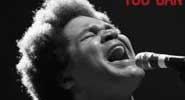
Mike Mattison

Mike Mattison is a veteran of the music wars, having for the past decade or so been the lead singer with the Derek Trucks Band and then moving to backup vocals when Trucks formed the Tedeschi Trucks Band with his wife. Here, on his first solo record, the emphasis is on soul music, with a couple sidesteps into gospel and country.Mattison has also been known for his writing, most notably the beautiful “Midnight In Harlem,” which he sings here. The arrangement and vocal are stunningly soulful while the guitar playing is tasteful and never tries to compete with the version featuring Trucks’ incendiary playing.
The guitars on Mattison’s record are played by Paul Olson (his old Scrapomatic pal) and Dave Yoke. The guitar feel stays melodic and deep throughout; they stand out on “Gin House Blues” where the feel is gospel and the soloing is sweet.
It’s clear from this record that Mattison can fly on his own. But watching him with Tedeschi Trucks, one gets the feeling everyone’s having too much fun to break up that band.
This article originally appeared in VG‘s October ’14 issue. All copyrights are by the author and Vintage Guitar magazine. Unauthorized replication or use is strictly prohibited.
-
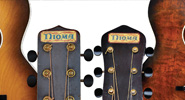
Nioma Guitars

(LEFT) 1936 NIOMA Hawaiian guitar and peghead. (RIGHT) 1936 NIOMA Hawaiian guitar and peghead. NIOMA musical instruments from the 1930s and ’40s – with their vaguely Hawaiian-looking name – have mystified vintage-guitar enthusiasts over the decades when they’ve occasionally surfaced in retail shops and guitar shows.
The seven known models – three acoustic guitars, two dobro-like resophonics, and two electric lap steels – were oriented to those who made Hawaiian music. But the backstory of NIOMA represents far more than those surviving artifacts – it’s the untold saga of a 1930s franchise music school founded in Seattle – the National Institute of Music and Arts, or NIOMA.
On July 7, 1932, attorney D. Wilbur Zundel represented founders Harry Baxter and Mary M. Strnad in filing incorporation documents with the State of Washington. NIOMA’s headquarters, at 4519 University Way in Seattle’s Kalberg Building (now home to the Seattle Daily Times) were “spacious, modernly equipped studios” and the three comprised NIOMA’s initial Board of Trustees, though Baxter and Strnad remain a bit mysterious. Each lived within blocks of the school in 1933, but then disappeared from the business/telephone directories. It seems Baxter is the same Harry V. Baxter who was a one-time flautist with the Los Angeles Symphony Orchestra, longtime member of Los Angeles Flute Club, and in 1916, head of that city’s Baxter-Northup Music Company. He believed that “love for music and the desire to offer the advantages of a musical education would lead not only to the betterment of the individual, but to the social, civic, and moral uplift of the community.” Strnad resurfaced later in Los Angeles – where, intriguingly, a second branch was opened in 1934, at 951 S. Western Avenue.
NIOMA’s goals
NIOMA’s Articles of Incorporation make clear the goals of its founders; to “operate, maintain and conduct for profit, schools and studios for the teaching of all classes of instrumental and vocal music… all forms of dancing, radio broadcasting, dramatics, public speaking and all other forms of art, music and entertainment.” In addition, they intended to eventually “manufacture, buy, sell, export, import, publish and deal in violins, pianos, organs, phonographs, radios, musical instruments, musical appliances, accessories, musical supplies, musical publications, and sheet music.”NIOMA was possibly inspired by Harry G. Stanley’s Cleveland-based Oahu School of Music, whose business model franchised hundreds of schools across America beginning in 1926. Stanley’s associated Oahu Publishing Company later began producing sheet music and song folios for their legions of students, and he also contracted with various established instrument manufacturers (including, reportedly, Harmony, Kay, National/Valco and Rickenbacker) to build “Oahu” guitars and amps. But, given the range of arts classes offered at NIOMA, Seattle’s school seems to have been even more ambitious.
Student Orchestras
When NIOMA was founded, the national economy couldn’t have been worse; the Great Depression, one would think, left few families with spare funds to send their kids to an arts school. But, NIOMA’s salesmen went door-to-door pitching $1 weekly lessons in clarinet, cello, trumpet, piano, viola, and violin, and by March of 1933, the shop’s musical director, Charles F. Hodell, had 400 kids performing pop standards like “All Through The Night,” “At Dawning,” “Believe Me If All Those Enduring Young Charms,” “Drink To Me Only With Thine Eyes,” and “I Love You Truly” publicly in a gigantic orchestra.Later that year, NIOMA conjured up what was perhaps the ultimate ploy to attract even younger students with an idea almost certain to spark the interest (and dues-paying!) of proud parents – that of forming the Seattle Baby Orchestra, which would be led by noted child educator Miss Margaret Gribbin. Then, circa 1934, the Seattle school had Herman Bueller leading its 30-member Junior Symphony Orchestra (which presumably featured more-advanced players selected from the overall pool of students). By ’35, NIOMA had several branches in Seattle and would soon have others in Washington towns like Aberdeen, Bellingham, Bremerton, Camas, Port Townsend, Tacoma, Vancouver, Wenatchee, and Yakima – along with Gresham, Hillsboro, Oregon City, and Salem in Oregon, and Boise, Idaho. In time, schools were also established in far-flung locations like Salt Lake City, El Paso, and Calgary.

The NIOMA Guitar Orchestra, Seattle, 1939. Note the two NIOMA resophonic guitarss in the back row. The Guitar Orchestra
Later in ’35, NIOMA added guitar instruction. In Seattle, a 40-strong ensemble Guitar Orchestra was formed and featured scores of Spanish-style guitars along with even more Hawaiian-style lap-steel guitars. After a year of learning to steel on an acoustic, students could opt to move up to an electric lap-steel – but lessons increased to $2 each. The organization published a series of sheet-music folios – the “NIOMA Modern Plan of Hawaiian Guitar Instruction,” along with an individual song series (“NIOMA Hawaiian Melodies”) that included island classics like “Aloha Oe,” “Akahi Hoi,” and “Ahi Wela.” A variety of guitars can be spotted in the various surviving NIOMA band photos, but those relevant here were produced under the schools’ own brand.NIOMA Hawaiian Guitar
This entry-level student-model guitar is a simple 12-frets-to-the-neck flat-top acoustic with a light-toned birch body and white-painted trim around the top edge and sound hole. It also has a NIOMA logo decal on the peghead, black-button tuning gears, a raised black nut (for Hawaiian steel playing), floating wooden bridge, and a rudimentary stamped metal tailpiece. This model (manufacturer’s date of “1/36” stamped into the back of the peghead) was, in all likelihood, produced for NIOMA schools by the Regal Musical Instrument Company, of Chicago, which also produced instruments for the Montgomery Ward’s department-store chain.NIOMA Spanish Guitar
A step up in quality from the Hawaiian Guitar is this 14-fret Spanish-style (probably walnut) with white trim, arched top, and raised pickguard. The guitar also boasts a NIOMA logo decal on the headstock, black-button tuning gears, floating wooden bridge, and a stamped metal tailpiece. It offers a few more clues as to its origins, specifically a manufacturer’s model number (1169) inked inside and the code “VV W” stamped into the neck heel. Guitar/amp historian Mike Newton believes it was likely produced by the Chicago-based Harmony Company in 1937 or ’38, after it had bought the Stella and Sovereign product lines from the bankrupt Oscar Schmidt Company. “The body size and shape are pretty much identical to the ‘new, improved’ $9 model 1105 Stella guitar in the 1939/’40 catalog,” he said. “It’s also the same size and shape as several of the nicer Harmony flat-tops, one of which is the $11 Model 1193 – it even has the same peghead shape. The design of the stamped tailpiece would date it to 1937 or so. All of that, along with the inked 1196 – doubtless the Harmony model number – pretty much nails it as being a Harmony product.”NIOMA Resophonic Guitar
This square-neck acoustic with metal resonator cone was produced by Regal, which made countless instruments under many brand names and supplied guitar bodies to the “big boys” on the West Coast – Dobro Manufacturing Company and National String Instrument Corporation. This 12-fret NIOMA has a Regal (Model 25) body with a sunburst finish, maple body binding (top and bottom), two f-shaped sound holes, a standard Regal brushed-metal resonator, rosewood neck, raised white nut, white-button tuning gears, slotted peghead with gold heat-stamped NIOMA logo, and a chrome tailpiece. An even more deluxe variation – the Regal (Model 37) body, with a solid headstock and two screened ports – was produced later.NIOMA Lap Steel Guitar
This handsome solidbody electric lap-steel guitar – which was sold with a matching amplifier for about $70 – is clearly another student-quality instrument. The guitar’s wooden body is sheathed in gray marbled pearloid plastic, but other specimens exist in green. The angular, almost-Art-Deco body, boasts minimal features – a lone knob to control volume, a chrome palm rest, a jack on its butt, white-button tuning gears, and a small metal logo tacked to the peghead.Guitar historian Lynn Wheelwright detected similarities between the NIOMA’s split-blade electromagnetic pickup and circa 1938-’40 National/Dobro designs. Newton concurs, adding that two NIOMA amps he has examined bore the names of different L.A.-based manufacturers – one was by Musical Electronics Inc., the other by Western States Wholesale Musical Corporation. Both are three-tube “shoebox” amps with one input jack and an on/off/Volume knob along with an 80 rectifier tube, a 6N7, 6V6, and a 6″ field coil speaker.
It’s also possible these NIOMA instruments were constructed by L.A.-based Dickerson Musical Instrument Manufacturing Company, which had been wholesaling electric lap steels and matching amplifiers to various guitar schools since at least 1939 – and some of those were clad in a very similar pearly plastic, with one model sharing an angular top profile. Of notable interest is the fact a guitar identical to this except for an additional Tone control knob was produced under the GEB brand (which was likely run by NIOMA stockholder W.C. Gebs), and Newton has suggested these guitars (and amps) were ordered through GEB.

(LEFT) 1930s NIOMA Resophonic Guitar
and peghead. (RIGHT) NIOMA lap steel.
’30 NIOMA resophonic courtesy of Frank Ford.
Nioma lap steel image courtesy of Lynn Wheelwright.End of an Era
In 1935, NIOMA’s general manager, J.H. Ryan, offered a bit of hope about the economy’s negative effects on people, telling the Seattle Daily Times, “There is no better harbinger of deepening optimism than this increasing return to the cultural side of life by expenditure for these finer things.” And, as the economy improved, NIOMA continued expanding. The company began offering scholarships, holding composition contests, and even forged an affiliation with the national non-profit Junior Musicians of America.By 1940, NIOMA had begun referring to its Los Angeles branch as the “main school,” and the following year, the Seattle shop moved to 4719 University Way. The NIOMA era likely saw its crowning achievement in ’48, when 200 Seattle students traveled to L.A., where they joined thousands of other young musicians in a mass concert at the Hollywood Bowl, which was broadcast nationally via radio on August 15. In 1951, Seattle’s NIOMA moved again, to 4224 University Way, and then downtown, to 1001-5 New World Life Building, in ’52.
By then, America was experiencing a whole new post-war dawn. The Hawaiian and exotica music fads of recent times were fading, while country/Western music and rock and roll were about to make huge inroads with the record-buying hordes, and public schools began ramping up their music-education programs. In December of ’52, the National Institute of Music and Arts’ directors and stockholders met in Los Angeles, and President A.W Ryan, Vice-President Rose McNeil Stromberg, Secretary M.M. Strnad, and various shareholders (J.H. Ryan, W.C. Gebs, and Wilbur Zundel) all signed a document that effectively dissolved NIOMA after a generation of local guitarists (and other players) were educated and offered an opportunity to gain stage experience.
This article originally appeared in VG January 2014 issue. All copyrights are by the author and Vintage Guitar magazine. Unauthorized replication or use is strictly prohibited.
-
Willie’s American Guitars turns 25
Nate Westgor and the staff at Willie’s American Guitars, St. Paul, Minnesota, are marking 25 years in business.
Westgor opened the shop in 1989, after moving from Chicago with his sons, Brett and Nick. A veteran player who also traded and fixed classic guitars and amps, Westgor named the shop after his alterego and stage name – Willie DelMar. From the outset, it has specialized in used and vintage guitars.
“We always have catered to the working pro who has little patience for cheap junk,” said Westgor. “Willie’s policy is hire the best and most talented – just like with a great band – and above, all avoid the corporate foolishness that always seems to foul up music endeavors. Manufacturers need to have a heart to find a spot in Willie’s!”
The store has a long list of clients that includes Bruce Springsteen, Sheryl Crow, The Rolling Stones, Joe Walsh, The Who, Billy Joel, Elvis Costello, Lyle Lovett, Bonnie Raitt, Cheap Trick, Eric Clapton, Crosby, Stills & Nash, Prince, Pearl Jam, Los Lobos, and more.
“Everybody here would like to take a deep bow and say to our customers, ‘Sincerely: Thank you!’” he added.
-
Pinnick – Gales – Pridgen

Dug Pinnick, Eric Gales, and Thomas Pridgen have returned with the followup to last year’s Pinnick–Gales–Pridgen. That first album was fueled by superb musicians rising to the occasion to create inspired work in just 13 days.Now, PGP offers detuned heaviosity, incendiary guitar work, and frenetic drumming. Minus the novelty, our attention is focused squarely on artistry.
Pinnick and Gales don’t have a lot of vocal contrast. What makes King’s X the greatest underrated metal band in history was the juxtaposition between Pinnick’s black-church vocal flourishes, and Ty Tabor’s dark John Lennon fixations. Pinnick and Gales are vocally too similar. Despite this, PGP2 kicks it and shines brightest when Pinnick takes over on “Every Step Of The Way.”
The album has scorching blues, gospel, and heavy rock compositions highlighted by skillful playing. Pridgen’s busy syncopations push the band beyond any similar collaboration, while Pinnick’s lyrics are as intense and personal as ever. Gales has hit a creative plateau and burns on autopilot, but his autopilot is superior to his contemporaries on their best day.
PGP2 is a powerful album with percolating groove, soul, and more soul.
This article originally appeared in VG‘s October ’14 issue. All copyrights are by the author and Vintage Guitar magazine. Unauthorized replication or use is strictly prohibited.
-
ZZ Top Suspends Tour
ZZ Top has been forced to suspend its current tour with Jeff Beck after bassist Dusty Hill slipped and fell on his hip aboard his tour bus the evening of August 26. The affected dates include the bills shared with Jeff Beck through September 13. Beck will perform August 29 in Salamanca, New York, August 30 in Atlantic City, and August 31 in Mashantucket, Connecticut. The performers are asking those who hold tickets for the shows scheduled for September 6-13 to continue to do so, pending the possibility of rescheduling these concerts.
-
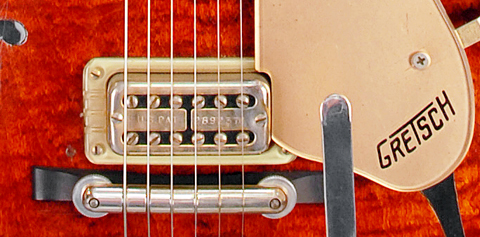
Gretsch Country Gentleman

Just three of the many Chet Atkins album covers that featured Gretsch guitars. Consider American guitar manufacturers that have been in business during the last 100 years and the different instruments they’ve produced. Only a handful have become cultural icons – given no information except “Les Paul,” “Stratocaster,” “Telecaster,” and “White Falcon,” even non-players can identify them as guitars. It’s not uncommon to hear “Telecaster? That’s a Fender guitar isn’t it?” Many non-players also identify certain artists with specific instruments, and some can even name specific artists and song combinations that featured a particular instrument.
While the Les Paul, Stratocaster, Telecaster, and White Falcon are clearly in the first echelon of cultural icons, Gretsch’s Country Gentleman is ensconced at the upper end of the second echelon, due largely to the impact of Chet Atkins and George Harrison, two of its most-celebrated players.

A 1960s Gretsch Country Gentleman. The Chet Atkins Country Gentleman (the model’s official name) had at least two distinct incarnations (and several variations) during its long life span: originally as a single cutaway model and later as a double cutaway version. The development of the original single-cutaway model probably began in late 1956/early ’57, years which saw competition in the electric guitar market really begin to escalate. Gretsch and Gibson were pursuing very similar design/development paths during this time period. The parallels and timing are quite intriguing. Both companies were working steadily on what they perceived to be the next generation of electric guitars semi-solid with a much thinner body and electronics that didn’t hum. Gibson was developing its legendary humbucking pickup, and the ES-335 – and Gretsch was working on its humbucking pickup, the Filter’Tron, and what was to become the Country Gentleman model.
Grestch’s earliest forays into this new generation of guitars were shaped by artist/endorser/guitar superstar Chet Atkins who had experienced some noise problems with the DeArmond pickups used on his Chet Atkins Hollow Body Model 6120 and Chet Atkins Solid Body Model 6121. Chet was a “no frills” guy, and while delighted to have an endorsement deal, he wasn’t completely enamored with the “flashiness” of his 6120 and 6121. He preferred a high-end, no nonsense instrument with quality design and construction rather than making a visual statement. He was also interested in increasing an instrument’s sustain and thus was a proponent of solid construction – from the nut to the end pin. He made several recommendations to achieve this (including using a metal nut and bridge) and even suggested that having a closed body might make the instrument sustain more. The earliest version of Chet’s vision/philosophy was produced in mid 1957 and has come to be known by Gretsch aficionados as the “White Gentleman” (appropriately named for its white colored top). Bearing no official name, just a lable affixed to the bottom of the pickguard with the model number 6122, these instruments appear to be Country Gent prototypes. And very few were produced. Three or four have surfaced and all of them have serial numbers in the 23000 range. It’s clear from examining these “White Gents” that Gretsch was developing one of the earliest semi-solid, thin body electric guitars.
The Country Gentleman (numerically designated in Gretsch catalogs as Model PX6122) made its official debut in late 1957, as a 1958 model. While the name “Country Gentleman” could aptly describe Chet Atkins himself, it’s more likely in reference to a song of the same name that Chet originally recorded in 1953. As a high-end model (it was the top of the line in the Chet Atkins series), it was produced in limited numbers. And given the $500 price tage, a substantial sum of money in 1958, it sold in limited numbers (in Gretsch’s electric line, only the White Falcon was more expensive). Produced as a single cutaway from model year 1958 through model year 1961, there’s a simple understated elegance to this version of the Gent. Sporting a closed 17” wide “electrotone” body (with solid bracing and simulated f-holes), Gretsch’s new humbucking pickup (the Ray Butts-designed Filter’Tron), and its trademark metal nameplate on the headstock, the Gent was fairly conservative in its appearance. Its walnut/mahogany stained finish was quite a contrast to the rest of the Grestch line which featured wild colors like Oriental Red, Bordeaux Burgundy, Cadillac Green, Lotus Ivory, Bamboo Yellow, Copper Mist, Spotlight Sparkle silver, Smoke Green, Jaguar Tan, and Amber Red/Orange. From the sophisticated Art-Deco stairstep Grover Imperial tuners, to the ebony fingerboard with the neo-classical position markers, to the exquisitely figured curly maple used to construct many Gents from this period, it’s clear that this is a very fine, high-end instrument. Just look at our beautiful examples from 1959, 1960, and ’61.
By ’61, Gretsch had decided to revamp its line of electric guitars. The single biggest change was the decision to phase out the single cutaway construction in favor or a double cutaway design. The Country Gentleman made this transition in late 1961. Other significant changes included a snap-on back pad for more comfortable playing, and the addition of two felt “string mutes” (one for the bass strings and one for the treble strings) that could be raised or lowered by dialing up the appropriate knob. Still a high quality instrument, the Gent retained the Grover Imperial tuners, dual Filter’Tron picups, and metal nameplate. As with the single cutaway Gent, many of these early double cuts continued to feature beautifully figured maple tops.

A 1962 Gretsch Country Gentleman. In Feburary 1964 the Beatles visited America for the first time. Their appearance on the “Ed Sullivan Show” marked the beginning of the “British Invasion” and is touted as “the day popular music in America was changed forever.” By this time George Harrison had been a Gretsch player for several years (his first quality American electric guitar was a Duo Jet) and when he appeared on the Sullivan show playing a 1963 Country Gentleman (with a very dark mahogany stained finish that on television looked black), this marked the beginning of the Country Gent’s rapid rise to the role of cultural icon. It also marked the beginning of a huge increase in the production of the Country Gent and of Gretsch guitars in general. If Gretsch had a rough equivalent to Fender’s Stratocaster in terms of production numbers/volume, the “post Sullivan appearance” 6122 was it. Gretsch sold thousands of Country Gents based on George Harrison’s unofficial “endorsement.” Gretsch couldn’t produce them fast enough and, for quite a while, demand far exceeded supply. Today, even though the single-cutaway Gents are much harder to come by, the ’63 version, with stair-step tuners and “flip-up” string mutes with red felt pads, may well be the most sought-after by collectors.
Like most of Gretsch’s other instruments, the double-cutaway version of the Country Gent went through many changes in its production life, including different pickup configurations, truss-rod systems, tuners, mutes, control knobs, and closed/open f-shaped sound holes (our example from ’67 has a single string mute for all six strings and large button Grover tuners.) There were very few 12-string versions produced, quite possibly only one or two.
This article originally appeared in VG Classics #02 issue. All copyrights are by the author and Vintage Guitar magazine. Unauthorized replication or use is strictly prohibited.


