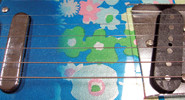
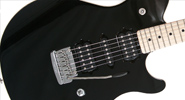
Aristides Instruments 010 guitar has a body and neck made from the company’s Arium material. It has a 25.5″-scale neck with compound-radius ebony fretboard, Seymour Duncan and APS pickups, a push/pull master Volume pot for coil splitting, and a master Tone. Its hardware includes Sperzel locking tuners, a choice between the Hipshot US Contour bridge or a Wilkinson VS100N vibrato bridge, and Schaller strap locks. See it www.aristidesinstruments.com.
The Seymour Duncan Jason Becker Perpetual Burn Humbucker has an Alnico V bar magnet and measures 12.11k DC resistance. It’s a drop-in replacement for any humbucker-equipped guitar and requires no modification to the instrument. Visit www.SeymourDuncan.com.
Luthier Nicholas Frirsz’s Filmocaster has a 25.5″-scale maple neck with compound radius and hand-crowned frets. Using a maple core, Frirsz attaches body “wings” made of cast-aluminum film reels replicated to look like those from the 1930s. It has a humbucking pickup, vintage wiring, and a stacked potentiometer to control volume and tone. A limited edition, some will include Stetsbar’s vibrato and an onboard MIDI controller. Read more at www.frirszmusic.com.
Paul Gilbert and the crew that makes up Mr. Big – bassist Billy Sheehan, drummer Pat Torpey, and vocalist Eric Martin – reunited a couple years ago on the heels of a Gilbert gig at the L.A. House of Blues where he, Sheehan, and Torpey jumped onstage together. Digging the vibe, they soon called Martin, then got after it.
The band’s new album, Live From the Living Room, was recorded in January, 2011, in front of an audience at a television studio in Tokyo. It offers stripped-down versions of some of the band’s hits and several tracks from its 2011 album, What If…, some accompanied by a string quartet.
So, the Mr. Big gig has been going well?
I keep hoping AC/DC will ask me to play drums for them… but in the meantime, playing guitar for Mr. Big is an excellent job!
We had a long tour last year, mostly doing headlining shows around the world and in the U.S. But also we did a lot of festivals in Europe. It was fun to play big stages and win over audiences that were comprised mostly of Judas Priest and Ozzy fans. It taught me to play with big, physical motions, and made me realize that as a guitar player, I don’t want to be careless. I also don’t want to be careful. I want to be carefree. Somehow, though I’m playing intricate arpeggios and scale patterns, I still want to put Pete Townshend energy into it. In a small club, you can get away with standing like a statue a little more. But at a big outdoor rock gig, you’ve got to rock. And that means movement.
You told us last year that writing the What If… album was an enjoyable experience – spontaneous, with minimal overdubs, etc. Why do you think it worked so well?
Everyone in Mr. Big formed their musical muscles playing in bands and playing live. I didn’t even know that overdubs existed when I was a kid. I would hear “More Than a Feeling” by Boston and be mystified at how they could sound like that. I think some musicians work really well with the format of the studio and the options it gives. But for Mr. Big… We’re just more comfortable jumping into the songs and trying to make them work as a live performance. That pays off when we take the songs on the road, because they tend to really blossom live. There were some overdubs in the studio, but it’s funny; Kevin Shirley, our producer, would grab a guitar track from an earlier performance of a song and add it as a double to my live guitar. So I actually wasn’t overdubbing to a recording. He’d always use takes that were tracked live with the band, and put those together. Even the lead vocals were recorded live with us on What If… That’s a rarity these days, but was much more common in the ’50s and ’60s, when most of my favorite records are from. It’s a good process.
Was there a particular strategy for touring to support the album?
We just asked our manager to book us everywhere. Japan was the first country we booked, and less than a month before our first show, the earthquake and tsunami hit the Tohoku area. Quite a few artists cancelled tours, but our promoter assured us the venues were safe, and audiences would be happy to have some rock and roll to give them respite from the turmoil. So we went, and had an amazing, very emotional time. I’m a guitar player… I don’t have training as an ambassador of goodwill. But it was nice to have my guitar playing serve that purpose.
Were acoustic shows something the band did now and then to change it up on tour, or did you do the Living Room gig for the sake of recording the set that way, with an album in mind?
As much as Billy and I are known for electric things, I sometimes prefer Mr. Big as an acoustic band. Certainly, the song “To Be With You” did very well for us, and I just like how the vocal harmonies stand out more when we play acoustically. It’s also challenging because we often throw some of our athletic songs into the acoustic set. The big strings, higher action, and clean sound of an acoustic can make those 16th note triplets pretty tough. But I have a good time trying.
How did you pick songs for the set?
Pat usually organizes the setlists, thank goodness. He knows the lengths of the songs down to the second and has a good sense for how they fit together, especially from the standpoint of groove and tempo.
How do your playing dynamics change when you shift from electric to acoustic?
I usually plug into a compressor pedal. That gives me a fighting chance for getting sustain and volume out of the higher notes. Maybe the biggest help is just playing solos with chords instead of single notes. I’ll try to use open strings, too, if I can find some that work for the key of the song. Maybe the toughest thing is trying to bend with a wrapped G string. It’s really hard to bend that thing. So much of my phrasing vocabulary is based on bending, so when the G is taken away as a bending option, I have to re-think phrases by sliding or jumping to another string.
What’s next on the agenda for the Mr. Big?
I try to keep all my new projects a secret until they’re ready to be unleashed on the world. Seriously, though, when we’ve got something new, we’ll let the world know. Until then, we shall remain shrouded in mystery!
How about for you, as a solo artist?
The Great Guitar Escape! I’ve organized a guitar and music camp in New York this July. It’s a week of workshops and concerts. I’ve put together a thoroughly overqualified staff; Guthrie Govan and Tony MacAlpine are my featured instructors. I also have Kid Andersen, who is an unbelievable rockabilly and blues guitarist; Scotty Johnson, who is a Berkeley instructor and has played on several of my albums and tours; and Sam Coulson, who has some of the best vibrato I’ve ever heard as well as some seriously ripping technique.
I also have world-class instructors for drums, bass, engineering, and guitar-tech skills, and I’ll be doing workshops for beginning guitarists in addition to my daily workshops on advanced playing.
My overall concept is to give the students a huge amount of practical ideas to work on, and just as importantly, lots of inspiration to fuel their own practice and creativity. The location is the Full Moon Resort, which has been hosting music camps for people like Todd Rundgren, Dweezil Zappa, and the guys in King Crimson. I’m excited to try my own version of a total-immersion guitar camp.
This article originally appeared in VG May 2012 issue. All copyrights are by the author and Vintage Guitar magazine. Unauthorized replication or use is strictly prohibited.
Los Lonely Boys is a smart band that understands the business of the business. Avoiding the usual Texas blues clichés, the ensemble is radio friendly, with the charisma of Ritchie Valens and the soul of Carlos Santana. Embracing their deep Texican roots, the brothers Garza features bassist Jojo, drummer Ringo, and guitarist Henry.
This new album is an earthy pop-rock record that attempts to cover all the bases. With collaborative help from outside songwriters Radney Foster, Matthew Gerrard, David Quiñones, George Pajon, Jr. (Black-Eyed Peas), Keith Harris, and Raul Pacheco (Ozomatli), there’s something for everybody. Between the rootsy pop of “Blame It On Love” and the infectious “It’s Just My Heart Talkin’,” Revelation makes a great couples record.
With tight musicianship throughout, this collection shifts from the reggae-influenced “Give A Little More” to the bouncy pop of “There’s Always Tomorrow.” “So Sensual” showcases the band’s soul leanings with Henry displaying great maturity and versatility on guitar. “Can’t Slow Down” is for the blues-rock folks, while the acoustic “The Greatest Ever” and the cloying “Everything About You” is for the ladies.
This article originally appeared in VG‘s May ’14 issue. All copyrights are by the author and Vintage Guitar magazine. Unauthorized replication or use is strictly prohibited.
R&B stalwart Castro comes out with guns blazing on his latest, adding some raucous rock and roll to his usual helping of soul and blues.
There’s an added edge to songs like the riff-driven title cut with its rowdy lead guitar and leather-throated vocals. “Two Steps Forward” is an arena-ready rocker that transforms into a Gospel revival tune with former J.Geils harpist Magic Dick supplying added firepower. “Greedy” supplies some of the same with Castro’s guitar sounding like it’s been fed extra juice.
Even with the edgier feel, there’s plenty of the great R&B you expect from Castro. “Mojo Hannah” is a chugging piece driven by Marcia Ball’s piano and guest vocal, as well as Castro’s brilliant singing. “I’m Tired” is a funky rocker with a signature Castro vocal and some slinky guitar work that manages to stay afloat despite guitar from Joe Bonamassa that seems a bit out of place.
Rounding out the guests is Tab Benoit, who makes a perfect duet partner with Castro on the R&B stomp of “When I Cross The Mississippi.”
The Devil You Know takes regular fans of Castro a bit outside their comfort zone. But it’s a worthwhile trip.
This article originally appeared in VG‘s May ’14 issue. All copyrights are by the author and Vintage Guitar magazine. Unauthorized replication or use is strictly prohibited.
Jim Heath, the fleet-fingered and irrepressible godfather of psychobilly, is back, leading his trio, Reverend Horton Heat, through their first new long-player since 2009. And while some are hailing it as a return to form, truth is Rev serves up generous helpings of hot rockabilly, surf, and country licks that accompany references to internal combustion, hard women, the show-biz grind, and red, red meat – all standard fare that Horton Heat fans have come to love, lo these 23 years since the band’s debut.
Rev kicks off with the aptly titled instrumental “Victory Lap,” which segues sans break into “Smell Of Gasoline,” à la the “Big Sky”/“Baddest Of The Bad” diptych from 1994’s Liquor in the Front, a longtime opener in the trio’s live set. Throughout, Heath’s fluid guitar work seems effortless, abetted by his old compadre Jimbo Wallace on doghouse bass and stickman Scott his first RHH platter since ’05.
But one of Reverend Horton Heat’s strongest suits has always been Heath’s humor, and once again he does not disappoint. “Let Me Teach You How To Eat,” rivals 1996’s “Big Red Rocket Of Love” for its innuendo, while “My Hat” (as in “is getting handed to me”) is a priceless paean to the problems of Everyman.
Three things in life are constant: death, taxes, and Reverend Horton Heat. Rev proves you can count on all three, though you won’t be blamed if you look forward to just one.
This article originally appeared in VG‘s May ’14 issue. All copyrights are by the author and Vintage Guitar magazine. Unauthorized replication or use is strictly prohibited.
From the ever-expanding world of boutique pickups comes a builder out of southwest England who creates a handmade, hard-hitting alternative – Bare Knuckle Pickups.
We received three sets of pickups from Bare Knuckle; the Mule (humbuckers), Blackguard Flat ’52 Series (for Teles), and the PAT Pend ’63 Veneer Boards (for Strats). All were installed in suitably styled instruments and tested through a smallbox 1969 50-watt Marshall, a ’66 Vibrolux Reverb, and ’65 Vox AC-30TB.
The Mule humbuckers are based on Gibson’s classic PAF design, meticulously copied down to the 42-gauge plain-enamel wire on each coil. The Mules have a medium output (neck is 7.04k, bridge 8.01k), perfect for blues, jazz, and classic rock-and-roll tones. Bass response is where it needs to be; mids are fat without being flatulent, the treble is prominent enough to give presence without screech. Not surprisingly, the Mules sounded best through the 50-watt Marshall, providing just the right amount of oomph to overdrive the preamp, conjuring classic crunch and clarity. A particular treat is using both pickups in the middle position, and rolling off both Volume controls slightly, which produced a full but clear tone perfect for both chordal work and cleaner leads. Through the Vibrolux Reverb channeled Mike Bloomfield tones.
For Telecaster tones, Bare Knuckle claims that before designing the Blackguard Series as a “vintage-accurate” collection, they conducted extensive research on early Tele pickups. Installed in our ’50s-reissue Telecaster, the Flat ’52s produced a very accurate twang with one nice surprise – the neck pickup is actually usable. Through all three amps, the guitar sounded very punchy and clear, and the neck pickup sounded very similar to the Strat neck pickup tone we all know and love, with a great bass response and deep tone. Coupled with the Vibrolux Reverb, the Tele simply sounded excellent, its bridge pickup sounding bright and full without the cloying icepick-to-your-ears effect. And while the output varied significantly (neck 5.13k, bridge 7.11), there was no significant volume difference when switching pickups.
Originally commissioned by Fender’s U.K. Custom Shop a few years back, the PAT Pend series (called ’59 Slab Boards and ’63 Veneer Boards) have a slightly hotter wind, which adds fullness.
A/B’d with vintage Fender Stratocasters from ’59 and ’63, the PAT Pends were closer, tonally to the ’59. In the pickup selector’s second and fourth positions, the PAT Pends produced pure Strat quack through both the Vibrolux and AC30, though the PAT Pends also sounded beautiful through the Marshall. The PAT Pends measure 5.7k (neck), 5.74k (middle) and 6.18 (bridge)
One minor nit is that the mounting screws included with the PAT Pends have round heads versus the oval-head screws used on Strats until the early ’70s. This is a non-factor, tonally, but something that might put off a true vintage nut.
This article originally appeared in VG September 2012 issue. All copyrights are by the author and Vintage Guitar magazine. Unauthorized replication or use is strictly prohibited.
Since the introduction of the electric guitar, builders have sought ways to increase the variety of tones that can be had from an instrument; in 1959, Gibson created the Varitone circuit for its ES-345, and in the decades since, virtually every company has attempted some means of tonal tweaking.
Ernie Ball/Music Man’s first such effort, the Game Changer, is based on its Reflex guitar/bass but with an electronic memory designed to provide a quarter million – yes, that’s 250,000 – pickup and wiring combinations.
How does it work? The Game Changer’s tonal variations can be achieved through its pickups, pots, and switches, or by connecting to a computer using an included USB cable and logging on to a website dedicated to the instrument. While the cable doesn’t allow the guitar to be heard through the site, the guitar can simultaneously be plugged into an amp with a traditional 1/4″ cable; this method allows sampling of the actual tones produced by the variety of pickup configurations, all of which are graphically displayed on the site while simultaneously programming them into the guitar. Combining any order of the DiMarzio pickups’ coils in series, parallel, forward, or phase-reverse modes, the player can preview tones and save them to the instrument as pre-sets. The site allows comparisons with settings from a library of tones created for various genres, as well as others invented and uploaded by their players featured in the Artist section.
When connected, the USB powers the guitar (though it does not charge the batteries); when not connected, the guitar’s brain is powered by AA batteries. In our tests while plugged into a variety of low and high gain amps, the electronics were free of interference and background noise.
After viewing the online Tutorial (highly recommended), operating the guitar was a piece of cake. The Tone control is a push/pull pot that selects between Bank A and Bank B, each of which have five pickup selections, and the toggle switch on the upper horn gives access to 15 pre-set pickup selections (called Bank Z). We had the most fun playing the guitar straight into a reverb-equipped tube-driven 1×12 combo and experimenting with the sounds from the three banks. Our favorite variations were created by employing coil-splitting and single-coil combinations, which gave unique and useful tones. Favorite tones can be saved by holding down the Volume knob for two seconds. Pressing down the Volume for 10 seconds reverts the system to its factory presets – a very useful feature. One small nit: when not connected to the website, there is no way of identifying which combination of pickups one has saved to the guitar unless they’re physically accessed via the switches and pots. For iPad users, an app for the Game Changer allows access to pickup configuration functions.
Electronics aside, the Game Changer is a well-built, 22-fret instrument weighing just under eight pounds and sporting a comfortable neck, typical of Music Man guitars. Our tester had a rosewood fingerboard and a vibrato of chrome-plated/hardened steel with steel saddles (the guitar is available as a hardtail, with an piezo bridge, and with two humbuckers).
A great asset for studio and stage, the Game Changer is easy to use and does a great job delivering on its promise to deliver a variety of sounds.
This article originally appeared in VG December 2012 issue. All copyrights are by the author and Vintage Guitar magazine. Unauthorized replication or use is strictly prohibited.
One of Les Paul’s favorite aphorisms when assessing other guitarists was, “Can his mother pick him out on the radio?” Or as Albert Collins put it, “Does he have an identification?”
David Grissom passed those tests decades ago. His tone is equal parts crunch and definition. His style melds blues, rock, and country with tinges of jazz. He seamlessly shifts from single-note lead (infused with double-stop bends) to hard-driving rhythm. In fact, if he sounds like anyone else, it’s likely to be a devotee trying to cop the style that Grissom has perfected as a sideman (with Joe Ely, John Mellencamp, the Dixie Chicks), band member (Storyville), session ace (Chris Isaak, Ringo Starr, James McMurtry, Buddy Guy, Martina McBride, and many others), and poster boy for Paul Reed Smith Guitars, whose DGT model he designed.
After the Kentuckian moved to Austin in ’83, he made his mark on the vibrant scene in no time. It wasn’t unusual for him to be simultaneously juggling gigs with four bands. But, on the heels of his 2007 solo debut, Loud Music, on his own Wide Load label, he has concentrated on writing and recording originals and leading his facile quartet.
His fourth CD may be his best, striking just the right balance between songwriter and guitarslinger. The opener, “Bringin’ Sunday Mornin’ To Saturday Night,” borrows a page from the radio hit he wrote for Storyville, “Good Day For The Blues,” in mentioning various influences. Usually, this is risky territory, but, as with “Good Day,” his shoutouts to Ralph Stanley and John Coltrane come off as sincere, not gratuitous.
Whether or not the instrumental “Way Jose” is a nod to Freddie King (as in “San-Ho-Zay”) is irrelevant, but it would doubtless bring a grin to Freddie’s face. At the other end of the spectrum, his bell-like acoustic tone sparkles on the ballad “Overnight,” co-written with Kacy Crowley, who guests on harmonies.
A special bonus is the inclusion of four live cuts: “Flim Flam” and “Way Down Deep” (from his album of the same name), ZZ Top’s “Nasty Dogs And Funky Kings,” and “Jessica,” which Grissom has performed subbing and sitting in with the Allman Brothers Band. As seasoned a pro as Grissom is in the studio, it’s in front of a live audience that he truly comes alive, and these tracks don’t disappoint. Rising above bar-band covers, they show why his onstage jams with Eric Johnson, Sonny Landreth, Billy Gibbons, and Robben Ford have become the stuff of legend.
This article originally appeared in VG‘s May ’14 issue. All copyrights are by the author and Vintage Guitar magazine. Unauthorized replication or use is strictly prohibited.

 Aristides Instruments 010 guitar has a body and neck made from the company’s Arium material. It has a 25.5″-scale neck with compound-radius ebony fretboard, Seymour Duncan and APS pickups, a push/pull master Volume pot for coil splitting, and a master Tone. Its hardware includes Sperzel locking tuners, a choice between the Hipshot US Contour bridge or a Wilkinson VS100N vibrato bridge, and Schaller strap locks. See it www.aristidesinstruments.com.
 The Seymour Duncan Jason Becker Perpetual Burn Humbucker has an Alnico V bar magnet and measures 12.11k DC resistance. It’s a drop-in replacement for any humbucker-equipped guitar and requires no modification to the instrument. Visit
  Luthier Nicholas Frirsz’s Filmocaster has a 25.5″-scale maple neck with compound radius and hand-crowned frets. Using a maple core, Frirsz attaches body “wings” made of cast-aluminum film reels replicated to look like those from the 1930s. It has a humbucking pickup, vintage wiring, and a stacked potentiometer to control volume and tone. A limited edition, some will include Stetsbar’s vibrato and an onboard MIDI controller. Read more at