
Month: August 2013

  • Musicvox Space Cadet 12

    Musicvox Space Cadet 12

    Musicvox Space Cadet 12

    Musicvox Space Cadet 12
    Price: $899 (direct)
    Contact: musicvox.com

    As you may have read in Michael Wright’s profile of the Spaceranger guitar (September ’11), Musicvox started producing kooky, retro-styled solidbody guitars in the ’90s and was prominently featured in the comedy film Austin Powers. The company was on hiatus for a decade and recently returned with new models including the Space Cadet 12-string. We asked, and Musicvox was happy to let us twang this thang.

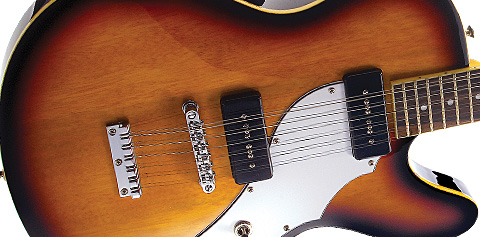
    Made in Indonesia, the guitar is an attention-getter with its swank, vintage look. It has an old-school tobacco sunburst finish and single-cut body shape sporting a large treble-bout horn (tamed down, size-wise, compared to earlier Musicvoxes like the Spaceranger!). The swingin’ ’60s décor continues with a sexy, sweeping white pickguard, large dot inlays, and a rare open-face headstock for the tuning machines (six on the side, six on the rear).

    Other features include a mahogany body, a 251/2″-scale bolt-on maple neck with a 22-fret rosewood fingerboard, chrome hardware, master volume and tone, a three-way pickup selector, and two black P-90 pickups that match the truss-rod cover. The bridge is a tune-o-matic type, while the simple bolt-on tailpiece is a top-loader – handy for 12-strings.

    One thing you can say for that large horn is it makes the guitar sit snugly on your lap and helps balance the Space Cadet (a feature useful with headstock-heavy 12-string axes!).

    Using a tube combo and a solidstate acoustic amp, the Space Cadet 12 proved likeable. In the hand, its maple neck has a big C profile that feels much like an acoustic. The super-flat fingerboard and wide nut (17/8″) further evoke that acoustic vibe.

    It might take a few minutes to familiarize yourself with the Space Cadet’s six side-facing machines and six rear-facing ones, but once you become accustomed to the instrument, it can be tuned up as quickly as a six-string. Overall, the Space Cadet’s tuners are decent, though they have a lower gear ratio than most guitars (which means you have to turn them more to change pitch). Once in tune, though, the Space Cadet holds it well. If you plan on gigging heavily with this guitar, it’s something to keep in mind.

    Sonically, the Space Cadet 12 is not a one-trick guitar. Using the bridge P-90, you can find plenty of classic ’60s tones, from the Byrds to the Beatles and everything in-between. It’s a thinner, brighter, chimey sound with folk-rock nostalgia mixed in. In the center and neck pickup positions, you get a fuller tone, of course, along with more-bell-like flavors. The guitar sounded good through the tube combo, but took on a whole new personality through the acoustic amp, which added tons of sparkle (keep in mind, acoustic amps aren’t just for acoustic guitars!). The Space Cadet sounded very different through different amps, and simply invites experimentation. Also keep in mind, compression is a important ingredient for ’60s jangle, so you might try the Cadet with the comp pedal of your choice.

    Whether you want to jangle like Roger McGuinn, George Harrison, or Marshall Crenshaw, this Musicvox fits the bill. Yes, there are cheaper electric 12s on the market, but many have tuning issues. This guitar sounds and looks hip, is fun to use for everything from open chords to big barre chords to ethereal, ringing arpeggios, and does a good job staying in tune. If you want a blast from the past, jump into this chime machine and enjoy the ride.


    This article originally appeared in VG December 2012 issue. All copyrights are by the author and Vintage Guitar magazine. Unauthorized replication or use is strictly prohibited.


  • Dokken

    Dokken

    DokkenDokken is still going strong with their 11th studio album Broken Bones. With vocalist Don Dokken as producer, it’s an album that is shameless in its mission to reproduce the sound that made the band one of the top recording and touring acts of the 1980s. Though half the classic lineup is long gone, the group still retains drummer Mick Brown and, of course, Don Dokken on the mic.

    Sean McNabb on bass and guitarist Jon Levin follows a series of guitarists filling George Lynch’s wicked shoes. Beginning with the opening track, “Empire,” this album makes no apologies for sounding as close as possible to classic ’80s era Dokken. Although the album benefits from a much improved and less dated production style, the signature songwriting remains intact.

    Levin nails every nuance of Lynch’s patented guitar style. Every squeal, Gothic Octave run, and slippery vibrato is reproduced to perfection. If you didn’t know it was Levin on guitar, you’d swear that Lynch was back in the band. On “Blind,” Levin rips up the fretboard in a dazzling display of Lynchian pyrotechnics, while on “The Victim Of The Crime,” the band stretches out a bit stylistically, but only to the extent that it sounds like something that would appear on a Lynch Mob record.

    Broken Bones features the strongest Don Dokken vocal performances ever recorded, particularly on the ballad “Today,” with its rich and haunting acoustic guitar lines. There’s nothing new here. You won’t find any musical growth or socially relevant lyrics – but the album is truly “Rockin’ Like Dokken!” And it happily lacks the paper-thin commercial hooks of their heyday. It’s a solid but derivative effort. The fans have spoken. They wanted the old Dokken, and they’ve got it.

    This article originally appeared in VG‘s Jan. ’13 issue. All copyrights are by the author and Vintage Guitar magazine. Unauthorized replication or use is strictly prohibited.

  • Havens’ Ashes to be Scattered at Woodstock

    On Sunday, August 18, the ashes of Richie Havens will be scattered across the field where the Woodstock Festival was staged in 1969.

    Today, it is the site of Bethel Woods Center for the Arts, which has scheduled a day of song and remembrance honoring Havens. The event is free and open to the public.

    The Bethel Woods grounds include the Museum at Bethel Woods and features temporary exhibits. It will open at 10 a.m. and the memorial celebration will begin at 3 p.m. Guest speakers include Havens’ longtime friends and fellow activists Danny Glover and Louis Gossett, Jr. (who co-wrote “Handsome Johnny” with Havens), along with Woodstock organizers Michael Lang and Joel Rosenman, with musical appearances by Jose Feliciano, John Hammond, John Sebastian, Guy Davis, and others. Following the performances, Havens’ ashes will be scattered with flower petals, from the air, across the field of Max Yasgur’s farm.

    An exhibit at the Bethel Woods Center for the Arts.
    An exhibit at the Bethel Woods Center for the Arts.

    “Richie was one of the world’s greatest gifts, a consummate songwriter and performer,” said Darlene Fedun, Chief Executive Officer of Bethel Woods. “He was very supportive of Bethel Woods, our museum, and our mission to educate and inspire expression. We are proud to have known him and to be able to honor his wishes. He will be greatly missed.”

    For more information visit www.richiehavens.com and www.BethelWoodsCenter.org.

  • Quilter Intros Aviator Deluxe

    Qulter Aviator DeluxeQuilter Amplifiers’ Aviator Deluxe has 100 watts of output per channel and weighs nine pounds. Channel 1 (clean) has controls for Master volume and Tone Shaping, which scoops the tone to the left and has a pronounced midrange boost to the right. Channel 2 (gain channel) has controls for Gain, Low Mid and High frequency EQ, Master volume, as well as a Hi Cut, which has a high-frequency roll-off. Onboard effects are Reverb and Dwell (decay time, or how long the reverb lasts), and the rear panel has an effects send and return and Quilter’s proprietary direct out. It is covered in black tolex, and available with an optional foot controller. Read more at www.quilterlabs.com.

  • Electra Guitars Adds to Phoenix Series

    Electra Phoenix
    The Electra Phoenix H

    Electra Guitars has expanded its Phoenix Series with two guitars, the H and S, based on the X110. The Phoenix H has been updated with an Original Floyd Rose vibrato and a newly designed MagnaFlux Plus extra-high-output passive humbucking pickup. The Phoenix S has a similar design, but includes a classic, non-locking vibrato and utilizes three specially designed single-coil pickups fed into a switching system that allows any and all Electra Phoenix basscombinations. The Phoenix bass will also get updated electronics and is available in four- and five-string configurations. Check them out at www.electraguitar.com.

  • Rick Berlin and the Nickel and Dime Band

    Rick Berlin and the Nickel and Dime Band

    Rick BerlinIt’s not glam rock, although “(I’m A) Slut” sparkles with a certain Bowie/ Roxy Music sexual ambiguity. It’s not Captain Beefheart’s industrial-strength experimental rock, though “Karaoke,” with a West Coast cool sax solo from Don Govoni furthers the Beefheart connection. Whatever elements make up Berlin’s musical amalgam, he often sounds like he’s working off pure inspiration, completely in the moment.

    Songs like “No One Can Be Everything,” with Ricky Mclean’s hypnotically repetitive guitar lick underpinning, are much more thought out and considered than they may first seem. Mclean is a virtual yin to Berlin’s yang. Or is it vice versa? Either way, Mclean is a man with a plan – and one that bears impressive results.

    In “(I’m A) Slut,” he lays out a pre-punk solo worthy of a Roky Erickson tune. For “Hilary (Galway Girl),” Mclean gives out another deceptively simple-sounding single note solo that adds to the ’60s Brit-pop tone that lies just below the surface throughout the album.
    The way Govoni’s sax tag teams with Mclean, Rob Manochio, and Jesse Adams-Lukowsy’s guitars in “I Love You In The Rain” highlights the kinship with Roxy Music and others of glam rock’s best.

    Berlin made a name for himself on the New York punk scene fronting the band Orchestra Luna whose theatrical approach made them a band to see as much as to hear. That type of drama is still a part of Berlin’s process. But while Orchestra Luna made good performances, the songs here are significantly and consistently stronger. Whatever Berlin had to go through to get here was well worth the trouble.

    This article originally appeared in VG‘s Jan. ’13 issue. All copyrights are by the author and Vintage Guitar magazine. Unauthorized replication or use is strictly prohibited.

  • The DGN Custom Guitars Paragon Standard

    The DGN Custom Guitars Paragon Standard

    DGN Custom Guitars Paragon Standard

    DGN custom guitars paragon standard
    Price: $3,000 (base)
    Contact: DGNcustomguitars.com.

    For the past few years, luthier Dan Neafsey has been making a name for himself from his small workshop in southern Connecticut, and for good reason. The instruments from DGN Custom Guitars are customized, hand-made, and of very high quality. One of his newest models is the Paragon, a Les-Paul-inspired single-cut that is actually a semi-hollowbody that is miraculously light and boasts several custom variations.

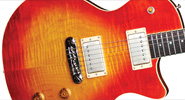
    The Paragon Standard has classic features; Honduran mahogany body and neck, figured maple top, Indian rosewood fingerboard, and Kluson vintage-style tuners. Its neck and body are all made from single pieces of wood, not laminated. Neafsey is particular about the components in the Paragon, so it’s dressed with a Graph Tech nut, Switchcraft pickup selector and jack, Mojo CTS 500k pots, Jupiter paper-beeswax .022 capacitors, and a hip aluminum wraparound bridge from ATB. The parade of features doesn’t stop there – the luthier winds his own pickups, here a set of PAF-style humbuckers that are “low-wind” to create better body/resonance mojo (in contrast to high-output winds that emphasize more magnet than wood).

    Another cool element is the Paragon’s water-based finish, applied on our tester over a tasty cherry sunburst. From grain filler to clearcoat, it’s all safe and environmentally friendly. The coatings are as thin and durable as traditional nitrocellulose, but have a smoother feel and are less prone to weather-checking. Not only is this water-based finish beautiful, it’s not toxic and, Neafsey says, safer for the luthier who applies the lacquer. Other accouterments include an inlaid, almost-3D mother-of-pearl DGN logo on the headstock, as well as cream binding around the top and fingerboard, again reminiscent of its Gibson archetype.

    Before it’s even plugged in, the Paragon grabs attention, thanks to its naturally resonant body. And Neafsey can customize the neck to any dimension or profile the customer prefers, ensuring individualized playability. Our tester was set to his preference – a beefier neck, a la ’50s Gibson, set with low action.

    Running through various settings on a tube amp and software modeler, you can feel the vibe of this guitar as it reacts; rock and blues are the obvious go-to style, from Bluesbreakers-era Clapton to modern-hero stuff like Joe Bonamassa.

    Sure, the Paragon Standard has all kinds of vintage attributes – and intentionally so. But the attention to detail in its build is amazing. Neafsey’s work here is darn impressive – and he builds everything from acoustics to nine-string electrics and, in his spare time, knocks out a few tube amps and stompboxes!


    This article originally appeared in VG August 2011 issue. All copyrights are by the author and Vintage Guitar magazine. Unauthorized replication or use is strictly prohibited.


  • Michael Tobias Design (MTD) Releases Kingston Rubicon

    Kingston RubiconMichael Tobias Design’s Kingston Rubicon has a carved alder body with flamed maple top, MTD’s asymmetrical one-piece maple neck, compound fingerboard radius, and the Buzz Feiten Tuning System. The 22-fret version has a fixed GraphTec ResoMax bridge while the 24-fret has a TremKing vibrato. For more, go to www.mtdkingston.com.
     

  • St. Blues Bluesmaster, Blindsider, and Delta Blues Box

    St. Blues Bluesmaster, Blindsider, and Delta Blues Box

    Saint Blues Bluesmaster Blindsider

    Saint Blues Bluesmaster/Blindsider
    Price: $2,399 (Bluesmaster); $2,550 (Blindsider)
    Info: saintblues.com

    St. Blues’ history stretches back to the days when its founders customized guitars for the likes of Jimmy Page, Billy Gibbons, and Duane Allman as their tours passed through Memphis. Today the company has a storefront just a few yards from the legendary Sun Studio, and in a nearby factory builds their top-of-the-line Workshop Series, which includes the Bluesmaster and Blindsider models.

    The Bluesmaster is St. Blues’ cornerstone design, first created by merging elements of an Esquire and a Les Paul. The unlikely pairing yielded a real looker; the slightly undersized body features soft curves and a squared-off tail, with a bolt-on maple neck (available with maple or pau ferro fretboard). The model sent for our review had an ash body with a gorgeous Honeyburst finish (also available in Tobacco), which St. Blues lacquers with six to 15 coats coats of nitrocellulose. At about 71/2 pounds, and well-balanced for playing while seated or standing, a Bluesmaster is more comfortable to hold and play than either of its predecessors right out of the box.

    Despite the mixed heritage, the feel, tone, and electronics of the Bluesmaster are unmistakably from the Tele school. A three-way pickup selector controls a pair of Lollar pickups, with coil cuts available on the push/pull volume and tone knobs. These Lollars are a great match with the Bluesmaster since both preserve some of the best features of classic guitars while providing the refinements of a boutique design. Played clean through a 33-watt tube combo, both pickups offered lead tones that were round and buttery, with a big bottom end and excellent string separation allowing every note in a strummed chord to be distinguished. For more overdriven sounds, the neck pickup drove the amp a little harder than the bridge, which is fitting for a guitar with a tonal sweet spot in the mid-to-low range and highs that never get too brittle or biting. With a rich bottom and soft top, the Bluesmaster tone is more in the range of an Arlen Roth than, say, Roy Buchanan, though with the coil cuts and a nice throw range on the tone pot it’s not at all difficult to dial in a tone with teeth. Also, hybrid-picking players, in particular, will appreciate how the Bluesmaster seems to have a bit more range available for right-hand dynamics than most guitars do; even after hitting that compressive Tele slap, there remains headroom for harder or softer attacks. On balance, this guitar captures the finer qualities of a high-end Tele while throwing off the clunkier physical and tonal aspects of that workman’s axe. The Bluesmaster is a class act.

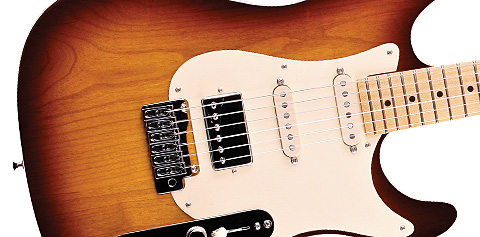
    Like the Bluesmaster, the Blindsider plays beautifully. It’s shaped more like a Strat but without the rounded edges, save a rear contour cut on the upper bout for comfort. The maple neck is available with maple, Pau Ferro, or rosewood fretboard, and the alder body can be finished in Honeyburst, Blueburst, or Tobacco. A distinctive design choice on the Blindsider is that the five-way switch and the knobs for volume and tone are housed in a Tele-style control panel rather than in the pickguard, which lends a nice hybrid touch. The model we tested had a “super strat” setup – two Vintage Blackface single-coils and one Imperial Humbucker from Lollar – though the guitar is available with three Lollar singles (St. Blues also offers the Blindsider outfitted with pickups from Lindy Fralin). The bass and middle pickups are wired together and the push/pull cut on the tone knob splits the humbucker into a single coil, multiplying the tonal possibilities on what is already a very diverse guitar.

    Delta Blues Box

    Saint Blues Delta Blues Box
    Price: $275 (Delta Blues Box)

    We could hardly take our hands off the Blindsider’s neck, which was flawless from the nut to the 22nd fret and had an accessible higher end that allowed unobstructed chording on inside strings even way up at 18th position. The uniform resonance of all six strings, evident when playing unplugged, contributed to the Blindsider’s complex overtones and impressive sustain when amped. Between the pristine neck and the Lollars, the guitar was uniquely responsive to nuances from both hands. The trem system is tightly sprung, and demands a little technique to get a nice waver going; this is no whammy bar for greasy kid’s stuff. We found that when the arm was pulled upwards, all strings remained sharp by a few cents after the bar was released. But without rear routing this trem’s intended range is all downwards from pitch, and following a down-scoop with the arm we were back in tune.

    Both of these Workshop Series guitars feature a 25.5″ scale, six-on-a-side Sperzel tuners (locking tuners on the Blindsider), genuine bone nut, Jescar medium-jumbo frets, Dunlop strap buttons, Bourns pots, ABM bridge (strings-through), oil-filled caps from Mojotone, nickel-plated hardware, and an electrosocket jack mount. Each guitar comes with a form fitted, custom case from TKL.
    For an extra shot of fun, St. Blues also sent us a four-string Delta Blues Box, which president Bryan Eagle says was initially produced on a lark after a trip to the Juke Joint Festival in Clarksdale, Mississippi. Tuned to open G and ideal for sliding, this featherweight box has a dark and gutsy piezo tone and is more fun than a bottle of moonshine. The narrow, flat-back neck makes it a great starter instrument for young players, if you could bring yourself to hand it over, and is also available in a three-string model with dulcimer fretting (no sharps or flats).

    With these cigar-box guitars, St. Blues threads the needle on the low-cost guitar market and stays true the company’s genuine Delta roots – without sacrificing the high-class craftsmanship that marks St. Blues’ full-bodied instruments.


    This article originally appeared in VG July 2013 issue. All copyrights are by the author and Vintage Guitar magazine. Unauthorized replication or use is strictly prohibited.


  • Jamey Johnson

    Jamey Johnson

    Jamey JohnsonLike earlier country outlaws, Jamey Johnson forges his own paths while never forgetting his forebears. One is singer-composer Hank Cochran, who died in 2010. A giant among Nashville writers, Cochran wrote many tunes over nearly half a century, some now country standards. Having worked with a prerocking Eddie Cochran (no relation) in the early ’50s, he settled in Nashville in 1960. Among his earliest friends: singer-songwriter Willie Nelson, just in from Texas.

    On 15 of the 16 tracks here, Johnson’s joined by others, many of them Cochran’s friends and peers. The band, largely bare bones, keeps voice and lyrics dominant. Brent Mason handles most lead guitar, with Steve Gibson on three tracks and Tommy White doing most pedal steel work.

    Many arrangements here echo the originals. Johnson and Alison Krauss follow the hit Ray Price and Eddy Arnold renditions of “Make The World Go Away.” The bluesier treatment of Patsy Cline’s “I Fall To Pieces” featuring Merle Haggard offers a totally different feel. Ray Price revisits “You Wouldn’t Know Love” with full string arrangement.

    Emmylou Harris guests on “Don’t Touch Me,” a ’60s hit for Cochran’s thenwife Jeannie Seely. Cochran fan Elvis Costello is the guest on “She’ll Be Back.”

    Johnson pairs with George Strait to revive the 1991 Waylon Jennings hit “The Eagle,” backed by ex-Jennings steel guitarist Robby Turner. Bobby Bare revisits “I’d Fight The World,” a hit for both Jim Reeves and Cochran himself. Other guests include Kris Kristofferson, Asleep at the Wheel, Vince Gill, Leon Russell, and Lee Ann Womack. The title song, a life summary, features Cochran’s voice with additions from, Kristofferson,

    Haggard and Nelson (playing Trigger). Hank Cochran’s songs long ago proved timeless. Livin’ For A Song serves as a powerful reminder.

    This article originally appeared in VG‘s Jan. ’13 issue. All copyrights are by the author and Vintage Guitar magazine. Unauthorized replication or use is strictly prohibited.