 The TC Electronic PolyTune 2 has the same polyphonic tuning capabilities as the original, but with a new chromatic strobe tuner offering 0.1-cent tuning accuracy, a bigger, brighter LED display with ambient-light sensor, Drop-D and capo tuning modes. It is wired with true-bypass switching and ships with hook-and-loop fastener. Learn more at www.tcelectronic.com.
Month: August 2013
-
TC Electronic Intros PolyTune 2
-

Mark Knopfler
 When it comes to inspired songwriting and guitar playing, Mark Knopfler’s not in dire straights. On his new solo album, he had so much material, he chose not to leave good songs on the shelf and released Privateering as a two-CD collection, his first double-disc studio recording in 35 years.
The result is the most far-ranging album of Knopfler’s career. With electric guitar, slide, National resonator, and acoustic guitar, he lays down sea shanties, Celtic folk songs, country and electric blues, rootsy Americana tunes, and yes, some good old rock and roll. It’s as if he standing at a crossroads alongside where the Mississippi meets London’s Thames River.
For guitar fans, this album is pure bounty. It opens with the rolling country blues of “After The Beanstalk,” pairing Knopfler’s fingerpicked guitar with driving, lowdown harp from the Fabulous Thunderbirds’ Kim Wilson and mandolin from Tim O’Brien.
By contrast, on “Corned Beef City,” Knopfler cranks up his electric guitar and band for a rollicking track that sounds as fresh and full of youthful vigor as anything off his debut Dire Straits album from ’78. His trademark volume swells and slide licks color the song.
Knopfler cut the album at his own studio, British Grove, where he assembled his team of backing musicians that have been working together since the mid 1990s: guitarist Richard Bennett, Guy Fletcher and Jim Cox on keyboards, bassist Glenn Worf, and a new drummer, Ian Thomas. He’s also joined by special guests, including Paul Franklin on pedal steel and the Wailin’ Jennys’ Ruth Moody providing background vocals.
Throughout, Knopfler feels at ease to stretch out and explore each song; there are no “radiofriendly” time limits or lack of space on a single CD to hold him back. Most songs run four to six minutes, Knopfler playing lengthy solos and obviously having fun at his craft.
“Gator Blood” sounds like a wandering Junior Kimbrough Mississippi Hill Country boogie, highlighted by a searing Knopfler electric-slide solo. “Redbud Tree” is pure acoustic Americana crowned by stinging Stratocaster tones. “Haul Away” is a sea shanty while “Kingdom Of Gold” is Celtic folk.Like Knopfler’s Dire Straits and past solo albums, his songs are vignettes sketching portraits of desperate characters, lovers and losers. Each is a compact story, the telling accented by widely different guitar styles.
Knopfler’s never really mellowed with age. He’s certainly become more introspective, which has added depth to his lyrics and his fretwork. But he still rocks out or gets low-down and dirty at the drop of a hat.
As a double album, is this Knopfler’s Exile on Main Street or “White Album”? No – nor is it his Sandinista!Instead, it’s the sound of a master craftsman enjoying himself, striving to create something special and unique in each song. And knowing that he has succeeded.
This article originally appeared in VG‘s Jan. ’13 issue. All copyrights are by the author and Vintage Guitar magazine. Unauthorized replication or use is strictly prohibited.
-
Richmond Empire
 Canada’s Richmond Guitars offers instruments with a retro vibe and styling coupled with fine modern components. Their latest offering, the single-cut Richmond Empire, epitomizes the company’s efforts.
The Empire may look like old-school, but of course, looks can be deceiving. Close inspection reveals its three-piece body with maple center and poplar wings, and 243/4″-scale bolt-on mahogany neck with 12″-radius rosewood fingerboard and 111/16″ nut. The satin-finished neck has a broken-in feel with real vintage vibe. Vintage-style chrome-button tuners and a wraparound bridge complete its basic-is-better nature, along with a master Volume, single Tone control, and basic three-way pickup selector. Tones come courtesy of a Godin single-coil pickup in the neck and vintage-voiced humbucker in the bridge. Finally, the one-ply pickguard and traditional shades of finish (black, cream, or natural) help it transition smoothly from garage to stage.
Sporting the heart of a rocker with more spirit, the Empire’s maple/poplar body and mahogany neck yield interesting sonic results. Notes are consistent all over the neck, with focused low-end that responds very well when playing low rhythm chords.
Plugged in, it’s easy to forget the Empire is a intermediate–grade instrument; overall construction screams of Godin’s influence, but with a garage-band sort of twist. Its electric tones are somewhere between a cool old Danelectro and an old Les Paul Special. The single-coil in the neck is similar to an old TV ’Tron pickup with a hint of a lipstick-tube-pickup vibe. The bridge-position pickup offers just the right amount of grit – not overly hot, but with ample windings to render good overdriven tones.
Live and in the studio, the Empire is a cool sonic option. Its low-end is simply fun, and it has a cool retro spank thanks in part to its wraparound bridge. The body resonates really well, which helps the fullness of the chordal work. The neck pickup is useful for blues, punk, and even surf, and responds favorably to overdriven tones.
The Empire’s bridge pickup has a just-right amount of bite without being overly aggressive – more early-PAF than hot rocker, which maintains the garage-band nature of the instrument.
Richmond guitars keep getting cooler. The company’s line is relatively small, but offers a great mix of well-conceived instruments, useful in a variety of applications.
Richmond Empire
Price: $639 (list)
Contact: RichmondGuitarsCanada.com.
This article originally appeared in VG January 2011 issue. All copyrights are by the author and Vintage Guitar magazine. Unauthorized replication or use is strictly prohibited.
-
Jody Payne, Longtime Willie Nelson/Family Guitarist, Passes

Jody Payne (left) onstage with Willie Nelson. Guitarist Jody Payne, who backed Willie Nelson for more than a third of a century, died August 10. He was 77 and had a history of heart-related health issues.
Payne’s career began in 1951, when he played with bluegrass musician/guitarist Charlie Monroe, the elder brother of Bill Monroe. After serving in the Army from 1958 to ’60, he moved to Detroit, then jumped aboard the traveling band of Merle Haggard. Payne met Nelson in the early ’60s and in November of ’73 began playing lead guitar in Nelsons’ band, The Family. His career also included recording with Hank Snow, Tanya Tucker, Leon Russell, and his own material. Following his retirement, he continued to teach guitar lessons. Payne was interviewed in the February ’00 issue of VG.
-

Cow Bop
 Picture yourself in a smoky cowboy-jazz joint around 1952, and you’ll get the picture on where Cow Bop is coming from. The combo’s music is tantalizing postwar bop, but with ample heaps of Western swing and country hokum ladled on for fun.
The mastermind behind this venture is Bruce Forman, the virtuoso swing and bop guitarist who resides in California and is a dominant West Coast jazzer. With wife Pinto Pammy’s superb vocals and crack musicians around them, Cow Bop comprises one of the most refreshing swing outfits in recent memory, as heard on their fourth album, Cowlifornia Swing.
For a sense of Forman’s fretboard mastery, listen to him rip on the opener, “It’s All Your Fault.” Instead of a gratuitous display of single-string chops, Forman separates the men from the boys with a dazzling chordmelody improvisation, one of the hardest jazzbox techniques to master. On “A Girl In Calico,” Forman plays a classic ’50s-style solo that brings Johnny Smith or Jimmy Raney to mind: it’s elegant, commanding, and has the kind of finesse that defined the best archtop work of that era.
“Indian Love Call” features tight, fast unison phrases with saxman David Wise, speaking to Forman’s ace sight-reading chops. Later in the track, he lays out as compelling a jazz solo as you could ask for. In the country corn department, look for the campy “Mambo Italiano” and “These Boots Are Made For Walking,” the latter sporting a truly barnburning guitar solo.
On one level, you can listen to this CD and revel in the lightspirited cowboy jazz and crowd-pleasing antics of the band. But if you have any appreciation for jazz guitar, it’s hard not to be blown away by Forman’s playing. While he’s been on the jazz scene for more than 30 years – performing live, playing Hollywood movie dates (notably on Million Dollar Baby and Flags of Our Fathers), and teaching at USC – Forman seems to have found a sweet spot with Cow Bop.
It’s a catchy, likeable jazz vibe and a fine platform for this guitar master to stretch out and blow. All told, whether you’re in it for Forman’s killer bop chops or the breezy Western swing, Cow Bop will make the perfect soundtrack for your next dude-ranch vacation.
This article originally appeared in VG‘s Jan. ’13 issue. All copyrights are by the author and Vintage Guitar magazine. Unauthorized replication or use is strictly prohibited.
-

Fareed Haque
 For the most part, Fareed Haque’s new recording harkens back to the days when Blue Note Records ruled the jazz world. The songs are soulful, moody, and feature great playing by Haque and others, including jazz vets Billy Hart and George Mraz.
The opener, the Haque original “Waiting For Red,” lets you in on what’s to follow. It’s a bopper that echoes those classic days, but still sounds fresh and new. Haque plays outside the box, but still makes the playing soulful and accessible. His mix of chords, octaves, and single notes, driven with a slightly distorted sound, is a guitarist’s delight. He often blends the best of Wes Montgomery and Grant Green.
Most of the songs follow the same sort of formula, with things getting a bit different only on a cover of Coltrane’s “Giant Steps.” It’s a different take, with a driving ’70s fusion vibe. It’s the only song that steps outside the record’s vintage sound.
“Inner Urge” sounds like it’s going to be an experiment in free jazz, but then starts swinging hard with a wonderful guitar solo that builds beautifully.
Haque’s always been a fine guitarist who covers lots of styles. But here, playing just jazz, he proves to be one of the genre’s current giants.
This article originally appeared in VG‘s March ’14 issue. All copyrights are by the author and Vintage Guitar magazine. Unauthorized replication or use is strictly prohibited.
-
Ampeg Reissues V-4B
 Ampeg’s V-4B reissue emulates the 1971 version of the original and produces 100 output using four 6L6GC power tubes and two 12AX7 preamp tubes. It has a master Volume along with controls for Bass, Mid, Treble, Gain, and rocker switches to boost/cut ultra-low and ultra-high frequencies, as well as a midrange boost that can highlight 220, 800, or 3,000 Hz frequencies. Modern appointments include an integrated DI with ground lift, -15dB input for active basses, and a range of speaker outputs at different impedances. For more, visit www.ampeg.com.
 -
Guy Forsythe
 Call this music “Americana,” if you have to put a label on it. The opener, “Red Dirt,” establishes straight away the muscular Midwestern quality that reflects Guy Forsythe’s musical coming of age in Kansas City, a locus for many musical styles.
Blues, jazz, R&B, and rock and roll – Forsythe puts them all to good use. “Can’t Stop Dancing” sounds like a three-way collaboration between Leonard Cohen, Tom Waits, and George Clinton, but with a horn intro straight out of 1950s Miles Davis.
Then there is “Econoline,” an ode to the singer’s faithful old van and the glory days and good times that were had in, around, and because of it. The song jumps right out at you, starting with two biting electric guitar notes and a sharply-shouted “Ha!” It’s carried by Forsythe’s expert electric slide playing and some compelling big-footed drumming from Nina Sing.
Seemingly out of nowhere comes “Sink ’Em Low (The Holler),” an a cappella field holler. But since Forsythe doesn’t often shape his songs in traditional form, the tune is a perfect fit for this eclectic mix.
Despite his being such a strong guitar player who could certainly indulge himself in an extended solo or three, most of his best guitar moments come in accents and intros. “Thank You For My Hands” is proof of that, and the song’s title is a phrase that a guy who plays like Forsythe must utter several times a day.
This article originally appeared in VG‘s Jan. ’13 issue. All copyrights are by the author and Vintage Guitar magazine. Unauthorized replication or use is strictly prohibited.
-
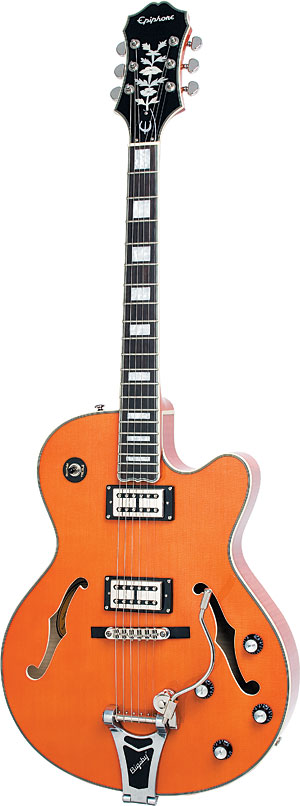
Epiphone Emperor Swingster
 Though its high-point in terms of popular exposure may have occurred when McCartney, Lennon, and Harrison “discovered” the Casino, Epiphone has historically been most known for its archtop guitars. Today, that legacy is largely carried by the Emperor model and its variants.
The new Emperor Swingster is based on the popular Emperor Regent, with a few noteworthy differences. The Swingster has an arched spruce top and laminated/triple-bound maple body with maple veneer. The neck is three-piece maple and is also bound, then capped with a rosewood neck and block inlays. The look carries over to the headstock, with binding and Epiphone inlay.
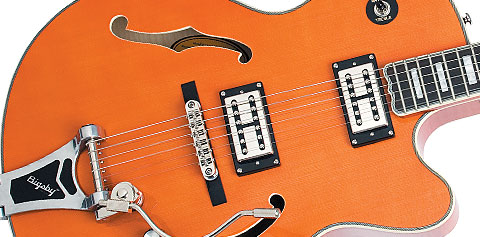
What makes the Swingster “swing” is its electronics, coupled and a Bigsby vibrato tailpiece with a custom arm ideal for serious floating action. A roller bridge helps make its use and sound fluid, and helps keep the instrument in tune.
Epiphone created its new SwingBucker pickups for this instrument. With Alnico V magnets, they offer a blend of warmth and twang. Better yet, two push/pull pots on the Tone knobs allow for series/parallel function of both pickups. Throw in a standard two Volume/two Tone control configuration and a three-way switch, and you’re ready to rock the roadhouse.
Overall build quality of the Chinese-made Swingster is impressive. It has no construction issues, and the binding is expertly crafted. Most striking is the finish work on the flame-maple laminate. Playability is also impressive; the setup on our tester was comfortably low, and the wide neck had a slight roundness to the profile reminiscent of classic archtops. It plays well and access to the upper register is easy. The Bigsby and the “pinned” rosewood base with roller tune-o-matic saddles are not typically found on budget-level entries, and makes a world of difference on the Swingster. Vibrato effects are smooth, with no awkward jumpiness you usually get with a roller bridge.
It’s obvious where Epiphone was going with its SwingBucker pickups. The Alnico V magnets give a “best of both worlds” vibe to their tone, with the neck pickup sounding typically warm and round, perfect for jazz, big-band swing, and blues. The bridge pickup is arguably the crown jewel – if you need twang, it can deliver.
Another seldom-seen option on guitars of this style at this price point are series/parallel potentiometers. It’s certainly a plus when you can get a single-coil-type sound out of a box like this – almost like a hollowbody Tele. The only nit to pick is that the Swingster is wired with the parallel portion of the tone with the knobs in the “pulled” position. This means you have to pull up on the knob to get your big boomy tone and push it in for your quasi-single coil vibe. Traditional wiring would have had these flipped. For some, this may be an issue, but it’s probably not a deal breaker.
The Swingster is an impressive offering for the money. Its playability is good, its vibrato is smooth, and it sounds great. Epiphone knows its niche.
Epiphone Emperor Swingster
Price: $1,165 (MSRP)
Contact: epiphone.com.
-
Clapton’s Crossroads Fest Film Slated for Screens
 The concert film “Eric Clapton’s Crossroads Guitar Festival 2013” will play August 13 at nearly 500 U.S. theaters. The concert, held at Madison Square Garden in April, included the Allman Brothers Band, Robert Cray, Booker T., Buddy Guy, Derek Trucks, Doyle Bramhall II, Clapton, Gary Clark Jr., Gregg Allman, Jeff Beck, John Mayer, Keith Richards, Keith Urban, Los Lobos, Sonny Landreth, Vince Gill, and Warren Haynes.
The film will screen for one night and features highlight performances as well as glimpses backstage. For more, visit www.fathomevents.com.