Fans of the Roots who’ve seen “Captain” Kirk Douglas play with the group in concert or on their regular weeknight gig as the house band for Late Night With Jimmy Fallon know his original three-pickup Gibson SG Custom is a favorite. And that 1969 model, is the inspiration for the Kirk Douglas signature guitar, which pairs its multi-ply neck binding and acrylic pearloid block marker inlays with gold hardware (including Grover tuners), a gold Maestro vibrato arm with gold plate-style tailpiece, gold Tune-O-Matic bridge, a double-wide white pick guard and three classic ’57 humbuckers with push-pull tone pots allowing for trim single-coil sounds.
Made from solid Grade-A mahogany in a high-gloss Vintage Cherry nitrocellulose finish with a rosewood fingerboard topped with a large Custom headstock with multi-ply binding and a split-diamond inlay.
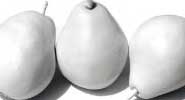
Dwight Yoakam’s 1986 Guitars, Cadillacs… etc. etc. infused Bakersfieldstyle twang into the New Traditionalist trend then sweeping a country scene weary of frothy country pop. Two years later, he revived the career of long-time hero Buck Owens with their hit duet on “Streets Of Bakersfield.” 3 Pears, his first album of new material since 2005, reflects Yoakam’s consistency, compositional gifts, and taste in covers as he moves between neo-traditional country; roots music, classics, and other retro-based forms.
On many tracks, Yoakam alone handles guitar duties. That includes “Take Hold Of My Hand,” an aggressive original he began writing two decades ago and completed with Kid Rock’s assistance. On it, Brian Whelan added pedal steel. Sheer whimsy dominates the loopy original “Waterfall” while “Long Way To Go” sits in a zone between country and rock.
Two numbers have ’60s overtones. A period shot of John Lennon wearing three pairs of sunglasses inspired the title song and “A Heart Like Mine,” one of two tunes co-produced by Beck at his studio, has an obvious garage band feel.
The sole Bakersfield shout-out is a chugging arrangement of “Dim Lights, Thick Smoke (And Loud Loud Music).” Joe and Rose Lee Maphis wrote it after watching Buck Owens, then only a local star, onstage at Bakersfield’s famous Blackboard Cafe. Here, Jason Falkner adds steel with Eddie Perez on lead guitar. Falkner does both bass and guitar honors on “Missing Heart.”
By contrast, “Long Way To Go” features only Yoakam’s voice and Whelan’s piano. The two bonus tracks – covers of Johnny Cash’s “Ring Of Fire” and the Bee Gees’ “To Love Somebody” – get full band treatment.
3 Pears affirms Yoakam’s maturity and reaffirms the edginess that made him compelling over a quarter-century ago.
This article originally appeared in VG‘s Jan. ’13 issue. All copyrights are by the author and Vintage Guitar magazine. Unauthorized replication or use is strictly prohibited.
The first of Flores’ 11 solo albums came out in ’87, but by then she’d run the gamut from singer/songwriter (in sort of an L.A./Ronstadt mold) to punk (including a 1984 LP by her all-girl Screaming Sirens). Along the way, she dueted with Wanda Jackson and Ray Campi, hosted NPR’s “Whole Lotta Shakin’” rockabilly series, and produced the late Janis Martin’s final album.
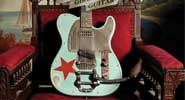
Considering that she’s logged numerous sessions as both singer and guitarist (her résumé includes a stint as Butch Hancock’s guitar player), it’s surprising that this is the first album on which she handled all of the six-string duties. Hence, instead of a portrait of Flores, the CD cover is of her surfgreen, Bigsby-equipped, metalbody James Trussart Steeltopcaster (but fans will appreciate the back-cover shot of the ageless beauty, in fishnets no less, playing said Trussart with a contented smile).
The repertoire mixes Martin’s “Drugstore Rock And Roll” and Elvis’ “Too Much” (with Rosie not going quite as far out on a limb as Scotty Moore did, but digging in nonetheless) with a beautifully soft reading of George Harrison’s “While My Guitar Gently Weeps” (shifting to a lightly swinging shuffle for the bridge). Her three originals include the instrumental “Surf Demon #5,” co-written with the bassist for the Minneapolis sessions, Tommy Vee, son of Bobby Vee. Yes, that’s the Bobby Vee of “Devil Or Angel” and “Come Back When You Grow Up” fame. The elder Vee harmonizes perfectly with Rosie on his composition “Love Must Have Passed You By,” with Flores mixing crystalline arpeggios with Duane Eddy twang.
The younger Vee and drummer Noah Levy played on Brian Setzer’s Songs From Lonely Avenue, and handle ballads and rockers, like Ritchie Mintz’s galloping title tune, with equal ease and oomph.
Flores kept her rig simple, running the Trussart through a ’50s Princeton or a Deluxe Reverb. Her playing and, for that matter, her whole career is best described by her original “Little But I’m Loud.” If she decides to use any session guitarists in the future, they’d better bring their A game.
This article originally appeared in VG‘s Jan. ’13 issue. All copyrights are by the author and Vintage Guitar magazine. Unauthorized replication or use is strictly prohibited.
The Electro-Harmonix East River Drive is the company’s first pedal designed around a JRC4558 integrated circuit. Voiced to give an usable, nuanced mid-frequency boost, its controls include Volume, Tone, and Drive and the company says the pedal can be used in front of a clean amp or to push an already overdriven amp. Other features include true-bypass switching and AC or DC power capability. For more, go to www.ehx.com.
B-Band’s Crescent series preamp has a crescent-shaped housing that mounts on the inner edge of a guitar’s round soundhole and can be accessed by fingertips. It has preamp controls are designed to be accessed by fingers, and it’s available in three models – Crescent 1, Crescent 2 XOM with Blend control, and Crescent U with a USB interface – as well as one for ukulele. All include mounting hardware with a battery holder. Learn more at www.b-band.com.
West Fargo High School guitar students and teacher Mark Berntson (bottom) with the PRS “Pay It Forward” SE Santana.
PRS Guitars and Vintage Guitar recently donated an SE Carlos Santana model to the West Fargo High School (ND), for use in teacher Mark Berntson’s Guitar 1 and Guitar Ensemble classes. The school supplies guitars for the courses, and Berntson teaches 50 to 60 students per semester. PRS gave the guitar to VG as part of the builder’s annual “pay it forward” effort, in which it sends instruments to various professional affiliates and asks them to find a suitable recipient.
“We really love our new PRS,” said Berntson. “The look is incredible and the playability is great! We ordinarily use instruments of a little lesser quality, so it’s nice to have a go-to electric that looks, plays, and sounds like a professional instrument!”
PRS SE 245 Single Cut
Price: $650 (street).
Info: prsguitars.com
Pick up the PRS SE 245 and turn it around a few times. After blinking repeatedly at its finish, you may have trouble believing this is a mid-priced guitar.
A single-cutaway from the company’s Korean-built SE line, its intent, of course, is to provide entry-level/intermediate players a chance to play a PRS without the investment required to get into one of the company’s U.S.-made instruments.
But does the SE offer the same overall quality? We recently set to find out.
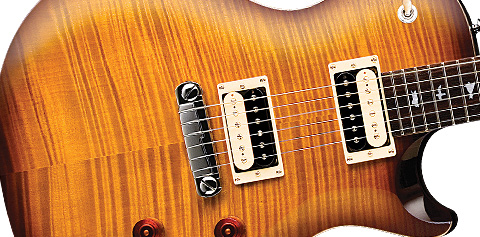
Sporting many standard PRS features – mahogany body and one-piece neck, 22-fret rosewood fingerboard, bird inlays, a pair of PRS zebra-stripe humbuckers, and a simple, elegant wraparound tailpiece. The body is extra thick, much like a Les Paul, but not all that heavy. Also notable is the chrome hardware and a pair of Volume and Tone knobs (the Volume knobs are in the two row, which takes a minute to get used to, but makes sense).
There are a few differences between the SE and U.S.-made PRS single-cuts. As its name implies, the SE 245 has a 241/2″ neck scale, unlike the usual 25″ scale that Paul Smith made famous. And while a half inch may not seem like much, it gives the guitar a different feel compared to upscale PRS models. Also, the neck on the SE is substantially fatter than its upscale brother, more like a beefy ’50s Les Paul Junior. It’s reasonably comfortable to play, but presents a key difference in feel.
As we alluded to earlier, the finish on our review SE was stunning. From even a few inches away, you couldn’t tell the 245 apart from a three-grand PRS, though the top on this guitar is a veneer (glued atop another maple slab, except on opaque models) rather than a 1/4″ piece of maple. And the back has that famous purply-brown stain. Workmanship and finish are shockingly good.
Another hint this isn’t an American PRS is that the neck needed a minor bridge adjustment to fix a fretted-out note. Once done, the guitar rocked like a hurricane.
Plugged into a high-end tube combo, the SE 245 handled the paces well, churning out big, fat notes from blues to hard rock. Upping the gain brought in more chunkiness, covering the range from Mountain to Iron Maiden to Avenged Sevenfold. At some points, the 245’s deep body provided tones almost too fat, practically forcing the use the middle pickup position to get that best-of-both-worlds tone. Cleaned up, the guitar was very good, as well, finding all sorts of interesting sounds from total clean to just-slightly dirty. Sonically, there’s nothing to complain about.
It’s hard to argue the SE 245 is anything but impressive. Veneer top or not, its finish and construction are beautiful, all the moreso when you consider the bird inlays. The only caveats are the different scale length and larger neck, but that’s a personal taste – your mileage may vary.
This article originally appeared in VG December 2012 issue. All copyrights are by the author and Vintage Guitar magazine. Unauthorized replication or use is strictly prohibited.
Heartfelt personal developments inspired Phelps to write 11 of these 12 biblically themed gospel/blues songs. Accompanied only by his brilliantly played slide acoustic, he helps expand appreciation of blues styles other than vintage Mississippi Delta and Chicago electric varieties.
Those popular styles define the blues for some, drawing much of their character from vocal and instrumental dynamics and crescendo. The blues tradition Phelps draws from gets its character from delicate, precise figures played over a relentless clockwork rhythm – calm on the surface but with a lot more to it than at first meets the ear.
Phelps evokes East Coast blues guitarists like Rev. Robert Wilkins in “Down To The Praying Ground.” On “Talkin’ To Jehova,” he plays just ragged enough to divert your attention from how much is actually in the mix, his acoustic slide so punchy you can almost feel the air puffing out of the guitar’s soundhole every time he does a bass run.
“Goodbye To Sorrow” springs from the music of ragtime-inspired Piedmont players like Blind Blake. Phelps often marries his vocal to the fingerpicked melody, a blues technique that was adapted by jazz players like George Benson. It isn’t as easy to pull off as one might think, but Phelps slips in and out of it expertly while maintaining that relentless, compelling rhythm that’s almost formal in its preciseness and all the more irresistible because of it.
You don’t have to share Phelps’ religious beliefs or hold any such beliefs at all to enjoy this album. If you feel your soul has been saved, it makes all the sense in the world to celebrate with music – and the blues in particular, which remain one of the earthly world’s greatest joys.
This article originally appeared in VG‘s Jan. ’13 issue. All copyrights are by the author and Vintage Guitar magazine. Unauthorized replication or use is strictly prohibited.
Reverend Guitars is offering a limited number of Pete Anderson Eastsider T and PA-1 RT guitars in Gold Metal Flake finish, available at Wildwood Guitars. The Eastsider-T has a chambered Korina body, compound-radius maple fretboard, push/pull phase switch, custom Alnico pickups, stainless-steel saddles, and a graphite nut. The PA-1 RT has Reverend Revtron pickups, a hollow maple body with Reverend’s proprietary Uni-Brace system, three -piece Korina neck, 15th-fret neck-and-body joint, embossed knobs, and a logo pickguard. Its Bass Contour variable bass roll-off adjusts pickup voicing, and all PA-1s use a Bigsby B70. For more, visit www.reverendguitars.com.
Lollar Pickups’ Gold Foil pickups use hand-stamped foil inserts and are wound with 44-gauge wire around a rubberized ferrite magnet. They are available as singles, two-piece or three-piece sets with nickel, chrome, or gold covers. For more, go to www.lollarguitars.com.




 The Electro-Harmonix East River Drive is the company’s first pedal designed around a JRC4558 integrated circuit. Voiced to give an usable, nuanced mid-frequency boost, its controls include Volume, Tone, and Drive and the company says the pedal can be used in front of a clean amp or to push an already overdriven amp. Other features include true-bypass switching and AC or DC power capability. For more, go to www.ehx.com.




 Lollar Pickups’ Gold Foil pickups use hand-stamped foil inserts and are wound with 44-gauge wire around a rubberized ferrite magnet. They are available as singles, two-piece or three-piece sets with nickel, chrome, or gold covers. For more, go to www.lollarguitars.com.