Month: July 2011

  • Richard Thompson

    Richard Thompson

    Richard ThompsonRichard Thompson is one of the most prolific songwriters pop music has ever seen. Of course, being prolific is meaningless if one just churns out pap. But the quality of Thompson’s output is as impressive as its quantity – which goes far beyond his steady stream of standard releases to include soundtracks, DVDs, and website-only releases.

    It’s in live settings that all of Thompson’s talents shine brightest – as singer, songwriter, acoustic and electric guitarist (in his case, two utterly distinct but equally impressive animals). But here again, Thompson doesn’t approach live recording conventionally (typically a rehash of greatest hits, often used to buy time while an artist struggles to come up with new material); instead, Attic presents 13 new tunes performed with minimal rehearsal as part of an eight-date tour.

    Helping pull off the feat are ex-Dwight Yoakam bassist Taras Prodaniuk, McGarrigle Sisters violinist Joel Zifkin, ace percussionist Michael Jerome (whose credits range from John Cale to the Blind Boys Of Alabama), and Pete Zorn. Much of Zorn’s resume concerns his bass playing, but in this lineup he shifts from rhythm guitar to mandolin, flute, and sax.

    Thompson invariably takes more chances on guitar live than in the studio. Known for exploring the dark side, his flurries on “Crimescene” amplify the theme (the downside of aging), while “Demons In Her Dancing Shoes” features wide, wild bends that would make Buddy Guy jealous. His melodicism is in full display on “Stumble On,” but “The Money Shuffle” skewers our financial wizards lyrically as well as with a stinging solo, with plenty of bite in his trademark out-of-phase tone.


    This article originally appeared in VG’s Oct. ’10 issue.  All copyrights are by the author and Vintage Guitar magazine.  Unauthorized replication or use is strictly prohibited.

  • Jackie Greene

    Jackie Greene

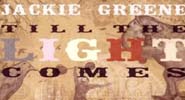
    Jackie GreeneJackie Greene’s music is hypnotic in the way of all good pop-rock. Its strongpoint is finely crafted interplay between guitars and keyboards. His new album is replete with gorgeous layered vocals, and while the lyrics are pretty plain, one is drawn in by the sounds; the Beatles’ influence is obvious, as is a lot of classic rock (though not in “classic-rock radio” sense). It’s a mix of sounds hard to resist.

    “Shaky Ground” has crunchy rhythm guitars and a pervasive 12-string line. A double guitar line near the end gives way to Harrison-style slide. “Grindstone” has a downer lyric, but the music and vocals are amazing. Echoing guitar fills drift in and out of the song with ease and a wash of guitar through a wah pedal floats all around the tune. “Temporary Color” is a garage rock stomper with crunchy chords, cheesy organ, and when the song takes a quick break, the bass line from “My Generation” pops in and fits perfectly in every way.

    Greene and Tim Bluhm play guitars and co-produce. Their love of stringed instruments is obvious, and Greene pulls out a sitar that fits perfectly on “Spooky Tina” without seeming gratuitous or unneeded. The music of ’Til the Light Comes will stick to your ribs.


    This article originally appeared in VG’s Oct. ’10 issue.  All copyrights are by the author and Vintage Guitar magazine.  Unauthorized replication or use is strictly prohibited.


  • Michael Landau, Robben Ford, Jimmy Haslip, and Gary Novak

    Michael Landau, Robben Ford, Jimmy Haslip, and Gary Novak

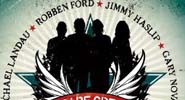
    Michael Landau, Robben Ford, Jimmy Haslip, and Gary NovakWhen four musicians the caliber of these get together, you always hope for the best, but sometimes it doesn’t happen. Here, however, it does. Michael Landau and Robben Ford supply most of the music, vocals, and the guitar, while Jimmy Haslip and Gary Novak form an amazing rhythm section. No one dominates, and each player contributes beautifully without overkill.

    Landau wrote and sings several of the songs, and they display his affinity for rock and Jimi Hendrix; “What’s Up” is a riff-based tune that gives ample room for soloing. His vocals bring to mind Mark Knopfler, with a bit more gruffness. Ford contributes great cuts like “Soft in Black Jeans,” a hip rock tune with big electric guitars and quiet acoustic. In fact, the entire record is an incredible display of dynamics.

    It’s easy to distinguish the solos; Landau’s lean more to the rock-androll/ Strat side, with the Hendrix influence and other elements, while Ford’s familiar big, brassy sound is intact and his always-interesting choice of notes is evident. And both supply wonderful support for the other. When they interact, there’s an obvious mutual respect.

    With hints of jazz, this is clearly rock and roll on a fine record that stands on its own merit, regardless of the “cast.”


    This article originally appeared in VG’s Jul. ’08 issue.  All copyrights are by the author and Vintage Guitar magazine.  Unauthorized replication or use is strictly prohibited.

  • Kenny Vaughan Set to Release Solo Debut

    Kenny Vaug

    7/26/11

    Sugar Hill Records is set to release V, the solo debut from Nashville guitarist Kenny Vaughan, on September 13. Vaughan has been a member of Marty Stuart’s Fabulous Superlatives since 2001, and in 2006 he was recognized as Instrumentalist of the Year by the Americana Music Association.

    An early pupil of fellow Coloradoan Bill Frisell, Vaughan has performed and recorded with an array artists including Lucinda Williams, Kim Richey, Rodney Crowell, Tim O’Brien, Jim Lauderdale, Elizabeth Cook, Greg Garing, and more.

    “As V so aptly demonstrates, Kenny is no slouch as a frontman, either,” says Sugar Hill. “His songs and singing are charmingly conversational, with no shortage ofhooks and clever verbal volleys. His cohorts in the Fabulous Superlatives (including Stuart on guitar and mandolin) offer road-tightened support that is honest and heartfelt.” Learn more at sugarhillrecords.com.

  • IBMA Fan Fest Celebrates Bill Monroe


    IBMA Fan Fest

    This year’s IBMA Bluegrass Fan Fest will celebrate the 100th birthday of the late Bill Monroe, Father of Bluegrass Music. Scheduled for September 30 through October 2 in Nashville, the event will include more than 30 acts, including Alison Krauss & Union Station featuring Jerry Douglas, The Grascals, and Doyle Lawson & Quicksilver.

    In addition to the music and being able to meet artists, attendees can visit a bluegrass-themed exhibit hall with more than 100 booths.  Also planned are celebrity jams and a “Name that Bluegrass Boy” trivia competition for fans. For more, go to worldofbluegrass.org.

  • Foghat

    Foghat

    FoghatFoghat guitarists “Lonesome” Dave Peverett and Rod Price have both passed on, but the band’s blues-boogie legacy is being carried forward by drummer (and co-founder) Roger Earl and singer/ guitarist Charlie Huhn, who worked with Ted Nugent for many years.

    Joined by slideman Bryan Bassett, the new Foghat is bluesier than ever, cranking out roadhouse stompers like “Born for the Road” and “Needle and Spoon.” Another tune, “So Many Roads, So Many Trains,” is an ode to the great minor-blues arrangements of the ’60s, featuring nods to Clapton and Greenie, albeit with some seriously gain-laden guitar solos. The terrific Bassett further cuts loose with hot, greasy slide work on “Last Train Home” and “Shake Your Money Maker.” Along with Huhn’s vocals, he pretty much steals the show.

    As an extra perk, 86-year-old harmonica master Eddie “Bluesman” Kirkland guests on two tracks and lends some authentic blues mojo to this stew. The recording is excellent, too, and all the guitar tracks were captured in rapturous, tube-fired glory. By the last track, it’s clear this lineup makes fine rockin’ boogie in the time-honored Foghat tradition. Somewhere, Lonesome Dave is smiling ear to ear.


    This article originally appeared in VG’s Oct. ’10 issue.  All copyrights are by the author and Vintage Guitar magazine.  Unauthorized replication or use is strictly prohibited.


  • Robert Cray

    Robert Cray

    Robert Cray Made on the heels of Strong Persuader and the single “Smoking Gun,” Robert Cray and his band are superb during this live show, and Cray plays a lot of interesting, soulful guitar.

    Early parts emphasize older material, like a killer version of “Don’t Touch Me” and the funky pop-soul of “Bad Influence,” while later songs like “False Accusations” and “New Blood” showcase the players’ skills. Lyrically, Cray often deals with infidelity or the desire for something different, and his guitar solos wonderfully convey his emotion on the topics. “Phone Booth” gives the listener the full treatment; a truly great vocal is almost overshadowed by soloing that mixes single notes, chords, double-stops, and everything inbetween. It’s followed by “Playin’ In the Dirt,” with its racy lyric matched by an intense solo and the band’s funk. Sterling versions of the two songs that were extremely popular at the time – “Smoking Gun” and “Right Next Door (Because of Me)” have Cray and the band playing tight and fiery. In the years since, Cray has changed his musical formula a bit and some would argue he should play more guitar. Still, recordings like this prove he’s a true master of the sixstring.


    This article originally appeared in VG’s Oct. ’10 issue.  All copyrights are by the author and Vintage Guitar magazine.  Unauthorized replication or use is strictly prohibited.


  • Various artists

    Various artists

    This Is The BluesThese two CDs almost couldn’t help but be hodgepodges, since they’re compilations culled from compilations – the tribute albums Rattlesnake Guitar (from 1995, dedicated to Peter Green) and 2002’s From Clarksdale To Heaven (remembering John Lee Hooker) and a ’97 roundup of then-newly recorded British blues, Knights Of The Blues Table. But they’re intriguing hodgepodges, with enough inspired performances to outweigh a few clinkers.

    Nearly half of the 30 combined tracks come from Rattlesnake. Wisely, artists didn’t attempt to mimic the Fleetwood Mac founder; indeed, Larry Mitchell’s version of “If I Loved Another Woman” (the epitome of Green’s economic style) is closer to a Stevie Ray – a note-filled barrage, but a very impressive one. And paired with Jon Paris’ vocal, bass, and harp, Harvey Mandel throws in plectrum-edge harmonics, chicken pickin’, and his trademark sustain on “Ramblin’ Pony.”

    Rory Gallagher handles vocals, mandolin, and slide (acoustic and keening electric) on a nice “Leaving Town Blues,” while “Stop Messin’ Around” is given a swinging, acoustic groove by Savoy Brown, featuring founder Kim Simmonds. The standout Green homage, though, is Simmonds’ former bandmate, Lonesome Dave Peverett, on the minor-key “Love That Burns,” with his Foghat partner Rod Price on fat-toned slide and some great harp courtesy Southside Johnny.

    Hooker is best represented by T.S. McPhee, whose Groundhogs were named after Hook’s “Ground Hog Blues,” reprised here. Accompanied by only his acoustic guitar and Dick Heckstall-Smith’s sax, it’s perhaps the most original reading of the set.

    Highlights from Knight include Mick Taylor’s gnarly slide on “You Shook Me” and Otis Grand’s jazzy guitar, backing Paul Jones on a T-Bone Walker medley. The set also offers rare platforms for the underrated Duffy Power (in a drummerless trio featuring Heckstall-Smith again) and Cream lyricist Pete Brown, not only taking a lead vocal but producing many of the tracks.


    This article originally appeared in VG’s Oct. ’10 issue.  All copyrights are by the author and Vintage Guitar magazine.  Unauthorized replication or use is strictly prohibited.


  • Gretsch Intros Harrison Signature Duo-Jet

    Gretsch Intros Harrison Signature Duo-Jet

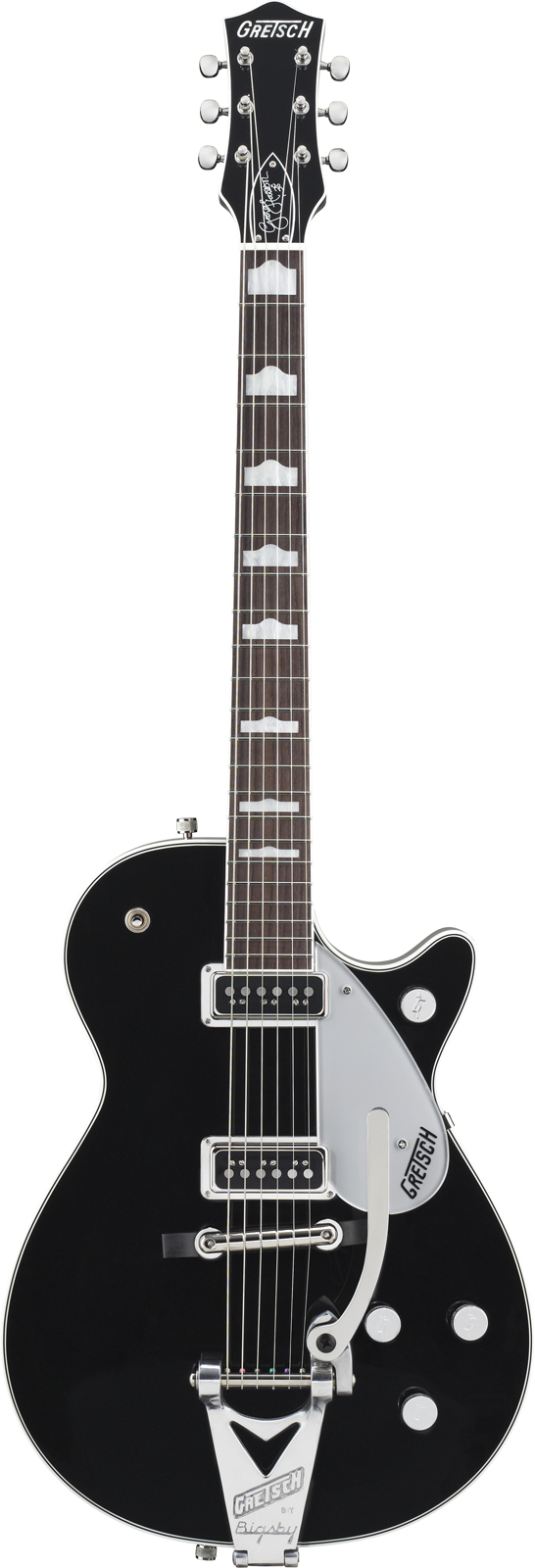
    Gretsch G6128T-GH Harrison Duo Jet

    The Gretsch George Harrison Signature Duo-JetGretsch’s George Harrison G6128T-GH signature Duo Jet is modeled on the instrument the guitarist referred to as his “first real decent guitar.” It employs appointments and mods found on and inspired by Harrison’s ’57 Duo Jet, including a chambered body, arched maple top, mahogany back and sides, one-piece mahogany neck, Bigsby B3C tailpiece with a black Phillips head vibrato-arm pivot bolt, and an offset strap button on the lower bout.

    Other features include three-ply binding (white-black-white) on the body, white single-ply neck and headstock binding, 22-fret rosewood fingerboard with 12” radius and hump-block pearloid inlays, two single-coil DynaSonic pickups, vintage-style “rocking bar” bridge with rosewood base, silver plexi pickguard, chrome-plated Grover V98CM Sta-Tite tuners, Gretsch “G” arrow control knobs, chrome-plated hardware, Harrison’s signature on the truss rod cover and a premium tweed case. Learn more at gretschguitars.com.

  • Shannon McNally and Hot Sauce

    Shannon McNally and Hot Sauce

    Shannon McNally and Hot SauceShannon McNally still prefers to write narratives that favor punch lines over actual choruses or refrains, but on Coldwater, her songwriting is tighter and more disciplined than ever.

    Lyrically (“Lonesome, Ornery And Mean”) and musically (“Lovely”) her songwriting style still owes a lot to late-’70s Bob Dylan (she even closes out this album with a crooning version of “Positively 4th Street”), but certainly, there are worse role models. McNally likes to operate in mid-tempo and “Lovely” and “Bolder Than Paradise” show she can bring things to a slow boil the way Dylan did in songs like “Hazel” and “You’re A Big Girl Now.” It’s an approach that indicates confidence in the strength of her material, something that shows in her guitar playing, too.

    In concert, McNally often wields a Telecaster and handles a good chunk of her own emotionally propelled leads. Eric Deaton is the other guitar player, and though the album notes don’t give an exact breakdown much of the lead work has McNally’s country blues touch, it’s probably Deaton adding the grace notes and the solo to “Lonesome, Ornery And Mean” while McNally rides out the last few bars and takes the reins on “Lovely” and “Bohemian Wedding Song.”

    After a strong start, McNally, has only gotten better over the course of a handful of albums. Coldwater is her best yet.


    This article originally appeared in VG’s Oct. ’10 issue.  All copyrights are by the author and Vintage Guitar magazine.  Unauthorized replication or use is strictly prohibited.