Month: February 2010

  • Tommy Emmanuel

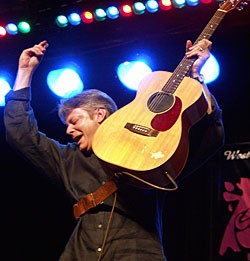
    Tommy Emmanuel

    Photo: Brian Blauser

    Experiencing a Tommy Emmanuel performance is one of those “You-shoulda-been-there” musical epiphanies. Emmanuel strides onstage with his acoustic guitar, displaying a self-assured countenance under his widow’s peak, and proceeds to mesmerize.

    The Australian is also one of the privileged few pickers who recorded a duo album with the legendary Chet Atkins; their 1997 Columbia release, The Day Finger Pickers Took Over The World, was nominated for a Grammy. Being an Atkins protegé is just one of the many facets of Emmanuel’s decades-long career, and when VG caught up with him, he was in the middle of a tour, anxious to talk about the release of his first true solo album, Only, on Steve Vai’s Favored Nations label.

    Vintage Guitar: Your earliest musical efforts involved playing in a family band.
    Tommy Emmanuel: The first music I remember listening to would have been Hank Williams, Jimmie Rodgers, Hank Snow, and some traditional Australian country singers. The Shadows were big, we listened to them, the Ventures, Duane Eddy, and some traditional Hawaiian music, as well. Merle Travis and Joe Maphis were high on our list, but it was hard to get that kind of music in Australia. My brothers, sisters, and mom and dad and I were all music nuts; we loved to play and learn.

    I heard Chet when I was seven years old, and that kind of changed the course of my whole life. I was happy being the rhythm player in a band – my brother played lead – and when I heard that sound, it blew my mind. I could hear what was going on; I just didn’t know how to do it. But I kept at it, and eventually worked it out. Chet was not only an influence, he was a person who set a standard for you to look up to – in playing, sound, recording, quality of melody.

    Did hearing Chet make you want to play more acoustic, even at that age?
    Well, I wasn’t really aware of much difference; it was just guitar! It was a little later in life that I got into acoustic, but I’ve played electric all the time, and I still play electric a bit, but not much on tour.

    I’ve still got my first electric guitar, an Australian-made instrument called a Maton, and I still play Maton acoustics on the road. I’m not an endorser, but I play their guitars, and they sound great. I’m a big fan of Martins, Gibsons, and Larivees, but at the moment I can’t travel with many of my guitars – I do have some wonderful Taylors, too – but I’m on tour all the time, and I take Matons out with me. You can play cricket with ’em (laughs)! They hold up very well.

    Who played what in your family band?
    My oldest brother, Chris, was on drums, my sister, Virginia, played Hawaiian steel guitar, my brother, Phil, was on lead, and I played rhythm and bass. I wasn’t so aware of bass guitar; I was kind of playing bass and rhythm at the same time. We formed the band in 1960, and it wasn’t until a couple of years down the road when we were playing a show with a bunch of other bands that I saw something onstage in the band that came on after us, and I asked my brother, “What’s that other guitar up there?,” and he said, “I don’t know; it’s only got four strings!” That was the first time I’d really noticed what a bass guitar was.
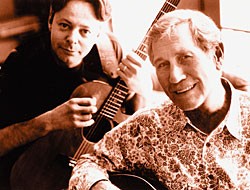
    Emmanuel and Chet Atkins

    Emmanuel poses with his mentor, Chet Atkins, in 1997, the year their collaboration album, The Day Finger Pickers Took Over the World, was released.

    You established yourself in Australian sessions before you achieved international acclaim.
    Between 1975 and 1990, I played on an enormous amount of records and film soundtracks; people like Air Supply, Roberta Flack, and a lot of Australian bands. I was was offered the soundtrack to the Crocodile Dundee film – the first one – but I turned it down because I didn’t think it would get off the ground. In hindsight, what a fool I was (chuckles).
    Is it fair to say you established yourself in most of the world’s markets, and the U.S. is the last “frontier?”
    I think America, England, and Germany are the new frontiers for me, because I’ve done a lot in Australia and Asia, and things are building well.

    I’m really just getting going (in the U.S.); it takes time, and you have to keep coming back. I think getting the Only album out on Favored Nations is gonna take things up to a new level.

    Describe how you eventually met and began your musical association with Chet Atkins.
    I had been writing to Chet since my dad died. As I said, I just about lived inside (Chet’s) albums; that was my whole world. As I found out once I got to know him well, he would listen to people from around the world, and would want to know what they were doing. People who were from Australia that went to the States would take him my tapes. He was fascinated by his influence on people so far away.

    In 1980, I finally got to make the trip to Nashville; we met in person and played. We had a great time. By ’88, I’d had enough of playing on everybody else’s albums, and I started my solo career. I got a tour with John Denver in ’88 that kind of “launched” me into the public. The musicians knew me, but when the public discovered what I did, it appealed to them. I’m always out there playing for the people, anyway, and I think that’s another reason I got so much studio work – because I didn’t approach a session like a studio player; I approached it like a real performance; what was right for the track.

    Was James Burton the guitarist for Denver at the time?
    Yeah, and that’s somebody else who taught us so much. All those old Ricky Nelson and Elvis records; we all bought them and learned from them. Jerry Scheff was with John Denver then, too. I saw them, along with Glen Hardin and Ronnie Tutt – the “Elvis” tour – boy, did they play great!
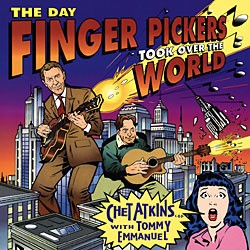
    The Day Finger Pickers Took Over the World

    The Day Finger Pickers Took Over the World

    Was The Day Finger Pickers Took Over The World the first time you’d recorded with Atkins?
    No, the first thing we recorded together was in ’93, on my album The Journey; a track called “Villa Anita.” From that time on, we started to get close, like family. Every time I came to Nashville, he’d invite me up to his house, and I ended up staying because he had kind of a “granny flat” on the side. I’d get up early in the morning, come up to the kitchen and sit with him and (Atkins’ wife) Leona, and we’d start playing.

    Details about The Day Finger Pickers Took Over The World?
    We both wrote for the album, and wanted to do “Waltzing Matilda,” the famous Australian song. I wrote a song on there called “Mr. Guitar,” which is dedicated to him, and another original of mine on there is “Dixie McGuire.” We did an arrangement of a tune called “Borsolino,” which is from an Italian movie. We sing together on “The Day Finger Pickers Took Over The World,” and there are a couple of comedy songs; “Mel Bay” is kind of a spoof about how we’re two guys who bought Mel Bay’s books.

    Other exciting times with other notable players besides Chet?
    I was the opening act for Eric Clapton on an Australian tour, and he was very nice to me. I’ve toured with Tina Turner and Michael Bolton.

    Has any of your live material ever been released on CD?
    I’m sure there are live albums all over the world, but there’s no label on them (laughs)!

    How many Chet Atkins Appreciation Society conventions have you attended?
    Every one since 1996.

    One of your more exciting numbers, as performed at that organization’s closing concert in 1997, is “Initiation,” which you announced was inspired by an Aboriginal ritual. The song included use echo and percussion effects you play on the guitar body. Tell us about how you set things up for that song.
    The song is a piece of musical drama; it’s supposed to be telling the story of the ritual where a boy proves himself to be a man. It takes time, and he has to go through all sorts of tests; they circumcise him with a rock, cut him, burn him, and leave him out where he has to survive. I try to create an atmosphere using the body of the guitar, and I try to create sound effects that add to the storyline.

    I use extreme EQ on it; exagerrated midrange and bottom-end. That’s the way you get those sounds, but if you bang on (the guitar) too hard, you’ll break speakers, so I have to be real careful at the same time. I use digital delay, and the sound man at the front puts some long reverb on it; about four seconds. And I crank everything up until it’s almost in the red. While that’s going on with all of those noises that are supposed sound like wind, rain, thunder, and animal sounds.
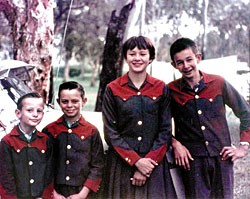
    The band, 1963

    The band, 1963. Left to right, Tommy, Phil, Virginia, Chris Emmanuel.

    I’ve got this groove going, kind of like a pulse. The way I play the melody with the digital delay, it sounds like there’s at least two things going on at the same time. In fact, people are always looking around to see who else is playing! Or they’re at least looking around for a lot more equipment, and there isn’t any.

    Is “Initiation” your standout concert piece?
    Yeah, but I play a lot of different styles. I play flatpick style as well as thumb- and fingerstyle. I play blues, jazz and country, but I’m a melody player; that’s my main criteria. I try to make people feel good when I play; I’m in the happiness business!

    “Initiation” isn’t the only song where you hit your guitar with your hands to evoke a percussion effect. Has your style ever been compared to Michael Hedges or Preston Reed?
    I think it’s totally different. I don’t know whether people compare me to those guys or not, but occasionally people will say, “Do you listen to a lot of Michael Hedges?,” and the truth is, I didn’t. But I really liked what he did. In fact, when we were making Only, we played a lot of Michael Hedges’ albums in the control room before we started working. He had a beautiful tone.

    How did you earn the coveted “Certified Guitar Player” (C.G.P.) designation?
    That had to come from Chet, and it was a total surprise to me when he gave me the award, which says “For A Lifetime Contribution to the Art of Finger-Style Guitar.”

    It’s his way of recognizing someone who has taken what he’s done and has done something different. But I’ve also taught all over the world, and I continue to do that; I’m like an ambassador for him for that style. I try to pass it on to others.

    Only is all original material, but do you have any favorite covers, besides “Waltzing Matilda?”
    I really enjoy Beatles songs, but I choose carefully what I want to play. Everything has to work; the arrangement has to work and the melody has to be strong.

    Why was Only recorded in Germany?
    A friend of mine has a great studio there. My wife and daughters and I had moved from Australia to England, and I didn’t want to go all the way back to Austraila to record. At the time, my youngest daughter was having some health problems, so I didn’t want to be far away. She’s fine now.

    Did you write specifically for that album, especially since it was your first true solo album?
    There were some songs I’d written a few years ago that I reworked, and I started writing the rest of them on the road. I didn’t write specifically for that project, but once I got my freedom from another label, I wanted to make a solo acoustic album because a lot of people told me they wanted to hear me play on my own.

    One could infer that “Train to Dusseldorf” might have been written specifically for Only.
    That was written about two weeks before we recorded, but my only criteria was to try and write the best songs I can.

    How long did it take to record the album?
    Two afternoons. Everything was one take, except for track number five, “Questions.” I did a take of it the first evening, came back and listened to it the next morning, and said “Nah, I can do it better; I can get a better feel on it,” so I did it again. But everything else, I just played once.

    “Biskie” is about a minute and half long, and the last 10 seconds have about a zillion notes.
    (Laughs) I wrote it, then I did have to practice it. It’s the name of the daughter of a friend of mine named Will Harmon who lives in Knoxville. She’s been to a lot of my shows; she’s really sweet. She became a fan, so I wrote her a song!

    You played at the closing ceremonies for the 2000 Sydney Olympics. How did it feel to be performing for a television audience estimated at 2.75 billion?
    Well, NBC went to a commercial break (chuckles)… But it was very exciting. My brother and I rehearsed for about a week; we did a John Jorgenson song called “Back on Terra Firma.” There were 150,000 people in the stadium; 30,000 people on the ground there. That was just the live gig not counting the television feed, so plenty of people heard it.

    After a long career, you’ve finally gotten a true solo album out. Are you satisfied with the way Only turned out?
    Well, at the time, I did the best I could in the short time I had, and I think the strength of the songwriting and performance is there. I can play the songs a lot better now – I’ve “polished” them – plus I’ve written a lot of new songs, so my next album will be solo acoustic, as well. Hopefully, the next album will be out around April.

    The fact it only took Tommy Emmanuel two afternoons to record Only, plus the fact that all but one track on the album were first takes underlines the level of his abilities. There are still musicians who can be entertainers without videos and other visual aids, and Emmanuel exemplifies the same dedication as his mentor, Chet Atkins.


    This article originally appeared in VG‘s Dec ’02 issue. All copyrights are by the author and Vintage Guitar magazine. Unauthorized replication or use is strictly prohibited.
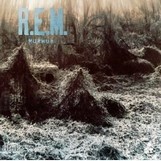
  • REM – Murmur

    Some CDs deserve to be remastered and reissued. And though vocalist Michael Stipe’s mumbled vocals contributed greatly to the atmosphere and underground appeal of the original release, if you were the type who needed to sing along to enjoy music, this was not your deal. The new remastered deluxe edition of Murmur may not turn Stipe into a master of diction, but it sure makes it easier to appreciate the album.

    Murmur was Rolling Stone‘s “Album of The Year” in 1983; its combination of Stipe’s cryptic lyrics, quirky vocal style, Peter Buck’s minimalist-yet rhythmically-complex guitar parts, and Mike Mills’ melody-carrying bass lines created a fusion that was familiar yet so fresh that the jaded rock press responded enthusiastically. Even 25 years later, Murmur doesn’t sound dated or boring. Sure, it’s only rock and roll, but songs such as “Talk About The Passion” feature such interesting melody lines that don’t go where you expect them to, that even today they are still refreshingly novel.

    To celebrate its 25-year anniversary, I.R.S. has packaged a newly remastered version with a never before released 16-song live performance recorded at Larry’s Hideaway in Toronto. The live set includes nine of Murmur‘s 12 songs as well as three songs from the band’s earlier EP, Chronic Town, and two songs from 1984’s Reckoning. The sonics on the live set are actually better than on Murmur in that Stipe’s vocals are clearer and more up-front than on the atmospheric studio mix. Backing vocals are a bit louder than ideal, and the overall sound is much drier, but the set makes for a fascinating comparison between the band’s live sound and its studio efforts. The live version of “Pilgrimage” kicks the studio version’s butt.

    In 2007, R.E.M. was inducted into the Rock and Roll Hall of Fame. If you didn’t catch on to them the first time around, this new version of Murmur will help you find out why they deserve to be there.


    This article originally appeared in VG‘s Mar. ’09 issue. All copyrights are by the author and Vintage Guitar magazine. Unauthorized replication or use is strictly prohibited.

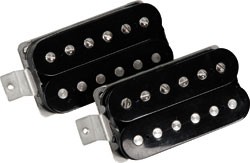
  • Smit Boosted Classic and Bucker Lite pickups

    Smit Boosted Classic/Bucker Lite

    Smit Boosted Classic/Bucker Lite

    Being a guitarist for more than 30 years, Kevin Smith learned much in his quest for great tone. For years he has dissected pickups while devising his own “recipe,” and today he builds pickups for a living in a one-man shop that specializes in a line of production and custom-wound humbuckers.

    The Smit Handwound Guitar Pickups Boosted Classic bridge pickup and Bucker Lite neck pickup are direct replacement units for standard-sized humbuckers, and are sold with all necessary hardware. Both are neatly constructed and potted for feedback reduction, with a standard single lead, braided-shield wire and Alnico V magnets (different Alnico formulations are available and the Bucker Lite is available with ceramic). The Boosted Classic is modeled after the legendary Gibson “Patent Applied For” (PAF) pickup, with a slight increase in the number of windings, while the Bucker Lite offers a more single-coil-like output from two coils.

    Installed in a late-’70s Ibanez Artist plugged into a Fender Blues Deluxe reissue set for clean tones, the Boosted Classic produced classic PAF tone with clear, tight low-end response and sparkly highs, with notable articulation and note separation. Pushing the amp’s gain to breakup, the pickup really sang, with sparkly high-end harmonics with nice penetration and, again, very clear lows. Articulation and separation stayed consistent as the pickup produced increasing sustain. Through a Peavey Valve King set to high gain and running through a 4×12″ cabinet, the pickup lost none of its clarity or note separation, instead offering very nice upper-midrange harmonics while low-end response remained clear and tight. And even at high gain, it created very little feedback.

    Through the Fender set for clean, the Bucker Lite produced clear tones with sweet sparkly highs, very clear low-end, and great note separation – and it lived up to Smith’s promises in that its output ran neck-and-neck with the Boosted Classic. As we pushed more and more gain from the Fender, the Bucker Lite proved very musical in its presentation of harmonics and squeaky-sweet highs with big, clear, low-end. The overall tone was nicely balanced, with shimmering sparkle and great note separation and articulation – primo blues tone with nice sustain. Through the Peavey set to high gain, the Bucker Lite retained its incredible clarity and note separation. Yes, it has many tonal characteristics of a single-coil, including upper-end harmonics and clean, clear lows guaranteed to make you smile. And even in close quarters, the Bucker Lite resists feedback under all but the most intense conditions.


    Smit Boosted Classic/Bucker Lite
    Price $80
    Contact Smit’s Parts and Handwound Guitar Pickups, phone (615) 390-7181; smitsparts.com.


    This article originally appeared in VG‘s May 2008 issue. All copyrights are by the author and Vintage Guitar magazine. Unauthorized replication or use is strictly prohibited.

  • Kay Violin-Style Guitar

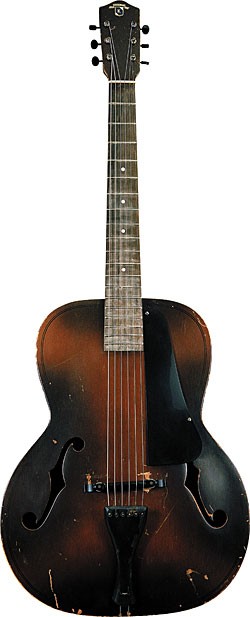
    1938 Kay Violin-Style Guitar

    1938 Kay Violin-Style Guitar.

    One prominent thread in the story of the guitar is a quest for more volume – a search that was effectively achieved with the dominance of the electric guitar that began in the early 1950s. But it actually started in the 1890s when, influenced by the popularity of mandolin orchestras, guitarists began to replace their gut strings with wire.

    The trapeze tailpiece was invented at the same time, to help the guitar’s top support the increased tension created by steel strings. Around the time of World War I, some makers began increasing the size of their guitars; witness Martin’s first “dreadnoughts.” In the 1920s, the Dopyera brothers’ metal-bodied National resonator guitars presented the next solution to the volume dilemma. While electric guitars first appeared following the invention of electronic recording in 1924 (Stromberg-Voisinet’s Electro of 1928 is the first documented, if unsuccessful, electric), the next step in the evolution of the march toward volume was the predominance of the archtop guitar in the 1930s. Paced by companies such as Gibson and Epiphone and individual luthiers such as New York’s John D’Angelico and Boston’s Elmer Stromberg, everyone touted their high-volume archtop guitars, including Stromberg-Voisinet, which had become the Kay Musical Instrument Company by the early ’30s, and was heavily promoting guitars such as this swell Kay Violin-Style archtop guitar from 1938.

    By the time this guitar was produced, Kay had become one of the biggest players in the big Chicago guitarmaking game. Why American guitarmaking settled in Chicago has many reasons, but none more important than the presence of the big catalog retailers Montgomery Ward and Sears-Roebuck, both of whom were busy outfitting the recent settlers of the rural heartland breadbasket with every conceivable consumer good, including guitars. The 1890s saw an explosion of manufacturers in Chicago, including the Groehsl Company, founded in 1890. Groehsl thrived, possibly in part by providing guitars for Ward’s, and in 1921 the company changed its name to Stromberg-Voisinet (S-V). In 1924, S-V pioneered the use of laminated woods in guitarmaking, though not all models used the technique. While “plywood” is often disparaged today, at the time it was considered advanced, adding strength and longevity to S-V guitars.

    By the late 1920s, S-V’s Secretary was one Henry “Hank” Kay Kuhrmeyer, the man behind the Electro guitar. Another of Hank’s projects may have been S-V’s distinctive, asymmetrical Venetian guitar line, developed by luthiers Philip Gabriel and Joseph Zorzi and introduced circa 1927. These were further developed by Zorzi, turning into round-hole 14-fret archtops (bent, not carved) that were introduced in 1930 or ’31 as the Kay Kraft line. In ’31, Kuhrmeyer became the President and sometime between 1931 and ’34 the company changed its name again to become the Kay Musical Instrument Co.

    One unique feature of the Kay Kraft Venetians was a bolt-on neck that allowed you to easily adjust neck tilt and, thereby, the action. Kay’s Kay Kraft Venetian archtops were the top of the line through the early ’30s and were joined in ’33 by the Arch Kraft line of archtops (again bent with round soundholes) with more conventional Spanish body shapes. Also in ’33 Kay introduced two other curious guitars, one a flattop with f-holes centered on the waist, the other an archtop described as having “arched top and back, new Arch Kraft model. Built similar to a violin with f holes, giving it more volume of tone. Rich reddish brown piano gloss finish with strongly contrasted shading, white striped edges, oval fingerboard with 14 frets clear of the body.” In 1934, Kay replaced the Venetians with a line of Spanish-shaped Kay Kraft Deluxe guitars, again with arched tops and round soundholes. All these guitars utilized Zorzi’s adjustable neck design. In ’35, Kay finally landed on a “classic” archtop that anchored its line until the War. These came in various sizes and had a bent (not carved) top, Spanish shape, f-holes on the lower bout, and, finally, a glued-in 14-fret neck with an adjustable bridge for tweaking the action.

    In late 1936, Kay began using the Kay brand name and by ’37, the Kay Kraft name was gone.

    Which brings us to Kay’s fascinating Violin-Style guitars, “distinctively new and different style guitars” that were offered in 1937 and ’38, primarily through the distributors Tonk Brothers and Continental. Actually, what was new and different about these archtops was the use of “oversize” tops and backs that extended over the rims to provide a “lip” reminiscent of the protruding edges on a violin. These guitars were made of laminated birch and maple veneer with a laminated spruce top that was, as always, pressed rather than carved. The 14-fret necks were set in and featured ebonized hardwood fingerboards. All were finished in a thin “antique violin” brown lacquer. Several variations in headstocks can be found. Some featured a flat, normal width head that ended in a round horizontal scroll similar to those found on some ’60s Baldwin Burns guitars. Others had a very narrow pointy headstock carved into something like a cello scroll head. Still others, as here, had standard flat Kay headstocks.

    The use of the extended lips on Kay’s Violin-Styles may have been a clever idea, but basically this is a thin ridge of soft laminated spruce. Bang into a chair or a wall and you’re asking for damage. It’s pretty rare to find one of these without a raggedy edge in places.

    Kay Violin-Style guitars were hardly high-end guitars, but then it’s important to remember that this was the Great Depression and few people could afford an expensive Gibson, much less a D’Angelico. Most Kay archtops have a trebly, cutting sound which was, after all, the object of a form intended for breaking through in a dance band. The Violins are no exception – pleasant enough, but don’t expect the response or full volume of a good, professional carved archtop!

    Kay’s archtops were pretty well-received among average players, and were the mainstay of Kay’s reputation for many years. Few instruments of any kind were produced once World War II began in 1941, and after the War, Kay returned to archtops for the top of its line, but it was only a matter of time before electric guitars would edge them into relative obscurity. Kay finally went out of business in 1968, though the name is still used on Asian imports. Nevertheless, these Kay Violin-Style guitars remain fascinating examples of an era of hard times, when the archtop
    was king.


    This article originally appeared in VG‘s Jan. ’07 issue. All copyrights are by the author and Vintage Guitar magazine. Unauthorized replication or use is strictly prohibited.

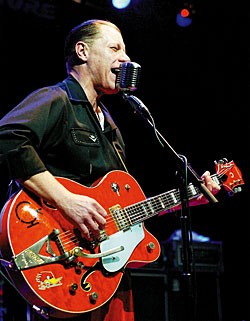
  • The Reverend Horton Heat

    Reverend

    Photo courtesy of Yep Roc Records.

    After two decades of constant touring, Jim Heath decided it was time to go home. Guitarists who put out half the energy he expends in concert usually burn out much sooner. Heath, a.k.a. Reverend Horton Heat, stayed home in the Deep Ellum district of downtown Dallas, Texas, to be with his family while he decompressed, opting to record the next album just down the block at Last Beat Studio.

    “We travel to play music, and I’m gone so much,” says Heath. “To leave my hometown to have to go sit somewhere to do a recording, that’s just very hard for me to do. I’m away from my family enough as it is.”

    Recorded in 10 days, Revival is loaded with RHH’s trademark energy, excitement, fun, and high-octane guitar picking.

    Vintage Guitar: Talk about those ascending crosspicking licks on Revival’s title track.
    Rev. Horton Heat: I like to try to emulate Merle Travis and Chet Atkins licks. I can’t play much of that Chet Atkins stuff, but I’ve got some concepts from him going lately. The crosspicking thing is something a lot of the country guys who fingerpick while they’re holding a flatpick do.

    For the lick in “Revival,” you hold a three-note chord, hit a note with the flatpick, then pull up with your finger to hit that middle note, come back over the top of the middle string and hit the high string with your flatpick, come back up with your finger, then down with your flatpick. It’s a lick you don’t have to do that way, but it makes it very easy to flow in and out of playing straight chords and other fingerpicking patterns. I can get those fast, banjo-style 16th notes through the crosspicking.

    One of the great curveballs you throw on this album is “New York City Girls.” What led you to that sound?
    That one has some jazzy twists and turns. When we finished our last album, one of the things I got into was Django Rheinhardt. A lot of those are just three note chords, but they sound so fat. “New York Girls” has a Django-style rhythm part to it, kind of mixed in with a little surf riff. It uses minor 6ths, and I’ve been doing that for my whole career.

    You have a lot of different guitar sounds and textures on this album. Was it a long equipment list?
    Not really. We were trying to get this done as quickly as possible, so my goal was to get one good guitar sound and not change. But that was hard to do because my amps kept going out and we had to switch them out with ones that worked. But our amp repair guy lives a block from the studio, so it worked out. I had guitar trouble, too. My Gretsch 6120W actually got a problem in the middle of the session and I had to switch to the Gretsch White Falcon for a couple things. I used my ’54 Gibson ES-175 a little, too.

    Are you a collector?
    I have several pretty cool guitars and amps, but I’m not a big collector. I have a ’57 Gretsch Streamliner that looks brand new, which I got from Billy Gibbons. I’ve also got an early-’60s Gretsch Sparkle Jet that’s in excellent condition, and a New American Standard Tele I like a lot.

    The ’54 Gibson used to be your main axe. What led you from that to the Gretsch?
    I used to use vintage guitars. I’ve got an old Guild Duane Eddy, and the Gibson was about the only one I was using for a long time. But I was having a lot of trouble with it on one tour, and I had all my tour money in my pocket, so rather than re-fixing the Gibson I decided to buy another guitar. I saw the Gretsch 6120W, and it had the hollow body and the Bigsby. The Gretsch can do the jazz thing really well on the neck pickup, but the other pickup can do rock and roll. I can also get a little Telecaster sound that I really couldn’t get out of the Gibson. And it had that vintage tone. Nothing’s like a vintage guitar, but those are all different, too. The Gretsch just worked. We’re a road band. I don’t have time to be fixing all this fancy vintage stuff.

    Any chance you’d give away the secrets of your setup?
    Sure, I don’t mind. From the guitar I go to an Ernie Ball volume pedal. That’s fun because I can get steel guitar-like swells and a little simulation of an amp vibrato with it. I also have the switch for my echo there. Next it goes to a Boss tuner, then to one input of a Chandler digital delay. I rarely change the settings on that. It always does a simulation of a ’50s-style slapback echo. Can’t be a rockabilly cat without my slapback, y’ know? From the Chandler’s right output it goes to the silverface Fender Super Reverb that’s turned all the way up.

    From the other side of the Chandler a line goes to stomp boxes. There’s a Boss analog delay that I rarely use except to make crazy sounds, for when I break a string or when I’m just feeling like an idiot and want to screw around. Then there’s a Boss Blues Driver that’s always on, and then it goes into a blackface Fender Twin. When I record, I can just pan those a little bit side to side and it’s a great big sound.

    I get a distorted signal through the Twin because of the Boss Blues Driver, which I can turn up a bit to get just a little extra dirt. In certain rooms that are really small but dry, I can’t turn the Super up to 10, but I can turn up the Blues Driver and still get the dirt. I don’t usually turn the Twin up very loud, because that isn’t really the bulk of my sound. My sound really comes blaring out of that Super Reverb. It doesn’t have any distortion of its own, but I get distortion by turning it all the way up, and by the way I play. If I grind out a little extra, it almost sounds like heavy metal, but if I play a little bit cleaner it sounds like a country thing. It’s hard to get that kind of sound from any distortion device, so I prefer to go that route for most of my sound.

    Recently you’ve been playing live with baffles in front of your amps. What’s the reason for that?
    People come up and say, “Turn it down a little bit!” But if I’m getting a good sound and my amp is on 9, and I turn it down to 8, it changes the whole tone structure. The baffles let me keep it on 9 and keeps my amps from bleeding too much into my vocal mic. We try to help the people right up front hear the whole band, like the rest of the house can, because those people up front are our best fans.


    This article originally appeared in VG‘s Aug ’07 issue. All copyrights are by the author and Vintage Guitar magazine. Unauthorized replication or use is strictly prohibited.

  • Reverend’s Stage King Series Charger 290

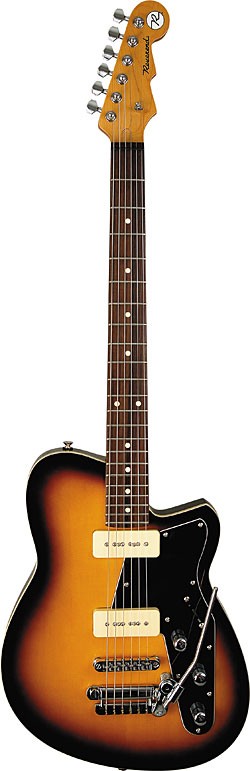
    Reverend Charger 290 Guitar

    Reverend Charger 290 Guitar

    Reverend Musical Instruments’ luthier/boss Joe Naylor singlehandedly designs every Reverend guitar, and chooses their components and materials.

    And in some cases, Naylor provides specs for “external” builders who produce instruments for his company.

    One example is the company’s new Bolt-On series of guitars, which is built in Korea and consists of nine models. Naylor recently invited us to test his Charger 290.

    The Charger is fitted with a bolt-on maple neck with 251/2″ scale and medium-C profile with a 12″ radius rosewood fingerboard and 22 medium jumbo frets. A dual-action truss rod allows for two-way adjustment, which means backbow can be actively corrected instead of simply relieving the tension (every guitar should have this feature!).

    An amber-tinted satin finish on the back of the neck feels velvety smooth, while the neck was very comfortable – not too thin and not too thick. The action was set up nicely. The body is chambered mahogany, which makes for a lighter feel and, Reverend says, fatter tone. A 5.5-mm solid spruce top is laid over the body, giving it more response.

    The Charger’s electronics include two Reverend P-90-style pickups wired to be hum-cancelling when both are engaged, with the bridge pickup being wound slightly hotter. Tones are controlled by a single volume, single tone, and Bass Contour controls, along with a three-position pickup selector switch. Our test model was equipped with an optional ABM Les Trem vibrato with a roller bridge. The stock setup uses a stop tailpiece and tune-o-matic-style bridge. Tuners are Wilkinson EZ-lock with staggered heights.

    Overall, workmanship on the Charger is exceptional. The neck pocket and pickup routs are every tight, and everything about the guitar is rock-solid.
    We plugged the Charger into an Alessandro Working Dog Boxer 1×12″ combo with an Xotic BB preamp. We set the Boxer to clean with the Charger’s volume and tone full up, and got a meaty, darkish tone. Manipulating the Bass Contour revealed more sparkle – the tone was reminiscent of a Fender Stratocaster, but notably fatter. The Charger’s pickup volumes are balanced very well in terms of output, and the Volume and Tone controls have a very smooth taper. To our ears, the Bass Contour was more drastic as we came from full-on, and became more subtle as we backed it all the way down. This is a great feature, as it gives a player access to many voicings using just one knob; with the bass rolled off, we dialed in a very fat tone with the bridge pickup, then added distortion via the Xotic BB. With the bass control dimed, you get a fat rock tone – the bridge pickup is tremendous for this. Rolling bass control back brightens the tone, but it’s always slightly darker than your average P-90 (which is good because P-90s can get a little harsh). Perhaps the combination of the solid spruce top and chambered mahogany body smooths the edges? Whatever the reason, the result is pleasin’! Switching to the neck pickup revealed a great bluesy tone with a nice edge when the bass is rolled off, sort of like an overwound Strat pickup, but fatter. With the Bass Contour pushed up, the bridge pickup sports near-humbucker qualities.

    The ABM Les Trem vibrato proved usable and stable. It’s not a locking unit, so you dive-bombers would probably be better served with a different axe.

    While many a gear snob will look down their nose at an “outsourced” guitar, they’d miss out by dismissing the Charger 290; it’s a well-constructed rock/blues machine that will “out-tone,” “out-feel,” and “out-price” many a contender.


    Reverend Charger 290 Guitar
    Price $469 (add $100 for vibrato).
    Contact Reverend Musical Instruments, 27300 Gloede, Unit D, Warren MI 48088; phone (586) 775-1025; reverendguitars.com.


    Reverend Charger 290 Guitar

  • The Gibson Les Paul Model

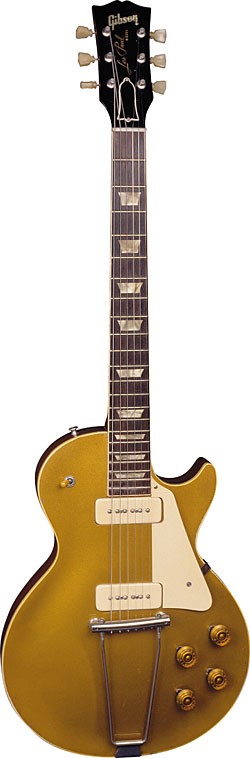
    Gibson Les Paul Model

    Photo: Robert Parks, courtesy George Gruhn.

    Its official name – Les Paul model – doesn’t do it justice. After all, Gibson has made over a hundred different Les Paul models through the years. But call it by its nickname – “goldtop” – and everyone knows you’re talking about Gibson’s first solidbody electric guitar.

    Like many important guitar stories, the goldtop story was not documented very well, and writers didn’t start tapping the memories of the two primary figures in its development, Gibson president Ted McCarty and Les Paul himself, until more than 30 years after the fact. Ted and Les had been close in the 1950s but not so close from the ’60s onward. Not surprisingly, two stories emerged. Ted said Gibson came up with all the design features then sought Les’ endorsement, which resulted in the finish color and the tailpiece. Les said he and M.H. Berlin (head of Chicago Musical Instrument Company, Gibson’s parent) came up with the design and Ted delivered it. The two stories seem mutually exclusive, but if you allow a margin of error for memories, omissions and egos, both accounts are true.

    Gibson reacted immediately to Leo Fender’s introduction of the Esquire in the summer of 1950, and by the end of the year, Gibson’s Hollywood rep, Clarence Havenga, had a prototype solidbody in hand. In the meantime, McCarty was trying to lure Les away from his arsenal of customized Epiphones. Les had just set himself apart from other guitarists in the world with two multi-tracked instrumental hits, “Brazil” and “Lover.” In 1950, he added his wife, Mary Ford, to his act, and his fortunes increased exponentially; in 1951, their recording of “How High the Moon” spent nine weeks at number one on the pop charts.

    At some point, Les met with M.H. Berlin, and it was Berlin – a violin collector – who specified the carved top (Les preferred a flat top). During the prototype stage, Gibson settled on the maple top cap and mahogany body. McCarty explained that the maple cap was for sustain, the mahogany back for lighter weight. However, since greater sustain was always one of Les’ goals, it would not be surprising if Les had some input into the maple/mahogany body.

    A maple-top prototype does exist, but its most interesting feature is its neck joint. The neckset angle is relatively flat, like that of the first production models, but the entire neck is set higher above the body, so the strings would be high enough to pass over a bar bridge like the one on Les’ trapeze-style combination bridge/tailpiece (a later prototype of the Les Paul Junior also has this high-set neck). Gibson was familiar with Les’ tailpiece, as there is one installed on the modified Epiphone Mary Ford is playing on the sheet music of their 1950 hit “Mockin’ Bird Hill.”

    There was a misconnection between the maple-top prototype and the final version, however. Gibson set the neck deeper into the body, for better stability, but inexplicably failed to compensate for the lowered string height. When McCarty presented the guitar to Les at the Delaware Water Gap, a resort where he and Mary were performing, it had Les’ tailpiece but was virtually unplayable.

    The crossbar that served as a bridge on Les’ tailpiece was about 1/2″ thick and it sat on height adjustment nuts. The neckset angle of the prototype (assuming it was the same as subsequent production examples) only allowed for a bridge height of 3/8″. Even with the bar laying flat on the top of the guitar, the action was probably a full 1/16″ higher at the 12th fret than Les was accustomed to.

    Les, unfazed by the lack of woodworking tools, heated up the blade of a screwdriver over the burner of a stove and gouged out the top of the guitar so the crossbar of the tailpiece could be lowered. Now, with a playable instrument, Les signed what would become the most lucrative endorsement deal in the history of musical instruments.

    In addition to the tailpiece design, Les asked for the point of the cutaway to be rounded off a bit, and he thought the gold would look good on the new model after seeing the finish on an ES-175 he’d ordered for a friend in 1951.

    When the new Les Paul model shipped in March, 1952, the neckset angle hadn’t changed. Gibson’s solution was simply to flip the tailpiece over so the strings wrapped under the bar. The high bar forced most players to alter their right-hand motion, and made muting the strings with the heel of the right hand awkward, if not impossible.

    Les was bound by the terms of his contract to play a Gibson, but it would appear he didn’t like much of anything about his own model. He replaced the tailpiece with a standard Gibson unit and a presumably homemade bar bridge. He also installed DeArmond pickups and repurposed one of the control knob holes for a jack. When the Les Paul Custom was introduced in ’54, he had several made for his own personal use with a flat top.

    In the meantime, Gibson implemented its own changes. The earliest examples had an unbound fingerboard, which was consistent with other Gibsons that had only single-ply binding on the top; however, the gold finish gave the Les Paul model an expensive look, so Gibson quickly gave it fingerboard binding.

    Inexplicably, Gibson waited well over a year to fix the neckset/tailpiece issue. In ’54, the company changed the neckset angle to introduce a new bridge/tailpiece that was essentially a bar anchored on studs mounted directly into the top of the guitar. It wasn’t perfect (for intonation adjustment, it wasn’t even as good as the three-saddle system that Fender had been using since 1950), but the strings now wrapped over the bar, and the stud-mounted bridge provided better sustain than the trapeze.

    When Gibson expanded the line to include the lower-priced Junior and fancier Custom in ’54, the Custom sported a new “Tune-O-Matic” bridge designed by Ted McCarty and had adjustments for each individual string length. Again in an inexplicable delay, it was late ’55 before the goldtop received the upgrade.

    The next change was the last and most important: double-coil humbucking pickups, which replaced the original “soapbar” covered P-90s in mid ’57. In ’58, with sales falling, Gibson changed the finish to Cherry Sunburst and the name to Les Paul Standard. With that, the goldtop era ended.

    The goldtop’s importance – like Les Paul’s – is tricky to assess. The guitar was a moderate commercial success, but not in the way anyone would have predicted. The first guitarists who embraced it were bluesmen such as Muddy Waters, B.B. King and John Lee Hooker – stylistic opposites of Les. Then, as now, virtually no guitarist bought a Les Paul because he wanted to play like Les. In fact, Les’ popularity waned faster in the mid ’50s than sales of the goldtop.

    The historic importance of the goldtop as Gibson’s first electric solidbody is obvious. Often overlooked in the cosmetic dazzle of the “‘bursts” is the fact that the culmination of electric soldibody guitar design, signaled by the arrival of humbucking pickups, occurred with the ’57 goldtop. The goldtop may not be the most highly sought vintage Gibson electric, but as the vehicle for the introduction and development of the Gibson solidbody as we know it today, it remains Gibson’s most important electric model.


    For more on the Gibson Les Paul, read Gibson Electrics: The Classic Years, by A.R. Duchossoir, The Early Years of the Les Paul Legacy: 1915-1963 by Robb Lawrence. Other sources include the author’s personal interviews with Les Paul and Ted McCarty.


    This article originally appeared in VG‘s March 2009 issue. All copyrights are by the author and Vintage Guitar magazine. Unauthorized replication or use is strictly prohibited.


    1968 Gibson Les Paul Goldtop noodling fingerpicked

  • Del Casher

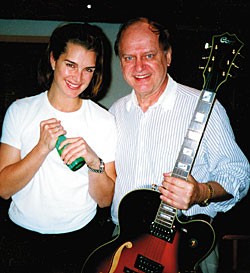
    Casher with actress Brooke Shields at a soundtrack recording session.

    Casher with actress Brooke Shields at a soundtrack recording session.

    He’s called “The Papa of the Wah-Wah Pedal” and has been a top session cat since the early 1960s, introducing the Ecco-Fonic and wah pedal to film scores. He’s also an unsung hero of the recording industry whose love of technology made him the perfect candidate to usher in a whole new era of sounds and guitar effects that still resonates today.

    Vintage Guitar: Do you see yourself sort of as the bridge between the old-guard session guys and the younger guys who could add a rock sound.
    Del Casher: Absolutely. I came from the school of having to learn my harmony, my chops, my chord progressions and learning how to write what I had played. I saw this revolution happening. The older guys from the big-band era, were different. When they tried to play a rock date, the flair just wasn’t there because they hadn’t grown up with it. I grew up hearing Elvis Presley and Chuck Berry. I was playing tunes that had 30 chords, so it was easy for me to look at a chart.

    I played a lot of record dates for Motown, and they were fun – you could really show your stuff. I wasn’t part of The Wrecking Crew, but I was certainly being called in along with them.

    How did you hook up with Elvis?
    I got a call from the music director at Paramount Pictures. He said he wanted me to do a film with Elvis, called Roustabout. He said, “You’ll have to be on the set with Elvis, because they’re going to need somebody to appear in the scene.” Well, the first thing Colonel Tom Parker said on the set was, “Nobody talks to Elvis!” On the fourth day, we broke for lunch and I started practicing. Elvis was sitting in the director’s chair, staring at me. So I start rippin’. Five minutes later, he walks up very humbly and says, “I’d give anything if I could play guitar like that.” He was so nice.

    That afternoon, I was back onstage, and the other musicians were in a closeup shot with Elvis. I’m staring at the ceiling while we’re filming, and Elvis suddenly ran over to me and said, “You’re in the movie! I want you to be with me!” Then he ran to the cameraman to make sure he wasn’t blocking me out. He blocked the scene in such a way that the spotlight would be on him and myself.

    What have you been up to lately?
    I’m recording several new projects called “The Americana Suite” with an orchestra. I’m doing tours and a bunch of personal appearances demonstrating some of my vintage guitars I’ve used over the years. I have a pending television show where I guest host. I’m still playing the guitar all the time and perform at every opportunity. I play to my audience; at the Viva Las Vegas Festival, it was rockabilly, which I love. So I played “Guitar Boogie” and “Freight Train,” which is sort of a country tune, but I take the guitar playing all over the world and play in a bunch of different styles. I play “Twelfth Street Rag” which is a fast tune. Some of these are things I’d done with The Three Suns back in the early ’60s, and the audience loved it because it’s retro. I played The Coffee Gallery in Altadena and the audience is a lot different. They want to hear some of my classical works. I play “Guitar On Fire” which is an original guitar flamenco work. I play several jazz works… a lot of Jerome Kern. My latest album is called Magic Guitar.

    What kind of gear are you using these days?
    The guitar I have for my jazz stuff is the R.C. Allen, which is sort of a copy of my Stromberg, which I don’t like to go out and play. I’m also representing Sunlite guitars, which are very much like Fenders. Of course, I still use my Gretsch Duo-Jet, and I still have my Strat. I have a collection of 60 or 70 that I’ve kept and always enjoyed playing.

    For amps, I use one of my vintage Fender Deluxe Reverbs. I also have a tweed Fender Bandmaster, and an amp made by a friend named Russell Alee. It’s called Amp. I still have my Ecco-Fonic units working. If I’m doing a show where it’s really a truly vintage show, I’ll bring a vintage amp, a vintage Ecco-Fonic and a vintage guitar. I want to let them know that those guitars are still working and also I’m still working [laughs]!


    This article originally appeared in VG‘s Nov. ’06 issue. All copyrights are by the author and Vintage Guitar magazine. Unauthorized replication or use is strictly prohibited.
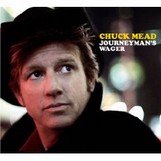
  • Chuck Mead – Journeyman’s Wager

    The BR549 co-founder’s new disc
    is loaded with great stuff, including
    his guitar work. In the band, Mead
    split lead duties with Chris Scruggs
    and Gary Bennett, but was more than
    capable of handling the job on his own.
    After Bennett left, he did, and Don
    Herron picked up the slack, though
    his main ax was pedal steel.

    Here, guitarists Kenny Vaughan and
    Audley Freed get “lead guitar” where
    applicable, while Pat Sievers fills the
    chair on “Journeyman’s Blues.”

    Mead makes this very good album
    better by coming off comfortable,
    practiced, and happy in his musical
    skin. Check the Gene Clark-like “Albuquerque,”
    the plaintive alt-country
    of “A Long Time Ago,” or “She Got the
    Ring (I Got The Finger),” co-written
    with Jon Tiven. There’s hardly a dud
    in the bunch. A version of George
    Harrison’s “Old Brown Shoe” has
    Vaughan deftly expanding on the rare
    John Lennon slide lead, and Mead
    giving an enthusiastic yodel at the
    end. There’s no better way to illustrate
    the effect of the kicks in store on this
    excellent disc.


    This article originally appeared in VG‘s Aug. ’09 issue. All copyrights are by the author and Vintage Guitar magazine. Unauthorized replication or use is strictly prohibited.
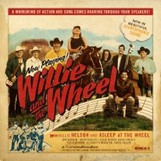
  • Willie Nelson – Willie & The Wheel

    Aside from Jerry Wexler’s standing as a titan of R&B, soul and rock, his musical range extended far beyond. A lifelong country fan, Wexler enjoyed Hank Williams and Bob Wills when they were alive and touring. He was aware of Willie Nelson – who grew up playing Western swing around Abbott, Texas – in the early ’60s, when Willie, far from stardom, was renowned as Nashville’s hottest new songwriter. After meeting him at a party in Nashville in 1972, Wexler made him the flagship act in Atlantic’s short-lived country division. That same year, Asleep at the Wheel recorded its first album (for United Artists). Willie admired them from the start and a deeper bond developed when the band moved to Austin. Wexler also became friendly with AATW co-founder Ray Benson.

    Even in retirement, Wexler still wanted to produce a Willie-AATW Western swing album. A few years ago, he sent Benson his reissue swing LPs with tracks he’d noted long ago as possibilities for Willie. For the most part, he wanted to stress the acoustic pre-WWII swing sound, wisely bypassing predictable Wills standards in favor of material from iconic Western bands including Milton Brown and his Musical Brownies, Cliff Bruner’s Texas Wanderers and post-war talents Spade Cooley and Hank Penny. The two finalized the song list in 2007. Failing health prevented Wexler from hands-on production, but he approved the final recording before he died last year at 88.

    With Willie taking vocal lead, Benson, fiddler-electric mandolinist Jason Roberts and Elizabeth McQueen each get their vocal moments. The relaxed, often rollicking two-step beat and austere instrumentation convey pre-war swing, spiced by occasional placed brass and reeds that hint at the music’s Dixieland roots. With Nelson focusing on vocals, nearly all the hot string moments come from Benson, Eddie Rivers’ cleanly articulated lap steel and Roberts’ electric mandolin.

    Most tunes come from the prewar repertoires of both the Musical Brownies (formed in 1932, nearly a year before the Texas Playboys) and Bruner, a onetime Brownies fiddler. Everyone’s strong on “Hesitation Blues,” “Sweet Jennie Lee” “Sittin’ On Top of the World” (a duet with McQueen) and “Oh! You Pretty Woman.” A full-bodied rendition of Bruner’s “Ain’t Gonna Give Nobody None O’ This Jelly Roll” compliments “South,” the Kansas City jazz instrumental most Texas bands (including Wills) played, with a piano cameo from Paul Shaffer and a blazing Vince Gill guitar break. Two numbers reflect postwar swing: a straightforward remake of Spade Cooley’s 1945 “Shame On You” and Hank Penny’s “Won’t You Ride In My Little Red Wagon,” a tune Willie has recorded before.

    Willie is an American institution and after 40 years, Asleep at the Wheel is in a similar zone. Their 1975-’80 big band remains their peak moment, but this is the most powerful and dynamic incarnation Benson has led in years. They not only offer a more rounded, funkier picture of Western swing’s beginnings, they helped the legendary Wexler pull off one hell of a final act.


    This article originally appeared in VG‘s May ’09 issue. All copyrights are by the author and Vintage Guitar magazine. Unauthorized replication or use is strictly prohibited.