Month: January 2006

  • Michael Franks – Watching the Snow

    Watching the Snow

    It’s the time of year when you may be looking to make a “Eclectic” addition to your collection of Christmas records.

    Michael Franks is the perfect complement for Christmas. Light pop-jazz with subtle twists and a sensuous quality that oozes through his music. Ten originals, all good, with fine playing. They show his usual influences – Miles, Coltrane, and especially Jobim. Fine guitar work all over the record, with Jay Azzolina and Romero Lubambo contributing. There’s even a new arrangement of his very funny “I Bought You a Plastic Star (For Your Aluminum Tree).” A perfect Christmas record.


    This article originally appeared in VG‘s Feb. ’05 issue. All copyrights are by the author and Vintage Guitar magazine. Unauthorized replication or use is strictly prohibited.


  • Chris Thile – Deceiver

    Deceiver

    The only disappointing thing about Chris Thile’s fifth solo album is its length – 34:23. Highlighting his songwriting and arranging skills, Deceiver displays the strong influences of not only fellow Mutual Admiration Society member, songwriter Glenn Phillips, but also classical chamber music, avant-garde jazz, rap, and South American Chioro music. The final result comes across like pop music for the mid-21st century.

    At the ripe old age of 23, Thile has already cut a swath across the world of bluegrass. His first album, Stealing Home, released when he was 13, established him as one of the most technically adept mandolin players ever to play a fiddle tune. His subsequent albums, both with the group Nickel Creek and solo, revealed his ability to draw from traditional music while creating entirely new musical amalgamations.

    Deceiver comes across as Thile’s most intimate and self-exploratory album. Songs such as “I’m Nowhere and You’re Everything” dwell on complicated interpersonal relationships, just the sort of thing you’d expect from a precocious, sensitive, early 20-something. The complexity of the melodic, rhythmic, and harmonic structures separates Thile’s work from other young songwriters. Just when a song has settled into a groove, it’ll veer into uncharted territory. Deceiver ain’t for old traditionalists who can’t adjust to a bit of ear-stretching. Co-produced by Thile and engineer Gary Paczosa, it sounds glorious. The two solo mandolin pieces “Jessamyn’s Reel, and “Waltz for Dewayne Pomeroy” have the steamy intimacy of a warm studio on a summer night. Even more sonically ambitious pieces such as “Empire Falls” demonstrate how wonderful texturally complex modern pop can sound.

    Each time Thile delivers a solo album the event comes across like an intellectual and emotional challenge. Can you keep up? This music doesn’t just sit there like aural wallpaper. Instead, it demands you pay full attention if you want to get your head and heart around it.

    In a world full of musical pabulum, being confronted by complicated music that requires some effort on the listener’s part is cause to rejoice.


    This article originally appeared in VG‘s Jan. ’05 issue. All copyrights are by the author and Vintage Guitar magazine. Unauthorized replication or use is strictly prohibited.

  • Keb’ Mo’ – Peace… Back By Popular Demand

    Peace... Back By Popular Demand

    Keb’ Mo’ is swimming upstream, issuing a new CD with a picture of peace sign prominently displayed on the cover. Not that the disc largely consists of ’60s protest songs, but it comes at a time when flag-waving patriotism is in vogue.

    That Mo’ (real name Kevin Moore) would be moving beyond the country blues he has established should come as no surprise. He has previously made use of classic material, but not to this extent. And due to his relative youth compared to these songs, he’s a little loose with the time frame.

    The album starts with Buffalo Springfield’s “For What It’s Worth.” In short order, he layers on “People Got to be Free,” by the Rascals, “Get Together” from the Youngbloods, and Bob Dylan’s “The Times They Are A-Changing.”

    So the peace spread isn’t so monochromatic, Marvin Gaye’s “What’s Happening Brother?” is included, as well as a song from Donnie Hathaway.

    Elvis Costello’s “(What’s So Funny ’bout) Peace, Love, and Understanding?” from the early ’80s, leads into the album’s finale – John Lennon’s “Imagine.” The Mo’ original “Talk” is an imaginary conversation with the President. It fits very well.

    I’m in favor of peace and all that, and Moore’s restrained vocals bring a new life – and some modern-day relevance – to the songs.


    This article originally appeared in VG‘s Jan. ’05 issue. All copyrights are by the author and Vintage Guitar magazine. Unauthorized replication or use is strictly prohibited.

  • Fleetwood Mac – Rumors

    Rumors

    Considering Fleetwood Mac’s enormous popularity in the 1970s, which can be traced to the moment Lindsey Buckingham and Stevie Nicks joined the waning band, Buckingham would have to rank as one of the most underrated guitarists in rock. He is also one of the more unorthodox.

    An ex-folkie who displays his acoustic fingerpicking on “Landslide” and “World Turning” from the group’s self-titled 1975 comeback, Buckingham’s “technique” on electric lead was closer to clawhammer banjo – flailing away with pickless fingers, which usually ended up bloody by the end of a set. But his sensibility was best exhibited on “I’m So Afraid,” from the same album, which became his extended showstopper onstage. The licks were simple, but with Lindsey’s sense of dynamics (and a super-long setting on his delay), the effect was mesmerizing.

    Mac’s three albums from the height of the band’s popularity, repackaged with bonus material, reveal the changes the group was undergoing collectively and Buckingham’s artistic growth in particular.

    On the heels of their unexpected success, the band was in the midst of broken relationships and divorces. But instead of spelling the demise of the band, the tension fueled a startlingly revealing album that would eventually sell 30 million units worldwide.

    The band’s inner turmoil was evidenced in lyrics such as “Players only love you when they’re playing,” “I’m just second-hand news,” “You can go your own way,” and “I can still hear you saying you would never break the chain.” The fact that the three songwriters wrote alone was nothing new; they’d seldom collaborated. Ironically, all five members had a hand in composing “The Chain.”

    In addition to his solo fingerpicked country ditty, “Never Going Back Again,” Lindsey’s showcase this time was the herky-jerky “Go Your Own Way.” And for the Rumours reissue, a full second disc was needed to house the outtakes, jams, and songs that didn’t make the cut. The outtakes aren’t particularly revealing, except to show that the finished takes were indeed more fleshed out and heartfelt. “For Duster,” an instrumental blues jam named for early Mac cohort Duster Bennett, shows the band having a good time in the studio.


    This article originally appeared in VG‘s Sep. ’04 issue. All copyrights are by the author and Vintage Guitar magazine. Unauthorized replication or use is strictly prohibited.
  • Metropolitan Tanglewood

    Metropolitan Tanglewood

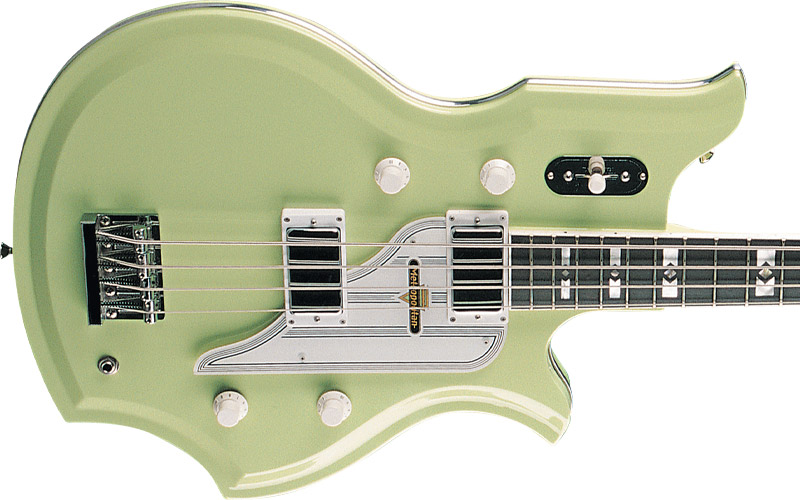
    The Metropolitan Tanglewood. Photo courtesy of Alamo Music Products.

    Many guitar aficionados are aware of the instruments proffered by Houston’s Alamo Music. The Texas manufacturer has created unique low-end (sonically, that is) items, some as regular production basses, others as prototype and/or custom-orders.

    Among the most unique and rare were no more than a half-dozen map-shaped Metropolitan Tanglewood basses created in the mid/late ’90s. The company conceived and built Tanglewood guitars, neo-retro six-string items inspired by the map-shaped, Valco-made National instruments of the early ’60s. National’s guitars and a couple of its basses, were made in Chicago, and fashioned from wood or Res-O-Glas (molded fibreglas and resin). The Windy City progenitors were unique-looking, but their quality and sound were atrocious.

    And as might be expected, the wood-bodied Tanglewoods are light years beyond their visual predecessors. According to Alamo’s David Wintz, his firm had given preliminary thought to experimenting with a Tanglewood bass, but the definitive go-ahead came at the behest of Cheap Trick bassist Tom Petersson, a longtime collector, who special-ordered the first example.

    The differences between Tanglewood guitars and basses were the neck and pickups. The bodies and control layout were the same, as were cosmetic differences between the Custom and Deluxe versions; the Custom had a bound ebony fretboard with butterfly inlays and a German carve on front and back of body, while the Deluxe had an unbound rosewood fretboard with dot inlay and a German carve on the top only.

    Bodies of the full-scale (34″) Tanglewood basses were poplar or African fakimba, and the pickups were a new Rio Grande model called the Pitbull, which was developed specifically for this bass. The Pitbull is a humbucker designed to fit in guitar pickup-sized humbucker routing, and while Tanglewood basses were short-lived and few and far between, the Pitbull is still in the Rio Grande lineup.

    Company records indicate that the few Tanglewood basses Alamo built were finished in standard Metropolitan colors – Shell Pink, Pearl Aqua Blue, Pearl Mint Green, and Basic Black. Our “model” model is a Tanglewood Custom from the late ’90s in Pearl Mint Green.

    As for the number of instruments produced, Wintz acknowledged that the Tanglewood bass would have needed a large demand to justify putting it into full production. However, that doesn’t mean the company didn’t have an interesting time creating these retro-vibe rarities, as Wintz affirmed.

    “We enjoyed making ’em, and they’re cool to look at!” he said.

    That’s an understatement.


    This article originally appeared in VG’s February 2004 issue. All copyrights are by the author and Vintage Guitar magazine. Unauthorized replication or use is strictly prohibited.
  • Epiphone U.S. Map

    The idea of making “presentation- grade” guitars – special instruments meant as much for marketing as for rich customers – probably goes back to the beginnings of guitarmaking.

    Certainly by the late 19th century, when industrial expositions and World’s Fairs proliferated, and prizes were awarded to superior instrument makers, it was common for guitar builders to create presentation models to compete in the judging and impress potential buyers. In the old days, these were often made of premium timbers and heavily decorated with abalone and pearl inlays.

    The craze for fairs began to fade and, as a more commercial economy matured at the end of the 19th century, the National Association of Music Merchandisers (NAMM) essentially took over the presentation function as instrument makers brought their wares, including special and limited-edition guitars, to entice retailers to carry their lines. The 1982 Epiphone Map guitar was one of those kind of special guitars intended to be more of a promotional item than an actual part of the Epi roster.

    At the time this guitar appeared, the Gibson company was on the ropes. It and other American companies had suffered a pummeling from Japanese competition during the ’70s “copy era.” Plus, Gibson was owned by Norlin, part of a South American conglomerate that had lost some of its interest in making guitars. Quality control was not what it once was. Part of Norlin’s survival strategy – like so many companies in the ’70s – was to begin to shift its production away from expensive unionized workers in the North to cheaper, non-union labor readily available in the primarily agrarian South. In 1974, Gibson opened a second guitar factory in Nashville and began to slowly move production out of its historic Michigan plant in Kalamazoo.

    By the early ’80s, the transition was almost complete. Most Kalamazoo workers had been laid off. But in ’82, Gibson decided to produce a few models of its “budget” Epiphone line in Michigan, and called some of its craftsmen back to work. At that time, most Epiphones were being made either in Japan or (with some of the Genesis models) Taiwan. It’s not known if the plan was focused on boosting the Epiphone line in a period of economic recession or simply to give some work to hard-hit former employees. Anecdotal information suggests that, for reasons unknown, the Gibson brand name could not be used at the Kalamazoo plant, but that seems a bit odd and it’s more likely that they wanted to pump up Epi sales.

    The principal Epi models produced in the U.S. were the one-and two-pickup Spirit models, nice little utilitarian double-cutaway guitars reminiscent of, but different from, the Les Paul Special. Another American-made Epi at the time was the Special, basically an SG variant. Most, it’s believed, have serial numbers indicating that they were made in the latter half of ’82. They were not promoted after September, though some were made at least into October.

    As one would expect, Gibson made a great deal of noise about resurrecting the Epiphone line with its made-in-the-U.S. American Series. Their ads even offered prizes for test driving one of these new Epis at your neighborhood dealer. The Grand Prize? A trip to Kalamazoo – “an All-American city” – for one day, plus three days in Nashville!

    It was during this promotion that the Epiphone U.S. Map guitar was conceived. Basically, they took a couple of blocks of nice mahogany, glued them together, then scroll-sawed out the Lower 48. Sorry, Alaska and Hawaii, but you might take some consolation in being the players shoulder and elbow, respectively! The thin Gibson neck with rosewood fingerboard was glued into the East Coast. These were basically twin-humbucker guitars with Schaller BadAss-style adjustable finetune bridge/tailpieces, basic three-way select (located in San Francisco), and two volumes and two tones. The serial number of the example shown tells us it was completed on September 13, 1982.

    You might expect this to be better to look at than play, but it’s remarkably well-balanced and easy to pick. And a pair of hot Gibson humbuckers is never shabby. Like any pointy guitar, the points are always vulnerable, and with this guitar’s geographic verité, that is even more true about one of these maps! Both Maine and Texas had better mind that mic stand, or plan to secede!

    Perhaps it was because of the political statement they made (there was still plenty of anti-Japanese sentiment in ’82, and a bad economy didn’t help), but the Epiphone maps were very well-received. So much so that Gibson decided to convert them to a Gibson model, which debuted in ’83. They were featured prominently in Gibson advertising, with its “made in U.S.A.” theme, shown in the photo, as if they were being hand-carved! Some of the information floating about says the Gibsons were simply the Kalamazoo Epiphones with replaced head faceplates. But whether that happened is anybody’s guess. And whether or not all map guitars were produced in Kalamazoo, or if any were made in Nashville, are also unknown. According to Gruhn’s Guide to Vintage Guitars, nine maps were produced with American flag paint jobs.

    How many of these promotional map guitars, Epiphone or Gibson, were produced in ’82-’83 is another unknown, but the number would have been, by definition, pretty small. These were not exactly “production” guitars and weren’t made on numerical carving machines. They have to be considered rare birds.

    After the demise of the Spirit, Special, and U.S. Map at the end of ’82, U.S. production of Epiphones ceased, though a few later models were either assembled (e.g. Spotlight) or completely (e.g. Coronet) made in America. In ’84, Epiphone production was outsourced to Korea, where it remained until other Asian countries got into the game. Also in ’84, Gibson finally closed the Kalamazoo plants for good. Part of the property was sold to a group including ex-Gibson employees to house the new Heritage guitar company. The Epiphone U.S. Map guitars were among the last Gibson guitars to be made in their longtime home of Kalamazoo, All-American city!


    1982 Epiphone Map, serial number #82562042. Photo: Michael Wright

    This article originally appeared in VG‘s May ’05 issue. All copyrights are by the author and Vintage Guitar magazine. Unauthorized replication or use is strictly prohibited.

  • Crafters of Tennessee Prodigal 5

    Return of the Prodigal Mandolin

    During his tenure at Gibson, Lloyd Loar oversaw the production of over 250 F-5 mandolins. But he produced just one A-5 model – a special order for The Griffith School of Music in Atlanta.

    In those days, most Gibson instruments were sold through music schools and teachers, a method that populated mandolin orchestras with Gibson instruments. If you lived in the South and wanted to buy a Gibson, Dr. William B. Griffith was the man to see. And he had clout in Kalamazoo, so when he asked for an F-5 “without points,” Kalamazoo complied.

    The instrument remained in the possession of the Griffith family until the late 1950s, when it was purchased by Tut Taylor, a well-known bluegrass musician and instrument collector. Tut played the mandolin for 20 years before he sold it to a collector in the late ’70s. In the mid ’90s, he borrowed it for a recording project, and while he had it, his son, Mark, took measurements and X-rays, then made drawings of the instrument with the intent of one day making a copy.

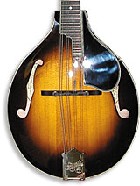
    What’s so special about the A-5? Gibson (among others) has been making A models since they began building mandolins. But neither Gibson nor anyone else has ever made a mandolin that had the exact specs of the Loar A-5. Every other has been an approximation. Taylor’s company, Crafters of Tennessee, is the first to make faithful replicas, and they call it the Prodigal 5.

    The first Prodigal 5 was produced in ’03, and so far 12 have been built, every one snatched up by a mandolin connoisseur (many of whom also own original Loar-signed F-5s). With its five-digit price tag, the Prodigal 5 is one of the most expensive A-styles available.

    Mark Taylor recently arranged for me to look at #7, owned by Mitch Simpson, who graciously allowed me to examine it.

    Close Up
    The Prodigal 5 makes a stunning first impression. The quality of its finish ranks with the finest from any builder; the color and tone perfectly match that of a vintage Loar. The binding and inlay work are also impeccable, the intricate headstock inlay is especially impressive. With nickel silver Waverly tuners, a pearloid-engraved truss rod cover, and a specially engraved vintage tailpiece, the Prodigal 5 looks like a premium instrument.

    The woods on the Prodigal 5 also demonstrate that no expense was spared. The bookmatched flame maple back and sides complement the tightly grained silky spruce top. The ebony fretboard is fully bound, with the edges of the frets lining up beautifully with the ivoroid fret ends. Small details, like the way the underside of the pickguard is carefully finished, indicate that the Prodigal 5 comes from a builder who cares enough to get even the smallest details perfect.

    The Prodigal 5’s neck profile is quite narrow, similar to skinnier Loar-period F-5s. While not quite as triangular as some Loar necks, its canoe-shaped profile takes a bit of getting used to, especially if you routinely play beefier necks. Without a neck strap button or any points sticking out to secure it on your lap, it requires using your left hand not only to fret the strings, but also to hold it in playing position. A strap is necessary to play any A-style comfortably.

    The Prodigal 5 has a unique sound, with more bass energy than nearly any mandolin I’ve ever played. The sound is ideal for bluegrass-style chop chords and bass-string tremolo. For upper-string single-note work, it’s rather dark sounding. In a bluegrass ensemble situation, it did not have the same projection on high notes as it did on bass chops. Overall, it was not as harmonically balanced as the best vintage Lloyd Loar or modern F-5s I’ve played.

    Obviously “perfect tone” is a subjective thing. Some prefer brighter or darker harmonic balance. Anyone looking for a new mando with the bass fundamentals of a much older instrument would be delighted by the review Prodigal 5. Players who want an instrument with a more even volume throughout its harmonic range may find the Prodigal 5 less to their tastes.

    The True Loar Model A-5?
    The principle reason most players own an A-style rather than an F model is that A models are almost invariably less expensive than F models. The Prodigal 5 is more expensive than most F models, including even the Gibson varnish-finished Master Model (which lists for $12,500, but usually streets for less). Given its price, the Prodigal 5 will appeal to a limited number of buyers. While it is not my sonic cup of tea, the Prodigal is a special instrument. It’s a beautiful instrument that is certainly competitive with other premium mandolins of similar cost.


    Crafters of Tennessee Prodigal 5 mandolin
    Features Bookmatched flame maple back and sides, spruce top, ebony fretboard, ivoroid fret ends, nickel silver Waverly tuners, pearloid-engraved truss rod cover, vintage-style tailpiece.
    Price $12,000.
    Contact Crafters of Tennessee, 14919 Lebanon Road, Old Hickory, TN 37138, phone (615) 773-7200, www.crafterstn.com.


    This article originally appeared in VG‘s July ’04 issue. All copyrights are by the author and Vintage Guitar magazine. Unauthorized replication or use is strictly prohibited.
  • Danelectro Free Speech

    Well, we’ve all had the fun of trying to mimic – even on the worst of nights – a Peter Frampton tune featuring the dreaded “talk box,” possibly even venturing into the dreaded Joe Walsh territory, and usually with lots of laughs and little success.

    The reasons for our failure could be many, including a). the replacement gear sucks, b.) we suck (Get it?? it’s a visual joke… oh, never mind!), or c). the whole concept is so silly we start to laugh while vocalizing those dreaded notes while singing, “Do you feeeeeel.”

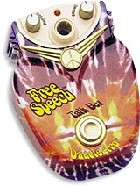
    But get ready to warm up your vocal chops, folks, because the folks at Danelectro have revamped, yet again, another hoary device, and issued the Free Speech Talk Box, a free-standing box that promises to deliver.

    Now did it? Lessee…

    Cleverly evading the complex tangle of signal to plastic tube to michrophone, the engineers have come up with a lovely, if weighty, foot pedal signal processor with volume and growl controls, and a nifty little tube-plus-mic that can easily sit on your mic stand, bypassing the PA, and putting you right back where you wanna be – running through your own mighty fine amp.

    The two miniature mics on the tube are sturdy, and padded, and the device is easy to use, fulfilling my idea of a good box. But how does it sound? Very cool, actually!

    Through a ’50s tweed Fender Twin with an outboard reverb unit and no other effect (save for a wee bit of echo), this device rocked! A P-90-driven LP Junior sounded fat, sassy, and… wouldn’t you know, I somehow felt those apocryphal words emanating from me mouth… “Bap-Bap-Bap-bow-dooooh!” (to quote Joe Walsh). It was indeed, alright.


    Danelectro Talk Box
    Type of Effect: In-line talk box.
    Features: Built-in mics eliminate need for external mic, heavy-duty metal housing, accurate, classic talk box effect, ease of use.
    Price: $129
    Contact: Danelectro, PO Box 73010 San Clemente, CA 92673, phone (949)498-9854, www.dan- electro.com.


    This article originally appeared in VG‘s Feb. ’03 issue. All copyrights are by the author and Vintage Guitar magazine. Unauthorized replication or use is strictly prohibited.
  • Chicago Blues Box Roadhouse amp

    Hot Windy City Tone

    Illinois-based Butler Custom Sound recently introduced its Chicago Blues Box amp series with the blues player very much in mind.

    Company president Dan Butler has repaired and modified countless tube amplifiers for many years, for many great players. From this experience, he has come to understand that most players would just as soon forget the bells and whistles and settle for nothing less than a reliable amplifier with enough raw guts to cut through a band mix and enough pure tone to ignite artistic inspiration.

    Butler offers two amp models – the Halsted (18-watt 1×12″ combo) and the Roadhouse (50-watt 4×10″, also available as a 2×12″). We recently put to the test the bigger Roadhouse.

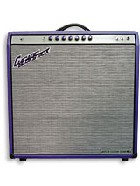
    Physically and in terms of features, it measures up to its Fender Super/Bassman-inspired brethren, with its four 10″ speakers, two power tubes, reverb, tremolo, etc. But beyond that, it shares few aesthetic qualities with any other amp; purple tolex, matte silver faceplate and grillecloth, and Q-parts knobs with purple mother-of-pearl inlays all add a hot rod element to its streamlined two-tone appearance – just enough flash to make you anxious to give it a test “drive.” And when you dig a little deeper, it shows a personality and flavor all its own.

    The Roadhouse uses five 12AX7 tubes (three in the preamp, one for the reverb and one for the tremolo), and a choice of tube configurations using 5881s, 6L6s, KT66s (which ours had), or EL34s, and the 5AR4 rectifier. The solid pine, fingerjointed open-back cabinet is loaded with four Jensen C10Q speakers in parallel/series configuration.

    Front-mounted controls include a High/Low treble boost switch, passive Treble/Middle/Bass tone controls, Tremolo Speed and Intensity, a Reverb Level, and the Power and Standby switches. Parked on the back panel are a Harmonic Boost switch (essentially a power amp governor) and the footswitch and speaker jacks.

    Hands Upon The Wheel
    To test the tone of the Roadhouse, we recruited a Strings-n-Things single-cut loaded with Seymour Duncan single-coil pickups, a Carvin TL60 with three stock single-coils, and a Tradition S2004 with Alnico humbuckers (“Gear Reviews,” March ’04).

    Plugging in, it was easy to get a big, open sound from the Roadhouse. And immediately apparent was its sensitivity to a player’s pick attack. With the Harmonic Boost turned on, the amp opened up even further, offering plenty of sustain without buzzy distortion or noise. The more we dug in, the more the amp reacted – exactly what a player likes to hear (and feel) in a “blues” amp.

    Regardless of how hard we picked the strings of any of our test guitars, the low-end stayed tight right up until the volume control was dimed. On the other end of the spectrum, the Roadhouse cleaned up nicely using only the guitars’ volume controls, all but eliminating the need for channel switching. And any tone or gain changes can be also be accomplished at the guitar, or by simply altering pick attack.

    The High/Low/Bright switch worked well when we changed guitars from the single-coils in the Strings-n-Things to the humbuckers in the Tradition. The switch added just enough sparkle to the humbuckers so we didn’t have to mess with the amp’s tone controls. The reverb and the tremolo were top-notch in terms of sound – the reverb is smooth, lush, and did not wash out, while the tremolo has a smooth, deep swell that doesn’t change the tone of the amp.

    In all, the Roadhouse is a monster blues amp with a cool look and a very expressive tone. Keep yer’ eyes on Butler Custom Sound!


    Butler Custom Sound Chicago Blues Box Roadhouse
    Type of Amp Semi-open-back 4×12″ combo.
    Features All tube circuits, point-to-point wiring, 20-foot power cord, reverb and tremolo, Jensen speakers.
    Price $2,695.
    Contact Butler Custom Sound, 770 N. Church Rd #1, Elmhurst, IL 60126, phone (630) 832-1983, www.chicagoblues-
    box.com.


    This article originally appeared in VG‘s Aug. ’04 issue. All copyrights are by the author and Vintage Guitar magazine. Unauthorized replication or use is strictly prohibited.
  • Merlefest Live – The 15th Anniversary Jam CD/DVD

    The 15th Anniversary Jam CD/DVD

    Doc Watson. If you aren’t familiar with him you can’t consider yourself any kind of expert on American music. He’s simply the most influential acoustic guitarist this side of the Fertile Crescent. Blind at birth, self-taught on guitar, Athel Watson gained the surname Doc because of his ability to fix or doctor almost any object back to life. His only son, Merle, also a superb guitarist, was killed in a tractor accident in 1985. As a memorial, his friends put together the first Merlefest concert in ’88. Since then Merlefest has grown into one of the premier music festivals in the country. The 15th Anniversary Jam CD brings Merlefest to those of us not fortunate enough to attend in person.

    Featuring Doc Watson joined by a who’s who of roots musicians, the CD’s 19 cuts span the breadth of great American music. Sam Bush, Chris Thile, Earl Scruggs, Peter Rowan, Tony Rice, Jerry Douglas, Bryan Sutton, Stuart Duncan, Sean Watkins, Pete Wernick, Byron House, Alison Krauss, Sara Watkins, Patty Loveless, Albert Lee, and John Jorgenson all contribute to the musical stew. Large jams, combined with small intimate groupings, gives The 15th Anniversary Jam musical variety and spice. Song choices vary from old rock and roll standards such as “Blue Suede Shoes” and “Tutti Frutti” through jazz classics such as “Sweet Georgia Brown” and “Summertime” to traditional fare including “Shady Grove,” “Careless Love,” and “Amazing Grace.”

    Executive producers Jim Barrow and B. Townes roped together a top-flight production staff, including Bill Blankenship, Michael Sheehan, Claire Armbuster and Naomi Newman. Audio post-production involved five different engineers in five different studios. The final mastering took place at Airshow Mastering in Boulder, Colorado, where David Glasser had the daunting task of giving the whole mix a final polish. The finished results rival the best you’ll hear on any live concert CD. The recordings preserve the sense of “liveness” along with excellent clarity and natural ambience.

    The companion DVD has eight additional selections, and a 5.1 surround sound mix in addition to the two-channel tracks. The surround sound mastering, done by Zapp Labs, nearly makes up for the abominable video quality. The picture is soft, grainy, and only slightly above what you’d expect from a hastily-assembled TV special. The picture is difficult to enjoy on anything larger than a 36″ direct-view monitor. The performances deserve better. Still, Alison Brown group’s “Mambo Banjo,” and longtime Watson duo partner Jack Lawrence’s solo on “Leaving London” make the DVD a winner in spite of its substandard image.

    The easiest way to get a copy is from the Merlefest website, merlefest.org, or by calling 800-871-2738. Given the size and scope of Merlefest, I hope this disc is just the first of many from this fine venue. The 15th Anniversary Jam graphically proves that great players with synergistic chemistry can make exceptional music.


    This article originally appeared in VG‘s Sep. ’03 issue. All copyrights are by the author and Vintage Guitar magazine. Unauthorized replication or use is strictly prohibited.