In 1922, Gibson introduced Lloyd Loar’s L-5, lauded as the first modern archtop. Luthiers have been “advancing” the design ever since.
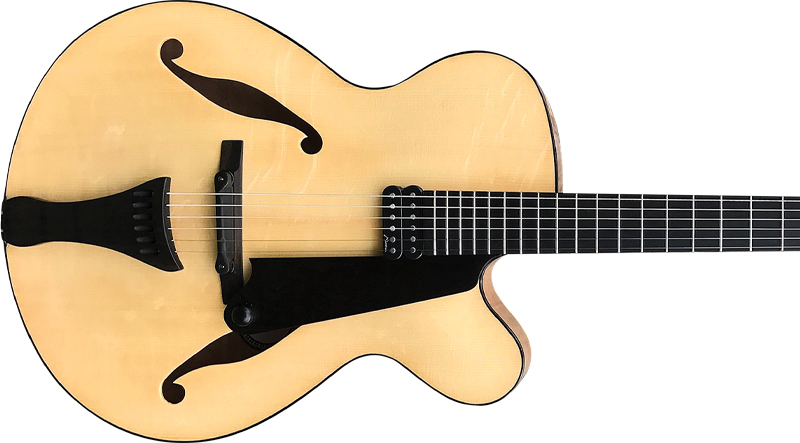
Marchione Guitars’ 16″ Archtop shows how the violin family influences evident in Orville and Lloyd’s work have fared in the hands of Stephen Marchione.
Larger archtop guitars were created to fill the demand to produce more volume before the days of amplification, but Eddie Lang and later guitar luminaries including Marty Grosz and Julian Lage discovered that the 16″ archtop design hit a “golden mean” among size, comfort, volume, and tone.
Enter Marchione, a Houston-based luthier blessed with the assistance of two experienced Texas woodworkers. His study and practice of violin-making has profoundly informed the 16″ model, as seen in his use of ebony, European spruce and maple, violin-inspired tailpiece, hot hide glue, and a cello-style neck joint. For aficionados of fine woodworking, the functional elegance of the neck joint alone is worthy of meditative consideration.
First impressions count, and the graceful simplicity of the 16″ Archtop, with its stylistic references to earlier great modern archtops, creates a memorable imprint, both familiar and distinctive. The tailpiece is, again, cello-inspired, attached with thick copper wire, enhancing tuning stability. The ebony comprising the pickguard, fingerboard with stainless-steel frets, headstock overlay, binding, and tailpiece offers bold contrast to the body tonewoods. The one-piece quartersawn maple neck, 3″ sides, and slab-sawn back are all beautifully flamed or figured, naturally enhanced by the bear-claw spruce top. Black locking key-head Sperzel tuners and inlaid pearl spelling “Marchione” adorn the expansive headstock. Everything from the sound-plate carving to the masterful nitro finish speaks of an understated elegance.
The slightly bulbous cutaway is accessible, and the sound port on the bass side allows a literal peek inside to see the craft that went into the Marchione. And, lest one think this is just another little electric jazzbox, applying a pick near the bridge on an Am6 chord at the fifth fret before plugging it in results in sound loud enough for Manouche rhythm. Picked closer to the fingerboard for a warmer solo or swingin’ rhythm voice, the obvious overtones are focused around a solid fundamental. Various pick techniques with open and fretted altered chord voicings created an orchestral wash, but with a definitive attack. Single notes all over the fingerboard had a fat, round presence, with the sound port helping accent resonance. String articulation for acoustic fingerstyle was excellent, with a firm attack and lengthy decay.
The pickup, developed by Marchione with DiMarzio’s Steve Blucher and Eric Corpus, is a low-impedance humbucker designed for tone, not aggressive output. A/B tested through a ’50s tube amp and modern-jazz solidstate, it offered a smooth, balanced response devoid of out-of-balance “wolf tones.” With only a pickguard-mounted Volume control, the guitar is capable of a range of tonalities and levels of attack and definition simply through its response to right-hand dynamics and detailed left-hand manipulations.
Could you rock out? Sure! But the 16″ Archtop is set to within an inch of its life as a solo vehicle for any style. Electrically, its sound is distinctive and defined enough to stand out in a mix, and could be prettied up with chorus and delay without getting muddy.
The Marchione 16″ Archtop invites an appreciative look. More important, it’s material and workmanship could well make it that “lifetime guitar” for a discerning player.
This article originally appeared in VG December 2017 issue. All copyrights are by the author and Vintage Guitar magazine. Unauthorized replication or use is strictly prohibited.
In the latest installment of our “Have Guitar Will Travel” podcast, host James Patrick Regan connects with James “JC” Curleigh and Cesar Gueikian to discuss their roles in the revamped Gibson guitar company.
New CEO Curleigh is the former president/CEO of Levi Strauss and Salomon, and he has a reassuring message about Gibson’s direction and future. As CMO, Gueikian was in charge of establishing new leadership within the vaunted brand. A guitarist himself, he talks about what he has accomplished so far and what he’s striving to achieve.
Have Guitar Will Travel, hosted by James Patrick Regan, otherwise known as Jimmy from the Deadlies, is presented by Vintage Guitar magazine, the destination for guitar enthusiasts. Podcast episodes feature guitar players, builders, dealers and more – all with great experiences to share! Find all podcasts at www.vintageguitar.com/category/podcasts.
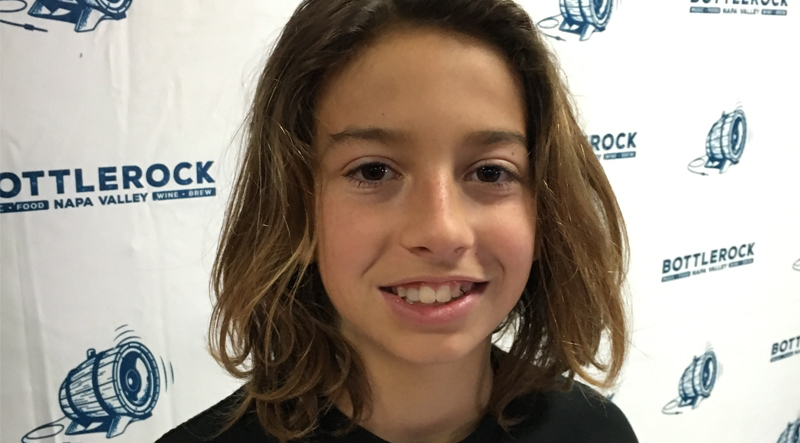
One last show from BottleRock ’18, with guests including Chris Vos (Record Company), Austin Burns (Dani Bell and the Tarantist), and the Alive’s Bastian Evans, the youngest guitarist to play the main stage.
Have Guitar Will Travel, hosted by James Patrick Regan, otherwise known as Jimmy from the Deadlies, is presented by Vintage Guitar magazine, the destination for guitar enthusiasts. Podcast episodes feature guitar players, builders, dealers and more – all with great experiences to share! Find all podcasts at www.vintageguitar.com/category/podcasts.
Have Guitar Will Travel, hosted by James Patrick Regan, otherwise known as Jimmy from the Deadlies, is presented by Vintage Guitar magazine, the destination for guitar enthusiasts. Podcast episodes feature guitar players, builders, dealers and more – all with great experiences to share! Find all podcasts at www.vintageguitar.com/category/podcasts.
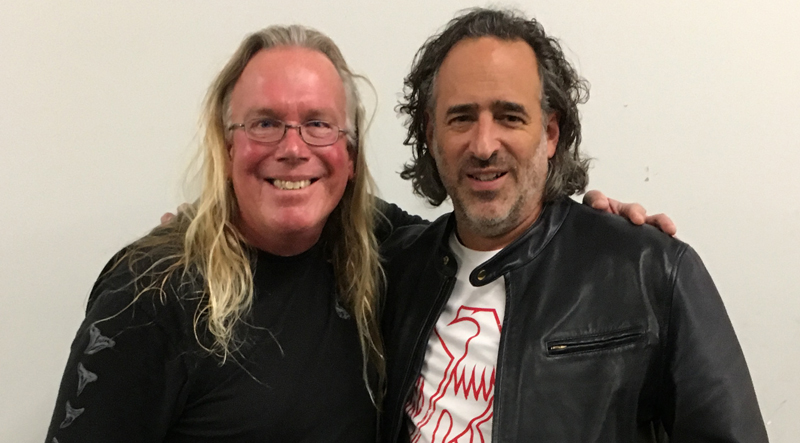
James connects with cool guitarists at the 2018 BottleRock Napa Valley music festival, including the Struts’ Adam Slack, Rudy and Billy Raffoul, and Les Priest.
Have Guitar Will Travel, hosted by James Patrick Regan, otherwise known as Jimmy from the Deadlies, is presented by Vintage Guitar magazine, the destination for guitar enthusiasts. Podcast episodes feature guitar players, builders, dealers and more – all with great experiences to share! Find all podcasts at www.vintageguitar.com/category/podcasts.
David Victor wrote, recorded, and produced his first album in 1991, then later formed Velocity. A video of him doing Boston’s “Smokin’” led to joining that band. He also worked with Ronnie Montrose and today is lead vocalist and guitarist with David Victor: The Hits of Boston and More, Platinum Rockstars, David Victor’s Supergroup, and others!
Have Guitar Will Travel, hosted by James Patrick Regan, otherwise known as Jimmy from the Deadlies, is presented by Vintage Guitar magazine, the destination for guitar enthusiasts. Podcast episodes feature guitar players, builders, dealers and more – all with great experiences to share! Find all podcasts at www.vintageguitar.com/category/podcasts.
Bryan Kehoe went to school with Les Claypool and played with Exodus. He later joined M.I.R.V. and toured the world with Cheap Trick, Run DMC, and Jerry Cantrell. Today, he plays with his own band with Claypool’s Duo de Twang. Working for Jim Dunlop, he’s constantly on the lookout for the next wave of guitarists.
Have Guitar Will Travel, hosted by James Patrick Regan, otherwise known as Jimmy from the Deadlies, is presented by Vintage Guitar magazine, the destination for guitar enthusiasts. Podcast episodes feature guitar players, builders, dealers and more – all with great experiences to share! Find all podcasts at www.vintageguitar.com/category/podcasts.
Billy Rowe is the guitarist/co-founder of Jetboy, which rose to prominence in the mid ’80s while touring with some of the biggest bands of the era. Tinkering with guitars led to starting his company, Rock N’ Roll Relics. James and Billy talk music, guitars, the ’80s crash, and the state of music.
Have Guitar Will Travel, hosted by James Patrick Regan, otherwise known as Jimmy from the Deadlies, is presented by Vintage Guitar magazine, the destination for guitar enthusiasts. Podcast episodes feature guitar players, builders, dealers and more – all with great experiences to share! Find all podcasts at www.vintageguitar.com/category/podcasts.
In “official” terms, the Fender Custom Shop opened in 1987. But its story actually began February 1, 1985 – the day CBS announced the sale of Fender Musical Instruments to a group led by Bill Schultz, who’d served as President of the company for four years. Speaking to the Los Angeles Times the following day, Schultz said, “This is an opportunity to keep a very viable and legendary name alive in the industry.” He envisioned regaining the company’s status from the days when Leo Fender was at the helm – when it enjoyed a reputation of innovation, quality, and value among players of all levels.
Fred Stuart with an early Custom Shop 6/12 doubleneck.
In two decades of ownership, CBS Corporation had turned Fender’s reputation upside-down. Through the ’70s and ’80s, most players viewed Fender as lacking innovation, quality, and value. As Schultz planned new manufacturing facilities after the sale, he recognized that in addition to production models, they needed to offer discerning players the chance to build their “dream guitar” and watch as it was brought to life.
In 1986, Schultz (1926-2006) hired Michael Stevens to head a custom-build facility slated for construction in Corona, California. Stevens completed the first “Fender Custom Shop” guitar – serial number 0001, at his shop in Texas prior to arriving in Corona. This guitar was also the first ever doubleneck Fender, essentially a Strat on top and an Esquire.
The first item on Stevens’ agenda was to lure former Fender R&D whiz kid John Page back to assist him. With a staff of two, the Fender Custom shop was open for business.
“When word got out that we had a custom shop, at the end of three months we had [several hundred] orders,” Stevens recalled. A small team of top-shelf builders was hired, including J.W. Black, George Blanda, Mark Kendrick, Fred Stuart, Alan Hamel, and Gene Baker. In ’89, Page took the helm.
“The Custom Shop was the beginning of bringing the soul back to Fender,” he said. “It was a big component in healing the scars created from CBS ownership. We were about making the best-quality guitar we were capable of making, and pushing it artistically.”
That kind of work gets noticed, and guitars were soon being made for Eric Clapton, Johnny Cash, Merle Haggard, Jimmy Page, joined quickly by a profusion of other top players in the queue.
The first Custom Shop guitar was also Fender’s first doubleneck.Fred Stuart.
Over the past three decades, the Fender Custom Shop has produced everything from dead-on historic replicas to guitars that are more like works of fine art.
While the Custom Shop is now home to many more luthiers building many more guitars, the ethos remains true to the vision of its founders: unshackled creativity married to absolute attention to detail. While the guitar world debates the horrors of the “race to the bottom,” with manufacturers continuously finding new ways to cut costs and flooding the market with cheap instruments, the Custom Shop stands as proof there remains a market for superior instruments.
This year, Fender reunited the builders who shaped the Custom Shop legacy and each was asked to build a Founder’s Design 30th Anniversary guitar that reflected their personal passions and design philosophies. Vintage Guitar spoke with Page, Black, and Kendrick, as well as current Master Builders Dale Wilson and Scott Buehl along with VP of Product Development Mike Lewis.
In 1999, car builder Jaguar commissioned the XK-50 Strat to mark the 50th anniversary of its XK model.
How did each of you get into the wonderful world of guitars?
Mark Kendrick: I come from a family of guitarists/singers, so guitars have been in my life as far back as I can recall. My uncle started with Fender after leaving both Bob Wills and Leon McAuliffe’s band. He was the original artist-relations rep. My dad was an early Fender endorsee.
John Page: My dad was a very conservative preacher, and I think my desire to get into music was my way of rebelling against that whole rigid structure. My first musical influence was Elvis Presley, then the Beatles, then SoCal surf culture. They were all guitar-powered, so getting into guitar was kind of a given. My family didn’t have money to spare, so no one was going to finance my musical-instrument needs. Because of that, I started working at 14 as a janitor in the oil fields. I spent all my earnings at the local pawn shop, buying guitars, tearing them apart, and trying to make better ones out of the parts. I started building my first guitar from scratch at 15. I started building so I could play in bands, but the building ultimately ended up taking priority over playing.
Scott Buehl: I began working with guitars at age 14, when I got an apprenticeship at Rex Bogue’s shop in San Gabriel. I went after school or whenever I had time. After I graduated high school, I worked full-time at Jackson/Charvel. That was the summer of ’84. I came to Fender in early ’87.
Dale Wilson: I started by working on my own guitars and progressed to working on some of my friends’ guitars, then eventually got a job at a small repair shop near my house.
Mike Lewis: It all started in the third grade, when I played a half-size string bass in the school orchestra. Later, I strummed a guitar from a neighbor and thought ‘I could play this.’ They let me borrow the guitar, and when the Beatles came out a few years later, that gave me complete focus. It just took off from there.
John Page with his Founders Design Double F-Hole Esquire.
What does a Custom Shop Fender mean to you?
JP: It’s the perfect, tangible realization of Fender’s history and the customer’s vision, shaped of wood, metal and plastic by the most-talented hands and minds the company has to offer. Anything less is unacceptable.
MK: Creative liberty… When I say that, it also means more than just being relegated to the four horsemen of Strat, Tele, P-Bass, and J-Bass.
DW: To me, it epitomizes the best guitar Fender has to offer.
SB:I think about the quality. Specifically, the playability, fit, and finish, the wiring and the paint being a cut above. Some of the hardware is only available from the Custom Shop.
Work stations in the early Custom Shop.John Page and fellow original Master Builder Michael Stevens at the inception of the Custom Shop.Mark Kendrick with his Founders Design Glittercaster.
How do you describe the Custom Shop family?
JP: As exactly that – family. We worked for a common goal and had a great time doing it. Every member had strong points and weaknesses. We all knew them, so we worked with each other to weave a team without voids. One of the hardest, but most important things to me, running the shop, was not just to manage it, but orchestrate it – put the right people in the right place, train them, support them, laugh with them, move forward arm in arm. It sounds pretty “Kumbaya” – and it was! It was a very special group.
MK: Someone once asked me if there was competition among us. I didn’t see it that way. We were propping one another up. I could walk across the shop and talk to any of the guys to get their hit. Page’s door was always open and I could ask him what he thought and, from a creative standpoint, even if he didn’t agree with what I was doing, he’d say “Go ahead.” He was the administration. We’d get visits from Dan Smith, but more often than not he’d ask, “What do you guys have?” Or “We need a signature bass.” Then, low and behold, we’re doing a Stu Hamm Urge Bass. Occasionally, we’d get visited by the higher-ups but early on I’m not sure they knew what we were doing. They knew there was a buzz, and left us to it. That, and Page kept us really insulated. All we had to do was create and build.
DW: I’d describe us as a close-knit group with the goal of building musicians’ dream instruments.
SB: I like everyone I work with; some are as close as blood. I’m considering adopting one of the Master Builder apprentices, but his wife is fighting me on it (laughs).
ML: It’s a close-knit family of talented people who are keenly aware of exactly what Custom Shop means to the customer. We’re dedicated to building exactly the way the customer wants and every guitar is treated like a separate journey.
J.W. Black’s Founders Design Stratocaster resembles those that put the Custom Shop on the map.Michael Stevens’ Founders Design Esquire pays tribute to CS #0001.
What distinguishes a Custom Shop guitar from a high-end production model?
JP: It starts with the wood, which is selected for tone, aesthetic, and weight. Next, detail shaping of the neck and body should be virtually flawless, as should fit and finish. Frets should be dressed and polished to the highest degree of quality, as should the setup and playability. Simply put, where production guitars can range in quality and performance from acceptable to excellent, a Custom Shop guitar must always be excellent at minimum.
MK: I’ve said it time and again – personalized attention to detail. That’s not to say that a high-end production model is less, but it isn’t “custom.” If it suits your needs, fine.
DW: It’s not one or two big things that set it apart, but a lot of smaller improvements – raw materials, pickups, or the time spent on each instrument. The bits add up.
SB: Our production guitars are nice, but a Fender Custom Shop guitar is really dialed-in.
ML: It’s not about specs, but the recipe, ingredients, and tools used to prepare the guitar. We have people who have worked here for 15, 20, and even 30 years. Some have been with Fender since the early ’60s. Just think about the experienced hands.
The Eric Clapton “Blackie” Strat was the Custom Shop’s first artist signature guitar, while the pine-body Snakehead Tele was a reproduction of Fender’s first guitar.
What distinguishes a Custom Shop builder?
ML: Their experienced hands. When you spend years and decades making one-off guitars, you get a different perspective of detail, care and dedication that shows in the result.
JP: No two builders are alike. Each has different experiences and I was fortunate to learn from historic guys. I had an amazingly cool job at a very young age. Being a model maker in R&D at 21 and a designer at 23 were the coolest things in the world. Combine that with working with world-class builders like Michael, J.W., John Suhr, Fred, and many others makes for a unique view and skill set.
Because of that background, I combined engineering with hand-building, mass-production techniques with one-offs, business with art. I’m lucky to have a bunch of tools in my tool box that most guys don’t have. It doesn’t mean I’m a better builder than the next guy, it just means I’m going to look at it differently.
What was the most complex or time-consuming build you’ve completed?
JP: The first really time-intensive guitar that comes to mind was the Alex Gregory seven-string Strat that Michael and I did in 1987. On one, he wanted it to back-loaded without pickup-adjustment screws on the top, but it also had a vibrato. I spent hours designing different layers of routs and mechanical means to make it happen. From there, it was all old-school fabrication – taking the drawings, turning them into routing templates, then making the body. There were also interior aluminum plates, as I recall, to mount the pickups and segregate them from the vibrato workings. It was pretty complex.
DW: Probably the stained-glass Esquire for the 2016 NAMM show. There was a lot going on, from the stained-glass panel to the LED lights to the electronics.
MK: Hands down, the Roscoe Beck project. [It was] back and forth for nearly three years. He knew what he wanted, never deviated, and we chased it for that long.
SB: The Splatocaster with Jimmy Stout. The neck was straightforward, but the body was not. I had to hammer it out of aluminum sheet metal in pieces, weld it together, and polish it to a mirror finish. I made liquid-filled plastic windows that covered the face according to Jimmy’s design and lost about a pound of hair trying to figure out how to make that piece. But it was special when it was done.
How have your philosophy and outlook been shaped by your time in the Custom Shop?
JP: I started at Fender when I’d just turned 21, and my early years in Research and Development with Freddie Tavares taught me the ins and outs of Fender design. The experience and interfacing with the manufacturing end of the Fullerton factory taught me a lot of old-school building techniques. My latter years, in the Custom Shop, taught me to take designs way outside the lines of Fender’s history, push for better quality, and search for new manufacturing methods.
It all taught me is that sometimes the most innovative thing you can do is to go backward. I don’t just build for a customer, I build for me. The old-school ways are my ways. A pencil and paper on the drawing table, hand-making templates, using hand tools instead of computers. I have a better connection with the instrument and put more of myself into it.
MK: I’m not sure I picked guitar building, but it certainly picked me. My time in the Custom Shop, particularly the earlier years, set into motion various creative pursuits. Being a player, there’s a sound in my head that I chase. It isn’t static. It just is. I walk toward that daily.
When Michael Stevens was hired to start the Shop, Bill Schultz told him, “I don’t care if we just break even, I want the coolest custom shop and the best product available.” Still the case?
ML: For us, it’s not about how much [money] or how many guitars we produce. It’s about the art and craftsmanship – creating tools for artists, fulfilling guitar dreams that deserve to come true. The smallest detail is as important as the biggest considerations.
What’s the vision moving forward, say five or 10 years from now?
ML:We’re constantly improving our capabilities, looking for new ideas and designs, listening to customers. We hope to continue to enhance the personalized experience.
Special thanks to Fender and Henry Diltz for photography and archival material.
Creating The Marilyn Strat
Caught in the Act
by James R. Petersen
James Petersen (right) with John Page, Buddy Guy, and Jenny McCarthy.
In 1973, Playboy hired me to give sex advice, and for 20 years I wrote and edited “The Playboy Advisor.” If you had a question regarding fashion, food, sports cars, dating dilemmas, or etiquette, I’d find an answer.
When hired, I was a 25-year-old Boy Scout. How was I qualified to give sex advice? I’m not sure, but the Scout Motto is “Be Prepared,” and from the time I was 12 I read everything I could about sex in case it ever happened to me. To increase the odds, I learned to play guitar.
I wrote Playboy’s first profile of Bruce Springsteen and bailed members of the E Street Band out of jail in New Orleans – bond for a traffic offense, but still. On the side, I played acoustic, wrote songs, and freelanced for other magazines. While writing a celebration of “The Guitar That Rocked The World” for American Way magazine, I discovered an odd coincidence – Leo Fender created his “electrified Spanish guitar” at the same time Hugh Hefner first pieced together a men’s magazine he called Stag Party. December, 1953. They emerged with the Stratocaster and Playboy – two things that changed America and bothered parents everywhere.
Jump to 1993. I asked sources at Fender if they were planning a 40th Anniversary Strat that we could feature in the magazine’s Gift Guide. John Page had a better idea.
Marilyn Strat courtesy of Fender.
“How about a 40th Anniversary Playboy Stratocaster?”
The Custom Shop had just created a limited-edition Harley-Davidson Strat for that company’s 90th anniversary.
John and I had conversations about working for legends, the limits imposed by rivalries (Fender vs. Gibson, Playboy vs. Penthouse), and how to make the familiar new. We were peers.
Then the fun began. The Harley Strat had been simple – it had to have enough chrome to blind the sun, it had to say “Harley-Davidson,” and it had to be loud. For Playboy, John suggested a guitar with a vintage feel, cream colors, and some kind of pinup in the style of World War II bomber art. Playboy published a Vargas girl every month, but the artist’s best-known work was associated with Esquire. We talked about using something by Keith Haring, a painter whose graffiti-like cartoon characters defined the decade, or Pat Nagel, whose stylish images accompanied the “Advisor” column. While likely neat, they would have become “the Keith Haring Strat” or “the Patrick Nagel Strat.”
I played with parking the famed Rabbit Head logo on the body, set it aside, then asked around the office, “Should the image be clothed or unclothed? Recent Playmate or the original? Could we embed the actual Marilyn Monroe centerfold from the first issue?”
Really, there was only one choice; Hef viewed the Marilyn calendar shot as the soul of the empire. The year before (1992), he had purchased the mausoleum next to Marilyn’s in the Westwood Village Memorial Park Cemetery. As a prelude to the 40th anniversary, he autographed a limited-edition Monroe photo.
So, I sat and my computer and clicked the image within the curves of the Strat. She fell into place as though Leo had designed the guitar with Marilyn in mind. I played with colors, including Marilyn reclining on a red guitar. John wanted something original, one of a kind. He turned to his community of artists and came back with a Pamelina Hovnatanian (a.k.a. Pamelina H.) painting on a black backdrop. Page wanted a Femlin (who adorned Playboy’s “Party Jokes” page), so Pamelina sketched a Femlin for the headstock. I played with the Playboy typeface, trying it between the tuning pegs, putting it on the 12th fret. John and Playboy art director Tom Staebler looked at the prototype and said, “Redundant!” My five-year-old daughter saw me playing with paper and scissors and suggested putting the Rabbit Head where the dots would be. Three elements – the Marilyn, the Femlin, and the Rabbit Head – said “Playboy.” This all happened pre-Photoshop, so I was photocopying images from Fender press releases, then sized various Playboy images to move around. A folder of my attempts contains an alternate Femlin and the final 40th-anniversary logo, which we considered putting on the third fret before placing it on the headstock.
The Custom Shop finished the prototype in August of ’93. When it arrived, we were blown away. Pamelina had created a living, breathing Marilyn. The 175 production units used the 40th anniversary logo approved by Hef (numbers over a Rabbit Head) and the 12th-fret logo with a double rabbit-head inlay, removed a tiny Rabbit Head from Pamelina’s original painting, found an original LeRoy Neiman that fit the headstock rather suggestively, and added gold-etched cavity covers to the back. The guitar sold with an embossed Playboy strap, a red silk chemise “modesty panel” so stores could display the guitar, a red-leather gig bag, and a flight case. Readers caught their first glimpse in that year’s Christmas Gift Guide. Playboy got 25 of them, four of which were framed and hung in offices.
I kept number 40 in my office, the neatest artifact from a long career, still trying to impress women and visiting writers. I also kept a black and white photo of Playmate of The Year Jenny McCarthy presenting one of the guitars to Buddy Guy at his Legends club in Chicago.
John gave me the prototype and I kept it in a closet, where it survived curious kids and repeated decluttering frenzies. I resisted the urge to play it – I have a Clapton Strat for that – and have read that the Marilyn is the second-most-sought-after Custom Shop limited edition, and counterfeiters have turned their attention to it. Dream on. The prototype is magic, caught in the act of creation.
Michael Stevens and the Custom Shop’s New Path
Necessary Stray
by Matte Henderson
In 1986, Michael Stevens had a noteworthy profile in the Japanese music press and stellar reputation amongst the stateside vintage-guitar cognoscenti.
One person who took notice of his work was Dan Smith, a VP at Fender Musical Instruments, who approached Stevens to consult on multi-string basses after seeing Roscoe Beck play a custom six-string while backing Robben Ford; Smith was also aware of two other instruments made by the Austin-based builder – a doubleneck built for Christopher Cross and the peculiar Guit-Steel played by Junior Brown. Both resembled something that could have rolled out of the Fender factory in its glory days with Leo at the helm.
Smith took the discussion further by gauging Stevens’ interest in helping start what would become the Fender Custom Shop. After a one-on-one with new owner Bill Shultz, Stevens took the gig.
“I don’t care if we just break even,” Stevens recalled Schultz saying. “I just want the coolest shop and the best product.”
Early on, the Custom Shop focused on artists relations, including Stevens’ work converting the necks on a handful of American Standard Strats to Eric Johnson’s preferred specs and teaming with R&D master George Blanda to develop an Eric Clapton signature Strat. Another element was the Designer series conceived by Smith.
“Dan told me, ‘We’d like to get into the Gibson market and we’re interested in licensing the LJ,’ which was a guitar I was working on at the time,” said Stevens. “I said, ‘I like that idea a lot.’”
The LJ was a set-neck double-cut design Stevens developed earlier in honor of the late Larry Jameson, his longtime friend and partner in the renowned Guitar Resurrection shop, which opened in California in 1967 before relocating to Austin in ’78.
The LJ’s headstock logo was testament to the Fender Custom Shop’s effort to stray from tradition and its glued-in neck set it apart any other Fender previously made in the U.S.
The LJ went into formal development in late 1988 as Fender’s first American-made set-neck guitar and the Custom Shop’s first all-original concept. Machinist Steve Bollinger built the tooling and the team included John English and Scott Buehl.
“The first couple came from a plank of mahogany that was perfect,” Stevens said. “Then, we ended up with a few 10-pounders. So, I honeycombed some of the bodies and chambered others. We ended up with two different animals; the chambered guitar was much better all-around but wouldn’t quite run with Pearly Gates. The honeycomb lightened the guitar and, tone-wise I couldn’t tell the difference between it and a solidbody.”
Marketing was not alerted of the change.
“We just did it and shipped them,” Stevens said. “We stamped them ‘H’ for honeycomb and ‘C’ for chambered. For a while, some said ‘S’ for solid until we realized that was redundant.
“For awhile, I was trying to stay away from using only Gibson-style parts, but that turned out to be impossible,” he added. “We put saddles in roller bridges from the [Japan-made] Esprits, and they sounded good. We tried a non-screw tailpiece, but it all pushed up labor and machine costs, so we ended up doing tune-o-matic bridges and bar tailpieces, and nobody blinked.”
Other evidence of the Gibson influence included its figured-maple top, 1.75″-thick Honduras mahogany body, mahogany neck, Brazilian rosewood fingerboard, and bass-bout toggle.
Stevens carved the tops on the panagraph in his own garage, as Fender did not yet have one, then tops and backs were glued in the Custom Shop. Ivoroid binding was sourced from Japan, and Stevens opted for a 14-degree headstock angle and black-plastic pickup surrounds because he couldn’t source cream rings that matched. Stevens painted all of them.
Things got more interesting where the model diverted from the Gibson formula.
“The treble side of the neck pickup is approximately where it would be on a Les Paul,” said Stevens. “But the bass side was moved toward the bridge to brighten bass notes and even-out string response. The bass strings on the bridge pickup are in the same place as a Les Paul while the unwound strings are closer to the fretboard, which fattens up their sound.”
The neck pickup is mated with Fender’s Treble Bass Expander (TBX) control, and each pickup can be split via push/pull pots on the master Volume and bridge Tone controls. In split-coil mode, Fender quack is abundant from the custom DiMarzios designed by Steve Blucher.
The earliest adopter of the Stevens LJ was jazz guitarist and GIT founder Don Mock. Danny Gatton was also a proponent. Only 30 or so Custom Shop LJs were built and shipped – two variants were made in Japan – and today they stand in testament to Stevens’ genius and Fender’s resurgence as an iconic guitar company.
This article originally appeared in VG December 2017 issue. All copyrights are by the author and Vintage Guitar magazine. Unauthorized replication or use is strictly prohibited.
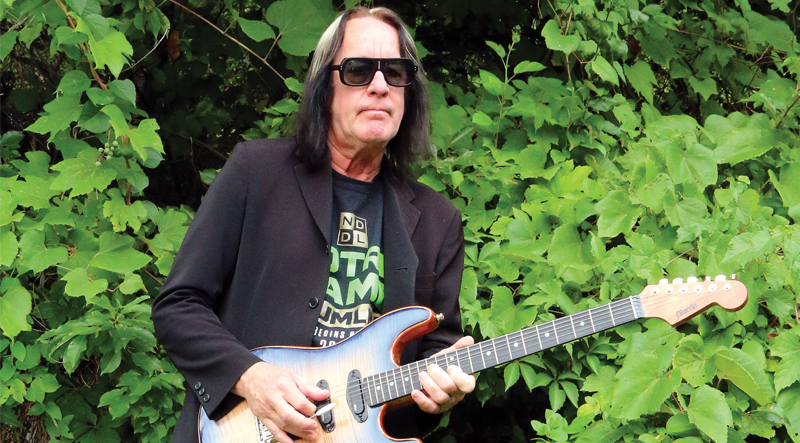
For 50 years, Todd Rundgren has been compiling one the most eclectic and impressive resumés in music. From forming the Nazz in 1967 to stints with Utopia, Runt, The New Cars, and a successful solo career, his accomplishments as a multi-instrumentalist, singer, composer, engineer, and record producer are rarely equaled by even his most-distinguished contemporaries. After also establishing himself as a pioneering video director and champion of electronic music, Rundgren was the first major artist to sell his own music directly to fans via the internet.
Albums engineered or produced by Rundgren include Hall and Oates’ War Babies, The Band’s Stage Fright, Grand Funk Railroad’s We’re An American Band, Badfinger’s Straight Up, XTC’s Skylarking, and Meat Loaf’s Bat Out Of Hell (which has sold more than 43 million copies worldwide). Additionally, for the past six years he’s been a charter member of Ringo’s All-Starr Band.
One would assume Rundgren is in The Rock and Roll Hall Of Fame, considering the one-hit wonder inductees who didn’t even write their one hit. Does he feel slighted?
“No,” he says, very matter-of-factly. “I never really think about it until someone brings it up. You know, honestly, from the very first time I heard about it, I thought it was a dopey idea. These things don’t exist for the reasons the populace at large believes they do. The idea that you’re more legitimate because you’re in or less legitimate because you’re not… I don’t even know what legitimate means in those freakin’ terms. It’s just another way for them to keep the wheel spinning.”
Rundgren’s commercial breakthrough occurred in 1972 with the double album Something/Anything?, for which he composed all of the material, played every instrument on three of the four sides in addition to doing all vocals, and which included two signature songs, “Hello It’s Me” and “I Saw The Light.”
His latest album, White Knight, exhibits his continued passion for musical diversity, featuring guitarists Joe Satriani and Joe Walsh, Steely Dan keyboardist Donald Fagan, rapper Dam-Funk, singers Daryl Hall and Bettye LaVette, plus industrial-metal rocker Trent Reznor.
Rundgren ’70s: NBC/VG Archive. Rundgren in the mid ’70s with the Gibson SG “Fool” that had previously been used by Eric Clapton in Cream.
How did your guitar playing days begin?
My parents bought me this cheap, really cheesy acoustic, but I had to commit to two months of guitar lessons at the local music store. I hated the lessons – hated having to learn to read, because I could easily pick things up by ear. I also hated the discipline of technique that the teacher tried to put on me. He would always say, “Always pick down. Never pick up.” That didn’t feel right to me, so I was just happy to have the lessons over. When I first started performing with the Nazz, the guitar was like a shield for me. You felt kind of naked with without it. Now, I’m pretty comfortable with or without one.
At what point did you first consider being in a band?
I was in junior high when The Beatles started happening, and I could already see that they represented some kind of revolution. It seemed all you had to do was get four guys together, dress them all the same, grow your hair long, and find the right songs. There was a lot of fake controversy at the time as to who was better or more authentic, the Beatles or Rolling Stones, but the Stones didn’t unify the world. The Beatles did.
You’ve cited The Yardbirds as a major influence, even naming your band after one of their songs.
The B-side of “Happenings Ten Years Time Ago” was called “The Nazz Are Blue,” and it was also the first time we ever heard Jeff Beck’s voice. We didn’t know what “nazz” meant, but we liked the sound of it. We were just looking for something that didn’t really have a whole lot of meaning and wasn’t silly.
What mainly attracted you to their music?
The way Beck was playing slide guitar on the first album really freaked me out, because it was the first time I heard that particular sound. I was unfamiliar with the Telecaster and thought slide guitar was a particular kind of guitar! I was as much into The Yardbirds as I was into the Beatles because I was a guitar player and they were basically a guitar-playing academy, with Beck, Eric Clapton, and Jimmy Page all going through at some point. It was easy enough to copy a finely composed George Harrison eight-bar solo, but trying to improvise on the guitar the way those three did was what really got me to be serious about the instrument.
How influential were The Beatles’ early recordings to your development as a record producer?
One of the things I noticed when I heard the first Beatles songs and other records from the British Invasion was how they had a very different sound and different tightness than American records, which seemed to be mixed weird and flabby-sounding, probably from some old studio or session approach. There was a discernible difference between the way records were made in Europe and over here. Following the way they did theirs, you had learn how to reverse-engineer the sounds, which is essentially how I learned to mix, engineer, and produce records.
It seems Nazz was highly influenced by the wave of garage bands that were popular a few years earlier.
Yeah, I think it all goes back to “Louie, Louie,” which I consider one of the foundational elements of all rock and roll. Later, we’d have loved to have been part of the scene in England, like some bands that actually moved there to get their careers kick-started. The New York Dolls couldn’t get any attention here, so they went to England, which took to them right away and turned them into a phenomenon that eventually influenced The Sex Pistols.
One of your first successes as an independent producer was the Dolls’ 1973 debut album. Many critics insist their aggressive sound was never faithfully captured on record. Would you record them any differently today?
Well, the biggest problem was that the band got a little too much in a hurry at the end of the recording process. There was a lot of, “We gotta wrap this up because we got a gig to go to.” In recording any band, there’s always a bit of “herding cats” involved. Another thing I learned right away is to never allow a band in the room while you’re mixing. What a mistake that is! “I can’t hear my drums,” “I can’t hear my guitar!” Eventually, all of the faders are at the top of the board and you have to start over. The record would also have had so much more punch if we had the budget to take the tapes to a state-of-the-art mastering lab like Sterling instead of using an old, non-variable pitch lathe at The Record Plant.
Rundgren with ankh guitar: Ebet Roberts. Rundgren with one of two “ankh” he designed and had built by John Veleno in 1977. It has a hollow round-rimmed body with a bridge humbucker and single-coil on the crossbar.
It’s a shame the band didn’t enjoy greater commercial success.
You know, some things are defined by their lack of discipline. One reason the Stones have lasted so long is that no matter how wild and woolly their image is, and even if drugs were involved, they took the business side of things seriously. The Dolls never did. Also, bad boy Mick Jagger is still one of the fittest human beings on the planet.
Though Grand Funk in the early ’70s was breaking attendance records set by The Beatles, they never really cracked the singles charts until you produced “We’re An American Band.” It seems you really streamlined their sound.
Well, their biggest problem up ’til that time was that their former manager, Terry Knight, was also producing their records and was a terrible producer. He’d let them spend too much time jamming in the studio, and everyone around thought the band was compromising their talent in terms of their ability to write songs and to deliver a tight performance. They were all good players, but after I started working with them, they realized they weren’t Cream. They came from that Detroit R&B scene, so they started getting back to their roots and becoming more song-oriented.
What’s the history of Bat Out of Hell, which went from very modest beginnings to becoming one of the biggest-selling albums?
When we started, there was no record company. I wound up underwriting the album myself. So essentially, I owed Bearsville Records the budget for the making of the album until they found a label for it. Every major label turned us down. We had to find a little subsidiary Cleveland International, before we could even put it out.
Besides playing lead guitar on the album, what are some of your fondest memories of the recording sessions?
Well, it was one of the last albums for a long time that was done primarily live in the studio, which is kind of the fun part of making music. If you can get everyone familiar enough with the material, get the sound in the headphones just right so no one is complaining and just focused on the music, that’s one of the fringe benefits of recording that way. When you can make that happen, as a producer you realize you might be listening to what the final product is going to sound like while it’s happening. Bat was essentially a live recording.
Can you contrast the pros and cons of the way you recorded Bat with your new album, where the collaborators sent parts for you to overdub, without their involvement?
Well, living in Hawaii, it’s difficult for me to call a session (laughs), and that necessitated the way this and most of my recent records have been done. Yes, the downside is you don’t have fun anecdotes to tell about being in the same room. The upside is that because I wasn’t with any of the artists when they made their recordings, there wasn’t any pressure on them because, as a producer, it’s my prerogative to constantly make suggestions. I think this way I was able to get more-natural performances out of everybody. Everyone kind of sounds like themselves instead of what I imagine they should sound like. It’s a lot more democratic.
What was your original vision for the album?
When Cleopatra Records approached me, I didn’t have a particular concept in mind. Then I decided on the collaboration aspect, but what really got me going… and I don’t know if it’s a matter of legacy, but after Bowie and Prince died, I realized that you never really know how much time you have left. So, I started thinking of the album as a serious crusade. Bowie, Prince, and I had some things in common, being the kind of unpredictable auteurs who don’t really adopt one style and stick to it. We’re always experimenting with other things.
Where does the album’s title come from?
In the urban dictionary, a “white knight” means either somebody who comes in and saves a company from a hostile takeover or a guy who defends women who are harassed on the internet. The implication is also that he may be trying for some romantic reward, and I say, “Why not?” (laughs)
Do you think this is the kind of album your long-time fans were expecting in 2017?
I don’t really know what they expect at this point. The last two records were pretty aggressive experiments in modern music. A lot of my fans are not as up on that as I am because I do a lot of research before I make a record. I do think the previous albums have been challenging to fans, so they were probably expecting something even further challenging in that regard. The collaborations on the new album kind of evened everything out, in a songwriting sense. As it turns out, it seems to be a more-accessible record than some of the previous ones, which took a few listens to get used to.
One track has generated some controversy – “Tin Foil Hat” – which is not exactly praising President Trump. Reportedly, you’ve received death threats because of it.
There have been, but I don’t take them that seriously. I mean, Stephen Colbert makes fun of Trump on a nightly basis, sometimes savagely. He must be getting threats. And when I was on Jimmy Fallon’s show I asked if he gets them, and he said, “Yes.” You really have more to fear from the fan who’s off his rocker, the Mark David Chapmans. Those are the guys that actually act out. These other people are too busy trolling to get off their chairs. As far as the ticket cancellations, a lot of people who don’t realize there’s politics and sociology in what I do are the ones who haven’t come to a show in years, and when they do, if they don’t hear “Bang The Drum,” “I Saw The Light” and “Hello, It’s Me,” in the first half hour, are gonna walk out anyway. So I think that’s a wash in that regard.
Todd Rundgren: Elliot Stephen Cohen.
What’s your favored gear these days?
For some time, I’ve been using Reason [software with amp and effects simulators for guitar], which until recently had Line 6 stuff built into it. When I perform, I’m pretty much a Line 6 guy, principally because of the simplicity of it. I understand the system and how to program it, but whatever licensing deal they had has ended and the devices are no longer standard equipment. They’ve licensed other technology I’m not as comfortable with, but we’re still using Line 6 onstage. When I can get it, I’ll use a Flextone 111 amp. I also own an original AX 212 amp I really like, but I’m hesitant to take it out on the road.
Speaking of gear, you’ve recently favored a green guitar onstage.
I used to tour Japan a lot in the late ’80s; the Japanese were flush, and a guy who worked for a guitar company would show up with a half-dozen guitars and let me pick one. So, I kept coming back from Japan with lots of guitars that were piling up in storage. I went through them, and the P-Project one had the best combination of pickups and was the easiest to play.
Do you use the same guitars on solo shows and with Ringo?
Pretty much. With Ringo, I play a lot of acoustic – a Guild that was provided for the tour. I carry just three electric guitars to keep it kind of simple. We carry extra guitars for the heck of it, not because they’re alternate tunings, but just because they look different. So for one song now and then I’ll play a guitar somebody gave me that has rhinestones all over it and sounds okay, though I probably wouldn’t use it outside of that context. Or, I’ll play the Fool replica.
From seeing The Beatles on “The Ed Sullivan Show” in 1964 to now working with Ringo, it all must seem almost surreal. Even after six years, do you still pinch yourself and think, “My God, I’m actually working with a Beatle!”
Well, you not only pinch yourself, you say, “I’m flying on a private jet with a Beatle! I’m having dinner with a Beatle!” He’s the boss because somebody’s gotta be the boss, but otherwise he just wants to be one of the guys and hang out with the band, like he did with The Beatles. It’s not as if he travels separately from us or stays in different hotels. It’s more than simply playing with him, you know? It’s being friends on a day-to-day basis.
Sitting behind the drums, Ringo at 76 seems almost like a teen having the time of his life.
He gets incredibly bored on the road when we’re not playing, because he’s been everywhere and done everything. Also, he can’t just go out walking around the streets because people will hassle him. So he winds up stuck in a hotel room, the whole point of his day being to get behind the drums. It’s fun watching him have fun. The more fun he has, the more fun we have.
When The Beatles first came over, could you have imagined any of them – or any rock musicians – still performing in their 60s and 70s?
I couldn’t even imagine myself being 50. Now that I’m 19 years beyond that, I realize there’s still a lot of distance to cover. I’ve learned to respect and idolize people who continue to play until they’re physically unable to do so. At this point, I actually feel better onstage than when I’m off. I still expend as much energy as I can in the process. That’s what people pay money for; they want to see you do something unusual or extraordinary and be at the top of your game or edge of your limits. That’s what performance is all about.
This article originally appeared in VG December 2017 issue. All copyrights are by the author and Vintage Guitar magazine. Unauthorized replication or use is strictly prohibited.

 In 1922, Gibson introduced Lloyd Loar’s L-5, lauded as the first modern archtop. Luthiers have been “advancing” the design ever since.



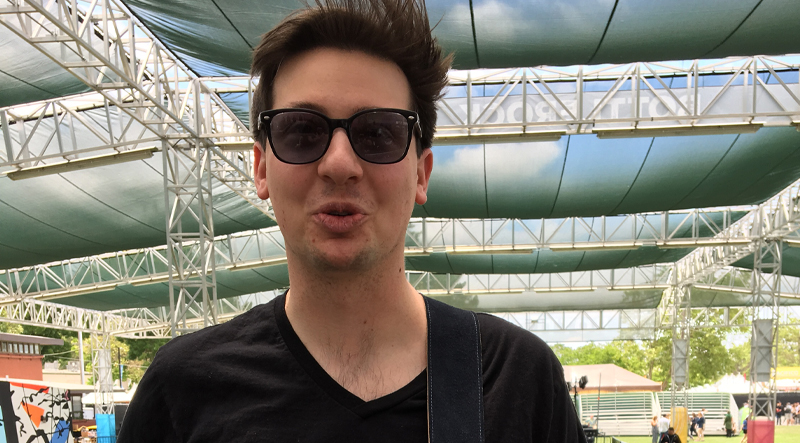

 James connects with cool guitarists at the 2018 BottleRock Napa Valley music festival, including the Struts’ Adam Slack, Rudy and Billy Raffoul, and Les Priest.

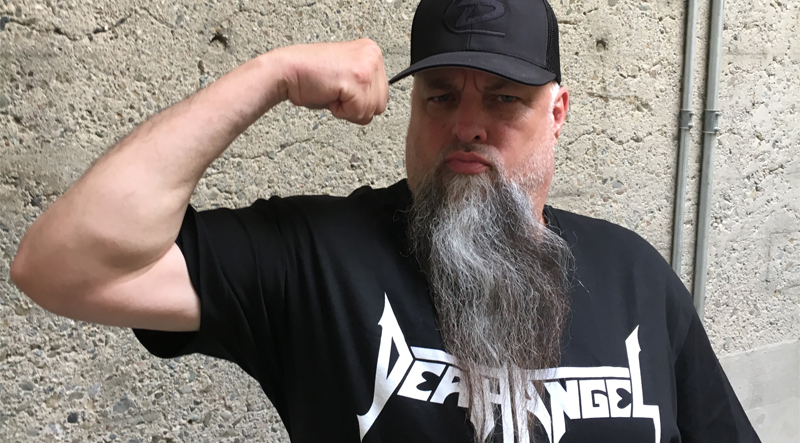
 Bryan Kehoe went to school with Les Claypool and played with Exodus. He later joined M.I.R.V. and toured the world with Cheap Trick, Run DMC, and Jerry Cantrell. Today, he plays with his own band with Claypool’s Duo de Twang. Working for Jim Dunlop, he’s constantly on the lookout for the next wave of guitarists.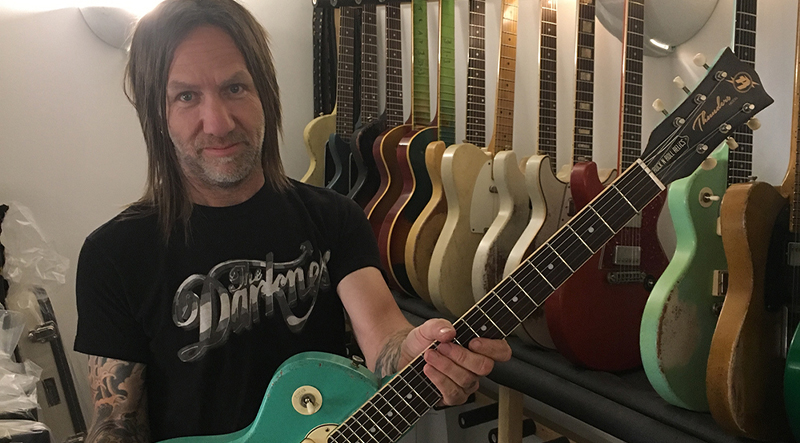
 Billy Rowe is the guitarist/co-founder of Jetboy, which rose to prominence in the mid ’80s while touring with some of the biggest bands of the era. Tinkering with guitars led to starting his company, Rock N’ Roll Relics. James and Billy talk music, guitars, the ’80s crash, and the state of music.
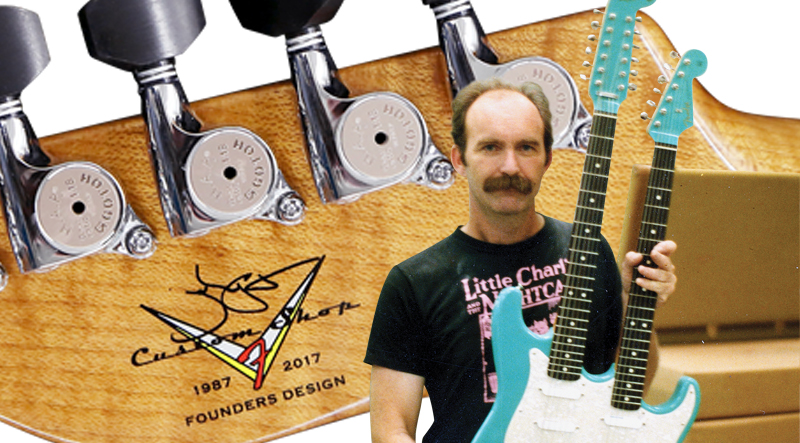

 In “official” terms, the Fender Custom Shop opened in 1987. But its story actually began February 1, 1985 – the day CBS announced the sale of Fender Musical Instruments to a group led by Bill Schultz, who’d served as President of the company for four years. Speaking to the Los Angeles Times the following day, Schultz said, “This is an opportunity to keep a very viable and legendary name alive in the industry.” He envisioned regaining the company’s status from the days when Leo Fender was at the helm – when it enjoyed a reputation of innovation, quality, and value among players of all levels.


 DW: Probably the stained-glass Esquire for the 2016 NAMM show. There was a lot going on, from the stained-glass panel to the LED lights to the electronics.

 This all happened pre-Photoshop, so I was photocopying images from Fender press releases, then sized various Playboy images to move around. A folder of my attempts contains an alternate Femlin and the final 40th-anniversary logo, which we considered putting on the third fret before placing it on the headstock.
 In 1986, Michael Stevens had a noteworthy profile in the Japanese music press and stellar reputation amongst the stateside vintage-guitar cognoscenti.
 guitar and, tone-wise I couldn’t tell the difference between it and a solidbody.”