Tag: features

  • Keeley Electronics’ D&M Drive

    Keeley Electronics’ D&M Drive

    As the gear industry seeks to reach new segments, Robert Keeley has turned his attention from making products for road warriors who perform onstage to tone freaks who obsess about gear online. His D&M Drive is a collaboration with Daniel Steinhardt and Mick Taylor, who host an online video program focused on effects.

    Price: $229
    Info: www.robertkeeley.com

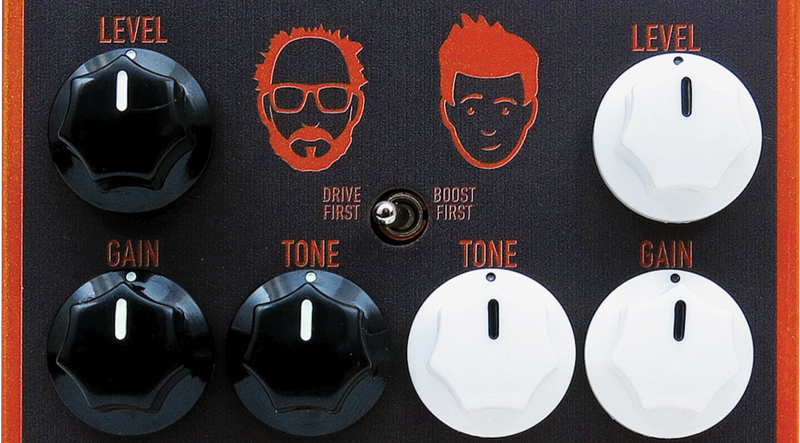
    The D&M is a sturdy 9-volt double-duty dirt pedal with two circuits designed to work independently or together. Drive and Boost functions can be stacked in either direction with the flick of a toggle switch. With separate Level, Gain, and Tone knobs, and the ability to change the order of the circuit, the D&M offers all kinds of boosted dirty goodness.

    The Boost side’s clean midrange nudge allows the user to add degrees of modded grittiness to the signal. The high operating voltage yields lustrous clean headroom and works great as a stand-alone boost for other overdrive pedals.

    The D&M’s Drive side elicits clear but substantive overdrive with sustain and harmonics with variable tonal settings. It also has lots of headroom to maintain tube-like warmth and smooth, fuzz-free saturation. The inputs give loop-based switching users the option of using TRS cables to separate each side of the pedal into separate loops. Putting the Drive first yields a louder boost and mid-heavy saturation, while the Boost going into the Drive results in a louder, thicker, scooped gainy sound with guts. Many useful combinations are available – everything from stage-friendly clean volume boost to myriad overdrive tones combining both circuits with a buffet of gain settings.

    Using higher gain settings from the Boost side along with lower gain settings from the Drive side produces a big, sweet low-end that adds chunkilicious flavor to an amp’s signal. It’s pretty hard to beat.


    This article originally appeared in VG April 2018 issue. All copyrights are by the author and Vintage Guitar magazine. Unauthorized replication or use is strictly prohibited.
  • Heritage Guitars’ H-155M

    Heritage Guitars’ H-155M

    Price: $3,995 (list)
    Info: www.heritageguitar.com

    Heritage Guitars still builds instruments by hand… in Kalamazoo. Like its veteran brethren in the industry, it focuses on craftsmanship, timeless aesthetics, and a consistent product line.

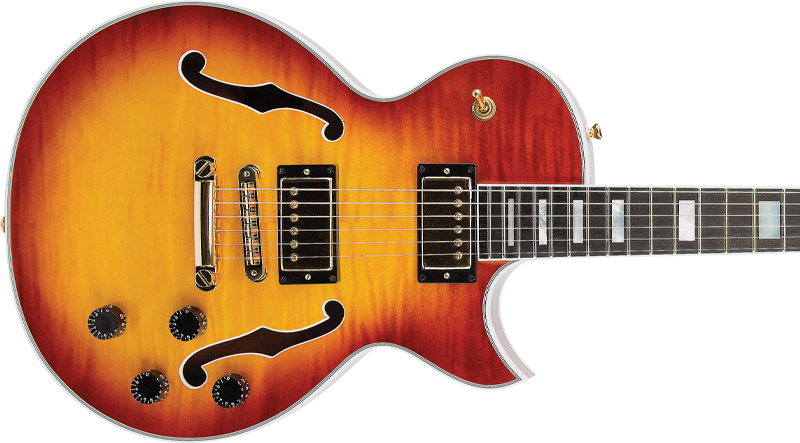
    One of its newer offerings, the H-155M is a gorgeous semi-hollowbody with a carved curly-maple top, chambered mahogany sides and back, solid center block, Florentine cutaway, and a high-gloss nitrocellulose lacquer finish. It has a thicker body binding than comparable models, but the fit and finish are fabulous, as is the top-notch hardware, which includes a TonePros bridge, stop tailpiece, and Grover tuners.

    The H-155M is loaded with two Seymour Duncan Seth Lover pickups. A toggle and two Volume and two Tone speed knobs put you in charge. The neck is one-piece mahogany with a 24.75″ scale, ebony fretboard, and mother-of-pearl inlays. Its 12″ fretboard radius, 22 frets, and C-shaped neck are player-friendly as it gets.

    Those spoiled by the comfort of Strats but craving the sound of Royal Scam-era Larry Carlton without the bulkiness of a 335 might find the H-155M just the ticket. Unplugged, it’s loud, resonant, and woody. Chords ring with vibrant zeal. Plugged into a clean amp, it straddles the sonic chasm between jazz, blues, and country. A flick of the toggle flips it from teeth to cozy jazz warmth in the neck position. The Seth Lovers are sweet and clear. Add gain, and the H-155M sings in every position with a smooth, organic complexity.

    The H-155M has a personality all its own. It rocks, bops, burns, and through it all handles like a vintage sports car. Good luck putting it down.


    This article originally appeared in VG April 2018 issue. All copyrights are by the author and Vintage Guitar magazine. Unauthorized replication or use is strictly prohibited.
  • Preston Thompson 00-45

    Preston Thompson 00-45

    Given their scarcity, few mortal pickers will ever own a pre-war Martin 00 or 000 with 45-level appointments. But a handful of luthiers have dedicated their work to building instruments that attempt to offer the sound and feel of such classic vintage instruments. Preston Thompson is one such builder, and examples of this dedication manifest in his 00-45.

    Price: $28,850 (base)
    Info: www.pktguitars.com

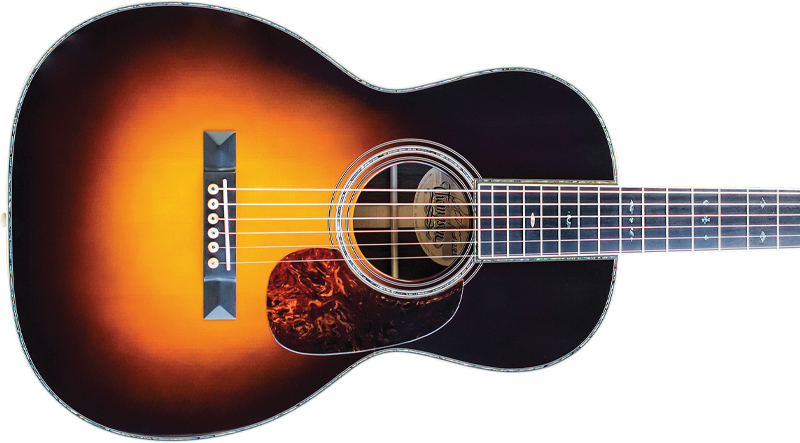
    Boasting “shipwreck” Brazilian rosewood back and sides and an Adirondack spruce top, it emulates Martin’s 45 series instruments, which were given that company’s fanciest ornamentation on a production model.

    Thompson used more than 270 inches of abalone on the borders alone, and it also encircles the top, back, and sides in addition to the tail graph and heel-to-body joint. Other features taken from vintage designs include the dovetail neck joint, hand-graduated top, hand-carved scalloped interior bracing, multicolored “flag of many nations” backstrip inlay, ivoroid heel cap, 45-style “snowflake” position markers, ebony fingerboard and pyramid-style bridge, Honduran mahogany neck with volute, fossilized ivory pins and strap button, Waverly three-on-a-plate engraved brass tuners with ivoroid buttons, and natural nitrocellulose finish with a vintage teardrop sunburst.

    As with traditional 12-fret-to-the-body designs, the Preston Thompson 00-45 has a slotted headstock. The review sample came with light-gauge Elixir strings and was safely housed in a Harptone deluxe case.

    From the moment of unboxing to the final note played before packing up and returning the guitar to its creator, the Preston Thompson 00-45 was a visual and aural treat. Even after multiple careful examinations I could not locate a single production flaw. Despite the perfect workmanship, this 00 certainly didn’t lack “mojo” or personality. Nowhere was the finish overly slick or too thick. All the workmanship was in service to the guitar’s vintage sound and aesthetics.

    And the 00-45’s playability was the equal of its workmanship. This masterpiece played well, with no buzzes anywhere from the first fret to the twelfth. The sustain, especially on the three higher strings, was long with a gradual decay on both chords and single notes. Even with a light touch the sound sprang out of the 00-45 with a vibrancy and energy reminiscent of larger, dreadnaught-sized instrument.

    The ultimate test with any new vintage-style instrument is how well it compares to the genuine article. The Preston Thompson 00-45 proved as loud and articulate as a 1936 000-18, with almost as much vintage midrange rumble. While the 000-18 had more bass energy and a more balanced and integrated harmonic character, some of this difference probably stems from the 00-45’s newness – it takes at least six months for hide glue to achieve its maximum hardness and nitro finishes can outgas enough during the first year to reduce their thickness to less than half of what it was after application. Preston Thompson’s 00-45 still has some serious maturing ahead before it reaches full sonic potential. To steal a line from Peter Rowan, “The guitar is so new it still thinks it’s a tree.”

    Yes, the outlay for this guitar is large. But, if you consider that a 1929 Martin 00-45 goes for more than $75,000 (and forget about finding a sunburst) the stunningly beautiful Preston Thompson 00-45 could even be viewed as a bargain.


    This article originally appeared in VG April 2018 issue. All copyrights are by the author and Vintage Guitar magazine. Unauthorized replication or use is strictly prohibited.

  • Bassics BPA-1

    Bassics BPA-1

    Price: $599
    Info: www.diffusion-audio.com

    Low-end tone is a critical component of a live mix or studio recording – if the bass doesn’t sound good, the music will suffer. Badly.

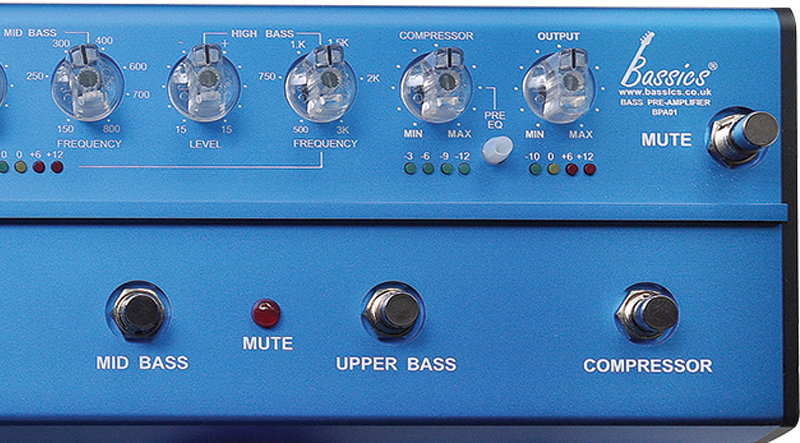
    The Bassics BPA-1, designed by legendary engineer and gear designer Malcolm Toft (Bowie, James Taylor, Beatles), is essentially the front-end of a bass amp or channel of an analog mixer, and it gives bassists serious control over their tone.

    Frequently, bassists are concerned with surgically precise EQ and level controls. With this in mind, Bassics included two inputs on the BPA-1, allowing bassists to have two instruments ready to go. Input 1 can accommodate both low- and high-impedance pickups, allowing for combinations of active and passive electronics, not to mention piezo-fitted axes. The back includes a 1/4″ output, as well as balanced XLR outputs (pre- and post-EQ) and an effects loop.

    EQ fans will dig the three-band equalizer featuring Level and Frequency knobs and 15dB of gain for each range: Low Bass (45 to 250Hz), Mid Bass (150 to 800Hz), and High Bass (500Hz to 3kHz). Each band has footswitchable on/off, while a master EQ Bypass turns off the section. While this might seem like overkill to rockin’ electric guitarists, bass players know they can set each band to a specific tone setting and activate it at the perfect moment. One example might be tweaking the Mid Bass and High Bass to deliver the bright Rickenbacker sounds of a Chris Squire or Geddy Lee. Conversely, pump up the bottom and mids for a more jazz-oriented tone, all at the tap of the footswitch. There’s also an excellent, one-knob compressor to control dynamics.

    Another great touch is that every knob is illuminated with a different color to help remember which circuits are deployed at any moment. And aside from sounding terrific, the BPA-1 is built like a tank, ready for the toughest live show or studio date.


    This article originally appeared in VG April 2018 issue. All copyrights are by the author and Vintage Guitar magazine. Unauthorized replication or use is strictly prohibited.

  • D’Angelico Excel EXL-1

    D’Angelico Excel EXL-1

    Price: $899
    Info: www.dangelicoguitars.com

    Few vintage guitars are as vaunted as John D’Angelico’s original handcrafted Excel archtops. Building a new – and affordable – version is a tall task. The EXL-1 from the re-created D’Angelico Guitars offers a modern counterpart.

    First things first; this guitar is made in Asia. And simply put, it’s built to a standard that’s hard to believe. The fit, finish, and playability are superlative.

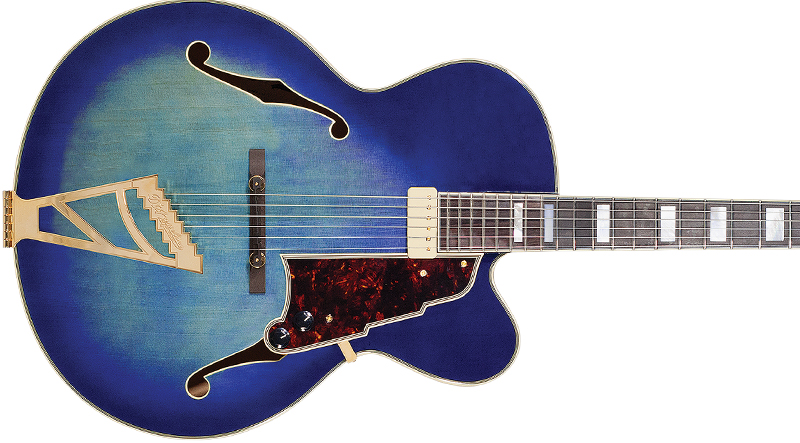
    The single-cut 17″ archtop body is a full 3″ deep, made from laminated flame maple with a laminated spruce top highlighted by seven-ply binding. And to support the statement about the construction quality, the guitar resonates beautifully, even when played acoustically.

    The slim C-shape neck with 25.5″ scale and rosewood fretboard ends in that famous D’Angelico streamlined Art Deco headstock with ebony veneer, mother-of-pearl inlays and Grover Super Rotomatics. At the other end, the dramatic Stairstep tailpiece provides lovely resonance and legendary style.

    The EXL-1’s Kent Armstrong floating mini-humbucker provides a range of tones, including the warm, rich sounds of the jazzer you’d expect. Twist the single Volume and Tone dials for a surprisingly powerful growl and bite. The range makes the guitar work well for swing, country, blues – even some down-and-dirty rockabilly.

    D’Angelico offers the EXL-1 in right- and lefthanded versions as well as a variety of finishes – natural-tint blonde, vintage sunburst, plus black, white, and a Blue Burst that sets off the gold hardware and tortoise-style pickguard.

    Today’s D’Angelico modeled the EXL-1 as an exacting tribute to the original – but with savvy modern upgrades. No, it’s not handbuilt by a master luthier in a tiny Little Italy workshop. But most of us will never even touch one of the originals.

    The EXL-1 is a guitar you can rejoice in every day. It’s a stunner, especially for the price.


    This article originally appeared in VG April 2018 issue. All copyrights are by the author and Vintage Guitar magazine. Unauthorized replication or use is strictly prohibited.

  • Holbrook TS50 Tommy Skeoch Head

    Holbrook TS50 Tommy Skeoch Head

    Price: $2,895
    Info: www.holbrooktone.com

    After Kevin Holbrook and rock guitarist Tommy Skeoch began working on a custom amp, the former took several trips to visit the latter, lugging prototypes between California and Florida. But, the mastermind behind Holbrook Guitars and Amplifiers was ultimately rewarded with something unique in a crowded sea of boutique amps.

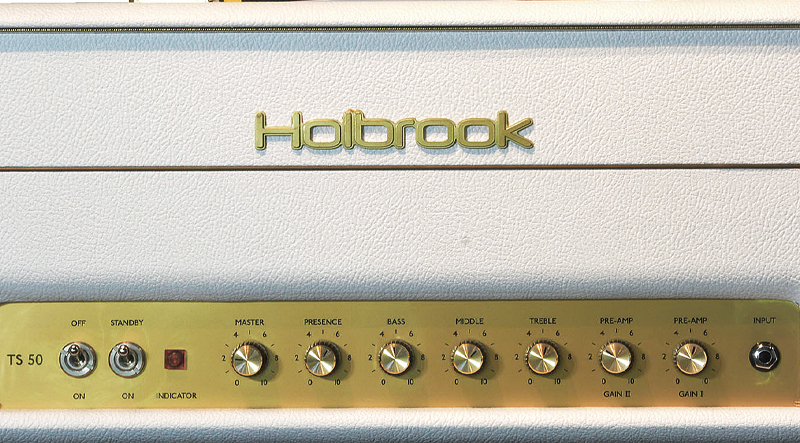
    Based loosely on Skeoch’s modified ’70s Marshall 2104 and a classic Marshall 50-watt plexi, the hand-wired Holbrook TS50 Tommy Skeoch Signature Head offers an ultra-high-gain “exceeds 11” dual-control preamp and a Metroamp zero-loss effects loop. The TS50 is available in a variety of tolex colors, but the tester arrived in white with gold piping dressing up its Mojotone cab and heavy-gauge steel chassis. Components include Classic Tone transformers, Allen Bradley resistors, Synergy Royal Mustard capacitors, Cliff jacks, CTS tone and gain pots, and a PEC master-volume pot. The tube complement includes three Sovtek 12AX7s in the preamp, a JJ cathode follower, and a pair of Tung-Sol 6550s in the power section, producing 50 watts.

    The TS50’s face-plate layout consists of Power and Standby switches, dual Gain controls, and a tone stack to tweak Presence, Treble, Middle, and Bass. The rear panel has an impedance selector, dual speaker jacks, effects loop in/out (with bypass toggle), and a detachable power-cord socket.

    The TS50 was tested with a Marshall 4×12 cab with Celestion Vintage 30 drivers, a Les Paul Standard with Burstbuckers, a Fender 1960 reissue Strat, and a reverb pedal patched into the effects loop.

    With the Strat plugged in and the Gain controls on lower settings, the TS50 captured that classic, open Hendrix plexi tone – ringing chords and singing single notes. Turning up the Gain gradually pushed the overdrive into a lush supersaturation while it maintained good note-to-note clarity and separation.
    With its British-sounding saturated overtones, punchy midrange, and ton of chime, the TS50 is classic plexi. With both guitars, its tone stack responded in a smooth, subtle manner, offering enough control without over-coloring. And the dual Gains offer thick, blistering overdrive to accompany near-infinite sustain when cranked – no need for an external OD pedal to push the front of this amp.

    Speaking of, that front end proved very touch-sensitive, cleaning up nicely by altering pick attack or rolling back the guitar’s Volume. While the Master Volume did a good job ratcheting-down overall volume, with the master dimed, the amp absolutely sang with overtones. The effects loop performed well, too, adding no noise and robbing no signal or gain.

    Lest you think the Holbrook TS50 is just another plexi clone, our takeaway was that it’s more like a plexi’s slightly evil twin with a “goes to 11” attitude and plenty of overdrive, while never losing that plexi chime and vibe. All those miles logged by Holbrook were well worth it.


    This article originally appeared in VG April 2018 issue. All copyrights are by the author and Vintage Guitar magazine. Unauthorized replication or use is strictly prohibited.

  • Backlund 400

    Backlund 400

    If George Jetson – or his daughter Judy, for that matter – played guitar, it’s safe to assume they’d go in for the Backlund 400, a futuristic-looking solidbody that’s part spaceship, part 1959 Cadillac.
    Price: $1,349 (base)
    Info: www.eastwoodguitars.com

    This sci-fi axe, with its aerodynamic body and chrome adornments, is the brainchild of custom builder John Backlund, who has teamed up with Eastwood to roll out some of his designs at manageable prices. But don’t be fooled by its cool looks – the Backlund 400 incorporates classic solidbody design elements.

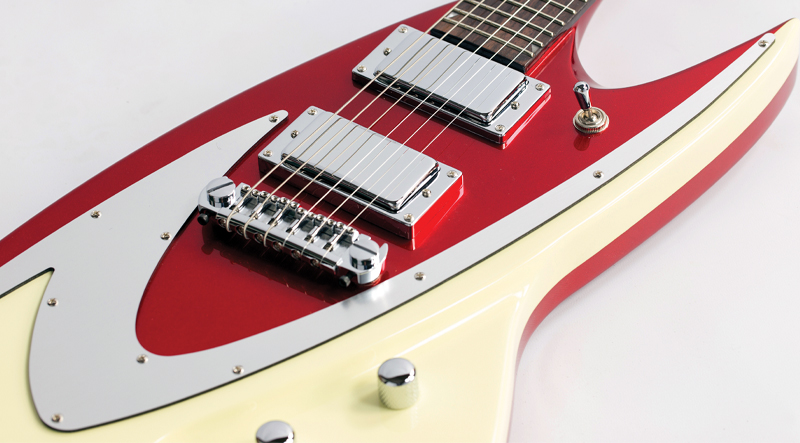
    Scaled like a Les Paul at 24.75″, it has a mahogany neck and body, rosewood fingerboard, and dual humbuckers. The fretboard offers up 24 medium-jumbo frets and a 14″ radius with pearloid “ski slope” inlays. The glued-in neck’s “soft C” shape is pleasantly full, but not clubby.

    For décor, the 400 sports a gorgeous, two-tone polyurethane finish of Cream with Metallic Blue or Metallic Red, or a Black/Mint combo. All showcase a dramatic brushed metal “Z” across the body.

    Electronics include two custom-wound humbuckers with a three-way toggle and master Tone and Volume. There’s also a wraparound tailpiece and chrome tuners mounted on the six-on-a-side headstock. Given the design, you might be surprised by how well the 400 balances on the lap. And it weighs just 7.5 pounds – a welcome spec in an age of brick-like solidbodies.

    Slung across the shoulder and cranked up, the Backlund 400 is as exciting as it looks. The flatter neck profile has the souped-up potential of a Flying V, particularly with all that access up the fretboard. The test guitar was set up with low action and nicely dressed frets, adding to its high-speed performance. The 400’s appearance may suggest surf or retro ’60s pop, but its mahogany body and humbuckers work for just about any style of music, including hot blues and hard rock.

    There’s not much to argue about here. The Backlund 400 is a mid-priced import that looks great and plays well. Keep in mind that with the lighter body in combination with a broad expanse of fingerboard might result in some neck-dive, à la the Firebird, so be sure to opt for a real leather strap that will grip your shoulder. Its styling won’t fit everyone’s taste, but if you want to make a bold statement onstage, you won’t find many rivals to this swept-wing design. It’s retro and futuristic all at once, and has the tone and playability to get the job done.


    This article originally appeared in VG April 2018 issue. All copyrights are by the author and Vintage Guitar magazine. Unauthorized replication or use is strictly prohibited.

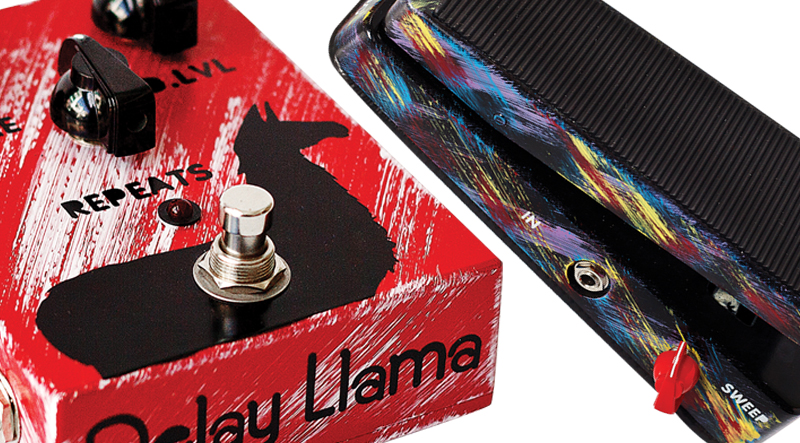
  • Jam Pedals’ Delay Llama & Wahcko Wah

    Jam Pedals’ Delay Llama & Wahcko Wah

    Price: $239 (Delay Llama)
    Info: www.jampedals.com

    Positioning its sonic M.O. squarely in the 1960s and ’70s, Jam Pedals strives to create a distinct line of effects. Beyond their fun graphics and tongue-in-cheek names, Jam’s stompboxes are set apart in the way they achieve their objective.

    Hand-made in Greece, Jam Pedals are wired for true-bypass functionality and use NOS chips, transistors, and carbon-comp resistors.

    One of the company’s newer offerings, the Delay Llama is a fully analog tape echo with a maximum delay of 600ms. It runs on a 9-volt adapter and uses BBD analog chips along with reproductions of the Panasonic MN3205 to replicate Jam’s rendition of vintage tone. A sturdy lo-fi delay, its controls are super simple, which forces the player to dive in fully and explore the ways in which it colors one’s playing rather than constantly twiddling the knobs. Its three controls are topped with chicken-head knobs; D. Time sets the amount of delay, D. Lvl controls the level of the affected dry signal, and Repeats controls the number of echoes. There’s also an internal trim pot that controls the number of maximum repeats.

    Price: 
$299 (Wahcko Wah)
    Info: www.jampedals.com

    The Delay Llama adds beautiful depth to the signal that is more useful for bringing a lustrous fullness to the sound, rather than for tricky delay settings. The repeats and delay times offer sweet slapback with great utilitarian range, but it’s the quality of the sound that will beat any digital delay. If you need bells and whistles like tap tempo and knobs to modify the decay, look elsewhere. You’ll just have to settle for having your rig sound amazing.

    Wah pedals can be a real rabbit hole. Given the number of models and features available, one could spend all day just thinking about options, when you could be making music. Factor in the level of grit and boost added to your signal, and you could quickly find yourself in a quagmire of catastrophic mental gymnastics. Another recent Jam offering, the Wahcko Wah cuts to the chase.

    Powered by a 9-volt adapter, it’s Jam’s version of the classic wah of the late ’60s and early ’70s, but with modern appointments. In addition to its red fasel inductor, internal gain trim, carbon comp resistors, and mini LED, the Wahcko has a handy six-position rotary switch for dialing frequency sweep to taste. With the switch turned all the way counterclockwise, it achieves the most edge and top-end with the toe forward. The last clockwise setting elicits a thick, warm, and throaty midrange in the toe position. The four positions between produce subtle variations of the two extremes. It’s like six wah pedals in one!

    Compared to similar effects, the Wahcko Wah exhibits a rugged, broken-in maturity. It sounds like a sweet old wah with lots of miles on it. Plus, it’s solid, sports a hip psychedelic paint job, and has an adjustable tension control to fine-tune the movement. The Wahcko makes a great addition for the discerning user, and provides superb tone-sculpting choices for clean and distorted amps.


    This article originally appeared in VG April 2018 issue. All copyrights are by the author and Vintage Guitar magazine. Unauthorized replication or use is strictly prohibited.

  • Emma Electronic DiscumBOBulator V.2 & Big Joe Powerbox Lithium

    Emma Electronic DiscumBOBulator V.2 & Big Joe Powerbox Lithium

    Prices: $199 (Discumbobulator V.2)
    Info: www.godlyke.com

    Scandinavia may not be the first corner of the globe that comes to mind when one ponders classic funk tones. But with their DiscumBOBulator V.2 the tone-tweakers at Denmark’s Emma Electronic have improved the circuitry of their acclaimed envelope filter. The result is the perfect tool for adding a blast of funk to your guitar or bass tone. The V.2 offers a clean booster for solos and punchy parts, as well as more headroom for active pickups (such as those on many basses). And the DiscumBOBulator V.2’s tracking is more precise than ever.

    Prices: $149.95 (Big Joe Stompbox Powerbox)
    Info: www.bigjoestompboxcompany.com

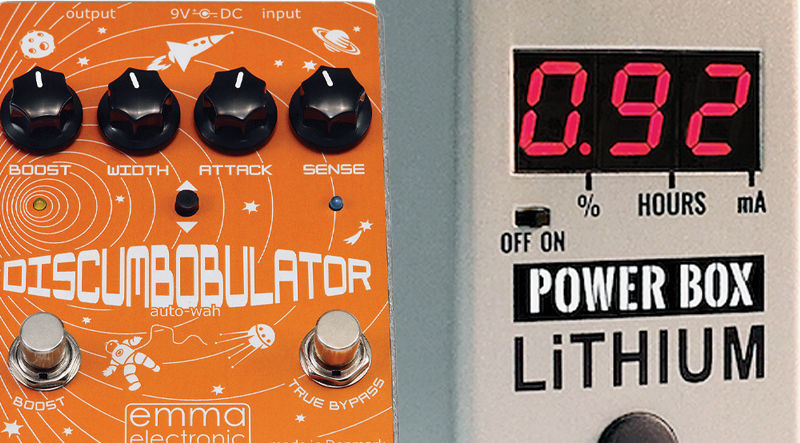
    The box has four controls and footswitches for on/off and boost: Boost (provides a 0-10dB level booster); Width (controls the bandwidth and strength of the wah effect); Attack (adjusts the effect’s reaction to picking from slow to fast); and Sense (the threshold and shape of the effect sound). There’s also an Up/Down button in the middle of the box to change the direction of the filter.

    With the V.2’s interface, a player can easily zero in on tones they like just by twiddling the knobs. Set all the way left, the Sense knob delivers a muted-trumpet tone that could be cool and useful on guitar or bass. Bring it up to trigger powerful filter sweeps that you can then sweeten with the other controls. The Attack knob will help you balance the right amount of effect for your picking style, while the Width control can help shape the flavor of the effect. Guitarists, of course, will like the DiscumBOBulator for funk rhythm or perhaps a dash of classic Jerry Garcia quack. Bassists will not only dig the funk envelope tones, but also that bit of fat synth bass. Overall, this pedal comes highly recommended.

    Also check out the Big Joe Stompbox PB-107 Powerbox Lithium. Charge it from your computer via USB (or a regular wall adapter) and plug it into up to eight 9-volt stompboxes with the daisy-chain cable. Suddenly, you have a portable power source and a useful digital readout displaying how much charge is left. With a battery life of 10 to 20 hours, the Powerbox Lithium is absurdly easy to use and incredibly handy.


    This article originally appeared in VG April 2018 issue. All copyrights are by the author and Vintage Guitar magazine. Unauthorized replication or use is strictly prohibited.

  • Have Guitar Will Travel – 012 Featuring Ken Emerson

    Have Guitar Will Travel – 012 Featuring Ken Emerson

    In this episode of Have Guitar Will Travel Podcast James speaks with Ken Emerson. Ken is one of the world’s most highly regarded traditional Hawaiian slack key & steel guitarists living today. He is an excellent player of both and he switches easily between them during his performances.

    We speak about his connection and playing beside the core of traditional Hawaiian music: Sol K. Bright, Gabby Pahinui, Genoa Keawe, Raymond Kane, Moe Keale and Auntie Alice. And his diverse guitar playing has been featured on Donald Fagen’s (Steely Dan) Grammy Award winning Morph the Cat. He has many additional touring/recording credits that we speak about including Todd Rundgren, Jackson Brown, Boz Scaggs, Charlie Musselwhite, Taj Mahal, and Elvin Bishop.

    Please like, comment and most of all share this podcast with your friends. And send me any comments or show ideas to the Have Guitar Will Travel podcast page at Facebook Instagram and Twitter.

    Each episode is available on Apple Podcast, Stitcher, iheartradioTune In, Google Play Music, and Spotify!


    Photos: James Patrick Regan/ 1928 National Tricone
    1973 Pink Strat w/honest wear
    1964 White Fender dou-sonic
    1982 Red Fernandes Strat
    1978 3 color sunburst Black pickguard Strat
    Gibson reissue Les Paul Special TV Yellow
    1968 3 color sunburst White pick guard Strat
    1965 3 color sunburst Fender Strat white pickguard
    Ken with his “pocket knife” slide

    Have Guitar Will Travel, hosted by James Patrick Regan, otherwise known as Jimmy from the Deadlies, is presented by Vintage Guitar magazine, the destination for guitar enthusiasts. Podcast episodes feature guitar players, builders, dealers and more – all with great experiences to share! Find all podcasts at www.vintageguitar.com/category/podcasts.