Month: January 2016

  • Carvin DN640K

    Carvin DN640K

    Carvin DN640K

    Doubleneck instruments have always been a unique niche in the guitar market, for good reason. They’ve also carried an air of superiority or the insinuation that they were intended for pro players; i.e., those who could deftly switch from one instrument to another in the middle of a song without doffing their part. And though they look hyper-cool strapped on, doing so quickly reveals them to be excruciatingly heavy and cumbersome.

    In business for almost 60 years, the Carvin company has been quite successful in its “factory direct” approach. Founded by Lowell Kiesel in Southern California in 1946, Carvin has expanded its facilities and relocated more than once. It now builds guitars, basses, amplifiers, and sound reinforcement gear under one gigantic roof in San Diego. And while the company has several retail stores, the bulk of its business is still done direct via phone, mail, and the internet, and those who order a Carvin stringed instrument have a plethora of options.

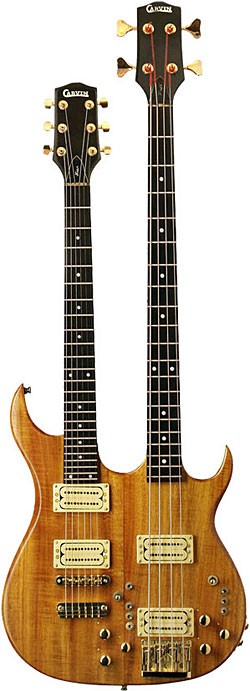
    Carvin’s DN640 is a unique example in the doubleneck genre. Unlike production doublenecks from other manufacturers (like Gibson’s EBS-1250 and Rickenbacker’s 4080), the bass neck is on the bottom instead of the top. Introduced in 1980, the DN640 and DN612 were the first modern/U.S.-made Carvin doublenecks, although the company had been assembling instruments with such a configuration at its factory since the mid 1950s. Moreover, this “reverse-neck” layout was only one of several unique facets of the DN640.

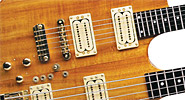
    Carvin instruments are custom-order (except for store stock), but in the early ’80s, the list of options was much shorter than it is today. The original owner of this doubleneck had it made with Hawaiian Koa wood – thus the K designation in the model number. In more recent times, Koa has gained respect as a tone wood, and has accordingly increased in price. The instrument has ebony fretboards and set-neck construction (in ’88, Carvin went to neck-through on doublenecks). The guitar neck has a 24 3/4″ scale, a la Gibson, while the bass neck’s scale is the standard 34″. Each neck has a brass nut, which was in vogue in the early ’80s. The owner also opted for gold hardware – tuners, bridges, and tailpiece, all by Schaller. The only other option Carvin offered at the time were block fretboard inlays. Finish choices at the time were also limited – white, black, red, or natural.

    The pickups are Carvin’s own 11-polepiece humbuckers – M22s on the guitar, M22Bs on the bass. The edge-to-edge polepiece design helped prevent signal loss during string bending.

    Logic also permeates the layout of the controls. Each neck has a volume control for each pickup, a master tone, and a three-way pickup toggle. Each line of three mini-toggles consists of coil-tap switches for each pickup and a phase switch.

    The mini-toggle in the middle of the body (near the pickup selector) is the neck selector. Some later Carvin doublenecks reportedly had the neck selector on the lower control area.

    The two output jacks are wired for separate necks, allowing separate amplification for guitar (lower jack) and bass (upper jack). However, both necks can be run through just the lower jack.

    Another potential plus for the DN640 was that its body was somewhat smaller than competing doublenecks, inferring less bulkiness. And the original owner of this example said the bass neck’s lower position gave it better balance than a Rick 4080.

    Other Carvin doublenecks include two-bass-neck examples (one fretted, one fretless), bass/guitar doublenecks with the bass on top, and two-fers with a Kahler bass vibrato and Floyd Rose guitar vibrato. There was even one left-handed six-string bass/six-string guitar.

    Carvin officially discontinued production of doublenecks in 1993.

    And of course, Carvin built other doublenecks that didn’t have a bass neck, but the DN640K was a unique and underrated example of twin-neck instruments built by American manufacturers.


    Photo: Kevin Wright. Instrument courtesy of carvinmuseum.com.

    This article originally appeared in VG‘s March ’05 issue. All copyrights are by the author and Vintage Guitar magazine. Unauthorized replication or use is strictly prohibited.

  • Billy Gibbons and the BFG’s

    Billy Gibbons and the BFG’s

    Bill Gibbons from Bob Merlis 2015A “solo debut” by Rev. Billy F. Gibbons, at age 65, is a bit like Satchel Paige being a 42-year-old “rookie” in major league baseball after two decades as the Negro Leagues’ greatest pitcher.

    Because ZZ Top’s longtime manager, Bill Ham, had some unorthodox philosophies, band members didn’t play on albums by, or even sit in with, other artists. ZZ’s first live TV appearance wasn’t until 1986, when they appeared on “The Tonight Show,” performing “Sharp-Dressed Man” and “Tush,” accompanied by Doc Severinsen and the band.

    When the group severed ties with Ham in ’96, Gibbons soon flexed his newfound freedom. Since then, he’s appeared on albums by B.B. King, John Mayall, Leslie West, Ron Wood, Gov’t Mule, Hank Williams III, Sam Moore, Revolting Cocks, Queens of the Stone Age, Johnny Winter, Les Paul (and Paul sideman Lou Pallo’s tribute to Les), and Buddy Guy’s latest CD.

    He’s jammed on stage with John Fogerty, Joe Walsh, Slash, Jeff Beck, was part of Roky Erickson’s band for the psychedelic pioneer’s 2008 “Austin City Limits” appearance, and reunited his pre-ZZ group, the Moving Sidewalks. Along the way, ZZ broke from its trio format, with Austin guitarist Van Wilks and B-3 specialist Mike Flanigin augmenting a European tour.

    Flanigin is onboard here, with organ chores also handled by Martin Guigui and Gibbons, who, in addition to guitar and vocals, also supplies bass, piano, and timbales, which he studied under mambo king Tito Puente in the ’60s. The marriage of crunch and hi-tech is no surprise, but there’s an underlying Cubano groove throughout – even on the opening Slim Harpo cover, “Got Love If You Want It.”

    Billy GibbonsDrummer Greg Morrow and percussionist Chino Pons anchor the rhythm section with bassist Alex Garza, who, as Alx Guitarzza, adds hip-hop vocalese to originals “You’re What’s Happenin’, Baby,” and “Quiero Mas Dinero.” Co-producer Joe Hardy joins the party, with additional guitar, keys, bass, and vocals.

    Ever the tonemeister, Gibbons lends catchy hooks and killer solos, sprinkled with pick-slicing harmonics, to Latin-infused covers of Roy Head’s “Treat Her Right” and Big Joe Williams’ “Baby Please Don’t Go,” with a nice balance of reverb and overdrive on the latter. The closing “Q’ Vo” finds Rev. Billy stretching out in an organ-trio setting. But make no mistake; as the crushing title track affirms, this is rock and roll with a generous helping of blues.

    What’s abundantly clear is that Gibbons is having a blast. As a disembodied voice (probably Gibbons’) introduced ZZ Top at the 2004 Crossroads Guitar Festival, “Senors y senoritas, it’s fiesta time!”


    This article originally appeared in VG‘s January ’16 issue. All copyrights are by the author and Vintage Guitar magazine. Unauthorized replication or use is strictly prohibited.

  • Marty Walsh

    Marty Walsh

    Marty Walsh
    Marty Walsh: Ron Lyon.

    Marty Walsh has plied his trade for decades, though relatively few may be familiar with his efforts.

    A Los Angeles native, the guitarist gravitated to his father’s old Martin when he was 15. The first guitar he called his own was a Gibson ES-1403/4 he bought from his brother and eventually traded (and $10) for a ’61 Les Paul SG.

    “Being a kid. I decided to strip the paint and make it white… Ouch!” he said. “I later sold it to buy a 335.”

    The young guitarist garnered knowledge and inspiration via lessons from Barney Kessel, and later, Jay Graydon. Working his way into the L.A. scene, he toured with Eddie Kendricks, Seals and Crofts, John Fogerty, John Denver, and Supertramp (including recording the band’s final hit single, “Cannonball”). With Denver, he shared the stage with James Burton.

    “I’ll never forget being at Red Rocks, in Colorado, playing rhythm when James played a solo that was so incredible I just stopped to watch and listen!”

    Walsh and his family moved to Massachusetts in 1996.

    “My wife is from there and we decided to get the kids out of L.A.,” he recounted. “I left my studio gear in L.A., and was flying to do sessions, but then I realized that Berklee [College of Music] is really the hub of the Boston music community, so I decided to pursue a job teaching there.”

    Walsh now teaches in the ensemble and music production departments, and the experience inspired him to craft an instrumental album.

    “My approach s quite different from other guitarists who taught there. I thought it would be good to do an actual guitar album, since I was teaching there, and felt I could make a unique record.”

    Walsh recruited players from L.A., Boston, New York, and Nashville to record The Total Plan, which touches a lot of ground with songs composed with more than simply guitar solos in mind – saxophone, organ, piano, and bass take melodies up front.

    “Conceptually, I wanted to feature many incredibly talented people. Each song came together by e-mailing files for the other musicians to put parts on. “I’d get a drum track, then figure out who I wanted to play bass on it.”

    Walsh used a Fender Stratocaster with Lace Sensor pickups, a ’70s Gibson SG with EMGs (set up for slide in Open E), a ’79 Gibson Les Paul, a ’59 Fender Esquire with Gibson mini-humbuckers, and a Valley Arts he calls his “secret weapon,” with a midrange boost made by James Tyler. “I also used it on the Supertramp and John Fogerty tours. It has a wonderful neck, and I do most of my solos with it.”

    Acoustics included a steel-string played by Steve Kercher on “Coast to Coast” (the only track with a second guitarist; Walsh played a nylon-string Alvarez-Yairi), and an old Silvertone used for a buzzing slide sound on “The Road.”

    Walsh is thrilled with the album. “One of the other things I was also trying to do was make an album that would be interesting to the masses. I wanted to make instrumental music that non-musicians could relate to. Hopefully, I achieved that.”


    This article originally appeared in VG January 2015 issue. All copyrights are by the author and Vintage Guitar magazine. Unauthorized replication or use is strictly prohibited.


  • Daredevil Pedals Atomic Cock

    Daredevil Pedals Atomic Cock

    Daredevil Pedals’ Atomic CockDaredevil Pedals’ Atomic Cock
    Price: $150 (list)
    Info: www.daredevilpedals.com
    .

    Despite the many clever take-aways one could derive from its name, the Atomic Cock is “just” an effects box offered by Daredevil Pedals.

    A variable fixed wah with adjustable gain, it offers more tonal options than a traditional wah while circumventing the tedious search for the notched sweet spot used by guitarists like Carlos Santana, Michael Schenker, and Mark Knopfler.

    A true-bypass stompbox without buffers, it allows the user to blend the effect into their amp’s signal, and it still offers a wide tonal spectrum just like a standard wah. Its hip metalflake green enclosure displays a well-thought design.

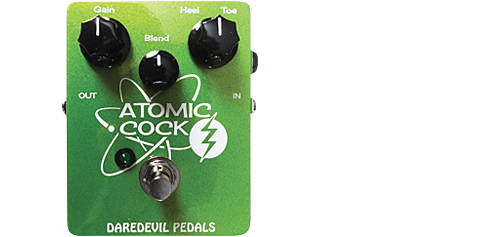
    The Atomic Cock’s Gain knob lends more or less grit and volume to the signal, while the Blend knob allows the player to mix variable amounts of their amp’s tone with the sound of the effect. The Heel/Toe knob, as the name suggests, replaces the rocker pedal normally found on a wah, producing all the filtered highs and lows without all the inaccuracy of foot operation. A green LED is situated just to the left of the On/Off switch near the bottom of the pedal, which can be powered by a 9-volt battery or adapter.

    Using the Atomic Cock with a clean amp shows just what this pedal is made of. Starting with the controls set at 12 o’clock, the pedal immediately introduces the user to a world of snarky “cocked wah.” The sound isn’t as luxurious as an upscale boutique wah, but it adds just the right amount of quacky goodness to distinguish itself in a band mix. With the Blend knob all the way to the left and the Gain knob maxed, the Atomic Cock offers a dirty boost minus wah and with more bass.

    Running through a dirty amp for soloing is where the Atomic Cock excels. The three knobs are perfectly teamed for crafting smooth-singing filtered tones in classic Schenker fashion. It’s a compelling combination of nasal warmth and bite with grittiness and tonal flexibility that can be preset, left, and returned to. The Heel/Toe knob affords full honking sweep, while the Blend knob lets the user refine their sound with plenty of room for an amp to retain its character.

    The Atomic Cock is a great idea and a very musical pedal, useful for a number of tone-shaping functions. It could do wonders to break a player out of a tonal rut or add extra sauce to solos.


    This article originally appeared in VG September 2014 issue. All copyrights are by the author and Vintage Guitar magazine. Unauthorized replication or use is strictly prohibited.


  • Richie Kotzen

    Richie Kotzen

    Richie Kotzen
    Photo Credit: Travis Shinn.

    So he’s not burning up the Top 40, but Richie Kotzen has been a soul-crooning monster guitarist for a very long time. With almost 20 solo albums and group projects with Greg Howe, Poison, Mr. Big, Stanley Clarke, and most recently, The Winery Dogs, the guitarist would like you to get to know him a little better.

    Why now to release The Essential Richie Kotzen?
    It’s an introductory CD for people who still don’t know who I am. In talking about the success of The Winery Dogs, there are people who come up to me and say, “Wow, I didn’t know you could sing!” In my mind, I’m thinking, “Damn. I’ve been singing since I was 17.” My second record came out when I was 19 and I was singing on that, but people don’t really know. So, people will look back and say, “What records do I buy?” There are so many that it’s kind of confusing.

    So I figured, “Let’s make one package that defines who I am.” That means picking songs from the past not because they’re old, but because they’re still relevant to who I am now. Then I threw a few new songs on there, and decided to do some re-records where I broke the production down with some of the older material and made it acoustic guitar and voice, or piano and voice.

    You’ve been around for a long time. Why don’t more people know what you do?
    Yeah (laughs)! I’ve read various threads of what people are saying, and it’s like, “If this is a real retrospective, why isn’t this song on there?” “Why doesn’t he have a song from his first record?” That’s because it’s completely irrelevant. I’m not going to play my first record. It’s like showing baby pictures of yourself to people. This is a record to tie in everything so that when people ask, “Who is Richie? What does he do?” I can hand them something. From there they can go back to the albums.

    This explains why you skipped over your first seven solo records.
    It’s to give an overview and define who I am as an artist. I’m not going to use things from my first record because I don’t play it live and it has nothing to do with what I became. The song selection is me painting the picture I think is relevant to who I am now.

    The songs fit together as a thematically cohesive whole. It’s singer/songwriter focused, without instrumental tangents.
    The first record was songs I wrote when I was 17 and recorded at 18. I was shredding, which was popular then. Fast forward to 30 years old, I became a different person. Fast-forward to 44, there’s something else going on. So when someone wants to know what I do, I want to be consistent with what’s happening when they come to see me play. It’s all a part of how I chose the songs.

    Your hardcore fans might wonder why you included material from Poison but not from Mr. Big.
    I picked the stuff that I like to play. I’m not going to put “Shine” on there. “Shine” is a cool tune, but I played the piss out of that song live. Same with “Stand.” There’s a million versions of that song and I even put it on one of my solo records. I didn’t put it on this one because it’s not essential for me. I’m going to put “Fooled Again” on there because that’s a song I think is completely essential. I’m going to put “OMG (What’s Your Name?)” on there because it has an element of something I do that’s very unique to me – a certain style and certain sound. I put “What Is” on there because I know when I wrote that song where my head space was, and that song just poured out of me. However long it is, that’s how long it took to write. I don’t mean to discredit what other people like, but c’mon, man! I’m just putting out a record. Roll with me here (laughs).

    What’s coming up next?
    My solo band is going on a full-on world tour. I’m also releasing another solo album in January and I designed something for Tech 21 called the RK 5. It will debut at the NAMM show. It’s a multi-effects signature pedal that includes a SansAmp, delay, reverb, and a two-stage overdrive. It’s just big enough so your foot can hit the switches. It’s really cool.


    This article originally appeared in VG January 2015 issue. All copyrights are by the author and Vintage Guitar magazine. Unauthorized replication or use is strictly prohibited.


  • Colby Amplification Park 45

    Colby Amplification Park 45

    Colby Amplification Park 45Colby Amplification Park 45
    Price: $2,500 (list)
    Contact: www.colbyamps.com

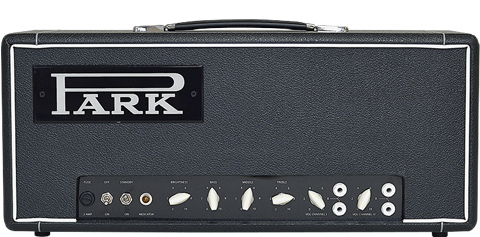
    There are legends that gear fanatics all know, and then there are hidden treasures known to only a few. Park amps were designed by Jim Marshall and produced in limited quantities. More consistent in construction and design than the ever-evolving Marshalls, the Park line had the tone and power that has made amps from the first decade of the company just as desirable as the namesake models.

    Mitch Colby rose through the ranks at Marshall and started Colby Amplification with his Mod Machine and Dual Tone Booster amps. His Park line is now manufactured by select techs in New York with both NOS and modern components that do the job the way he knows it must be done.

    The Park 45 head weighs in at 35.4 pounds, and that’s before you lug in your speaker cabinet (ain’t nothin’ easy about rock and roll). Two KT66 tubes, three 12AX7 tubes, and hand-wired circuitry are the magic behind the simple front panel with Channel 1 and 2 volume controls and two inputs per channel, as found on the early Marshall amps, as well as Treble, Mid, Bass, and Brightness controls, On/Off and Standby switches, and Mains fuse. The rear panel has two speaker outputs, AC socket, and Impedance selector switch, and HT fuse.

    Cosmetics? Pure vintage simplicity, with the classic Park logo, white “banana” knobs with matching white hardware on the front panel, and expertly applied tolex and piping details. The only visual differences from a late-1966 Park front-mount head are on the back panel, where some parts have been modernized by necessity. Otherwise, every attempt has been made to keep the Park 45 authentic – even the fuse holders are made by the original manufacturer.

    Inside the head, the aluminum chassis is heavier than the original and corner-welded for strength. The circuit boards are identical down to the original color. The standard Park 45 selectively uses NOS parts sourced from suppliers in South America and Europe.

    The Park 45 owner’s manual ends with the admonition to “Plug in, set your controls, and play some music!” And so we did, through a Zinky cab with two Celestion Vintage 30 speakers, using a PRS P22, a Les Paul Standard, and a Strat Deluxe.

    Park rates the 45 at 30 watts clean, anywhere up to about 6 on either Volume control. Crank either control past 6, and that’s where the fun begins, with the power peaking out at 45 watts driven hard. Each guitar, even at a hot volume, maintained its identity, with tonal qualities enhanced rather than masked by the big roar of the amp. With the Volume at 8 and crunch-tone fully in effect, the Tone controls on the amp are very effective, coloring the sound even through fully voiced power chords or sustained, harmonic-jumping long tones.

    The 45’s two channels have distinct voices. With identical tone settings, the right channel is clearly edgier and more cutting than the left, though the volume outputs are similar. The ’Burstbucker-equipped Les Paul seemed to be the axe that the right channel loved the most – power begat power.

    Inspired by advice from the manual, we plugged into the Park 45’s left-upper jack with a short 0.25″ cable connecting the lower-left jack into the upper-right jack of the right channel. Setting the right channel at an easygoing 6 o’clock, pushing the warmer channel up to 7, and volume-swelling a seventh-position D on the G string through the lead pickup, the D jumped to the A harmonic (as fingered on the high E at the seventeenth fret) and would have sustained forever, assuming the power didn’t go out or the neighbors didn’t pound on the door.

    With the tone knobs straight up and the Strat plugged into the right channel, we fiddled with the left-channel Volume knob, drawing some subtle changes in treble response while holding down a D major chord at the fifth and seventh frets. Again, harmonics materialized through the fat, crunchy chord, first accenting the A found at the high-E fifth fret, and then the D at the tenth fret.

    Backing off on the guitar volume control, a crisply defined rhythm sound emerged. But feeding the Park 45 with more gain for some classic rock and blues licks made us feel heroic, in an I-wanna-audition-for-the-Yardbirds kind of way.

    If you want to feel something like that, check out the Park 45.


    This article originally appeared in VG January 2015 issue. All copyrights are by the author and Vintage Guitar magazine. Unauthorized replication or use is strictly prohibited.


  • Pat Metheny

    Pat Metheny

    Pat Metheny

    This film of Pat Metheny’s talented Unity Band is another gem in his long career, featuring both live performances and insightful interviews. The Unity quintet is more of a straight-ahead jazz ensemble than the Pat Metheny Group, featuring the fierce tenor sax of virtuoso Chris Potter, but Metheny’s uncanny style and chorus-inflected tone still dwell within the fusion universe. Listen to Genealogy” or “On Day One” for the dizzying, melodic solos that have long been Pat’s hallmark, as well as contributions from gifted bassist Ben Williams.

    Metheny begins the ballad “This Belongs To You” by quietly playing solo on his Ibanez archtop guitar, reminding us what a monster he is at fingerstyle chordal work. Grabbing a flatpick, his solo on the track is a weeper and gives us a chance to observe the unique way he holds a pick.

    On “Kin,” Pat brings out his Roland/Synclavier guitar synthesizer – which some fans love and others hate – but it shows us that Metheny is about the only major guitarist with a truly identifiable guit-synth tone. He also brings out his 42-string Manzer Pikasso acoustic for “Come And See” and, like the rest of this superb DVD, it’s breathtaking in every way.


    This article originally appeared in VG‘s February ’16 issue. All copyrights are by the author and Vintage Guitar magazine. Unauthorized replication or use is strictly prohibited.

  • Realistic Entertainer-34

    Realistic Entertainer-34

    • Preamp tubes: two 12AX7 • Output tubes: two EL84s, cathode bias • Rectifier: EZ81 tube • Controls: Volume, Tone, Speed, Strength • Output: 12 watts RMS +/- • Speaker: one 12" Utah Photos: Matt Deason. Amp courtesy of Val Kolbeck.
    • Preamp tubes: two 12AX7
    • Output tubes: two EL84s, cathode bias
    • Rectifier: EZ81 tube
    • Controls: Volume, Tone, Speed, Strength
    • Output: 12 watts RMS +/-
    • Speaker: one 12″ Utah
    Photos: Matt Deason. Amp courtesy of Val Kolbeck.

    As prolific as the Radio Shack chain was in the ’60s, it’s surprising we don’t see more vintage Realistic guitar amps today. Maybe they were never valued enough to be handed down, much less hunted down.

    If anything, you’re likely to have stumbled on the Carnival 34, a straightforward 1×12″ combo, but even those are few and far between. As for this Entertainer 34, well, we’ve only seen this one in the flesh. And the Fender G-Decs, Peavey Solos, Marshall MGs, and other modern all-in-one “guitar practice systems” had better watch out, because the Entertainer packs a rather nifty surprise.

    Much like the hallowed mullet haircut, the Entertainer 34 was all business in the front, and a party in the back. Plug into any of the front panel’s three inputs (Hi-Gain, Lo-Gain, Bright) and you’re rewarded with surprisingly tasty tube tone. Hop around back, and – shazam! – there’s a fully functional gramophone to facilitate play-along jams with your favorite LPs and 45s. Have you ever seen anything cooler? We wager you haven’t.

    Literature on this thing is very scarce (we could find none other than a mention in a Radio Shack Washington’s Day Sale ad in the sports section of the February 21, 1967 edition of The Lowell Sun of Lowell, Massachusetts… lurking below a story about boxer Casius Clay’s failure to achieve a deferment of military service). As part of Radio Shack’s “Red Hot Guitar Amp Sale,” which stretched to a whopping two models, the Entertainer 34 was down from $99.50 to $69.50, alongside a $20 reduction that took the gramophone-less Carnival 34 to a mere $49.95. The ad copy also tells us the Entertainer 34 is a “34-watt guitar amp with built-in record changer,” though once you scope the specs, you realize that output rating is the kind of scandalous exaggeration that only your cheaper makers tried to get away with.

    Aside from the obvious answer, where did this thing come from? Did Radio Shack manufacture guitar amps back in the day? So many questions, and perhaps not quite so many answers. To the first, it’s difficult to tell for certain, but we have ferreted out some likely origins. To the second, of course not: Radio Shack or its umbrella brand, Realistic, didn’t make much of anything, and sourced the universally budget-minded goods from other manufacturers. While the control panel, graphics, and grillecloth were quite different, the Entertainer 34’s cabinet and handle are in line with those of the Mark X amp made by the New-Jersey-based Gregory in the mid/late ’60s. More tellingly, it carries the same tube complement and displays similar construction within the chassis. There are slight differences from the only Mark X amp we have seen, but it was not uncommon for budget brands to alter layouts on a whim, and the basic circuit and signal path are virtually identical. It might seem surprising that a major national chain jobbed its work to a fleeting, fly-by-night maker (we believe Gregory vanished in the late ’60s), but these amps were cheap as chips, of course. To discount them to $69.50, you can bet Radio Shack was buying them for very short money indeed.

    The Speaker of the 1967 Realistic Entertainer 34.
    The Speaker of the 1967 Realistic Entertainer 34.

    For all that, though, there’s no mention of Gregory to be found on the Entertainer 34, so such speculations remain unconfirmed. The record-player side of the package is stocked with components mostly of European origin, so who knows how that came to be; perhaps it was simply an affordable import of a size convenient to mount into the erstwhile Carnival 34.

    Despite the rather generic design and parsimonious construction, the Entertainer 34 isn’t a bad little guitar amp. Or, consider the going rate for the Carnival 34 sans turntable up against $114 for a ’67 Fender Princeton… but, yeah, it’s from Radio Shack. Regardless, it has the ingredients to get the job done, particularly if crunchy and tactile British-voiced tones at fairly low volumes float your boat. The powerhouse runs on a pair of EL84s with a EZ81 rectifier tube (as found in a vintage Vox AC15) supplying the voltages. The simple preamp uses half a 12AX7 for gain (with a passive treble-bleed Tone knob) and half for the bias-modulating tremolo circuit, while a second 12AX7 constitutes driver and cathodyne inverter for the output stage. The EL84s are cathode-biased, but without the traditional bypass cap to fatten things up, and there’s a little negative feedback between the output transformer’s secondary and the cathode of the driver to tighten the response a little. Textbook stuff, of course, and probably copied pretty directly from any of several available applications manuals, but it’s effective enough.

    As for that rather specious claim to 34 watts of power, well, the far-from-oversized output transformer is mounted right there inside the chassis, and stamped on top with its rating – “12W.” And that sounds just about right. Even up against a 22-watt Fender Deluxe Reverb of the same era with a similar 12″ speaker the Entertainer 34 was likely to leave the budding garage rocker feeling rather anemic, and perhaps somewhat cheated. Crank it in the space of your own home, though – or your own home studio – and there is certainly a tone you can work with. And then your Deluxe Reverb owner had to jerry-rig the family record player and plug it into his amp’s #2 input to get anything close to the same all-in-one, play-along excitement, and that’s got to count for something. The fact that the record player achieves some of the same “juicy, crunchy” EL84 tone as the guitar amp might not do much for the audiophile in you, but for the budding garage rocker in all of us, it’s a pretty groovy way to go.

    REALISTIC_04


    This article originally appeared in VG October 2013 issue. All copyrights are by the author and Vintage Guitar magazine. Unauthorized replication or use is strictly prohibited.


    You can receive more great articles like this in our twice-monthly e-mail newsletter, Vintage Guitar Overdrive, FREE from your friends at Vintage Guitar magazine. VG Overdrive also keeps you up-to-date on VG’s exclusive product giveaways! CLICK HERE to receive the FREE Vintage Guitar Overdrive.


  • Winter NAMM 2016

    Winter NAMM 2016

    Not at The NAMM Show this year? We'll recap all that's new each day at show close so you won't miss a thing!
    Not at The NAMM Show this year? We’ll recap all that’s new each day at show close so you won’t miss a thing!
    The long-awaited Blueridge collaboration with John Jorgenson has arrived! Almost a year in the making, this Signature Model dreadnaught guitar is a must-see.
    The long-awaited Blueridge collaboration with John Jorgenson has arrived! Almost a year in the making, this Signature Model dreadnaught guitar is a must-see.
    Controlling your music while you're moving around with the BT-Pro Bluetooth DI from Radial Engineering. The BT-Pro pairs with Bluetooth to wirelessly connect your laptop, phone, or tablet.
    Controlling your music while you’re moving around with the BT-Pro Bluetooth DI from Radial Engineering. The BT-Pro pairs with Bluetooth to wirelessly connect your laptop, phone, or tablet.
    Dean Guitars - Dave Mustaine VMNT Holy Grail guitar with 24k gold leaf over red finish!
    Dean Guitars – Dave Mustaine VMNT Holy Grail guitar with 24k gold leaf over red finish!
    We're loving the Montreaux Burst ES-275 Figured from Gibson Brands! One of the 2016 Limited Run Models, this beauty features a zig zag tailpiece, gold hardware, ES-355 appointments, and richlite fretboard with MOP inlays.
    We’re loving the Montreaux Burst ES-275 Figured from Gibson Brands! One of the 2016 Limited Run Models, this beauty features a zig zag tailpiece, gold hardware, ES-355 appointments, and richlite fretboard with MOP inlays.
    Spotted at NAMM, Apex™ Tube Matching - the new proprietary, state-of-the-art power tube matching system from CE Distribution. Apex™ Tube Matching is performed entirely in-house using CE's custom-designed software testing and matching methodology.
    Spotted at NAMM, Apex™ Tube Matching – the new proprietary, state-of-the-art power tube matching system from CE Distribution. Apex™ Tube Matching is performed entirely in-house using CE’s custom-designed software testing and matching methodology.
    Nail that classic 90s sound right out of the box with the SalemFuzz HONEY BUNNY! New from PureSalem Guitars, this pedal will give you straight forward fuzz tones with a tight and meaty low end. It's the perfect rhythm fuzz!
    Nail that classic 90s sound right out of the box with the SalemFuzz HONEY BUNNY! New from PureSalem Guitars, this pedal will give you straight forward fuzz tones with a tight and meaty low end. It’s the perfect rhythm fuzz!
    Meet Supro's new Black Magick, a recreation of one of Rock & Roll music’s holy-grail amplifiers. This all-tube, high-gain blues machine harkens back to the dimensions, cosmetics and circuitry of the Supro amps from 1959, just like the one loaned by Jimmy Page to the Rock and Roll Hall of Fame Museum.
    Meet Supro’s new Black Magick, a recreation of one of Rock & Roll music’s holy-grail amplifiers. This all-tube, high-gain blues machine harkens back to the dimensions, cosmetics and circuitry of the Supro amps from 1959, just like the one loaned by Jimmy Page to the Rock and Roll Hall of Fame Museum.
    Is 2016 the golden age of rock? It sure feels like it with this Koll Duo Glide with gold/copper leaf finish! Designed with the mind and hands of Saul Koll, this beauty features a chambered korina body, maple top, mahogany neck, ebony fretboard, a Schaller Signum wraparound bridge, and TV Jones Setzer Signature Fiter'Trons.
    Is 2016 the golden age of rock? It sure feels like it with this Koll Duo Glide with gold/copper leaf finish! Designed with the mind and hands of Saul Koll, this beauty features a chambered korina body, maple top, mahogany neck, ebony fretboard, a Schaller Signum wraparound bridge, and TV Jones Setzer Signature Fiter’Trons.
    Inspired by the classic sounds pioneered by players such as Chet Atkins and Eddie Cochran, the new Statesman LC, from Collings Guitars features a maple laminate body with a unique parallel trestle brace design.
    Inspired by the classic sounds pioneered by players such as Chet Atkins and Eddie Cochran, the new Statesman LC, from Collings Guitars features a maple laminate body with a unique parallel trestle brace design.
    Marchione Guitars are hand crafted in Houston, TX. Lucy and Stephen with their Premium Semihollow and 16" Premium Archtop.
    Marchione Guitars are hand crafted in Houston, TX. Lucy and Stephen with their Premium Semihollow and 16″ Premium Archtop.
    Fishman is celebrating 35 years in business with new products, partnerships, and artists, including Jennifer Batten, Devin Townsend, Greg Koch, and Stephen Carpenter.
    Fishman is celebrating 35 years in business with new products, partnerships, and artists, including Jennifer Batten, Devin Townsend, Greg Koch, and Stephen Carpenter.
    Rick Nielsen of Cheap Trick has teamed up withReverb.com to get some gems from his private collection into new hands.
    Rick Nielsen of Cheap Trick has teamed up withReverb.com to get some gems from his private collection into new hands.
    We think the new Julia from Walrus Audio sounds awesome!
    We think the new Julia from Walrus Audio sounds awesome!
    This special limited edition 500/1 Violin Bass from Hofner Guitars is designed by the legendary Klaus Voormann! It's one of only 60 available worldwide.
    This special limited edition 500/1 Violin Bass from Hofner Guitars is designed by the legendary Klaus Voormann! It’s one of only 60 available worldwide.
    From Buddy Holly to Billy Gibbons, guitar masters have always found their sound in Magnatone. We dig the Master's Collection. Do you?
    From Buddy Holly to Billy Gibbons, guitar masters have always found their sound in Magnatone. We dig the Master’s Collection. Do you?
    Big things are happening in the Danelectro booth at#NAMM2016. Including the first spruce electric (far left) and curve top (far right).
    Big things are happening in the Danelectro booth at#NAMM2016. Including the first spruce electric (far left) and curve top (far right).
    Spotted this Gibson custom shop Brian Ray Signature '63 SG with Bigsby while talking with Fred Gretsch.
    Spotted this Gibson custom shop Brian Ray Signature ’63 SG with Bigsby while talking with Fred Gretsch.
    Demeter is now offering a modern version of the VTDB-M-800D at a more competitive price with the same Demeter tone and power. Are you excited to try it?
    Demeter is now offering a modern version of the VTDB-M-800D at a more competitive price with the same Demeter tone and power. Are you excited to try it?
    Nothing says #NAMM2016 like the legendary John Page holding a John Page Classic Ashburn.
    Nothing says #NAMM2016 like the legendary John Page holding a John Page Classic Ashburn.
    Seems like everyone is a fan of the Fane-driven Fryette amps! Just ask composer, guitarist, and producer, David Torn.
    Seems like everyone is a fan of the Fane-driven Fryette amps! Just ask composer, guitarist, and producer, David Torn.
    As a lunchbox adaptation of their original pedals, the new 500 Series from JHS Pedals definitely gets us excited to pack our lunchbox and hit the studio!
    As a lunchbox adaptation of their original pedals, the new 500 Series from JHS Pedals definitely gets us excited to pack our lunchbox and hit the studio!
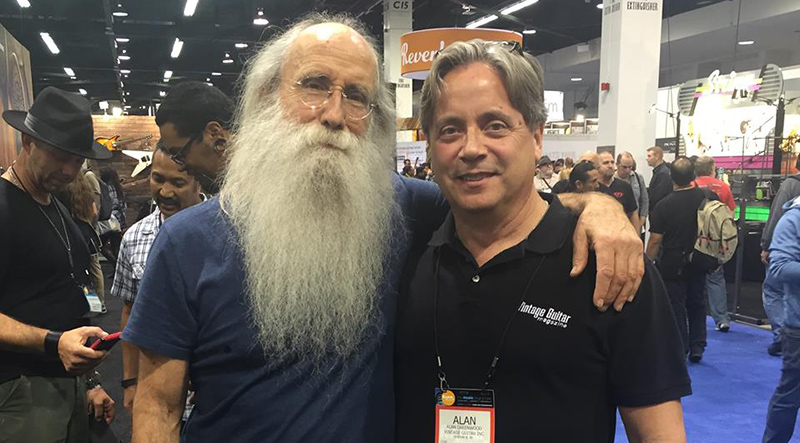
    It's not every day you run into one of the coolest bass players with the best beard! VG publisher Alan Greenwood posed with Lee Sklar at #NAMM2016.
    It’s not every day you run into one of the coolest bass players with the best beard! VG publisher Alan Greenwood posed with Lee Sklar at #NAMM2016.
    Get a look of this metal body USA Custom Shop Deluxe Wreath II from Recording King we spotted in The Music Link booth at #NAMM2016! The engraving definitely makes heads turn!
    Get a look of this metal body USA Custom Shop Deluxe Wreath II from Recording King we spotted in The Music Link booth at #NAMM2016! The engraving definitely makes heads turn!
    Seymour Duncan claims to have ended the quest for a pedal that truly sounds and performs like a high gain tube amp with the Palladium.
    Seymour Duncan claims to have ended the quest for a pedal that truly sounds and performs like a high gain tube amp with the Palladium.
    We asked the man behind Paul Reed Smith Guitars to show us a few of his personal favorites. One of his first grabs, this McCarty
    We asked the man behind Paul Reed Smith Guitars to show us a few of his personal favorites. One of his first grabs, this McCarty
    Four years, 70 prototypes, and one successful Kickstarter campaign later, the Thalia Capo is an aesthetically fresh and innovative way to make seamless one-handed key changes during songs.
    Four years, 70 prototypes, and one successful Kickstarter campaign later, the Thalia Capo is an aesthetically fresh and innovative way to make seamless one-handed key changes during songs.
    For bass players demanding well-defined clarity and stunning articulation together with a rich, full tone, Celestion's new PULSE Series of bass speakers deliver an ideal combination of responsiveness and rock solid low end.
    For bass players demanding well-defined clarity and stunning articulation together with a rich, full tone, Celestion’s new PULSE Series of bass speakers deliver an ideal combination of responsiveness and rock solid low end.
    DR Strings guarantees their new VERITAS acoustic strings to last up to four times as long as ordinary acoustic strings. Who's ready to put these strings to the test?
    DR Strings guarantees their new VERITAS acoustic strings to last up to four times as long as ordinary acoustic strings. Who’s ready to put these strings to the test?
    Over the past 100 years, the iconic Martin Dreadnought defined what an acoustic guitar can and should be. We caught up with the man himself while at #NAMM2016
    Over the past 100 years, the iconic Martin Dreadnought defined what an acoustic guitar can and should be. We caught up with the man himself while at #NAMM2016
    Introducing the latest member of the Strymon family! Aimed at juice-hungry stomps, the Zuma is one of two new power supply options from the company.
    Introducing the latest member of the Strymon family! Aimed at juice-hungry stomps, the Zuma is one of two new power supply options from the company.
    Fun fact: All Curt Mangan Strings are handcrafted with pride from the best American wire in Cortez, Colorado.
    Fun fact: All Curt Mangan Strings are handcrafted with pride from the best American wire in Cortez, Colorado.
    Here's your first look at the new Kenai T2 Double Purf in Sunrise from Knaggs Guitars, courtesy of Peter Wolf himself.
    Here’s your first look at the new Kenai T2 Double Purf in Sunrise from Knaggs Guitars, courtesy of Peter Wolf himself.
    It's pretty black and white in the Mad Professor#NAMM2016 booth. And we are digging the Old School and new super light 100W cabinets on display!
    It’s pretty black and white in the Mad Professor#NAMM2016 booth. And we are digging the Old School and new super light 100W cabinets on display!
    Keeley Engineering came to #NAMM2016 ready to do work! Their new Workstation Series features Tone, Mod, Super Mod, and Delay pedals.
    Keeley Engineering came to #NAMM2016 ready to do work! Their new Workstation Series features Tone, Mod, Super Mod, and Delay pedals.
    Check out the one-piece, quilted maple top on Kiesel Guitars 70th Anniversary K Series Guitar! Shown here with Kiesel Treated fingerboard, 7-piece neck, and mahogany body.
    Check out the one-piece, quilted maple top on Kiesel Guitars 70th Anniversary K Series Guitar! Shown here with Kiesel Treated fingerboard, 7-piece neck, and mahogany body.
    We're halfway through Day 3 of The NAMM Show! Let's celebrate with some Golden Era '55 Falcons from Gretsch.
    We’re halfway through Day 3 of The NAMM Show! Let’s celebrate with some Golden Era ’55 Falcons from Gretsch.
    A lot of colorful character in the Bare Knuckles#NAMM2016 booth! Makes it pretty hard to make a decision...
    A lot of colorful character in the Bare Knuckles#NAMM2016 booth! Makes it pretty hard to make a decision…
    It's too hard to choose between the Breedlove Oregon Concert Limited and Oregon Rogue, so we're not going to. We'll take both!
    It’s too hard to choose between the Breedlove Oregon Concert Limited and Oregon Rogue, so we’re not going to. We’ll take both!
    New for #NAMM2016: The Amptweaker JR Series distortion pedals, featuring TightMetal JR, TightRock JR, and TightDrive JR!
    New for #NAMM2016: The Amptweaker JR Series distortion pedals, featuring TightMetal JR, TightRock JR, and TightDrive JR!
    Lots of new and exciting things out of Electro-Harmonix this winter! The Soul POG multi-effect essentially combines two pedals - the Soul Food transparent overdrive and Nano POG - in one potent multi-effect. While the Lester G Deluxe Rotary Speaker and Lester K Stereo Radio Speaker provide two different options for putting the sound of a giant wood cabinet on a pedalboard.
    Lots of new and exciting things out of Electro-Harmonix this winter! The Soul POG multi-effect essentially combines two pedals – the Soul Food transparent overdrive and Nano POG – in one potent multi-effect. While the Lester G Deluxe Rotary Speaker and Lester K Stereo Radio Speaker provide two different options for putting the sound of a giant wood cabinet on a pedalboard.
    George L's original high end cable now comes in orange! Which begs the question, what is your color of choice?
    George L’s original high end cable now comes in orange! Which begs the question, what is your color of choice?
    Big Joe Stomp Box is changing the game with its new lithium smart battery for your pedal board. It comes complete with USB port and countdown features!
    Big Joe Stomp Box is changing the game with its new lithium smart battery for your pedal board. It comes complete with USB port and countdown features!
    Traveler Guitar has teamed up with ESP Guitars and the end result is the eye-catching Traveler Guitar LTD EC-1! Are you a fan?
    Traveler Guitar has teamed up with ESP Guitars and the end result is the eye-catching Traveler Guitar LTD EC-1! Are you a fan?
    Jimmy Vivino, guitarist, producer and band leader for Conan O'Brien, just picked up the red version of this metallic green Asher Rambler Resosonic guitar!
    Jimmy Vivino, guitarist, producer and band leader for Conan O’Brien, just picked up the red version of this metallic green Asher Rambler Resosonic guitar!
    Check out these Spectra Sonic Standard TPs with TV Jones T-Series Spectra-Flux Bridges and Necks.
    Check out these Spectra Sonic Standard TPs with TV Jones T-Series Spectra-Flux Bridges and Necks.
    Mojotone has taken its music industry expertise and applied it to its own line of premium quality, hand-crafted amplifiers with the MT Pilot, Hatteras, and Deacon. We got up close and personal with the new Mojotone Amps at #NAMM2016!
    Mojotone has taken its music industry expertise and applied it to its own line of premium quality, hand-crafted amplifiers with the MT Pilot, Hatteras, and Deacon. We got up close and personal with the new Mojotone Amps at #NAMM2016!
    Santa Cruz Guitar Co is celebrating its 40th Anniversary with amazing guitars, like this Custom FS Model. With a body binding, back strip, and peghead overlay made of entirely Koa, the Custom FS also boasts an Abalone rosette and top purfle.
    Santa Cruz Guitar Co is celebrating its 40th Anniversary with amazing guitars, like this Custom FS Model. With a body binding, back strip, and peghead overlay made of entirely Koa, the Custom FS also boasts an Abalone rosette and top purfle.
    According to Dave Mustaine, who uses Cleartone strings exclusively on his guitars, the coated strings produce "a ton more volume." Do you agree?
    According to Dave Mustaine, who uses Cleartone strings exclusively on his guitars, the coated strings produce “a ton more volume.” Do you agree?
    Powerful synthesis and sequencing can now be in the palm of your hand thanks to the groundbreaking iDS10 for iPhone software from Korg!
    Powerful synthesis and sequencing can now be in the palm of your hand thanks to the groundbreaking iDS10 for iPhone software from Korg!
    Chris from K-Line Guitars was kind enough to model the all new K-Line Guitar, featuring Klein pickups, for us at #NAMM2016.
    Chris from K-Line Guitars was kind enough to model the all new K-Line Guitar, featuring Klein pickups, for us at #NAMM2016.
    The time has come! A few Teles and Strats to mark the halfway point on the final day of #NAMM2016.
    The time has come! A few Teles and Strats to mark the halfway point on the final day of #NAMM2016.
    Staying true to the company's roots, Blackstar launched the Union Jack Fly 3 mini amp at#NAMM2016. What do you think of this 3-watt amp?
    Staying true to the company’s roots, Blackstar launched the Union Jack Fly 3 mini amp at#NAMM2016. What do you think of this 3-watt amp?
    Behold, the Airwave 12 from Reverend. A Kona semi-hollow with maple top and medium oval five-piece korina/walnut neck, the Airwave 12 features CP90 pickups and Reverend pin-lock tuners.
    Behold, the Airwave 12 from Reverend. A Kona semi-hollow with maple top and medium oval five-piece korina/walnut neck, the Airwave 12 features CP90 pickups and Reverend pin-lock tuners.
    Vintage Guitar stopped by the Analog Alien booth at The NAMM Show to see the latest effects pedals from the company behind the "coolest guitar pedals on the planet."
    Vintage Guitar stopped by the Analog Alien booth at The NAMM Show to see the latest effects pedals from the company behind the “coolest guitar pedals on the planet.”
    Ovation Guitars is celebrating 50 years in business with this 50th Anniversary Custom Elite in black.
    Ovation Guitars is celebrating 50 years in business with this 50th Anniversary Custom Elite in black.
    We ran into a wall of Sonamaster Series guitars with Alder bodies from Washburn Guitar while at the show. Really digging the Red Sunburst finish!
    We ran into a wall of Sonamaster Series guitars with Alder bodies from Washburn Guitar while at the show. Really digging the Red Sunburst finish!
    Do gentlemen prefer Tobacco Sunburst or Blonde? Because we'll take both of these Barney Kessel Gold K Signature Series Jazz Special Electric Guitars from Kay!
    Do gentlemen prefer Tobacco Sunburst or Blonde? Because we’ll take both of these Barney Kessel Gold K Signature Series Jazz Special Electric Guitars from Kay!
    Fil “SoloDallas” Olivieri brought a selection of vintage guitars along with The Schaffer Replica tower to NAMM 2016!
    Fil “SoloDallas” Olivieri brought a selection of vintage guitars along with The Schaffer Replica tower to NAMM 2016!
    Adam Grimm - Satellite Amplifiers
    Adam Grimm – Satellite Amplifiers.
    Aussie rockers Gwyn Ashton and Ian Moss at the National Resophonic booth.
    Aussie rockers Gwyn Ashton and Ian Moss at the National Resophonic booth.
    Saul Koll and the new gold-leaf Koll Duo Glide.
    Saul Koll and the new gold-leaf Koll Duo Glide.
  • The Charvel Model 4

    The Charvel Model 4

    Certain guitar brands develop a mystique among aficionados – sometimes it’s even deserved! Somewhere on this continuum lie Charvel USA guitars made in the early ’80s in San Dimas, California. Curiously, that “San Dimas guitar” mystique didn’t rub off to its foreign cousins like the Model 4 – the fine Japanese-made Charvels produced beginning in 1986.

    Japanese Charvels were the result of a collision between the dominance of ’80s heavy metal, the maturation of Asian guitarmaking, and the realities of economics. American-made Charvels were the namesake of Wayne Richard Charvel, who began making guitars as a teenager in the 1960s. In the early ’70s, Charvel worked as a refinisher for Fender. In ’74, he opened a repair shop in Azusa, California, which in ’76 became Charvel Manufacturing, offering a variety of parts so you could “build your own.” Charvel had an assistant named Grover Jackson. In ’77, Charvel Manufacturing ran into financial problems, and in ’78, Jackson bought the company from his boss, becoming Jackson/Charvel.

    That same year, Edward Van Halen brought attention to the name when he appeared playing a Charvel “parts” guitar. After supplying guitars to B.C. Rich and basses to Music Man, in 1980 the Charvel line of bolt-neck solidbody electric guitars and basses appeared, basically variations on Fender models. Even though Van Halen soon jumped ship and hooked up with Floyd Rose and Kramer guitars, Charvels found a steady clientele, and the brand prospered. In 1983, Charvels with the more-familiar pointy/droopy headstock appeared. When American manufacturing ceased in ’86, Charvel had produced nearly 6,000 guitars.

    Meanwhile, the Japanese juggernaut of the ’70s continued into the ’80s, though while Japanese quality continued to excel, unfavorable exchange rates made it increasingly difficult to import them. Rewind. Two enterprising Americans named Jerry Freed and Tommy Moore started the International Music Corporation (IMC) in Fort Worth, Texas. In 1969, they traveled to Korea and, transferring Japanese technology and techniques, established the budget Hondo brand. Cheaper Hondos were made in Korea, but its better models were produced in Japan. The Hondo brand thrived into the ’80s.

    Desiring to garner some of the hard-rock-player market, in 1985, IMC entered a licensing agreement with Jackson/Charvel to produce Charvel guitars in Japan. Chu Shin Gakki, in Matsumoto City, was awarded the business and samples were sent. It was this contract that ended the early phase of Robin guitar imports and thrust that brand into U.S. manufacturing. In 1986, IMC purchased the Jackson/Charvel company and that year, the first Japanese-made Charvels appeared in the U.S. Jackson-brand guitars continued to be produced in the U.S., though Asian-made Jacksons soon appeared.

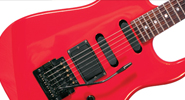
    A first-year (1986) Charvel Model 4.
    A first-year (1986) Charvel Model 4.

    Basically, there were six models of Chu Shin Charvels in ’86. At the top of the line were the Models 6 and 5, with a two-octave neck-through down-sized bodies called Dinky. Both had American-made Jackson active electronics. The Model 6 had a bound fingerboard with the ubiquitous “shark’s teeth” inlays, the Model 5 was unbound with dots. Models 4 and lower had bolt-on necks with regulation Strat-style bodies, all unbound dot-necks. Models 3 and lower had passive Jackson pickups; Model 3 (humbucker/single/single, locking vibrato), 3A (two humbuckers), Model 2 (single humbucker, locking vibrato), Model 1 (one humbucker, maple fretboard, traditional vibrato), and Model 1A (pickguard, three single-coils, traditional vibrato). A number of examples were “off-catalog.”

    The Model 4 was at the top of the bolt-neck line, with the same hardware and active electronics as the 6. Its thin, quartersawn rock maple neck has a satin finish and a wide, flat fingerboard. The body is basswood – medium weight, but solid. The single-coils are Jackson J200s; the humbucker a J50BC with “accentuated high frequency.” Like most good active pickup systems, it has a clean, wide frequency response with no noise. The toggles are on/off for each pickup, the vibrato is a Kahler Standard, and controls are one Volume, one Tone, and a pre-amp midrange boost/cut. The nut is phenolic.

    The Chu Shin Model 4 proved highly successful for IMC – so much so that in 1987 they upgraded it with a bound fingerboard and shark’s teeth inlays. This example carries serial number 227735 – lacking any apparent date encoding.

    Under the IMC/Jackson hegemony, the Charvel line continued to expand, and some fine and innovative guitars were produced. In ’89, the Charvette, made in Korea, was introduced. In the early/mid ’90s, IMC began to be hit by bad economic news, and parts of the company began to be sold off. Charvel electrics disappeared, though some acoustics remained. In ’97, IMC’s assets were sold to Akai Electric Company, leaving only the Jackson brand. In 2002, the entire kit and caboodle were sold to Fender, which to this day produces some very beautiful guitars and basses made in Asia. Wayne Charvel and his son, Michael, make and sell guitars remarkably similar to the original Charvel USAs under the Wayne brand name.

    Charvel guitars conjure a fascinating time in American guitar history when shred was the name of the game. American production lasted less than six years. Japanese production lasted about the same. Korean production probably didn’t last as long. Quite a few were sold, but no real information on production totals is available, so we have no idea how rare this guitar is (or isn’t). These Japanese Charvels may not have the caché of the American models, but if you play electric guitar and this was your only option, you would be happy with a guitar this nice!


    This article originally appeared in VG August 2013 issue. All copyrights are by the author and Vintage Guitar magazine. Unauthorized replication or use is strictly prohibited.