PureSalem Guitars and 323 Effects are teaming up to offer limited-run effects pedals in a series called the SalemFuzz Project. First in line are the PinkBeard high-gain/transistor fuzz, the Honey Bunny ’90s-style fuzz, and the Attack Captain ’60s-style fuzz. All are made in the U.S. with true-bypass switching, an aluminum enclosure with screen-printed graphics and fluted knobs, and are powered with an included 9-volt negative-ground adapter.
TV Jones’ Spectra Sonic Standard guitar has a chambered alder body with maple top finished in a matte-black urethane with off-white binding and a matching single-ply pickguard. Its neck is maple with a rosewood fingerboard and a 24.625″ scale, ABR-1 bridge with TV Jones Model 10 stop tailpiece or optional Bigsby B-12 vibrato, nickel hardware, and TV Jones’ new single-coil pickups or the company’s T-90 F.
TV Jones has also released a drop-in pickup set for Tele-style guitars. They use custom-made T-Armond magnets and magnet wire and measure 11.13K-ohm (bridge) and 7.32K (neck).
The Martin John Lennon 75th Anniversary model has a solid Adirondack spruce top with the company’s Vintage Tone System, as well as back, sides, and a headstock veneer of Madagascar rosewood. Its back is inlaid with mother of pearl in a peace-sign pattern, matching the marquetry of the sound hole. Lennon’s renowned self-portrait illustration is inlaid on the front of the headstock. The run will consist of 75 units.
Phillips with a Joe Veillette Gryphon 12-string. Photo credit: Mark Latham.
Ant Phillips was a founding member of Genesis and, along with guitarist/bassist Mike Rutherford, created the signature 12-string acoustic sound that marked the band’s classic albums. Phillips left the group after 1970’s Trespass album to study music, but his ’77 solo debut, The Geese and the Ghost, is regarded as a prog classic. It also launched his recording career on solo albums and sound track music for television and film. Now, his career has been summed up in Harvest of the Heart, a five-disc boxed-set look at every facet of his career, including a few rarities that will thrill fans of vintage Genesis music.
It has been 44 years since you were a member of Genesis, yet you are regularly asked about them. Does that get tiring, or is it a source of pride?
It’s tiring when people are only interested in that era and not my lengthy career thereafter. My role in the Genesis saga was brief, but very much during its formative period. Some of my personal sound and style went into the band’s musical genome, and I am proud of that.
One of the interesting aspects of Harvest of the Heart is that it reflects a long studio career that succeeded without live performances.
While I was among the keenest members of Genesis to start performing live in the early days, I was later seized by a burst of stage fright and that put me off playing live. Instead, I love the constant creativity of studio work; I feel I’m a better composer than a player, anyway.
You discovered the 12-string acoustic as a teen. Were you aware of landmark 12-string tracks like the Rooftop Singers’ “Walk Right In” or Simon & Garfunkel’s “A Hazy Shade of Winter?”
I vaguely remember “Walk Right In,’’ but can honestly say my 12-string style was formed largely in tandem with Mike Rutherford when we were at school together [from 1967 through ’69]. It was our own thing, though in a small way, John Whitney, of Family, influenced my rhythmic approach a bit with “The Weaver’s Answer” [1970 U.K. single]. Brilliant acoustic guitarists such as Simon Nicol and Richard Thompson did likewise with six-strings on the gorgeous Fotheringay album, but I really feel Mike and I plowed our own furrow on the 12-string, and boy, was it exciting!
When you played acoustic onstage with Genesis, how did you amplify it?
Mike and I had DeArmond pickups that fed back all the time. When that would happen, both of us would turn down, not knowing which was the offender. At times, this left Peter [Gabriel] as good as unaccompanied on vocals!
One of the box-set tracks, “F Sharp,” is clearly the basis for Genesis’ “The Musical Box.” Was it frustrating you never got a songwriting credit?
My contribution was small in the grand scheme of things, and if they hadn’t toured with it later on, I wouldn’t have made any money at all. So it’s fine with me.
What are your primary guitar tools these days?
I’m the proud owner of many guitars and stringed instruments. I have an Italian Vinaccia mandolin from 1784 and a German wald cittern from 1733! I usually play less electric, but am plugging in again for a new project, swapping between my ’57 Les Paul goldtop and a ’60s Strat. I also use a John Dickinson amp, with its signal split through an Avalon preamp to the mixer via a volume pedal. For effects, I use a Roland Dimension D; Strymon BlueSky reverb and Timeline delay; and T-Rex and Coopersonic overdrives, plus old faithfuls like the MXR Dyna Comp and Phase 100. I even have my old green Roland Chorus/Space Echo for occasional use.
In your mind, what qualities make a good 12-string acoustic?
Good action and accurate tuning, of course, but ideally an equal mix of a high, shimmery top voicing with deep, round, warm bass. And believe me, that’s hard to find! The closest to this I have is my Larrivee 12 – it’s a majestic instrument.
Tell us about your 12-string Veillette Gryphon.
I bought it from Ivor Mairant’s music shop in London. Mac, the guy who runs the store, often infuriatingly finds these things to tempt me with. It’s quite small, but packs a punch – fuller than you would expect in a small-body acoustic. Yet it has a crystalline top-end that really sings.
Do you ever spin Trespass for old time’s sake?
I haven’t recently, though perhaps I ought to. As is probably evident, my latter days with Genesis were somewhat traumatic, so that record is tarnished, in my mind. But I’m thrilled that so many people hold it in high esteem – the record took a lot of blood, sweat, and tears to get it there!
This article originally appeared in VG January 2015 issue. All copyrights are by the author and Vintage Guitar magazine. Unauthorized replication or use is strictly prohibited.
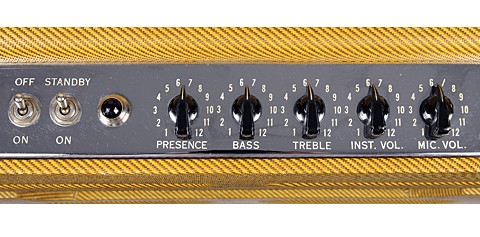
1956 Fender 5E7 Bandmaster Amp Amp and photos courtesy of Nadav Galimidi Preamp tubes: one 12AY7, two 12AX7
Output tubes: two 6L6s, fixed biased
Rectifier: 5U4G tube
Controls: Volume, Volume, Treble, Bass, Presence
Output: 28 watts RMS +/-
Speaker: three 10″ Jensen P10R
Two decades ago, when renewed appreciation of Fender’s narrow-panel tweed amps of the late ’50s really started to boom, the Bassman was generally considered king of the heap, with the 5E3 Deluxe winning fans among players who wanted to “crush it” in smaller rooms.
Hitting the mark between the two, plenty of blues players in particular have declared the toothsome utility of the 1×15″ Pro or the 2×12″ Twin, while Tele-twangers and others have lauded the 2×10″ Super. And that, you’d think, would have nicely rounded out an amp maker’s midsize/larger offerings. Wedging another between it all, a combo with three speakers no less, would seem utter madness; yet that’s precisely what Leo Fender felt he needed – and precisely the amp, in the form of the 5E7 Bandmaster combo, that sends collectors gaga today.
Three speakers. It’s utterly whack, right? Especially when you consider that the amp that carries them is the same under the hood as its siblings with a single 15″ speaker or two 10s (other than that the output transformer was wound to match the odd 2.7-ohm speaker load). Yet, as pointless as the Bandmaster might seem when considered amid the Fender line of the day, there is something strangely glorious about this configuration. It’s got more beef than a single 12 or two 10s, while retaining the faster, more-detailed 10″-speaker attack that the 1×15″ Pro might lack, and remaining more compact and portable than a 4×10″ Bassman or 2×12″ Twin. Any effort at practicality aside, it’s indescribably, esoterically, somehow ephemerally cool, regardless of its astronomical vintage value.
Not that vintage values can be disregarded. And as considerable as it is for the 5E7, the context makes this exceedingly clean 1956 example all the more precious. You might not call it “showroom” or “mint”condition, but it’s all the more appealing for that – just a tiny ding here and there, the very slightest fraying at some of the lower corners of the cabinet, a mere haze of dust on the speaker frames, some wear on the handle to show it was actually played, and that’s it. The tweed and grille are bold, untarnished, and untorn; the badge and control panel clean and unpitted; and inside the chassis… whoa, does it ever look sweet in there, as well as totally original. If it’s been played, it doesn’t seem to have been played hard, or long. There’s no evidence of excessive heat wear on the chassis, board, or power resistors, and those beautiful yellow Astron coupling caps and orange-brown Astron filter caps, salmon-pink “domino” cap, and turquoise selenium rectifier all look like they just left the factory. Indeed, some of the filter caps and that selenium rectifier – all well past their expected lifespan at this point – might need to be replaced if this is intended as a “player,” but it’s great to see them still in there, and in this condition. The only originality glitch in our feature amp appears to be a mismatched pair of 6L6GCs, but eh, that’ll happen – a tube fails, and you pop in what you can find (we’re guessing the small-bottle Realistic was a stop-gap… Bought any tubes at Radio Shack lately?).
The Bandmaster has often been written of as “a tweed Bassman with three 10″ speakers instead of four,” but it’s very much not that, and in plenty of important ways, in the same very real proportions as the Super and Pro are different from “a Bassman with two 10s or a single 15.” While it might have been “just a 10″ speaker bigger” in its configuration, the Bassman was truly a step up into big-amp territory, intended as it was for enduring the rigors of amplifying the four-string electric bass. It had a firmer, more-advanced output stage, a stouter 5AR4 rectifier tube, a bigger output transformer, and put out a significant 40 to 45 bold watts as opposed to the Bandmaster’s roughly 28 watts (often rated at 35 on paper). In fact, that it also sported a Middle control was the least of its differences. Like its siblings the Super, Pro, and Twin (the original, lower-powered Twin at least), the Bandmaster’s circuit employed the split-phase (a.k.a. “cathodyne”) inverter, as perhaps most famously used on the smaller Deluxe. This phase inverter used both halves of a 12AX7 to place a driver stage in front of a phase splitter, a configuration that is arguably more a part of “the legendary tweed tone” than the sophisticated long-tailed-pair in the Bassman and high-powered Twin, thanks to its propensity to distort rather early and thicken up the tone in a way we now commonly regard as “brown” and “tweedy.” Compound this with a smaller and more easily saturated output transformer, and a rectifier tube that’s more easily pushed to sag, and you’ve got significantly less headroom, and a quicker onset of everything we tend to love from narrow-panel tweeds, especially if we haven’t got the kind of gig that lets us push a Bassman into overdrive.
A closer look in the back of the cabinet reveals three unmolested Jensen P10R Alnico-magnet speakers, the first two of which bear matching date codes for the 34th week of 1956. The top speaker is from the 45th week of 1955, but it was never unusual for Fender to sling together parts from different batches. Note, too, that the top speaker needed to be mounted sans magnet cover for it to squeeze in behind the chassis; since it also has the correct Jensen sticker on the horseshoe magnet, it was undoubtedly supplied coverless and pulled from a batch that was going into service more slowly than the covered P12Rs used for the bottom drives (and for all four drivers in the Bassman at the time). Thanks to its extra 10″ speaker, the Bandmaster originally cost a little more than 25 percent more than the Super – $289 to $224 – which is surprisingly disproportionate considering the gulf between that difference in price and the far lesser cost of a Jensen P10R speaker back in the day (the Pro came in-between at $264). Plenty of potential Fender customers of the late ’50s must have weighed this differential carefully for themselves, too, since far fewer decided to spend to get the Bandmaster over the Super or the Pro. “Eh… three speakers? Two will be plenty – and hey, it’s easier to carry!” But if your grandpa was fond of odd numbers and prone to be a little spendy now and then, check the attic of the old homestead. These things are worth grabbing, when you can find them.
This article originally appeared in VG April 2014 issue. All copyrights are by the author and Vintage Guitar magazine. Unauthorized replication or use is strictly prohibited.
Fans of four-barrel, huevos-to-the-wall roots rock will do well to investigate the latest from this Denver-based trio.
Foregoing bass in favor of guitars and drums (à la Jon Spencer Blues Explosion), Yawpers ply their trade on the continuum between Steve Earle’s well-crafted lyrics and the Supersuckers’ whiff-of-sulfur punk abandon. Dig past Jesse Parmet’s raucous bottleneck, Noah Shomberg’s pummeling drums, and frontman Nate Cook’s, well, yawp, and it’s apparent this stuff goes deeper than the rowdy arrangements.
Cook’s narrator in “Burdens” is accompanied by Libba Cotten fingerpicking as the song builds and finally crashes in a cacophony recalling Uncle Tupelo at their early best. Which is apt – Cook paints wry pictures of dead-end smalltown life as well as the alt-country figureheads ever did.
Meanwhile, the title track’s riff gives off a sniff of Neil Young’s “Homegrown” while offering killer lines like “Livin’ my life with my head in the sand/Praise the Lord, I’m an American man.”
All the sonic tropes of loud white-trash rock are here, right down to Cook’s Gene Vincent yelps on “Doing It Right,” but the listener doesn’t need to look far to find an empathetic songwriter and tunes as complex as middle America itself.
This article originally appeared in VG‘s February’16 issue. All copyrights are by the author and Vintage Guitar magazine. Unauthorized replication or use is strictly prohibited.
Many articles have been written about how guitarists and dealers in the mid/late 1970s and early ’80s were asking Gibson to build a Les Paul that more closely conformed to ’59 specs. The following is not an attempt to rehash any of them, but rather to provide an overview of some of these “pre-’59 reissue” guitars with some narrative and details of their construction and features based on the author’s experience in collecting and playing these guitars. It’s ironic that, at a time in which Gibson was going through great strife with declining sales and profit margins, rivalries between the new Nashville plant and the Kalamazoo plant, and the downsizing and eventual closure of the Kalamazoo plant by 1984, the company was able to experiment and respond to requests for guitars that more closely emulated the beloved Les Paul Standard of 1959 – even though some of these attempts were way off the mark!
Chris Lovell, owner of Strings and Things in Memphis, placed a custom order for some Les Pauls in the mid ’70s that more closely approximated the original Les Paul Standard specs, including a narrower headstock, narrow binding in the cutaway, deeper carve top, etc. Approximately 28 guitars were made for Chris’ store between 1975 and 1978. The author of this article does not own a Strings and Things model because, in hunting for one, there does not appear to be any single set of definitive specifications or identifying features to authenticate a Strings and Things Les Paul. Some of the guitars advertised as Strings and Things models have different serial number formats, one-piece necks vs. three-piece necks, different bridges, narrow or wide binding in the cutaway, etc.
The only way to authenticate a Strings and Things reissue would be to find one that comes with a certificate or invoice from Strings and Things during the 1975-’78 time period. It continues to be an intriguing yet elusive quest for the Holy Grail.
Les Paul KM (“Kalamazoo Model”)
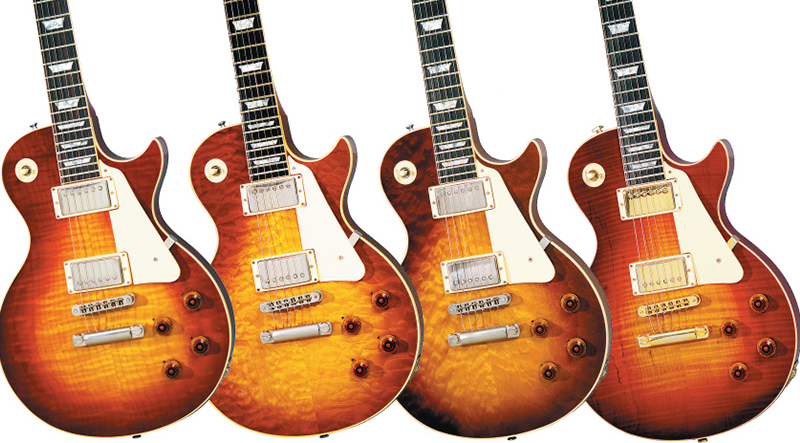
The Les Paul KM model was made in the Kalamazoo plant in 1979, supposedly at the request of a southern sales district, according to one account (this history is refuted by another account). The guitar was intended be a sunburst Les Paul that more closely approximated ’59 Standard specs. The result, the KM model, is a nice guitar but does not come close to a ’59 reissue. The guitar has exposed-coil, double-cream, T-top humbuckers, speed knobs, large, black side dot markers, a Nashville bridge, stop tailpiece, Grover tuners, wide binding in the cutaway, brown backplates, and “Les Paul K. M. ” engraved on the truss rod cover. The guitar has an unusually wide headstock and a volute and three-piece mahogany neck. The Gibson logo on the headstock has a closed “b” and “o,” and no dot above the “i. ” The first run had a “Custom Made” plaque loose in the case or mounted below the tailpiece. The guitar was available in Antique Sunburst, Natural, or Cherry Sunburst finish. Many examples of this model in Bright Cherry Sunburst or Dark Sunburst have been available, many with plain tops. Some flametops were reportedly made, such as the example shown, many of which were shipped to Japan. A total of approximately 1,500 Les Paul KMs were made. Our model has a nice flame top and dark cherryburst finish. It weighs 9 pounds, 10 ounces.
Timm Kummer worked for Guitar Trader in the early ’80s. When the Les Paul KM model was introduced, it was so far off from ’59 specs that it prompted his boss, Dave DeForrest, to identify specifications for the order for the Guitar Trader Reissue Les Paul from Gibson, which weren’t until 1982 to produce.
One-Offs and Small-Run Pre-Reissue LPs
There was a lot of experimentation going on in the early ’80s with reissues, especially from the Kalamazoo plant, so if one looks around there are a number of interesting “one offs” and other limited runs. The author has received emails from people around the world with unusual LPs from the early-’80s that don’t correspond to a particular model in any catalog at that time, many having ’59 reissue type features.
Some (not all) Kalamazoo-made pre-reissues have the familiar Gibson eight-digit serial number (YDDDYSSS, where “Y” is the year, “DDD” is the day of the year from 001-365, and “SSS” is the production sequence number for the day) inside their control cavity in addition to a reissue-style (Y XXXX format) serial number on the back of the headstock. Because authentic Guitar Trader Les Pauls always have this eight-digit number in the control cavity, many collectors incorrectly assume that any Kalamazoo-made reissue from that timeframe with this number in the control cavity is a Guitar Trader.
The Guitar Trader model pictured is a 1980 one-off, with a pearloid plaque on the back of the headstock with the number 001, along with a Kalamazoo eight-digit serial number, Gibson tuners similar to those used on Deluxes at the time, narrow ’59-style binding in the cutaway, ’59-style knobs, narrower headstock, large tortoiseshell side dot markers and a Nashville bridge. This guitar may have been a prototype for some of the reissue style guitars to follow.
The second GT model pictured is a 1983 one-off. It has the reissue format serial number (9 0732), thin binding in the cutaway, correct hardware, and a one-piece (i. e. , no center seam) highly quilted maple top. Folklore has it that this guitar was built by luthiers remaining in Kalamazoo shortly after the plant officially closed.
Heritage 80 Les Paul Models
With the exception of a few Kalamazoo-built prototypes or one-offs in circulation, all Heritage 80s were made in the Nashville plant between 1980 and ’82. These have a unique sharp and wide cutaway at the horn, Grover kidney tuners, and an eight-digit serial number with four-digit number beneath it. There does not appear to be any pattern to the second four-digit number – it was used for marketing reasons to distinguish these guitars as limited editions by Bruce Bolen, then head of R&D.
They have a unique headstock shape and are are generally on the heavy side (high 9 to high 10 pounds), have the thin binding in cutaway, small black side dot markers, and a Nashville bridge. The backplates for the control cavity and switch are brown. The Gibson logo on the headstock has a closed “b” and “o” and a dot over the “i.” The necks on these guitars are of medium thickness. While not as close in terms of vintage specifications as the Guitar Trader and Leo’s LP models, they are well regarded guitars by many players and collectors and have excellent fit, finish, tone, and playability. Tim Shaw of Gibson at the time designed reissue PAFs for them which sound very good and have come to be known as “Shaw PAFs” in the collector community. The pickups are one double white and one zebra under the covers. The truss rod covers are inscribed with the model names.
1.) The Heritage Series Standard 80 has a three-piece neck and rosewood fretboard. Some came with rather plain tops, others have moderate flame. There are a few examples with one-piece necks and ebony fretboards, which indicates that Elite necks were used during parts shortages. The example here has a very deep flame. Colors were dark cherry sunburst or honeyburst. The truss rod cover is inscribed with “Heritage Series Standard 80. ” The example shown weighs 10 pounds, 10 ounces. It has an exquisite curly flame top.
2.) The Heritage Series Standard 80 Elite has a one-piece neck, ebony fretboard, and a quilted top. Most came in honeyburst but some were also made in cherry sunburst. The truss rod cover is inscribed with “Heritage Series Standard 80 Elite.” The two examples shown are at opposite ends of the weight scale, one being 9 pounds, 3 ounces, the other being 10 pounds, 8 ounces.
3.) The Heritage Series Award has a plaque on the back of the headstock with a number from 1 through approximately 50 (approximately 50 of these guitars were made for dealers who sold a lot of Heritage models), cherry sunburst, ebony board, flame top, and gold hardware. The truss rod cover is inscribed with “Heritage Award.” The example shown weighs 9 pounds, 4 ounces.
Guitar Trader Les Paul
Guitar Trader Les Pauls were made in the Kalamazoo plant in 1982. There were only about 47 made, possibly in only two batches. Except for the prototype (which was cherry sunburst), most were painted in a ruddy reddish-brown color. The wood for the tops of these guitars was carefully selected by Guitar Trader. Kummer says Guitar Trader picked the “best” wood, and the rejects were used on Leo’s Les Pauls. Ironically, Rich Bandoni, who worked for Leo’s at the time, says they picked the “best” wood for the Leo’s and the rejects were used on Guitar Traders! Most Guitar Trader LPs have exquisite quartersawn flame tops, except for the prototype, which was quilted. All have one-piece mahogany necks, an eight-digit serial number in the edge of the control cavity with a vintage style serial number on the headstock in “Y XXXX” format (where “Y” = “9” and the first two digits of “XX” are “09”) and Kluson-style tuners. The Guitar Trader’s Gibson logo has the open “b” and open “o,” with a dot on the “i,” and the “Les Paul Model” logo appears to be very low on the headstock, almost touching the truss rod cover. The backplates for the control cavity and switch are black. These guitars sport the narrow binding in the cutaway and have the large tortoiseshell side dot markers. They tended to be a bit lighter in weight than the Heritage 80s, have a more accurate cutaway carve and headstock, and many of the parts were replaced by Guitar Trader to be closer to vintage specs. The guitar has excellent fit, finish, tone, and playability. The first 15 Guitar Traders had real vintage PAFs installed by Guitar Trader, from its parts stash; the rest had Shaw PAFs.
The Guitar Trader shown weighs exactly 9 pounds, with serial number 9 0920.
There is much confusion in the collector community over authentication of a Guitar Trader. Many more details of the Guitar Trader model, as well as a method to positively identify them, can be found in the March ’02 issue of Vintage Guitar, or reprinted at www.lespaulforum.com/slubarticle/vgarticle.html.
Guitar Trader “Special” Les Paul (a.k.a. “Replica” or “Bootleg” LP)
After the small run of Guitar Trader models produced by Gibson, the owners of Guitar Trader made a few (no more than approximately 10) “replica” Les Pauls. In their ads they showed these guitars with a headstock that said “Guitar Trader,” but they actually attempted (rather poorly) to emulate the Gibson logo on these guitars. These guitars had cherry sunburst tops, wireless ABR-1 bridge, one-piece mahogany neck, more accurate headstock shape, large tortoiseshell side dot markers, thin binding in the cutaway, and other accurate parts, as well as a long neck tenon, which none of the Gibson-produced LPs had at the time. The Gibson logo is poorly formed, but has an open “b” and “o” and a dotted “i.” The backplates for the control cavity and switch are black. After receiving a cease-and-desist order from Gibson, Guitar Trader stopped making these bootlegs.
Besides the bootleg (serial number 9 1017) pictured here (which weighs 9 pounds, 9 ounces), another bootleg appears in the Burst Gang book under Guitar Trader replicas, with a serial number very close to the guitar shown.
Leo’s Les Paul
Leo’s Les Pauls, promoted as a “limited edition series” were made for Leo’s Music, Oakland, from approximately 1980 through ’85. Approximately 800 were made, with at least half going overseas.
The Leo’s models built in Kalamazoo, which have the eight-digit serial number inside the control cavity (like the Guitar Traders) are considered a bit more collectible, but production was shifted to Nashville in ’83, and the Leo’s models from there are very nice guitars, as well (Nashville-made Leos can be identified by small, black side dot markers and no serial number in the control cavity). All had breathtaking flame tops, most in Cherry Sunburst, although some were done in Honeyburst, and a goldtop was available, as well. The Kalamazoo-made Leos have large tortoiseshell side dot markers, a medium-sized one-piece mahogany neck, white Shaw reissue PAFs, single-collar Kluson-style tuning gears with no writing on the back, and thin binding in the cutaway. The Gibson logo on a Leo’s has the closed “b” and “o” with a high dot above the “i,” and the “Les Paul Model” is usually higher on the headstock than on the Guitar Trader Les Paul. The backplates for the control cavity and switch are black. These guitars are of medium weight, play very well, have excellent fit and finish, and great tone. Leos can be easily identified because the first digit of their serial number is an L.
The Kalamazoo-made Leo’s model shown weighs 9 pounds 3 ounces and has serial number L1 0154.
Jimmy Wallace Les Paul
Jimmy Wallace LPs were special ordered by guitar dealer Jimmy Wallace from about 1980 up to the mid ’90s, but after 1990 they ended up with slightly smaller neck sizes. The Wallace LPs made in Kalamazoo in the early ’80s had beautiful quilted tops, with vintage serial numbers starting with 8 (for 1958). The features of these guitars are similar to those of the Leo’s and Guitar Traders, including the thin binding in the cutaway, ABR-1 bridge, etc. The truss rod covers of the Jimmy Wallace guitars say “Jimmy Wallace Model.” The early ’80s guitars had block letters for the Jimmy Wallace script, but later models had script lettering. These guitars have Gibson Deluxe Klusons, open “b” and “o” and a dot on the “i” of the Gibson logo. The 1980 model (serial number 8 1012) has black backplates for the control cavity and switch, large tortoiseshell side dot markers, and weighs 9 pounds 9 ounces. The 1990 model (serial number 0 0076) has brown backplates, large black side dot markers, and weighs 9 pounds 2 ounces. The 1990 model also has a small, clear sticker with gold letters that read, “Jimmy Wallace” in the control cavity.
Standard 82 Les Paul
The Les Paul Standard 82 was made in Kalamazoo. The folklore surrounding this guitar is that the luthiers in Kalamazoo wanted to show the luthiers in Nashville how to make a “real” limited edition LP reissue that was of high quality and closer to vintage specs. This guitar has the thin binding in the cutaway, ABR-1 bridge, narrow headstock, brown backplates for the control cavity and switch, large tortoiseshell side dot markers, “Made in USA” stamp on the back of the headstock, and tulip style Grovers. The example here weighs 10 pounds. The Standard 82s have a truss rod cover that says “Standard 82” on them, breathtaking quilted tops, in natural or honeyburst.
Summary
Hopefully, this little tour down the memory lane of early-’80s guitar history was interesting, and demonstrates some of the unique instruments Gibson was experimenting with in response to many requests for a Les Paul that more closely approximated the revered 1959 Les Paul Standard.
To finish the era of the 1980s, look for an upcoming article on ’59 reissues from 1983-’89, also known as “pre-reissues” or “pre-Historics. ” Mike Slubowski is a Gibson enthusiast, collector, player, and author, with a special passion for Les Pauls. He invites anyone with additional information or questions about the history of pre-reissue Les Pauls or any other Gibson model to contact him at MikeSlub@aol. com.
No part of this article may be reproduced without the expressed written permission of the author.
Credit is given to the Gibson Les Paul Book by Tony Bacon and Paul Day, Gruhn’s Guide to Vintage Guitars by George Gruhn and Walter Carter, and personal accounts given by owners of various pre-reissue Les Paul guitars.
This article originally appeared in VG February 2004 issue. All copyrights are by the author and Vintage Guitar magazine. Unauthorized replication or use is strictly prohibited.
When does Joel Hoekstra sleep? To say the always-smiling guitarist has a full plate is an understatement. For several years, he has juggled performing with the smash hit Broadway musical Rock of Ages, toured with the holiday sensation Trans-Siberian Orchestra, and served as a member of melodic hard-rockers Night Ranger.
He amicably parted ways with Night Ranger to join Whitesnake; hand-picked by founder David Coverdale, Hoekstra joined an illustrious list of axe-slingers including Bernie Marsden, Micky Moody, Mel Galley, John Sykes, Adrian Vandenberg, Vivian Campbell, Steve Vai, Warren DeMartini, Doug Aldrich, and current member Reb Beach. Whitesnake is set for a new album and tour in 2015.
Hoekstra has also released three solo albums, nurtured side projects, and done sessions and scores for the likes of singer Amy Lee and the television shows “Duck Dynasty” and “Wahlburgers.”
“Over the last five years, I’ve averaged 400 shows each year between Rock of Ages, TSO, and Night Ranger, including sessions and things like that. I’m basically gigging every day,” he said. Oh, and Hoekstra and his wife have a toddler, so down time is rare.
He’s currently on the road with Trans-Siberian Orchestra, and loves every minute of it.
“This year, we’ll be doing ‘The Christmas Attic’ for the first time. We’re excited to have new material to play. It’s just another page in what’s become a Christmas tradition for a new generation. It’s awesome to be a part of. I can’t think of anything else like it that appeals to so many different people and does so well commercially.”
Hoekstra grew up in the Chicago area, and his parents had him learning cello and piano at an early age. Then, something wonderful happened – he heard the guitar as played by Angus Young in AC/DC.
“At that moment, music changed for me – hearing AC/DC and ‘Back in Black,’” he said. “I thought Angus Young was the coolest thing in the world… I still do, really.”
He picked up the acoustic guitar first, and started studying rudimentary song books, but wasn’t satisfied. Wanting to rock, he hit up a friend who taught him power chords and told him about a teacher at the local mall who showed his students how to play rock-and-roll songs.
“I didn’t know there were such things as scales or exercises, per se,” he recalled. “I was learning all the songs I liked and that was a great way to get myself motivated.”
From there, he started playing in bands as a teenager and began learning on his own. He also started giving lessons, which he says was vital to his growth as a musician.
“I taught 70 students a week for years, which gave me a really good opportunity to work on my ear and fundamentals. It kept me playing guitar for a living,” said Hoekstra. “There are people who go, ‘I’m just gonna sell these stereos until my band makes it big.’ Eventually, though, you find out that practical living usually overcomes the dream living, and your ‘fantasy’ gets swallowed up.”
Hoekstra’s main electric guitars include a Gibson Les Paul goldtop ’57 reissue, various Gibson Les Paul Customs, a 50th-anniversary Flying V, an SG, a Howard Roberts, a Fender Jazzmaster, a Jackson PC1, and a striped EVH (several of them are fitted with Fernandes sustainers). His acoustic guitars include a Gibson CL-40, a Taylor 914ce, 614ce, and an 854c 12-string.
He caught a break while working with singer Cathy Richardson, who went on to portray Janis Joplin in the musical Love, Janis, and helped get him a spot in the production. Stints with Big Brother & The Holding Company, The Turtles, and others steadily built his career. Hoekstra is especially grateful for his eight-shows-a-week Rock of Ages gig, which has reached 2,000 performances and counting, and also led to a cameo in the 2012 movie. Each stepping stone, he says, has been important.
“You don’t go from not gigging, or even gigging in a bar band, to the next day gigging in an international touring act. You have to find your way through,” he said. “‘What’s the next step?’ I think that’s really the way careers are built. You find your career is built more off of just taking one step further every time than it is jumping from point A to point Z.
“I’ve always been of the mindset of it’s great to have as many avenues of employment going as possible, so if one of them goes away, your picture still remains good. I guess people could say that’s a sideman mentality, but I think it’s a musician mentality. At the end of the day, it’s a blessing to be able to make a living in music.”
This article originally appeared in VG January 2015 issue. All copyrights are by the author and Vintage Guitar magazine. Unauthorized replication or use is strictly prohibited.
Just when you thought you were done building the perfect pedalboard with all the coolest overdrives and time-based effects, you realize you need to control your sound. No doubt, a volume pedal is the way to go for controlling the volume of your amp and effects – not to mention for creating unholy atmospheric swells.
Enter Ernie Ball’s “Most Valuable Pedal,” a.k.a. the Ernie Ball MVP Volume/Gain Expression Pedal. This effect has some nifty bells and whistles. In addition to being a straight-ahead volume pedal, the MVP offers its owner the option of 20dB of gain boost that can be adjusted for cleaner settings.
Powered by a 9-volt battery or adapter, the MVP has an input and output in the front of the pedal, as well as a tuner output that can be used at any volume with any tuner with no ill effect on the audio signal. There’s zero frequency loss, and it can work with active or passive audio signals, no problem.
The MVP’s Gain knob goes from transparency to 20dB of adjustable boost, and is a nice option when a virile injection of oomph is called for. The Min (minimum volume) knob is where most of the tweaking occurs, as it allows the player to set up 50 percent of their volume level in the heel position and 100 percent in the toe. With a clean setting in the heel position, the user can smoothly shift to the toe position for some dirty-boosted shock and awe. (The MVP’s pivot action is smooth and effortless.) When the Gain knob is backed off, the Min knob can be set up to give separate clean settings: one for clean rhythms and another for louder solos.
The MVP offers many options to help the player gain ultimate control of their amp and pedalboard. It even allows fine-tuning of volume and gain for specific effects. With the Gain knob cranked and the Min knob off, the MVP can provide a fully controllable clean-dirty boost to silence a rig with absolutely no signal loss.
The MVP’s gain improves the best qualities of an amp, and the control it offers can make it a very useful piece of gear. So, if you’re looking to complete the pedalboard of your dreams, the Ernie Ball MVP just might be the missing link, and at a reasonable price.
This article originally appeared in VG September 2014 issue. All copyrights are by the author and Vintage Guitar magazine. Unauthorized replication or use is strictly prohibited.
Martin’s D-222 Anniversary Edition is a 12-fret dreadnought with a Sitka spruce top with the company’s Vintage Tone System, mahogany back and sides, grained ivoroid binding, slotted headstock, and an ebony fingerboard and bridge. Offered to commemorate the 100th anniversary of the dreadnought (1916-2016), it will be limited to 100 units.



 TV Jones has also released a drop-in pickup set for Tele-style guitars. They use custom-made T-Armond magnets and magnet wire and measure 11.13K-ohm (bridge) and 7.32K (neck).
 The Martin John Lennon 75th Anniversary model has a solid Adirondack spruce top with the company’s Vintage Tone System, as well as back, sides, and a headstock veneer of Madagascar rosewood. Its back is inlaid with mother of pearl in a peace-sign pattern, matching the marquetry of the sound hole. Lennon’s renowned self-portrait illustration is inlaid on the front of the headstock. The run will consist of 75 units.







 When does Joel Hoekstra sleep? To say the always-smiling guitarist has a full plate is an understatement. For several years, he has juggled performing with the smash hit Broadway musical Rock of Ages, toured with the holiday sensation Trans-Siberian Orchestra, and served as a member of melodic hard-rockers Night Ranger.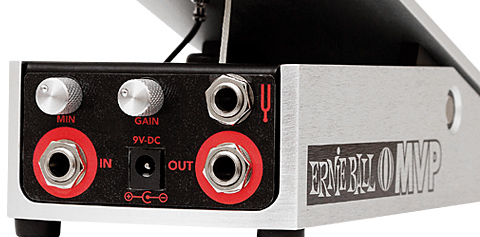

 Martin’s D-222 Anniversary Edition is a 12-fret dreadnought with a Sitka spruce top with the company’s Vintage Tone System, mahogany back and sides, grained ivoroid binding, slotted headstock, and an ebony fingerboard and bridge. Offered to commemorate the 100th anniversary of the dreadnought (1916-2016), it will be limited to 100 units.