Two words describe these two records from Chicago guitarist Guy King: mature and eclectic. That holds especially true for the double record, I Am Who I Am And It Is What It Is. King has an affinity for old Ray Charles songs, and does an amazing job on “Hard Times” and “Crying Time.” The trio, with Ben Paterson on organ and Mike Schlick on drums swings hard on “Sweet Lorraine” and “Roll With My Baby.” Two Stevie Wonder songs get stunning takes; his soloing on “Isn’t She Lovely” is lively and imaginative. All in all, it’s an amazing double set with dazzling guitar work.
By Myself features King solo. He sings and plays chestnuts from the likes of Robert Johnson, Muddy Waters, and Lightnin’ Hopkins. The album wraps it up with a jazzy version of “Nature Boy” and a Latin-drenched “Acapulco.”
While his past work was wonderful, King has stepped his game up here. He proves adept at jazz, blues, and anything in-between. Between the two releases, there are 45 reasons to appreciate what a great player he is.
This article originally appeared in VG‘s July ’14 issue. All copyrights are by the author and Vintage Guitar magazine. Unauthorized replication or use is strictly prohibited.
(LEFT) Gabriela Quintero and (RIGHT) Ridrigo Sanchez. Photo: Jim Mimna.
This is Rodrigo Sanchez and Gabriela Quintero’s first album of new material in five years. It comes two years after the duo’s big collaborative effort, Area 52, and marks a return to the intimacy that brought them to national attention with their accessible fusion of flamenco and acoustic metal.
Recorded at their own studio, 9 Dead Alive weaves aggressive strumming and percussive slapping amidst melodic gems like “The Soundmaker,” “Fram,” and “Misty Moses.” Ignoring traditional flamenco repertoire and techniques, the duo has been known to use guitar picks, wah pedals, and is as influenced by Paco De Lucia and the Guitar Trio as they are by Metallica.
“Sunday Neurosis” is a somber piece that benefits from dialogue snippets discussing the existence of God along with light B3 underpinning. “Somnium” is thrillingly reminiscent of Al Di Meola’s “Mediterranean Sundance” and the duo’s interplay is absolutely sublime. The nylon slide guitar on “Torito” pops, and “Megalopolis” is beautiful rich perfection.
This is an exquisite record from two fine guitarists thinking outside of the box and making great art.
This article originally appeared in VG’s July 2014 issue. All copyrights are by the author and Vintage Guitar magazine. Unauthorized replication or use is strictly prohibited.
The 1972 Lenny Kaye-compiled Elektra double-LP Nuggets: Original Artyfacts From The First Psychedelic Era, 1965-1968 spawned the Pebbles series, Rhino’s various regional Nuggets volumes, and eventually 2001’s Nuggets, Vol. 2: Original Artyfacts From the British Empire & Beyond.
While Vol. 2 featured such established Brits as the Pretty Things, the Creation, Small Faces, and Love Sculpture, Love, Poetry And Revolution shines a long-overdue light on such obscure acts as Crocheted Doughnut Ring, Blossom Toes, and the Cortinas (named for the British Ford compact car). A few familiar names pop up among the three CDs, like the Spencer Davis Group (post-Steve Winwood), the Crazy World of Arthur Brown, Noel Redding’s post-Hendrix Fat Mattress, and pre-Be Bop Deluxe Bill Nelson, while the only overlap is the Misunderstood – ironic, since they hailed from Riverside, California, before moving to England in ’66. They’re represented here with “Find The Hidden Door,” featuring lap steel guitarist Glenn Ross Campbell, later of Juicy Lucy.
Accompanying the 65 tracks, which clock in at nearly four hours, is an impressively illustrated 36-page booklet, with a paragraph on each cut/band, although in most cases personnel are unfortunately not listed. So, for example, we don’t know the identity of the Drag Set’s lead guitarist on “Day And Night,” who’s sort of a cross between Jeff Beck and the Music Machine’s Sean Bonniwell (redundancy noted).
The Mirage’s “Ebaneezer Beaver” borrows more than a little from “I Am The Walrus,” and Jason Crest sounds like a cross between Procol Harum and Small Faces. Future Wings guitarist Jimmy McCulloch’s One In A Million are dead ringers for the Who, while Deep Feeling sported a pre-Traffic Jim Capaldi and excellent lead guitar courtesy Luther Grosvenor, later of Spooky Tooth and, as Ariel Bender, Mott The Hoople. And not satisfied with one song each on Axis: Bold As Love and Electric Ladyland, Experience bassist Noel Redding returned to his main instrument, guitar, with Fat Mattress.
There are plenty of fascinating finds here, but even the clunkers have a sort of “Listen To The Flower People” charm. The Deviants, with guitarist Paul Rudolph, offer an acoustic, spacey “Child Of The Sky,” while “Jagged Time Lapse” by John’s Children was allegedly inspired by a migraine endured by guitarist Geoff McClelland. If a Rutles track was slipped in, you’d hardly notice.
Forty-plus years hence, it’s refreshing to discovery a parallel pop universe that never reached American airwaves.
This article originally appeared in VG‘s July ’14 issue. All copyrights are by the author and Vintage Guitar magazine. Unauthorized replication or use is strictly prohibited.
The latest from Ray Bonneville features 10 songs that seem to work together as one large body of music. The tunes here revel in a minimalist yet swampy vibe. Bonneville’s guitar and harp playing perfectly match the moods of his lyrics. He travels from melancholy to bitterness, and back. The opener, “Who Do Call The Shots,” matches punchy guitar and mysterious vocals with a great lyric. Bonneville’s guitar style is not based on chops, but on sound and feel. His chords and double stops are effortless and perfect on “Shake Off My Blues.” His haunting guitar work and lonely harp make the walking blues of “Love Is Wicked” a highlight of the record. And when he wants to get a little funky, he ups the playing on both instruments; witness the blues march “When I Get To New York.” Bonneville wrote or co-wrote all of the songs here, except for a cover of the Hank William’s chestnut “I’m So Lonesome I Could Cry” that sounds just like you’d expect. Easy Gone is another treasure from an artist deserving of more exposure.
This article originally appeared in VG‘s August ’14 issue. All copyrights are by the author and Vintage Guitar magazine. Unauthorized replication or use is strictly prohibited.
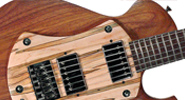
While some players look for nontraditional body types in a solidbody, such designs can often breach the realm of the weird or ungainly. Maryland luthier Peter Malinoski understands this, and uses that knowledge to create bold, visually engaging, and good-sounding guitars sans the outlandish shapes. His New Moon model is a case in point – an aesthetically pleasing single-cutaway with an array of tone woods.
The New Moon’s body is an interesting sandwich of woods. The top and rear center stripe are walnut, while the back is ambrosia maple. The holes for the three-bolt neck are also filled with walnut (technically, the neck is both bolted and glued, effectively making it a set neck). The maple is highly figured with thick brown streaks of grain caused by the Ambrosia beetle, and the bugs also leave visible holes that create a decorative effect. There’s also a dramatic contour on the rear cutaway, adding to the ergonomic feel of the guitar, and a pickup plate of ambrosia and Douglas fir is affixed to the front with five screws. Not many folks use this type of plate, but it looks good, and definitely works.
Malinoski employs recessed cavities in various locations; Tone and Volume knobs are dropped into the face, the screws affixing the pickup plate to the body are recessed, and even the Sperzel open-gear tuners are sunk into the face of the headstock.
Speaking of the headstock and neck, the New Moon’s 24-fret neck is made of figured cherry with a separate headstock of ambrosia maple glued on with a scarf joint (sometimes called “luthier’s joint”) around the third fret. The fingerboard and truss rod cover are wenge, the former with maple fret dots – two each on the first and twelfth frets, as well as very large ones on the side of the fingerboard. The entire guitar is finished in a type of Danish oil, giving it a natural, luxurious feel.
The New Moon has a chrome Hipshot hardtail SS bridge and two Lollar Imperial low-wind humbuckers. There’s also a five-way pickup selector (bridge; neck/bridge parallel, phase reverse; neck/bridge parallel; neck/bridge series; and neck) and push/pull knobs. The Volume knob triggers a coil tap when pulled, and the tone knob brings in a piezo transducer. The input jack is on the butt end of the guitar body, just south of the strap buttons. Clearly, there’s a lot going on under the hood of the New Moon.
Plugged in, the guitar has real spirit. The neck has a big C shape, while the smallish body hangs comfortably around the neck. The New Moon’s neck, which does dive a bit, is pretty fast and features a 12″ radius and 24 large frets. No question, this is a California-influenced mélange of exotic woods that brings to mind Jerry Garcia and other heroes of the jam-band movement, but with its otherworldly design, the New Moon seems predestined for more varied sonic trips. Thanks to the nonstandard hardwoods, the New Moon has a brash, bright sound overall, at times not far removed from a Telecaster. The pickup selector can also be used on the piezo pickup to invoke different sounds and tones. For players who want at least 20 tones at their fingertips at all times the New Moon is a real tone puppy.
The Malinoski New Moon is a beautifully designed custom axe, especially with its sculpted cutaway, sensual body contours, and wicked pickup plate. A large part of the pleasure here is the craftsmanship of a master wood carver, but the guitar is not just a set piece. It’s a hip, versatile guitar, and sure to provide decades of enjoyment and fine tones.
This article originally appeared in VG June 2013 issue. All copyrights are by the author and Vintage Guitar magazine. Unauthorized replication or use is strictly prohibited.‘
You’re hearing it here first: The Hold Steady returns with its sixth studio album, and while the focus is usually on frontman Craig Finn and his idiosyncratic lyrics, this is one of the best-sounding guitar albums of the year. Thanks to the twin-guitar onslaught of musical leader Tad Kubler and recent arrival Steve Selvidge, the band’s sound is leather-jacket tough, tight, loud, and all-around glorious.
For his part, Finn blurts about the down and out amidst a sound echoing the Replacements and straight-ahead American rock. He wears literary references on his sleeve as he intertwines the work of dead novelists and poets, replete with Springsteen-style sagas of the working class. Gritty prose about despair, hard knocks, and battered losers are offset by the façade of a streetwise band with hearty middle-American rock grooves.
This bar band for lit majors aspires to a harder sound with the departure of keyboardist Franz Nicolay and the addition of Selvidge on guitar. Rounding out the lineup is Kubler, drummer Bobby Drake, and bassist Galen Polivks. The album is produced by Nick Raskulinecz (Foo Fighters, Rush),
While past releases echoed a nod to Hüsker Dü (a primary influence), Teeth Dreams goes its own way, with graphic-novel depictions of the warped and the wicked.
Finn’s flawed-but-sympathetic protagonists almost validate his quirky sense of meter and long-windedness. He spits out split-second images and vignettes, but no matter what you believe he’s singing about, only Finn really knows what he’s going on and on about.
Finn’s stories get lost in favor of well-placed sound bites. Diehard Hold Steady fans are sure to “get it” and make up their own craft-beer-soaked narratives.
Fortunately, it’s good old American guitar-driven rock and roll throughout, and even the most obtuse can’t help but appreciate Selvidge and Kubler’s seamlessly woven guitar arrangements.
“The Only Thing” benefits from crafty rhythmic interplay, familiar chord ornamentation, chugging guitars, pitch-perfect vocal harmonies, and lyrics that pop in all the right places. “Ambassador” is a ballad that showcases Raskulinecz’s excellent production skill; he brings a stylish sense of mood and atmosphere to the album.
“Big Cig” has a killer riff and makes great use of feedback, while “Runner’s High” has an “Already Gone” vibe à la the Eagles that morphs but still twangs. “Almost Everything” is a coffeehouse acoustic number full of passion and vulnerability that acts purposefully to give the album breadth, range, and dynamics.
Teeth Dreams is a well-paced record for pseudo-brainy dad rockers that balances low-frills rock ensemble work with portraits of down and outers without ever getting its hands dirty.
This article originally appeared in VG‘s August ’14 issue. All copyrights are by the author and Vintage Guitar magazine. Unauthorized replication or use is strictly prohibited.
If Ron Asheton had recorded just one album in his musical career – the Stooges’ 1969 debut – he still would be regarded as a legend. The Stooges’ proto-punk opus laid the blueprint for a thousand punk, alt-rock, and grunge bands that followed and featured the cult classic “I Wanna Be Your Dog.” Asheton passed away in 2009, but the folks at Reverend Guitars have honored him with their Ron Asheton model, available in both white and a rather badass deep orange.
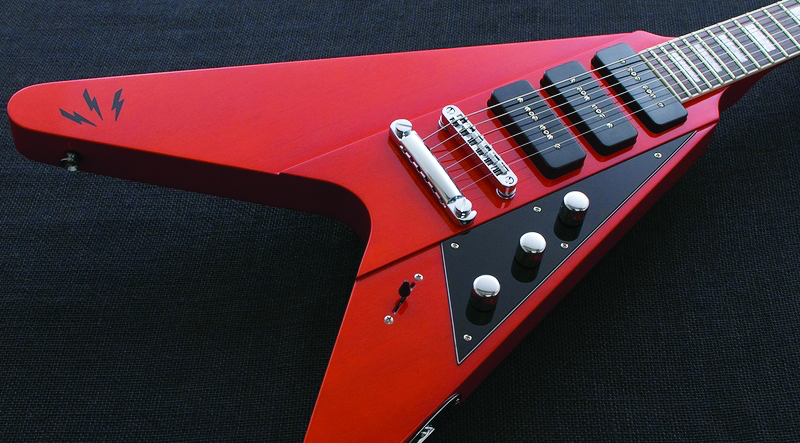
The Ron Asheton solidbody merges several ideas into one compelling instrument. Obviously, there’s the Flying V-styled body (made of white limba Korina, no less), but Asheton and Reverend builder Joe Naylor also added the big block inlays that recall a Les Paul Custom. The triple P-90 pickup configuration speaks to a number of vintage guitars, like the early-version Gibson Switchmasters and the non-reverse Gibson Firebird III. A raised body elevation down the guitar’s face also brings to mind the venerable Firebird.
In addition to the historical touches, Naylor and his team added some cool tweaks, like a rosewood fingerboard with 22 medium-jumbo frets, a dual-action truss rod, a black swept-wing pickguard, a five-way pickup selector, and chrome control knobs. Other design perks include three lightning bolts on the upper wing of the V and a laser graphic of Asheton’s signature, located on the back of the headstock.
Like the three-piece body, the Gibson-scaled neck (24.75″) is also Korina and features a 1.65625″ graphite nut. The Reverend-design triple CP90 pickups include a bridge unit that is hotter than a traditional P-90, while the middle and neck versions are slightly cleaner and reputedly less noisy than vintage P-90s. The neck has a pretty flat 12″ radius with a medium-oval profile, while the three-and-three headstock features Reverend pin-lock tuners. Hardware also includes a tune-o-matic-style bridge and stop tailpiece. For controls, there are Volume and Tone knobs along with a bass contour, basically a passive bass roll-off that adds more single-coil twang to the CP90s and puts some variable pickup voicing in easy reach – cool idea. Better still, the Volume knob is smooth and perfectly sited for volume swells on the go.
Plugged in, the Ron Asheton quickly impresses. It’s a nicely balanced guitar and the neck feels great. Its weight is right on the money and the body’s resonance is obvious before the cable is even inserted into the nicely recessed input jack. Tonally, the Asheton offers a big sonic dimension, even when played through smaller combo amps. Asheton may have been proto-punk in his day, but this guitar is killer for both flat-out rock and electric blues. The pickups offer a wide range of tones, including easy and meaty Clapton- and Peter Green-style sounds from the neck CP90. A swing through the clean to dirty ranges finds all sorts of warm, puckery tones. And don’t be fooled by the Flying V shape – you may even be surprised at the cool country twangin’ the Ron Asheton delivers. Want to crank up the gain and go to Metalville, but are afraid of the P-90 noise? Positions 2 and 4 on the selector switch are completely hum-canceling and deliver all the crunch with a little out-of-phase tone for good grace. More importantly, these pickups are super-clean, giving incredible note definition with the crunch on, in some cases better than that from a typical humbucker. Clearly, Asheton and Naylor knew what they were doing when they designed this solidbody.
Made in Korea, Reverend guitars are set up in the United States by in-house technician Zack Green (whose initials are on the back of every headstock). And the build itself is fairly superlative – the guitar is solid and its controls and switches seem tough enough for regular gigging. The neck is fast playing, allowing relatively easy bends on the high E, and the tone is versatile and pleasing. Onstage, the V shape, three CP90s, and hot finish will more than grab fans’ attention. Ron Asheton’s spirit clearly lives on in this fine guitar sure to unleash any guitarist’s raw power.
This article originally appeared in VG November 2013 issue. All copyrights are by the author and Vintage Guitar magazine. Unauthorized replication or use is strictly prohibited.
Electra Guitars’ Phoenix S model is based on the company’s X110, with an offset double-cutaway ash body, maple neck, maple fretboard with 25.5″ scale, 22 jumbo frets, dot inlays, and a GraphTech Tusq nut. It uses three Electra MagnaFlux SC single-coil pickups controlled with the company’s Analog Tone Blend control and a five-way switch dialed in with single controls for Volume and Tone. It has Hipshot inline tuners, a vintage-style vibrato bridge, and is finished in Trans Black or Sunburst. Visit www.electraguitar.com.
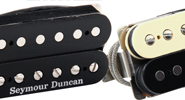
In lean times, who can afford to introduce anything but a winner? Wisely, Seymour Duncan has learned how to stack the deck in their favor, using its Custom Shop to test-market designs before moving to factory production. The result is boutique sound at pocket-friendly factory prices. Their latest roll-outs are the Whole Lotta Humbucker and the 59/Custom Hybrid humbucker.
Originally a U.K. Custom Shop exclusive, the Whole Lotta Humbucker (8.78k) is based on a pickup Duncan re-wound years ago for a certain famous player from England with the initials J and P. Apparently, Duncan re-wound the ailing pickup using enamel-insulated wire and replaced its weak magnet with a stronger rough-cast Alnico V version. The 59/Custom Hybrid (11.5k), meanwhile, is a mélange of vintage and modern, pairing one coil that has vintage attributes with one that has higher output and is much thicker-sounding.
Thanks to easy instructions and included hardware, installation was a snap with both of these bridge-position humbuckers. The Lotta immediately pleased with its vintage-styled tone, pleasant compression, and focused sound. It offers slightly more midrange and low-end than vintage units, yet was clear and defined, with a bit more forcefulness and an almost in-your-face feel.
The 59/Custom is a different beast. Tone-wise, it has much more low-end response than most ’buckers, yet still had crisp highs thanks to mismatched coils that temper what could be a very dark/undefined overwound tone. Given its high output, backing off on the guitar’s Volume produces a clean signal. The 59/Hybrid produced the thick tones and high output associated with an overwound pickup, but with the greater fidelity of a lower-output design.
The Whole Lotta Humbucker is a great choice for those who want to live on the border between vintage PAF-style tones and high output. The pickup’s slight compression and pushed midrange tone make it an excellent classic rock pickup that will pair well with any amp. The 59/Custom Hybrid, though partially vintage in its implementation, is a modern bruiser that offers clarity. Its low-end punch is formidable and will push just about any amp’s front end into very pleasant overdriven bliss.
This article originally appeared in VG November 2013 issue. All copyrights are by the author and Vintage Guitar magazine. Unauthorized replication or use is strictly prohibited.
Rodrigo Sanchez is one half of the fiery acoustic duo known as Rodrigo Y Gabriela. They have evolved from a stripped-down dual-acoustic-guitar sound to catapult their music in new directions. On their latest release, Area 52, Sanchez and partner Gabriela Quintero enlisted the help of producer Peter Asher and a 13-piece Cuban orchestra. The result is a sprawling, epic blend of Latin rhythms and melodies, with a soulful rock underpinning. Recorded in Havana, the disc re-imagines compositions from their back-catalog and takes them to new and exciting places. To find out all about it, VG recently caught up Sanchez while he was on a brief respite from touring.
How did you come upon the idea of recording in Havana?
It seemed to be the right time, based on the fact that we wanted to come up with something different and see how much we could experiment and go away from our comfort zone.
It was also very much an excuse to go there and learn from them, as well as come up with a project that allows us to get some time to do whatever we were going to do next.
Why re-work older material instead of writing new compositions?
When we decided to do this, we were still touring on the 11:11 album. We didn’t really have time to stop touring and write new material. It was kind of appropriate for us to experiment with something that wasn’t going to do any harm. We didn’t really care too much about the fact they were old songs, because it was the nature of the idea.
Did you pick up any techniques that influenced your guitar playing?
Not techniques, but ideas. I was looking to find different sounds and now that we already did the first tour with the band in Europe, it’s a lot of fun. It’s different for me to play electric guitar onstage now, after many years. I’m playing electric-guitar solos and getting used to playing the lap steel onstage, as well. Those are the kinds of ideas I thought about doing on this album, just to experiment. I think they’re giving us a whole different perception of what we can do as a duo for making our next album.
You and Gabriela have Yamaha signature guitars. Are you happy with the final result?
Absolutely. They worked so hard getting those prototypes going. They were following us around to different countries. They took the prototypes we were working on and saw how we were feeling them. The piezo system is very complex – quite an amazing system. Even our guitar techs on the road can’t do anything if the system is broken. We have 14 guitars on the road and sometimes they break because of the nature of the way we play. It’s a very delicate instrument, but we have enough guitars that they provided to cover us. We’re very happy.
There probably aren’t many guitarists using a wah pedal with a nylon-string guitar. What kind of wah do you use?
I use the Dunlop Crybaby and sometimes I use the Vox. I have three stations on different parts of the stage. The one I use very rarely is the Vox, which is on the right side of the stage, but it has a different tone. The one I really like is the Crybaby.
Any problems playing a nylon-string through a wah and other effects?
When we started adding effects onstage, there were. When I started adding distortion, I wanted it to be going to a Marshall. My guitar tech and the sound engineer worked things out. My system is special because it divides in stereo. It’s quite complex. I have a few things running onstage, and backstage I have my Marshall. When I see the routing, I don’t even understand it (laughs)!
We had to go to that level because we were playing festivals. The normal pickups wouldn’t work on a nylon-string because of feedback. To get to that level with all the volume, our stage show had to be modified.
What else do you use?
D’Addario strings and Dunlop Jazz 3 picks. I’m also going to be using a Jackson Soloist for the electric parts of the tour. It sounds awesome! It’s funny, when you finally make enough money to pay for your own gear, they give it to you for free (laughs)!
You and Gabriela came from metal and moved into your own thing. What do you say to people who are seeking their own style?
I suppose you have to detach from the idea of thinking that you have to follow certain patterns to make it happen. Gabriela and I never thought about doing a project with two guitars playing a little bit of Latin music and a little bit of metal. We were traveling Europe and playing on the streets, and that’s what came out.
The only thing that we did commit to was to not to do anything else but play music. We didn’t go to Europe to work as a waiter. That’s the only thing we did commit completely to. “No matter what, the only thing we’re going to do is play our guitars. If we have to play guitar for nine hours on the street to make a living, that’s what we’re going to do.”
A project has to be natural. If you plan it too much, I think you’re fooling yourself. That’s my own experience. You have to follow your influences and feel it. I think there are many ways to succeed. I also feel you have to find something within yourself.
This article originally appeared in VG July 2012 issue. All copyrights are by the author and Vintage Guitar magazine. Unauthorized replication or use is strictly prohibited.


 Two words describe these two records from Chicago guitarist Guy King: mature and eclectic. That holds especially true for the double record, I Am Who I Am And It Is What It Is. King has an affinity for old Ray Charles songs, and does an amazing job on “Hard Times” and “Crying Time.” The trio, with Ben Paterson on organ and Mike Schlick on drums swings hard on “Sweet Lorraine” and “Roll With My Baby.” Two Stevie Wonder songs get stunning takes; his soloing on “Isn’t She Lovely” is lively and imaginative. All in all, it’s an amazing double set with dazzling guitar work.

 Recorded at their own studio, 9 Dead Alive weaves aggressive strumming and percussive slapping amidst melodic gems like “The Soundmaker,” “Fram,” and “Misty Moses.” Ignoring traditional flamenco repertoire and techniques, the duo has been known to use guitar picks, wah pedals, and is as influenced by Paco De Lucia and the Guitar Trio as they are by Metallica.





 Electra Guitars’ Phoenix S model is based on the company’s X110, with an offset double-cutaway ash body, maple neck, maple fretboard with 25.5″ scale, 22 jumbo frets, dot inlays, and a GraphTech Tusq nut. It uses three Electra MagnaFlux SC single-coil pickups controlled with the company’s Analog Tone Blend control and a five-way switch dialed in with single controls for Volume and Tone. It has Hipshot inline tuners, a vintage-style vibrato bridge, and is finished in Trans Black or Sunburst. Visit