Month: June 2007

  • Pete McCann – Most Folks

    Most Folks

    Pete McCann is not one of those jazz guitarists who can be placed in a column and left there. For instance, the title cut of his new disc, Most Folks, is a fine bopper that lets McCann show his chops, at full speed. There really is no doubting his chops after one listen to that opener. And the mix from there is as varied as it gets. The influence of folks like John Scofield and Bill Frisell shows up on cuts like “Rack ‘Em Up” with its very un-jazzy distortion, and the funky “Yes, My Friend” with its wild, chorused solo and very-rock-and-roll guitar work. “Third Wheel” is a nice acoustic piece that lets McCann show off his harmonic wares.
    The band is a quintet, and the interplay is wonderful throughout the record. McCann and saxophonist John O’Gallagher seem especially simpatico. Most of the songs interplay the two, whether restating the head before each embarks on solos, or when the solos intertwine. The rhythm section of Mark Ferber (drums) and John Hebert (bass) nicely drive it all, and pianist Mike Holober is present at every turn.
    Whether you’re a fan of fusion, or simply like soft acoustic jazz, this fits the bill.

    This article originally appeared in VG‘s Oct. ’06 issue. All copyrights are by the author and Vintage Guitar magazine. Unauthorized replication or use is strictly prohibited.

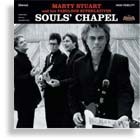
  • Marty Stuart and His Fabulous Superlatives – Souls’ Chapel

    Souls' Chapel

    Marty Stuart evolved from a precocious musical whiz kid into a complicated renaissance man. He’s known for his music, colorful personal style, documentary photography, and comprehensive collections of cowboy boots, guitars, and country-western memorabilia. Lately, he has turned his keen curatorial eye toward what he refers to as “Southern Culture.” Souls’ Chapel represents the first musical fruits of this passion.
    An ironic series of events led to the its creation. First, Stuart’s ex-father-in-law, Johnny Cash, died, precipitating an alcoholic binge after two years of sobriety. “I got arrested for drinking and driving. I was so embarrassed, I felt worthless. I got out of jail and got on the bus the next morning for a show in Chicago.” At that show, gospel greats Mavis and Yvonne Staples, along with their father, Pop Staples’ presented a guitar to Marty. “It was like being knighted with an instrument of light. It gave me the inspiration to make this record.”
    The guitar sound here serves as a musical homage to Pop Staples. Using Pop’s trademark blackface Fender Twin-Reverb tremolo and plate reverb tone, Stuart distills the essence of what he calls “Delta Gospel” – a combination of swamp guitar, Fender bass, Hammond organ, minimally configured trap drums, and complex three and four-part harmonies create an organic musical entity that harkens back to one of the South’s earliest popular musical forms. The songs are a mixture of standards, including Pop’s “Somebody Saved Me,” A.J. Sims’ “The Unseen Hand,” and Stuart originals created specifically for Souls’ Chapel. Two songs, “Come Into The House of the Lord” and “It’s Time to Go,” stand out as especially powerful.
    Other musicians include Kenny Vaughan on electric guitar, Chad Cromwell on drums, Barry Beckett on Hammond B-3, Glen Worf and Michael Rhodes on bass, Harry Stinson, Brian Glenn, and Mavis Staples on vocals. In addition to playing electric guitar and singing most of the lead vocals, Stuart produced the recording. Engineered and mixed by Chuck Turner, Souls’ Chapel was mastered by Jim DeMain at Yes Master. I was bowled over by the recording’s expansive soundstage and sumptuous harmonic balance. Its overall sound reminds me of the best analog recordings from RCA’s old Studio B in Nashville, where Chet Atkins’ records were made.
    This first CD on Stuart’s Superlatone Records imprint sets a high standard. Personally, I can’t wait for his next secular record, but in the meantime Souls’ Chapel will get heavy play.

    This article originally appeared in VG‘s Oct. ’05 issue. All copyrights are by the author and Vintage Guitar magazine. Unauthorized replication or use is strictly prohibited.

  • Andreas öberg – Solo

    Solo

    Swedish guitarslinger Andreas öberg is a firebrand, playing mainstream jazz and Gypsy jazz with a fury. His style is ultra-modern – fast and driving, with a rock and roll-inspired intensity.
    Fronting the Hot Club of Sweden, öberg has released several albums, sometimes joining forces with today’s generation of Gypsy phenoms such as Ritary Gaguenetti, Yorgui Loeffler, and Jimmy Rosenberg. Now he’s back playing Solo.
    This new CD spotlights öberg’s lead and rhythm playing, multi-tracking his acoustic and electric guitar work. His repertoire is both old and new, from Gershwin to “Manha de Carnaval,” “All God’s Chilluns Got Rhythm” to a handful of original compositions.

    This article originally appeared in VG‘s Nov. ’06 issue. All copyrights are by the author and Vintage Guitar magazine. Unauthorized replication or use is strictly prohibited.

  • Peterson VS-S

    Fast, Accurate Sour-Note Killer

    Peterson Electro-Musical Products may not have invented the strobo-tuner, but since the early 1950s, it has been a major player in the electronics field as it relates to instrument tuning devices. In the late ’60s, its Model 400 strobo-tuner was one of the most popular tuners on the scene, and appeared on stage with the Grateful Dead, the Who, Frank Zappa, Pink Floyd, and other top-notch professional acts.

    Since the mid 1980s, Peterson has been the only company in the world building strobe tuners. In 2001, it took the technology into the digital age with its VS-1 Virtual Strobe Tuner, and in ’04 brought the concept of hyper-accurate tuning into the realm of the pedalboard.

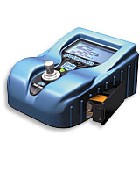
    The Peterson VS-S StroboStomp is a compact (5″ x 4″ x 23?8″) unit that will fit in any pedalboard, yet surrender nothing to its big brother VS-1 or to any strobe tuner of yore.

    Housed in die-cast aluminum, the VS-S oozes durability (Peterson’s website has a StroboStomp vs. a baseball bat section dedicated to this) with its chassis-mounted 1?4″ input/output jacks and balanced XLR output. Controls are straightforward and include a true-bypass stompswitch and two microswitches for changing modes and calibrating. There are also small dip switches in the battery compartment for selecting tuner mode (true-bypass or tuner monitoring) and lifting the ground on the XLR output. And its 21?4″ x 11?8″ backlit display is easy to read in any lighting condition.

    The VS-S operates in two modes – true-bypass and tuner monitoring; in true-bypass, the signal from the 1?4″ output is muted and routed to the tuner. When the tuner isn’t muted, the pedal essentially drops out of the signal chain.

    In tuner monitoring mode, the stompswitch still mutes the output, for silent tuning. But the tuner and DI out are always active, for continuous monitoring of the signal. The VS-S ships in this mode, but I switched to true-bypass and tested it by plugging directly into an amp, then adding the tuner to a signal chain. There was no noticeable tone or signal loss.

    The menu switch lets the user adjust the tuned-to pitch from A433Hz to A447Hz in 0.5-Hz increments, which can be saved as a default setting (so you won’t reset it every time you power up). Pushing the menu switch twice brings up the drop-tuning menu, which offers 10 drop and capo settings, ranging from a straight SRV/Hendrix Eb to a drop-C, all of which can be saved.

    Three pushes of the menu switch brings up the temperament presets. Again, there are 10 to choose from, plus two user-programmable presets. The first (EQU), is a straight chromatic temperament, followed by a Peterson “sweetened” guitar temperament suitable for EADGBE tuning. This one found the note faster and held steadier than the EQU setting, especially when intonating a guitar. There’s also a sweetened setting for bass guitar, designed to tune when accompanying an acoustic piano.

    The next two presets were also Peterson temperaments for 12-string guitar – one for the standard strings and one for the octave strings. All of the Peterson temperaments work well for fast, accurate tuning.

    The last five presets work on guitars equipped with the patented Buzz Feiten Tuning System, and include temperaments for electric, bass, acoustic, and two for 12-string. The Feiten system is similar to stretch tuning on a piano, where the intonation isn’t necessarily mathematically correct, but more musically correct and more pleasing to the ear.

    The Peterson VS-S StroboStomp eliminates pedalboard domination by an old-school strobe tuner, or having to turn around to see one in your rack. Gone also are the days of having to settle for the inaccuracy of an LED pedal tuner, especially if your guitar has the Feiten system or you use a custom tuning temperament.

    The active DI output and the true-bypass are mere icing on the cake, because the Strobostomp’s greatest asset is its fast, accurate tuning that can be accomplished on just about any fretted instrument.


    Peterson VS-S Strobostomp
    Features Die-cast aluminum chassis, 9-volt AC/DC with power-through jack, backlit strobe display, balanced direct output, programmable.
    Price $309.
    Contact Peterson Electro-Musical Products, Inc., 11601 S. Mayfield Ave., Alsip, IL 60803; phone (708) 388-3311; www.petersontuners.com.


    This article originally appeared in VG‘s March ’05 issue. All copyrights are by the author and Vintage Guitar magazine. Unauthorized replication or use is strictly prohibited.

  • Larry Carlton

    Larry Carlton

    The buzz about Fire Wire, the new record by guitar legend Larry Carlton, was that he was going to rock more than he had in years.

    Yes, the guy who played incendiary guitar on Steely Dan cuts like “Kid Charlemagne” and “Don’t Take Me Alive,” not to mention a million studio dates, was going to do something he’d never done – give up the duties of producer.

    “Talking with the folks at BMG, we thought it might be exciting to bring in an element with a vision I might not have,” Carlton told VG. “So I interviewed a number of candidates and kept coming back to Csaba [Petocz].”

    Petocz mixed and recorded Carlton’s previous album, Sapphire Blue. But that didn’t make it easier to give up the role of producer.

    “It took us many months to articulate his vision,” says Carlton. “He could hear it in his head, but for me to grasp it, we had to have quite a few conversations.” How far did the search go? “I would play, and Csaba would set the amp. It was actually very cool!”

    As a result, the songs on Fire Wire are quite different. “I found it difficult, at first, to compose for the CD, because the songs are not harmonically sophisticated or funky. So I started writing different lines, to get the energy Csaba described to me.”

    Some of the sounds may shock longtime fans, with hints of everything, including heavy metal and grunge. On the first few tracks, Carlton used his trusty 335 and his famous Dumble Super Overdrive amp. But after recording them, he spent two months away from making the album.

    “I went back to my little studio, but my 335 wasn’t at the house, so I pulled out a ’57 Gibson Les Paul Special and composed the second half of the album on it. When I sent a demo to Csaba, he immediately asked, “What guitar are you using? I love the tone.” So we used the Les Paul Special the rest of the way.

    “I used the Dumble on everything, but Csaba also integrated a Vox AC-30, and put mics on both. He was very creative getting guitar sounds.”

    He also was a guest on a Christmas album released last year by Anita Baker. “She hand-picked the guys she wanted to play on the record, and I was available – and flattered – that she called. I went in and did my four or five songs with the band one Sunday afternoon.

    Carlton and his wife, singer Michelle Pillar Carlton, live in Nashville. “We’re one hour from my daughter and her two kids, so I spend time with them when I’m in town. We have a little farm with horses, dogs and cats, so, we’re living the quiet, country life.”

    The road keeps him busy about 100 nights a year, and also keeps him from a job he dominated for many years – studio work. “I really enjoy just going out and playing with my band.”

    Guitar fans of all shapes and sizes will be happy to note part of the road work he is planning involves Robben Ford. He and Ford recently played a gig in New York City, and Carlton says there’s more to come! “I’ve been wanting to do something with Robben for many, many years. I contacted him about doing the show in New York and he was up for it. And, yes, I have plans for Robben and I to do more together in 2006 and into ’07, but I’m not going to tell you anything about that now.”

    Carlton also has a signature Gibson 335, the guitar which he was so prominent in bringing to the forefront back in the ’70s. “It’s going very, very well. Gibson geared up all of last year to do a mass production. We’re also gearing up now to do an acoustic Larry Carlton model, so I’m pretty excited about that.”

    It might be hard for guy who’s played some of the finest solos in the history of pop and rock music to put it all in perspective, but Carlton has a good grasp of things.

    “As I reflect on my very, very blessed career, what comes to mind is that I’ve played the guitar the way I like to play it and that world has agreed,” he said. “So, that’s a blessing right there. It’s not something you can plan on. I think most musicians are driven by making music they like and then if someone likes it, there you go! Really, I’m a blessed man.”


    Photo courtesy RCA/BMG.

    This article originally appeared in VG‘s June ’06 issue. All copyrights are by the author and Vintage Guitar magazine. Unauthorized replication or use is strictly prohibited.

  • Roger Mayer

    Straight-shooting Effects Builder to the Stars

    In the early 1960s, a young Research Laboratory engineer named Roger Mayer filled his “spare time” hanging out with a jaw-dropping collection of up-and-comers on the fledgling London blues-rock scene, and building effects pedals for these future stars before most guitar players knew enough to ask, “What’s an effect pedal?” Though this would lead to one of the most famous artist-technician relationships of all time – as studio and tour tech for Jimi Hendrix – Mayer resolutely refuses to rest on those laurels, however legendary they may be.

    Vintage Guitar: What first got you started on effects?
    Roger Mayer: When I was growing up in southwest London in the early 1960s, I got to meet some of the guys who played in the local bands, like Jeff Beck, Jimmy Page, and Eric Clapton. They were playing blues, and I play the guitar myself, so when I started hanging out with them we were always interested in what made the American records sound different.
    We were listening to people like Freddie King, James Brown, and all kinds of music not a lot of other people were listening to, because it wasn’t on the radio. And even when I was still in school, I’d started making treble boosters and playing around with different guitar tones.

    Were you studying electronics at the time?
    I did six years of university, studying mechanical engineering and electrical engineering. Then I worked at the Admiralty Research Laboratories in Teddington, near where a lot of this music scene was happening in southwest London.

    You were getting involved with the music scene even while you were still working there?
    Oh, yeah. That was the day job, the night-time job being that I had a lot of friends who were professional musicians making different sounds.

    Jimi Hendrix is clearly your most famous association. But who did you first build pedals for?
    I suppose really it was Jimmy Page. He and Big Jim Sullivan in the early years. In fact, one of the fuzzboxes I designed and made in 1964 was on a number one hit record – the first recorded in England. Big Jim Sullivan played it on “Hold Me” by P.J. Proby.

    I built a treble booster for Jeff Beck, and I was told that he borrowed Page’s fuzz box for some of the Yardbirds’ stuff. I believe I made a few things for Ritchie Blackmore of Deep Purple. There was also Steve Marriott, and of course, Syd Barrett from Pink Floyd.

    Later, when I was really doing custom-made professional recording studio equipment, I made a lot of stuff for Ernie Isley of the Isley Brothers, and for the great reggae guys; I made distortions and Octavias and wah-wahs for Junior Marvin of The Wailers, and Bob Marley had one or two of my pedals. But I don’t think he used them on records. In more recent years, I made things for Stevie Ray Vaughan, Robin Trower, Joe Perry, Kenny Wayne Shepherd, and plenty of other guys.

    Then, of course, there’s Jimi Hendrix…
    Yeah. Working with these other guys in the mid 1960s and hanging out on the scene, I eventually met Jimi. We hit it off, and became good friends pretty quickly.

    Hendrix couldn’t just go to a shop and pick up different boxes for different sounds, because they just weren’t there. But better than that, you were in the studio with him. What was that process like?
    Basically, Jimi would have a particular song, and there would always be an emotion he wanted to portray in the song. Jimi and I would spend a lot of time around the flat or at the speakeasy discussing what sounds we might want to do. If you were going to use echo on it, that would be one sound. Or if you wanted the guitar to appear to disappear then come back… The sound you’re ultimately going to put on the record is going to depend on a couple of things: what the song’s about – you’re not going to put an inappropriate sound on it for that; and what key the song’s in. Because you can then voice the box differently. You might want to tune a wah differently for it…

    Tuning in resonant frequencies and such – would you go as far as that?
    Oh, yeah. We had one amp, two amps, we had multiple-path techniques of processing because we were only recording to four-track, so it had to be done pretty well immediately. I’d go back to the control room and have a listen, and then…

    …And then get out your soldering iron!
    Yeah, well (laughs)… We had the room at the back there, the maintenance room, where we could go and change that. But you’d take to the studio a few different things that you wouldn’t have onstage – different driving stages to put in front of the fuzz boxes, different equalizing stages, different voltages on the fuzz boxes. You’d segment the stages out. “Remember, we are only concerned with making a good sound on tape, and we’re going to use anything we can to get it.”

    Even with all of Jimi’s experience, did you have to do anything special to create the mood in the studio, to get the atmosphere just right?
    Up to even the Axis Bold As Love album, he was very shy in the studio. He didn’t think he could sing. All the lights would have to be out, he’d sing with his back to the control room, he was very shy. He needed a lot of encouragement.

    One of my jobs with Jimi – technically, obviously, I could handle that side of it – was that you want three minutes or so of magic. That’s the end. The whole day has to lead up to that, whatever your job is – engineer or making the sandwiches or whatever – your objective is to capture 200 seconds of magic.

    Jimi would cut a solo, and I might be sitting next to him on the floor of the studio, and he’d say, “Go and listen to that, Roger.” He wouldn’t even bother to come back in. I’d listen to it, and Jimi’d go on the intercom to the studio and go, “How was that?” Chas [Chandler] would go, “That’s great, Jimi, that’s a take.”

    And then Jimi’d say to me, “What do you think?” I’d say, “Take one more, Jimi.” Then he’d do the actual solo, and people’s jaws would just drop. See, I knew him, and I knew what he could do. He was just messing around, and that solo wasn’t the one.

    I guess Chas Chandler, Jimi’s producer, had some other considerations, too.
    Yeah, well, Chas was always watching the wallet. Jimi would happily spend all day in the studio, but Chas was always in a hurry. Though Chas, as a producer in the studio, was very, very good.

    The production work in the studio was between Chas and Jimi. I handled guitar sounds, and Eddie Kramer really was the engineer. He had no idea what the song was going to be until Jimi was finished with it. No one did, really. Then they totally couldn’t believe it, because we were breaking new ground.

    Clearly, requirements in the studio were entirely different from the requirements for live work.
    The important thing in the beginning was actually producing the sound to be on the record. Because once you’ve got it on the record, people can play it at any level and it’s going to sound right. So I started off making stuff that was used on records. It obviously worked live, as well, but that’s really what I’m probably most known for – making pedals and devices that were used on records.

    Let’s look a little more at your broader career as a pedal maker. What was your first commercial product? Was it the Octavia?
    Well, I never originally offered that commercially as such. I made them for a few select people. They were like prototypes.

    So you didn’t offer a line of pedals until you brought them back, almost as reissues of your custom devices for these players?
    Well, I was working with Jimi, and when I made the Octavia for him, we made half a dozen or so. But when I went to live in America in 1969, I went straight into manufacturing recording studio electronics.

    I was making studio consoles and equalizers, and was involved in the startup of the Record Plant and Electric Ladyland and all that sort of stuff, so I wasn’t into making little guitar boxes. The only time we’d make a few guitar boxes for people would be for famous players, not anything available commercially in a music store.

    There was a period in America, after Jimi’s death and up to the early ’80s, where he wasn’t popular. It was disco music and this and that. Guitar music wasn’t at all popular. I was doing specialized work for bands like the Isley Brothers, in the studio, making pedals for Ernie. Then I went down to do the stuff with Bob Marley.

    It got to about 1980 or so and people started to ask for my effects a bit more, and that’s when I designed the rocket-shaped enclosure.

    Which is now such a distinct thing.
    It’s an icon, really. I designed it because I wanted to have a pedal that when anyone looked at it, they knew it was mine. You didn’t have to put any writing on the box. And the shape of the rocket has a lot of ergonomic considerations; it’s got the fins on the back that protect the knobs from anyone putting their foot on them, you can drop the box and never hit the knobs, and you can also hit the footswitch from any angle – back, front, sideways.

    What did you first put into that enclosure?
    The Octavia. But when we first made it, we did it with an optical switch; it didn’t have a snap-action switch in it. We put those out, and some people liked the snap action of the switch. So we changed it.

    And your stuff’s been more or less available since?
    Yeah, since the early ’80s. We had the Axis Fuzz, a Metal Fuzz, and the Mongoose pedal.

    It seems you’ve had something of a boom again, recently.
    When we came back to England (in ’89), I stopped making specialized rackmount equipment, and concentrated on worldwide distribution. Japan has always been our biggest customer. We’re probably number six for pedal makers in the whole of Japan.

    What do you think of today’s “boutique” pedal market?
    Boutique pedal market? I don’t consider myself in that market. Most designers aren’t doing anything new. They’re not putting any R&D into it, they’re not designing their own enclosures, and they’re not making anything new. And I’m getting tired of being ripped off.

    But because you were one of the first pedal makers, it’s probably hard to follow you without building an effect that’s at least vaguely similar to one of yours.
    Yeah, but what I’m saying is they’re really not taking it any further. And it’s bad to continuously go back to the past, and not evolve. That’s not investing in the future. In any publicity, I’ve never said that all we do is make a version of our old pedals. We’re constantly evolving, using new components. We never make a feature out of using an old component, because most old components were horrible. They are better today.

    Many people make a big deal about dredging out vintage germanium transistors or carbon-comp resistors…
    We use germanium transistors in a couple of designs, but you’ve got to buy thousands of them, then sit and test them all, and you’ll come up with a small percentage that are any good. As for carbon-comp versus metal film resistors, there’s nothing in the composition of a resistor that’s going to add or subtract any harmonics to the signal.

    So what are your own goals as a designer?
    You want a tone that’s organic. And it’s so easy to build a fuzz box or a distortion type of box – you’ve got many boxes that, to be frank, you put a guitar into them and you wouldn’t know what type of guitar it is. The whole tonal quality of that guitar just disappears. It’s got “brick wall” processing in it, and this is ever so true of some of the cheaper multi-effects processors. Horrendous!

    Do you feel you’re best-known for any one particular pedal?
    I suppose the most unique pedal is the Octavia, which is the frequency-doubling effect Jimi first used on “Purple Haze.” And that’s the one that’s probably been ripped off the most.

    Had anybody done anything like that before you?
    Nah. I was just thinking about different electronic techniques for doubling a frequency, and I came across a technique that, looking at it simplistically, it almost acts like a mirror. It doubles the number of images of the note. And that, apparently, makes it sound twice the pitch. And because the sound wave is going up and down twice as much, even though you’ve changed the relationship of it, the ear perceives it as twice the frequency, although it isn’t. It’s much like putting a picture up to a mirror and seeing two of them, but there’s still only one picture.
    Do you ever wish you’d put out the Octavia commercially yourself back in the late 1960s?
    No. I had my other work, and besides, the interesting thing is that the copies never quite did it right. But I’ve got no sour grapes about any of that. The one matter about infringing the copyright, though, is they should at least pay respect, you know? If you’re making a copy of something, don’t tell me the copy’s better than the original.

    What has excited you the most of your newer designs.
    We released an updated Octavia, the Concorde+ treble booster, and the Voodoo Vibe Jr. in the new Vision enclosure last year. The enclosure has both a hard-wired output, and two buffered outputs, so the player can choose whichever is best for his applications, or use both buffered outs together. As for the Vibe Jr., it has the same main circuit as the big Voodoo Vibe, with the same carefully selected light cells, so the sound is all there, but the control functions are simpler, so we can sell it for a lot less. It’s all an evolution of my modifications to Jimi’s own Uni-Vibes, with further improvements to make them quieter and more stable.

    You recently released a version of your very first fuzz box, the one you made for Jimmy Page.
    Yeah, it’s called the Page 1, and it’s also in the new Vision enclosure. The one I originally built for Page was loosely based on the Gibson Maestro (Fuzz-Tone), and the Page 1 uses the same main circuit with a pair of selected AC128 germanium transistors. But it has been vastly improved for noise, I have added a very useful Tone control, it has a circuit in it to operate off a positive power supply rather than the negative supply they used to require, and because it’s in the Vision enclosure it has the three outputs and all those other benefits.

    What does it sound like?
    It’s a cool pedal, but it’s definitely a 1960s fuzz sound. The unit has a gating effect within the amplifier – it doesn’t have a lot of sustain like modern rock or metal fuzzes; it’s a very percussive effect, and it reacts very well to the way you’re playing.

    Out of all these, though, the thing I am probably most excited about at the moment is the new guitar-strap remote effects controller I’m developing. This has never been done before, and it has a lot of potential.

    What does the remote controller do? How does it work?
    It consists of a transmitter unit mounted on the guitar strap, with a receiver unit on the floor next to the effects set-up. The Vision has two loops for switching pedals. Buttons on the controller allow the guitarist to trigger one or both loops remotely to instantly change sounds without having to run back to the pedalboard, and without breaking eye contact with the audience. The transmitter uses code-hopping technology that changes each time you hit the button, so no one can scan it and break into the code, and the receiver can learn up to seven controllers, so you can have multiple transmitters for different guitars.

    The first unit will be the Roger Mayer Skull Controller, with the transmitter housed in a small metal skull, which is a very iconic shape. It’s great for the rock and metal players. Then we will also release the transmitter in different enclosures, to suit the different tastes and budgets. We should begin rolling that one out early in the new year.

    Do you think Jimi would have gone for one of these controllers?
    Yeah. He’d have loved to use something to make performance easier and bring control to him and help him not look stupid – rather than cool – whilst changing tone, as he was the consummate guitar showman.

    Do you ever think back and maybe miss the heyday of working with Hendrix?
    The thing I miss probably most about Jimi is that he was up for anything. If you came up with a new idea and it appealed to him and he could imagine it, he’d say, “Let’s do it!” The enthusiasm he exhibited for doing something new and exciting and innovative was great.


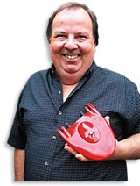
    Roger Mayer with his latest pedal, the Spitfire. Photo: Dave Hunter.

    This article originally appeared in VG‘s Aug. ’05 issue. All copyrights are by the author and Vintage Guitar magazine. Unauthorized replication or use is strictly prohibited.

  • Reverend Rick Vito

    Tone, Style,

    Reverend Musical Instruments head honcho Joe Naylor began playing guitar in 1982, graduated from the Roberto-Venn School of Luthiery, started and ran an amp-building company, and in 1996 fired up the highly touted Reverend company in his home state of Michigan. Readers of VG are familiar with the man and his products.

    Naylor’s latest creation is a collaboration with Rick Vito, the renowned guitarist who has worked with Fleetwood Mack, Bonnie Raitt, Jackson Browne, Todd Rundgren, Bob Seger, and others. The new Reverend Rick Vito Special and Signature model guitars are variations on Reverend’s Advanced series Slingshot guitar, but with a few funky twists. Both employ the Slingshot’s semi-hollow design with polymer rims and 6″ mahogany center block with steel sustaining rod. Both guitars have an anodized aluminum top and back, veneered to phenolic laminate.

    The guitars each have a satin-finished bolt-on maple neck with a 251/2″ scale and dual-action truss rod. Their fingerboards are rosewood with 12″ radius, 22 medium-jumbo oval frets, and a graphite nut.

    The Vito uses two slightly overwound Reverend P-90 single-coil pickups, which become humbucking when both are engaged. The bridge pickup is wound slightly hotter, creating a near-perfect balance in volume and tone.

    Controls include a master volume, master tone, a separate bass control, and three-way pickup selector. The bass control allows for rolling off low-end response.

    The Vito’s simple design and clean lines share all the elegance we’ve grown accustomed to with Reverend, while the custom sandblasted graphics (designed by Vito himself) add a high degree of funk. Both are visually appealing, and being semi-hollow, they weigh in at a svelte 6.75 pounds.

    The headstock on the Special has a satin finish, while the Signature features a black finish that matches its body. Both guitars utilize Sperzel locking tuners and feature a string-through-body hardtail bridge available with an optional Bigsby vibrato with a roller bridge.

    The guitar’s look is complemented by its nearly flawless workmanship; fretwork is impeccable, and the neck is extremely comfortable, with a smooth, low, and fast action. The necks on our two testers felt identical, which would lead us to believe Reverend is consistent from guitar to guitar.

    To test the tones of the Slingshots, we plugged them into an all-tube Peavey JSX with a Peavey 4×12″ cabinet. Starting with the JSX’s clean channel, we were met with a fat, warm tone with tons of low-end, with noticeably nice sparkle and a very responsive overall sound and feel. Rolling the bass to about half gave us a sweet, almost Telecaster-like tone.

    The guitar’s Volume control is very responsive; even when rolled back, the tone doesn’t lose sparkle. And due to their calibrated winding, the pickups sound balanced regardless of the position of the selector switch. Run together, they proffer a fantastic blues tone and lend themselves nicely to overdrive, with more-than-ample low-end that never gets mushy and high-end response that never wanes.

    We tested the Vitos against a humbucker-equipped solidbody and were pleasantly surprised to hear the Vitos actually deliver a fuller, fatter sound. Overall, the Special is a slightly more midrange-focused than the hardtail version. Both guitars sustain nicely, with the hardtail holding a slight edge over the Bigsby.

    Looking to add a little snoose and snort to our tone, we switched the triple-rectified Peavey to heavy overdrive. Given its semi-hollow design, one could expect to have to wrestle the Reverend in an extreme-volume situation. But feedback was never a factor. And even when delivering heavily distorted tones, arpeggiated notes remained distinct and clear, with the same full, fat tone and no loss of sparkle. And as in the clean channel, when we backed off the volume, the guitar behaved as if we were messing only with the amp – we experienced no loss of high-end detail or tone.

    Rolling the bass control all the way off was like switching guitars to a vintage three-pickup Fender. This is an extremely usable control, and the single-coils are very quiet.

    Turning our attention to the Special’s Bigsby vibrato, we ramped up our riffage in an attempt to knock the guitar out of tune via classic “whammy abuse.” It didn’t work. The Bigsby, of course, doesn’t do dive bombs, but such units have a reputation for tuning instability. But this one was tough.

    Both Reverend Vitos are incredibly playable guitars with excellent tone and great sustain. The bass control is supremely functional, and gives the guitars a true personality twist. Whether used clean or with massive overdrive, the Vitos are ultra-versatile, offer incredible craftsmanship, and Stylish looks.


    Reverend Vito Special/Signature
    Features: Semi-hollow construction with mahogany center block, sustain bar, polymer rims; aluminum-phenolic laminate top and back; 251/2″-scale maple bolt on neck with 12″ radius rosewood fingerboard; medium jumbo frets; graphite nut, Sperzel locking tuners, Reverend pickups, hardtail bridge with Bigbsy option, chrome armrest.
    Price: $1,349 (Special), $1,499 (Signature).
    Contact: Reverend Musical Instruments, 27300 Gloede, Unit D, Warren, MI 48088; phone (586) 775-1025; www.reverend
    guitars.com.


    This article originally appeared in VG‘s Jan. ’06 issue. All copyrights are by the author and Vintage Guitar magazine. Unauthorized replication or use is strictly prohibited.

  • PRS Modern Eagle and SE Soapbar II

    From

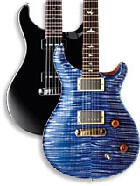
    Gee, I have to review two Paul Reed Smith guitars today… I know – it’s a tough job, but somebody’s gotta do it. Today’s subjects are the top-end, USA-made Modern Eagle and the lower-end, Korean-built SE Soapbar II.

    The Modern Eagle is top-of-the-line PRS all the way, much like the Private Stock line that’s been available for a while. If you read our PRS factory-tour article a few issues back, you learned how much emphasis Paul Smith puts on grading guitar tonewood. Suffice to say, the hard-maple top, mahogany body, and rosewood neck on the Modern Eagles are among the best pieces of tonewood PRS has to offer, which partially accounts for its formidable pricetag.

    As for the specs, the guitar has a carved, maple “10” top and mahogany back. The neck and 22-fret fingerboard are separate pieces of Brazilian rosewood, the neck being highly figured itself. It has a 25″ scale and 10″ radius. The inlays are abalone birds, and there’s a wide-fat carve on the neck. The headstock has an overlay of Brazilian rosewood with a Modern Eagle inlay.

    Hardware includes a pair of RP humbuckers, master volume and tone (the latter with push/pull coil tap), three-way pickup toggle and PRS’s new 14:1 Phase II locking-grommet tuners. Interestingly, there’s a blend of hardware finishes, most of which is gold, but the humbuckers have a brushed-nickel finish with gold screws and cr

  • June 2007

    FEATURES

    RICH ROBINSON
    Back on the Wing
    As the co-founder of the Black Crowes preps a new album, we speak with him about the band, its classic sound and style, and the vintage electric and acoustic instruments he has used to record its many hits. By Ward Meeker

    AMP-O-RAMA
    The Fender Deluxe Reverb
    If guitarists were to vote for the one “best amp for all occasions,” this one would very likely earn a majority decision, especially if you’re talking the original 1960s blackface version. By Dave Hunter

    THE GIBSON LES PAUL SPECIAL
    The “somewhere between Custom and Junior” member of the original Les Paul “family” of guitars was the first to lose the Les Paul name. But that small distinction has not diminished its appeal to players and collectors. By George Gruhn and Walter Carter

    CHOCOLATE GODZILLA
    Circa 1952, Ted McCarty asked Seth Lover to design a few amps. So he threw a few wires together with some Astrons, put them in pine cabinets, and for this one added the name of the most famous player of the era. Meet the Gibson Les Paul GA-40. By Nathaniel Riverhorse Nakadate

    KEVIN GRANTT
    Pentecostal to P-Basses
    He was bitten by the music bug while watching his grandpa play guitar in church. But it was “Don Kirschner’s Rock Concert” that influenced him to pick up his instrument of choice. By Zac Childs

    KAWAI MOONSAULT
    By the early 1970s, some of the top guitar people in Japan wanted to create uniquely Japanese guitar designs. They included the Iceman, the “Lucky Cat,” , and this Kawai, which became one of the country’s most popular models. By Michael Wright

    BASS SPACE
    The Gibson EB-6
    It wasn’t the first and may not be the best, but there’s little doubt that when it began shipping in 1960, the oddest production model in Gibsons’s thinline semi-solid series was intended to stand out. By Willie G. Moseley

    DEPARTMENTS

    Vintage Guitar Price Guide

    Builder Profile
    Valvetrain Amplifiers

    Upcoming Events

    Vintage Guitar Classified Ads

    Dealer Directory

    The Great VG Giveaway ’07
    Win a Koch Studiotone worth $2,600!

    Readers Gallery

    FIRST FRET

    Reader Mail

    News and Notes
    Clapton Crossroads ’07, new McCarty bio, Steve Morse on DVD, Dallas Guitar Show, In Memoriam, more!

    Michael Monarch
    Corporate Rock, Diverse Tones
    By Willie G. Moseley

    Al Viola
    1919-2007
    By Jim Carlton

    Jon Rauhouse
    Steelin’ Old Sounds
    By John Heidt

    Ask Zac
    By Zac Childs

    Mitch Easter Activates
    The Let’s Active Leader’s Solo Debut
    By Dan Forte

    Dave Stryker
    Jazz Via Omaha
    By John Heidt

    Bill Carson
    Last of the “Old Guys”
    By Willie G. Moseley

    CITES Gets An Update
    NAMM Issues Warning to Guitar Builders, Players
    By George Gruhn

    COLUMNS

    The (Way) Back Beat
    Cool Cats in Big Hats
    By Peter S. Kohman

    Q&A With George Gruhn

    Acousticville
    Midwinter Festival Time, Again
    By Steven Stone

    “401K” Guitars
    Shipping Solace
    By Gil Hembree

    Fretprints
    Johnny Smith
    By Wolf Marshall

    TECH

    Guitar Shop
    Bridge Repair
    By Tony Nobles

    Dan’s Guitar Rx
    Gold All Over
    By Dan Erlewine

    Talkin’ Amps With…
    Bill Yates: Vintage Amps Under $1,000, Part Four: Silvertone
    By David Jung

    REVIEWS

    The VG Hit List
    Zombies, Al DiMeola, Asleep At the Wheel, John5, Flatt & Scruggs, Strange Brew: Eric Clapton and the British Blues Boom, 1965-1970, more!

    Check This Action
    Surf Steel A’GoGo
    By Dan Forte

    Vintage Guitar Gear Reviews
    Danelectro Pro, Eastwood Airline H44 DLX, Dan Armstrong Sound Modifiers, D’Addario/Planet Waves accessories!

    Gearin’ Up!
    The latest cool new stuff!