Month: March 2007

  • Ernie Ball Earthwood

    A Big ABG

    Way before “unplugged” became a popular way to play music and fretted acoustic bass guitar (ABG) models began appearing from so many manufacturers and independent luthiers, Ernie Ball bought a Mexican guitarron and gave it frets. Unable to interest manufacturers in the viability of an acoustic bass in the early 1970s, the veteran musician, retailer, and stringmaker created one himself.

    There were, of course, prior attempts at making and marketing an acoustic bass. Gibson’s humongous Style J mandobass was made from 1912 to circa 1930 and had a 42″ scale (same as an upright bass). Four decades after the demise of the mandobass, Ball’s short-lived attempt at a true acoustic bass guitar was innovative and eyecatching – and ahead of its time. Guitar manufacturing legend George Fullerton (Leo Fender’s right-hand man for decades) departed the Fender company five years after it was acquired by CBS, then worked with Ball to create the prototype acoustic bass. They hit the market in 1972.

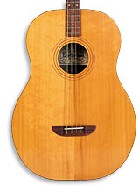
    Perhaps the most intriguing facet of the Earthwood acoustic bass models was that wood was used wherever possible, including places where plastic or metal may have been more typical. On the latter-day example shown here, the truss rod cover, body, and headstock binding, fret markers, and soundhole trim are all wood. Note the flame maple overlay on the headstock, and Schaller tuners. And there were variants of the ABG, including bodies of different depths – 65/8″ and 81?4″. The model shown is shallower, and many examples had maple fretboards and/or wood pickguards.

    The top of #1021 is two-piece spruce. Its body is 25″ tall and 183?4″ wide at the lower bout. The sides are made from two pieces of bookmatched mahogany that flare in opposite directions from center vertical strips of wood at the top and bottom of the body. The back is two-piece bookmatched mahogany, as well. The maple neck is bolted on, and a small panel on the back covers the three neck bolts as well as (surprise!) a tilt-neck adjustment access hole for an Allen wrench. The instrument’s serial number is stamped on the assembly that houses the neck bolts inside the body.

    The scale on this beast is a full 34″ standard length, and the strings have to be loaded through the soundhole, then through the holes in the bridge. Moreover, this example is technically an electric instrument – there’s a Barcus-Berry Hot Dot pickup mounted under the bridge, and the cord for amplification plugs into the large lower strap button. There are, however, no controls – no volume, tone, equalizer, or active circuitry of any kind. The general line of thought for a player whenever one of these was wired up was probably to hope like hell it didn’t feed back (which it has a propensity to do when amplified).

    For most would-be players, terms like “cumbersome” or “ergonomically-challenged” don’t even begin to describe the reaction when you first sit to plunk on an Earthwood bass, but then the guitarron on which it was based isn’t exactly sleek and slim, either.

    Nevertheless, these gargantuan instruments can generate a generous and resonant sound once (and if) a player becomes accustomed to the bulkiness. It can add a unique (usually appreciated) low-end to any pickin’ and grinnin’ session in nearly any acoustic-oriented genre… and it’s still a lot smaller than a doghouse bass!

    These days, improvements in piezo pickup technology and active circuitry have made it possible for the bodies of modern acoustic basses to be the same size as their guitar counterparts… as long as they’re running through an amplifier. But an Earthwood bass, considering the immense size of its body, moves a whole lot of air, so it’s more than capable of holding its own in a purely acoustic environment, as notable players like the Who’s John Entwistle and the Violent Femmes’ Brian Ritchie could attest.

    For slightly over a decade, amidst stops and starts for various reasons, the Earthwood acoustic bass and other Earthwood instruments were created and produced sporadically until 1985. The brand name lives on for the Ernie Ball company, and currently serves as the moniker for its #2070 phosphor-bronze acoustic bass strings.

    The quantity of Earthwood basses made is nebulous, but they are relatively rare – and big – birds.


    This article originally appeared in VG‘s Aug ’05 issue. All copyrights are by the author and Vintage Guitar magazine. Unauthorized replication or use is strictly prohibited.
  • Carl Martin Vintage Series Pedals

    More Effect, Less Coin

    If you’re the type of hardcore gear geek who spends as much time evaluating guitarists based on what’s in their hands, rigs, and pedalboards as you do actually listening to what they’re playing, then you’ve probably noticed that a lot of pros these days are using Carl Martin pedals.

    After hitting the scene with its first pedal in the early 1990s, the Carl Martin company started to make serious waves early in the 21st century with the Hot Drive ‘n Boost and Contour ‘n Boost pedals (reviewed in VG, December ’01). In early ’05, the company’s DeLayla XL and PlexiTone were launched to more rave reviews (VG, June ’05), and Carl Martin pedals were enjoying a reputation for being top-shelf in terms of construction and sound.

    With its new Vintage Series pedals, the company is breaking new ground in regard to style and price while holding to its standards of quality and sound.

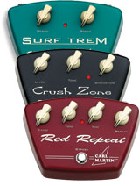
    The three pedals in the series are the Crush Zone (a high-gain overdrive), Surf Trem (tremolo) and the Red Repeat (analog delay), all of which are manufactured not in Denmark, but in China. And while the words “made in China” have traditionally caused gearheads to recoil in disgust, these pedals suffer none of the low-quality, cookie cutter traits often associated with the tag. Rather, they boast Martin-designed (and tested) circuits and keystone-shaped heavy die-cast metal chassis with satin-finish paint and cream-colored stenciling, heavy-duty mechanical-bypass footswitches, easy-access 9-volt battery compartments, 9-volt power adaptor jacks, and cream-colored chickenhead knobs (the good ones, with the brass inserts).

    A quick look inside one of the pedals reveals its Euro-style chassis mounted on a high-quality PC board that is wired very neatly, with 1?4″ input/output jacks, and chassis-mounted Alpha pots. Unlike so many imported pedals that use jacks and controls mounted directly to the circuit boards (and are thus prone to damage even if you do something as innocuous as stepping on one of the cords), the chassis-mounted components on the Carl Martin offer the promise of years of trouble-free functionality. We couldn’t find any deviations or shortcuts in design or components compared to Carl Martin’s standard pedal line, though they do lack an internal power supply.

    Controls on the Vintage Series pedals are straightforward; the Crush Zone has controls for Level, Tone and Distortion; the Surf Trem has dials for Depth and Speed; and the Red Repeat lets you manipulate signal via controls for Echo, Tone, Time, and Repeat.

    We had a listen to the Vintage Series using a Fender Custom Classic Telecaster running through a 1966 Fender Bandmaster with an open-back 2×12″ cabinet loaded with Tone Tubby speakers.

    We began with the Surf Trem and were quickly pleased with the results. It proffered a lush ’50s-style tremolo effect with a smooth, deep “swish” and smooth waveform that really sounded great. Switching the pedal on and off several times revealed an exemplary purity of tone – very quiet, clean, and transparent. Comparing the Surf Trem to the Bandmaster’s own tremolo, we could dial them in to sound almost exactly the same; in fact, we’d give the Surf Trem the nod for its ability to produce a deeper effect, and its wider range of speed settings.

    The Red Repeater also added no appreciable noise or coloration, just classic analog delay/echo with those slightly dirty, not-so-sterile repeats. Its Time control created anything from a super-short slap-back all the way to a 600-millisecond delay. The Tone control, which is essentially a high-cut, rolled off high-end on the repeats, allowing us to soften them so they didn’t get in the way of the dry signal, somewhat like the low-fidelity repeats from a tape echo. The only nit we have to pick with any of the Vintage Series is with the Red Repeater’s Time control – and it’s a common shortcoming on many units of this type; the lack of a label for the control’s milliseconds setting. Yes, it’s a minor thing, but it would help a user more accurately set delay times.

    The Crush Zone produced a full-out high-gain distortion with definite midrange boost and aggressive overdrive. Even with its Distortion dialed out completely, the pedal distorts the signal enough to eliminate it from potential use as a boost. But it excels in the high-gain category with a pleasant, crunchy distortion that isn’t thin or brittle, even with the Tele bridge pickup. The Tone control is well-voiced, allowing for flavors ranging from bright and “spitty” to dark and creamy smooth. The only time we could coax any mush from it was if we jacked Distortion past 3 o’clock, and even then, the sound was more like a cool over-the-top super-high setting on a fuzz pedal.

    This nifty-looking trio certainly lives up to the Carl Martin name in terms of pro-quality components, quiet operation, killer vintage tones, and a killer low price.


    Carl Martin Vintage Series pedals
    Price $129 to $159 (retail).
    Contact Gary Castelluccio & Associates, phone (973) 772-3333; www.carlmartin.com.


    This article originally appeared in VG‘s July ’06 issue. All copyrights are by the author and Vintage Guitar magazine. Unauthorized replication or use is strictly prohibited.
  • Elvin Bishop – Gettin’ My Groove Back

    Gettin' My Groove Back

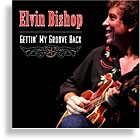
    Elvin Bishop has suffered tragedy in recent years and it understandably shows on a couple of cuts here. “What the Hell is Going On” is a boogie that roars about everything going on in the world. “Come On Blues” is one of the most harrowing pieces of music to come along in years. It’s obvious Bishop is using the blues to help him deal with events, using just voice and guitar, and the piece is frightening in its emotion; not the kind of thing you’d associate with a guy who did a song that “called all cows back to the barns.” It stands with the masters of the blues idiom.

    That said, one of the real pluses is how the album reconciles the link between Bishop, the blues, and the good-time music that has always been a staple of his catalog. “Blues Train” has a lyric that’s fun as hell, delivered by a man who wants nothing more than to play music for his fans. “Got To Be New Orleans” is a funky tribute that has taken on new meaning for a city known for music. “He’s a Dog” is a sweet tale of Kirby, the dog shown on the back of the CD. Bishop shows off his slide chops on an instrumental take of “Sweet Dreams.” Gorgeous and soaring, it features melodic slide guitar as thick as you’ll ever hear.

    Bishop’s first Blind Pig release is darn near perfect – a fine effort from a veteran who has been around many of the high points in the history of rock and roll.


    This article originally appeared in VG‘s Dec. ’05 issue. All copyrights are by the author and Vintage Guitar magazine. Unauthorized replication or use is strictly prohibited.
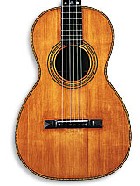
  • J. Howard Foote Parlor guitar

    Parlor guitar

    P.T. Barnum probably didn’t coin the classic modern truism “There’s a sucker born every minute,” even though it does fit well with the Barnum legacy! Most of us know Barnum because of his traveling circus, The Greatest Show on Earth, later the Barnum & Bailey Circus, but that was really almost an afterthought from the end of his life. Far fewer of us know that he was perhaps the greatest promotion man who ever lived, and that he arguably had more impact on the development of popular American culture as it emerged in the 19th century than any other single person. But what has he got to do with this guitar?

    Phineas Taylor Barnum was born in Bethel (now Fairfield), Connecticut. His father died when he was very young and he set about making his fortune variously as a grocer, lottery agent, newspaperman, and exhibitor of “curiosities,” early famous examples being Joyce Heth, the “161-year-old slave,” and the “Fiji Mermaid,” a clever fusion of a fish with the head and torso of a female orangutan! By 1841, he was prosperous enough to purchase New York’s American Museum, in Lower Manhattan, which would become his life’s great work.

    American museums had begun in Philadelphia with Peale’s Museum (Barnum later purchased the collection), a combination of Linnaean classification of natural history, paintings, artifacts, and amusing oddities to entertain the public. Barnum’s American Museum expanded on these themes, interspersing scientific wonders (he was a major supporter of the excavation of dinosaurs!) with miniature models of cities, mummies, live animals (like giraffes), America’s first aquarium (including whales!), and exotic people, including fat ladies, giants, trapeze artists, Eng and Chang (the first “Siamese” twins), and General Tom Thumb. Various exhibits and members of his museum family regularly toured America and Europe.

    The American Museum also had a theater, and Barnum employed a company with some of the best actors in America. At a low point in American thespianism, he invented the first “family” oriented theater, barring liquor and whores and only presenting plays suitable for the little lady and the kids.

    P.T. Barnum was also one of the early American music promoters, his most stunning achievement being to convince the most famous female singer of the century, the “Swedish Nightingale” Jenny Lind, to tour America in 1850. She swept the nation off its feet, a la The Beatles 113 years later! Perhaps you see where we’re heading…

    Rewind to the late 18th century, when the practice of white folks performing skits in burnt cork “blackface” began to appear, mainly a highly racist art form that ridiculed slaves. In the late 1820s comedian Thomas Dartmouth Rice observed a comical black man doing a dance routine and enshrined it in the song “Jump Jim Crow,” performing it in blackface with great success on New York stages for years, including at Barnum’s American Museum. American Minstrelsy was born.
    Circa 1840, a musical group called the Tyrolese Minstrel Family toured America singing middle European folk songs. This gave unemployed actors Dan Emmett (composer of “Dixie”), Frank Bower, Frank Pelham, and Billy Whitlock the idea to do an American version. They formed the Virginia Minstrels, performing in blackface with banjos at Barnum’s museum in New York in 1843. Barnum put them under contract and they had a successful run, after which he sent them on a European tour. In the spring of 1846, among the musicians taking Barnum’s stage was a young man called Bini “the Amazing Guitarist.”

    Little is known of Joseph E. Bini’s origins or career. By the 1830s, at the height of Mauro Giuliani’s popularity in England, it was not uncommon for European guitar “virtuosi” to visit and settle in the New World. We do know that, in addition to performing, he built guitars, including the one shown here made for J. Howard Foote. He lived in Mount Vernon, New York, north of the city. In 1867, Bini was granted a patent for a novel bracing system that was basically a hybrid X- and fan-bracing pattern. According to the patent, it was intended to distribute the treble frequencies more evenly over the guitar. According to Michael Holmes’ list of American manufacturers (see mugwumps.com), Bini may have built guitars until 1901 or later.

    John Howard Foote is equally mysterious. He apparently was a musical instrument importer and retailer with shops in New York and Chicago. He was known for selling violins (made in Mittenwald, Germany), horns, Matchless banjos (made in New York by Buckbee), and guitars, including this one made by Bini. Again according to Holmes, Foote’s business was around from 1835 to 1904.

    This Foote/Bini guitar is a handsome little beast that features “Bini’s Improvement,” his elaborate bracing system. Like most 19th-century guitars, it has a solid spruce top with colored wood marquetry. The body is solid Brazilian rosewood, the nice V boat-neck is mahogany. The fingerboard is ebony with pearl diamond and snowflake inlays. The tuners are modern replacements, the original soft brass having warped irreparably (replacement nut, saddle, and pins, too). This is currently strung with a set of gut strings (nylon basses). It’s not certain when this guitar was made, but it was probably after Bini’s patent, so probably 1870 or later.

    So, does Bini’s Improvement work? Well, it is a nice idea, very ahead of its time, but with gut strings, it’s no better than a ladder-braced guitar, and indeed, many are better-sounding. It’s possible that silk and steels, which became popular after 1880, might sing nicely, but using them could be risky for the top and neck.

    Still, this is a nice example of a 19th-century guitar that serves to bring two more names of that era – Joseph Bini and Howard Foote – to our attention. Or perhaps three, because without P.T. Barnum’s active promotion of American music in general and Bini the Amazing Guitarist, in particular, who knows if these creations would ever have been born for suckers like us to enjoy?


    Ca. 1875 J. Howard Foote Parlor guitar, SN 654.

    This article originally appeared in VG‘s Dec. ’05 issue. All copyrights are by the author and Vintage Guitar magazine. Unauthorized replication or use is strictly prohibited.

  • Donovan – Try For The Sun: The Journey Of Donovan

    Try For The Sun: The Journey Of Donovan

    Donovan Leitch rose from Dylan wannabe to the flower-power embodiment of all things peace and love. He sometimes appeared to be more a hanger-on than his own artist – the wide-eyed clone who Dylan seemed alternately amused by and dismissive of during his ’65 English tour in the documentary Don’t Look Back, one of the tagalongs when the Beatles went to India to meditate with the Maharishi in ’68.

    But as Joan Baez points out in the liner notes to this boxed set, when Dylan almost condescendingly asked Donovan to sing something to his entourage-filled hotel room, the Scotsman “proceeded to silence them with an enchanting ‘Catch The Wind.’”

    The three CDs and one DVD housed in this purple velvet box – its 60 tracks including 16 demos, alternate versions, and unreleased studio and live performances, with the 40-minute documentary, There Is An Ocean, for good measure – leave no doubt that Donovan was, and is, his own man. And from beautiful folk melodies like “Catch The Wind” and “Colours” to protest songs like “Universal Soldier” to psychedelic fare like “Atlantis” and “Hurdy Gurdy Man” (backed by three-fourths of Led Zeppelin), he proves himself a major artist. Between hits like “Mellow Yellow” and “Sunshine Superman,” Leitch gets jazzy on “Sunny Goodge Street,” dips into bluesy terrain on “Hey Gyp,” and reveals his Celtic ancestry on “Lalena” and “Guinevere.”

    In addition to Jimmy Page’s contributions, Jeff Beck shows up on “Barbajagal.” But Donovan’s own abilities as an acoustic fingerpicker should not be overlooked.

    Although Try For The Sun is the most expansive Donovan retrospective, spanning 40 years, it should have taken a cue from the two-CD Troubadour collection from ’92, which includes track-by-track personnel credits. Some of that information is woven into the 56-page booklet’s liner notes, but it seems a bit lazy to not have all of it, clearly spelled out. Also, the packaging, which requires you to pry out the cardboard-encased discs, ensuring that they’ll eventually get dog-eared or worse, is a bit too clever for its own good.


    This article originally appeared in VG‘s Feb. ’06 issue. All copyrights are by the author and Vintage Guitar magazine. Unauthorized replication or use is strictly prohibited.

  • George Benson – The Essential George Benson

    The Essential George Benson

    Sony/BMG’s Legacy division has released single- and double-CD retrospectives on everyone from Igor Stravinsky to Earl Scruggs as part of its “Essential” series. It has spanned 50-plus years, surveying giants like Dave Brubeck, and released such dubious titles as The Essential Redbone. Not Leon Redbone – Redbone, the band. “Come And Get Your Love,” “The Witch Queen Of New Orleans” – that Redbone. Somehow “essential” isn’t the first word that comes to mind when one thinks of Redbone – as infrequently as that might occur.

    But with someone as formidable as George Benson (who has had at least two dozen retrospectives devoted to him), the problem is how to cram 40-plus years of great playing and singing, delving into his many sides and talents, into a two-CD set. Not that everything Benson has committed to vinyl or plastic is “essential,” but his batting average is mighty high.

    If you were to randomly ask 100 jazz guitarists who the best living exponent of jazz guitar is, more than likely Benson would emerge as the frontrunner, poll after poll. The reasons are obvious; his technical mastery of the instrument, his rich tone, his innate sense of swing, the aggressiveness with which he attacks some songs, the subtle nuances with which others are imbued, his unswerving hipness, the unmistakable funk, the breadth of the material and environs in which he’s comfortable. And then there’s his singing!

    It’s interesting to compare Essential to the two-disc Anthology Rhino/Warner Archives released in 2000. Both kick off, appropriately, with Benson in the company of organ great Brother Jack McDuff – Anthology with the Burrell-influenced “Shadow Dancers,” from the 21-year-old’s first solo LP; Essential with 1963’s “Rock Candy,” from a blowing live outing by McDuff (followed by “Shadow Dancers”).

    We then follow Benson, the new Columbia discovery, the guest on Miles Davis’ Miles In The Sky, the heir apparent to Wes Montgomery’s commercial funk with A&M, part of the CTI stable, and finally the hit vocalist of “This Masquerade,” “On Broadway,” and “Give Me The Night” – with cameos behind Stanley Turrentine, Tony Williams, and Dexter Gordon along the way. That takes us up to only 1980, therefore excluding such notable excursions as his 1990 foray with the Count Basie Orchestra, his album of standards (Tenderly), and Collaboration, with his former rhythm guitarist, Earl Klugh.

    But whereas Anthology covers more ground (the above albums and more), it comes off as a bit of a sampler, whereas Essential illuminates more of the half of a career it concentrates on. And there’s no law saying Legacy can’t release The Essential George Benson, Vol. II someday. Plenty of guitarists would welcome it


    This article originally appeared in VG‘s June ’06 issue. All copyrights are by the author and Vintage Guitar magazine. Unauthorized replication or use is strictly prohibited.

  • Paul Curreri – Are You Going to Paul Curreri

    Are You Going to Paul Curreri

    Those familiar with Curreri might be surprised to hear this live trio effort, where he plays his Fender Tele through the entire set!

    That’s certainly not a bad thing, as his style translates well and his playing is as quirky and fine as it is on acoustic. The first cut, “Senseless as a Cuckoo” starts with funky, country-ish guitar. The steely bends show right away that he’s comfortable on the electric. “Maria” has a finger-picked rhythm with a light rockabilly feel. And that influence appears in other places, too, like the wonderful “If Your Work is Shouting.” Cuts like “The Heavy Deal” also show a blues/funk feel, and it should be noted that Curreri has his own vision for this stuff. His blues/funk isn’t like Al McKay or Robben Ford. It’s quirky, and all his! And that just adds to the uniqueness of his music. His solos are few and far between, but his playing dominates these songs.

    Curreri’s quirks bleed through to every part of his music, including the lyrics and his wonderful vocals. His is a unique talent, with a vision.


    This article originally appeared in VG‘s Oct. ’06 issue. All copyrights are by the author and Vintage Guitar magazine. Unauthorized replication or use is strictly prohibited.

  • Tony Bennet – Cloud 7

    Cloud 7

    Because of its warmth and range, jazz guitar (in the right hands) is perfectly suited to accompanying vocalists singing standards in intimate settings – sometimes requiring no other instruments at all.

    The best-known example of this combination is Barney Kessel’s work backing Julie London (with Ray Leatherwood on upright bass) on the 1955 hit LP Julie Is Her Name – a formula Kessel repeated, with variations, behind Sarah Vaughan and Dean Martin. (For Julie Is Her Name, Vol. 2, London kept the format but used Howard Roberts on guitar.) Al Viola’s guitar was the sole accompaniment for London’s follow-up, Lonely Girl, and was featured in a sparse setting behind June Christy on This Intimate Miss Christy. Johnny Mathis’ 1959 classic, Open Fire, Two Guitars, featured Al Caiola and Tony Mottola, and one of Sammy Davis, Jr.’s finest albums paired the singer with Laurindo Almeida’s lone guitar, in 1966.

    Similarly, in 1954, after a string of hit singles with orchestral backing, Tony Bennett recorded Cloud 7, his first full-fledged album, backed by a jazz septet featuring guitarist Chuck Wayne. The album begins not with a bang, but with the floating sound of Bennett humming a counter melody to Wayne’s harmonics on “I Fall In Love Too Easily.”

    What will strike newcomers to the Bennett camp, who only recently discovered the “Unplugged” Tony dueting with k.d. lang or Elvis Costello, is the soaring quality of his voice – its power and flexibility. Of course, at 78, Bennett is still a fantastic singer, in some ways more expressive than the Bennett of yore, but there are things that he’s not physically capable of that he was at 28 – things that are on ample display here.

    As usual, Bennett’s song selection is impeccable, and Wayne’s solos are impressive and hip without ever detracting from the song or singer. The guitarist received marquee billing on the album, and his bouncy single-note work on “My Baby Just Cares For Me” and lush chordal bed on “While The Music Plays On” demonstrate why. Charles Panely’s trumpet swaps center stage on most songs, and the two split arranging duties.

    Needless to say, the CD issue of this out-of-print album is most welcome and highly recommended. But it’s just one chapter in a book that’s still being written. Having already compiled a career-spanning four-CD retrospective, Forty Years: The Artistry Of Tony Bennett, Legacy has now issued an expanded, five-disc version, appropriately retitiled Fifty Years Of Artistry. Hopefully, when Tony turns 88, there will be a six-CD version celebrating Sixty Years Of Artistry.


    This article originally appeared in VG‘s Jan. ’05 issue. All copyrights are by the author and Vintage Guitar magazine. Unauthorized replication or use is strictly prohibited.

  • 1973 Hayman 3030H

    1973 Hayman 3030H

    If England has a Leo Fender, his name is James Ormston Burns.

    Like Fender, Burns was a seminal influence on electric guitar design in the U.K., creating the guitars played by Hank Marvin and the Shadows, the British equivalent of the Ventures. The Ventures didn’t always play Mosrites! Like Fender’s guitars, Burns’ guitar designs would cross the pond and have some influence on the other side. And like Fender, once Burns had “retired,” he couldn’t stay out of the game. The 1973 Hayman 3030H represents one of his happy returns.

    As a teenager, Burns (1925-’98) began to play lap steel. In 1943, he joined the Royal Air Force and was a mechanic assigned to duty in North Africa. Not carrying a guitar along, Burns improvised his first guitar out of scrounged materials. Following the war, he played professional lap steel and became interested in Spanish electrics. He later decided to begin manufacturing, and produced his first guitars under the Supersound name in 1958. A year later he made some Burns-Weill guitars with partner Henry Weill. In 1960, Burns went back on his own and began making Burns guitars. His first model was the Artist, followed by the Black Bison, and then the Marvin.

    Over the next five years, Burns continued to expand his line, innovating with new pickups and perhaps his most famous design, the Burns vibrato – a triangular, top-mounted unit – and the so-called “gear-box” neck adjustment, a geared affair in a neck-heel pocket that required a special long T-wrench to adjust the truss rod. Other especially cool developments included the Burns Jazz Split-Sound guitar, with a rotary pickup select that included a “Wild Dog” setting, perhaps the most famous description in guitar history. Alas, it was really a fairly weak out-of-phase sound; but that isn’t what you feel when you dial it in!

    Burns guitars were among the best in the U.K. at the time, and as a result they inspire feelings as strong as some of America’s revered brands do in the U.S.

    Unfortunately, Burns, a colorful personality, wasn’t all that good at business. By 1965, he was deeply in debt to suppliers. That year saw the height of the ’60s guitar boom in America. The Beatles landed in New York in February, 1964, and every kid in the post-war baby boom (not an insignificant number) wanted an electric guitar. Well, a lot of them did anyway. Manufacturers and importers could sell any guitar they got their hands on. To big corporations (musical and otherwise), this smelled like money. A feeding frenzy followed.

    About this time, Leo Fender fell ill and decided to retire. So, he put Fender on the block. The Baldwin Piano and Organ Company, in Cincinnati, wanted to diversify into guitars. It put in a bid on Fender but was outbid by the Columbia Broadcasting System (CBS). Not to be denied, Baldwin looked overseas and found Burns for sale. The agreement was that Jim Burns would not use his name for three years. The principal Burns guitar models began to be imported into the U.S. as Baldwin guitars, the main difference being scroll Baldwin headstocks.

    Baldwin, confident of success but not satisfied with the Burns results, expanded its line by purchasing the Fred Gretsch Company in 1967. Baldwin/Burns models were phased out, but certain features were incorporated into Gretsch models, including the Burns vibrato and gear-box. Production in England was closed down and shifted to the U.S. Baldwin guitars basically took an American tack thereafter, and that’s a different story.

    Like Leo Fender, who sprang back with Music Man and then G&L, Jim Burns scoffed at retirement. From 1966 to ’68, Burns marketed Ormston Steel Guitars, a line developed by Nigel Dennis and Gordon Huntley. He built at least one semi-solid prototype electric guitar with a distinctive hump on the upper shoulder (much like a Burns Vista Sonic) and an f-hole. This had a black-bound maple fingerboard, two single-coil pickups, and a string-through-body design. Controls were on a little Tele-style plate.

    In 1969, Ivor Arbitor, head of Dallas Arbiter, a major British music company, asked Burns to design a line of guitars to be called Hayman with former Vox guitar man Bob Pearson. Burns and Pearson settled on a new shape that looked similar to the Ormston prototype. If you squint, a Fender Tele comes to mind. The first Haymans, the solid 1010 (three Super Flux single-coil pickups) and semi-solid 2020 (two Super Fluxes), were introduced in 1970, both with mahogany bodies and maple fingerboards. These were followed in 1971 by the twin-pickup solidbody Hayman 3030 and the 4040 Bass, both with bodies of obeche wood. Former Burns employees Jack Golder, Norman Holder, and Derek Adams worked on production.

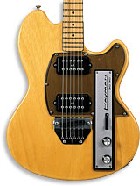
    Burns, however, got antsy and departed Dallas Arbiter in the Fall of 1971, leaving Pearson in charge. In ’73, the Hayman line added models with Re-An humbucking pickups, yielding this Hayman 3030H. Like its predecessor, the body is of obeche, which is nicely set off by the maple neck and fingerboard trimmed in black binding. The smoked plexiglass pickguard adds a touch of class. Controls are a simple three-way with one volume and one tone knob. Strings pass through the body. These pickups have a nice, clean frequency response, but a somewhat restrained personality. The feel is distinctly different from American designs. The 3030H was produced for less than a year.

    There were other interesting Hayman prototypes built, including one plexiglass guitar based on John Lennon’s customized Epiphone (plans were abandoned when Dan Armstrong’s guitar appeared), but Dallas Arbiter folded in ’73. Pearson, Golder, and Holder stayed together and introduced Shergold guitars, which carried on the tradition begun by Jim Burns, but had nothing to do with him. In ’74, Burns tried to introduce guitars under his own name again, but his lack of business acumen quickly brought it to an end. From 1979 to ’83 he tried again to resurrect the Burns brand, with no luck. He returned one final time in 1992 as a consultant to Burns London, Ltd., which was reviving some of the ’60s classics. Today, the Burns name lingers on in fairly decent “replicas” produced in Asia.


    Photo: Michael Wright.

    This article originally appeared in VG‘s Jan. ’06 issue. All copyrights are by the author and Vintage Guitar magazine. Unauthorized replication or use is strictly prohibited.

  • March 2007

    FEATURES

    KEITH URBAN
    Down-Under Über-Picker
    The super-talented artist not only writes hit songs, gathers accolades, and recently married a movie star, he’s also a straight-up hellacious guitar picker and gear lover of the highest order! By Zac Childs

    AMP-O-RAMA
    The Vox AC15
    Designed by Dick Denney in 1957, the little Vox AC15 is appreciated by “tonehounds” for its sweet, juicy glories, and ability to hit its sonic sweet spot at volumes equally friendly to ears and microphones. By Dave Hunter

    EPIPHONE EXCELLENTE
    When Gibson acquired Epiphone in 1957, its plan was to introduce a line designed to be slightly less expensive than the equivalent Gibson model. But in the acoustic flat-top line, it wasn’t quite that cut-and-dried. By George Gruhn and Walter Carter

    CHARLIE GRACIE
    Rock’s Unsung Pioneer
    He had a #1 hit in 1957 that bankrolled the company whose roster subsequently boasted Chubby Checker, Bobby Rydell, and others. And for decades, he was more a footnote than a chapter in rock history. By Dan Forte

    THE DOMINO CALIFORNIAN REBEL
    California’s reputation for non-traditional thinking should make it no surprise that when its makers wanted to name an outré guitar design, they attached an association with the state, as with this 1967 Domino Californian Rebel!
    By Michael Wright

    BASS SPACE
    Gibson’s EB-4L
    While initial reaction to it was akin to “big deal,” some of Gibson’s innovations in the early 1970s had merit. And if you wanted to play a long-scale Gibson SG-shaped bass, it was the only game in town! By Willie G. Moseley

    THE DIFFERENT STRUMMER
    Semie Moseley: The Lost Interview, Part Three
    We conclude our exclusive series of transcriptions with never-before-told tales from the 1970s that find Semie down in spirit, but planning one more run at the brass ring. By Michael Wright

    DEPARTMENTS

    DEPARTMENTS
    Vintage Guitar Price Guide

    Builder Profile
    Goodsell Amplifiers

    Upcoming Events

    Vintage Guitar Classified Ads

    Dealer Directory

    The Great VG Giveaway
    Register to win a First Act Delia worth $2,500!

    Readers Gallery

    FIRST FRET

    FIRST FRET
    Reader Mail

    News and Notes
    Gretsch, Chet Together Again, Petty, Emmanuel, and Frampton Grammy noms, Electric Prunes EP, BBE Donates to Wounded Warrior, In Memoriam, more!

    John Hammond
    Ripe to Write
    By John Heidt

    Chuck Loeb
    “Most Wanted” for Melody
    By John Heidt

    Greg Howe
    By Oscar Jordan

    Ask Zac
    By Zac Childs

    Jim Campilongo
    Sounds Abound
    By John Heidt

    Robert Lockwood, Jr. 1915-2006
    By Dan Forte

    The Steepwater Band
    By Ward Meeker

    Johnny Rivers
    By Elliot Stephen Cohen

    COLUMNS

    COLUMNS
    Q&A With George Gruhn

    Acousticville
    Hey, Kid! Wanna Buy a Cheap Mandolin?
    By Steven Stone

    Fretprints
    Link Wray
    By Wolf Marshall

    “401K” Guitars
    Insurance Assurance
    By Gil Hembree

    TECH

    TECH
    Guitar Shop
    Tuning Gear Tune-Up
    By Tony Nobles

    Talkin’ Amps With…
    Bill Yates: Vintage Amps Under $1,000, Part One: The Gibsons
    By David Jung

    REVIEWS

    REVIEWS
    The VG Hit List
    Vince Gill, Michael Powers, Bill Kirchen, Tony Furtado, The Pretenders, Doug Sahm, Building a Selmer Maccaferri Guitar, more!

    Check This Action
    Harry Smith’s Enduring Influence
    By Dan Forte

    Vintage Guitar Gear Reviews
    Chicago Blues Box Buddy Guy signature amp, DNA Analogic effects, HAO Sole Pressure & Rust Driver, HomeBrew Hematoma, Vibratos by Stetsbar, StepMax, and SuperVee!

    Gearin’ Up!
    The latest cool new stuff!