
Month: November 2006

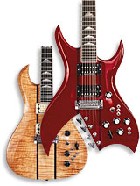
  • B.C. Rich Eagle Supreme, Bich 10 Supreme

    For the Metalhead in All of Us

    From the Mockingbird to the Bich and the Eagle, since the 1970s, B.C. Rich guitars have been seducing players (and fans!) with their over-the-top looks and sexy body shapes.

    Loaded with an unmistakable hard rock vibe, B.C. Rich axes have long induced a Pavlovian response in budding metalheads who salivate at the sight of one, then often give up a few of their one-time/former favorite guitars to get one. From pros like Kerry King (Slayer) and Joe Perry (Aerosmith) to your local garage band, B.C. Rich has always made an axe that could be appreciated by everybody.

    One of the company’s newest twists/phases included opening its USA Custom Shop, the product of which are the company’s all-hand-crafted guitars. At the BCRUSACC, there are no fancy CNC machines, and there is no mass production. In 2004, they produced 242 pieces employing “just” good ol’ American craftsmanship. Bodies are cut, shaped, and painted in California, then sent to Cincinnati for final assembly, with a total of six to eight months building time for each guitar.

    We recently got a firm grip on a couple of B.C. Rich Custom Shop units; an Eagle Supreme and a Bich 10 Supreme. Both are constructed with 1?2″ flame-maple top over laminated five-piece bodies (alternating between mahogany and walnut), with a mahogany neck that, in true B.C. Rich tradition, runs through the body.

    Our Eagle tester was a natural-finish beauty, while the Bich 10 sported BCR’s Translucent Red. And both boasted a flawless high-gloss finish that really accented their maple tops. The mahogany necks were capped with bound ebony fretboards with neatly executed abalone cloud inlays and bound rosewood overlays on the headstocks. The necks also featured 24 jumbo frets with superb levelling work, nicely rounded ends, and a polished finish, as well as a nicely cut and finished bone nut. The neck-through construction and absence of a neck heel allowed for excellent access up to the 24th fret. The comfortable C-shape necks gave both a fast feel, while the flatter 12″-radius fretboard allowed for low, buzz-free action.

    The guitars’ heavily rounded and contoured bodies make both very comfortable to play and lighter than you might expect (about 8.5 pounds). Both have chrome hardware, including B.C. Rich Quad Bridges with intonation adjustments, and ultra-smooth Grover Imperial tuners. The Bich 10’s four octave/high strings (E, B, G, D) were threaded through string ferrules in the headstock to four more tuners mounted in a body cut just past the bridge, which makes tuning easier than on a traditional 12-string, and it doesn’t clutter the headstock or make it look unbalanced. Electronics on the Bich 10 include a Seymour Duncan JB (bridge position) and Jazz (neck position) pickups, and a Dimarzio Super Distortion/bridge. The Eagle uses a Duncan PAF in the neck position, with coil splitters, phase switches, a varitone-like rotary switch (which uses capacitors) and an active WolfRose Bullet Preamp Circuit. Even with the 10-plus knobs and switches on each guitar, the layout looks good and well-conceived, following the body lines, not at all clunky or out of place.

    Navigating the sea of switches and knobs on both guitars is at first a bit intimidating, and certainly isn’t everybody’s cup of tea. But these are custom guitars and can be set up with or without active electronics, coil splitters, phase switches, or the varitone.

    I checked both guitars through a Carvin Belair 212 (VG Aug ’05) combo (for clean tones), and a 50-watt Randall MTS running through 4×12″ cab (for distorted tones). Through the clean channel of the Carvin, both proffered a huge variety of sounds, from clear and shimmering to fat and jazzy. The Bich 10’s hybrid 12-string sound was the most fun to manipulate with the onboard electronics, producing a whole lot of usable and interesting clean sounds, from a thin, glassy acoustic 12-string sound to a big, full rhythm tone. The varitone and phase switches colored the sound a little too much for my taste, but the coil splitters and boost preamp were very useful. Through the Modern module in the Randall, and with the guitars’ active preamp and varitone switchs bypassed, both guitars had a tight, focused sound. The pickups were well-balanced, with strong upper midrange. The absence of the octave strings on the low E and A means you can chug on power chords without cluttering up the tone, then switch to the Clean module for shimmering 12-string passages.

    The active preamp on both guitars means all the drive and sustain you could want are right at your fingertips. The circuit is useful for soloing and doesn’t add much noise. It does lessen note definition, though, if you punch it in too much.

    In the fair amount of time I spent playing the Bich 10 and Eagle, I came to appreciate their tones with the electronic preamps for the most part bypassed. Run “dry,” both offer nice, full humbucker sounds. But guitar players like their switches and knobs, and the ability to customize your tone can be very appealing, as well.

    Both B.C. Rich guitars played as “seductively” as they looked; a true testament to American guitar craftsmanship and design where art meets technology.


    B.C. Rich Eagle/Bich 10 Supreme
    Features Handcrafted, flame-maple tops, neck-through construction, contoured bodies, active preamp circuitry with varitone, coil splitter, and phase switches, Grover Imperial tuners, pickups by Duncan and DiMarzio.
    Price Eagle Supreme: $3,900 (retail); Bich 10 Supreme: $4,099 (retail).
    Contact B.C. Rich Guitars, 4940 Delhi Pike, Cincinnati, CA 45238:(800) 999-5558; bcrich.com.com.


    This article originally appeared in VG‘s Oct. ’05 issue. All copyrights are by the author and Vintage Guitar magazine. Unauthorized replication or use is strictly prohibited.
  • G&L S-500 Deluxe

    Still hand-made, still Leo-like

    The people at G&L Guitars consider themselves more than simply guitar builders. Rather, they are the caretakers of Leo Fender’s legacy. Built on what started as Clarence Leo Fender (CLF) Research in 1970, G&L, according to V.P. Dave McLaren, is still Leo’s place.

    “Leo is still here,” he says. “You can feel his presence everywhere, particularly in his office and laboratory, which remain just as they were on the day Leo went home for the last time. At times it can be disconcerting, even to the longtime employees who’ve somehow become accustomed to… how should I put this.. events?” he says. “But many of the people who work in the historic Fender Avenue plant today have been there since the ’70s and ’80s, and were taught by Leo himself. We’re as proud of the place, the people, and traditions as we are of the beautiful instruments handcrafted there.”

    So McLaren will be the first to tell you that the company’s S-500 model is a refined, custom guitar with high-end features; it is not a “copy” guitar in any way.

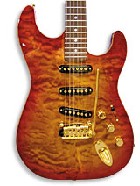
    We recently asked for a test unit to see if the S-500’s Deluxe variant delivered on the promise of its “high-end” accoutrements, like the birdseye maple neck, quilted maple top, wood binding, gold hardware, etc.

    The 500’s body is made of Alder and has deep contours like Fender Strats from the 1950s and ’60s. Its weight is a pretty average at just under eight pounds. The 3/16″ quilted maple top on our Deluxe model had a deep cherry sunburst finish that was nicely executed and framed by the binding, and (thankfully) had no pickguard, because the top added nicely to the guitar’s high-end appeal.

    The birdseye maple neck, like that on all G&L guitars, starts life as one piece of wood before getting the company’s Bi-Cut treatment for truss rod installation. Ours was capped with a 12″ radius rosewood fretboard with big, polished frets. Hardware was all gold and included G&L’s patented Dual-Fulcrum vibrato tailpiece, angled/recessed jackplate, dome knobs, and Sperzel locking tuners. Going beyond the call of duty are the gold pickup polepieces and gold truss rod nut! Quite dressy!

    Electronics included three S-500 Magnetic Field Design (MFD) single-coil pickups, a five-way selector, PTB tone controls (a passive system that allows the user to cut bass and treble separately), and a push/pull volume pot that let us select between bridge and neck pickups.

    Straight out of the case, the 500 played marvelously; its low/fast action and familiar C-shaped neck profile were very comfortable. The big frets made bending a breeze, and there was minimal fret buzz. The deep contours and gloss finish on the neck gave the 500 a vintage feel, which is not all that surprising considering G&L still builds guitars entirely by hand. The gloss finish on the neck may turn off some players, but the neck has such a great overall feel that you barely notice the gloss.

    To test the 500’s sounds, we employed a couple of combo amps – an all-tube 2×10″ and a “modeling” 1×12″.

    The 500’s pickups proffer a noticeably darker, fatter sound than traditional Alnico-magnet units. Players looking for the “bell” tone many be a little disappointed (and may want to check out the company’s Legacy guitar, with hand-wound Alnico V pickups), but the S-500 makes up for that in the overdrive department. Fatter, more focused mids give the guitar a defined, even overdrive/distortion tone. Being single-coils, the pickups can get a little noisy if one uses too much overdrive, but the out-of-phase positions were markedly quieter.

    The push/pull switch in the volume pot added some very usable clean sounds. With the neck and bridge pickups on simultaneously, the guitar gave us a P-90 kind of sound, but with a twang. The PTB tone controls allowed us to manipulate the sound to some extent, but we mostly ran them wide open.

    With locking tuners, a graphite string tree, and a well-machined bridge, the guitar stayed in tune even with heavy use of the tremolo.

    In all, G&L’s S-500 scores high in the looks department, plays effortlessly, sounds great (especially with some overdrive), and does indeed have that unmistakable – and ultimate – Leo Fender vibe.


    G&L S-500 Deluxe
    Type of guitar Electric Solidbody.
    Features Curly maple top, birdseye maple neck, gold hardware, low/fast action, hardshell case included.
    Base Price $1,650, $2,880 as shown.
    Contact www. glguitars.com.


    This article originally appeared in VG‘s Sep. ’03 issue. All copyrights are by the author and Vintage Guitar magazine. Unauthorized replication or use is strictly prohibited.
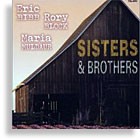
  • Eric Bibb, Rory Block, & Maria Muldaur – Sisters and Brothers

    Sisters and Brothers

    I like this one for a couple of reasons. The first is it’s a perfect example of some vets getting together and just making good music. No ego involved, just three people who want to put good songs on tape, and make them sound good. Bibb’s been around since the late ’60s, performing as a solo blues and folk artist. Rory Block is a wonderful singer/guitarist who’s also had a long career. She’s recently been on the upswing, with a couple of excellent albums on the Telarc label. And Maria Muldaur has always been a wonderful singer who can cover a range of styles.

    On this, the three run through old songs, new songs, and some in-between. Listeners will recognize a swampy version of Bob Dylan’s “Gotta Serve Somebody” that lets Eric show his vocal chops, while the girls sing textbook gospel-tinged backgrounds. Funky acoustic guitar helps guide “Don’t Ever Let Nobody Drag Your Spirit Down.” “Maggie Campbell” is one of those 12-string blues tunes that always feel at home, whether recorded in 1935 or 2003. “Good Stuff” has fine finger-picked country blues to go along with a nice, gruff vocal from Eric. There’s lots of fine guitar from Bibb and Block, but my favorite, “Bessie’s Advice,” has very little guitar. Muldaur’s vocal on this one is as good as it gets. Seductive, self-assured, and (pardon the expression) ballsy, it’s a seven-minute gem by Bibb and Muldaur that has the singer talking about advice from Bessie Smith.

    If you’re a fan of any of these three as solo artists, or if you just love good, solid music done well, check out this one.


    This article originally appeared in VG‘s June ’04 issue. All copyrights are by the author and Vintage Guitar magazine. Unauthorized replication or use is strictly prohibited.
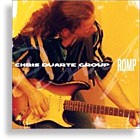
  • Chris Duarte – Romp

    Romp

    Chris Duarte is a unique voice in a batch of blues-rock guitarists who hail from down Texas way. His playing, while rooted in many of the same influences the other fellas have, is daring and subtle in ways that their playing isn’t. He’s not afraid to take chances, and his solos often bring a smile to your face because of their unique qualities.

    The kick-off is “Do the Romp,” a Junior Kimbrough chestnut. It’s plain ol’ rough-and-rowdy blues rock. And Duarte’s solo follows suit. Downright nasty! Another tasty cover is one of my favorite Dylan tunes, “One More Cup of Coffee.” It starts as a quiet, almost folksy tune, with a vocal that’s as much spoken as it is sung. By the time he’s done, Duarte has transformed it into the tale we’re all used to with loud, very lyrical guitar playing. As far as originals, it’s tough to top the very scary “Last Night.” The lyric is backed up by the use of incredible dynamics that really drive home the point of the words. And his solo is about as good as it gets. “Mr. Neighbor” is one that should be required to lots of folks who live in the ‘burbs like I do. The instrumental “Like Eric” is exactly what you’d expect – a tribute to Eric Johnson that lets Duarte show off a creamy, singing tone that replaces his normal Strat sound.

    As far as vocals go, his fit the music perfectly. Sometimes gruff, sometimes soft and caressing, usually perfect. Chris’ band is fine, too. John Jordan on bass, and Ed Miles on drums round out the trio. They work great together, and the trio setting also lets Chris drive the songs where they need to go.

    If you’re not familiar with Duarte, check out this one or any of his older CDs. Also, check him out when he comes to your town. It’s a nice musical experience.


    This article originally appeared in VG‘s June ’04 issue. All copyrights are by the author and Vintage Guitar magazine. Unauthorized replication or use is strictly prohibited.

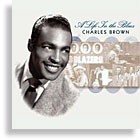
  • Charles Brown – A Life In The Blues

    A Life In The Blues

    This is more than just an album by the late R&B great Charles Brown. It’s truly the story of a life – a scrapbook of history, photos, testimonials, music, vintage film clips, a live concert, discography, and more packed onto a CD, DVD, and liner booklet.

    Brown was truly one of the stars of rhythm and blues. He boasted some 26 Billboard chart hits, numerous Grammy nominations, multiple WC Handy Awards, and a ’97 National Endowment For The Arts National Heritage Award. Last, but far from least, he was inducted into the Rock & Roll Hall of Fame in 1999, the year of his death.

    Above all, however, he made great music. This CD collects 10 tracks from a 1990 concert at the Lone Star Roadhouse, backed by a DVD film of the performance. The show includes several of his greatest hits, including “Drifting Blues,” “Seven Long Days,” and “Merry Christmas Baby.”

    Best yet are two short films of Brown with Johnny Moore’s Three Blazers in 1945. These “soundies” are part old-time kitsch, part classic cool, showing the band making R&B history.

    If you’re a Brown fan, you can’t be without this collection.


    This article originally appeared in VG‘s June ’04 issue. All copyrights are by the author and Vintage Guitar magazine. Unauthorized replication or use is strictly prohibited.