
Month: September 2006

  • Valley Arts Brent Mason signature model

    Pro-Level Versatility

    With a client list that included a who’s who of West Coast guitarists – Larry Carlton, Lee Ritenour, Tommy Tedesco, to name a few – Valley Arts gained a reputation in the 1980s for its custom guitars and professional repairs.
    Then, on the day after Christmas in 1990, a fire destroyed the company’s retail store, which accounted for the majority of its income. Devastated (and underinsured), McGuire and Carness opted against rebuilding.

    In November of 2002, Valley Arts was “born again” with the help of Gibson. Seeing potential for the line, and needing its own custom-build facility to handle lines it didn’t have at the time, the godfather of the guitar bought the Valley Arts name, and using space it already owned in Nashville, set up shop.

    In late 2003, Valley Arts opened a new facility in Nashville that includes a full-line music store, guitar repair center, a manufacturing facility, plus space for a restaurant and a music venue.

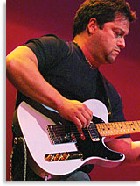
    Valley Arts and session king Brent Mason recently unveiled the Brent Mason signature model. Mason’s resume includes pretty much everyone, and he has won multiple Academy of Country Music “Guitarist of the Year” awards, as well as the County Music Association’s Musician of the year.

    Why do you suppose they’d pick him for a signature model guitar?

    The Mason model is a re-creation of his personal (and heavily customized) instrument, which he uses in the studio and live. It’s a classic single-cut, but with a much more versatile arsenal of pickups, and a unique look.

    Made of swamp ash carved in a traditional single-cutaway body style with a matte pewter finish, the Mason employs a bolt-on one-piece maple neck capped with a maple 14″-radius maple fretboard. The neck has a 251/2″ scale length, 22 polished medium frets, and dot markers. A very Fender-esque bridge sports steel saddles, satin-finished Sperzel locking tuners, Dunlop strap locks, and a gold control plate with chrome knobs. Pickups include a chrome-covered Gibson mini-humbucker in the neck position, a red-bobbined Seymour Duncan Classic Stack in the middle, and a Duncan Vintage Lead Stack in the bridge.

    Controls include a three-way blade pickup selector, volume control for the neck and bridge pickups, separate volume for the middle pickup, and a master tone control with a push/pull tap for the middle pickup. The separate volume for the middle pickup offer a total of seven pickup combinations!

    From a playability standpoint, our test guitar was fantastic, right out of the case. The action was comfortably low, and the neck has a “mixed” feel to it, the flatter fretboard radius and bigger “U” profile are definitely on the Gibson side, but the tension of the 251/2″ scale length gives it Fender feel, as well.

    The guitar weighs what you’d expect for the body style, and has a good, balanced feel. It took only a few minutes to get comfortable with the guitar, and the polished frets and flat-radius fretboard help it play effortlessly.

    We plugged into a Crate V5212 tube combo to check out the tone of the Valley Arts. The Duncan Vintage Lead Stack had a fat, punchy tone in the clean channel of the Crate, but like most stacked single-coils, it missed a bit of the snap and sparkle compared to a traditional Tele pickup. But that’s the price one pays for a hum-free sound.

    Blending the middle Duncan adds that missing bell tone, along with some nice out-of-phase sound. The combination sports a big, lush sound – very usable, with good note separation.

    Tapping the middle pickup thins the sound a bit, giving it more sparkle and high-end, but at the expense of some of that “roundness.”

    The big surprise was how well the Gibson mini-humbucker sounded. It wasn’t at all mushy or dull, like one might expect a humbucker to sound in the neck position. The tone is round and full, like a humbucker, but had some sparkle on the top-end, and good note definition. Even with the overdrive piled on, the pickup retained good note separation and definition. Typically, in a H/S/S setup, a humbucker – especially in the neck position – will overpower the single-coils and sound out of place. Not so with this guitar; all the pickups meshed very well together and sounded a matched set even though they were quite different from each other. Blending in the middle Duncan with the mini-humbucker gave a cool, lush tone reminiscent of a Stratocaster, and then adding the bridge pickup made the sound even bigger.

    The Mason signature is every bit what you expect when you take it from its case; a good-playing, great-sounding workhorse axe with a variety of usable tones. It might look a little funky, but in the guitar business, looks aren’t everything.


    Valley Arts Brent Mason model
    Type of Guitar Electric solidbody.
    Features Swamp Ash body, maple neck and fretboard, Seymour Duncan single-coils, Gibson mini-humbucker, gold and chrome hardware, locking Sperzel tuners.
    Price $3,000 (list).
    Contact Valley Arts


    This article originally appeared in VG‘s April ’04 issue. All copyrights are by the author and Vintage Guitar magazine. Unauthorized replication or use is strictly prohibited.
  • Eric Sardinas

    Hard-rockin' blues

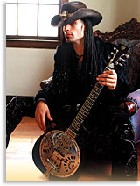
    By integrating traditional blues with heavier, more flamboyant rock styles, Eric Sardinas has carved a raw, fiery sound, favoring electric and acoustic resonator guitars to deliver the appropriate vibe.

    Growing up, Sardinas was exposed to everything from early Delta blues to Chicago blues to R&B, soul, and rock artists like Creedence Clearwater Revival, Chuck Berry, Led Zeppelin, and Jimi Hendrix.

    “Basically, my influences come from anybody,” he said.
    VG recently talked with Sardina s to discuss the making of his third disc, Black Pearls (Favored Nations), which was tracked live to analog tape and produced by the legendary Eddie Kramer.

    Vintage Guitar: Who were your main influences, early on?
    Eric Sardinas: I started playing when I was five or six, and was exposed to a lot of R&B, soul, and Motown music. I grew up listening to blues albums and buying blues records on my own, just out of the interest that I developed in blues.

    I grew up playing those things and I just wanted to push it into a different genre. As far as being influenced, I think everybody you hear and listen to influences you. It’s a big well of music that shapes and molds the spirit of where you draw from and what you feel when you’re connecting with your instrument.

    Had you started out playing slide?
    Well, no. I didn’t start out playing slide. I started out with a nylon string acoustic guitar. I started playing slide in my early teens, probably at around 13. I bought my first resonator guitar in a pawn shop. It was about two-hundred dollars. I was a teenager and it seemed like a million dollars to me.

    Which players were most inspirational as you began to shape your tone?
    My tone is just my own thing. I drilled pickups into my guitar, and that’s my tone. I didn’t derive it from anything except a screwdriver and putting electronics into my guitar, which was a Dobro. I found an old lipstick-tube pickup and I just basically just cut a hole in the guitar where I thought the pickup would go, and put it in there.

    Tell us about the material on Black Pearls. How did the songs come together?
    The record came together by collecting what I was thinking, and putting lyrical ideas together with musical ideas I compiled.

    I completed writing while working with Eddie Kramer, to see how we wanted to deliver the music. We agreed that the key is capturing the energy and magic, so that’s what we went for.

    How did you hook up with Eddie?
    I had him in mind because I heard my songs capturing the sort of energy you hear in the stuff he’s done with the Stones, the Beatles, and Zeppelin. It’s always got this really organic power to it and I really wanted the songs to breathe and be real. So I sent him the songs and we got in touch. He loved the music, and so we just started from there.

    How did working with Eddie make this experience different from your previous recording work?
    I really felt there was a mutual goal – to capture magic and let things be real – nothing else except creative. That allows you to do your best. We were on the same page, so it was nice.

    What was your setup for the recording?
    I used my custom Rivera amps and some vintage 4x12s, but most of it was through my custom-built Rivera head and Rivera 4x12s. I also had combinations with some ’60s Marshalls and stuff like that. I used my resonator guitars – my main two and a couple of steel-body guitars. I brought in a bunch just to have them around in case the spirit moved me for something else.

    What do you use live?
    It’s basically the same setup – the custom Riveras with a Rivera 4×12 and sub-bass cab. For guitars, I play the Washburn ES Cutaway and one of my older Dobros from [the early ’70s]. For effects, I have a wah and a Uni-Vibe.
    I do have the vintage stuff, but onstage I’ve been using the Dunlop wah and Uni-Vibe, and the Dunlop Preaching Pipe – my signature slide, which is brass. I use .013-.058 Gibson phosphor bronze acoustic strings on all of my guitars, and I use Dunlop thumb picks.

    Tell us about your signature model Washburns.
    I’ve had my own guitars forever, just because I did them myself. And I’ve had other companies design outlines for what I want. I’ve been using alot of those guitars forever, but Washburn wanted to work with me [to] build a guitar. So we worked on the design. [I wanted it] to function in an electric format and in acoustic formats, so there are acoustic and electric versions. They’re two different body shapes and body styles, so the acoustics are different. But both have resonators, and they revolve around the same woods. One has a different barrel because of the shape of the body and its cutaway.

    There are other aspects of the design that are different because there are certain things I thought were necessary for the electric; things like a reflective surface on the back of the resonator cone that helps project the sound out of the barrel. Plus, the cuts on the sound barrel of the electric are angled to project a little more, for greater contact with the pickup, as opposed to the more basic, straight-ahead acoustic.

    Which of your personal guitars were they modeled after?
    I created my own resonator, and I’ve got about 25 of them. So it stemmed from what I like in the shape of the body, the tones, and the woods. I prefer ebonies, and really basic ply bodies. I have tons of guitars that are so beautiful, but [looks are] unnecessary for tone. The cheaper it is, the better it sounds. I’m all about the runt of the litter when it comes to guitars.

    Do you have a collection of vintage instruments?
    I have many, and I really don’t delve into them as often as I’d like… unless I’m recording or writing. You can have 10 guitars that are exactly the same, from the same year, made one right after another, and none of them will sound exactly alike. They all have personalities, whether they’re steel bodies, or walnut, or flamed maple, or just traditional wood-body guitars. They’re all different and have great sounds.

    So I love everything from my ’30s National tri-cones to the guitars I play onstage.

    What advice can you offer to other guitarists on developing their style and tone?
    If you love playing guitar, play it for yourself and be yourself. Write music and forge your own way, because you can do anything you want with it.

    What advice can you offer on becoming a better songwriter?
    I’m always growing and I’ve got a long way to go. I think it’s a real gift to be able to communicate an idea or a thought or a feeling, and transpose it into a song. There are a lot of elements that go into that.

    Just keep those channels open, always write down your ideas, and try to write songs, no matter how bad they may be. You never know what might come out of it.


    Photo courtesy Favored Nations.

    This article originally appeared in VG‘s Feb ’04 issue. All copyrights are by the author and Vintage Guitar magazine. Unauthorized replication or use is strictly prohibited.

  • Epiphone Model M Steel

    The Epiphone company already had a long history when it hit big with banjos in the early 20th century. And it was quick to change with the times as musical tastes and the needs of musicians changed.

    For example, in response to Gibson’s violin-like L-5 archtop guitar, Epiphone fired what could only be termed a preemptive strike on the archtop market by introducing no fewer than 10 new archtop models in 1931! Clearly, a line had been drawn. So it was that Epiphone went toe-to-toe with Gibson (and to a lesser extent, Gretsch) for the next 25 years on guitars of all types, including the Epiphone Model M lapsteel.

    The Model M was at once one of Epiphone’s earliest, fanciest, and as it turned out, short-lived steel guitars. Introduced in ’37, it was also one of the company’s earliest forays into the electric guitar market. Guitar manufacturers were cautious about the possibilities of amplified music and the market for electric instruments. Hawaiian music, still popular some 20 years after it burst on the scene, lent itself to amplification and, while not exactly loud, early electrically amplified steel guitars were louder than the resophonic instruments produced by National and Dobro.

    While many of the early amplified steel guitars resembled planks of wood with a pickup, the Model M was a professional-grade instrument with an inspired art-deco appearance defined by stairstep sides and a plexiglas-covered painted metal top with an artistic design. The standard model was typically a six-string, but seven-string and eight-string models could be custom-ordered. All came in a specially designed hardshell case, many with the Epiphone “slashed E” logo embossed in the felt lining.

    The special-design pickup was typically large, and the output was decidedly lacking in high-end response. Early versions used a horseshoe pickup, but an update in ’38 brought a more conventional coil-wound unit with adjustable polepieces and a fixed handrest.

    Tuners were open-back Grover “butterbean” style and were gold-plated on some instruments. The rosewood fingerboard had different-colored dot markers to make locating positions easier, and the headstock had an Electar logo. No doubt thought up by some marketing specialist, Electar was Epiphone’s early trademark design for its electric guitars. Indeed, some did not even carry the Epiphone name, as the company still considered the market for electrically amplified instruments to be small, volatile, and lacking growth potential.

    Okay, they were wrong. But at the time, who knew? With much of the country’s economy mired in a depression, Epiphone’s only hope for survival was to play it safe.

    At any rate, the Model M’s pickup design, and consequently its sound, had only limited appeal. It was discontinued in ’39. Today the Epiphone Model M Lap Steel is sought by collectors primarily for its looks rather than sound. Neither common nor rare, it is just as often encountered in seven or eight-string variants as the standard six-string, and is an attractive piece of electric guitar history.


    This article originally appeared in VG‘s Feb. ’02 issue. All copyrights are by the author and Vintage Guitar magazine. Unauthorized replication or use is strictly prohibited.

  • September 2006

    FEATURES

    LEFTY FRIZZELL’S GIBSON/BIGSBY J-200
    Lefty Frizzell was one of country music’s most influential artists, and a true honky-tonker. With his first royalty checks, he bought a diamond ring, a Nudie suit, and this SJ-200, and took it straight to Paul Bigsby. By Dan Forte

    GUILD STRATFORD X-350
    Few companies have successfully marketed both acoustic and electric guitars. Once Epiphone was no longer an independent company, Guild was Gibson’s only real competitor in the archtop market. By George Gruhn and Walter Carter

    NUDIE’S MOSRITE MANDO
    In the mid 1970s, Kosmo and Kathy Cominos collected knives, jukeboxes, wristwatches, etc… But their favorite finds were celebrity-associated musical instruments like this unique Mosrite mandolin, built for Nudie Cohn, the renowned cowboy tailor. By Ward Meeker

    G.L. STILES SOLIDBODY
    Its hint of “American primitive” construction proves it’s one of the earliest guitars from the renowned West Virginia luthier. After considerable detective work and with a lot of luck, we‘ve saved Stiles’ story from possibly slipping into obscurity. By Michael Wright

    ICON CORNER
    1973 Zemaitis Doubleneck
    Zemaitis instruments are true works of art, with the ultimate “Who’s Who” list of players. And while all Tony Z. axes have unique tops, this is perhaps one of two doublenecks by the late master. By Willie G. Moseley

    TOM SCHOLZ
    A Wizard Re-Works His Magic
    As a 20-something product engineer, he spent his spare time recording songs in his basement. Those songs became part of a 17x-platinum album, and were recently given a fresh digital polish. By Ward Meeker

    MARK SEBASTIAN
    Craving For Craviolas
    As a teenager in the mid ’60s, he co-wrote a smash hit for the Lovin’ Spoonful. And as a burgeoning recording artist in the early ’70s became an endorser for the unique Giannini Craviola. By Willie G. Moseley

    THE DIFFERENT STRUMMER
    Engineering Art: German Guitars, Part I
    If Germany hadn’t been defeated in WWII, German guitars might never have been a part of the American guitar landscape. And if it weren’t for the Beatles, a discussion of them might be academic! By Michael Wright

    DEPARTMENTS

    Vintage Guitar Price Guide

    Builder Profile
    DM Darling Guitars

    Upcoming Events

    Vintage Guitar Classified Ads

    Dealer Directory

    Readers Gallery

    FIRST FRET

    Reader Mail

    News and Notes
    Clifford Antone remembered, Easton update, new releases, Montreaux Jazz on DVD, In Memoriam, more!

    Rick Nielsen
    Rockford State of Mind
    By Willie G. Moseley

    Nick Colionne
    Smooth and Cool
    By John Heidt

    Ask Zac
    By Zac Childs

    J.J. Cale
    Up Close & Personal
    By Dan Forte

    Gary Moore
    Remembering Phil Lynott
    By Willie G. Moseley

    Eric Gales’ Crystal Vision
    By Oscar Jordan

    Andy Timmons
    No Texas Typecast By Willie G. Moseley

    Dueling Gut-Strings
    The Blazing Guitars of Del Castillo
    By Dan Forte

    COLUMNS

    Q&A With George Gruhn

    Acousticville
    I Want to Be Like Mike… and Matt
    By Steven Stone

    Fretprints
    Jeff Beck
    By Wolf Marshall

    TECH

    Dan’s Guitar Rx
    Bolt It On!
    By Dan Erlewine

    Guitar Shop
    A Cluster of Queries
    By Tony Nobles

    Amps
    Simply Functional
    By Gerald Weber

    Ask Gerald
    By Gerald Weber

    REVIEWS

    The VG Hit List
    Music and Video Reviews: Booker T. & The MG’s, Buck Page, Popa Chubby, Hacienda Brothers, Gary Moore, Freddy King, Darrell Scott, Fogerty Long Road Home DVD, more!

    Check This Action
    Music With No Expiration Date
    By Dan Forte

    Vintage Guitar Gear Reviews
    Charles Fox Ergo, Ernie Ball Axis SS and SM-Y2D, Nik Huber Orca, Magnus Ultimate Attenuator

    Gearin’ Up!
    The latest cool new stuff!