

Month: April 2006

  • Danny Marks – Big Town Boy

    Big Town Boy

    On his Off The Floor Live! album, from 1996, Amos Garrett talks about all the clubs and acts he heard as a kid along Toronto’s Yonge Street – the Shays, David Clayton Thomas’ pre-Blood Sweat & Tears, with Freddie Keeler on guitar – over a John Lee Hooker boogie. Stuff we never heard “south of the border.”

    Danny Marks has filled that void with a trip through space and time, back to the Toronto scene of the ’60s. Or I should say, the Toronto radio scene – because it’s a mix of local heroes, Canadian covers of English and American hits and B-sides, and the eclectic sounds that were streaming out of the radio when radio was cool. So the repertoire represents a regional scene, but isn’t confined to a regional sound; it encompasses all the sounds that were blasting into and out of Toronto – some blasted by Marks himself. And he recreates the Shays’ “Take Me Back” in perfect garage fashion, with a gnarly nod to the aforementioned Keeler.

    Thanks to excellent, no-nonsense production by bassist Alec Fraser, with assists from Marks and drummer Leon Stevenson, the sound is great throughout, without resorting to nostalgia or gimmicks.

    Similarly, Marks plays what the tune calls for, not what would show off his hottest licks. In other words, he’s got taste – even when all a song like “Tiger” needs is a repeated one-note bend through the 12-bar changes. The Fabian cover is one of the CD’s two non-Canadian entries, and if you’re thinking Fabian personifies the lightweight end of early rock and roll, you’re right – but Danny proves that “Tiger” is a cool song, nonetheless.

    Our friends to the north got a lot of these songs second-hand – so the Sevilles’ classic “Charlena,” was a standard by Ritchie Knight And The Mid Knights; Young Jessie’s “Mary Lou” was a bigger hit by Ronnie Hawkins whose part-Canadian combo, the Hawks, later became the Band.

    The album closes with Danny covering himself (as it were), with Edward Bear’s 1970 hit, “You, Me And Mexico.” All I need now is a compilation CD of the original (or, I should say, Canadian) versions of these songs. Marks has piqued my interest.


    This article originally appeared in VG‘s May ’05 issue. All copyrights are by the author and Vintage Guitar magazine. Unauthorized replication or use is strictly prohibited.
  • Kramer Duke

    If you think the headless, downsized Kramer Duke series was conceived and designed as a copy of the groundbreaking Steinberger bass, think again, because that’s not half of the story.

    Kramer began producing its eye-catching aluminum-neck instruments in the mid 1970s, touting their resistance to neck warpage and other problems. The aluminum necks had a slightly T-shaped profile, with wood inserts on the underside in an attempt to evoke a more natural feel. Fretboards were made of Ebonol, a substance similar to the material used in bowling balls.

    While inspired by the even more unique Steinberger bass, the Duke series happened somewhat accidentally. According to a former Kramer employee, another model, the TL-8 eight-string bass (which had four tuning pegs on the headstock and the extra four anchored to the end of the body), was experiencing production problems, and when he happened to chop off the wood “wings” of one, he noticed the Steinberger-like silhouette with the remaining body portion and strings attached to it behind the bridge. Hacking off the headstock conjured up even more of a Steinberger-ish profile, so the first 100 or so Dukes were made from bodies intended for TL-8 basses. All Duke necks have wood inserts, but they were painted over to match the body.

    Duke models differed from Steinbergers in more than one facet. Kramer’s effort at the downsized style had a short-scale of 301/2″, while the original had a full 34″ scale. Unlike Steinbergers, which were intended for use with double-ball/quick-change strings, Dukes used regular bass strings, with the ball end anchored at the headless portion of the neck. Regular strings could be used on Steinbergers if a special clamp was installed. Moreover, the tuners on Steinbergers were knurled and cylinder-shaped, whereas Dukes used conventional Schallers in a deeply routed area on the end of the body.

    Both brands eventually offered headless guitars, and on Kramer Dukes, a set of string posts was installed behind the bridge to guide each string to its tuner.

    The Duke bass was available in two models – the Standard and the Deluxe. Pickups were usually DiMarzios on Standards and a Schaller “Double J” on the Deluxe, which also offered a three-way mini-toggle for series, parallel, or phase pickup coil selection. The Deluxe also came with an upgrade Schaller bridge/tailpiece.

    There are other differences on Dukes; the bottom edge of the white Deluxe seen here sports a ridged “pad” to allow the instrument to rest in a more stable manner on a seated player’s leg. And while the jack on the Deluxe is on the same bottom edge, the Standard’s jack is on the top, where the mini-toggle is on the Deluxe. Some variants may be encountered, however; a Standard might be found with a bottom-edge jack, for example. Both instruments sport aftermarket graphics.

    As for sound, well, Duke basses are “sonically challenged,” for a couple reasons – the smaller body and the short scale both detract from realizing decent resonance compared to most full-scale basses with normal-sized bodies. However, they’re extremely lightweight and easy to play, and their pickups provide decent sound.

    Kramer Dukes were the last of the aluminum-neck Kramers. Usually found in black or white (though other colors exist), these small, easy-to-handle instruments represent a brief and interesting glimpse at not only the Kramer company, but the saga of American guitar building.


    Early-’80s Duke Deluxe, serial #B6038 (white) and an early-’80s Duke Standard, serial #B3736 (black). Instruments courtesy of Charles Farley and John Kotlowski.

    This article originally appeared in VG‘s Aug. ’04 issue. All copyrights are by the author and Vintage Guitar magazine. Unauthorized replication or use is strictly prohibited.

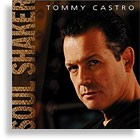
  • Tommy Castro – Soul Shaker

    Soul Shaker

    It’s time to give Tommy Castro his due. And with this new record, he might actually get it. For years, he has played the blues circuit, doing his thing – singing about as well as anybody, playing guitar forcefully and soulfully, and being the ultimate showman. He has released fine records in the process. This one seems to have a little more soul influence. And that’s a good thing.

    Very few voices in the music industry can do this style of music this well. The Southern soul of “Anytime Soon” is a vehicle for Castro’s voice. His rhythm guitar helps set the pace for that one. Same for the uptempo “What You Gonna Do Now?.” Throw in a solo full of double-stops and chord work, and you’ve got a winner. The boogie-soul mix and pull-offs on “Take Me Off the Road” match the urgency of the lyric. Funk takes over on “Big Love” with a blistering, in-your-face wah solo. The title cut is exactly what it says. It also gets a push from the slide guitar of Roy Rogers. All of these tunes were written or co-written by Castro. All are driven by his guitar, his voice, and some nice horn charts.

    I’ve always enjoyed Castro’s material and his pure command of this style of music. In a perfect world, this album would break a very talented artist. If you’re unfamiliar with Castro, check this one out. Then move backwards through the catalog. The reward will be well worth the effort.


    This article originally appeared in VG‘s March ’05 issue. All copyrights are by the author and Vintage Guitar magazine. Unauthorized replication or use is strictly prohibited.

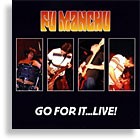
  • Fu Manchu – Go For It… Live!

    Go For It... Live!

    Britain’s NME magazine nailed Fu Manchu’s oeuvre when it dubbed them “damn near the most conceptually perfect rock band since the Ramones.” Now comes a damn near perfect double live album. Fu’s concept: Southern Cali pinball playin’ surfer dude into classic American muscle cars, ’70s hard rock and skate punk, belting fuzzed-to-the-gills, yet economical and catchy riffs cranked to 10… er, 11. No frills. Loud-fast-rules for maximum impact. Certainly not far removed from the Ramones’ glue-sniffin’ NYC street-brat shtick.

    Recorded on the Cali quartet’s ’02 international tour, the two-disc Go For It features 22 songs culled mainly from Fu’s last three CDs. There are enough old-school Fu nuggets to satisfy longtime fans, though (the band has been recording and touring for more than a decade). The sound is excellent, the performances are head-buttingly strong, and there’s no time for useless stage banter.

    If you aren’t lucky enough to own a tricked-out ’72 Camaro, pop this in the player, hit the gas, and you’ll feel like you do. That’s truly one of the beauties of Fu. Sex on four fat tires. Killer tracks: “Boogie Van,” “Regal Begal,” “Downtown in Dogtown” “Weird Beard” and the band’s awesome longtime live cover of BOC’s classic “Godzilla.”

    Ultimately, Fu’s got such a sly wink-wink I’m-in-on-the-joke-myself-man, sense of rawk and fun (again, like da Ramones) you can’t help but want to join the club.


    This article originally appeared in VG‘s Feb ’04 issue. All copyrights are by the author and Vintage Guitar magazine. Unauthorized replication or use is strictly prohibited.

  • April 2006

    FEATURES

    BRAD PAISLEY
    Even though his name is dropped on major-celebrity news shows and he has performed on Letterman, Conan, and Kimmel, Brad Paisley is still a hardcore guitar guy. We take a listen to his new record and a peek at his collection of guitars and amps. By Zac Childs

    JOHN MONTELEONE
    The Next One Is Always The Best One
    One of the premier builders practicing the art today, he lacks formal training as a luthier. From summers spent working as a pattern maker in his father’s shop to his Quattroport model, we tell his story. By George Gruhn

    BRIAN BROMBERG
    Bass All Over The Place
    He has gigged with numerous notables, is a longtime session player in L.A., and has designed and helped market several models of professional-grade electric solidbody basses. By Willie G. Moseley

    BASS SPACE
    Windy City Weirdness
    Fun to plunk and funky-sounding, the Harmony H22-1 electric bass arrived on the scene late from the Chicago-based instrument manufacturer, but nonetheless offers a nice time-warp experience. By Willie G. Moseley

    SOVEREIGN AUDITORIUM
    Most are only vaguely aware that two names associated with a major East Coast guitarmaker stretch back to the late 19th century – a company whose legacy is belied today by pale memories and shadows, but can indeed be savored in guitars like this. By Michael Wright

    THE DIFFERENT STRUMMER
    Molding a New Idea of Guitars, Part 3
    No more trees! Well, that may be a bit premature. But it doesn’t hurt to consider the possibility that the traditional timbers we know and love may not be available in the future. By Michael Wright

    DEPARTMENTS

    Vintage Guitar Price Guide

    Builder Profile
    WCR Pickups

    Upcoming Events

    Vintage Guitar Classified Ads

    Dealer Directory

    Readers Gallery

    FIRST FRET

    Reader Mail

    News and Notes
    PRS wins again, Martin museum, Ventures Grammy nod, In Memoriam, Stolen Gear, more!

    Hank Marvin
    England’s Original Guitar Hero
    By Elliot Cohen

    Rocky Athas
    Touch of Texas VooDoo
    By Ward Meeker

    Jon Butcher
    Back To Barefootin’
    By Willie G. Moseley

    Alex Lifeson
    Three at 30
    By Willie G. Moseley

    Ask Zac
    By Zac Childs

    Deke Dickerson
    Confessions of a Guitar Geek
    By Teisco Del Rey

    Stoll Vaughan
    Lead-In For Legends
    By Willie G. Moseley

    Roscoe Beck
    All Over the Map
    By Willie G. Moseley

    COLUMNS

    Q&A With George Gruhn

    Acousticville
    Twelve Strings, Lots of Punch
    By Steven Stone

    Fretprints
    Kenny Burrell
    By Wolf Marshall

    Guitars With Guts
    1955 Marcelo Barbero Flamenco
    By R.E. Brune

    Gigmeister
    Will ’06 Be The Year?: Seven Ways to Improve Your Playing
    By Riley Wilson

    TECH

    Dan’s Guitar Rx
    Black Beauty
    By Dan Erlewine

    Guitar Shop
    PAFs: Reissue vs. Real
    By Tony Nobles

    Amps
    Better Reverb Reliability
    By Gerald Weber

    Ask Gerald
    By Gerald Weber

    REVIEWS

    The VG Hit List
    Music, Book and Video Reviews: Otis Rush, Greg Koch, British Blues Revival, Southern Culture on the Skids, The Blackguard, and more!

    Check This Action
    Who Needs Pickups?
    Dan Forte

    Vintage Guitar Gear Reviews
    Warren Classic II, Garcia Amplification 60-watt, Taylor T5, Subdecay Liquid Sunshine, Kangaroo Covers

    Gearin’ Up!
    The latest cool new stuff!