Month: May 2003

  • Motorhead – Hammered

    Hammered

    In these uncertain times, thank goodness for reassuring constants: mom’s home-cooked meals warming the belly, the Red Sox not winning a World Series… and Motorhead frying eardrums.

    Like the Ramones, Motorhead does one thing, and does it extremely well, again and again (in this case, a take-no-prisoners amalgamation of speed/punk/metal). Forget reinventing the wheel, Motorhead just wants to ride the sucker fast ’til it crumbles into dust. And Hammered does the job nicely. Indeed, there’s something downright life-affirming about 56-year-old “Lemmy” Kilmister, Motorhead bassist and founder, rocking out as loud as a midnight missile attack.

    Hammered continues the 25-year-old group’s tradition in admirable style. All the trademarks are here, most notably Lemmy’s thundering bass and gnarled croak of a voice juiced along by Phil Campbell’s thick humbucker tones peppered with wah and flanged solos. Standout tracks include “Voices from the War,” Lemmy’s thoughtful rumination on the fate of history’s dead soldiers; “Shut Your Mouth,” which cribs from the band’s classic “(We Are) The Road Crew” while managing to pummel with just as much intensity; and “Red Raw,” which ups the m.p.h. rating to the delight of all speed metal heads. The highlight, meanwhile, might just be the boogie-fried “Dr. Love,” which indicates repeated listening to mid-’70s ZZ Top.

    Conclusion: Hammered is mandatory on-the-job listening for all 18-wheel truck drivers. It’s further proof that on the Mount Rushmore of Heavy Music, Lemmy’s beautiful mug shines bright as ever.


    This article originally appeared in VG‘s July ’02 issue. All copyrights are by the author and Vintage Guitar magazine. Unauthorized replication or use is strictly prohibited.


  • Omar & the Howlers – Big Delta

    Big Delta

    In his 22 years as a recording artist, Omar Dykes has churned out a steady stream of solid albums (more than a dozen to date), but lately seems to be on a creative roll. He answered the multitude of jump-blues wannabes with 1999’s Swing Land, and in 2000 The Screamin’ Cat brought a new wrinkle from former Killer Bee Malcolm Welbourne in the producer’s chair. This time Welbourne (a.k.a. Papa Mali) co-produces with engineer Max Crace, and spices Omar’s meat-and-potatoes blues guitar with Dobro, slide, baritone guitar, and electric sitar.

    Smart money would normally advise against backing a primitive like Omar (think Howlin’ Wolf) with a rhythm section whose collective credits encompass Eric Johnson, Frank Zappa, Leonard Cohen, Missing Persons and Lee Michaels. But from “Linin’ Track,” the work song that opens the program (about as unadorned as you can get), to the loose “Conversation Mambo” that closes the set, bassist Roscoe Beck and alternating drummers Terry Bozzio and B.E. Smith (better known as “Frosty”) sound like they were born in the same Delta as Omar – or at least got there as soon as they could.

    Selections from earlier Omar albums are revisited and reinterpreted here, with fresh results every time. Beck and Bozzio dig the ultimate groove through “Monkey Land,” a Dykes original that reveals a sense of humor and irony that recalls Willie Dixon. Frosty is behind the kit for “Muddy Springs Road” and “Mystery Walk,” both of which nod in the direction of Tony Joe White. The album’s catchiest melody is “Bad Seed,” co-written by Omar and R.S. Field, which again features some oddly appropriate electric sitar.

    The focus here is on the songs and Omar’s gravelly baritone. When he does stretch out instrumentally, as on the slow blues, “Life Without You,” it’s strictly business – and Omar & Co. get down to it.


    This article originally appeared in VG‘s May ’02 issue. All copyrights are by the author and Vintage Guitar magazine. Unauthorized replication or use is strictly prohibited.

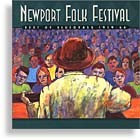
  • Newport Folk Festival – Best of Bluegrass 1959-1966

    Best of Bluegrass 1959 - 1966

    Before Farm Aid, Telluride, or even Woodstock, there was the Newport Folk Festival. Begun in the late ’50s, this yearly gathering molded and defined a generation’s tastes in music. It was the all-star event of roots music. Vanguard’s just-released pair of three-CD sets, one for blues and one for bluegrass, let us hear what some of the greats sounded like when they were on top of their game.

    The bluegrass box features Hylo Brown and the Timberliners, The Stanley Brothers with the Clinch Mountain Boys, Lester Flatt and Earl Scruggs and the Foggy Mountain Boys, Jim and Jesse and the Virginia Boys, Don Stover, The Lilly Brothers with Don Stover and Tex Logan, Hazel Dickens and Alice Gerrard, and the father of Bluegrass, Bill Monroe. The Bluegrass Boys who performed behind Bill for this 1965 set included Peter Rowan on guitar and lead vocals, Tex Logan on fiddle, Don Lineberger on banjo, and James Monroe on string bass.

    While some of this material has been previously released, there are 16 tracks that have never seen the light of day. Since bluegrass is primarily ensemble music that makes extensive use of improvisation, studio albums (especially from the mid 60s) rarely capture the true spirit of the music. These Newport performances offer us a priceless glimpse of what these bluegrass pioneers could do when playing live before an appreciative audience.

    If you’re a serious fan of bluegrass, you can’t consider your collection anywhere near complete without these CDs. They are as essential as air or water.


    This article originally appeared in VG‘s July ’01 issue. All copyrights are by the author and Vintage Guitar magazine. Unauthorized replication or use is strictly prohibited.
  • Mark Sampson: Matchess

    Man

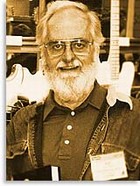
    The garage behind Mark Sampson’s Southern California home is a Batcave for vintage tube amp lovers. Dark, dusty storage areas are crammed with ancient tan-colored Vox AC-10 “TV” models from the late ’50s, Super Beatles with chrome stands, original mint-condition Vox sales and promotion banners. There are also prototypes of the superb Matchless amps Sampson designed and assembled here on his work bench amid a clutter of electronic parts and pieces, wonky graying tube testers and oscilloscopes that look as if they were taken off a World War II battleship. The venerable old Vox and sleek new Matchless amps exist side-by-side, one informing the other.

    Of course, Matchless has long outgrown Sampson’s garage. There’s a new factory in Pico Rivera. The product line has been expanded from the original DC-30 amps to a full range of heads, cabinets and combos of all sizes, and there’s also a series of heavy duty active pedals featuring analog-friendly 12AX7s.

    Sampson’s journey began in another garage, amid the world of drag racers and street rods in his native Mason City, Iowa. He did 10 years as a professional drag racer on the local circuit, building and modifying street rods, competing in custom car shows. Much of his interest in design engineering was formed during this period.

    “I worked in a shop where a guy could walk in with an idea in his head, and if he kept his bills current, nine months later drive it away,” he said.

    Another influence was his father, a TV repairman and tinkerer who handed down the know-how to read a circuit and a voltage meter and, most importantly, a curiosity about how electronic things worked. Then, of course, there was the Beatles.

    “I can remember a very detailed plywood collage I made when I was 12,” he remembers. “It showed the four of them standing on a stage complete with Rickenbacker guitars and Vox amps.”

    As he labored in the street rod shop by day, Sampson played in rock bands by night. His parents were as much relieved as supportive of the music.

    “I’d been racing dragsters for a living, so they saw this rock and roll band stuff as toned down.”

    The band would gig, and the amps would inevitably break down. Sampson couldn’t find anyone to fix them, so he took on the repair tasks himself. “Playing in the band taught me everything. Equipment breaks down on the road, that’s the story of every band. I was the fix-it guy. I learned a lot about how things worked.”

    As his band traveled, Sampson searched for the English Vox amps his heroes played, but there were none to be found in Mason City. “Nobody cared about amps back then. It was better to have a new, dependable amp.”

    He started making trips around the music stores of the Midwest and finally found a few Voxes at a Minneapolis store called Knut-Koupeé. He was still custom painting cars and worked a trade for the Vox amps by painting guitar bodies for Knute.

    One of the store’s more notable customers was Prince (back in the days when he had a name). Sampson painted two of the guitars used in the movie Purple Rain and ended up doing a lot of deals, trading his painting services for guitars and amps. He ranged further afield in his quest to locate British amps. James Werner, noted for his Fender serial number lists, put Sampson together with a trader in England Sampson describes as “…sort of the British inverse of me.” Soon, Fenders were being shipped to England and Voxes, Marshalls, and Hiwatts were coming to Iowa.

    “I was exposed to the British side of design and manufacturing,” says Sampson. “I amassed a collection of sounds, just because I wanted to know. I had a curiosity about why something sounded the way it did. I did a lot of reverse engineering of those English amps. A lot of them were in various stages of disrepair, which kept the prices down. You could buy an AC-30 for the equivalent of about $225. There was no market for them. This was in the early ’80s. A plexi Marshall cost about the same. If you had a piece owned and documented by someone famous, it was worth more, but not much. I remember buying a bass rig off one of the guys from Badfinger. It was an AC-50 in a small cabinet with a 15″ and a 12″ bottom. It was only 50 lbs. over normal price. I wish I’d kept it.”

    Sampson’s band was his testing ground. “But I was the only one interested in this English gear and it caused problems because, like any band, you’re trying to define yourself, your music and direction, and the other guys never knew where I was going. One week I’d show up with a Marshall half-stack and an SG Jr. The next week it’d be a Strat with a Bluesbreaker. I can understand now how frustrating it must’ve been for them, not knowing from week to week what I’d show up with or how I’d sound, but at the same time I wanted to know what these things were about. I tried to tell them, ‘Just don’t worry about me, I’ll come through. You take care of your deal and we’ll be fine.”‘

    Listening with a critical ear to a variety of British amps, Sampson began to note the differences in sound design.

    “There is a peculiar midrange thing all British amps do that American amps do not. And, of course, between British amps there are big differences. An AC-30 and a Marshall JTM-45 sound absolutely nothing alike when they’re clean or breaking up. But they both sound, in the midrange, unlike an American-made amp. Vox blue speakers don’t transfer the top-end like an American speaker does. They have a decided lack of bottom due to a lack of magnetic strength in the Alnico (compared to a ceramic), but a delightful, pleasing midrange. Celestion speakers are not as tight, and don’t carry the bottom end of American speakers. Having said that, the tweed Fender Bassman is almost the total exception to the midrange rule. Although the 10″ speakers tend not to have the midrange character a Celestion might have…to my ears.”

    Sampson saw how cultural differences between Americans and Brits influenced their amp designs.

    “Most design engineers agree that American stuff – and this goes for more than just amplifiers – tends to be overbuilt. Unless it’s on the very low end, it won’t break down. Whereas the British tend to make things a little finer, with nicer looks and detail, but with a trade-off in reliability. This could go for their car designs, as well. Anyone who loves Jaguars will see that.”

    Early Marshall amps had perceived reliability questions among vintage filament heads. But Sampson’s experience has shown him old Marshalls can hold up fine if they are biased right and have the correct tubes.

    “There was this perception, when the company switched from EL34s to sturdier but different-sounding 6550s, that quality control had suffered and the amps weren’t being built like they used to, and there might’ve even been some truth to that, as the company was expanding its market and wanted their export amps to avoid a rash of tube blowout problems. But it was simply a matter of re-biasing the amps to accommodate whichever tubes you wanted to use.”

    Looking into the work of another esteemed amp builder, Hiwatt’s Dave Reeves, Sampson found Hiwatt’s solid-core wiring created its own problems. “I’ve seen them wiggle and break. I don’t like solid-core wire and Hiwatts use a lot of it. Granted, they are fixed very neatly in nice right angles. You can see Reeves’ military influence. And the amps sound good.”

    But the sound and heritage of a Vox AC-30 was Sampson’s primary reference. He tracked down and bought all of Vox inventor Dick Denny’s original blueprints and schematic diagrams. He cultivated relationships with former Vox employees.

    “I’ve got a 10-page letter from the lady who was Tom Jennings’ first employee. She worked with him from ’52 to ’62. Her story was just amazing. This is post-World War II England, there’s nothing left of the country, the buildings have all been blown up, the economy is crap. It’s a shambles. And it’s just her and Jennings.

    “Jennings was a conservative man. He wasn’t so involved with the circuit design – that was Dick Denny’s. But he was very concerned with the company image, and what the product looked like. He was the one who painted Vox’s Celestion-made speakers blue just to distinguish them. And this lady was quite loyal to Jennings. He helped her family through tough times. He gave them food when there was no money. She stayed with him until the Beatles hit.”

    From the Vox employee and other sources, Sampson built a database on the Vox company, logging serial numbers, transformer changes, production dates. He calculated how many units the company was building, about 100 a day by 1963. According to a best guess, Vox built somewhere around 20,000 amplifiers in the course of seven years.

    “And they weren’t cheap, at least not for the working class and the average musician. It would’ve taken the average workman’s yearly wages to buy one,” Sampson said.

    Sampson remembers going to buy a Vox Super Beatle in 1966, “…and it was about $1,300, the price of a Corvair. That was a fortune back then, so you’d only see those amps with rich kids and rock stars on TV which is, by the way, a great marketing ploy if you can pull it off. Here is this amp that is seriously expensive, that the stars are using, and you figure they can afford the best, so you really have to have something that hits a home run with them before they’ll consider using it. They just won’t use some schlocky piece of gear even if it’s free, because they don’t respect that, either. Having the name of your amp on TV being played by stars, that’s the best kind of advertising there is.”

    While trading overseas, Sampson made his ultimate amp score right in his home town. “Carlton Stuart Music in Mason City was the store of my youth,” he said. “It was a place where mom and dad could come in and buy Junior a trumpet. I’d forgotten about this place when I started on my search of Vox and English amps. So I went in there and found a lady who understood what I was looking for. She pulled me aside and told me to come back on Saturday. I was intrigued. What? What are you gonna show me? She just said, ‘Come back Saturday.’

    “I wasn’t sure what was going on. The owner of the store had passed away, and the store was in probate. I went back, and this lady takes me upstairs to the storage area. We go through a fire door. It felt like nobody had been up there in years. The lady starts talking about an older man who had died up here under strange circumstances. The fire department had to seal the area off. I’m listening to this, and I’m feeling just a little buggy. Then she slides open a door and I walk into a room filled wall-to-wall with original Vox instruments, amps and guitars and Continental organs with price tags hanging off them, still wrapped in plastic shipping cases. There were Beatles and Stones endorsement posters on the walls. The same vomity green shag carpeting from the ’70s. It was like the Twilight Zone!

    “The store owner had literally shut the door to this room in 1972 and left all the instruments inside because Vox had gone bankrupt. I bought the whole inventory for $250 and the lady was happy to get the stuff out of there. I loaded the car as fast as I could. It took me three trips but they’d only let me in there to move the amps out on Saturdays, so it took me a month to carry it off!”

    Sampson sold off most of his Carlton Stuart cache (Vox made some pretty awful guitars) and saved the amps to disembowel and sound out.

    “The early Vox design was very similar to a Mullard-Osram valve company published circuit design for a power amp section,” he said. “Vox was designing circuits for organs, so they probably experimented with the Mullard design and their own preamp ideas. It was all influenced by available parts, suppliers, and vendors. An engineer might choose a part he can afford rather than the best one made, and that will affect everything else along the chain.”

    He detected a construction problem in the AC-30’s plastic input jacks and saw the amp’s lack of ventilation as a serious problem regarding the component longevity.

    That said, there’s a positive aspect to the heat generated by Class A amps.

    “Those EL84 tubes lose power when they’re not real hot. An AC-30 will typically get a bit louder as the night goes on. Same with a Matchless. We tried a fan on some of the early amps, but it didn’t work very well. In fact, the amps lost power. It got down to about 25 watts by the end of the night. The amps without fans went up to 40 or 42 watts of clean power. We’ve been railed on by a number of our competitors about this issue, and it’s not an accident that we let the our amps run hot.

    “I did a lot of homework on this issue, testing different brands of tubes with various rectifiers, plate voltages, different cabinet settings (head or combo). And every time it produced the same results. I came to the conclusion the cathode in the tube has to run at a certain temperature, and lacking the extremely expensive instrument to measure the temperature of the cathode, I accepted the fact that, because it was cooling too efficiently, it was cooling off the cathode and producing an electronic emission inside the tube and affecting the tube’s performance.”

    Sampson’s amp import/export business blossomed in the mid ’80s as old tube amps slowly caught the wave of the vintage guitar market. He remembers his business back then as something of a frenzy. “I was driving to airports 100 miles away, dealing with customs, freight payments, paperwork. It was a big headache to get these British amps into the country. Nowadays it’s easy. You call up a freight shipping service and it’s done for you. But where I was, I had to do it all myself.”

    He created mailing lists for his gear and started attending vintage guitar shows.

    “At the time there were only three or four a year, and you’d see the same people at each show. I sold guitars, amps, T-shirts, anything – just kind of a traveling salesman.”

    Eventually the business grew and had a few employees boxing and shipping amps while Sampson focused on finding them and bringing them back to good working order.

    “At the time I quit bringing them in an AC-30 could be found for $800 for a clean one. Then the price doubled and leveled off to where it is now, around $1,400 to $1,800 for an average one, with the extremely clean stuff always getting a premium.”

    Networking the vintage guitar circuit, Sampson expanded his contacts and developed a rep as the “go to” guy for all things Vox. John Jorgenson, then guitarist for the Desert Rose band and now a member of the Hellecasters and Elton John’s touring band, played and toured with AC-30s and called up Sampson looking for Vox parts.

    “John had a lot of amps that were broken,” recalls Sampson. “He asked how much I would charge to go to California and repair them. We hit it off. He showed me the work that had been done on his amps, and it wasn’t very good. So I started making trips out to the West Coast to re-engineer some of the modifications. Then I met a producer named Jack Joseph Puig. He also started flying me out to L.A. He had an entourage of people living at his house, all of them famous musicians with broken amps. I worked a lot of hours with Jack.”

    Jorgenson’s amps were breaking down so often, Sampson would sometimes fix them over the phone.

    “I taught John how to read a meter and run a soldering gun,” says Sampson. “I put a little spare parts kit together for him. He’d call me from a hotel room on the road and he’d have the meter on, and we’d sort of walk through the amp and diagnose the problem via long distance.

    It got to the point where I was making more money flying out here and doing repairs for John and Jack and their friends than I was buying, selling and trading. I started to study the amp market from a retail perspective, and I saw a giant void because, in the late ’80s, the only amplifier work being done was in modifying Marshalls. Rivera, Soldano, and Boogie. They were hot-rodding, not restoring. A good-sounding, roadworthy, clean amp was not being done.”

    Seeing there was more opportunity on the West Coast, Sampson and his wife made the move to Los Angeles. He stayed solvent troubleshooting amps, often in studio situations where the guitarists weren’t getting the sound they wanted.

    “Typically the producer and engineer would hire me,” says Sampson. “I’d come in, listen to the playbacks, talk to the guitarist to see what he’s going for. Then I’d start working on his setup and sound by re-tubing his amp, or change the speakers or mic the amp differently.”

    Sampson found himself in some decidedly Spinal Tappish moments.

    “I remember getting a call at two in the morning. I’m sound asleep. ‘You’ve gotta come down here’, this guy says. We’ve been here for 14 hours trying to get a sound.’ This is a high-profile artist, producer, and engineer. It’s the most expensive room in town. High visibility, groupies, hangers-on, the whole scene. I come down into Hollywood from my house, a 45-minute drive. I’m charging $100 an hour, two-hour minimum, cash only. I get there and they have this horrible rack, horrible cords, noise everywhere, a total mess. I unplugged everything. I plugged the guitar into the two AC-30s the guitarist was using in stereo. One sounded fine, the other sounded small and thin. I went over to this second amp and turned up the treble and bass. The guitarist hits a chord and shouts out in perfect Nigel Tufnel Britspeak, ‘That’s it! He’s gawt it!’ The engineer says, ‘Oh, so you have to fuss with the tone controls a bit, eh?’ We plug the racks back in and all is well. They spent 14 hours at $200 an hour, plus the engineer and second engineer, plus the producer’s time…to find out that a tone control had to be turned. Here I am, thinking, ‘Why is this guy making four times what I’m making, and he’s a star and I’m a nobody!”‘

    Soon after arriving in L.A., local trading acquaintance Albert Molinaro introduced Sampson to Rick Perrotta, who had a similar background in engineering and business. Perrotta had just sold his interest in a recording studio and was looking for something to do. He and Sampson got together one night.

    “We just decided we’d try to make some amps,” says Sampson. “It was simple, noncommittally. Just a, ‘Let’s have some fun’ kinda thing.”

    Their initial idea was to create an amp based on the sonic principles of an AC-30, but more reliable and roadworthy. Like the Vox, it would feature a Class A circuit and a quartet of EL84 tubes in a 2 X 12 combo. But it would also boast a structural integrity unlike anything else on the market. From the complaints he’d heard on his studio-repair rounds, Sampson detected a desire for an amp that, “You could just plug in and play without the hassles of a vintage piece – but with that familiar sound.”

    He evolved a design that would require only the best parts and would be expensive, but having dealt with the top echelon of Los Angeles studio players, Sampson believed his dream amp would appeal to pros who had to depend on their gear and could afford the best.

    “The market actually tells the manufacturer what it wants,” he said. “Of course we didn’t know this at the time. We were just going on instinct. Looking back, I can see the vintage market in Fenders, Voxes, and Marshalls actually redefined what a guitar amplifier should be. We had, in the ’50s and early ’60s, the creations and innovations of Leo Fender, Dick Denny, and Jim Marshall, then a technological progression into the ’70s with channel switching and the hot-rodding of gain stages in the Boogies and Riveras, and then in the mid ’80s a desire to return to the sounds of the earlier designs – driven by the music we loved – which gave birth to the vintage and reissue markets.”

    In looking for a name for their amp, Sampson and Perrotta searched out books, encyclopedias, lists of old trains, planes, and cars. Nothing stuck. “It was very frustrating,” Sampson remembers. “The circuit design was easy compared to getting the right name.” Then a friend of Sampson’s from Minnesota called with some ideas, one of which was Matchless, the name of an old British motorcycle. “We knew it when he heard it. It’s British, it means ‘no equal.’ That was us…we hoped.”

    From his car building background, Sampson was familiar with banging out and bending sheet metal for the chassis. In his garage he’d cut holes in the metal, mount parts and start the wiring. Then the unit would go to Perrotta’s house to finish the wiring, install more components, and detail the cabinet. Then the unit would come back to Sampson’s garage to have the chassis installed in the cabinet, the speakers mounted, speaker wires run, and then the hardest part – picking the tubes.

    “I would spend hours on the tubes,” said Sampson. “I’d take 30 preamp tubes and listen to each one in every location until I found the ultimate, best-sounding combination for that amp. The first 300-400 DC-30 amps were made that way.

    “We wanted the original Blue speakers Celestion had made for Vox, but at the time Celestion told us there was absolutely no way they were going to make them again. The speakers were too expensive, and they’d lost the tooling for the Alnico magnet. Cobalt had become extremely expensive and difficult to obtain. So we started tailoring the Matchless amp to sound right for the speakers we could get. We wanted to stick with Celestions because their sound was closest to the sound of the Vox Blues. We did a lot of listening, wiring up two 25-watt speakers, a 25 and a 30, two 30s, linking them in series, in parallel, every conceivable combination you could imagine.

    “We decided to use a combination of a 25 and a 30 because the two speakers did different things. It was a radical idea, but it sounded right. The 25-watt was smoother, and it sounded very good in the low midrange. The 30-watt had less of a midrange but an accented lower end and a better top end than the 25-watt. It was my decision and I went with one of each. Then we modified the speaker cones somewhat in an attempt to get them to sound like old speakers. By the time Celestion decided to reissue the original Blues, we had something we liked better. When the Blue speakers finally did come back (in the Korg reissue AC-30), I was sent a pair of engineering samples. We put them in a 2 X 12 extension cabinet alongside a pair of original Blues I had, with a pair of custom Matchless speakers in a third cabinet. Then we put all three cabinets through a Vox head and a Matchless head. We A/B’d everything, and it turned out the Vox speakers sounded best with the Vox head, and the Matchless speakers sounded best with the Matchless head.”

    Between prototypes they made a conscious decision to veer away from a Vox look.

    “There were obviously marketing considerations. And we didn’t want to get sued. Our intention had always been to go after the JMI Vox sound and feel, not necessarily the look and layout. And our amp was different in terms of the construction of the transformer, speaker configuration, number of channels and what they did. We also had a hi/low power switch, an effects loop, a master volume, and a couple of other electronic gizmos the AC-30 didn’t. So we made sure we altered the amp’s cosmetics, gave it a single handle instead of the three a Vox AC-30 had, and generally tried to avoid the comparison rather than invite it,” says Sampson.

    Jorgenson took the second and third Matchless prototypes out on the road for a year, along with his AC-30s.

    “We had to repair John’s Vox probably six to eight times in that year, and the Matchless never failed. The next amp we made was a head and cabinet, and it was for studio guitarist Mike Landau (VG interview, October ’97). It was made the same way as the first batch, sort of stuck together by Rick and I in our houses. I made the logo by cutting out a piece of clear plastic and using some stick-it letters, reversing them on masking tape and spray painting…it was like an arts-and-crafts project! At some point Landau brought it back for some kind of fix-up, and we thought it looked too hand-fashioned, too unprofessional. So we gave him a new one. I kept that first head and cabinet.”

    Around this time Steve Goodale, a marketing guy who was also hanging around the vintage guitar shows, saw what Sampson and Perrotta were doing with their amp prototypes. He begged to join them. Unsure of what role he might play, but in dire need of money for parts, Sampson and Perrotta tested Goodale’s enthusiasm by charging him $20,000 to become a partner, assuming it would scare him off. Goodale kicked in the money.

    “Steve’s big contribution was a knack for getting free publicity,” says Sampson. “Which Rick and I weren’t knowledgeable about. Steve was a bloodhound, always finding an angle, getting press attention, photos in magazines. He became the sales and marketing guy, Rick handled the business and I concentrated on design. That’s how we divided the duties.”

    With Steve aboard, Sampson and Perrotta continued refining. Sampson laughingly recalls having a brainstorm one afternoon driving home from Rick’s house, “We’ll light up the logo!” They did a cut and paste job on the prototype that went on the road with John Jorgenson. Then Jorgenson found himself playing on a TV show called “Hot Country Nights,” and the Matchless team was able to see their creation on national television. They realized the marketing value in the lit up logo, that it would stand out from the normal backline of amps. More free publicity.

    During a gig designing a recording studio, Perrotta met a talented carpenter named Kyle Kaiser, and hired him to build a cabinet. Soon, Kyle had his own cabinet-making shop with Matchless as his only client.

    The team then went to local dealers, trying to interest them in the new amp. Fred Walecki, from Westwood Music, had heard about Matchless from Jackson Browne, who had heard about it from John Jorgenson.

    “Fred called us and bought a couple amps and gave us a deposit for two more,” Sampson relates. “He was our first dealer. We were elated at his involvement because he has a high-end pro clientele – exactly the musicians we hoped to reach. Also, we needed a boost. We’d invested a lot of our own money in this venture and it was just sort of limping along. We didn’t have much to show for all of our work.”

    The shootout changed all that.

    Goodale learned Guitar Player magazine was conducting its first major evaluation of tube combo amps. The deadline for entering an amp in the comparison tests was only days away.

    “Steve told me I had to get an amp done in four days to send to the magazine,” says Sampson. “At that time it was taking us two weeks to do each unit. I was still living off repairing other people’s amps. Rick was working part-time in a studio. We both had to drop what we were doing and work on nothing but this one amp. The pressure was crazy. Steve was yelling at us to finish by the deadline. But I wasn’t satisfied with the sound. I wanted it to be as good as it could possibly be, and it wasn’t there yet. I was saying to Steve, ‘We’re gonna get creamed. We’re nobody, we don’t know anything about what we’re doing.’ We were also the most expensive amp on the market, other than a Dumble, which you just couldn’t get. We viewed ourselves as these tiny little Davids with giant Goliaths out there. Honestly, the best I hoped for was a picture in the magazine. And that they wouldn’t say anything bad.”

    They finished the gray-tolex DC-30 just in time, and Perrotta drove it to the site in San Mateo. They promptly forgot about it.

    “New Year’s Eve, 1991,” Sampson remembers. “We got a call from Gerald Weber, of Kendrick, congratulating us on winning the shootout. We were honestly floored. We really weren’t expecting anything like that. And we had absolutely no idea what kind of power and influence the article would carry. But the magazine with the shootout results wasn’t going to be on newsstands for another couple of months, so we knew we had this rave review but nobody else knew it. Which still left us hustling from one amp to the next.

    “The shootout article hit the stands and within 90 days we had 65 dealers, all with valid orders and 50 percent deposits,” he said. ” The dealers funded our venture. Everything turned around fast. In fact it happened too fast. Here we were, coming from the struggle to get money coming in, to struggling to fill all of the new orders we had! Everybody wanted their amps and we were still building them in our houses, one at a time.

    “It’s basically been a rags-to-riches story, like out of a film. But it worked because we worked real hard. We kept our collective nose to the grindstone. Personally, I would’ve kept going regardless of what happened. If Rick and Steve had wanted to give up, I would’ve continued. I just don’t give up when I sink my teeth into something. I never give up – until I’m ready to.”

    Clay Frohman is a writer of films and television, based in Los Angeles. In addition to creating the screenplays for Under Fire and The Court Martial of Jackie Rob-inson, he is a guitarist for the Rockinghams, a gang of innovative roots-rockers gigging around the Southland.


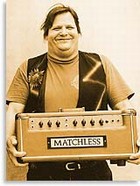
    Mark Sampson holding a Matchless prototype built for guitarist Michael Landau.

    This article originally appeared in VG‘s Aug. ’98 issue. All copyrights are by the author and Vintage Guitar magazine. Unauthorized replication or use is strictly prohibited.
  • May 2003

    FEATURES

    HENRY GROSS
    Open Henry Gross’ latest album is an amazing mix of pop, rock, country, and ballads. Those who remember him for nothing more than his ’70s hit “Shannon” are in for a treat. By John Heidt

    GARY MOORE
    He played with Thin Lizzy and BBM, and his solo albums are players’ favorites. We recently caught up with Moore, who is always eager to discuss his gear, his history, and his latest efforts. By Willie G. Moseley

    STILL BROADCASTING
    Richard Lloyd and Television Find New Life Television was a dichotomy of punk attitude and intellectual musicianship. To put it another way, they hated hippies, but liked guitar solos. By Ken Johnson

    GUYATONE LG-160T
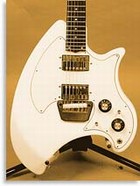
    While many Americans in the ’60s were seeing low-quality import guitars at the neighborhood Western Auto, there was a thriving domestic scene that produced guitars like this. By Michael Wright

    THE DIFFERENT STRUMMER
    Harmony’s Colorama Guitars Return with us now to the colorful days of the mid 1950s. Cool cars were on the road, and the Les Paul and Strat were on the street. But no company plunged into the spirit of the times with the gusto of Harmony, and its Colorama guitars. By Michael Wright

    THE BASS SPACE
    Fender’s Precision Elite II The Precision Bass has been offered in a myriad of models. One of the more intriguing (if complex) variants was the Elite II, from 1983. By Willie G. Moseley

    CABLE SUMMIT
    Our perception of how a cable affects our signal is a complex matter; and there is a large selection of high-performance instrument and speaker cables available for every style and budget. By Eric Kirkland

    DEPARTMENTS

    DEPARTMENTS
    Reader Mail

    First Fret: News and Notes
    – Entwistle guitars set for sale
    – Mike Longworth remembered
    – Winter NAMM
    – Arthur Nielson

    The Great VG Giveaway
    Win a Kendrick Texas Crude Harp Amp!

    Vintage Guitar Price Guide

    Builder Profile
    Morgaine Guitars

    Dealer Profile
    Mike’s Music

    Upcoming Events

    Vintage Guitar Classified Ads

    Readers Gallery

    Dealer Directory

    COLUMNS

    Executive Rock
    Dressin’ Up For “The Corporate Gig”
    By Willie G. Moseley

    Q&A With George Gruhn

    Acousticville
    The Bluestick Solution
    By Steven Stone

    FretPrints
    Grant Green
    By Wolf Marshall

    Gigmeister
    Good Hands
    By Riley Wilson

    TECH

    Guitar Shop
    By Tony Nobles

    Amps
    Correcting Vintage Amps Deficiencies
    By Gerald Weber

    Ask Gerald
    By Gerald Weber

    REVIEWS

    The VG Hit List
    Record, Video, and Book Reviews

    Check This Action
    By Dan Forte

    Vintage Guitar Gear Reviews
    Groove Tubes Soul-O Single, Gigliotti Special, Kammerer 11-2HNG, AdrenaLinn

    Gearin’ Up!
    The latest cool new stuff!

  • Mark Andes

    Son of Straight Arrow

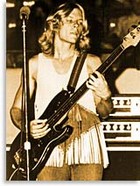
    There probably aren’t too many fathers of rock stars who’ve had a song written about them, but such is exactly the case with veteran actor Keith Andes. His son Mark has been the bass player with such bands as Spirit, Jo Jo Gunne, and Heart, and is now backing up Dan Fogelberg on tour.

    Mark Andes has been in the public eye since the late Sixties, when Spirit’s loping “Mechanical World” first began to be heard on what was then termed “underground radio” by some listeners. When Vintage Guitar talked with Andes, he was preparing to go back out on the road with Fogelberg, but we started his interview by inquiring about his youth:

    Vintage Guitar: Is it fair to say that you grew up in a show business family?

    Mark Andes: Definitely; my father was an “up-and-coming leading man” in the late Forties and the Fifties. He has his own television show called “This Man Dawson”; he also went on to act in series such as the original “Star Trek” and movies such as …And Justice For All.

    I always thought Keith Andes had such a distinctive, resonant voice.
    That’s why I think a lot of his best work was done onstage, in plays like Man of La Mancha. His voice could really be “featured” in that kind of format.

    Regarding the Spirit tune “Straight Arrow”, which was written about your father; was that the name of some character he played on TV?
    (chuckles) My father was a disciplinarian; that’s where the title comes from. Jay Ferguson, whom I’ve known since the seventh grade, wrote that song as kind of a good-natured lampoon; there was a “Dudley Do-Right mentality” about it. (laughs)

    But growing up within a show business family had some unique things going for it; my brother Matt and I got to go to Europe for a year while my dad was working over there, and people like Rod Steiger would visit our house. Dad worked with people like Marilyn Monroe and Robert Ryan. I went to school with Roy Rogers’ kids.

    As far you ending up in the entertainment business yourself, how and why do you move towards music instead of acting?
    My father was against Matt and I pursuing any theatrical stuff; he wanted us to go to college and get a commendable career; we got into music, which is just as bad and just as unpredictable as acting! (laughs) There have been some times in my adult life where I’ve pursued acting a bit, but those were when the musical career was in a lull for me; like the time between Firefall and Heart. And I discovered that as far as music goes, I picked the right path in entertainment; I didn’t have any hidden acting talent.

    One of the first songs I ever heard that got to me was Johnny Horton’s “The Battle of New Orleans”; it was a ‘gimmick’ song, but I fell for it. I liked the groove with the snare drum cadence. Then when surf music came around with players like Dick Dale, I figured I could play that kind of instrumental music, so by the time I was twelve or thirteen my brother and I were playing surf instrumentals on acoustic guitars; one of them was an old “The Gibson” that we had in our family. Then my grandfather got us a couple of Epiphone solidbodies in a cherry finish with a single pickup. That was sort of a “green light”; the elders realized we’d put a lot of energy into playing those acoustics, so they helped us out; by 1964 we had a high school band called the Marksmen.

    I knew Jay by then, and we’d decided that we might want to do something musically. He went off to UCLA, and when I got out of high school I was asked to join Canned Heat. Their producer at the time was Barry Hansen, who is Dr. Demento; he asked me to join.

    There was a surf band called Dave Marks & the Marksmen; any connection?
    No; we were the Standells for a while, but another group with that name got pretty big; we were constantly changing our name. (chuckles)

    You started on guitar; when did you switch to bass?
    During the high school band time; the bass player left and I switched over out of necessity. I was able to borrow a friend’s Jazz bass and Bassman amp, so I was lucky to have an initial experience with that instrument using good equipment; I think that’s one reason I’ve always loved the instrument; I still play guitar and write on guitar, but I never went back to it as a performance instrument.

    The first bass I got for myself was a ’63 or ’64 Precision; I put a ’57 Precision neck on it when I was in Spirit, and that’s the instrument I used for years; I still have it. Originally it was a three-tone sunburst; at one point I stripped the finish off of it, then sometime later I got a guy in Nashville to put a two-tone finish on it, and I put a gold anodized pickguard on it as well; so these days it looks pretty much like a ’57.

    So how did Spirit form?
    While Jay was going to UCLA, he and I actually played with Randy Wolfe, who became Randy California later, and Randy’s step-dad, Ed Cassidy; we were called the Red Roosters. We played places like the Ash Grove a lot. When that group broke up, Randy and Cass moved to New York; I was just barely eighteen but Barry got me into Canned Heat. The other players were Henry Vestine, Bob Hite, Al Wilson, and Frank Cook; other than me that was their original lineup. We played a lot of great gigs, and right about the time Randy and Cass came back from New York, Canned Heat was about to sign with Liberty Records. Jay and I had been talking again about putting a band together with Randy; when we looked up Randy, he and Cass were playing with John Locke and an upright bass player, doing a jazz gig. Jay and I thought it was interesting, so after talking with them we decided to form a band, and I left Canned Heat; Larry Taylor took my place.

    Wasn’t Spirit one of the first bands that signed with Lou Adler on Ode Records?
    We were the second signing; Scott MacKenzie, who sang the song about San Francisco

  • Robert Perine

    How I helped Leo Fender

    In all modesty, my role was small – especially in Leo’s eyes. Here was a man whose sole interest was making guitars and amps sound better, not worrying about the immeasurable whims of advertising. He was happiest hidden there in his Fullerton factory lab soldering and tweaking and listening for results. But for me, Fender Electric Instruments was mighty close to being the perfect account because, as Fender’s advertising guru, I was allowed to frequent the sales office and play.

    By “play,” of course, I mean play guitars! The latest models were always on hand – in Stan Compton’s office, the sales display room, later in the recording studio – all factory-tuned and poised for action, luring visiting artists to sit down, exercise their fingers, and offer an opinion. And if Leo happened to be around, he was the most curious about what that player had to say. His aim was improvement and his reaction and follow-up to good suggestions often meant changing a component, finding a better material, even reshaping or restyling a body. I was to learn that this trait drove most of his associates up the wall, despite the fact that such rabid attention to customer need is what ultimately made his guitars and amps so favored by professionally-skilled players.

    But let me back up a moment. I had graduated from the Chouinard Art Institute, in Los Angeles, in 1950 and gone off to set the world on fire as an artist of some kind. Following World War II, we all wanted to get on with life get through school, find a good job, get married. In 1956, after freelancing for several years, Ned Jacoby (my office mate) and I decided to escape the L.A. smog and move to the fresh air of Orange County. We found rentable space near the fishing boats in Newport Harbor and went about the task of starting over, calling ourselves Perine/Jacoby, knocking on the doors of young industries sprouting up nearby – plastics, electronics, boating, etc. (O.C. was then the third fastest-growing county in the U.S.).

    After a Rickenbacker ad I designed for F.C. Hall appeared in Music Trades Magazine, I received a call from Stan Compton at Fender Sales, asking me if I would be willing to do something similar for Fender. Like your average citizen in those days, I hadn’t heard of Rickenbacker or Fender guitars, yet I jumped at the chance to lend my graphic design skills to a product I had learned a little about in the service. During my time in the Navy, I was assigned to the South Pacific twice for a total of 28 months and during that time took up the study of guitar, learning my chords here and there from G.I. buddies willing to sit on my bunk and teach, loaning me their instruments for an evening. I sent home for a Georgie Barnes chord book and when it arrived I began expanding my repertoire of tunes, all on borrowed instruments. Later, on my second stint in the Philippines, I took an Epiphone rhythm guitar and a DeArmond pickup along for the ride and played in a company jazz band for a while.

    So the Fender phone call appeared to be providential and I was soon being instructed in the fine points of the solidbody electric by the likes of Compton and Don Randall, chief of Fender Sales. In 1957, my ad designs for Fender began appearing regularly in Music Trades, Downbeat, and one or two other publications, and by catalog time in 1958 I’d convinced Compton we should at least have a full-color cover on their major sales tool… the yearly product catalog… and, by the way, I had noticed the various Fender departments had been using no less than 13 variations of their logo on products and literature. Wasn’t it about time to integrate?

    “Yes, of course,” Compton agreed. So I made a collage of these disparate, amateur-looking trademarks to accompany my official modernized version for the cover of the upcoming 1958-’59 catalog. Randall and Compton mulled it over for a week or so and after a short conference, Compton gave me the green light.

    Leo, who was obviously focused on his own problems, or was left out of the loop, remained unconcerned about the inconsistencies of his potpourri of trademarks. Then one day after the catalog was printed, Randall called and asked me to go see Leo at the plant. Certain “people,” it seemed, were unhappy with the radical restyling of Leo’s very personal signature. Randall assured me that Leo and I could work it out if I took along an alternative sketch, perhaps a compromise version. Unclear as to what that actually meant, I drove to Fullerton with yet another design option. Leo, feeling put on the spot by the meeting, stared at my sketch for a long time, focusing mainly on the F.
    “It’s not a regular F, you know. It’s a German 7,” he informed me.

    “I know, but you see them all the time,” I said, adding my personal permission.

    Leo smiled. “Of course. That’s why I like it. But it’s having the right curve that counts.

    “Beg your pardon?” I said.

    Leo ran his finger the length of the F’s contour.

    “You see, Bob,” he said. “It should be like the curve of a woman’s back: it has to be just right. Higher here, a little lower there. I don’t think you’ve got it yet.”

    Having no answer for such subjectivity, I laughed, which I don’t think Leo appreciated. I could tell he respected my ability, but had to remain in the act somehow, to exercise the smallest iota of control over the final outcome. After all, hadn’t he been dictating the subtle curves of guitar bodies for nearly a decade?

    “So get that curve right and you’re okay,” he said in his Jean Hersholt voice, a kind of final pronouncement to send me on my way.

    The fact that I had left unchanged the double-loop style of the two Es was of little interest to him. His only concern was the damned F. I had the feeling I was expected to refine that curve and not come back. When I told Randall about the meeting he simply replied, “That’s Leo.”

    And so that’s how the 40-year-old Fender logo got its initial approval, back in 1958 in Leo’s modest little lab. Fender Sales immediately adapted my design for promotional materials, but the factory took almost four years to use up the old decals and name plates. Leo, it seems, could not abide waste.

    During the early 1960s, Fender guitars and amps caught fire, with our ads and collateral materials lending a steady boost to the process. A backlog of orders stacked up. Randall and Compton emphasized the teenage market was of vital importance because kids in every major city were being encouraged by dealers to take guitar lessons, so I slanted many of the ads towards them, going to teenage fairs in southern California, finding teen models, putting them in situations where the guitars looked user-friendly. Musically I wasn’t much sold on rock and roll, even though my three teenage daughters were filling the house with the sounds of the Beatles, the Beach Boys, and so forth. My choice since high school had been jazz and the big band sound, and the jazz players I knew treasured the mellow sound of the big acoustic electrics, like Gibson’s L series. The solidbody guitar sounded raspy, too sharp, had that loud, pristine sound Leo struggled against convention to achieve, doggedly distilling it with the filters of precision-wound pickup coils and crafty amp circuits. The impurities were thus removed and this annoyed musicians who preferred the more funky, throaty sound that’s caused by the resonating wood of an amplified acoustic chamber.

    Some jazz players, especially electric bass players like Monk Montgomery, for example, liked the sustained, “singing voice” they could achieve; Oscar Moore (with Nat Cole) was another willing trier of the Telecaster, and Joe Pass supposedly played a Jazzmaster on rare gigs. But others like Tal Farlow, Jim Hall, Wes Montgomery, Barney Kessel, and Charlie Byrd remained diehard acoustic/electric devotees. One night I carried a new Jaguar and a Twin Amp to a private party where I knew Hall would be playing and coaxed him to try it. While he gracefully obliged, I could see it was a foreign object to him, too harsh and crispy for his sensibilities. He did, however, like the brilliance and separation the amp was able to produce over a wide tonal range.

    Leo tried hard to win over the jazz guys with the Jazzmaster, the Jaguar, and (later) Roger Rossmeisl’s thin-body Coronado – a beautiful-looking instrument that didn’t play as well as it looked. Correcting Fender’s image as a country/western, rock and roll guitar producer was already a losing battle, it seemed, though acoustic players had no beefs with the rugged, durable, and powerful tube amps Leo was releasing.

    For me, the guitar as a basic instrument was a winner – always had been. Your well-made, generic guitar was versatile, easy to tote, a pleasure to hold and play, no matter its technical history or the player’s musical sensibility. I wanted Fender ads to express this universal quality, this love affair relationship a musician develops with his instrument which, in a sense, is his best friend, surely his voice, if not his lover.

    In the late 1950s, I conceived the idea of doing a series of ads that would photographically show this relationship of guitar to player. Wouldn’t it be interesting, I thought, to depict musicians of all ages unwilling to leave their wonderful, precious Fender guitars unattended. Why not play with this idea of attachment run amok, the needle hitting the peg on the possessiveness meter? The headline “You Won’t Part With Yours, Either” came to me one day and for the next decade this line triggered several dozen imaginary situations covering a whole spectrum of guitar players from as many walks of life. My associates played with the theme, as did ad directors Jim Williams and Charlie Rosenthal. More situational ideas surfaced than I could possibly fit into my photo shoot schedule. Finding the right models and locations became a challenge, but did I care? This was a natural. For the next few years these ads were unprecedented in the musical instrument industry. Dealers chortled with enthusiasm and Fender-lovers sent in comments. Wrote itchy dealers, “Why are my orders not being filled?” Wrote one visionary potential customer, “Can you make me a Telecaster with tiger stripes?”

    By 1965, Fender guitars and amps were on a roll and reached the first apex of their success and popularity. This is obviously why CBS stepped in that year and unintentionally altered the Fender landscape by buying out Leo, Don Randall, and company for $13 million cash. The influx of new money from the coffers of the blue chip giant activated an immediate expansion (a new, larger plant, a line of acoustic guitars, new Fender-Rhodes models, and a completely new line of solidstate amps) which began to tax the Fender team, spreading them inordinately thin. In due time, we predicted from the outside, quality control would weaken.

    After this noteworthy acquisition, however, Randall enlisted me to design a new face for the experimental solidstate reverb unit and Model S-125 amp, assuming that a graphic designer like myself could double as an industrial designer. I worked hard restyling control panels and reshaping the speaker box, visiting the plant occasionally to offer design “guidance.”

    When the solid state line went to market, however, they were an abject failure. Players continued still preferred the old tube amps because they simply “sounded better,” though there was no clear reason that Paul Spranger and his CBS team could see why the “old” electronics would sound better than the “new.”

    I like to believe that Leo was secretly delighted over this rejection, since he had spent years bringing his tube circuits to a kind of divine perfection. He was, after all, the sound wizard, having trained his ear (and his eye, incidentally) to the finer points of musician preference. Though he had been fitted with a glass eye because of an accident when he was a boy, Leo was phenomenal at distinguishing between string gauges.

    “That’s an 065 D-string,” he insisted to George Fullerton one day when stringing up a prototype Jazz bass, while I was looking on.

    “Sorry, Leo, it came out of the 070 bin,” Fullerton assured him.

    “Well, it’s not an 070. Go get the right size.”

    “Come on, Leo, you can’t tell the difference between 065 and 070 with your naked eye!”

    “Of course I can. This is the wrong size.”

    Fullerton trudged off grumbling but came back in a while with the correct string. “Sorry, Leo, you were right,” he reported. “It got put in the wrong bin.”

    Our yearly catalog shoots were a test of ingenuity and endurance. Lugging heavy amps all day, unwrapping new guitars, then returning them to their shipping boxes was always challenging. Protecting these gorgeous instruments against damage was another factor, especially when we shot the products in outdoor settings – guitars hung from trees, amps on rocks in the middle of a stream or on the beach, acoustic models scattered among wagon wheels at Knott’s Berry Farm, banjos on the wharf, Fender-Rhodes pianos set up on the Hollywood Bowl slopes or under the Balboa Pier. On three occasions, I was plenty relieved when instruments entrusted to my care were spared damage; once when it was necessary to trust an itinerant surfer to paddle out and catch a wave with a Jaguar strapped on his back; again when we handed over a Jazzmaster to a skydiver we had hired and watched fall from 10,000 feet and float majestically to the ground in front of us; and once again when another shiny new Jag endured a swift run down the ski slopes on Jim Williams’ back. In all three cases, the instruments received nary a scratch nor a dunking.

    One of my favorite photos is in the 1968 catalog, the page featuring the all new Coronados. My daughter, Lisa, is getting into my red ’57 T-Bird carrying a red Coronado. To enhance the red theme, we parked the T-Bird in a Santa Ana brickyard. Another page depicts a distraught young lady running down an LAX runway trying to flag down a departing jet, her suitcases resting just beyond an array of solidstate amps. Phrases like “the non-stop sounds of today” and “Fender solidstate supersonics” and “the jet roar sound” helped make the point.

    Another ad line we used was “The Most Imitated Guitar in the World.” One of this series depicted three thugs huddled over a Jaguar late at night with tape measure and calipers, implying that Fender quality and design was being copied, even clandestinely, and that certain zealous imitators were already getting away with it – namely the Japanese. Having imitators, of course, was inevitable, but for Leo such gall was simply a form of flattery, proof that he was the prime developer of the solidbody guitar and would remain the main man forever, even though, when prodded in later life, he would say modestly, “I just wanted to make a better instrument so musicians could achieve the effects they wanted.”

    Even after he left Fender and formed G&L with George Fullerton and Dale Hyatt, he continued struggling with the nitty gritty of bringing off new and better versions of his former successes.

    History tells us now that the pre-CBS years were probably Fender’s best – the most creative, the golden period of genuine team effort, when factory men like Freddie Tavares, Forrest White, George Fullerton, and Bill Carson worked together to achieve a common end, backed by several dozen skilled craftspeople, many of them Mexican-Americans, who were loyal to the Fender cause year after year. I consider myself fortunate to have been around in those days, able to put in my oar to aid the cause at the right time, right place. For me, the Fender account developed into a graphic designer’s dream, given its modest start.

    The beginnings of such relationships are often that way – slow, casual, trusting. I’ll never forget my first visit to the Fullerton factory in late 1957. I parked my little Fiat 600 inside the chain link fence that enclosed the parking lot and got out, wondering which of six identical buildings I should enter. Down the way was a young fellow hitting a tennis ball against the building. I approached, wearing my ad man’s sports coat and tie. He squeaked his tennis shoes and stopped swinging.

    “Are you looking for Leo?” he asked me as the ball rolled back against the fence.

    “Yes. Where do I find him?”

    He pointed at a door. “He’s in there. I’m Freddie Tavares, Leo’s assistant.”

    When Freddie put out his hand I shook it, wondering how the boss man’s assistant was able to get away with such casual recreational activity. Well, he did look sort of Hawaiian, and Polynesians are known to be fairly laid back. Besides, it was nearly lunch time.

    “We’re working on a new student guitar,” he went on. “Are you a musician?”

    “Not a professional,” I said. “I’m doing your advertising. Don and Stan sent me over.”

    “Well, come on in and see what we’re doing,” he said, and proceeded to lead me to Leo, who shook my hand quickly and asked the same question, then went on working. But Freddie launched into an immediate explanation of the merits of this instrument lying on the table before us, as if he were Leo’s designated spokesman. They had made modifications, he said, on an older guitar Randall had named the “Broadcaster,” then the “Telecaster,” and which had evolved into this, the contoured-body “Stratocaster.” Little did I know at that moment I was looking at what was already on its way to being Fender’s best all-time selling guitar – the infamous Jimi Hendrix axe.

    It’s difficult to remember the details of Freddie’s off-the-cuff lab tour that day, but with hindsight it seems quite likely I was being informed of Leo’s current modifications on the Strat and the Pedal 1000 steel guitar. I vaguely recall that someone (maybe Alvino Rey?) had trouble with the pedals and pedal rods on the 1000 and Leo was determined to fix it before another instrument was shipped.

    After 11 years of playing a part in the Fender success story, content to watch silently through the years as numerous official and unofficial Fender books have ridden the waves of Fender success, it seems timely to write this anecdotal version of how I helped Leo make it big. As a non-Fender employee, it was easier for me to maintain an outsider’s objectivity, as it was for Richard Smith in his recent book, Fender: The Sound Heard ’round the World. Though, as a young kid growing up in Fullerton, Richard knew Leo in somewhat the same way I did (though much later), his book maintains a clear historical perspective, has no axes to grind. It was no surprise, then, that Richard and I joined forces to make his well-researched book a reality.

    When he came to Encinitas in 1993 to see me, I finally knew why I had saved all my Fender memorabilia – ad proofs, catalogs, brochures, and photographs with their negatives. I believe the Smith book to be the most complete and balanced appraisal to date. I wrote with enthusiasm beneath Leo’s mug shot on the jacket flap: “This is the ultimate, definitive Fender book, whether you are a musician, a lover of Fender lore, an avid instrument collector, or simply a curious history buff.” I guess there’s nothing wrong with being flagrantly prejudice, since Richard’s heavily-illustrated book contains 162 of my images!

    If I was to become the artist I had dreamed of in art school, then Leo Fender, in an odd way, began helping me do that back when I was young and eager and full of ginger. After Perine/Jacoby’s exodus in 1969, when CBS and its delusions of infinite, rapid expansion shifted Fender advertising into fifth gear – bringing in an uptown L.A. ad agency – my artistic life was ready to take new twists and turns.

    Both Fender and myself had reached the point where more had become less. Guitars, like art, are slightly uncomfortable with commercialization, mass market proliferation. Serious musicians look for tailoring and craft, not rubber stamp. While nostalgically I missed seeing Randall, Compton, Williams, and Rosenthal, I was glad to move on to other pursuits. A move to San Diego was only about a year away for me, and by 1970 Perine/Jacoby had dissolved, its partners amicably wishing each other well.


    This article originally appeared in VG‘s Sept. ’97 issue. All copyrights are by the author and Vintage Guitar magazine. Unauthorized replication or use is strictly prohibited.