Month: May 2003

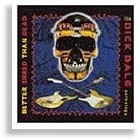
  • Dick Dale – Better Shred than Dead: The Dick Dale Anthology

    Better Shred than Dead: The Dick Dale Anthology

    Well, what needs to be said about this? The King of the Surf Guitar at his finest. This covers 1959 to 1996 and hits all the high points. All the tunes are here, even some rare stuff. And, as usual, Rhino’s packaging is exquisite. Great liner notes, plus track-by-track notes. If you are a fan of surf guitar, you must have this. Dick never disappoints. And it seems Rhino never does, either.


    This article originally appeared in VG‘s Sept. ’97 issue. All copyrights are by the author and Vintage Guitar magazine. Unauthorized replication or use is strictly prohibited.

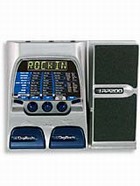
  • Digitech RP-200

    Budget-conscious way to go ampless

    Last month, I disclosed that I’ve gone ampless in 2002. Now let’s discuss how, and with what gear. My criteria is the same as with any gear I use – it must sound great, be flexible, tough, and not cost a lot of money. After lots of gear comparisons with units from Line 6, Korg, Zoom, and Digitech, I recommend the Digitech RP-200. It does all this and much more for only $200 list, and you can usually get a new one for around $150.

    DOD has been making pedals in the greater Salt Lake City area for nearly 30 years. Their early offerings of stomp boxes for compression, phasing, distortion, etc. were adequate, if somewhat nondescript. However, unlike some competitors, it managed to survive the era of keyboards and big hair. DOD did have the services of one Michael Dowdle, a tremendous guitar player with an ear for tone who offered his input. The company began their Digitech line as pro sound oriented pieces in the ’80s. Since that time, they have been producing rack gear for guitarists like the GSP-2100, which included sounds programmed by some of the biggest names in guitardom.

    The RP series has been around since the early ’90s. A former student once showed up with an RP-10, which had some cool sounds, but had to be run through a guitar amp to sound good. When I saw the RP-100 and read user reviews on Harmony Central, I thought this would be a great unit for my teaching, writing, and recording needs. The RP-200 is the same unit, with the addition of an expression pedal, bigger LCD screen for naming patches, and the included A/C adapter.

    The RP-200 has a dozen amp simulators, including a ’65 blackface (Fender), Matchless DC-30, Boogie Mark II-C, Dual Rectifier, ’57 Fender Deluxe (tweed), Vox AC-30 TB, Marshall JCM 900, Johnson JM150 High Gain, fuzz box, acoustic guitar simulator, and two small tube combos – clean and dirty. Thirteen cabinet models are included, mimicing 4×12 and 2×12 speaker configurations, as well as a “cabinet off” setting. The effects list is staggering, including pickup simulator, wah expression pedal, compressor, EQ, noise gate, chorus, flange, phaser, tremolo, panner, vibrato, rotary speaker, Ya Ya, Auto Ya, synth talk, envelope filter, detune, pitch shift, Whammy, delay and reverb. Whew! Additionally, the RP-200 has an onboard drum machine, as well as a jam-along feature that lets you plug a portable CD player or the like into the unit to jam along with your favorite sounds. The unit is encased in a heavy-duty steel housing with the expression pedal using photocell technology to eliminate scratchy pots.

    One major criticism of modeling gear is that it’s hard to program. But DOD put three parameter knobs on top of the RP-200 to allow us six-string Neanderthals to twist and tweak to our heart’s content. The LED screen makes it easy to see the controls and creating a new sound is a snap. You press the “Select” button and it brings up the first menu – you can opt for making that single-coil pickup sound like a humbucker or vice versa, if you wish. You can also choose a wah as well as which flavor wah tone – Cry(baby?), Boutique, and Full Range. When you get the sound you want, press the select button and access the next menu. The order is then compression, amp modeler, EQ, cabinet/mic/gate, effects, delay, reverb and expression. Each parameter is adjustable in at least two ways and the RP then lets you save the edited tone in one of 40 user presets. DOD provides another 40, giving you a total of 80 sounds in a package 81/2″ long, 10″ wide, and 21/4″ deep.

    When I began contemplating tossing the amp for a modeling processor, I asked around about several units. The POD requires a footswitch that adds another $200 to the price of a $300 unit. I tried the Zoom 505 II for a day and it sounded great, but needed an expression pedal to control volume as well as an optional A/C adapter. The RP-100 needed an A/C adapter that cost $20 or more and didn’t provide a means to control volume or other parameters with my foot. Consequently, I chose the RP-200 as the unit with most bang for the buck.

    Longtime “Gigmeister” readers know I don’t write about any piece of gear unless it sounds good. The RP-200 sounds great, plain and simple! Clean and dirty tones are very authentic and I can pre-set levels of distortion, tone, and volume with each patch. Best of all, I can use the expression pedal to tweak volumes as I play and sing – critical for success on an important gig.

    I’ve used the RP with tremendous results with my Yamaha SA-1100 as well as my Mexican Strat. I can set delay times precisely along with every other tone parameter to really nail any tone I need. The tones sound excellent when recorded to tape or disc. The onboard drum machine sounds very good, especially on heavy rock material, and makes practicing a lot more fun!

    The first gig I used it on was with Mirror Image at a biker convention in Oklahoma (a far cry from the Greenbrier Resort, but a real acid test for the RP-200). To my delight, the RP fit perfectly in the outside storage compartment of my Strat gig bag. I could run a stereo cable out of the RP into the board and hear myself completely through the group’s monitor system. I carried my gig-bagged Strat and RP with cables in one hand, and my clothes bag and guitar stand in the other! It takes three or four minutes to set up and tune the guitar (did I mention it tunes silently by depressing both footpedals?).

    I solicited input from our sound man, the great Noble Hatch. After that first show, I asked him to be honest about the guitar sound during the night. Noble said, “It sounds great – both the clean and the dirty stuff really sing and they don’t jump out and bite you when I crank your guitar up on solos. It sounds like a good amp would sound.” This was what I had been hoping for, as Mirror Image features three excellent vocalists and they sing better with quieter stage levels. So the RP-200 passed the test with flying colors.

    I do have a couple of beefs. The drum machine sounds are okay, but the patterns are lousy. And who the heck is gonna play urban music on guitar with this? Also, there’s no metronome feature, and there are no 3/4 or 6/8 time-signature feels. The drum machine should be footswitchable on/off for live use. I despise wallwarts, so naturally the RP-200 comes with one. The input jacks should have been located on the back of the unit so you’re less likely to trip over a guitar cable. The delay times should also be variable by more than 10-microsecond increments.

    However, these are very minor quibbles. I love my RP-200 as much as any piece of gear I’ve bought in a long, long time. My hat’s off to the folks on the Wasatch at DOD. This is a revolutionary piece of Gigmeister gear – congratulations!


    This article originally appeared in VG‘s June ’02 issue. All copyrights are by the author and Vintage Guitar magazine. Unauthorized replication or use is strictly prohibited.
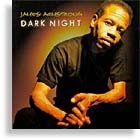
  • James Armstrong – Dark Night

    Dark Night

    James Armstrong comes back from an intruder attack in his own home to serve up a record brimming with blues fire. He can’t play guitar like he did in the past because of the attack, but he has learned to play some nasty slide. And the soloing of Michael Ross and friends Joe Louis Walker and Doug Macleod is as solid as it gets.

    The feel covers all the R&B bases, and covers them well. If funky southern soul is your bag, check out “Too Many Misses for Me.” Great shuffles like “Bank of Love” are everywhere. The slow blues of “Standing In Your Way” features some nasty guitar. And the very funky tribute to his son “Lil’ James” is marvelous, musically and lyrically. It’s somewhat of a miracle, but his two-and-a-half year old son was thrown off a second-story balcony in the attack on Armstrong, and survived unhurt.

    That attack does leave a somewhat world-weary (or should we say wary?) feel to some of the vocals and lyrics. And why wouldn’t it? All in all, this is a fine album. It’s good to still have your voice, James.


    This article originally appeared in VG‘s Jan. ’01 issue. All copyrights are by the author and Vintage Guitar magazine. Unauthorized replication or use is strictly prohibited.
  • Noel Redding

    Up to Date With

    When Vintage Guitar interviewed bassist Noel Redding in the Fall of 1992, he recounted his musical and personal history in an eloquent and easygoing manner, focusing primarily on his adventures as a member of the Jimi Hendrix Experience in the ’60s.

    And while a brief phone interview can impart only minimal chronology, fans of the Experience’s music also had the opportunity to read Redding’s perspective in his autobiography, Are You Experienced?, to which he also alluded during our ’92 conversation.

    But Redding has been busy in the ensuing half-dozen years, and he recently agreed to bring us up to date regarding his activities in the middle of the ’90s. In a casual trans-Atlantic conversation (Redding still maintains his idyllic lifestyle in rural Ireland), the affable veteran discussed his more recent ventures, including his namesake Fender Jazz Bass:

    Vintage Guitar: One of the final things you noted in our ’92 conversation was you had started writing songs again. Is that still the case?
    Noel Redding: Oh, yes; I’m thinking about doing another album. Tony Visconti is an old friend of mine. I went to his house when I was in New York last week; he’s married to May Pang, who used to hang out with John Lennon. We had hamburgers, sausages and beer, and he said to me, “I understand you might be doing another album. Do you want me to help you out?”

    I normally don’t use a producer; I do it meself, but I thought it might be a good idea because he’s highly professional. He’s been around for a long, long time. We had a meeting and I played him my new old stuff, and he liked it, so we’ve got a vague plan about doing an album around October.

    But in September there’s supposed to be some more TV stuff coming out on the BBC, I think. A guy made a short film about that Hendrix event in London last year. I went there with Kathy Etchingham, who was Jimi’s girlfriend for three years, and Pete Townshend. So there’s a lot of stuff happening.

    After your interview ran in ’92, you sent us a photo of two of your instruments – a Fender Bass VI and a Hagstrom eight-string bass. I know the Hagstrom was auctioned by Sothebys, but do you still have the Bass VI?
    I’ve still got it, but I converted it. I put guitar strings on it (chuckles), but I might change it back. It found it to be a bit strange trying to play a guitar with a neck that long, but the tremolo arm is very good. In concert, though, I only play Jazz Basses.

    One note from you following the ’92 interview noted some of the people you were planning on touring with, including Hendrix impersonator Randy Hanson. How did those plans turn out?
    Well, after my wife got killed, I immersed myself in work (note: Carol Appleby, who co-wrote Are You Experienced?, died in an automobile accident in 1990). Jim Dunlop, who makes pedals and picks, invited me to Frankfurt, where I did a gig with Randy. Then we worked in Finland and England; he’s a great player.

    I’ve been working with a lot of different people, like Eric Bell; he played guitar with me in Europe, and I’ve also worked with Eric Shenkeman, who was the original guitarist for the Spin Doctors. I also did a couple of tours with Corky Laing, the original drummer from Mountain.

    At one point, weren’t you going to do some performances with Leslie West?
    I did a tour with him in America; I did 13 dates, then I had to leave. I didn’t get on well with Mr. West (chuckles).

    More Jimi Hendrix Experience product has been released since Live At Winterland and Radio One, which we discussed first time around. Comments on any of the newer releases?
    There was another BBC CD released about a month ago; some extensive live stuff from ’67, as well as a Lulu television show we did in ’69. At that show, it was thought Hendrix was going to play “Hey Joe,” but he decided to play “Sunshine of Your Love” instead; he dedicated it to Cream, and the director was going crazy, but they couldn’t unplug us, because it was live (laughs).

    After the gig, we all went upstairs for a pint, and I told everyone we were probably going to be banned from the BBC. But the director, a guy named Stanley Dalton, came in and bought us a pint, and said, “That was brilliant!” It was weird, and they still play that clip on television a lot.

    There’s a photo of Carol Appleby playing maracas in Are You Experienced? that also shows the headstock of a Squire Jazz Bass poking in from one side. Do you still use that instrument?
    Well, since Fender did the bass with my name on it, that’s all I use.

    Then we ought to go ahead and discuss how your signature bass came to be.
    I’d sold my original Jazz Bass to a collector some years ago. A couple of years ago, Fender contacted me saying they wanted to make a custom-type bass with my name on it. So I found the collector and Fender got the original bass from him, copied it, and sent me a prototype, and it was exactly the same as my original bass; they did a brilliant job.

    I believe your signature bass premiered at the January ’97 NAMM show in Anaheim, along with some Hendrix special Fenders, as well. There was a lot of memorabilia in glass cases, including a well-worn sunburst Jazz Bass. Was that the original?
    Right; there was also one of my old original Sunn amps, and some shirts I’d worn onstage.

    You were at that show; what was it like?
    Joe Carducci, from Fender, is very nice, and when we went down to the show, he asked if I’d sign a couple of autographs. I said, “Yeah; of course.” Three hours later (laughs) – I’m serious about the time – he says, “You can take a break now.” The next day, when we went back, he asked me to sign a couple more autographs, and I said, “Certainly.” This time it lasted two and a half hours; it was amazing.

    Weren’t some of Hendrix’s relatives at the same event?
    Yeah; I saw Jimi’s stepsister, Janie, and her husband, Troy, and Al (Hendrix’s father) was there. I did a gig with the drummer from the Knack, about a 45-minute jam, but it was completely loose, and it was the first time I’d played the Jazz Bass with me name on it. It felt and sounded great.

    Backing up just a bit to the creation of the signature bass; did Fender get any input from you?
    It was a stock ’65 and I told them just to try to recreate it “as is.” One little point Fender picked up on was that I had taken off those funny covers over the pickups, because I had to get close to the strings to play loud. None of the modern Fender basses have covers on them; I may have been one of the first guys to take those off. So when my bass was introduced, it didn’t have pickup covers.

    At that NAMM event, I was introduced to the guy who had made my original bass back in the ’60s; they tracked down the production records to see who had built it.

    I gather the Noel Redding bass has been pretty successful. A guy I know named Dave Glover – he played guitar with me – works at Arbiter, in London, and he told me they sold the most Noel Redding basses last year, and they got a plaque for it.

    Any other musical occurrences and/or other future plans?
    I’m gigging hard on the road. The album I’m supposed to do in October is going to be recorded at my house in Ireland; doing it in the house is much easier and much cheaper, and if someone needs to take a break, no problem.

    There’s talk about me going to Australia; I’ve never been there and I’d like to go. If that works out, I’d probably go a day early, find some Australian musicians, and rehearse for about 10 seconds (laughs). But I’m also going back to my European band, which includes the original drummer from Status Quo; he worked with them for 28 years. We also have a guy from Thin Lizzy, and we all get along well; we just did an Italian tour.

    Later on, we’ll do a U.K. tour with Eric Bell and Eric Shenkeman.

    There’s at least one future plan that’s quite positive; I understand you’re engaged.
    That’s right, to Candace Carell. She’s from New York; she’s a makeup artist who was with [David] Letterman for 15 years. I met her when I did the Letterman show in October of ’90. We sort of commute; she’s in New York and I’m in Ireland. We don’t have a date set; I’m quite busy.

    Busy? It shows. Redding has stayed active throughout the ’90s, and the Fender limited edition Noel Redding Signature Jazz Bass is an industry acknowledgment that the venerable musician has secured his place in the pantheon of rock bass heroes.


    Redding at the January ’97 NAMM show, in front of a display containing his original Fender Jazz Bass, Sunn amp, and a concert outfit he wore in the Jimi Hendrix Experience. Photo: Susan Carson, FMI.

    Nov. ’98 issue. All copyrights are by the author and Vintage Guitar magazine. Unauthorized replication or use is strictly prohibited.
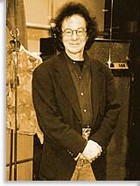
  • Reverend Guitars

    Guitars

    Judging by the melee of favorable product reviews, Reverend guitars go beyond colors and chrome to inspire comments like, “…has the feel and finesse of a $2,000 guitar…instant blues machine…superior resonance and sustain…warm and midrangy with the perfect amount of upper-end shimmer and jangly sparkle…”

    Whence cometh these righteous instruments that spawn such praise? Would you believe Eastpointe, Michigan?

    Around the back of a small commercial building on Gratiot Avenue you’ll find a white garage door punctuated with a 4″ X 8″ retro-look sticker that reads “Reverend Musical Instruments.” Knock on that door and you’ll meet Joe Naylor, the man behind Reverend guitars.

    You may have heard the name Naylor before, attached to a line of acclaimed speakers and hand-built amplifiers. In 1996 Joe sold his interest in Naylor Engineering, the speaker and amplifier company, to found Reverend Musical Instruments. These days behind that door you’ll find Joe, his wife Kristen, right-hand man Kraig Sagan, and three other employees.

    Reverend Musical Instruments is a two-room operation that each month produces about 65 guitars and basses bearing names like Slingshot, Avenger, Spy, and Rumblefish. The larger of the two rooms houses raw materials, tools, jigs, and more. In this room the guitars take shape as a white mahogany center block, a steel bar, a molded rim, and a brightly colored phenolic laminate top and back are joined together. The smaller room houses the office, along with the electronics and the final assembly/setup operations.

    Vintage Guitar: Describe your journey from guitar player to guitar designer/manufacturer.
    Joe Naylor: I was into guitar players before I played guitar. Pete Townsend was my idol, along with Jimi Hendrix, Jeff Beck – the old-school guys. I have three brothers who play guitar, so there was always a guitar around the house. My older brother would lock us in his room and make us listen to him playing along with Hendrix and Cream records. If we tried to get up, he would push us back onto the couch.

    I started playing in 1980, and I knew almost immediately that I wanted to work on guitars. I began reading everything possible, bothering repairmen, things like that. I was guitar bloodthirsty.

    I learned a lot of repair on my own. I got an old Guild from my brother. I had it with me at Western [Michigan University, Kalamazoo, Michigan], and I ripped it apart and rebuilt it. Then I decided to refret it, so I yanked all the frets out and brought the guitar to a repairman in Kalamazoo named Pete Moreno. He’s one of the best in the world. Since I couldn’t afford to pay him to do the refret, he gave me some fret wire and carved me a little neck-holding block, and he pounded a couple of frets in to show me how to do it. That was my first foray into repair. Then I started repairing guitars for other students.

    After I graduated, I decided I wanted to repair and maybe build guitars for a living, and that it was time to get serious. So I went to Roberto-Venn School of Luthiery, in Phoenix. I remember getting off the plane and driving to the school – which looked like nothing more than a metal shack sitting on a big lot in the middle of the desert – my first thought was, “This is nuts. What a waste!”

    Then the people took me inside and showed me two or three guitars that the instructors, John Reuther and James Weisner, had built. They were incredible, so I figured I’d better stick around. The course was three months long, but I stayed an extra two months and learned semi-hollow construction from James.

    Have semi-hollows always been a focus?
    Yes. Early on I was attracted to them because I liked a lot of the players: Alvin Lee, Pete Townsend, Chuck Berry, Billy Zoom, Malcolm Young. One of the first guitars I owned was a semi-hollow Silvertone, an amp-in-case model with a single lipstick in the neck position. It sounded incredible. When I realized that such a great-sounding guitar was made with masonite, of all things, I started experimenting with alternative materials – acrylic, aluminum, foam, different types of laminates, phenolics, plastics. I’ve probably built a guitar out of every conceivable material.

    Did you use wood for the frame on your first guitars?
    Yes, the early ones were usually wood frames with wood center blocks, similar to the Silvertone. I did one that had a foam center block – that was interesting – and an aluminum top and back. I probably built something like 30 or 40 bodies on the way to the current guitar. I would build a body and, if I didn’t like it, I’d run it through the band saw and throw it out. There aren’t too many of those first guitars around.

    So when they open the Reverend Guitar Museum 30 years from now, they’re not going to have a collection of prototypes, just production models.
    Actually I sold some guitars under the J.F. Naylor name. I probably built and sold 10 or so.

    Were those unusual designs?
    They were mostly masonite tops and backs, though on some of the later ones I started to use the phenolic. One of those masonite guitars is pictured in the 1987 Guitar World Buyer’s Guide.

    What came next?
    In 1992, my wife and I moved to Detroit and I opened a store specializing in sales and repair of used guitars and amplifiers. That was a laboratory for me, where I learned a lot about vintage guitars and what makes them tick. I would inspect and play every single piece of equipment that came in – whether it was the cheapest Hondo or a nice vintage piece.

    We started Reverend in 1996. That’s when I came up with the injection molding process for the body rim and finalized the structural design of the body, which is patent-pending. We call it the high-resonance body.

    You said you were always attracted to the semi-hollow sound. What in particular about that sound attracted you?
    Initially, I was very attracted to the feedback aspect. I love feedback – Hendrix, Santana, and of course the Nuge in the early days.

    One might get the impression you are aiming for something beyond the semi-hollow sound of the Silvertone and the 335-type guitars.
    I’m trying to make a semi-hollow guitar that also appeals to a solidbody player. A Reverend has more attack and sustain than a Silvertone or a 335 because of the metal block. And the feedback is more controllable – all without sacrificing the resonance of a semi-hollow design.

    What sound are you aiming for with these guitars? With the pickup configurations, each model is going to sound different, but is there some overall sound you’re after?
    There is an overall sound you hear no matter what pickup you put in a Reverend guitar. I’m going for a resonant sound that’s very lively, very responsive to how you pick, a sound rich in harmonic content, with a wide frequency range – lots of high-end, lots of low-end – the sound you hear not only in a good semi-hollow, but also in a good, light solidbody. It’s an overall liveliness I’m looking for, and the Reverend body – compared to solidbodies, where some are good and some are duds – is a design that guarantees every guitar will be resonant. I was going for consistency.

    Body resonance doesn’t depend on this big chunk of wood, which might be alive with tone, or might be dead.
    Right. I tell people that a lot of my body is air, and air is fairly consistent worldwide.

    How did you come up with the body shape? Was it an epiphany or a long struggle?
    It was a combination of influences: Fender, Rickenbacker, Art Deco. I combined features from some of my favorite guitars of the ’50s and ’60s – Jaguars, Jazzmasters, Supros, Nationals – and put it all together into one. I was also influenced by what Paul Chandler started doing 10 years ago, combining vintage aesthetics with good, workable components.

    And then you have the headstock, which is not Stratocaster and not Telecaster; it’s unique.
    I wanted it to have an identity, but I also wanted it to be somewhat familiar. Guitar players are fairly conservative and if something is too far out, they won’t be attracted to it. I wanted it to be familiar, but I didn’t want it to be an overt copy of something.

    What makes a Reverend guitar a player’s dream?
    It has a vintage vibe and feel and a somewhat vintage tone, but not a vintage price tag. It also has modern reliability and playability. I guess those factors would make it a dream guitar for a lot of people. In fact, most of the people who buy my guitars either own or have owned vintage guitars.

    And for many, there’s something about the way that neck fits into the hand…
    That’s the vintage influence. The neck is patterned after an early-’60s Strat, but with a flatter radius (15″) and bigger frets, which is a common mod to older Strats. I guess that’s my crowd: a vintage crowd, a lot of blues and blues-rock players. Although a lot of younger players are picking up on it now.

    Did you ever experiment with a string-through bridge?
    By the time this goes to print Reverend guitars will have a string-through bridge. Our main motivation is to continually improve the product. We want to give our customers the best possible product, and if we can improve something, we’re going to do it. That’s our philosophy. I believe in continually evolving.

    How did you decide on the name?
    I was actively searching for a name, an appropriate name for a retro-type product. I was in a bookstore and I saw Blues Review magazine. I grabbed it, thinking, “There has to be a name in here.” So I started thumbing through it and the word “Reverend” came up two or three times. There was something on Rev. Gary Davis. As soon as I saw it, I knew that was it – Reverend!

    It’s an effective marketing ploy with a few people. All the electric guitar-playing clergy I know play Reverend guitars.
    Funny you should mention that. I’m building a roster of contemporary Christian rock bands. The bass player in Jars of Clay is touring with a Reverend. I get a lot of calls from contemporary Christian bands, and clergy. There’s a minister in South Bend, Indiana, playing one.

    Is it the name that attracts these people?
    I’m sure they like the guitar in the first place. But the name is the icing on the cake. Maybe it just says something to them.

    That would really depend on the style of minister – the hellfire and brimstone types might really go for the Avenger. Which brings up another question – where do the model names come from?
    Kraig and I make them up. Initially, we were going to go with all religious names like the Minister, the Bishop, the Friar, the Hellfire. But I didn’t want to get locked into that. I thought, “What happens when we run out of names?” So we decided just to pick names we like.

    Who would you like to see playing a Reverend guitar?
    I think Jimmy Page and Ronnie Earl would like my guitars. Billy Gibbons, too. It’s got his name on it – the Reverend Billy Gibbons.

    How about the Rev. Horton Heat?
    That would be cool. I’ve heard he really smokes.
    We do have an active endorsement program. We recently added Rick Vito. He’s using a Spy on tour with Bonnie Raitt.

    What’s next?
    The Rumblefish bass is taking off really well, so we’re working on a five-string. I’m also working on a line of Reverend pickups that will probably be out this year. I’m considering doing speakers again, and maybe a small amplifier, all under the Reverend name. And maybe some larger-bodied, single-cutaway guitars and some higher-end custom models.

    With birdseye phenolic?
    Actually, I was thinking about that…

    Contact Reverend Musical Instruments at 23109 Gratiot Ave., Rm. #2, Eastpointe, Michigan 48021, phone (810) 775-1025, fax (810) 775-2991, e-mail Reverendmu~aol.com, web site www.reverendmusical.com. Dealers inquiries can be directed to Rick Carlson, phone (530) 582-8889.


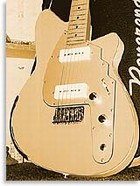
    P-90 equipped Slingshot guitar with two-tone case. Photo courtesy of Joe Naylor/Reverend.

    May ’99 issue. All copyrights are by the author and Vintage Guitar magazine. Unauthorized replication or use is strictly prohibited.
  • Johnny Winter

    Still Alive and Well

    John Dawson Winter has been a troubadour for the blues for over 40 years, plying his razor sharp licks from the Texas roadhouses where he first cut his teeth in the early ’60s through the massive audiences of rock festivals like Woodstock, to his world tours of the present day. A true original in the Texas guitar slinger tradition of T-Bone Walker, Freddie King, and Albert Collins, Winter’s instantly recognizable guitar style and gravely roar have gained him a worldwide following and reverence in the rock and blues communities.

    Born in Beaumont, Texas, in 1944, Winter and his younger brother, Edgar, played in a variety of local rock and roll bands before they made their recording debut for Dart Records in ’59. In the early ’60s, Johnny cut singles for several regional labels before moving to Chicago to immerse himself in the blues scene, jamming with local blues legends and a young Mike Bloomfield, among others. Unfortunately, he was unable to break into the Chicago blues scene and soon moved back to Texas, where he played in various blues and rock and roll outfits for the next few years.

    In 1968, after deciding to concentrate solely on blues, Johnny assembled a trio with bassist Tommy Shannon (today with Double Trouble) and drummer Uncle John Turner. The trio soon built a following in Austin and Houston, which resulted in a Rolling Stone magazine writer calling Winter “…the hottest item outside of Janis Joplin.” The subsequent buzz culminated in a major-label bidding war, concluding with Winter signing with Columbia Records in ’69 and recording his highly regarded self-titled debut album shortly after. Throughout the ’70s, Winter released a slew of successful albums, often with collaborator Rick Derringer, including the now classic Johnny Winter AND Live, and Still Alive and Well, his comeback following a debilitating substance abuse problem.

    In addition to being a world-class guitarist, Winter won a Grammy in 1977 for producing Muddy Waters’ landmark comeback album, Hard Again. The team of Muddy and Johnny stayed together long enough to win two more Grammys, for 1978’s I’m Ready and 1979’s Muddy Mississippi Waters Live.

    In the ’80s, Winter was inducted into the Blue’s Foundation’s Hall of Fame and recorded three albums for Alligator, including the excellent Guitar Slinger, before settling in at his current home of PointBlank records. 1998 saw the release the critically acclaimed Live in NYC, a bold testament to his enduring feel for raw blues which contained tributes to Freddie King and Johnny “Guitar” Watson. Live In NYC captures the grit and fire that made Winter a living legend. Also recently released is the Pieces and Bits video (VG, June ’01), a compilation of video clips throughout the years.

    In late 2000, Johnny was sidelined with a broken hip after a fall at his home. He has made a full recovery and recently returned from a summer tour of Sweden. VG caught up with Johnny between sessions at The Carriagehouse, a Connecticut studio where he recently began recording tracks for his upcoming release, his fourth on PointBlank, and tentatively scheduled for release next Spring.

    Vintage Guitar: How are you feeling these days?
    Johnny Winter: I am feeling pretty good, thanks. The hip is doing well, it’s healing. Lots of times it hurts when I’m playing, but it’s getting better all the time.

    You’re recognized as one of the ambassadors of the blues, turning on larger audiences to this music, while giving credit to your heroes. What’s your take on the blues in the year 2001?
    The blues has been around for years, and with younger guys coming up all the time and doing pretty good, I think its gonna stick around forever.

    Having produced and won Grammys for your work with Muddy Waters, to playing Woodstock to jamming with Jimi Hendrix, what do you feel has been the highlight of your career?
    Working with Muddy was definitely the biggest highlight of my career.

    You started out playing both rock and blues, but for the past 20 years have concentrated on the blues. How do you feel about playing rock?
    Well, I don’t play rock any more, but the blues is pretty rockin’ sometimes (laughs). But as far as the music they call “rock,” I haven’t really ever played anything but rockier blues.

    You’re best known for fiery electric blues , but your acoustic bottleneck blues, like “Dallas” (from the debut LP) is reminiscent of Robert Johnson and arguably some of the best ever recorded. What is your favorite acoustic setup, and what do you use for a slide on acoustic?
    I’ve got an old National, actually several old Nationals, and for slide I’ve got a piece of conduit pipe that I got years ago. A friend of mine from the Denver Folklore Society helped me get it from a plumbing supply house. He used it and felt it was good. I used to play slide before this, but could never find a good slide. I’d use everything from a wristwatch crystal to broken off test tubes to lipstick cases, bottles… I tried everything, but nothing would work, until I found this conduit pipe, and I’ve used the same piece of pipe for 30 years for both acoustic and electric slide. It’s just a piece of plumber’s pipe that just fits my finger real good.

    What finger do you wear it on?
    I wear it on my little finger

    Do you have any plans to play any acoustic blues live?
    Well, I just don’t feel comfortable doing it because I can’t hear myself playing an acoustic live. A lot of people have asked me to play an acoustic set in addition to an electric set, or maybe a little bit of acoustic, but its hard for me to hear.

    Any plans for an all-acoustic blues album?
    No, I don’t think I know enough acoustic slide stuff to make a whole album (laughs).

    So how does it feel working on the new tunes?
    Feels good. We’re working on the album now and we’ve already got two tunes down – “Lone Wolf” and “Cheatin’ Blues.” I’m working with Tom Hambridge, Susan Tedeschi’s drummer and producer, and his band. Also working on the record is Dick Shurman, who produced my last few albums and goes back to [my time with] Alligator. It’s hard to say exactly when the album is gonna come out because I still have a lot of work to; probably three to four months worth.

    Over the years, how do you think your playing has changed?
    It’s always been blues-based. In the early days it was some rock and roll, but now it’s all blues.

    Do you still enjoy playing live, and do you feel you play differently live versus in the studio?
    Yes, I still enjoy playing live a whole lot. I don’t think I play really any differently live as opposed to playing in the studio… we just go in and do two or three takes and it’s pretty similar to live.

    In the early days, who inspired you?
    Initially, it was Chet Atkins. It was a terrible loss when he passed away, though he lived a beautiful life. I just picked up the record he did with Mark Knopfler and it’s a great record. And of course all of the blues guys back then, like (Howlin’) Wolf, Muddy, B.B., I listened to all of them on the radio before I could get into the clubs.

    Do you remember your first good guitar and amp setup?
    The first good electric guitar I bought was a Gibson ES-125, with no cutaway and one P-90 pickup. It was a thicker-body from the ’50s. A few years later I got a white SG-shaped Les Paul. I wish I still had that one. I wish I hadn’t sold all the guitars I did (laughs).
    As for an amp, my first was a Fender Bassman, a tweed 4×10 model. Still a great amp!

    What are you primarily playing these days?
    I’m still playing the Lazer, built by Mark Erlewine in Austin. As far as amps, I’m playing a MusicMan HD410. It’s really similar to a Super Reverb except they’re a little bit louder.

    You’ve been playing the Lazer for close to 20 years now… What, in particular, do you like about that guitar…
    It’s got a nice treble sound to it, like you can get on a Fender Strat. And it plays like a Gibson, but its lighter.

    What’s the story behind the red Strat you gave Rick Derringer in the early ’70s (which appeared on Derringer’s 1973’s LP, All American Boy)?
    I always liked the sound of Strats, but I never have been able to play them. I put everything in the world on that guitar, including the stop tailpiece, trying to make it so I could play it, but I never could get that right. So I gave it to Rick.

    You’ve also been closely associated with Gibson Firebirds… do you still play one live?
    Yeah, I use it on all the slide songs.

    Do you use an open tuning for that?
    Yes, open E.

    Do you use heavy-gauge strings on the Firebird?
    Not too heavy, I use D’Addario 10s on both the Lazer and the Firebird.

    How did you develop your style of playing with a thumbpick… did you pick that up from Freddie King?
    No, I picked that up from my first guitar teacher, he was a country and western guitar player named Luther Nallie, who since then went on to play with The Sons of the Pioneers. He played blues for a long time before that. Luther played with thumbpick and his fingers. Also, I was listening to people like Merle Travis and Chet Atkins; they could play chords and a melody at the same time…using the fingers to play a melody while keeping the bottom going with the thumb. So Luther showed me how to do that.

    Ever play with fingerpicks?
    No, I never had any use for fingerpicks but I do use all my fingers.

    You recently covered Freddie King’s “Hideaway” and “Sen-Sa-Shun” on Live in NYC – ’97. Was he your favorite of the three kings?
    No, I’d probably say Albert King was my favorite; he had such good style, a good attack.

    Did you ever get a chance to play with Albert?
    I don’t think I ever got to play with Albert (laughs).

    Who are your all-time favorite musicians, and are there any current players you are listening to these days?
    Again, Chet Atkins inspired me. Of course, Muddy… Robert Cray is definitely one of the younger guys I like, and as far as harp players, my favorite is Little Walter.

    For the majority of your career, you’ve been the only guitarist in your band, but you’ve had the good fortune to share the stage with a lot of the greats, including Muddy and Jimi Hendrix. Do you like playing with other guitarists, or would you prefer to play as a trio?
    I prefer a trio, really. When I played with Jimi I always laid back, left him spaces, because I liked his playing so much and I wanted to hear him. I didn’t take the lead on most songs we did. There was one song – “The Things I Used To Do” – that I did take the lead on… There’s a good tape of that floating around.

    And just hearing Muddy play was a big treat. We opened for him in the early days, and I had probably learned all of his records before we played together in the ’70s. So by the time I played with him I felt like I had played with him for years because I knew all his stuff.

    Do you have any plans for going touring anytime soon?
    I’ll be in the UK, and then we’ll finish the new record. U.S. tour dates are posted on my website, johnnywinter.com.

    Your rendition of “Highway 61” on the Bob Dylan tribute show at Madison Square Garden was explosive. How did that come about?
    Well, they asked us to do it, but we didn’t have that much time for rehearsal… really, none. So I just got up there and plugged in and started playing, and I couldn’t hear myself at all at first. I was standing on the monitors because I didn’t have a big stack of amps, just had the Music Man, and I was getting drowned out completely. I kept making signs to the sound man and the band to turn me up, and finally after the first verse or so, I was turned up so I could hear it. But I was scared at first!

    You’ve had a very prolific career, recording more than 20 albums in 30 years. What are your favorite Johnny Winter recordings?
    The Johnny Winter record, which was the first one for CBS, is definitely one of them. Also, the ones with Muddy, especially Hard Again and the Muddy Mississippi Waters Live are up there. I like Still Alive and Well… among the rock records, it’s my favorite. For other peoples’ records, the one I produced for Sonny Terry, called Whoopin’, is one I really like. That one’s got Willie Dixon playing bass…

    A lot of people got turned onto you during the Johnny Winter And Live years, with the McCoys backing you up. Are those on your list of favorites?
    I don’t particularly care for those…

    What would you like Johnny Winter’s legacy to be on the world of music?
    I’d like to be remembered for my work with Muddy… definitely some of the best moments of my career.


    Thoughts on Johnny Winter: Rick Derringer

    Rick Derringer is one of the more enduring veterans of his generation. As a teenager in the 1960s, he was already something of a rock star when his band, the McCoys, scored a hit with “Hang On Sloopy.” But, looking to shed any trace of a burgeoning “bubble gum” image, he joined Johnny Winter’s band in the late ’60s.

    Throughout the ’70s he earned a reputation for his hard-rocking live shows. Here, he shares some of his memories from working closely with Winter, and updates us on his life.

    Vintage Guitar: When did you first become aware of Johnny Winter?
    Rick Derringer: Through Steve Paul (owner of The Scene nightclub, NYC), who had read a now-famous Rolling Stone article (on Winter) and said he was going to find this guy. Sure enough, he found Johnny and brought him back to New York.

    The first time I saw Johnny play was at the Fillmore East, I think it was in ’68. I didn’t meet Johnny that night, but did a few months later, when Steve brought Johnny and Edgar to see The McCoys at The Tarot Club.

    How was it decided that The McCoys become the and in JW and…?
    Well, both Johnny and Edgar were sufficiently impressed when they saw The McCoys that night, and that’s when Steve hit us with the idea they should do something together. The McCoys were in a bad situation… our music had become characterized as “bubblegum,” and we didn’t want to be seen like that. We wanted a way to gain some credibility, since we thought we were pretty good players. Johnny came on the scene with some real respect, so we looked at this as an opportunity to get what we were looking for, some respect ourselves (laughs)!

    JW said your playing complemented his and he enjoyed playing with you. How did you guys figure out who was going to play what?
    We didn’t, and that’s why it worked. I’ve always been a guy who’s pretty supportive, it’s just my nature, so I came in to the situation with the attitude that I wanted to support Johnny and make it work. I’d grown up when electric guitar playing was still in its infancy, so I first learned how to play rhythm. This allowed me to be very supportive of Johnny, who was and is known primarily as a lead player, and frankly, is not a rhythm guitar player. So our roles became very defined very easily because of the nature of our styles. I took the rhythm place, which a lot of people didn’t know how to do the way I could, and this was really the first time that Johnny had a rhythm guitar player. On the other hand, when he gave me a solo, I certainly knew how to take advantage of the opportunity.

    What were you guys playing for guitars and amps?
    I was playing mostly my Les Paul and my Gibson 355. Johnny was mostly playing his Epiphone in those days, that little solid body model. For amps, we both were playing through Marshalls.

    You produced several of Johnny’s best albums, including Johnny Winter AND, Johnny Winter AND Live, Still Alive and Well, Saints and Sinners, JDWIII. What was it like to work in the studio with him?
    I produced all of his stuff that was either gold or platinum (laughs)! Johnny was great in the studio; he was there to make the music he wanted to make. We lived beside each other and had a rehearsal studio that was just ours, so we could rehearse every day. We played all of the songs on the first Johnny Winter AND every day before we recorded them, so that when we got in the studio, it was totally easy, as we knew exactly what we wanted to do.

    My job at that time was to communicate Johnny’s wishes to the engineers, and to the people in New York. He felt that on his first projects with Eddie Kramer, being from Texas, he needed somebody to “translate” (with faux Texas accent). He felt like his wishes weren’t getting through. So, as a guitar player and a guy who has some common sense, and a friend of his, I was able to communicate his wishes to the hierarchy.

    Johnny did some of your songs. Did you write them for him, or were they already written? And what did you think of his versions?
    I wrote “Rock and Roll, Hoochie Koo” for Johnny and that band. We also did “Out on a Limb,” “Ain’t That A Kindness,” and my brother wrote a song called “Am I Here?” We did a lot of our songs. Johnny was the boss, so what I felt about them wasn’t really relevant. But when I got the chance to go back and record them myself, then I was able to go back and reflect about what I was able to improve.

    And your recording of “Rock and Roll, Hoochie Koo” just got an award, right?
    Yes, it just received a BMI award for 1,000,000 airplays.

    You did a tour with Johnny in ’97. How was that?
    It was great! It brought Johnny back to life in some ways. Without anybody to push him, Johnny – like anybody – might get a little bored, or sink into complacency. Those shows allowed Johnny to hear us go on before him every night, and once again hear me trying to do the best I can. I’m a pretty competitive guy, and Johnny really responded. Each night, he got a little better, his solos got a little hotter, and I think it worked out pretty well.

    You’ve been playing a lot of blues over the last 10 years or so. How did playing with Johnny influence your blues playing?
    The influence was in his slide playing. The first time I heard him play at the Fillmore East, I wasn’t really impressed. He had come on the scene with everybody telling me how great he was, and I didn’t hear it. Well, he over played, and because of his eyesight problems, he would sometimes go to the wrong fret and hit the wrong note. I was a little kid from Ohio who was into perfection, and I just didn’t get it! I was hearing a bunch of mistakes, when all of a sudden, he strapped on the slide guitar, and I said, “Now I get it.” There was nobody at the time who was playing slide guitar like Johnny, and nobody, or no white guy at least, was playing country blues like that on the acoustic guitar. At that point I realized what Johnny had to offer.

    He taught me some things specifically, more than just from listening to him. We sat down and he showed me things like the open tunings he used, and some different fingerings. He showed me all the things that I now know about slide guitar and country blues.

    Getting to your own career, how are things going and when can the readers of VG expect another album?
    Well you know, my whole life has changed a lot over the past couple years. In the ’90s I was doing those Blues Bureau records, but over the past two years, I have really gone back to my Christian roots and have been born again. I know some people will be surprised to hear it, but I’ve found that my music, whether it’s blues or rock, or whatever you want to call it, can be channeled into a positive direction that actually helps people. Because of this I’ve been working on an all-Christian album. I’ve just finished a 12-song demo, which I’ve been taking around to all of the big Christian labels in Nashville. Some of the biggest Christian artists have agreed to help me with it, including Charlie Peacock, Phil Keaggy, John Elefante, Leo Ahlstrom from NewSong, and Myron LeFevre. My family is involved and my wife Brenda is a great, great writer. She helps me with the writing of everything and also sings with me. I owe a lot to Brenda. Our kids, Lory and Marty, also sing on the record.

    And what makes me happy now has changed, as well. It’s one thing to play in a bar or at a biker festival, and hear a guy who’s been drinking beer all day come up and tell you how good you are. For a long time, that’ll make you happy.

    I started The McCoys in 1962, so I’m approaching my 40th year in the entertainment business. So, after awhile, you can only get so much happiness from a guy who’s drunk come up and tell you you’re great. For me, I go in and play a few Christian songs for an audience, and now I have people come up and not tell me I’m great, but tell me that my music is helping save their lives, helping them in the Lord, and helping them end their vices. That makes me feel good! I never knew music could have that power before. I’m approaching a whole new part of the music business and a whole new life for me, and that’s what I’m looking forward to.

    A few years back I went through a terrible time, and I started praying for the answers, and I got them. And part of that was finding Brenda… I know it makes me sound like I’m running for Miss America or something, but it’s for real, and it’s helping change lives. I’ve been playing a new version of “Still Alive and Well” that says “Jesus Christ has risen up to Heaven from the grave, and he’s still alive and well.” Some people are afraid of going this route, but it’s not scary, it’s only positive, good stuff. It’s not a cult, and you get a lot back. I want Johnny to come to one of my concerts and hear my testimony…

    Are there any other things regarding your experiences with Johnny Winter that you’d like to share with the readers of VG?
    No, just that I had a great respect with Johnny, and still do. He’s really great, and I really enjoyed my time with him. We learned a lot together!


    Thoughts on Johnny Winter: Luther Nallie

    Luther Nallie garnered fame as a member of the Sons of the Pioneers, arguably America’s oldest group, around in one form or another since 1933. But few know of his role as Johnny Winter’s guitar teacher.

    Vintage Guitar: Johnny mentioned that you were a big influence on him as a guitarist and a teacher that set him on his way. Was teaching your main gig back then?
    Luther Nallie: Yes, it was. I was also doing some club dates off and on, but teaching was my living. I did teach Johnny and Edgar both, Johnny more than Edgar. I remember this kid coming in who had previously taken lessons from Seymour Drugan, a fine guitarist who had played on the “Breakfast Club” on one of the major radio networks. Johnny had me scratching my head a lot of times because he would soak up anything I taught him immediately, and I would have to think up something else real quick to show him. He was a very normal boy, very polite, and extremely talented. It was always a pleasure when it was time for Johnny’s lesson or if he just happened to come by to visit. I taught Johnny for about a year, I think, and this was in 1956 in Beaumont, Texas, at Jefferson Music Company.

    Johnny says you were responsible for teaching him his thumbpicking technique, and a lot of things that went way beyond basic blues…
    Everybody knows what a super blues player Johnny is, but I don’t think they know that he can do a lot of other things very well, also. He does Chet Atkins style very well, as well as many other styles. He’s also capable of singing any type of song – country, pop, or whatever. Again, everybody knows what a great blues singer he is.

    Did Johnny ever teach you anything?
    Heavens, yes! Every time he learned one of the new things the guys were doing with rock and roll, he would show it to me.

    So it sounds like he was a pretty quick study…
    I was in the army from June 1957 to May ’59, and when I came back, Johnny was just a monster blues player. I was so proud of him – not of what I had taught him, but what he had done for himself.

    What have you been doing since your days in Texas?
    I’ve been with the Sons of the Pioneers – Roy Rogers old group – since ’69 and am still going at it. Johnny and I stayed in touch for a long time as he was growing up, or should I say maturing, but I’ve lost track of him in the last 15 or 20 years. I saw Edgar a few years ago in Reno. We were playing Harrah’s Reno and Edgar was playing Harrah’s in Tahoe, so I got to visit with Edgar for awhile and was really good to see him.

    What are you doing these days? Still touring?
    Yes, I am. We spend most of the year in Branson, Missouri, doing morning shows at the Braschler Theater. And we still travel some during the summer. We spend our winters doing a Chuckwagon Supper thing in Tucson from January to the middle of April. We’re based in Branson, and I live in Hollister, Missouri, and have made my home there since 1984.


    Thoughts on Johnny Winter: Luther Nallie

    Mark Erlewine is the proprietor of Erlewine Guitars, Austin, Texas, maker of custom instruments including the Lazer, Johnny Winter’s main guitar.

    “I first became aware of Johnny Winter when I was in high school in Wheaton, Maryland. I got hold of a copy of the Progressive Blues Experiment album, and not too long after, saw him at the Ann Arbor Blues Festival in 1970. My family used to run the bar backstage at the festival, and I was lucky enough to witness an amazing set that featured Johnny and Luther Allison trading licks.

    In 1974 I moved my guitar shop to Austin and began building guitars, including the Chiquita, the mini-travel guitar. Years before I had apprenticed in my cousin Dan Erlewine’s shop, and learned a lot from him. In the late ’70s I went to a Johnny Winter show, and I brought a Chiquita backstage… Johnny loved it and bought it on the spot. A few years after, I designed a headless guitar called the Lazer, which was built to my specs in Korea by IMC. Well, I took a black Lazer with me to a Johnny Winter show, and brought it back to him… and he bought that, as well! I think he was tired of the weight of the Gibson (Firebird) he was playing. He then bought a red Lazer before approaching me about a building a custom white one. Around the same time, the contract with IMC was up, and I began building Lazers on a custom basis.

    Johnny wanted a two-pickup model with a single-coil in the neck and a humbucker in the bridge that could be split with a toggle switch. This became the Johnny Winter model, and featured a decal of one of his tattoos in between the pickups. Over the years I also built him custom gold metalflake Lazer, which I’ve never seen him play (laughs)!

    I’ve kept in touch with Johnny over the years, which is difficult because he is rather reclusive. One time he wanted me to repair his main Lazer, the white one, and I had to drive down to San Antonio, pick up the guitar and take it to the shop, then return it, all in the same night. Another time, his management set up a 2 a.m. meeting at my shop. One thing I can tell you about Johnny is that the few times we’ve been together, he’s been really nice, really friendly, and very complimentary. His skin is so pure and white, and wrinkle-free… must be because he stays out of the sun!

    These days, I usually get calls from his guitar techs when they need special parts for his Lazers. His main guitar is still the white Lazer, which has barely anything left on the frets because he plays so hard. This must be his prized guitar, because he refuses to let me put new frets into it… kind of like Willie Nelson and “Trigger”… he won’t let me touch the frets on that, either!

    I can usually tell when and where Johnny is out touring, because I start getting calls from his guitar-playing fans telling me they’ve just seen him and asking me about the Lazer and how they can get one!”


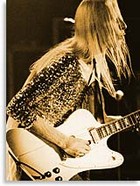
    Photo: Neil Zlozower.

    Nov. ’01 issue. All copyrights are by the author and Vintage Guitar magazine. Unauthorized replication or use is strictly prohibited.
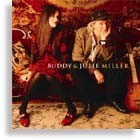
  • Buddy and Julie Miller

    Buddy and Julie Miller

    The family that sings together swings together. If that family is the Millers, they do more than just swing; they rock, shimmy, shake, frug, gyrate, and quiver.

    For readers unfamiliar with this dynamic domestic duo, Buddy Miller is a sideman extraordinaire, lately with Emmylou Harris’ Spyboy band, where he not only supplied blistering hot guitar licks but impeccable backup vocals.

    Julie Miller fattens their connubial checkbook with songwriting royalties for singers like the Dixie Chicks, Lee Ann Womack, Little Jimmy Scott, and Hank Williams III.

    She has also recorded two solo albums, while Buddy has three, all on Hightone records. This is their first duo album, and after a listen or two you will wonder why they waited so long.

    Julie and Buddy serve up hardcore roots country music spiced with modernity that sounds both new and ancient. Their music demonstrates a complete understanding of what makes music primal and vibrant. Beginning with their treatment of the Richard Thompson gem “Keep Your Distance,” the Millers deliver a edgy performance that reminds me of the last stormy days of Richard’s musical partnership with his ex-wife, Linda. Eight original songs, seven by Julie, and one Miller collaboration, join tunes by Utah Phillips, Richard Thompson, and Bob Dylan. My favorite original is “You Make My Heart Beat too Fast,” a nasty number that is a musical amalgamation of country, garage, and swamp rock, with a touch of punk thrown in for attitude. Buddy contributes a screaming, snarling guitar solo that would make even Keith Richards jealous.

    To further enhance the intimate homegrown feeling of this CD, it was recorded in Buddy’s home studio (affectionately named “Dogtown”). Spyboy bandmate/drummer Brady Blade joins Gary Talent, Byron House, Joey Spampinato, and Rick Plant on bass, Phil Madeira on Hammond B-3, and Tammy Rodgers on mandolin. Buddy and Julie handle the lead vocals, and Buddy performs all the guitar tracks. Emmylou Harris adds her uniquely melodious harmonies on “Forever Has Come to an End.”

    Buddy and Julie Miller is so musically addictive it’s hard to let a day go by without putting it into a CD player. But unlike chocolate or cognac, if you binge, it will only do you good!


    This article originally appeared in VG‘s Jan. ’02 issue. All copyrights are by the author and Vintage Guitar magazine. Unauthorized replication or use is strictly prohibited.
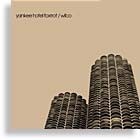
  • Wilco – Yankee Hotel Foxtrot

    Yankee Hotel Foxtrot

    The album opens with static. The distortion bleeds into a sonic maelstrom of competing radio signals before a backbeat of drums launches the first song, “I Am Trying to Break Your Heart.” Welcome to Wilco’s fourth CD, which is named for a short-wave radio code and is easily the band’s finest, if not defining, moment.

    The story behind Yankee Hotel Foxtrot is typical rock and roll melodrama. After the band’s first three albums on Reprise, the label laughed at this new album and warned front man Jeff Tweedy et. al. that it would ruin their careers. Rumor has it the band bought the masters for $50,000 and shopped them around until finding a happy home with Nonesuch. Following on the heels of releases by such diverse musicians as Emmylou Harris and the Kronos Quartet, it seems a fine place for Wilco’s experimentation.

    Yankee Hotel Foxtrot was produced by the band and mixed by studio experimentalist Jim O’Rourke (of Sonic Youth and Stereolab fame). In the best tradition of The Beatles’ four-track innovations, this album blends pop music and sonic exploration, proving they do not have to be mutually exclusive.

    The album comes across like a late-night broadcast from a strange and wonderful pop-music station located somewhere in time and space. Songs that begin with graceful intros, such as “I Am Trying to Break Your Heart,” “Ashes of American Flags,” and “Poor Places,” end in static and distortion. Other tracks such as “Kamera” are pure pop jingles, catchy and fun. This album is destined to become a classic.


    This article originally appeared in VG‘s Aug. ’02 issue. All copyrights are by the author and Vintage Guitar magazine. Unauthorized replication or use is strictly prohibited.
  • Amazing Rhythm Aces – Stacked Deck and Too Stuffed to Jump

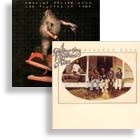
    Stacked Deck and Too Stuffed to Jump

    A couple of issues back, I reviewed re-releases of these two albums that I said were long overdue for a number of reasons. I also complained about the poor packaging. Well, that’s been taken care of, along with better sound quality.

    These releases, sanctioned by the band, restore the packaging and lyric sheets in a nice package. A good listen will also show a very nice clear quality that one-ups the somewhat dull sound of the release this summer by Collector’s Choice Music.

    I won’t repeat everything I said then about the music. Suffice it to say, Russell Smith was writing great songs and singing great, and guitarist Barry “Byrd” Burton was everything you’d want in a guitarist. Whether it was a blues, a swing tune, straight country, or a burnin’ rocker, his playing always elevated the song. Put that together with a killer rhythm section, and you’ve got two of the best albums of the ’70s. Highly recommended, but make sure for the complete package to go with the Valley Entertainment releases.


    This article originally appeared in VG‘s Feb. ’01 issue. All copyrights are by the author and Vintage Guitar magazine. Unauthorized replication or use is strictly prohibited.
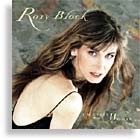
  • Rory Block – I’m Every Woman

    I'm Every Woman

    I’ve always thought of Rory Block as a modern country-blues, acoustic-slide playing, soulful singer. Here, she changes the program a bit. The emphasis here is on soul music. Not the stuff of Robert Johnson and delta bluesmen, but the stuff of Al Green and Ashford and Simpson. And, Block handles it all nicely.

    If you’re a fan of her guitar playing, there’s not a lot of what you’re used to here. The cuts on the CD are bookended by short bluesy acoustic blues that she performs solo. In between, there’s some really good guitar playing, but most of it is by veteran studio ace Jeff Mironov. His right-on-the-money rhythm licks and fills propel cuts like the cover of Al Green’s “Tired of Being Alone.” Block’s vocals on that one really shine too. Her soulful ease around the notes and the words are both a tribute to the original, and sound fresh. Both Block and Mironov shine again on a cover of the Womack and Womack chestnut “Love T.K.O.,” a song made a hit by Teddy Pendergrass way back when. Keb’ Mo’ makes the cover of “Ain’t Nothin’ Like the Real Thing” a soulful treat. Even the one Block original, “Talkin’ About My Man” is one for fans of soul music. It’s a soul ballad with great vocals and a wonderful arrangement.

    The other main influence here is gospel. The a capella versions of “Sea Lion Woman” and “Ain’t No grave Can Hold My Body Down” are incredible. Block’s vocals mix with performances by various guests that will bring chills to your body.

    This is one of my favorite albums in a while. Block’s earthy vocals mix with a very sultry sound she can seemingly pull up from anywhere and at anytime to really help a tune convey what it’s supposed to. If you’ve never been impressed by Block as a vocalist, check this one out. It’s well worth your attention.


    This article originally appeared in VG‘s April ’02 issue. All copyrights are by the author and Vintage Guitar magazine. Unauthorized replication or use is strictly prohibited.