Month: June 2001

  • John And Jake Andrews

    The Family that Frets Together...

    The “father and son” idea of musical lineage isn’t anything new, and it shouldn’t be surprising that more than one generation of electric guitarists has attained notice in the popular music spectrum, as more and more parents who played their share of (sometimes loud) guitar-based music is now seeing one or more offspring attempting to hone their own musical chops.

    Such is the case with Austin’s John and Jake Andrews. John was the guitarist for Mother Earth, an acclaimed aggregation that started out as a latter-day “Frisco” band in the late 1960s. While the focal point of the band was vocalist Tracy Nelson (VG, April ’98), who hailed from Wisconsin, the bulk of the combo was comprised of players from Texas. John Andrews’ sojourn started several years earlier in the Lone Star State, and included more than one brush with notable musicians.

    Andrews is originally from Houston, but in ’64 was playing in an Austin combo called the Wigs. The vocalist and other guitarist for that band was Boz Scaggs, who would also migrate to the San Francisco area and encounter his share of fame, first as a member of the Steve Miller Band before going on to a successful solo career. The motivation for Andrews’ own move to the Left Coast was a chance to work with the Monkees’ Michael Nesmith, an opportunity presented by former bandmate David “Spider” Price.

    “I got a call from Spider. He told me Michael Nesmith wanted to put together a band of Texas musicians called the Armadilloes,” Andrews recounted. “I got hold of (bassist) Bob Arthur, and we went to Los Angeles. We were together for a few months, but then the Monkees’ TV show didn’t get renewed, so the money dried up.”

    Andrews’ next opportunity came when he auditioned for Little Richard’s band.

    “The auditions were at a Baptist church in Watts,” he said. “And the first day there were about 50 drummers, 50 horn players, and maybe 10 guitarists. I made the cut the first day; it was down to three guitarists, and I knew the material and the other two didn’t. So I felt sure I’d get the gig.

    “But that night, I got a phone call from Travis Rivers – Mother Earth’s manager – he’s also from Texas. They’d been playing around the Bay Area for several months, and had just signed a contract with Mercury Records. They were supposed to start recording in two weeks, and they’d just fired their bass player and guitar player. Bob Arthur and I drove up that night – I never went back to the Little Richard audition – auditioned for Mother Earth, and we cut the first album, Livin’ With The Animals, in August of ’68.”

    Keyboardist Mark Naftalin (VG, April ’98) was on board for the first album. He had been a member of the original Butterfield Blues Band, which included guitarists Mike Bloomfield (VG, July ’97, April ’98) and Elvin Bishop (VG, July ’97). Bloomfield also played lead on the Memphis Slim song that was also the band’s moniker, but Andrews (nicknamed “Toad” during his stint with Mother Earth) advised that Bloomfield, who was living in Berkeley at the time, was actually recruited by Nelson rather than Naftalin.

    And Andrews was into vintage guitars and amps when Livin’ With the Animals was recorded. He’s seen playing a blond Fender Telecaster – a ’54 he still owns – in one photo in the album.

    “Back then you could get them for less than $100,” he noted with a chuckle.

    Mother Earth’s second album, Make A Joyful Noise, was recorded in Nashville, and the band ultimately moved to Music City. The combo lasted until ’76, and Andrews cited a five-day stint at the El Mocombo Club in Toronto as its final gig. While Nelson would continue to use the Mother Earth name, Andrews remained in Nashville and began buying and restoring antique ceiling fans he found in old hotels. He and a partner found encouraging demand and profit from restoring such collectibles.

    “We’d have maybe $20 or $30 into each,” he noted. “And we could sell them at antique malls for about $300, so it was a huge profit margin.

    “TGI Friday’s corporate office was in Nashville, and we furnished about 10 of their restaurants with 10 fans each. We bought motors from Hunter and Friday’s didn’t like the blades of the fans, so we made our own blades. George Gruhn had his GTR store back then, and he let me use his bandsaw and drill press to finish off the new blades.”

    Andrews moved back to Austin in the Fall of ’77 and opened his first Texas Ceiling Fans store a few months later. In ’86 the company expanded its inventory to include full lighting fixtures, closet lights, chimes, etc.

    Andrews has an enviable collection of vintage guitars – most are in a bank vault. Several were obtained during his days with Mother Earth, so he was ahead of the curve in the “old guitar phenomenon.” His main interest is in old Fenders, and in addition to the ’54 Tele he cited earlier, he also has a May ’54 Stratocaster (refinished), a matched ’53 Esquire and Telecaster set, a ’59 Custom Telecaster, and two early Broadcasters. He still owns a ’57 Bassman 4 X 10 amp he used in his tenure with Mother Earth.

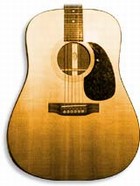
    Some of the instruments have celebrity connections. His ’51 Esquire was formerly owned by Clarence “Gatemouth” Brown. Brown has authenticated the guitar, and told Andrews that Leo Fender gave him the instrument. Andrews’ ’44 Martin D-18 was owned by country blues picker Sam McGee, and one of the Broadcasters belonged to Michael Esposito of the Blues Magoos (which charted in the mid ’60s with “We Ain’t Got Nothin’ Yet” and “Pipe Dream”).

    Andrews also dabbled with student-grade Fender instruments, such as Musicmasters and Duo-Sonics, and recalls one “volume” purchase of budget instruments when he and Travis Rivers pooled their finances.

    “We were in Houston, auditioning a drummer,” he recalled. “And we went to this pawn shop in the black section of town called Wolf’s Pawn Shop. They had three ’50s sunburst Les Paul Juniors and a Fender Duo-Sonic; at the time, I couldn’t have cared less about Juniors because I played Fenders. So Travis got the three Gibsons and I took the Duo-Sonic – we got all four of ’em for $100.”

    Ultimately, Andrews refinished the Duo-Sonic and it was one of the first guitars his son Jake (born in 1980) learned to play.

    Jake’s star is now on the rise, as the young guitarist’s first album, Time to Burn (Jericho), has garnered noticeable airplay (particularlythe title track) across the U.S.

    Jake acknowledges that he grew up in a musical household, even though his father wasn’t a full-time professional guitarist anymore.

    “My father was pretty much out of the [music] business, but he still played at certain gigs, just for fun. I remember being around guitars ever since I was real young, and I started playing when I was about five.”

    At an early age, Jake was sitting in with players like Albert King at legendary venues such as Antone’s.

    Another early guitar of Jake’s was a ’53 Gibson ES-140T, a 3/4-scale instrument his dad bought as a Christmas gift when Jake was 10.

    “When I was 11 or 12 I felt like I could handle a Strat,” he noted. And that model has been his instrument of choice since. He played one of his father’s clean mid-’50s Strats and some vintage reissues, then for some time played the aforementioned early-’54 Strat. He currently utilizes a sunburst ’60 model, “…but there’s not much sunburst left on it,” Jake said with a chuckle.

    The second generation guitarist concurs that Time to Burn contains what many listeners will consider stereotypical “Texas tones.” But Jake noted that “…while there are some regional similarities, almost everybody’s gonna have a different style.”

    Most of the album’s 13 tracks are performed in a three-piece format with occasional keyboards and horns. And the late Doug Sahm played piano on one of his own compositions, “Glad For Your Sake.”

    “My father knew Doug since the ’60s,” says Jake. “We ran into him at a hotel in Los Angeles and asked him to play on the album.”

    The young player also acknowledged the influence of other Texas vets in the liner notes of Time to Burn (citing Jimmie Vaughan, Carla Olson, Eric Johnson, and other guitarists), and also noted other players such as Charlie Sexton and Doyle Bramhall II.

    “They’re still older than me, but I still listened to them when I was growing up.” The album is dedicated to the late Oscar Scaggs, Boz’s son.
    Jake was upbeat about the reception Time to Burn had been receiving, noting that the title track had been heard in more than 120 radio markets. He’s toured with George Thorogood, The Allman Brothers Band, and the Doobie Brothers. The buzz concerning his playing and singing continues to grow.

    In addition to the ’60 Strat in his current rig, Jake favors Marshall amps. “I’m always changing amp setups,” he noted. “Recently, I’ve been using a ’73 100-watt Marshall head and a ’68 4 X 12 cabinet. They sound great.”

    So Jake Andrews is following in his father’s musical footsteps, even though John has gone on to a very successful post-music career. Both are appreciative of their respective personal musical histories, and both are upbeat about the future. It doesn’t get much better than that.


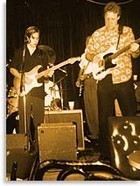
    Photo courtesy of John Andrews. John (right) and Jake (center) Andrews at a jam with Bonnie Raitt’s original rhythm section in July of ’95.

    This article originally appeared in VG‘s Aug. ’00 issue.
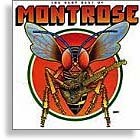
  • Montrose – The Very Best of Montrose

    The Very Best of Montrose

    Ronnie Montrose is known less for his guitar capabilities than for fronting a mid-’70s hard rock band that featured an unknown lead singer named Sammy Hagar. Still, Montrose released a quartet of heavy albums before heading into solo-artist obscurity. This new collection from Rhino features 18 tracks selected by Montrose, who also provides commentary in the liner notes. Running chronologically, the set begins with the self-titled Montrose album from ’73.

    Ably produced by Ted Templeman, Montrose burns from start to finish. Every song is a heavy rocker, and production values are excellent. As with many sophomore efforts, Montrose’s second was more stylistically diverse, a fact reflected in this package, as well. Unfortunately, the songs weren’t as strong, but they show a band maturing, stylistically.

    Hagar had departed by the release of Warner Bros. Presents Montrose in ’75 and the band seemed particularly lifeless. Produced by Ronnie Montrose, the record was poorly mixed and featured mostly mid-tempo songs. The best cut on the album, the ethereal “Sailor,” isn’t included here. Shame!

    Montrose got back on his rockin’ shoes for Jump on It, in ’76, produced by Jack Douglas of Aerosmith fame. The three uptempo songs here show the band had improved greatly, but fans had apparently given up.

    Rounding out this compilation are three cuts from Montrose’s recent solo effort, Mean, which capture to good effect his ability to create spacey melodic music. Sound on this remastered best-of is uniformly excellent, and the liner notes are complete and include shots of a number of Ronnie’s custom guitars. Some of Montrose’s best guitar playing came with his ’80s band, Gamma, and while none of those cuts are included here, a Gamma retrospective is close to completion.


    This review originally appeared in VG‘s May ’01 issue.

  • Fulltone Clyde Wah

    Vintage Tone For Modern Players

    The original Vox Clyde McCoy wah pedals of the late 1960s are high on the list of soughtafter vintage effects. They were widely used during live performances and on legendary recordings by players such as Jimi Hendrix, Eric Clapton, Jimmy Page, and Jeff Beck. Because of both the historic value and the distinct sound they produce, original McCoys command big bucks. And vintage purists know you’ve got to have the real thing if you want the real tone.

    But wait. With the increasing prevalence of faithful reproductions and reissues, does that still hold true? One of the potential disspellers of that myth is Fulltone’s Clyde wah pedal, an unofficial reissue of the Clyde McCoy.

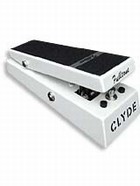
    Built by Mike Fuller, the Fulltone Clyde is available in Powder-coated White, Hammertone Black, and Hammertone Gray colors. The pedal itself is solidly constructed and includes a rubber slip-proof surface on top of the treadle. The treadle rocks back and forth smoothly with a small amount of resistance that allows for better control of the effect. The tension of the treadle can be adjusted with the proprietary “nylock” nut on the side, placed at the pivot point. The Clyde will stay set in whatever position selected, which isn’t always possible on wah pedals that are well-worn. The Clyde also includes four large rubber feet on the bottom of the pedal, which prevent it from slipping. The insides are accessed by removing the feet, which is done easily and without a screwdriver.

    Inside, Fulltone’s handwired circuit incorporates a design similar to that of the original and uses comparable components, such as carbon composition resistors, Polypropylene WIMA .01 capacitors, and a tuned-core handwired inductor made from the same type of wire (with the same inductance) as the original. The Clyde also includes Fulltone’s “Fullrange” pot, a copy of the ’60s Icar pot used on the originals. The Fullrange pot is rated at 150,000 turns per lifespan, instead of the industry standard 15,000, and it provides a much wider sweep. The Clyde also includes a trim-pot that functions as a resonance control to add more gain and expand the effect’s frequency response for more lower-mids and bass. Set it at 6 o’clock, you’ll hear the standard ’60s Vox wah setting. The pedal’s on/off switch is easy to engage and doesn’t cause any sort of loud pop through the amp when you step on it. And the Clyde causes no volume loss.

    And the sound?

    Since the Clyde was created as an upgraded reissue, we ran it up against the original, which was made in Italy, and a recent Dunlop Crybaby. We recruited a ca. ’67 Vox Clyde McCoy “picture” wah (Clyde’s picture’s on the bottom), and a ’68 Vox Clyde McCoy “signature” wah (no picture, Clyde’s name in italics). We compared their tonal responses and functional capabilities, listening for the differences in the tones produced by each pedal’s filter, and to relate the signal and noise levels each pedal created.

    With many vintage effects, there’s often wide variation between pedals. That’s to be expected, even among the same models built in the same production run. In the ’60s and early ’70s, components weren’t always built within tight tolerances, and manufacturers often used whatever components were available at the time, so slight variations in construction were not uncommon. As anyone who has tinkered with any number of vintage wahs knows, all wahs were not created equal.

    Our tests revealed many things, including that the sweep range of the Fulltone was a bit wider than that of the vintage pedals, with noticeably more bottom and top-end. The taper of the pot on the Fulltone pedal was super-smooth, and we were able to hear minute changes as the treadle was moving in each direction. Very cool!

    Along with all the vintage mystique of the older pedals, there were some quirks with each of the original Vox wahs (as might be expected with any vintage effects that have seen 30 years of use). We do have to take into consideration that these pedals were the best of what was available at the time, and possibly the best examples of well-working originals. However, for modern players who need signal processing to be extremely quiet and highly reliable, some of those quirks are simply unacceptable.

    Some things we noticed; when using the “signature” Clyde, we heard some clunking sounds through the amp as the treadle hit the base in its full up or down positions. And the “picture” Clyde produced some scratchy sounds heard as the pot was turned to the mid point. On both original Clydes, the switches were fairly noisy and produced distinct pops. Furthermore, both originals showed slight volume loss when the effect was engaged. The Fulltone’s switch was quieter than both, and there was no volume loss at all when the effect was on.

    In summary, of all the wah pedals in our selection, the Fulltone demonstrated the widest tonal range, the best tapered pot, smoothest treadle action, and offered the most control of the effect. In addition, the Clyde operates on a single 9-volt battery and can also be used with an optional AC adapter.

    So, our assessment revealed that the Fulltone Clyde carried the classic design to the next generation by preserving that alluring ’60s tone and adding the flexibility preferred by modern players. If you’re in the market for a wah pedal, be sure to check out the Clyde.


    Fulltone Clyde Wah
    Type of Unit: Wah pedal
    Features: Extended travel range, custom Fullrange pot, resonance control, tuned-core inductor, true bypass switch, adjustable treadle, operates on 9-volt battery or AC power (AC adapter is optional), limited lifetime warranty
    Price: $279
    Contact: Fulltone Custom Effects, 3815 Beethoven Street, Los Angeles, CA 90066, (310) 397-3456, e-mail,fulltone@aol.com, www.fulltone.com


    This review originally appeared in VG‘s Apr. ’01 issue.

  • The Domino Kings – Life and 20

    Life and 20

    The Domino Kings are (if such a thing still exists) honky-tonk kings. If you like your music with that Bakersfield kick, look no further. Stevie Newman breathes new life into country guitar, the kind of I haven’t heard since Pete Anderson was regularly lighting up Dwight Yoakam songs with sonic forays based in the playing of folks like Don Rich, but broke lots of new ground too.

    If you don’t believe me, you don’t have far to go on the CD to hear it. Check out the one and two-note bends on the opener, “Borrow a Lie.” It’s honky-tonk heaven. “Will He Be” starts with some awesome twang, and before the song is over, Newman has delved into the swampy sound of John Fogerty crossed with a wild-man country player. “Where Your Lies Stop” has a solo that mixes chords, hammer-ons, double-stops, and single-lines into a perfect guitar stew. If straight-ahead country chickin’ pickin’ is more your style, check out “The End of You.”

    You get the idea. Newman knows the sound he wants, and he gets it. No mean feat in this day and age, when you’re playing country music.

    The rest of the band is Brian Capps on bass and Les Gallier on drums. Capps and Newman share vocals. And they all get it. They understand what this style of music is all about and obviously lived it and soaked it in for quite some time.

    If you’ve grown cynical because country music has become stale and boring, check these guys out. They’ll adjust your attitude.

    This review originally appeared in VG‘s Mar. ’01 issue.

  • PRS Basses

    Subjective Funk & Cool

    The Paul Reed Smith bass was introduced at the January ’96 NAMM show.

    Set-neck and bolt-on (CE model) models were offered, with mahogany bodies and one-piece mahogany necks. On Bass and Curly Bass models, a maple-capped body was included, and the Curly models had transparent finishes. Figured-top bass bodies typically had a 1/4″ maple cap. Options included a 10 top at an additional $100 retail, and bird fingerboard inlays at an additional $200. The standard Bass model wore an opaque finish, and a few were made with maple fingerboards. The necks had 22 frets, except for the fretless models, which were, in fact, void of any frets whatsoever.

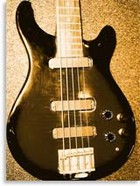
    The electronics setup was very Alembic-esque in that the PRS bass husk housed single-coil pickups with a vari-tone and hum-canceling dummy coil.

    The PRS electronics consisted of three single-coil pickups, a dummy coil on the rear of the body, a master volume, a five-position vari-tone knob, bass pot (labeled “deep”) and a treble knob (aptly dubbed “clear”). These basses were pretty dark and bottomy, but were also versatile in that you could select the combined tones of all the pickups or touch on the sounds generated from the pickups in the different positions on the body.

    Production of these basses reportedly lasted from ’86 through ’89, and about 2,000 units were sold. Famous users included Allen Woody, from the Allman Brothers Band, and of course Robbie Shakespear, of just about anything quality being done in reggae at that time. Some of the complaints were about the tight string spacing on the five-string models up to mid ’89. Another major complaint was the pickup placement close to the neck. Slappers don’t like the feel of plastic under their thumbs! I say if there is a will there is a way, and if you are good enough, you can make due on a turd with decent action height, but why put yourself through the heartbreak of discomfort if you can take a vacation on a bass of your choice.

    PRS basses are gaining popularity amongst collectors of small-production pieces, but who knows what the future will bring for their appreciation in the future collectible market? These basses are comfortable to wear, nice to play, and have a cool tone coloration palette, so it’s not like the wall hangers that look cool but never have a place on the stage or even in the hands of an amateur musician/collector. Go to a local guitar show or check one of these puppies out at a dealer/purveyor of all that is warm and fuzzy in the new, used, and vintage bass market. It may just float your boat and prompt good feelings in your pins.


    This article originally appeared in VG‘s Jun. ’98 issue.

  • Guitar Picks

    The Fine Art of Pick Collecting

    “You’re collecting guitar picks!? Is this a joke?”

    I can’t recall how often I’ve been accosted with this query. At this point I pull from my pocket (and how often can one carry around part of a collection in your pocket?) a small leather change purse containing a myriad of vintage plectra. Trapezoids, mosaics, cork-grips, corrugated. The former doubting Thomas is easily drawn to the diverse shapes and colors. In a world where there are not just one but two books devoted to the collectibility of happy meal toys, why should an interest in the hobby of collecting the lowly guitar pick be so farfetched?

    My personal quest into the world of pick collecting began rather casually. I found a nice old Martin Style C uke from the ’20s and rather than use the customary felt pick, I recalled a long oval celluloid pick I used when I began to play guitar in 1966. Because it was so flexible, the pick did the work, not the wrist. It might do the trick. Realizing no modern store would have such an ancient piece, I perused the older shops in downtown Boston. Alas, no luck there, but a clerk alerted me to a recently published book called Picks! by Nashville studio veteran Will Hoover. I absorbed that little book on my trip home, where I went through all the picks I’d saved over the last 30 years and found many a collectible entity. I was hooked and my journey was begun.

    Here, we’ll attempt to unearth a little-known corner within the world of vintage instrument collecting – the art of the pick! I’ll endeavor to unravel the questions: what to look for, where to look, and how to rope, corral, and store these little critters.

    What to Look For
    One of the beauties of pick collecting is that there are so many aspects to it. For the sake of being concise, we’ll address half a dozen. Arguably, the most soughtafter pick today is the celebrity pick – a pick designed specifically for a star.

    It seems just about every time a tour commences, a new celeb is put out for show. Thus, celeb collecting could garner dozens of logos for the same act over a period of years. Some celeb picks are in more demand than others. Stevie Ray Vaughan is a case in point. But buyer beware – there seem to be quite a few fakes out there and even these are demanding top prices.

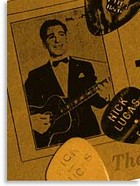
    Some tend to favor early celebs. Nick Lucas was a famed guitarist who, in the early ’30s, was part of a team that designed what has become known as the “Lucas shape” – the D’Andrea #351. Even competitors describe their 351 shapes by this title. The Lucas imprint was one of the first produced and made from the ’30s through the ’70s with various changes in logo design. Other pre-celebs include Nick Manoloff, with his name impressed in the pick rather than screened on, like the Lucas. Bob Clifton had a celluloid “Tu-Way” diamond-shaped pick, also with his name impressed. Roy Smeck never seemed to meet an endorsement he didn’t like, and had a metal finger pick and a celluloid thumb pick with his name engraved on them.

    Any discussion of early celebs leads to the largest area of collectible picks – the vintage variety. By this, we mean anything older than 25 years, and in most cases, not being made anymore. Although there were dozens of pick companies, we’ll stick to the D’Andrea and Herco companies.

    The D’Andrea company has been around the longest. Founded in 1922 by Luigi D’Andrea, this family-run firm is still producing picks and other supplies 75 years later. At one point in the late ’40s/early ’50s, D’Andrea offered 59 styles, including picks with rubber, cork, or corrugation, all designed to improve grip. They had picks for mandolin and banjo and some way-out sizes that defy description. If a player wanted something special, D’Andrea would supply them. Eventually, the selection pared down to about two dozen. Thankfully, Luigi had a numbering system.

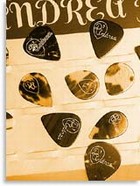
    D’Andrea’s biggest competition came in the ’50s from the Herco company, started by the Hershman family of New York. The Hershmans imported picks from Japan, and their 720 collection had only 11 flat picks, three thumb picks, and a finger pick. Although they offered similar sizes as D’Andrea, there are several distinguishing features to look for. D’Andrea had a logo, Hercos did not, but can be identified by the small “Japan” imprint on the face of the pick. D’Andrea corkgrips have a smooth cork finish, while the Hercos are rough. D’Andrea picks are highly polished and the Hercos usually have a dull sheen. Same shapes had different numbers. The D’Andrea Lucas shape was #351. Herco’s was #25. While D’Andrea used many celluloid colors over the years, Herco kept the same faux-tortoise amber and brown until later years, as well as an occasional multicolored mosaic. And finally, a red-speckled shade. The Herco company was swallowed up by the giant Jim Dunlop corporation and the D’Andreas are still thriving.

    A far easier division of pick collecting is the shop imprint. Most stores have some kind of logo on a pick. Commonly, it’s only the name of the establishment and perhaps a phone number. But there are some with stylized artwork. Needless to say, if you live in Colorado, there’s not much chance of finding a shop imprint from New Hampshire. So visit shops in your area and grab a handful for future trades.

    Most major guitar companies have logo picks. For the most part they are D’Andrea made. Different companies have offered various sizes. In the ’50s, Fender only had the small #358 and the Lucas-shaped #351. In the ’60s they expanded to include the rounded-triangle #346 and the large #355 triangle. An interesting sidebar to the Fender pick story is that Leo never applied for his name to be trademarked. CBS didn’t get around to it until August of ’65 and didn’t receive it until ’72! So, if you find an old pick without the trademark “R” after the word Fender, chances are you’ve got a pre-CBS pick!

    Gibson, on the other hand, had been selling picks since the ’20s and by the ’40s and ’50s they had more than a dozen shapes. Some of the earliest have “Gibson” impressed directly on the pick with either a straight block letter logo or an arched name. Later, they began to have the name screened in gold block letters on shell-and-white picks. To confuse matters more, Gibson’s numbering system was not the same as D’Andrea’s, even though they were D’Andrea-made. Four sizes in a black material called eboneen emerged in the early ’70s. These are sometimes referred to as the raindrop pick, for the unique design.

    Other companies would follow suit, including Guild, Gretsch, Epiphone, and National. Although the Nationals from the ’50s and ’60s came in white-and-shell, Lucas-shaped, and #346 size, they were imported from Japan.

    More than any other vintage pick, genuine tortoiseshell and real ivory are the most sought after. Both of these materials have been on the endangered species list since the early ’70s and are no longer made. D’Andrea offered tortoiseshell picks with their logo from the ’30s through the ’70s. Once you’ve played with a real shell pick, you may never go back to nylon.

    During the ’50s and ’60s, regional music distributors handled most of the door to door operations of selling National products to smaller stores in their area. Some even had their own logo picks made by D’Andrea. In the Northeast, one large distributor was Harris-Fandel. They offered all of the popular D’Andrea styles with their own “H-F” stamp. One of their best claims to fame came in 1973 when they commissioned D’Andrea to make the “Famous No. 351” pick to commemorate their anniversary. Other distributors would include “Coast” and “Pacific” on the west coast, “Maxwell” and “Cortley” in the south and “Heater” in the northwest. These companies usually offered a “jobber” catalog for the stores, which are invaluable in identifying the picks that were available in these areas.

    Another offshoot for vintage paraphernalia are pick cards and display cases. The cards would hold a dozen or more picks at three for 25 cents, or 10 cents each. Nick Lucas, Nick Manoloff and Bob Clifton could be found elbowing each other and Herco and D’Andrea for counter space. Both D’Andrea and Herco offered similar plastic pick display boxes. Finding these old boxes isn’t easy. Most were used until broken and then tossed away. Any that might still be around are in rough shape. Oversized display picks are also in demand. I’ve seen these with the Fender, Guild and Martin logos.

    Finally, there’s always someone trying to reinvent the pick. Some of these designs are quite intricate and not very practical. They soon fade into memory. While others carry on in hopes of finding their niche. Dunlop offered their grey nylon pick with a rubber band through it. You’d wrap the band around your finger for better grip. In the early ’70s there was an ad for a “Band-it” pick. It had a large loop over the pick so the player could slip his finger through. Then, there is a new pick on the market called “Dava.” Depending on where you hold the pick it functions as everything from thin to heavy. Who knows, some of these might be collectible in 20 years.

    Where to Look
    After deciding on an area to concentrate, the question arises – where do I find them? The easiest attainable are shop imprints. Just go in and buy some. Next would be the most desired – celebs. If you frequent clubs or concert halls that your fave guit-meister might alight, bring some stamped self- addressed envelopes and make contact with a guitar tech. Be polite and ask if he might drop in a few picks (one for your collection and some for trade) and mail them off to you. A complimentary soda or beer might not be a bad incentive.

    As for the vintage buds, most modern stores haven’t been planet-bound long enough to have the older material. Your best bet is to seek out the old mom-and-pop operations that have been in business for decades. Here in the northeast, there were many large mills in small rural towns. They employed many ethnic peoples and their music. These smaller shops catered to them. Most of the mills are long gone but some of these shops still survive. There’s a good chance a large cache of vintage stuff had been collecting dust in the back room or under the counter for the last 30 years. I’m sure they would be happy to unload them at a discount. But you’d better move fast. These places are dying off.

    The most obvious place to look for vintage picks are vintage instruments – in their cases. When you happen on a vintage shop, pawnbroker, flea market, antique store or luthier repairman take a look in the pocket of the case. Voila! I once visited a large antique fair in central New England and there among the overpriced cherry desks and Tiffany lamps I found many a banjo and mandolin case with a hidden treasure inside. In another instance, at a vintage guitar show in the L.A. area, I approached a stunning 1957 Fender Strat in mint condition. I told the dealer I couldn’t afford such a luscious specimen, but what about these nice old Fender picks in the case? “Take ’em,” he offered. That’s about as close to anything I’m ever going to get in a ’57 Fender. And free is always my favorite price.

    The best source I’ve found to increase one’s collection is by joining a trader network. There is strength in numbers. If you can’t find what you desire in your neck of the woods, chances are someone in another part of the country (or for that matter, another part of the world) might have what you require and vice versa. There are always ads in the back of Vintage Guitar and other publications searching for the same. Besides making a fresh contact, you’ve made a new friend.

    Storage and Display
    Now that you’ve started to acquire a few picks – okay, a lot more than a few picks. The final step is the proper storing and displaying of your collection. As noted in Will Hoover’s book, picks are more sensitive to fire than the scarecrow in The Wizard of Oz. How often have you seen a guitarist with a nice ‘stache put his pick on one side of his mouth, smoking a cigarette on the other side while doing a fast tune-up on stage? “Nice pyrotechnics, man!” Yeah, but what do you do for an encore?

    I’ve found an easy solution for storing picks. I use plastic cases with many compartments. The type used for jewelry. They are perfect for placing picks of the same color and brand. An important point to make here is – picks have to breathe. Celluloid is porous. Take ’em out for air occasionally. In time, if they stay all cooped up they become dry, brittle and break easily.

    As for displaying your new-found friends, care is also paramount. Celluloid, being a finicky element, must be kept away from moisture. Avoid common transparent tape, the glue will do irreversible damage in the long run. For displaying, I like to use archival photo slide sheets (top mounting). The clear plastic enables one to view both sides of the pick. They fit into an ordinary three-ring binder for easy storage and transport. Other methods include mounting picks on large display boards, but make sure to use archival tape. Placing picks of the same heritage together in a frame makes an attractive gift. Try not to make any display permanent, as a collection grows you might want to shift your picks from one spot to another.

    Value
    I was tempted not to broach this subject, but as we live in a mercenary world, I suppose I must.

    As with anything old, collectible, no longer available, or just plain “I gotta have that at any price!,” value is in the eye (or more precisely in the pocketbook) of the beholder. If someone is willing to shell out $75 for a plastic Halloween pumpkin from McDonalds, I suppose someone might do the same for a genuine Eric Clapton pick. I believe picks were designed for a purpose. There is beauty in their simplicity. But invariably when used they wear out and die. Therefore, if it’s a mint piece as with any commodity, someone’s going to charge and someone will probably pay. I’d hate to see pick collecting go the route of vintage guitars and amps. Eh, c’est la vie.

    Wrapping Up the Picks
    Pick collecting is far from a new enterprise. Guitar Player has had several articles about picks dating back to 1975. I came to pick collecting searching for a sound of my youth. I found a vast tract of uncharted and undiscovered information. I’m in this for fun, not profit. As vintage guitars, amps and effects have become beyond the grasp of the everyday player and into the vaults and display cases of deep pocketed collectors, the humble pick satisfies the “collecting jones.” And at a mere pittance. There are so many avenues to go down. You can specialize in one or more areas and never tire of the seemingly endless stages of the pick. And, someone is always trying to build a better mousetrap …er, pick.

    Oh, and what’s my favorite pick, you ask? I bought a gross of Fender #351 in medium in 1970 in a clear plastic box. No trademark after the Fender logo. I’ve still got some left and I cherish every one of these babies.


    D’Andrea pick selection courtesy of Chris Gaylord. Photo: Brett Sterrett.

    This article originally appeared in VG‘s May. ’99 issue.

  • Guitar Picks

    What's So Special About Guitar Picks

    You may have one in your pocket. They only cost about 25 cents. But if you have always used one to play guitar, you are lost if you don’t have one. They are picks! Skinny little bits of celluloid, plastic, nylon, or any of a hundred other substances. There really isn’t anything special about picks except that you probably use one every day.

    Picks finally got some respect back in 1995, with the Miller Freeman publication of the book Picks!, by Will Hoover. It’s a cute book, and it’s informative in an area where little knowledge had previously been gathered.

    “Picks are fun,” says Hoover. “Fun is the word.”
    Indeed it is, ask anyone who collects them. The hobby of pick collecting got a real shot in the arm when the Hoover book was released, because there was finally a written reference work that created a common language.

    Why collect picks? “Why not?” say collectors. Picks have attributes that make them collectible. There are endless varieties, lots of vintage makes, and your favorite guitar player probably uses one. Wouldn’t it be nice to own one of his (or her) picks? They don’t take up much space, a ready trader market exists to meet your needs, and vintage picks are cool case accessories for your old guitar. We talked to some pick collectors to find out what inspires them.

    “I really like the vintage picks,” says Chris Gaylord, a South Carolinian who has collected picks for 18 years. Gaylord has acquired a well-deserved reputation as a plectrologist. His interest in and knowledge of vintage picks has spread beyond the picks themselves and into pick display items such as cards, boxes, and pouches from the vintage era.

    “My collection is broad and showcases picks made by several companies, starting with D’Andrea in the 1920s, to Gibson in the ’30s and ’40s, to the Herco and Fender picks of the ’50s, along with a lot of forgotten names like Coast, H&F, and Wabash.

    “I have many discontinued sizes and shapes represented in an array of colors and materials such as ivory, tortoiseshell, glass, stone, horn, metal, leather, and celluloid.”

    Harry Anderson has many vintage picks, but takes a different approach to collecting. Beginning in the mid ’80s, Anderson began collecting picks with store logos on them. Now his collection contains picks from 49 states (only Idaho isn’t represented).

    “I like to describe mine as a general collection” he says.

  • Martin D-1

    Not Your Typical Martin

    Over the years, I’ve tried to include instruments in this column that were functional and affordable. Occasionally, we’ve lucked out and found spectacular instruments that offer more than your money’s worth. Some of my personal favorites from the past include the Mesa/Boogie Mark III amp, Kramer Pacer guitar and the Gibson L6S.

    This month’s entry is a guitar I can no longer ignore. The Martin D-1 is my favorite new acoustic, and yet I see them priced new for $700 or less across the nation. I’ve started seeing them used in the $600 range, and for what you get in return, this may just be the best bargain I’ve ever written about in this column.

    Martin guitars need little introduction. In 1833, Christian Frederick Martin left 19th-century Germany and relocated in the hills of eastern Pennsylvania. Through the years, the company has made dozens of models, almost completely handmade, and hammered out a reputation that business people in any industry could only envy. The D-1 is a new guitar, which first appeared on the scene at the Winter NAMM show in 1993. With a list price of $995, the folks in Nazareth were doing their best to produce a quality made-in-America acoustic deserving of the “since 1833” moniker. As the current catalog illuminates, “Martin opted to utilize a two-piece solid mahogany back, coupled with veneered mahogany sides. The three-ply sides provide an extraordinary dimensional stability.”

    Cosmetically, it’s hard to tell the sides are not solid wood.

    “Perhaps the most radical departure from most typical Martin guitar construction is the redesign of the top bracing pattern and neck-to-body joint area,” the catalog continues. “Unique A-frame braces tie directly into a laminated alder neck block, adding support to the soundhole area. The neck incorporates a buttress extension designed specially to support the fingerboard.”

    Gibson pioneered the concept in 1960, with the Johnny Smith jazz guitar. The idea is to have more wood beneath where the fingerboard joins the top. Smith reasoned this would give better sustain and fewer dead spots above the 12th fret. While the D-1 isn’t a cutaway guitar, it does add clarity to upper-register notes. I also suspect this diminishes the chances of the fingerboard pulling away from the top. Martin also stresses that “the X brace has been modified to a full square overlap, and a unique, angled maple bridge plate minimizes failure of this high-stress component.”

    Thus, the different construction techniques are designed to improve an already excellent design many players argue can’t be improved upon.

    Visually, this isn’t the typical Martin finish. The white spruce top, made famous on dreadnoughts and concert 00 series guitars, is missing, along with the shiny glossed rosewood back and sides. The D-1 looks like a Gibson LG-0 made in Nazareth and sized like a D-18. With the cost of a new D-18 over $2,000 (list), Martin wisely decided to opt for a less expensive finish and still use quality materials. The D-1 looks like it’s made totally from mahogany wood and finished with a paper-thin coat of lacquer sealer. In fact, Martin says the D-1 uses “a special cross link finish… extremely thin, to optimize tone.” The typical dreadnought features apply – 20 frets on an 251/2″ scale, 14 frets clear of the body, etc. The fretwork is nice, with somewhat larger frets than the typical Martin. Tuners are chrome-plated affairs that look suspiciously like Schallers without really saying so. In my experience, they are the weakest part of the guitar. While many will find they work satisfactorily, they are also the easiest part to replace.

    We’ve looked at the cosmetics and the materials, but how does the D-1 sound?

    To my ears, fantastic! In the past two years, two students have bought these guitars and they both have special stuff I didn’t expect to find in a newer acoustic. I think of the D-1 as almost two separate guitars – a great fingerstyle instrument and a very good bluegrass “battleship.” Unlike most every D-series Martins I’ve played, the D-1 responds to every little nuance, whether played with fingers or fingerpicks. It seems lighter than other acoustics I’ve played, but the D-1 is probably my favorite fingerpicking dreadnought. If you need more guts, grab a flatpick and it’s all there.

    To be fair, the D-1 doesn’t have the bluegrass festival volume of a good D-28 or even an average D-18. However, it doesn’t cost anywhere near as much, and to me, the D-1 is more versatile. Most studio players don’t record fingerstyle parts with a dreadnought. This guitar is perhaps the only Martin D size you could do it with and still sound convincing. Maybe the top bracing, thinner finish or combination of woods is responsible; whatever does it, the D-1 works.

    I don’t think Martin should drop its other guitars and just make the D-1. I don’t care for its appearance, only because I prefer the white spruce top on the other D-series guitars. Many of you will find the mahogany finish attractive. I also don’t care for the tuners, but I’ve already said this can be remedied easily, and if Martin had to cut any corners, this is without question the place to do it. But these quibbles are picayune, and the D-1 is one of my favorite new guitars, regardless of price.

    The best thing about this guitar is its consistency. Phil Jones, in North Carolina, and John Jegen, in Texas, both have D-1s I’ve played extensively, and both instruments amaze me. This is hard to do with any instrument, but even more so with a flat-top acoustic. If you’re looking for a new, American-made acoustic with real tone and magic, snap up a D-1 before Martin wises up and raises the price $500 or so. You might find these guitars on sale new for around $700, or call one of our VG dealers and tell ’em Riley sent you. Happy hunting, amigos!


    Special thanks to Phil Jones and John Jegen for the use of their guitars and Michael Havens at Brook Mays music for research for this review.


    This article originally appeared in VG‘s Aug. ’97 issue.

  • Seth Lover

    Seth Lover

    The history of the musical instrument business is full of stories, from the drab to the miraculous. Some bean-counters will busily push their way to the forefront, grabbing for a piece of history, while others quietly create. Seth Lover peers out at me from the doorway of his humble Southern California ranch house looking for all the world like an elf dressed in worn work clothes. Welcoming me inside as if he’d known me all his life, I enter a home that is rooted as firmly in the past as in the present. The charming Mrs. Lover joined us for our afternoon together, occasionally chiming in from time to time. Electronics manuals and instruments are in every corner, and the inner sanctum, Seth’s crowded two-car garage, is a wonderland of old inventions never marketed, examples of his prodigious career spanning five decades, and enough parts inventory to start a musical instrument company.

    A noted creator

  • Philip Kubicki

    The First Days of Fender Acoustics

    One day in early June, 1963, I was sitting in the outer office of a deserted (maybe deserted isn’t the right word; it was an almost-empty building waiting to be filled) assembly plant in Fullerton, California, after being tipped off about the development of an acoustic division of Fender Guitars. I took it as a sign, so I filled out an employment application at the “plant” and sat down, awaiting a job interview with Roger Rossmeisl.

    In the silence of the building, I began to ponder my life and how I’d arrived in that position.

    When I was young – perhaps 12 or 13 years old – I found an old, handmade acoustic guitar in my grandfather’s closet. It seemed funny no one in my family except me had any interest in it. I felt an amazing fascination and mysterious connection with it. Even at that early age, I felt my life pivot around that instrument. My grandfather gave it to me, and I still have that old guitar.

    Through childhood, I had a fortunate but average life. I enjoyed insects, art, building models, drawing, and swimming. My father’s adept abilities at mechanics were among his many gifts to me. When I was eight, we moved from Michigan to California, for my father’s health. He knew his time was limited and made the most of the lessons he taught me.

    He revealed the benefits of a logical approach and patience. He taught perseverance and patience. I discovered that, much like my dad, I enjoyed long-term, complex projects. My father died when he was 46. I was 18.

    Early in high school, I discovered Andres Segovia and started collecting all his albums. I thought rock and roll was great, but Segovia and classical guitar was very important to me. The parents of a friend knew about my interests, and introduced me to Ernie Drumheller, who had a production workshop. His hobby was making classical guitars, and he became a new focus of my life.

    Ernie took me under his wing and I started making my first guitar. It was a classical and he had me make it in the Antonio Torres tradition. Ernie encouraged me and I could feel his enjoyment teaching me his skills. I could only spend Saturdays and summers working on guitars, so progress was slow. But slow as it was, by 1961 I was proud of my accomplishments and had made six guitars in three years. I made them one at a time and each was better than the last. I even traded one for a 1931 Chevy I owned for over 20 years.

    After graduating from high school, I enrolled at Fullerton Junior College and studied engineering for two years. F.J.C. was located, with the all determination of fate, a convenient two miles from Fender Guitar company’s assembly plant on Raymond Ave.

    One day in 1963, I went to the plant and asked for a tour, and to my surprise got one. The facility was made up of nine buildings, side by side, all the same size.

    The tour set my blood on fire. Strats and Teles were being manufactured production-style. I saw the neck and body production areas, final assembly. The air was filled with the sounds of electric guitars being tested.

    I mentioned to the guide, Babe Simoni, that I made acoustic guitars and he told me of Fender’s plans for an acoustic division. It was in its development stages and located nearby on Missile Way. He suggested I apply for a job.

    Not long after, I was sitting in the front lobby of the soon-to-be-acoustic division waiting for a reply to my employment application. I brought my most recent classical guitars to show my skills and interest in guitarmaking. I did not wait long before Roger Rossmeisl emerged, with my application in hand.

    Roger was a husky, confident individual with a heavy German accent. We talked for a minute and retired to his office to look at my guitar. While Roger looked over my handiwork, I noticed a diploma on the wall naming Roger as “Gitarrenbaumeister.” It was a “master guitarmaker” degree with accompanying teaching credentials he earned in eight years at a school in Mittenwald, Germany. Down the road, I would benefit greatly from those credentials.

    Roger was very gracious as he examined my guitar, then gave me another tour. The beautiful aroma of Brazilian rosewood swept through me and I knew I would be working there. There was no one in the building of approximately 12,000 square feet, just stacks of Brazilian rosewood, mahogany and spruce. Some of the machinery was in place.

    Roger was designing and tooling up to make the King and the Concert Fender Acoustic guitar models. He also said he would not be hiring for six months. He then showed me some rosewood backs and sides. Pulling out a set, he handed them to me, and said, “Go now, and make a guitar.” I was astonished and gratefully accepted the rosewood before we said goodbye.

    For the next six months, my top priority was making the best classical guitar I could, to impress Roger. I felt myself enter a new level of awareness toward craftsmanship, and by December, 1963, I’d finished the guitar and was on my way to see Roger.

    We had a strong reunion. He got a kick out of the guitar and complimented me on my effort. He again invited me for a look at the factory, which had been transformed into a full-production facility. A huge bandsaw for re-sawing lumber into tops and backs, a ferris wheel-like gluing machine for tops and backs, a widebelt sander, upright routers, finish department, all an amazing sight.

    Finally, Roger spoke the exact words I wanted to hear. “Do you want to work here?”

    My response was as you’d expect.

    “We will start in January,” he said, and on January 27, 1964, he called for my first day of work.

    I worked for and around Roger for the next nine years and I was with him on his last day at Fender. Stories about Germany and his youth, his nine years at Rickenbacker, while making acoustic, jazz, and special projects for the likes of Jimi Hendrix and George Harrison. I had no idea what great things lay ahead.

    But for the time being, the great thing was simply making the first Fender acoustic guitars.


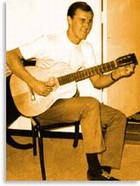
    Phil Kubick in in 1966, with one of his handmade classical guitars. Photo courtesy of Phil Kubicki.

    This article originally appeared in VG‘s Nov. ’97 issue.