In the 25-plus years that Motorhead has been purveying its fast, furious, high-decibel entertainment, there have been changes and there have been constants.
The World’s Most Brutal Heavy Metal Band has been through five guitarists and four drummers, but has always been anchored by Ian “Lemmy” Kilmister.
Another constant is the band’s effort to regularly release albums.
In his first interview with VG (’94), Ian “Lemmy” Kilmister said, “…if a band can’t put out an album a year, then they ain’t workin.’”
And his combo has taken that credo to heart in the interim, releasing Sacrifice (’95), Overnight Sensation (’96), Snake Bite Love (’98), Everything Louder Than Everyone Else (’99), We Are Motorhead (’00), Boneshaker/25 & Alive (’01), and Hammered in April of this year.
They might’ve missed on a ’97 release, but so what?
That’s still respectable output for any group these days.
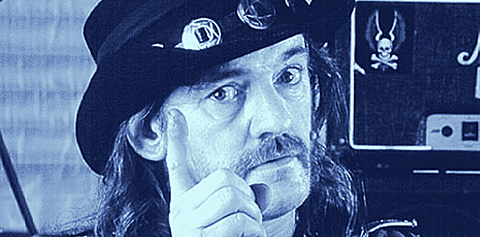
“Ow ya doin’, Wil?” chortled “Lemmy” Kilmister, the Godfather of Metal in that inimitable, nicotine-coated rasp of his. The veteran Rickenbacker basher was in an upbeat mood when we talked to him between the U.S. and European segments of Motorhead’s tour to promote its latest album, Hammered (Metal-Is Records), and was willing to discuss any subject. We opted to keep it genial and straightforward.
But don’t be fooled by Lemmy’s abilities when it comes to interviews. The ol’ Oberbefehlshaber is still – to borrow a line he used to describe the entire band on the live album Everything Louder Than Everyone Else – “completely unrepentant,” as exemplified by many of the lyrics on Hammered (the final line of “Brave New World,” states that “…if Jesus showed up now, he’d be in jail by next week”).
We began our dialogue by soliciting his p.o.v. about Motorhead’s return to a three-man lineup when guitarist Wurzel left the band following the release of Bastards in the mid ’90s.
Are you satisfied with the way the subsequent three-man albums have turned out? Yeah. If we hadn’t been, we would’ve changed it by now.
Bass players will want to know what you were using on the intros to “I Don’t Believe A Word” and the title track of Overnight Sensation. The tone on those tracks was huge; presumably the latter song’s intro was done on a open A string, and it sounded like it could have decapitated some listeners. (chuckles) It was a 4×12 cabinet and one of my Marshall heads; no effects… I was sensitive that day (laughs)! The bass was the new carved Rickenbacker [4004LK].
The live double CD was recorded in Hamburg. Is Germany still a stronghold for the band? Yeah, very much so. They stayed with us when everybody else deserted us back in the ’80s. A lot of places dropped us like a brick, except for Germany.
Further details about your Rickenbacker signature bass? Well, it’s your basic Rickenbacker construction with the one-piece maple neck running all the way through. It’s a beautiful dark wood, hand carved in oak leaves.
I think they’ve got one fellow carving by hand. They’re kind of expensive, but I do think it’s worth it; it’s a really beautiful piece, with a great neck. I’ve got the prototype. And it has three pickups? Yeah, they made an excellent pickup. In concert, I have the controls full up, and I use the bridge and middle pickups, for the most part.
What about your use of acoustic guitars on albums? That was just on Overnight… I think. We always like to changed a few things. On Hammered, there’s a keyboard on a couple of things.
You’ve also still done the occasional power ballad, such as “One More ****ing Time” on We Are Motorhead. How did you come up with the concept of that, and its intriguing title? I was trying to think of a phrase that went “One more something time,” and I couldn’t think of anything that summed it up better than that. I was pissed off.
There have been other unauthorized live albums that have been marketed since we last talked. One was recorded in Sheffield in ’83 when Brian Robertson was your guitarist, and another was recorded in Brixton when (drummer) Phil Taylor returned. The Wordsworth concert has been remastered and re-released again, too. I’ve heard about ’em, but I haven’t heard any of ’em. The only live albums that are authorized are (No Sleep ‘Til) Hammersmith and the Hamburg album.
There was a bass solo on the ’83 album, just before you went into “(Don’t Need) Religion,” and in the middle of it, you yelled out “The white bass!” That would have been a white Rickenbacker, obviously; I think somebody gave me one to use, but I must’ve broken a string on it.
The newest version of the Wordsworth concert actually sounds fairly decent; better than earlier releases of it… It never was very good; maybe they digitized it.
You also cut your mutton chops and grew them back since our last interview. I had ’em for 14 years before I cut ’em; I just woke up one morning and wondered what I’d look like if I did it. So I shaved ’em off, then got lazy and grew ’em back, and besides, it’s hard to shave around the moles.
Details on the 25th anniversary concert? It was done at Brixton Academy in London, in October 2000. There’s a DVD of it, and if you order it there’s an aural CD as well. (The DVD) has old clips and old videos,
Eddie Clarke sat in. After he was in Fastway, he did a solo album, but now I think he’s livin’ off his royalties. We couldn’t get Phil Taylor, but I’ll tell you who did come – (Queen guitarist) Brian May!
Most observers would see Queen’s style versus Motorhead’s an incredible paradox… Didn’t matter to me; he asked to come down and play, y’know? And we said, “Of course!” I knew he was gonna play on “Overkill,” and we started that song, then this thing flashed past me, crashed down to his knees, doing this rock star thing, and it was Brian (laughs)! I mean, he never really moved that much in Queen. He might have posed a bit, but with us, he came flyin’ straight out in front!
What’s different about the new album? Well, obviously, it’s gonna sound like Motorhead, but we still try to change the parameter. I like to stick a couple of odd things in; we’ve got a spoken-word thing on this album – which we’ve never done before – keyboards on a couple of things, synthesizer saxophones on “Mine All Mine.”
“Brave New World” is one of the angriest songs you’ve written in quite a while. Aw, there’s always one of them; I like to have a go at the government. You’ll find one on every album. This one’s about putting lunatics out on the street… that’s really gonna help, isn’t it? Turnin’ out asylums onto the street to become homeless persons, then bitch about ’em and lock ’em up…
No power ballads on the new album? It wasn’t a deliberate move; I just hadn’t written one. We don’t have a particular plan.
Why did you opt to do “Serial Killer” as a spoken word track? Well, I’d had those words for about 10 years, just kickin’ around, and I wanted to finally do something with them. They’re quite scary, but I couldn’t work a tune around ’em, ‘coz they don’t “scat.” So I thought “**** it; I’ll try to record just the words on their own to see how it sounds.”
Try listening to it in the dark (laughs)! (Professional wrestler) Triple H is on “Serial Killer,” double-tracked with me.
What about the wrestling theme on the album (“The Game”)? It’s not our song, it’s their song, but Triple H said he’d like for us to record it for him to use. But they’ve got another band that recorded it now; it’s terrible; Triple H don’t like it.
Has (New York Mets catcher) Mike Piazza ever sat in with you on drums? I heard he’s a fan. Not yet. He came to my birthday party, He’s a nice guy.
Hammered concludes with another live version of “Overnight Sensation,” recorded, according to the liner notes “somewhere in Europe” in 2000. That was the record company, thinkin’ they needed an extra track. I don’t get it, myself.
As prolific as you are when it comes to songwriting, how long do you think you can arrange major chords to create songs? How many more songs do you think you can come up with? Aw, about 10,000, I should think (chuckles). We use a couple of minor chords now and again, but you can’t play minors on the bass, so I don’t tend to write in minor!
How long is the European segment of the Hammered tour going to last? About two months, same as the American tour.
How much of the tour will be in Germany? About a third. It’s difficult to find a place (in Europe) where we haven’t played before. This time, we’re going to Greece and Italy; we haven’t been to Greece for a while.
How many of your European gigs are in former Communist Bloc countries? You don’t get a lot of gigs like that; maybe two or three per tour, but Estonia has been one where they have regular shows now. Bulgaria is “sketchy;” Russia seems to be running a good entertainment thing now. No shows in Romania, and East Germany is part of Germany now, so it don’t matter. They like to have plenty of shows when they can go nuts, ‘coz they didn’t have any shows for years, y’know?
You’re now in the latter half of your ’50s. How much longer are you going to keep playing this loud and this fast? As long as people show up for it. What else am I gonna do?
This article originally appeared in VG November 2002 issue. All copyrights are by the author and Vintage Guitar magazine. Unauthorized replication or use is strictly prohibited.
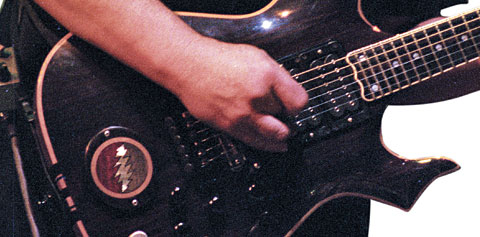
Jerry Garcia with the Cripe-built guitar called Lightning Bolt. Photo: Rick Gould.
Steve Cripe left a unique legacy in the annals of music history. He was not a guitar player, not a songwriter. In fact, you may not even know his name. But the guitar builder became part of the fabric that makes up the story of the Grateful Dead when he built guitars for the legendary Jerry Garcia during the final years of the musician’s life.
Garcia long favored the work of another builder, Doug Irwin, whose custom instruments – known to the band and its fans as Wolf, Tiger, and Rosebud – were played at Dead concerts for almost 20 years. Garcia was loyal to his Irwins throughout his career.
Cripe traveled an unorthodox road that led him from crafting ornate woodwork interiors for luxury yachts to collaborating with the venerable icon.
“He was always good with his hands,” said Cripe’s older sister, Rhonda Williams. “He worked almost exclusively with exotic woods,” and she said he became interested in building guitars because he wanted to learn to play them.
In July, 1990, Cripe bought a how-to book on electric-guitar construction. But despite his in-depth knowledge of woodworking, success was limited due to what he termed as “errors” in the book; his first guitar had “…a neck the size of a baseball bat.” Nonetheless, inspired by the Dead’s cover of “Morning Dew,” a guitar-driven staple of the band’s live repertoire, the longtime Deadhead decided to build another guitar, but this time one intended expressly for his idol.
Building on Garcia’s taste for Irwin’s guitars, he emulated the body style of Irwin’s Tiger, and, referencing only a VHS copy of the Dead’s video So Far, studied Tiger as it appeared in 1985. He built two prototype guitars in this fashion. The top and back of one is lignum vitae, with a core of greenheart, and a laminated Brazilian rosewood/maple neck. Inlaid in the Brazilian rosewood fretboard is a lightning bolt of lignum vitae sapwood. The top and back of the other are Cocobolo with a Zebrawood core, while the neck is laminated Cocobolo, maple, and rosewood with an ebony fretboard. Inscribed on the cover of its electronics cavity is, “Prototype of J. Garcia’s Lightning Bolt Guitar, June 92, S. R. Cripe.” Both guitars have 22 frets.
After he realized Garcia’s preference for 24-fret guitars, Cripe began work on one in March, 1993. The guitar, dubbed Lightning Bolt, was completed one month later, and Cripe described it in an article he wrote in ’95 for Dead fanzine Unbroken Chain. “Lightning Bolt is made of a black walnut core and East Indian rosewood top and back, with rock maple for contrast. The neck is also made of the same rosewood and maple. The East Indian rosewood is recycled from an old opium bed that was given to me a few years ago. The fretboard is of Brazilian rosewood recycled from an old hotel in Miami Beach. The lightning bolt itself is mother-of-pearl surrounded by padauk, tinted maple, and rosewood.”
Lightning Bolt. Photo courtesy of Steve Armato.
Pat O’Donnell, proprietor of Resurrection Guitars, makes Cripe replicas and notes how Cripe created the guitar’s unique green color by applying a coat of blue with a felt-tip pen before putting lacquer on its maple body.
Like Irwin’s method of construction for Tiger and Rosebud – sandwiching layers of wood horizontally to make the bodies – Cripe built the “wings” of the body of Lightning Bolt with three layers of wood laminated horizontally. But at its heart is a nine-ply vertically laminated neck/center block that extends the length of the guitar. The result? Massive sustain.
The volute, the bulbous mass of wood at the base of the headstock, is another distinct feature of Cripe’s guitars. And no two are the same; guitarist Steve Kimock, who owns two Cripes – one made of teak, the other ebony – said of the volutes, “Who knows what [Cripe’s] intention was? It may have been equal parts attempt to strengthen that area of the neck, which was a great idea, and give a little more physical balance to the instrument.”
Satisfied with the guitar, Cripe embarked on a campaign to get the instrument to Garcia. This was ultimately accomplished through a record-company contact friendly with Garcia collaborator David Grisman. Weeks went by before Cripe came home one day to hear Grateful Dead publicist Dennis McNally on his answering machine, saying Garcia was “intrigued” and “fiddling around” with the instrument.
A month later, Garcia tech Steve Parish contacted Cripe with a flurry of questions. The conversation led to the official naming of what was to become Garcia’s primary instrument. And Cripe was surprised to learn that Garcia had already been playing it with the Jerry Garcia Band, and that he planned to play it at Dead shows in Oregon.
Parish also said Garcia wanted to order another guitar. Honored – and motivated – Cripe delivered Top Hat in November of ’93, this time consulting with Gary Brawer, of Brawer Stringed Instrument Repair, an expert in the electronics of Garcia’s Irwin guitars, including the MIDI modifications Garcia required.
Top Hat and its pronounced volute. Photos courtesy Steve Armato.
During the construction of Top Hat, Cripe called Parish while the band was at Madison Square Garden. He asked Parish to measure Lightning Bolt so he could match the neck to that guitar, Parish responded, “How did you make the first one?” Cripe replied that he “…winged it.” Parish, then Garcia himself, told Cripe to use his intuition again. “If I don’t like it,” Garcia said, “I’ll send it back.”
Top Hat has a walnut-and-maple core, Cocobolo top, back, neck, and fretboard, and was named for the motif on the battery cover – a skull wearing a red, white, and blue top hat. The inlay is also made of non-endangered warthog tusk, as are the fretboard and Cripe’s firecracker logo inlays. And though the guitar never made an appearance onstage, it was also never returned.
In December, 1993, Cripe realized his first sale as a luthier, receiving a check from Grateful Dead Productions, Inc. The stub on the $7,000 check says, “2 custom guitars for Garcia; OK per Parish.”
Cripe finally met Garcia backstage at a Dead show in Miami in the spring of ’94. They spoke for 45 minutes, with Garcia praising Cripe’s work. Later, at a ’95 Tampa show, Parish told Cripe that Lightning Bolt was “…holding up better than any guitar Jerry has ever owned.” He also said that Garcia enjoyed playing Top Hat at home.
Garcia commissioned two more guitars from Cripe, one to be made at Cripe’s discretion, another to be a refinement of what he’d accomplished with the first two.
Hal Hammer, Jr., who mentored Cripe as he learned to build guitars, recalls that Cripe was reluctant to send the resultant guitar – called Eagle – because “… [it] looked so much like a Weir guitar. But he still thought it would be cool to send a couple guitars and let Garcia choose.”
While still working on the second guitar, Cripe’s mission would change after Garcia’s untimely death in August of ’95. Steve decided to finish the guitar, now fittingly called Tribute, in honor of the late musician. Adam Palow, who was eager to apprentice with Cripe in Florida, says of the guitar, “[it] has 64 pieces of mother-of-pearl inlay, a nine-ply neck, an eight-ply body with a 1/2” cocobolo top, piezo pickups, three humbuckers, an effects loop, and the cover plate features the planet Saturn with sterling silver rings.”
Steve Cripe. Photo courtesy of Pat O’Donnell. The guitar that was to be called Masterpiece, after the deadly fire in Cripes’ workshop. Photo courtesy of Steve Armato.
According to Hammer, Cripe was working on yet another guitar, called Masterpiece. But on May 21, 1996, Cripe was in his workshop, using high-phosphorous gunpowder in pursuit of another passion, making custom fireworks. An explosion occurred and Cripe was killed. Masterpiece, too, was lost in the fire.
Following the tragedy, The St. Petersburg Times reported that a neighbor, Jack Smith, had admired a guitar in Cripe’s workshop that appeared to be almost done. Smith said he was struck by the material Cripe was using – black wood. “It was a beauty,” Smith said, adding that he enjoyed visiting his neighbor’s workshop. “I lost a friend,” he added. So, too, did guitar enthusiasts everywhere.
Stephen Ray Cripe’s Lightning Bolt and Top Hat are on display at the Rock & Roll Hall of Fame in Cleveland. Eagle and Tribute remain in private collections.
Steve Armato hosts www.cripeguitars.com. James D. McCallister is a novelist, freelance writer, and Deadhead. Special thanks to Nick Meriwether and to the family and friends of Steve Cripe.
This article originally appeared in the January 2010 issue. All copyrights are by the author and Vintage Guitar magazine. Unauthorized replication or use is strictly prohibited.
You can receive more great articles like this in our twice-monthly e-mail newsletter, Vintage Guitar Overdrive, FREE from your friends at Vintage Guitar magazine. VG Overdrive also keeps you up-to-date on VG’s exclusive product giveaways! CLICK HERE to receive the FREE Vintage Guitar Overdrive.
Mark Sebastian: Lee Lawrence.Mark Sebastian’s new album, The Real Story, is a paean to his musical roots in the Big Apple.
“About a year ago, I realized I had almost an album’s worth of new songs, and wanted to record them,” he said. “I’d been playing the Living Room, here in New York City, (and) my vocal and guitar chops were up, so after years of recording in L.A., I recorded in my hometown.”
Sebastian noted the NYC connection in the album’s liner notes, and the new songs come across as more personal and introspective.
“Maybe the colors of New York affect music,” Sebastian opined. “The grey and black shades of the shadows and buildings. My memories of the folk scene in Greenwich Village, where I grew up, are a lot different, visually, than memories of my Laurel Canyon days! It certainly is more sober, visually, than California. My return to New York right before 9/11 had me walking the old streets, staring at the clubs like the Gaslight, where I performed as a teen. I’d walk by the old Night Owl Cafe space, and remember the Lovin’ Spoonful playing there before they made it. It definitely pulled me back into a more Eastern mindset.”
Instrumentation on The Real Story consists primarily of acoustic guitars accompanied by bass and drums, with electric guitars utilized in a subtle manner.
On the title track, Sebastian used a Gibson Advanced Jumbo formerly owned by late blues man John Campbell, and producer Jimi Zhivago played a reissue Danelectro electric 12-string.
“I went from protesting his putting it on the track to fighting for more of it in the mix, months later! I fought for more-substantial production values on the whole record, but, to his credit, Jim kept it comparatively less-ornate. My tendency has always been to put more, rather than less, on a track.”
He also utilized two 12-string acoustics – a Guild J-65 and an Alvarez Yairi.
“My buddy, Dan Martin, sent me the Alvarez Yairi JY-84/12,” Sebastian recounted. “It is actually at the center of the mysterious nature of this album. He sent it to me not long after I returned to New York, saying, ‘You need this.’ I was in shock at how stable it was. It made me sound like a quicker player, since it responded more immediately.”
Martin, a former roadie for artists such as Bob Dylan, Janis Joplin, and the Rolling Stones, passed away in 2007.
“He was a crucial part of The Real Story, because he armed me with the guitar that was at the center of my beginning to do gigs again, and writing songs for a new album,” Sebastian said.
As for six-string electrics, Sebastian detailed, “Wherever I played electric guitar on the album, it was my ’66 Epiphone Riviera. It was a gift from my brother. Those pickups have aged in such a way that it speaks like no other guitar I own. We just wanted that vintage sound.”
Sebastian clarified his advocacy of using vintage gear on albums that have a vintage vibe.
“All the instruments on the album are real – no synths, no synth bass, no drum track,” he said. “So it was in keeping with the spirit of the album that I didn’t use my more-modern electrics. I have a very early custom PRS from the nascent days of PRS. It’s all over my previous album, Bleecker Street, but it never made it past rehearsals for this one. The minute we auditioned the Riviera through an ancient amp, it seemed the way to go.”
There are several standout tracks featuring acoustic guitar. “I like the sounds I got out of my Yairi 12-string on ‘A Time For Lovers,’ ‘Invincible’ and ‘All Of Her.’ There are some passing notes you don’t hear very often. I play with a thumbpick, fingerpick, and my finernails. I’m definitely not bluegrass, but so many singer/songwriters lose me instantly when I see them just strumming up and down with a flat pick. I also like chords more complex than just majors, minors, or seventh chords. My hallmark, if I have one, is odd chords.”
Sebastian’s brother, John, played harmonica on two songs.
Sebastian is a longtime collector of ’60s Epiphones and kidney-shaped Giannini Craviolas, and remains an advocate of 12-string guitars, as well.
“I’m convinced that your first guitars, like your first girlfriends, determine what you gravitate to later in life,” he enthused. “I’ve been predominantly a 12-string player for decades. When the singer’s voice is of a certain timbre, it can really merge beautifully with the 12-string.”
This article originally appeared in VG‘s December 2014 issue. All copyrights are by the author and Vintage Guitar magazine. Unauthorized replication or use is strictly prohibited.
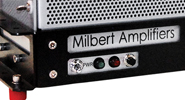
Gear reviews, whether describing guitars or amps, often speak to the versatility of the equipment in question. While some gear tabbed as “versatile” may be capable of several tasks when in the right hands, few pieces can be reasonably expected to be jacks of all trades. Milbert Amplifiers’ GAGA is possibly the exception that proves this rule. Lightweight and featuring an innovative transformerless design, GAGA – available in 30-, 60- and 90-watt configurations – may even be unparalleled in matching versatility with satisfying tube tone.
Under its hood of aircraft aluminum, GAGA D-60 accommodates any tubes, auto-matches impedance to any speaker, adjusts headroom, and provides phantom power for pedals. Milbert designers are coy about how GAGA steps voltage up and down without a transformer (schematics can be found online), but players only need to know that a transformerless amp allows pure, unfiltered tube response.
GAGA lets guitarists use any common power tubes in any combination of two, three, or four. Thanks to autobias, even mismatched tubes can be used to shape tone (the amp ships with four 6L6s). The GAGA’s stock 12AX7 and 12AT7 preamps tubes can also be swapped out.
The chassis’ distinctive face features a 10-step headroom dial (H) that controls total output power in a range from around 1 watt up to 60 watts, with lower headroom settings enabling tube overdrive at lower volume (V). The treble (T) and bass (B) are highly responsive to the tube complement and to the gain (G) setting.
For additional frequency adjustment, the three-way Flip toggle can be set to bright, brighter, or flat. Beneath it, the Loop bat applies signal to the input jack or to the rear-panel return, while its middle position provides a mute; because GAGA idles at low current, there’s no need for a standby. The Power toggle at far left indicates “on” with a green lamp. Next to it there are a red lamp and button for P3 phantom power, which supplies power to the ring terminal of a TRS cable. With P3 engaged and a splitter to distribute power, GAGA effectively does away with the external power supplies and power strips needed to juice 9-volt pedals.
Without a transformer to drive, the distinctive qualities of different output tubes are heard unimpeded. And because tubes can be easily swapped after pulling off GAGA’s top, the amp provides a singular opportunity to explore truly pure tube sounds. Testing exhausted just a handful of the hundreds of possible combinations.
First up were two EL34s. Playing a Tele on the neck pickup with the headroom low and the V and G controls each around 11 o’clock yielded a cozy archtop jazz sound. Low-end notes were beautifully defined and required no shaping with treble or bass controls. The broad midrange sound allowed closely voiced chords to bloom and fattened up single-note leads. With the guitar volume dimed, dropping the volume and pushing the gain completely changed scenes to a meaty midrange drive, not unlike the Marshall sound for which EL34s are known. A ringing power chord thrilled with the duration of its sustain and charmed with the upper harmonics at its tail end.
With the same settings, one EL34 was replaced with a 6L6. The resulting overdriven sound had more teeth and was more tightly in the upper midrange – a powerful, hard-rock tone with the drive of a British amp and the crispness of the California sound. Cleaning it up by dialing the gain back down and the headroom and volume up yielded a warm yet airy sound. After adding a second 6L6, the tone was sparkly with the mids scooped, something like a Twin but with a roundness and harmonic richness afforded by the lone EL34.
Any speaker cab or cab pair can be connected to GAGA, regardless of load, though for a perfect match of versatility and style, Milbert’s own 1×12″ cabinet is loaded with a 100-watt Jensen Jet Tornado, weighs under 30 pounds, and has moveable back panels. The GAGA head docks to the low-weight cab, allowing for an easy one-grip trip to the car.
GAGA could feasibly mimic most any tube amp. But well beyond the amp’s capacity for emulation is an opportunity to discover entirely new timbres and perhaps nail a sound that otherwise exists only in a player’s mind. Though the price tag will narrow its user base, touring musicians, session players, recording studios, and tone hounds may find GAGA irresistible.
This article originally appeared in VG January 2014 issue. All copyrights are by the author and Vintage Guitar magazine. Unauthorized replication or use is strictly prohibited.
When Cort isn’t busy making guitars and basses for major musical instrument companies, they’re hard at work building some pretty cool instruments under their own name. From jazz boxes to the Gene Simmons AXE Electric Bass, Cort covers a lot of territory.
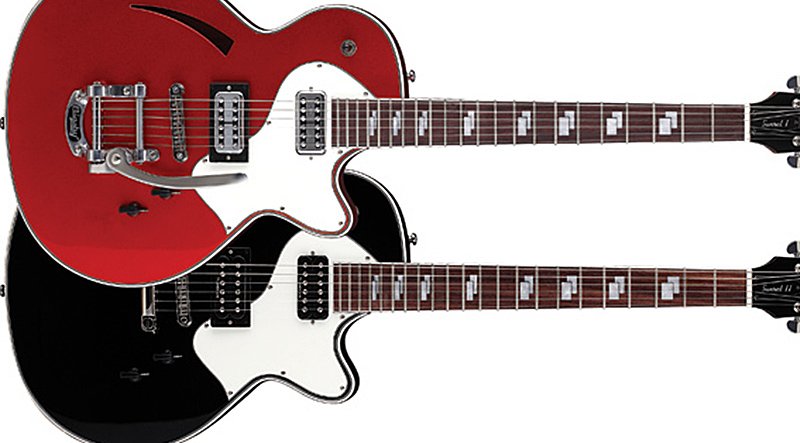
Cort’s new Sunset series includes the models I and II chambered-body electrics. Both guitars sport a 14.5″-wide, 2.25″-deep single-cutaway chambered mahogany body with a non-arched maple cap, positioning them nicely between Les Paul and ES body sizes. Both also feature a set-in 24.75″-scale mahogany neck, a 12″-radius rosewood fretboard with pearl double rectangular inlays, a Graph Tech NuBone nut, three-on-a-side headstocks with diecast tuners (Grovers on the Sunset I), body and neck binding, and TV Jones pickups. Controls include an upper-bout three-way pickup toggle and master volume and tone controls with chicken-head knobs.
Fit and finish on the Sunsets tested was flawless, with sharp inlays and nicely dressed frets. The Sunset I features a bit more of a retro vibe, with a single soundhole, Bigsby B50 vibrato tailpiece, tune-o-matic roller bridge, and TV Jones Classic (neck) and Classic Plus (bridge) Filter’Tron humbuckers. The Sunset II leans a bit more toward the modern, lacking soundholes and employing a locking TonePros stop tailpiece, tune-o-matic-style bridge, and two exposed-coil TV Jones LTD humbuckers. Both are relatively lightweight (about eight pounds) and very well-balanced, whether you’re sitting or standing. Their comfortably slim C neck profile and a low action make for great playability.
Both the Sunset I and II were tested through a Fender ’65 reissue Twin Reverb combo with a Tube Screamer and a Homebrew Paradrive mixed in for some overdrive. It didn’t take much to coax a killer rockabilly sound out of the Sunset I and the Twin – a full, clear low end, super-punchy mids, and shimmering highs abounded. The body construction really combined with the TV Jones Classics to give pop to the midrange and snap to the highs, producing a ton of old-school Gretsch-y jangle. The Classic Plus had a clear fat sound which, when combined with the somewhat laidback Classic, produced an ultra-lush middle-position sound. The slightly hotter Classic Plus also performed well with some overdrive dialed in – very crunchy with no unwanted squealing, suggesting a clear, fat overwound P90 sound. The Sunset I’s Bigsby had good feel and relatively good tuning stability thanks to the roller bridge and Grovers, although heavy use did result in a few tuning issues, mainly with the wound strings.
While the Sunset II’s sound palette retained a thick, natural midrange punch, it definitely had a tighter, slightly more aggressive sound than the Sunset I. The TV Jones LTD ’buckers have slightly narrower bobbins (about 2 mm), larger pole pieces, and a thicker Alnico V magnet than a standard humbucker, which helps focus midrange and adds clarity. Where the Sunset I had a classic jangle to its highs, the II had a bite that made overdriven chords and single notes really jump out while retaining a smooth midrange.
While both guitars excel at coveted rock tones with a thick rockabilly vibe, their semi-hollow characteristics give them very usable jazz-box tones, as well. With the tone controls rolled back a bit and the neck pickups engaged, they have a dark, rich tone that retains note clarity. Those who are looking for such versatility, but who don’t want to deal with a cumbersome hollowbody and the feedback produced when cranked up, either the Cort Sunset I or II might be just the ticket.
This article originally appeared in VG January 2014 issue. All copyrights are by the author and Vintage Guitar magazine. Unauthorized replication or use is strictly prohibited.
Vahdah Olcott-Bickford (b. 1885, shown with her husband, Zarh) was one of the most important figures in the guitar of the West Coast, founding the first classical guitar society in the U.S., and arranging or composing hundreds of works for guitar. Vahdah Olcott-Bickford photo courtesy Paul Ruppa.
Ed. Note: In the final installment in his series on the guitar in 19-century America, Tim Brookes offers a study of several women who played the guitar, and what the instrument meant to them. The first two parts are at Part One: The Guitar in Non-Anglo America and Part Two: Man and Machine.
“The guitar before 1850 was a much smaller and more delicate instrument than the classical guitar known today,” wrote one scholar. “It was strung with six gut strings which provide a delicate yet surprisingly resonant sound. It may not be too far fetched to suggest that the physical instrument of the time reflected the prevailing conception of women: soft, quiet, delicate, unobtrusive, yet always ready to accompany or entertain with a minimum of fuss.”
Now that we’ve established that the guitar was not limited to the parlor (as addressed in part one of this series, July ’05) nor to women (December ’05), let’s consider how women did use the guitar in 19th-century America, and what the instrument meant to them.
In one respect, the guitar was actually more popular in the 19th century than it is today; it was a central part of a well-rounded education, especially for a well-born young lady.
Despite – or perhaps because of – its reputation as an instrument of romance, the guitar had been seen for 250 years as one of the instruments, like the lute and the virginals and later the piano, that were to be expected as among the accomplishments of a young lady of birth and fortune, perhaps as a means of attracting a good husband and pleasing him thereafter. That’s not so say that young men didn’t also play the guitar as part of courtship – both sexes played, just as both were expected to know how to dance well.
From the 18th century onward, we can read of picnics and parties, soriees and excursions on boats and in canoes, with the guitar tinkling in the background or being strummed as individuals joined each other in song. But insofar as young women were more consciously and deliberately trained for successful courtship than men, so the guitar turns up in their teenage syllabus. As early as 1788, Horatio Garnet was advertising in the New Hampshire Spy that, having received his musical education in some of the principal cities of Europe, he now proposes “teaching the Violin, Bass-viol, Hautboy, Clarionet, Flute, etc, and also to give Lessons to Ladies on the Guitar…”
By the 19th century, the guitar has settled into the school curriculum. Mecklenburg Female College, for example, included “Music on Piano or Guitar, 32 lessons in 13 weeks, $20.00.” By the end of the century, guitar lessons were being offered by the New York YWCA, and even by correspondence – surely a hard row to hoe.
Having learned the guitar (or piano), a young woman might also play to entertain visitors to the home, or to entertain her husband once she was married – and her husband might well accompany her on another instrument, such as the fiddle or flute.
When Millard Fillmore was elected president in 1850, a guitar went to the White House with him. (Others may well have been there before. Washington and Jefferson both had female relatives who played, and Ben Franklin is known to have tried the time-honored ploy of offering to teach a young lady to play the guitar.) A friend wrote, “When Mr. Fillmore entered the White House, he found it entirely destitute of books. Mrs. Fillmore was in the habit of spending her leisure moments in reading, I might almost say, in studying. She was accustomed to be surrounded with books of reference, maps, and all the other requirements of a well-furnished library, and she found it difficult to content herself in a house devoid of such attractions. To meet this want, Mr. Fillmore asked of Congress, and received an appropriation, and selected a library, devoting to that purpose a large and pleasant room in the second story of the White House. Here, Mrs. Fillmore surrounded herself with her little home comforts; here her daughter had her own piano, harp, and guitar, and here Mrs. Fillmore received the informal visits of the friends she loved, and, for her, the real pleasure and enjoyments of the White House were in this room.”
In those last 15 words one can sense that the guitar often meant something profound to its owner. It might look to an outsider like just a “little home comfort,” but it is part of a stable, civilized, stimulating, reflective home, important to both a social and an inner life. The guitar is a meditation device; it has the ability to calm and center the player, to provide a quiet inner space, and this deeper value is hinted at or stated explicitly throughout the century…
…Especially during the Civil War, which shattered the living-rooms and the courtship behaviors of the genteel South. Time and again the guitar crops up in memoirs as the instrument of peace and solace, often symbolically placed in contradiction to the gun, as in the diary of Kate Carney: “May 30th 1861. One of Bro. Wilson’s negro men got very badly hurt with a mule today. Mended Sister’s hoop skirt. Finished The Virginians, read some papers and a magazine, practiced on my guitar, and this evening practiced shooting with Sister’s pistol.”
When this stable way of life was destroyed, the guitar changed meaning; late in the century, women in their autumn years often speak of it as their “old” guitar; it is charged with the sadness of everything they have lost.
In other areas of the country, and in other strata of society, women used the guitar in different ways. Many women, like many men, were porch/parlor/kitchen guitarists, whether they were wealthy or not. Women in Hispanic families often played guitar, and taught their children. In Appalachia, Merle Travis learned his thumbpicking style from Mose Rager, who learned it from Kennedy Jones, who always said that he learned it from his mother, Alice DeArmond Jones. Maybelle Carter was a 20th-century descendant of this tradition.
Others went beyond being social entertainers to being semi-professional or even professional entertainers. By the end of the century, several women guitarists were playing concerts; others were playing dances.
“I started playing when I was so young I used to play with dolls at home. This was about 1888,” recalled Mrs. Charley Huyck (b. 1875) of Lincoln, Nebraska, who had played piano, guitar, and mandolin at square dances for 50 years.
“We played in many a fine home in Lincoln for their private dances. These were held in the attic or on the third floor of those big houses. Square dances, polka waltzes, schottisches, and lancers were the popular dances. We used to haul a parlor organ in the spring wagon as most places had no organ or piano at that time.
The perfect young Southern lady, Mary Prewitt Davis with her handsome, beribboned classical guitar. Photo: Florida State Archives/Florida Memory Collection.
“…It was the custom to have a big dance in the hayloft whenever a new barn was built. This was a way of dedicating a new barn, and they were big affairs. The hayloft would be lighted with… lanterns… or hanging lamps, and these were pretty gay occasions.
“Everybody would climb up the loft ladder, even if they had to crawl over a few horses or cows to get to it. The crowd was always full of life and they sure could dance. There was no snobbery and everyone was friendly, no ‘cliquety’ people who would keep to themselves.
“The square dance was a very democratic gathering… Men and boys came dressed in overalls, swallow-tail coats, peg-top pants, or tight-fitting pants, derby hats; caps, and some wore an assortment which was a sight in itself. The women and girls wore bustles, some hoop skirts, tight-fitting basques, and hair ornaments… The young folks and the old folks mingled freely together. Often when the sets were on the floor, dancing, both young and old, even some of the granddaddies who were not in any of the sets would get out to the side and dance a lively hoe down or clog. I have played at dances where five or six small children would be sleeping on a pile of the dancers’ coats and wraps in a corner of the hall.”
Yet there’s a great danger in following this line of thought too literally because it leads to the assumption that a performer, or an instrument, are important only if they are “successful,” and they are successful only if they are playing for money. Or worse, that they are only successful if they have been recorded.
This is the core of the issue, ladies and gents; the 19th century was an era of live music. In fact, it was the last era of live music. It wasn’t just that the young woman was expected to play because music was a womanly occupation; it was that everyone was expected to play – to play something, no matter how basic the skill or the instrument, or to sing along with others who had more instrumental training. People didn’t listen to music – they made music.
Even before the end of the 19th century, the era of live music, which had been going on since the first musical sound, was doomed. The first recording devices (including the player piano) had been invented, and music was changing from a fleeting, magical experience created collectively by musicians and listeners, to a passive experience. The music business, which had begun with the manufacture and sale of sheet music, was turning music into a commodity, owned and manipulated largely by non-musicians. Hardly surprising, then, that Americans’ notions of what is important and successful were also changing.
This fact has led to widespread prejudice against the 19th-century guitar – but also against 19th-century women guitarists. As one scholar wrote, “Women did not play concerts; thus the superficial level at which music was learned was both reasonable and practical for the role it was intended.”
But in fact very few people played concerts in the modern sense – though everyone played concerts in the 19th-century sense. The division between the performer and the audience was nothing like it is now, and the cult of the professional had barely been born.The more one reads these assumptions about women and the guitar, the more it seems as if there’s something unspoken behind the false equations; it’s as if women were responsible for keeping the guitar down, both by playing at a mediocre level and by keeping it at home, as if the guitar were an adventurous teenager who wanted to see the world but was tied to his mother’s apron strings. There’s even an implicit criticism that the parlor guitar remained small because it suited a women’s reach and her short fingers.
By the time she was 20 years old (circa 1899), Elsie Tooker was a concert guitarist, teacher, and arranger who adapted classical and other forms of music into works for guitar. Photo courtesy of Paul Ruppa.
As we’ve seen, and as I’ve said before, this is a load of bollocks. Not a single word of it is true, but on top of every other explicit or implied insult, it insults the parlor as a place for making music, and as a musical tradition.
The musicologist Edith Boroff responds to this criticism with a resounding raspberry. In an article entitled “An American Parlor at the Turn of the Century” she dares to swim against a current that has been running with increasing force throughout the 20th century, and argues that the very absence of celebrity – or, if you like, the relatively domestic, humble and egalitarian activity of making music in the home – was a wonderful thing.
One musicologist, she begins, has described parlor music as “designed to be performed by and listened to by persons of limited musical training and ability.” That may be true to some extent, she concedes, but it misses a broader and perhaps more important point: parlor music was live music, and it kept the vital meeting and exchange of music alive.
“My grandmother established a musical parlor in Chicago as soon as she married and moved there in the 1880s. She was no musician, but she invited musicians daily to her home; the children were present, even as babies, and they became participants in due course.
“The parlor musicale was not a concert. A concert is a parenthetical one-shot event; a parlor was a continuing social institution… The parlor musicale was a part of one’s life, an activity that went on 200 or 300 times a year, or even, as in my grandmother’s case, more like 365 times a year. A family with this interest – and there were many – played and listened to music as often as we watch television today…
“Whoever could make music made it. This included household members and guests, and it most especially included the children, who listened regularly from birth (and before), and who performed when they were able. It was considered bad manners ever to refuse or to make excuses…”
It’s perhaps a sign of the times, or of the fact that her grandmother’s household was a sophisticated urban one, that she doesn’t mention hearing guitars, which had fallen out of middle-class fashion. But the repertoire was by no means narrow, staid, or mediocre; “I remember my mother’s older brother singing wonderful Vaudeville songs to the ukulele, acting such chestnuts as ‘Oh Lord, If You Won’t Help Me for Heaven’s Sake Don’t Help That Bear.’ I remember hearing my mother’s cousin playing his marvelous arrangements of popular songs on the banjo, my eyes popping as he whipped around that fingerboard – he was the best banjo picker I ever heard. And another of her cousins who played the flute dazzled me with Debussy’s ‘Syrinx,’ and then tore through her arrangement of Leroy Anderson’s ‘Fiddle-Faddle,’ calling it ‘Piccolo-Paccolo.’”
To us, the parlor embraced an extraordinary and unpredictable variety of music. It was an active, participant tradition, as opposed to passive listening to radio or recordings. It wasn’t produced for the profit of a flour company or a tire company or a life insurance company. It wasn’t organized by a instrument company or publishing company trying to sell more instruments or records or sheet music.
Above all, Boroff writes (and this was probably true of parlor music in less affluent and more rural households, too), it was egalitarian.
“[W]omen were equal with men, American music was equal with European, and fanciful performance was equal with literal performance.”
The parlor, though, was almost the last flourish of live, unamplified, unmediated, uncommercial music. The 20th century was upon it, and soon anything as unplugged and as full of the erratic human joy of the musical spirit would seem terminally square.
Tim Brookes is director of the writing program at Champlain College and the author of Guitar: An American Life, published by Grove Atlantic Press.
This article originally appeared in VG‘s May 2005 issue. All copyrights are by the author and Vintage Guitar magazine. Unauthorized replication or use is strictly prohibited.
(LEFT TO RIGHT) 1939 and 1941 Gibson Super Jumbo 100. Photos: Eric C. Newell.
The Super Jumbo 200 is Gibson’s most celebrated flat-top model, and deservedly so, thanks to its use by cowboy movie stars in the pre-World War II years and by country music stars in the post-war years. The Super Jumbo 100, on the other hand, is one of Gibson’s more obscure models – a status it does not deserve. In aesthetics, as well as performance, it should be ranked among Gibson’s most noteworthy models.
As its name suggests, the SJ-100 occupied a place significantly below the SJ-200. Since the model numbers reflected list prices – $100 and $200, respectively – Gibson seemed to be saying that SJ-200 was twice the guitar that the SJ-100.
While the SJ-100 did not have the degree of ornamentation of the higher model, it nevertheless had its own distinctive sound and – as these two SJ-100s show – its own distinctive look, as well.
The lack of attention garnered by the SJ-100 began with its introduction in 1939, in the shadow of the SJ-200. Both models were the same size – 17″ wide across the lower bout – and shaped like the “advanced” (widened) L-5 Gibson introduced in 1935. They were only 1″ wider than Gibson’s dreadnought-size flat-tops, but they appeared even larger thanks to their circular lower body shape. Gibson began making the SJ-200 on a custom basis (initially just called Super Jumbo) in ’38. It featured back and sides of rosewood – then, as now, the premium tonewood for flat-tops.
In ’39, when the model was first cataloged, a second super jumbo-sized guitar made its debut; the SJ-100 had mahogany back and sides, and though its price was only half of the SJ-200, it was still higher than other Gibson flat-tops (the Advanced Jumbo and the Nick Lucas Special), and it had features to justify the price.
The SJ-100’s bridge was the same open-ended moustache shape that the SJ-200 sported, but without the long blocks of inlaid mother-of-pearl. Early examples of both models had individual height-adjustable bridge saddles. The SJ-100’s pickguard did not have the engraving of the SJ-200, but it did have its own distinct shape, recognizable by a sort of scalloped feature on the upper edge. The top binding on the SJ-100 was only three-ply, compared to seven-ply on the SJ-200, but the SJ-100’s binding was unusually thick – around 0.25″ thick. Not only did it surpass the SJ-200’s binding in thickness by about .05″, its wide white layers outlined the body with a stronger visual effect than the seven thin plies. The SJ-100’s back binding was single-ply, but it, too, was extra thick.
The SJ-100 had the maple neck and ebony fingerboard of the SJ-200, but with pearl dot inlays instead of the 200’s crests. The 100’s peghead represented its biggest departure from the 200, and from Gibson tradition as well. Where the 200 was bound and sported an ornamental inlay, the 100 had no peghead binding and no ornament. It was further distanced by a series of notches on the sides. The reason or inspiration for the notched design is unknown, but it appeared on two other new models in ’39 – the mahogany-body dreadnought Jumbo 55 and the electric archtop ES-250.
In 1941, Gibson downgraded the SJ-100 slightly. The notches disappeared from the headstock and the open-ended moustache bridge was replaced with a more compact bridge. The new bridge, with pointed ends and a point extending from the lower edge, was arguably as elegant as the moustache, but it made the SJ-100 easy to identify. No other Gibson except the J-55, which received the same spec changes in ’41, ever had the sculpted bridge. The scale length was also shortened slightly, from 26″ to 251/2″.
Like most Gibson models, the SJ-100’s run officially ended at the end of ’41, when the U.S. entered World War II and Gibson diverted most of its production to war products. Total production, according to new research by A.R. Duchossoir, was 177 units, which was only 19 more than SJ-200 sales. One would expect the lower-priced model to have greater sales, but perhaps it didn’t meet the expectations of Gibson’s new owners, the Chicago Musical Instrument Co., which purchased Gibson in 1944.
In terms of sound, the typical SJ-100 exceeds expectations, especially compared to the rosewood-body pre-war SJ-200s. One would expect the 200 to have a voice as big as its body – bigger than a dreadnought – but the typical example simply does not produce the booming sound associated with large-bodied rosewood guitars. The typical SJ-100, however, sounds like a big guitar with an extra bit of sustain, and is sonically as good as Gibson’s other pre-war mahogany guitars, such as the Jumbo and J-35.
One wonders if the people at CMI actually compared an SJ-100 to an SJ-200 or to Gibson’s newly introduced J-45. Apparently, they did. Duchossoir notes that two SJ-100s were shipped to CMI headquarters in July, 1944, as were examples of most other models, presumably for review. Duchossoir also notes that those two SJ-100s were probably newly made, so it’s impossible to know how closely they followed the pre-war specs.
When the war ended, production resumed on the SJ-200, but with maple back and sides instead of rosewood – possibly a result of the sampling by CMI. The mahogany-body dreadnoughts J-45, J-50, and Southerner Jumbo had been successfully introduced during the war, and Gibson continued producing them when the war ended. Given the moderate success of the SJ-100, one would think there would be a niche for a mahogany super jumbo, but the SJ-200 was the only pre-war flat-top the new regime revived after the war.
The SJ-200 went on to lasting fame, billed by Gibson as “The King of the Flat-tops,” while the SJ-100 became one of Gibson’s most obscure – and most intriguing – flat-tops.
You can receive more great articles like this in our twice-monthly e-mail newsletter, Vintage Guitar Overdrive, FREE from your friends at Vintage Guitar magazine. VG Overdrive also keeps you up-to-date on VG’s exclusive product giveaways! CLICK HERE to receive the FREE Vintage Guitar Overdrive.
This article originally appeared in VG December 2010 issue. All copyrights are by the author and Vintage Guitar magazine. Unauthorized replication or use is strictly prohibited.
Since Dave Simpson and Rob Nishida joined forces to form Majik Box, they’ve been the go-to stompbox company for guitarists like Doug Aldrich, Dave Navarro, James “Munky” Shaffer, and Victor Johnson. Their most popular offering is the Paul Gilbert Fuzz Universe. At Gilbert’s request, Majik created the Fuzz Universe Custom to reduce the usual pop and click sound heard when engaging a true bypass pedal. The only difference between the pedals is the Quiet Click circuit added to the Custom.
The Fuzz Universe Custom is not a fuzz pedal, but a separate clean boost and an overdrive pedal in one box – Majik Box’s Venom Boost combined with a modified Majik Box Body Blow. It’s a handsome unit with black-on-white graphics, a purple planet Saturn, and Gilbert’s autograph on the backside. The controls are laid out for ease of use.
On the lower left the Thrust 2 On/Off switch controls the clean boost; on the lower right, the On/Off switch for Thrust 1 controls the overdrive. And on the upper left, a chicken knob called Thrust 2 controls the volume for the clean boost, while the knobs to the right of it control the overdrive. A Drive knob controls gain, a Tone knob controls the EQ, and the Thrust 1 knob controls the volume. Inputs and outputs reside on each side of the unit, and powering it up requires a center negative-tip adapter and removal of the 9-volt battery when using an AC adapter.
Using a 120-watt Peavey JSX head, a 1966 Fender Pro Reverb, a Les Paul, and a superstrat, the Fuzz Universe Custom elicited smooth warmth. Using a slightly dirty amp, the lead tones match those found on Gilbert’s Fuzz Universe album. Never harsh or heavy metal-sounding, it exudes a tight and organic signal. With some tweaking it yielded everything from old-school breakup through a clean amp, to stellar rock tones from a dirty amp. It excels with a dirty amp, however, producing rugged sounds with singing clarity.
Power chords were fat and satisfying with no flub. Maxing the Drive knob resulted in pliable gain, hard-hitting sustain, and rich Santana overtones. The Boost channel is voiced louder than would be expected, but it’s malleable; and turning on the unit is barely audible. Even for those with no interest in Gilbert’s distorted tones, the Paul Gilbert Fuzz Universe Custom will yield exceptional rock tones with invaluable boost capabilities.
This article originally appeared in VG October 2013 issue. All copyrights are by the author and Vintage Guitar magazine. Unauthorized replication or use is strictly prohibited.
(LEFT TO RIGHT) Robillard, an Epiphone endorser, gives this ES-295 plenty of stage and studio time. Onstage, sporting a fedora and a Les Paul Special. Robillard with a Strat.
Mix one part blues, one part jazz, one part swing, stir in some rock and soul, bring to a simmer, and you have Duke Robillard ala mode.
In his 35 years in the music business, Robillard has learned to do things his own way. Though a stint in the Fabulous Thunderbirds brought him closer to the mainstream in the early ’90s, he has always been at his best playing the jazz and swing-style music he loves.
And he has a keen interest in vintage instruments, having owned “…at least 500 guitars.” But he isn’t a collector as such. Rather, he buys and sells guitars, keeping only what he needs to accomplish whatever musical goal he’s working on at the time. His collection is as much newer instruments as true vintage guitars, and he favors Epiphone archtops for their midrange punch.
Robillard was born and raised in Rhode Island, and was playing in bands by the time he got to high school.
In 1967, he formed Roomful of Blues, which operated out of Westerly, Rhode Island. For the next 12 years, he led the band as it grew in stature from a regional phenomenon to a well-known touring troupe. Though they started out playing a mixture of R&B and swing music, by 1970 they had added horns and moved into a strict jump/swing style that was absolutely unlike what anyone else was doing at the time.
After a decade the band finally won a long-deserved recording contract, and released two albums before Robillard left the band in 1979. He initially signed on as rockabilly singer Robert Gordon’s lead guitarist in the Legendary Blues Band, but within a few months he was fronting his own Duke Robillard Band. His debut on Rounder Records came in ’83 with Duke Robillard and the Pleasure Kings.
The group evolved, and occasional forays into a more-experimental sound led Robillard to jazz-oriented solo work. In 1990, he joined the Fabulous Thunderbirds after Jimmie Vaughan left while the band was at peak popularity. He cut two albums with the T-Birds, and though he was a good fit with the group’s musical style, Robillard was accustomed to being a bandleader. Within two years, he was back on his own.
He signed a major-label deal with Virgin Records in ’94 and his first disc for the label, Temptation, was by far his most commercial. It sold well and was followed by two more albums. But while Robillard had a dedicated fan base, sales weren’t enough to hold the label’s interest. After a couple of albums with Shanachie, he hooked up with Stony Plain Records in the late ’90s and began a fruitful relationship. He released the live Stretchin’ Out in ’98, and New Blues For Modern Man in ’99. During that period, he also produced albums by John Hammond, Jerry Portnoy, Billy Boy Arnold, Eddy Clearwater, and others.
Duke’s Tools of the Trade
The guitarist’s toolbox can be extensive and varied, or limited to just a couple of instruments. But even as certain artists are associated with certain instruments, a variety of guitar sounds can help to color one’s music with different tones. So although Hendrix is forever associated with a Stratocaster, he nearly always picked up a Gibson (usually a Flying V, sometimes an SG or Les Paul) when playing “Red House.”
Duke Robillard has a variety of instruments at his disposal, and isn’t afraid to shift them as needed. There are vintage guitars, modified, and original. There are newer instruments, and others such as assorted Telecasters, acoustics, and a resonator. Duke’s gathering isn’t a guitar collection so much as a set of tools. Here’s a sample.
1. Gibson Tal Farlow reissue This Tuxedo Black guitar is used in the studio and on stage. “I love the sound of the big archtops,” Duke says. “And because this one has a laminated top, it’s a good stage guitar.”
2. A “No-Name” parlor acoustic “This one is probably from the 1930s and I used it to record ‘Hard Road’ on the latest CD.”
3. Epiphone ES-295 An import reissue of the ’50s Gibson favorite. Used on stage and in the studio.
A session with jazz great Herb Ellis, Conversations in Swing Guitar, was released in ’99; in 2000 he returned with with more original music on Explorer. During this time he also returned to live in Rhode Island, and built a studio in his home.
In ’99 Robillard won International Guitarist of the Year recognition by the French Blues Association and was nominated for Producer of the Year and International Artist of the Year in Canada’s Maple Blues Awards. In 2000 and ’01, he was nominated for the W.C. Handy for Blues Band of the Year and Blues Album of the Year. In ’02 he received The Maple Blues Award for Best International Artist. He also recently received his fourth consecutive nomination for W.C. Handy Guitarist of the Year, an honor he won in 2000 and ’01.
Vintage Guitar: You started playing guitar when you were about 10 years old. What was your first guitar, and what were some of your subsequent instruments?
My first guitar was an Old Kraftsman archtop with a round hole that had a kind of mandolin shape to it. I got it from my uncle. The neck was attached with a wingnut; it had a bolt-on/tongue-and-groove arrangement so you could reach inside the soundhole, remove the nut, and slide the neck off. It was a nice guitar, but I wanted an electric. So I convinced my father that I had to build an electric guitar for a science project.
I used to see James Burton with Ricky Nelson on “Ozzie and Harriet.” I thought he was the coolest guy who ever lived. He was playing a Telecaster. I didn’t know the name, but I drew a picture of it, and my father traced it and, using two pieces of 3/4″ plywood, cut it out on his jigsaw. We painted it robin-egg blue, took the bridge and tailpiece off the Kraftsman, and figured out how to attach the neck. I made a pickguard out of some formica and bought a Dearmond pickup for it. It played pretty well – and I won second place in the science fair!
What did you use for an amplifier?
A Premier…
An accordian amp?
I don’t know… It was a low-wattage amp with a 12″ speaker and got a good, sort of distorted, sound. I was always jealous of another guy I knew who had one of those Silvertone amps with the separate head and big speaker box.
The Twin-Twelve?
That’s the one. It sounded so good. And he had a Fender Jazzmaster that sounded great with it.
After the Premier, I got a Gibson GA-79 stereo amp that sounded incredible. But what I really wanted was a Fender Twin, and after a while I got one. It was too loud, and couldn’t really get the sound I wanted. But it was the late ’60s, and playing too loud was cool (laughs)!
Then I had a Magnatone amp with two 12s and a giant cabinet. It was tall, and after I got the Twin I put it on top of the Magnatone and used it for an extension speaker. Sort of my own stack… and it looked cool.
When did you get into a band?
I used to play into my brother’s reel-to-reel tape recorder, and it had a little speaker I’d put in the window. One day, a guy walked up and asked my mother who was playing guitar. He was a drummer, and asked me to join his band. That was about 1962.
Soon after, I convinced my dad that I couldn’t be in a band playing this homemade guitar, so he bought me a Gibson Melody Maker. And that was okay, but I really wanted a Stratocaster. Buddy Holly played a Strat, and that was enough for me.
4. Fender Strat Made from ’70s and ’80s parts, some imported, and with Duncan pickups. “This is my main Strat on stage and in the studio.”
5. D’Angelico New Yorker A new imported reissue that Duke likes. “I use this for some of the jazz gigs I’m doing, softly amplified. And I use it for recording with a Dearmond pickup.”
6. Epiphone Riveria Another recent reissue (Robillard is an Epiphone endorser), Duke says this guitar, “…has Seth Lover pickups and is one of my main stage axes.”
So after a while, I talked my father into getting me a beat up Stratocaster; about a 1960, because it had a rosewood neck. It had cigarette burns and a lot of wear. It was a great guitar and I had it for a couple of years, but then I wanted a shiny new one.
At that point, I traded it in for a new Stratocaster. That would have been about 1966. It played, felt, and sounded nothing like the other one, and I was a little disappointed. I couldn’t understand why it would be different.
I didn’t like the Strat very much, so I took it apart to figure out how it worked. I adjusted the pickups and messed with the action, but I couldn’t get it like I wanted. In the end, I traded it on a new Telecaster. That was a great guitar! Big neck and rosewood fingerboard. It sounded and played great. I think that established my pattern of trading guitars and equipment.
At one point, I got a Gretsch Anniversary. I realized there were certain things I couldn’t do on it. But I was still searching for a particular sound, I just wasn’t sure what it was.
Who were your early influences?
My brother was 10 years older than me, and he played guitar and had all the rock and roll records – Chuck Berry, Duane Eddy, Link Wray, Buddy Holly, all those guys. Little Richard, Elvis, all the popular music of the late ’50s. I loved the guitar in all of them.
When I heard “Blueberry Hill” by Fats Domino and that piano intro, I got goosebumps! I didn’t know what came over me. It was like a drug and I couldn’t stop after that. I played guitar all the time.
Did you see any of your favorites play live?
After school, I got a job at a printing press, and I used all of my pay to either buy guitars or see bands in New York or Boston.
Did you ever see T-Bone Walker or B.B. King?
I could have seen T-Bone, but I never did. At that time, I hadn’t heard his earlier stuff. And by the time I did get into it, he was dead.
Now, B.B. I’ve seen play hundreds of times. I remember him in ’67 at the Village Gate, on a bill with Herbie Mann. There were only about 10 people in the audience, but he was great! I’ve opened shows for B.B. He’s a really nice guy.
7. 1936 Epiphone Zenith An interesting student model guitar that has triple binding and upscale Broadway inlays. “I’ve had this one awhile and it was obviously customized with a mini-humbucker. It’s a neat guitar and I use it onstage a lot.”
8. Orpheum Imperial Archtop Probably made by Gretsch in the ’30s or early ’40s. “Great sound and big neck, a one-piece maple back and an added Lindy Fralin jazz pickup.”
9. Levin Archtop An interesting 1930s instrument made in Sweden with a solid spruce top and walnut back and sides. “Sounds amazing!”
What guitars were you trying at that time?
When I was working, I was trying out lots of guitars. I had a Gibson SG, a gold top Les Paul, a Gretsch 6120, a Gibson ES-345, and more early Strats.
Just one after the other…
One by one! I didn’t have the money for more than one. I was searching for a sound, and it never occurred to me that you couldn’t get it all out of just one guitar. I was listening to all kinds of blues and jazz, and some early rock.
So I was interested in different sounds. I didn’t know you had to have more than one guitar… and I couldn’t afford it anyway. Plus, I had to get used to playing different guitars. So it was a quest… I traded guitars like baseball cards.
You have a thing for the big archtops, particularly Epiphones. How did that happen?
I played a lot of Gibsons – an L-7, ES-300, ES-5, and they were great. But somewhere along the line, I got an Epiphone Deluxe. What a sound!
The Epiphones seem to have more midrange and less bass, and I like that. Sometimes Gibsons had a lot of low-end, sometimes more treble. And [Epiphone] necks were more comfortable, since I have sort of short fingers. They were cheaper.
Around that time, you started Roomful of Blues – a horn band in a time when everyone else was playing rock. Why?
Well, I was really into B.B. King, Jimmy Witherspoon, and T-Bone Walker, and they had horns. So it got me thinking. Then I found The Buddy Johson Orchestra, which was one album of rock and roll with horns, and it knocked me out. It was big-band blues. It just floored me because I didn’t know that kind of music existed before that, that whole style.
So I started to go back and find Louis Jordan, Ruth Brown, Roy Milton, all these people. And I found this music is everything I like – great blues, great solos, swinging sound, horn sections, great lyrics, funny songs. It was everything I loved about music.
So I went crazy hunting 78s, and became a sort of guru preaching about this stuff. I actually got a lot of people interested in it, including my band members. Everybody got excited, so we tried to make it sound like the real thing. I wasn’t thinking about commercial success and money. I’m not a person who thinks that way. I mean, I like money and love to spend it, but I’ve never thought “I’m going do this because it’s going to make me money.” I just did it because I didn’t know what else to do. I was obsessed with this sound.
10. Epiphone Grenada Mid-’60s Epi made by Gibson, this was Epiphones analogue to the Gibson ES-120T. However, Epiphone’s model was available with a cutaway. “Nice, clean one,” says Duke.
11. Epiphone Royal archtop A 1933 example with the rare Masterbilt headstock. Another clean, original example of Robillard’s enthusiasm for Epiphone archtops. “Only made for three years,” he notes.
12. Rodier Artist archtop An interesting guitar made in the ’30s in Missouri by a violin maker, it’s rather like a cross between a D’Angelico and a Stromberg, with build quality to rival either. “This is my holy grail,” Duke says. “Supposedly, only five guitars were made. It’s all blond, fully bound, has a special tailpiece, a nice carved bridge, and a wonderful re-carve at the edges of the top. It’s definitely the most interesting guitar I’ve ever owned. And what a sound!”
So Roomful became a working band, with lots of touring…
We worked five or six nights week for years. All these New England clubs, then Rochester, Toronto, New York, and Washington D.C. After our first album came out, we were all over the country.
That was 1977, right?
Right. We’d been a band for 10 years, and had the horns for most of that time, so it took us a while to get recorded. But it was a good record and opened a lot of doors for us.
Yet you decided to leave the band?
I had started writing a lot, and the material I wrote for the band was good, but some members were a little threatened by my coming up with so much material. You get to the point where people have different ideas about what the band should do.
I’ve never been a fan of a democratic situation in a band. I either want to be the boss or work for someone else. You tell me what to do, or I tell you what to do. But anything in between is not interesting to me. It breaks up most bands. So I just figured it was time to try something different.
So you were on your own after 12 years. What did you do?
I immediately started rehearsing people, but some were scared of being compared to Roomful. The funny thing is we did sound like them… we sounded the same and the music was mine. But a few people convinced me to try something more contemporary and guitar-oriented. So that’s what I tried to do. Which was good because it made me work hard and learn a lot.
Talk about getting the call from the Fabulous Thunderbirds.
That would have been 1990. We were all good friends, from before they were even recording. Their drummer, Fran Christina, had been in Roomful, and the bass player, Preston Hubbard, was from Providence. So I knew them, and we jammed a lot and played on each other’s recordings.
I thought it was a natural thing for them to ask me to join when Jimmie left. And I had to think a lot about it, but it was an opportunity, so I gave it a shot. Of course, I loved the band and the music. It was a lot of fun being with the T-Birds, but I did sort of miss being the leader.
To fill someone else’s shoes, which is what you have to do in a situation like that, you have to play a certain way. I mean, I played like myself, but always close to what I felt would represent what they had done with Jimmie.
After you left you signed with Virgin. Do you think your time in the Thunderbirds helped achieve that?
Not really. The material I’d written at the time was more commercial. I had done a record on speculation (Temptation), then a studio fronted me the time, and Virgin saw it as having potential. Actually, it ended up not selling…
…and you went for a more commercial sound…
Well, on my earlier solo albums without horns, there were always commercial songs. Turn It Around had quite a few with a rock influence, so Temptation was more in that direction, trying to be more song-oriented and rock-oriented. It was bluesy rock and roll, which was what I’ve always been playing. At that time, I was interested in writing good songs that were bluesy, but weren’t blues songs per se. But my core fans were interested in me being more traditional.
What’s the songwriting process like for you?
It’s always different. Usually. I get a lyric seed, but sometimes it starts with a music and groove. Very often it comes with a catch phrase – a few words or a title – and right away I try to figure out what groove is going to express the feeling the lyric suggests. So I usually write the music and lyrics together, but there’ve been a few times I just sat down and wrote lyrics, then turned them into a song. There are times I’ve had a musical idea then added lyrics, but generally they kind of come hand-in-hand.
Do you just sit down to write, or are you jamming, or do you go into your studio and try to put something together?
Generally speaking, it comes when it comes. Maybe I’ve been sitting on a plane and scribbled lyrics on [an air sickness] bag. I’ve got bags stored with lyrics on them! Or maybe napkins or a scrap of paper. Because I never know where it’s going to be.
But usually, I write when I’m going to make a record and a lot of times I’m inspired to write tunes a day or two before I record them. Sometimes when I’m going to make a record, I can just sit down and in a few days and write several songs. Sometimes that doesn’t happen.
And you have co-writers?
Yes, Al Basile and I write a lot together, though we don’t sit together and write songs. If I have a song I can’t finish, I give it to him and he brings it back an hour later, done. He has a talent for that. Maybe he gives me optional lyrics. We’ve known each other so long it’s easy for him to write in a style that works well.
Do you demo your recordings?
I don’t like the term “demo.” I’ll sing and play into a little cassette player to get the song going, but I don’t do professional demos. If I’m going into the studio, I want to make something into a product. I’m not going to make a demo, then to re-record it for the album. The first time I do it, I want it to be finished.
(LEFT TO RIGHT) Putting the squeeze on a Strat in ’98. Robillard keeps an eye on Gatemouth Brown at Handy Jam 2001, Memphis. Robillard with his 1933 Epiphone Royal archtop.
What’s in your live rig now?
I’m using two amps now: a Sovtek Mig 50 head with a single 12″ EV speaker cab, and a Gibson Lab Series L-7 solidstate amp that sounds really good. In terms of guitars it’s a pair of Fenders – a Strat and Tele – a Gibson Tal Farlow reissue, Les Paul, and an Epiphone Riveria. The new Epiphones have been really good road guitars.
There are some effects on your records. Do you use any in your live rig?
Just a Tube Screamer and chorus. I like the Leslie effect it gives. I’ll kick it in which I’m trying to play an organ solo on guitar.
You don’t use a lot of finger vibrato, and you tend to end phrases in different ways. Is that something you consciously avoid?
Playing a good, intense, clean vibrato that I could control real well is something I’ve never been able to do. It’s the one thing I’ve always wanted, but my fingers just won’t do it. I can do a slow, wide vibrato, and I did more of it when I was younger. The more jazzier material I play, the less vibrato I use. I try to be melodic and more interesting.
You can play solos hour after hour and never repeat yourself. And your phrasing brings solos together so smoothly. What’s your secret?
Well, the connecting has a lot to do with the early jazz horn players I listened to. I like the flow of jazz improvisation, and early jazz is based on simple chords. I try to mimic the approach the players would take to their solos, with trills and things that take up time between the notes. It kind of suspends things so the notes rolls over each other and flow like a horn line rather than a jazz guitar part, with clean arpeggios.
I don’t really play that way. I roll things over and slide and bend, and it makes it flow in a different way. It’s just the way I hear the music and it’s probably because I listened to more horn players for a long time.
What kind of music do listen to for pleasure?
Swing-era jazz, blues from the ’20s through ’60s, and popular music from different periods, old-time singers and all. I try to keep aware of current music, but nothing sticks that I really like.
Do you listen to your older music, or to artists you’re going to be working with in production?
I listen to my stuff once in awhile, if I’m looking to put something in my live repertoire. And I listen to other artists I’m producing, sure, though I’m usually pretty familiar with their work already.
Your recording studio is in your house…
Right. It’s the first real studio I’ve had, and it is convenient. We can do it all right there, and I’ve already done 10 albums. It’s called “Duke’s Mood Room” and Jerry Portnoy, who recorded his latest album with me producing, decided to call his record Down In The Mood Room. So it’s catching on (laughs).
But there are good and bad parts to having a studio. The bad is when I have work to do, and it’s right there, so I can’t really avoid it even if I’m not in the mood.
Describe your approach as a producer.
It depends on the person and what we’re trying to accomplish. I see my job as trying to make them sound as good as they can. Most of the people I have produced are fairly traditional, so the accent is always on making a great sounding blues or traditional album. The actual recording and mixing of the record are very important – there are a lot of good albums that just don’t sound good.
For me, producing can be a lot of different things, like helping pick material, helping arrange material and honing it down, finding a direction for it, sound-wise, and picking the good takes. Or if someone is trying to do something different, it’s helping them develop their ideas so it sounds good, musically.
Is it different from producing yourself?
It is. People come to me for a reason – they like the way my records sound. In some ways it’s easier to produce yourself, but it’s also harder to be objective.
Is the satisfaction you get from producing another artist different from producing your own work?
Whenever I make an album with somebody else, I feel like I’m making my own album because I put so much of myself into it that I feel like “This is another of my babies.” But the satisfaction is in knowing it’s not my work and I can be critical in a different way. It’s very hard to judge your own work.
You worked with Bob Dylan on his Time Out Of Mind album. How did that come about?
He called and asked if I could record with him. There was another guitar player there, but it was easy for me to find spaces to play. I think I did four or five tracks with them. And it was great because I sat very close to him during the recordings. Dylan wants his musicians to respond to him, and the tape is always rolling. So you have to be on your toes. What he wants is to capture an early performance, where everybody is kind of listening and falling in place with their parts. And I’m the same way. I like to get a song before it’s developed, not work it up to where it’s overdone.
There’s a freshness there…
Well, you’re capturing the spontaneity that makes for a more interesting song. It’s better than going out and demoing or playing it for months and honing it down. I like things to unfold in the studio.
How do you choose a guitar for a particular sound?
There’s no magic to it really; whatever seems appropriate. Sometimes I make a mistake, and I go get another instrument. I’m aware of the limitations and benefits of each guitar, and I think that’s important, so I usually can dial in something that’s going to work for the album.
How did you learn all those jazz chords? They don’t usually come to someone who is blues-based. Did you take lessons?
I learned them off of the records. Honest! They aren’t really that hard. Nothing I play is all that complicated, but blues and rock guys may not know them. Now some of the jazz guys like Jim Hall and Johnny Smith, I don’t have a clue what they’re doing. It’s all these altered chords and it sounds great… but I can’t play like that. What I do is pretty simple, but it might not seem so if you’re used to something else.
How did the second Conversations album with Herb Ellis come about?
We did 13 or 14 tracks during those original sessions, and decided right away to make two albums out of them. All of the tracks are good, and we mastered them all at the same time, so we figured we’d let the world hear all of them.
What’s in line for the Duke Robillard Band?
We’ll have a new album out in August. The working title is Exalted Lover. It’s a roots album that’s got everything form R&B to blues to jump, and country-flavored stuff. It’s almost all original material, American roots-type stuff.
Any cool twists we should watch for?
There’s a duet with Debbie Davies, where we do a little guitar duel. Also, I do a duet with country singer Pam Tillis. It’s an old song, in a very ’50s R&B/country R&B ballad style.
Any radio potential for the track?
We didn’t plan it that way, but it’s good enough to get airplay… not on mainstream radio, but certainly on Americana or roots rock stations.
Do you ever get tired of the music business?
I get tired of the “business” of the music business. But I never get tired of playing. The business can be a struggle. Now is a down time for the music industry and that creates different pressures. But I’m doing well. I’m still on an upward grade while the rest of the industry is down.
This article originally appeared in VG July 2003 issue. All copyrights are by the author and Vintage Guitar magazine. Unauthorized replication or use is strictly prohibited.
Before moving to the United States, Rybski founder Slawomir Waclawik repaired and built upright basses and violins for top jazz and fusion players in his native Poland. With newfound digs in the States came a newfound focus on crafting cutting-edge basses and guitars alongside builder Benjamin Harrison. Though the Cougar is Rybski’s first “standard” model, it is truly a custom guitar by any measure.
Handcrafted in Tennessee, our test Cougar has a figured/marbled walnut top with a mahogany core and holly accents. The 25.5″-scale elliptical/compound set neck has a wide, flat feel on its back and is constructed of hard maple with oak and rosewood stripes. It has a two-way truss rod and a Claro walnut headstock overlay. The shedua fretboard has 22 jumbo frets, abalone dots circled by mother-of-pearl, and mother-of-pearl side dots, and its feel is very modern, with a 12″ radius. Hardware includes Planet Waves locking and self-trimming tuners and a Schaller fine-tuning floating bridge. It ships in a custom submersible SKB flight case with a red crushed-velvet interior.
The Cougar was tested through a 1965 Fender Deluxe Reverb and a boutique 45-watt head powered by EL84 tubes. The setup is impeccable; a low action with easy bending and no fretting-out. The Cougar’s pair of cream Seymour Duncan P-Rail pickups proved versatile, and the instrument’s unique HCP Humbucker Control Pot system with coil tap allows blending coils, either tapped or filtered, with other coils. With the Deluxe on 3, a variety of fantastic tones evoked humbuckers, P-90s, and Fender single-coils. Run through dirt pedals or with the Reverb’s gained turned up, the Cougar never struggled with muddiness. Though its wiring is a bit more complex than most guitars, the Cougar soon becomes intuitive, and it’s very quiet in both single-coil and humbucking modes, thanks to the fastidious copper-shielding.
Under the Cougar’s rock-hard, ultra-glossy clear poly are some of the most beautiful woods seen on a guitar, especially for those accustomed to maple, alder, and ash instruments. Shockingly, no stains were used. Additionally, wood accents and handcrafted layered moon inlays gave the test Cougar an Alembic flair.
For adventurous souls looking for an instrument that is both eye- and ear-catching, the Cougar is a revelation – a fantastic-playing/-sounding instrument with an astounding appearance and versatile electronics that are always useful and never counterintuitive.
This article originally appeared in VG August 2013 issue. All copyrights are by the author and Vintage Guitar magazine. Unauthorized replication or use is strictly prohibited.