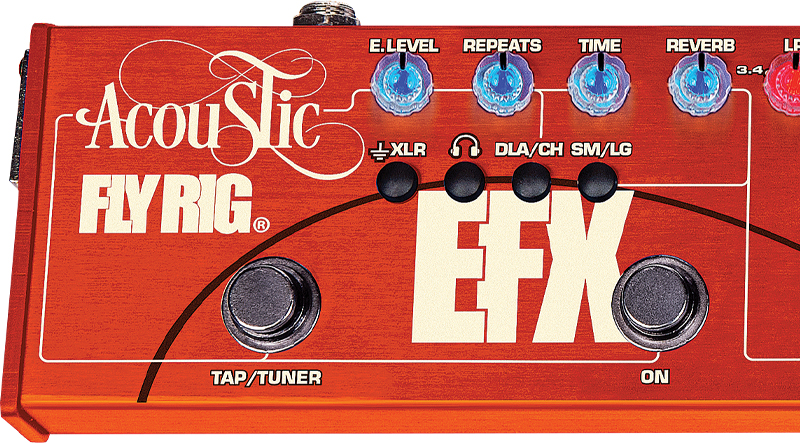
Adding to its line of compact DI/multi-effects units for traveling guitarists, Tech 21’s Acoustic Fly Rig is more than a collection of tone sweeteners – it contains a gig bag worth of functionality specific to the needs of acoustic performers.
Opening the black tin packaging, it’s immediately striking how miniaturized this pedal is. The chassis is only slightly wider than a guitar’s neck across the top and about 12 frets long. Tiny dials, buttons, and parameter names mean you’ll want to learn the controls before making changes on the fly in a live setting, but that seems reasonable for a unit you can slip up your coat sleeve.
A range of performance scenarios will be well-served by this rig, from acoustic player in a band, to troubadour-type, to solo instrumentalist. Using the row of black pushbuttons, setup choices can be made based on player preferences and the system you’re plugging into. For example, use the Acoustic Fly Rig as a DI running to a mixer from the XLR out or the 1/4″ universal output, or send the 1/4″ to the front end of a guitar amp. Other pushbuttons switch the 1/4″ to a high-powered headphone jack, swap the EFX section from delay to chorus, change the reverb’s room size, and reverse the phase for feedback control.
Tech 21 long ago staked its territory in amp emulation, and at the center of the Fly Rig is their all-analog SansAmp technology. The last thing most acoustic players want is to sound like they’re running through a tube amp. This SansAmp offers tone-shaping parameters acoustic performers need when going DI, like an EQ with Mid Shift and a Notch filter. Tweak to compensate for a quacky piezo pickup, PA quality, or amp characteristics that otherwise would be friendly only to an electric.
An EFX section is switchable via dedicated footswitch between delay, thick chorus, and dark reverb. The Comp section is understandably limited, but with just two dials to control spikes while strumming or bring out gentle fingerpicked attacks.
More smarts include a boost for acoustic solos, a clip indicator, switchable AC assemblies for overseas power, and a tuner that mutes when engaged – invaluable for amplified acoustics prone to feedback and microphonic sound. Whether going silent or using every bell and whistle on the Acoustic Fly Rig, guitarists on the move should be thrilled to have this much portable, patchless, clutter-free capability on hand.
This article originally appeared in VG May 2018 issue. All copyrights are by the author and Vintage Guitar magazine. Unauthorized replication or use is strictly prohibited.
Signature guitars tend to be either fan-boy models, the owners of which hang them alongside a collection of signed 8×10 glossies of the artists, or they’re useful instruments that just happen to carry the name of a famous chap.
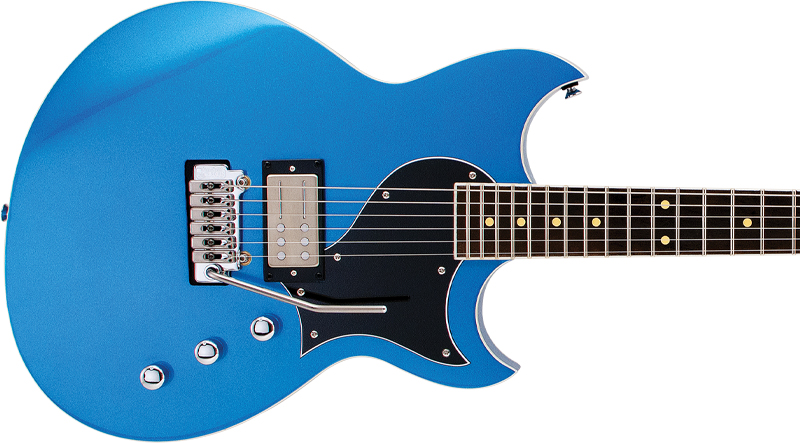
The Reverend Reeves Gabrels Dirtbike is ensconced in the second camp. Gabrels is a noted solo artist, former David Bowie collaborator, and current guitarist with The Cure. Under its vibrant exterior (finished in Reeves Blue, Violin Brown, Cream, Metallic Emerald, or Metallic Violet) his personalized version of the Dirtbike boasts many nods to beloved guitars of yore – its set neck, angled headstock, bound fretboard, contoured Korina body with pointed cutaways, and 24.75″ scale are all nods to Kalamazoo. Meanwhile, the offset cutaways, in-line tuners, colorful finish options, and vibrato clearly reference Fullerton. Other features include locking tuners and a Wilkinson two-point bridge, both of which boost tuning stability whether dive-bombing or simply giving a chord a gentle wobble.
The Dirtbike’s single pickup is a Railhammer Reeves Gabrels humbucker, and it keeps things edgy; it’s aggressive, yet has a full sound with plenty of fat-but-clear highs, warm mids, and tight lows. The balance is aided by Reverend’s choice of wood and hardware, but due mostly to the unique Railhammer design, which utilizes blades on the low strings and oversized poles under the unwound strings. The blades’ tighter magnetic field keeps low-end from getting tubby, while the wider magnetic field of the oversized poles adds to output and overall character.
Names like Railhammer and Dirtbike might create expectations in the mind of a guitarist, and here they’re apt, as the guitar is certainly capable of hitting the front end of an amp with authority; with the Volume knob turned up all the way, it works very well with a pedal or the preamp section of an amp. But it also cleans up nicely with a slight backing-off the Volume knob. Like all Reverend guitars, it has a treble-bleed circuit to preserve high-end response when rolling off the Volume control. The Bass Contour is another wonderful feature; as the knob is turned down, the character of the pickup changes from robust, hot-rod humbucker to a slightly politer (but never wimpy) single-coil tone. A perfect application of this control is as a channel-switching effect; dial in a dirty solo tone with the contour full up, then back it off to clean things up and achieve a slightly less-robust tone perfect for comping chords until the next solo.
The Dirtbike’s design and features encourage a player to take chances and have fun on a tuneful, easy-to-play instrument. It’s a beauty to behold, a pleasure to play, and its combination of simple, gig-friendly features and vintage-inspired appointments make it perfect for jumping off ramps and popping musical wheelies while simultaneously skirting that audition for the local Lawrence Welk tribute band.
This article originally appeared in VG May 2018 issue. All copyrights are by the author and Vintage Guitar magazine. Unauthorized replication or use is strictly prohibited.
Compressors can be a real mystery to guitarists who don’t understand the concept. Recording engineers bandy about words like “hard-knee” and “soft-knee” compression, “ratio,” “threshold,” and “transparency”; these are not guitarist-friendly terms. A test run on Pettyjohn’s Crush presents a good opportunity to discuss compressors in everyday guit-box talk.
Let’s start with the phrase “studio-grade.” Pro players who have worked in studios know the power and glory of rack compressors like the classic UA 1176, LA-2A, and Distressor, as well as those built into old-school mixing boards. Those circuits simply make electric and acoustic guitars and basses sound fatter and more robust and polished than if they went straight into an amp and to tape. Just ask David Gilmour, who cut more than a few great Pink Floyd parts by plugging his Strat straight into a mixer and skipping amps altogether.
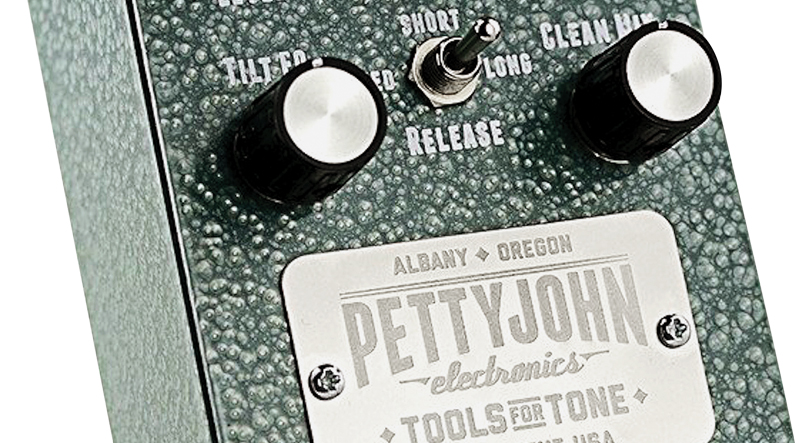
Designed for live work and home-studio applications, the Crush has a discrete VCA compression chip made specifically for Pettyjohn and delivers high headroom and that all-important transparent tone. Transparency is critical in guitar compressors because, while one may occasionally desire “squishy” compression (as available with cheaper pedals), most times, a player wants to hear their guitar and amp compressed without coloration. A knob here called Tilt EQ lets you tweak the EQ to taste, from big-and-bassy to a brighter tone, as compression can sometimes steal a little high-end response.
In the middle of the Crush are two switches. Ratio offers 2:1, 4:1, and 10:1 selections that change the amount of “crush”; Release offers Medium, Short, and Long release of the compression effect, with the last one enhancing sustain. Elsewhere, the Level control adds back any volume diminished in higher compression settings, while Clean Mix balances the compression circuit with the straight guitar tone, useful in retaining a natural tone.
In tests, the Crush delivered formidable compression power, tone control, and transparency. If you wince at the price, consider that serious players and engineers gladly pay for superior sound. You can certainly grab a $100 compressor, but you will likely get a colored, squishy tone and limited flexibility. If, on the other hand, you’ve been inside a studio and heard an engineer add sweet compression to a guitar or bass track, you understand the potential of the Pettyjohn Crush. Simply put, it’s a powerful and flexible pro compressor in a stompbox. That’s a big deal.
This article originally appeared in VG May 2018 issue. All copyrights are by the author and Vintage Guitar magazine. Unauthorized replication or use is strictly prohibited.
If you found yourself stranded on that proverbial desert isle with – horror of horrors – just a single guitar at your disposal, the Collings I-30 LC just might make you one blissful castaway.
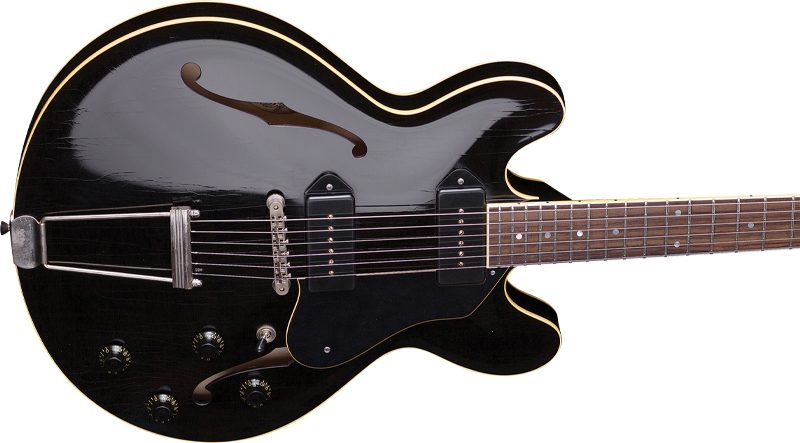
That combo of playability and tone comes courtesy of Collings’ version of a lightweight, fully hollow 335 body shape, a sweet neck, and Jason Lollar P-90s. Sounds simple, right?
Collings’ double-cut body is an interesting creation. Rather than the 335’s solid-block semi-hollow construction, Collings uses a trestle-braced hollow body that directly couples the neck with the tail block, creating what Collings claims is an exceptionally strong guitar with phenomenal acoustic transference.
The body is laminated maple, but the blend of laminates, grain orientation, and ply thicknesses enhances the sonic qualities. End result? The I-30 LC weighs a friendly five pounds and small change.
The neck is Honduran mahogany fashioned to a modern C shape and capped with a rosewood fretboard. With a 247/8″ scale and 111/16″ nut, it’s easy to play. Its tuners are Gotoh, the bridge is a Kluson ABR-1, and the tailpiece is Collings’ own trapeze. All straightforward and reliable.
Collings claims the I-30 LC is one of the most acoustically responsive and versatile electric guitars they’ve ever built, so it was tested through a now-vintage Fender Vibro-King. As noted, the guitar is so nicely balanced, lightweight, and well-proportioned, appointed, and finished that it’s a joy to play. Heck, the I-30 LC practically plays itself.
And then there are those pickups; Jason Lollar must have good ears, because his vintage-voiced dog-ear P-90s are the cat’s meow. Turn up the vintage-look knobs and you just want to keep on picking. They offer sweetness, twang, growl, bite, and more. They can do old-time country or blues, rock out on a rockabilly or British Invasion tune, or wail in a modern or alt-rock setting. You can even dial in a jazz-inflected warmth – especially with the neck pickup – then combine front and back to get a full and rich chimey sound almost Rick-like in sonority.
The mix of superlative pickups with the acoustic resonance of the Collings body adds up to a fullness of tone. While the thickness of sound that’s possible here may not equate to a vintage PAF-powered Les Paul, there’s still a stunning variety of tone. Simply put, this is one incredibly versatile guitar.
The I-30 LC is available in an array of finishes and options. A gorgeous natural blond stunner is set off by black pickup covers and pickguard along with gold knobs. Others range from a variety of sunbursts to a walnut and cherry, as well as premium painted versions in Sherwood Green Metallic, Pelham Blue Metallic, Gold Top, and Candy Apple.
Collings also offers an I-30 LC with aged finish and hardware, as tested. The deep, rich black finish boasts checking and worn-looking paint, a stylish relic finish like no other. You can also opt for tortoise-style binding, black top-hat knobs, a ’60s neck profile, a lefty version, and more.
This article originally appeared in VG May 2018 issue. All copyrights are by the author and Vintage Guitar magazine. Unauthorized replication or use is strictly prohibited.
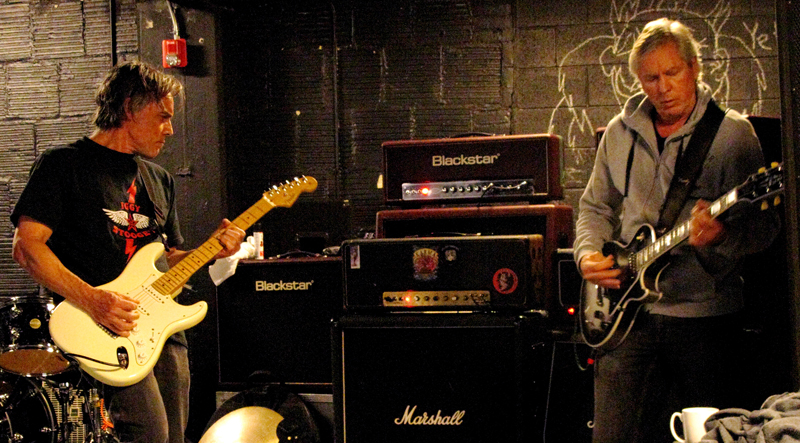
Deniz Tek/James Williamson: Anne Tek. Tek and Williamson during rehearsal for a Ron Asheton tribute concert in 2011. Tek is playing a USA Hardtail Strat while Williamson has a Les Paul Custom reissue in silverburst finish and fitted with custom-made Lollar Leopard Lady/Raw Power pickups.
The words “proto punk” arouse recollections of furiously strummed guitars and amps cranked to 10. For many, its sound and aggression were embodied by Iggy and the Stooges. But when Stooges guitarist James Williamson recently collaborated with renowned Radio Birdman axe-wielder Deniz Tek, each reached for an acoustic.
Williamson replaced Ron Asheton in the Stooges in time for the band’s 1973 classic, Raw Power, which included the in-your-face anthems “Search and Destroy” and the title track.
Raw Power was not a quick commercial success, and its failure led to the band’s split. But Williamson and singer Iggy Pop stuck together to record songs issued in ’77 as Kill City. Williamson retired from the music biz in the early ’80s and became a successful electronics engineer. In 2009, the Stooges gathered for their induction to the Rock and Roll Hall of Fame. The event spurred the band to record 2013’s Ready to Die.
Like the Stooges, Tek hails from Ann Arbor, Michigan, but by the early ’70s was living in Australia. Inspired by the Stooges, he formed Radio Birdman, an influential band that offered the classic Radios Appear in 1977, and split shortly after sessions for its second album in ’78; that disc was issued three years later as Living Eyes.
Tek later played with Ron Asheton in a band called New Race, and reunited with Radio Birdman. In ’07, the latter was inducted into the Australian Music Hall of Fame.
With a title modeled after the Stooges’s lo-fi 1976 live album Metallic K.O., Acoustic K.O. is a stripped-down affair highlighted by readings of two tunes from Raw Power (“I Need Somebody” and “Penetration”) and two from Kill City (“Night Theme” and “No Sense of Crime”).
We recently spoke to Williamson and Tek to get the story on their past, and their new collaboration, Acoustic K.O.
Williamson used his Weissenborn (left) to record “Penetration” and “Night Theme” for Acoustic K.O., his Gibson B-25 (middle) to compose the music on the Stooges’ classic album Raw Power, and this ’67 Martin D-28 on Acoustic K.O.
How did the collaboration happen?
James Williamson: This all came about after Deniz and I met when we did the Ron Asheton tribute show in Ann Arbor, in 2011. Though he had grown up there and there were many parallels to our careers, we’d never met. But we finally did in 2011 and continued to occasionally touch base like when the Stooges would play Australia. But I came to find out that he visited Hawaii frequently with his wife, Anne, so we became friends outside of music. And it so happened that during one of our get-togethers, we were chuckling about doing a lounge act, which germinated into the idea of, “Well, why don’t we do some acoustic songs?” He suggested some of my old catalog, and coincidentally, a super-fan had suggested the EP title some time ago, as well as the idea of orchestrating “Night Theme.” So, this was a vehicle for me to realize both.
Deniz Tek: In all the years James wasn’t playing high-energy rock and roll, he was learning slack-key and Hawaiian-style acoustic playing. So, he’s really into acoustic. We thought, “Maybe we should work up an acoustic set and play in some of the bars.” Nothing really serious. But then we got the idea of doing some of his old material, but acoustic. I thought it was a great idea.
Deniz, did you grow up with anybody who ended up in the Stooges?
DT: Growing up, I knew about the guys, but didn’t know them personally. I went to the same school as Iggy and the Asheton brothers, Ron and Scott; I think Ron and Iggy were five years ahead, Scott three years. But I ended up going to college in Australia.
How influential was the Stooges’ music on Radio Birdman?
DT: Oh, very influential. There was a lot of good music happening in Ann Arbor in the ’60s. We had local greats – the Rationals, MC5, the Stooges – and the music scene was happening enough that big, international bands would come through, also. We didn’t know how lucky we were to have access to so much great music. But when I came to Australia in ’72, there wasn’t great music going on. There’d been a great scene there in the ’60s, but not in the ’70s. So, I took the Stooges’ vibe – we didn’t try to copy them, but wanted to cop their attitude. Australia was perfect because it was virgin territory in that regard.
Tek in Radio Birdman: John Needham. Deniz Tek today: Anne Tek. Tek with his ’65 Epiphone Crestwood Deluxe in Radio Birdman.
When you arrived in Australia, did anyone know who the Stooges were?
DT:The Stooges and Funhouse had been released here, but hadn’t gotten any airplay. You could find used copies all the time for 50 cents. I used to buy them all; I’d go into the city and buy these records then pass them out to people and say, “You need to listen to this.”
When you began working together, did you click right away?
JW: Yes. I thoroughly like Deniz as a person as well as a musician. He’s very easy to work with – a very intelligent, skilled guy.
DT: We click as friends. He’s a great producer – knows what he wants, but he’s not a dictator. He’ll take input from anybody. He’s one of these guys who’s willing to try anything, but knows the destination, and knows it when he hears it. He was helping me get the vocals, and I really wanted to do well on the songs that Iggy sang on. You can’t top that. Can’t even get close. So, we did it in a different way and he was willing to take suggestions to get where we wanted to go.
What went through each of your minds while re-working songs originally sung by Iggy?
DT: Having grown up with them, everything I’ve ever done in music since probably 1973 has been influenced in some way by Raw Power. I know those songs intimately and have always loved that material, so getting to sing them was a great opportunity. It was a challenge also, because I wanted to do them justice.
JW: I liked Deniz’s vocals and I liked Iggy’s vocals. Iggy is sort of a husky baritone and Deniz sings slightly higher, but both have a good feel.
Were you together for the recording of Acoustic K.O.?
DT: I did guitar parts via file swapping, but the singing we did while in the same room.
James, were the overall sessions a polar opposite from those for Raw Power?
JW: Yes and no. In the sense that some of those for Raw Power, like “I Need Somebody,” were originally acoustic and electric. So, there were some similarities, but that’s probably where it ends. Essentially, I was in my 20s then, and my 60s for these sessions, so quite a gap there in terms of tastes and the things we did. Raw Power was my first album, and this one is my umpteenth. So, it’s different in that way.
Which guitars did you use?
JW: On “Night Theme,” I used a Greenfield G2. Michael Greenfield is a luthier in Canada and makes exceptional guitars. I’d been trying to find a purpose for it, and this turned out to be perfect. I also used a ’67 Martin, including for Nashville tuning for some of the higher-pitched stuff, where you hear what sounds like a 12-string. For “Penetration” and “Night Theme,” I used a Weissenborn lap-steel made by Tony Francis. It had a big role.
DT: On the EP, I used a Takamine Legacy series EF-341 dreadnought. I also had a Regal resonator I got maybe 30 years ago. It doesn’t have a serial number, but I think it’s an RD-40. I used it to play slide.
Did you use any amps?
JW: No. The rules were “entirely acoustic.” So, nothing is electric except for a pump organ. Otherwise, it’s acoustic guitars, Bob Glaub’s ’60s Kay f-hole bass, and a 1920s drum kit. Bob’s bass sounded perfect in the tracks.
Tek today with the Crestwood and his Regal RD-40.
James, what gear do you remember using for the Raw Power sessions?
JW: I was pretty sparse back in those days, but it was my ’70 cherryburst Les Paul Custom I call Leopard Lady, which I used on every record I’ve ever made up until the single(“Sickkk”) I cut last year with a singer named Maia. I donated that guitar and my Gibson B-25 to the Rock and Roll Hall of Fame Museum. I used the B-25 to write all of Raw Power and the Les Paul with a Vox AC30 because we recorded [at CBS Studios] in London. That was pretty much it. I did use an occasional Marshall for solos, but no pedals or effects. I occasionally had to bring in something that would sustain well in the studio, but mostly it was the AC30. For acoustic parts, I borrowed a Martin D-28; the ’67 Martin on the new EP was also a D-28.
J. Williamson Les Paul: Grant Groberg. Williamson’s 1970 Les Paul Custom, Leopard Lady, was his go-to in the Stooges. It now resides in the Rock and Roll Hall of Fame.
And what did you use for the Kill City sessions?
JW: I don’t remember the amp because I had to borrow it from somebody! It might have been a Traynor, but whatever it was sounded good. But it was the same guitar, and I used that B-25 for the acoustic parts.
Deniz, which guitars did you use with Radio Birdman in the ’70s?
DT: I used the first guitar I got, when I was about 12; it was a Harmony Bobkat. I later had a Danelectro, then an early-’60s National Val-Trol Baron. I sold that guitar to Keith Richards; if you see Keith’s recent documentary [Under the Influence], Pierre de Beauport holds it up and says, “This is an one of the guitars Keith wants me to fix.” It blew my mind. Later, I had the good fortune to get a ’65 Epiphone Crestwood Deluxe that had been owned by Fred Smith in the MC5. I was back visiting my parents in Ann Arbor, and bought it through a third party. Those are really rare, with three mini-humbuckers and the factory-installed Bigsby that replaced the Epiphone vibrato. And they put the “Custom Made” plate on them to cover the other two screw holes. It’s a rare and fantastic guitar, and was my main instrument in Radio Birdman for all those years.
The only other guitar that I played much in Birdman was a Rickenbacker 460 with Gibson “toaster top” humbuckers. I got that guitar off of Ben Miller, in Ann Arbor.
And which amplifiers did you use with Radio Birdman?
DT: I had a couple of Phoenix amps, made in Sydney. I don’t think they’re known outside of Australia, but it was basically a Fender Bassman circuit. I had a couple of those and a 100-watt solidstate Phoenix that sounded fantastic. I used it on the early recordings, but switched over to Marshalls when we started playing bigger places; I had a 100-watt JMP and a 50-watt MKII. The 50-watt didn’t have a Master Volume and was louder than the JMP by far. Anything with the Volume knob past 4 was lethal. I used Marshalls from then on.
Did you use any stompboxes?
DT: All I had in Birdman was an MXR Dyna Comp and a Cry Baby.
James, every few years, there seems to be a new appreciation of the Stooges. The most recent wave included the release of a coffee-table book, Total Chaos, and the documentary Gimme Danger.
JW: Yes, and I’m astonished, to be quite frank. I came back for the reunion after Ron died in 2009, and within a year we were in the Hall of Fame, then getting platinum albums. Quite a bit of momentum had gathered, really, when you consider these records were made 40-odd years ago. I’m in awe, frankly.
Stooges in ’73: Danny Fields. Iggy and the Stooges in 1973; Ron Asheton (left), Scott Asheton, Iggy, and James Williamson.
Did it serve as validation all these years later?
JW: Yeah, no doubt about it. I think all of us were pretty happy to get the industry recognition. It was kind of bittersweet, but still. And I don’t care what anybody says – you want to have it when you’re doing it. So, it was nice. Especially satisfying was the generational recognition. We literally became like the old blues guys, where people say, “Hey, those are the real guys” and then go see them.
Deniz, for people just discovering Radio Birdman, what’s a good starting point?
DT: I would say get the compilation on Sub Pop, The Essential Radio Birdman (1974-1978). It’s well-mastered, you can hear everything, and it’s got the best of the different albums.
Any plans for you two to work together again?
JW: I think “plan” is a strong word (laughs), but we remain good friends and enjoyed working with each other, so it certainly isn’t out of the question. I’m writing new material and we’ll just have to see what comes of it.
DT: We work really well together, so anything is possible.
James, would you ever work with Iggy again?
JW: I think that train is parked at the station permanently at this point. I never say never, but he doesn’t make records anymore, and that’s all I do anymore. I don’t play live, really, except for the occasional set where I sit in. We had about five years in our 20s, another five for the reunion, and that ought to do it.
This article originally appeared in VG May 2018 issue. All copyrights are by the author and Vintage Guitar magazine. Unauthorized replication or use is strictly prohibited.
W. Melvoin live: Robert Georgeff. Melvoin onstage in 2017.
As a guitarist backing Prince on the world-dominant Purple Rain along with Parade and Around The World In A Day, Wendy Melvoin helped crystallize a musical vision known as The Revolution.
Melvoin’s collaborations helped unveil Prince’s world view of humanity using a tight, funkalicious rock band that blended gender, race, and sexual identities. She co-wrote hit songs, recorded, and toured the world with the legendary singer/songwriter/performer, generating syncopated funk lines, sweet solos, and serving as a role model for guitarists of all ilks.
Since her time in that realm, Melvoin has been a sought-after session guitarist with a slew of high-profile credits including Seal, Glen Campbell, Sheryl Crow, and Joni Mitchell, and she’s composed music for film and TV including “Nurse Jackie,” “Heroes Reborn,” and “Shades of Blue.”
In 2017, The Revolution re-formed with original members to continue the legacy of love and unity embodied by its late founder. We spoke with Melvoin to get her story and her thoughts on the modern Revolution.
What attracted you to the guitar?
I started because I was kicked off my brother’s drums. I was six, and my folks were like, “We gotta get her an instrument.” My mother said, “Why don’t we get her a guitar.” I was like, “No!” To get me started, she took lessons with me. But after a month, I was hooked. I was in love with the instrument. I had a knack for rhythm and my mother and father used to say that the rhythms I played sounded slightly Brazilian. It was just what I was feeling.
I was one of those kids who listened to everything. My father [L.A. session pianist Mike Melvoin, part of the famed Wrecking Crew] was a member of the National Academy of Recording Arts & Sciences, so they’d send records. I was 10 years old and listening to Mahavishnu Orchestra or Miles Davis’ In A Silent Way. I’d ask my father who the guitar player was. Then I got into John McLaughlin. I started getting into rhythm players and James Brown’s band, and then it all started to culminate. 1977 until 1981 was, to me, the golden age of R&B disco – not bullsh**t disco (laughs), but Bohannon, Stargard, and the stuff Sly & Robbie were doing. I started getting into all these rhythms. I knew I was going to be a player.
Sounds like the perfect primer for a gig with Prince.
When I was 13, I went to a club in L.A. called The Starwood. I heard this song, so I ran up to the DJ and said, “What is that? Who’s that girl singing?” He said, “It’s not a girl. His name is Prince and the song is ‘Soft and Wet.’” I was completely floored and remember thinking, “That’s unbelievable.” That same night, Devo performed in the next room, so it was a memorable night.
I met Prince prior to actually playing with him. In the summer of 1982, [Revolution keyboardist] Lisa Coleman (Ed. Note: Coleman’s father is Wrecking Crew percussionist Gary L. Coleman) was in Los Angeles; our families were close and I was amazed when Lisa got the gig. I was like, “Do you even know who you’re playing with?” She said, “No, not really.”
Anyway, she invited me downtown, where they were filming videos for “Controversy” and “Sexuality.” I walked in as Prince was performing his oozing solo on “Sexuality.” He was very friendly and we hung out a lot with Lisa, but not for a minute was I about to say, “Hey, I play guitar!” By this time, the sordid love affair began with me and Lisa. I visited her at the infamous Rolling Stones concert where Prince was literally booed offstage during his set. It was right after that they flew to New York to do some gigs. I was practicing guitar in Lisa’s hotel room, and he heard me and knocked on the door. He said to Lisa, “Who was that playing? Was that you? You don’t play guitar like that?” Lisa said, “No, that’s Wendy.” He sat on the bed and said, “You didn’t tell me you played. Will you play me something?” I was sitting there thinking, “This is Prince. What am I going to play? I’m not going to play one of his songs and try to out-do him!” So I played a chord that stretched an octave and a half (laughs). He looked at me like a deer in the headlights and said, “Wow.”
Two days later, there was strife with guitarist Dez Dickerson after he didn’t go to sound check. Prince asked if I knew “Controversy.” I said, “Yeah…’” He said, “Go onstage. I’m going to go into the arena and walk around and check sound. Count the band off and play.” I did, and [drummer] Bobby Z says to this day he knew the band was complete. Prince called a few days later and asked if I’d join.
You just happened to know how to play “Controversy” at the perfect time.
The truth is that I had never played it before, but I’d watched him play that chord – F# on the second fret with the pointer finger, high E with the little finger on the B string. It’s a stretch, you can’t ring any of those other strings, and it has to be syncopated. I watched him do it so many times that I just did it. I got lucky.
There were people using that chord, but as passing tones. Prince was the first who stayed on those two notes and defined what the groove was. I thought that was mind-blowing. He played heavy strings, right through the board, with tons of compression. It was dry, tight, and you could tell the strings were really fat. It worked, and he found it.
Prince and the Revolution: Nancy Bundt. Prince and the Revolution in their mid-’80s heyday. Clockwise from top are keyboardist Matt Fink, bassist Mark Brown, keyboardist Lisa Coleman, Prince, Melvoin, and drummer Bobby Z.
Since reuniting with The Revolution, are there challenges other than handling lead vocals?
The big challenge is to not take it over. What we’re trying to do is say we don’t own it. Prince is Prince, with or without us. It was really important that the set be respectful and show what we miss about being in a band with him. The songs show how it was a full collaboration and we’re staying away from anything where people would say, “It’s just a tribute.” It’s a fragile position, but it’s really important that we don’t try to take ownership of him, but hold what he was for us. That’s been the most difficult thing to balance and measure against what the audience wants; let’s give the fans the feeling they got when they first heard those songs, give them a real sense of what it was like for us. Nobody is trying to replace Prince, but we want to play this stuff before we’re dead. If this ends up being a tour of boo-hoos and funerals, I won’t last and neither will the rest of the band. I can’t do funerals for the next 20 years. Whatever we can do right now, we’re trying to do it and be respectful.
Do you still have the purple Rickenbacker?
I had two of them – totally modified when we got them. At the time, I didn’t want to play any jangly Roger McGuinn guitars, so we closed the soundholes and put in G&L pickups so we could get a lot of sustain. It wasn’t really my call to get those in the first place, but Prince was keen on me playing big-body guitars. When I left the band, Lisa and I were getting ready to go on our first tour. We were at rehearsal and someone got into the back of our truck and stole my guitars. I’ve been looking for them for years, but they’re long gone.
Your image with that guitar, the outfits, and the hair are etched into the minds of so many people.
I know. It was the Zeitgeist of that moment. But I do have the white 335 from the Parade tour. That’s the one I’m using onstage now. Gibson brought it to a rehearsal for me in 1982 and it’s an absolutely spectacular instrument – built really well and I’ve been playing .012- and .013-gauge flatwounds on all my guitars for 15 years. I take it and my little white Fender Custom Shop Mustang. I also have a ’66 Jazzmaster.
Your live rig is small, but huge-sounding. What are you using?
Before the tour, I profiled all my amps – a little Top Hat, some great old Silvertones, and a vintage Fender – into a Kemper Profiler. It’s f***ing amazing. I didn’t think it was possible, but it is. I would love to go out with all my gear, but it’s not cost-effective. I have two Kempers and my guitar, and I’m good to go. I don’t even use a cab – it goes right to the board. There’s no sound coming from any speaker. It’s all profiled for my cabinets, speakers, effects, and my entire chain’s all coming through the monitors.
Which effects do you add?
I’m trying to stay true to Prince’s tones. I made sure I was using the right pedals; I have the old flangers, distortions, and my Crybaby. And I use expression pedals for boost, volume, tuning, and mix on my delay. For the Kemper, my backup is on two thumb drives. If anything f***s up, I put a drive in and reload. It has saved me thousands of dollars of cartage, and I get an amazing sound out of it. I had some help because it can be a little complicated, but once I dialed it in, I was getting sustain like I never thought I’d get. With the clean tone, I might as well be going right to the board. I profiled my Dumble through the Kemper. They translate beautifully onstage and sound even bigger.
What’s next on your schedule?
We’re taking a break and then hitting the road [this spring and summer], and Lisa and I did a third season composing for “Shades of Blue.” We’re also composing for a documentary for HBO.
This article originally appeared in VG May 2018 issue. All copyrights are by the author and Vintage Guitar magazine. Unauthorized replication or use is strictly prohibited.
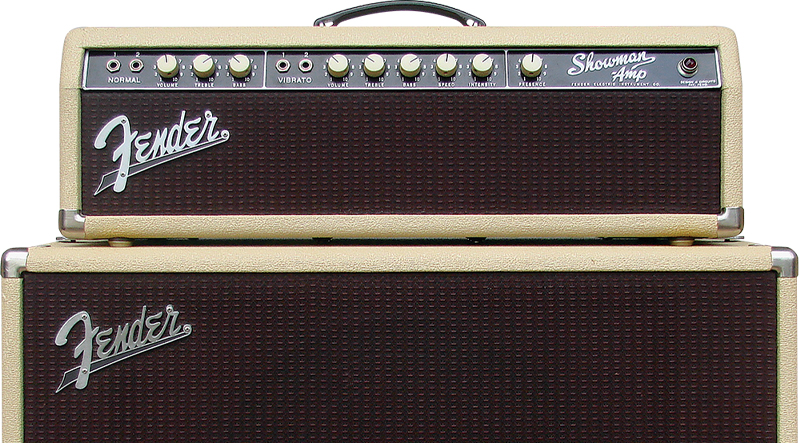
Amp courtesy of Tommie James. The “shadow” around this Showman’s speaker, just visible through the grillecloth, is the Tone Ring to which the JBL D-120 is mounted.
When Fender stepped up from the tweed-covered amps of the 1950s to the radically redesigned Tolex amps of the ’60s, one of the biggest leaps was in the “piggyback” head-and-cabinet sets. None better exemplified the need for a powerful, professional rig than the Showman.
The development and early evolution of the model have long been shrouded in myth, thanks in part to surf guitarist Dick Dale’s vociferous contributions to the lore and legend surrounding the R&D behind the new model.
What better way to explore the state of the seminal Showman than to probe an early – and admirably pristine – example?
1961 Fender Showman 6G14-A • Preamp tubes: four 7025, two 12AX7 • Output tubes: four 5881 • Rectifier: solidstate • Controls: Normal channel: Volume, Treble, Bass; Vibrato channel: Volume, Treble, Bass, Speed, Intensity; shared Presence • Speaker: one 12″ JBL D-120 • Output: approximately 65 to 80 watts RMS
Players and collectors have long talked about the Showman as “just a Twin in a separate head cabinet.” After all, both had four output tubes. But that easy summation is far from the truth. However you slice it, the progress of the Showman design through its several early iterations was all about power – making more of it, and doing so without blowing up anything.
Fender approached this as a unique and individual design challenge. Drill down a little further, therefore, and it’s no surprise that much of the effort lay in upgrading the amp’s output stage, especially its output transformer (OT). That, and the extension cabinets, and the speakers that went into them. So significant was the speaker cab, in fact, that the name of one version of the amp itself – the Dual Showman – would include a nod to the use of two speakers in the cabinet. But we’re getting ahead of ourselves.
Certainly, Dick Dale wasn’t the only artist who needed a louder amplifier, but he most famously urged Leo Fender to improve existing amps in order to achieve the pounding volume required to power his shows with the Del Tones at the Rendezvous Ballroom before a few thousand screaming, stomping surf teens. Throughout its front-end, the Showman was much like other medium- and large-sized Fenders of the blond Professional Series. It had two independent channels with Volume, Treble, and Bass for each, using the new preamp configuration that sandwiched the EQ stage between two gain stages supplied by a 7025 dual-triode (a 12AX7 equivalent), rather than the single gain stage and cathode-follower EQ stage of the late-’50s tweed amps. These Tolex amps also had Fender’s complex harmonic vibrato, something close to a true pitch-shifting vibrato, and they retained the Presence control from the tweed era, both of which would disappear by mid ’63 or so.
Otherwise, the first Showman amps differed little from others in the lineup, other than in the way it was all put together. Despite having four 5881 output tubes like the Twin, they were given an OT borrowed from the brown Vibrasonic, an amp running two 6L6GCs and spec’d at around 40 watts. According to Nic Grabien, an authority on early Fender Tolex amps, and likely the world’s greatest font of knowledge on the Showman, it appears Leo Fender might have hoped to have this OT pull double-duty from the start.
“The very first blond Showman heads used the Triad 45550,” Grabien said. “That’s the 16-ohm OT spec’d for the Vibrasonic. The original spec was probably for a nominal 40 to 50 watts, but the 45550 might have been rated as high as 80. Leo certainly wanted the Vibrasonic to be robust enough to go with a four-neck Stringmaster [steel guitar], which had a very wide frequency range. The amp put out between 25 and 40 watts depending on who’s making the claim, but bigger iron would certainly have helped. For reference, call it a 35-watt. Plus, Leo did plan to use the 45550 in the Showman, as well; the design for the Showman’s output stage made for between 50 and 80 watts, but I think the original Showman 6G14s were closer to 60.”
Problems arose, however, as Dick Dale duly observed, when these early 6G14 Showmans were pushed to the max. Mated with a speaker cabinet housing a single 12″/8-ohm JBL D-120 capable of handling about 50 watts, the amp proved too much for the speakers, which frequently blew, while the impedance mismatch and effort of producing that much power proved too much for the Triad 45550 OTs, which ran too hot and, on occasion, went up in smoke.
Changes were needed, and the first of those came in the form of a new OT.
The amp on display here is a gorgeous early-’61 Showman provided by collector and VG reader Tommie James, It’s a rare transitional model that carried the new OT and represents the first Showman to have resulted from a ground-up design of the output stage, rather than (as with the earliest examples) having been cobbled together using components from existing Fender amps. This 6G14-A has a tube chart stamped “KC,” denoting March of 1961, meaning it was likely assembled from parts acquired in January or February. Further examination reveals a new component – the Triad 45945, a larger OT that could produce more power and take the heat while doing so. According to Grabien, this transformer was rated at 80 watts into an 8-ohm load and would be the OT of choice for the single-speaker Showman heads.
These amps were then partnered with upgraded JBL F-series 12″ and 15″ speakers in single-speaker cabs, which could better handle the power increase, though they still weren’t rated for the head’s maximum output. The cabs were a huge part of the Showman recipe, too, and represented further R&D by Fender. The highly acclaimed “Tone-Ring” cabinets that accompanied the first few years of Showman models involved a ported design with dual speaker baffles and a metal mounting ring that positioned the driver to direct some of the rear-driven frequencies between the staggered baffles and out the front. Essentially, it was a concept borrowed from the hi-fi world, designed to enable fuller low-end reproduction, meaning the amp itself didn’t have to work as hard to produce the bass frequencies, and could therefore produce a more-balanced representation of midrange and high frequencies along with it. These cabinets were, however, costly to make, and eventually abandoned.
Together, it all adds up to a great-sounding amp that maximizes the efficiency of its parts.
The Showman’s chassis is all-original and impressively clean, especially for a 57-year-old amp.
“I’ve owned a 1960 blond Fender Twin-Amp for years, and replaced its original Jensen speakers with a pair of D-120Fs,” said James. “Since the Showman 12 has an almost identical chassis except for the 8-ohm OT, I expected the 12″ JBL to sound less powerful. At the same control settings, the Showman 12’s Tone-Ring cab sounds just as loud, clean, warm, and beautiful as the Twin with its open back!”
Grabien noted that Fender chose an even larger, more powerful Triad OT in March of ’61 – the so-called “Dick Dale OT” capable of producing 100 watts into a 4-ohm load, perfect for driving the Dual Showman cabs. This transformer had noticeably thicker iron laminations to withstand strain and heat. In side-by-side comparison of his early ’61 Showman and blond ’60 Twin, James observed this part – Triad OT number 45268 – is the same.
From this point onward, the 8-ohm OTs would be found in the “single” Showman heads, while the Dual Showmans would carry the 4-ohm. In mid ’61, however, Fender commissioned new Showman transformers from Woodward-Schumacher (initially using the same specs), and both of these rare, short-lived Triad transformers were phased out. By early ’62 (maybe sooner), the early designs of both Showman models were gone, rendering both extremely rare.
This article originally appeared in VG May 2018 issue. All copyrights are by the author and Vintage Guitar magazine. Unauthorized replication or use is strictly prohibited.
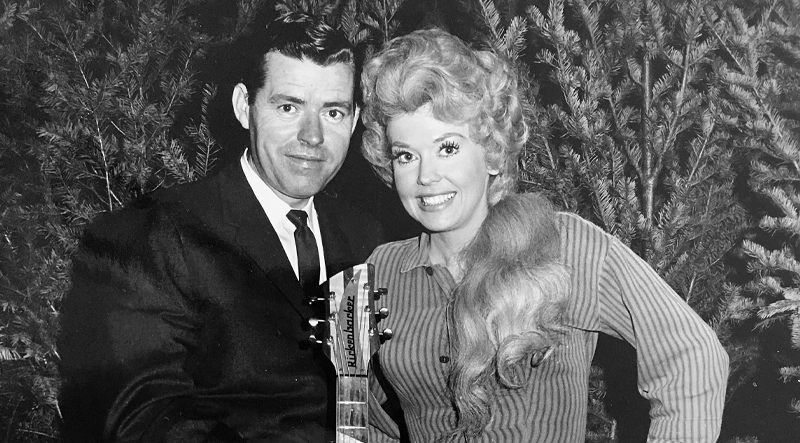
Bryant and his Rickenbacker with Donna Douglas (a.k.a. Elly May Clampett) in the early ’60s.
When Leo Fender strode into a cowboy bar on the outskirts of Hollywood one day in 1950, he had no idea the contraption he was toting would become a central force in a new age of music.
The Riverside Rancho offered an inviting atmosphere enjoyed by locals but was hardly the venue for myth making. Nonetheless, it was where Leo saw the historic marriage of man and machine, the latter being his newly-assembled Broadcaster – the first commercial solidbody guitar – as it was plugged into a Fender amplifier.
Leo himself was not a musician; he relied heavily on input from working pros and had driven many miles from Orange County to track down the guitarist who was rapidly becoming the talk of L.A.’s music scene. An unsuspecting audience and the house band gathered around Jimmy Bryant, awed as he coaxed never-before-heard sounds from a never-before-seen instrument – a “plank” very unlike the big, beautiful acoustic guitars held by movie stars and celebrity cowboys on album covers.
(LEFT) Bryant’s ’59 Tele has been restored to its original state. (RIGHT) The Fender Jimmy Bryant tribute Tele.
It could only happen in California – the harmonic convergence of two quintessentially American elements; a country-flavored guitar-slinging war hero whose playing evoked jaw-dropping appreciation, and the newfangled Fender guitar poised to change the world.
Bryant’s legend looms large in guitar lore. He dominates the first pages of any authoritative book about the Fender saga and wrote the opening chapter on Telecaster virtuosity, yet is woefully underrepresented in guitar literature. His preeminent status was established a decade before he was immortalized as “the fastest guitar in the country” – not coincidentally, the name of his 1967 album.
“He is the fastest and cleanest and has more technique than any other,” Barney Kessel said at the time. The sentiment was shared by Chet Atkins, who said, “I could never get in his league.”
And Bryant’s impact spanned oceans; English Tele master Albert Lee claims Bryant as a primary influence, as do Brit rockers including Ritchie Blackmore and Steve Howe.
“I first encountered Jimmy’s playing in the early ’60s,” said Lee. “There was a long-running radio show on the BBC every Saturday morning playing rock and pop records and live segments of recorded music by local artists like The Beatles, along with visiting Americans like Eddie Cochran and Gene Vincent. For weeks, they had a ‘Country Corner’ segment, and during one of them I heard ‘Arkansas Traveler’ by Speedy West and Jimmy Bryant, from Two Guitars Country Style. It made such an impression upon me. Later, Jimmy recorded several albums for Imperial and though they were never released in the U.K., I was able to get the info from Billboard and Cashbox. I found it hard to believe that such a great player could remain unknown by the public.”
“The perspective Bryant brought was as broad as Atkins,” added Howe. “He was more a single-note player, but compensated with his dexterity and fluidity on the fingerboard. And though he drew from Django Reinhardt, like Atkins and Les Paul, he seemed to come up with influences of his own. He had an indescribable worldliness that stayed in the country, hillbilly and Western-swing styles. It presaged rock and inspired and influenced the early rock and roll guitarists.”
Jimmy onstage with his early-’60s Rickenbacker 360.
Born March 5, 1925 to a dirt-poor sharecropping family in Moultrie, Georgia, Ivy James Bryant, Jr. was the oldest of 12 children. A true prodigy, he learned country fiddle at age five and, to help feed his family, worked as a street musician during the Great Depression. By 13, he turned pro and travelled to Florida to play with Hank Williams. At 18, Bryant joined the Army during World War II and served in Patton’s Third Army in France and Germany, where he first encountered Reinhardt.
While recovering from shrapnel wounds, he heard Tony Mottola play as part of the Special Services band, and was motivated to take up the guitar. A quick study, he was soon playing guitar and fiddle with the USO. Upon discharge with a Purple Heart, he bought a Gibson Super 400 with floating De Armond pickup, an amp, then played the Washington, D.C. area and Georgia as “Buddy” Bryant.
“Out there they’re having fun, in the warm California sun” proclaimed the words of the 1964 pop hit by The Rivieras. But the state’s real attraction as a Western paradise began as its population nearly doubled between 1940 and 1950. Culturally diverse and welcoming in climate, technology, arts and culture, it was home to aerospace and movie industries as well as blues, pop, jazz and country music. To Bryant, it seemed the promised land.
Jimmy onstage with his second Rickenbacker, a 365 Capri, in the early ’60s.
Soon after moving to Los Angeles, he secured radio work as lead guitarist with Cliffie Stone on “Hometown Jamboree” alongside pedal-steel wiz Speedy West and numerous budding country stars, sporting a sunburst Gibson Super 400 (with a floating DeArmond pickup) and a Fender Dual Professional/Super with two 10″ Jensen speakers. His first recording session was Tex Williams’ “Wild Card” (1950) for Capitol, which led to a five-year contract during which he made 65 singles as Jimmy Bryant. His first solo record, “Bryant’s Boogie,” was a trial, and he shared the date with Stone’s Hometown band and Tennessee Ernie Ford on the B-side.
“I first heard Jimmy when I was about nine with Tennessee Ernie Ford and Cliff Stone’s Orchestra,” recalled Howe. “It didn’t sound like an orchestra to me – it was ‘Blackberry Boogie’ with two hot guitarists! I wasn’t playing guitar yet, but was amazed and excited by the sound. At the time, I didn’t know it was Bryant, but it began my search for uncommon players.”
In performance and appearance, Bryant was the paragon of California country cool. He worked regularly on Western films, making 12 movies with Roy Rogers as guitarist and actor under contract with Republic. In his hands, a Fender guitar was seen for the first time on film (In Old Amarillo, 1951) and on TV shows hosted by Spike Jones and Tennessee Ernie Ford; his adventurous country/jazz blazed a trail with help from his black-guard Broadcaster prototype fabricated in Leo’s garage.
Bryant sported his Magnatone on the cover of his 1966 instructional album.
Bryant was the first and remains one of the greatest Tele heroes. In the ’50s, he played several versions including a blond-finish model with his signature on the pickguard, a custom hollowbody that became the precursor of the Telecaster Thinline, a maple-fretboard model with hand-tooled leather pickguard (reincarnated as a Fender Custom Shop tribute model in 2003) and a red ’59 with rosewood fretboard. He generally paired his Teles with tweed Fender Pro and Twin amps in the period. When playing together, Bryant and West positioned their matching Twins in a V configuration around a single microphone to achieve their trademark blend and balance.
Jimmy’s prototype ’66 Magnatone. Note the mailbox “M” stuck to the headstock.
Bryant’s association with Fender persisted through the decade, despite acrimony and disappointment resulting from a planned (but never released) signature model made in ’54 that was introduced later as the Stratocaster. The dispute led to relationships with Guild, Rickenbacker, and Magnatone in the ’60s (acrimony notwithstanding, he posed with a white ’58 Fender Jazzmaster in Roy Rogers’ New Sons of the Pioneers, and played Scotty Turner’s ’54 Strat on “Little Rock Getaway”).
In 1950, Bryant formed a duo with West, which Stone aptly dubbed “Flaming Guitars.” Their formal debut was West’s April ’51 session date for “Railroadin.’” Spawned in the cowboy bars of L.A.’s skid row, the partnership became legendary, creating compositions and an original sound in the studio with little or no preparation. Signed to Capitol, they first recorded as a team in June of ’51 on “T-Bone Rag”/”Liberty Bell Polka.” “Bryant’s Bounce” (’52) showcased Jimmy’s formidable jazz-informed chops and foreshadowed a busy solo career. He enhanced his visibility with the increasingly popular Tennessee Ernie Ford and made his first album, Two Guitars Country Style, in ’53. Concurrent with Merle Travis, Bryant/West produced the very first all-instrumental country albums – extremely rare in the industry. At this point, L.A. country was edgier and more progressive than Nashville fare, and Bryant/West were greatly responsible for its sound. At the time, Bryant made evident his ambitions to push the envelope even further; 1954 saw his ambitions realized with “Stratosphere Boogie” and “Deep Water.” Both featured an innovative approach to parallel harmonies, impossible to play on a normal guitar, where he sounded like two guitars, country-style. He had long admired the multi-tracking skills of Les Paul and developed a way to produce a twin-guitar effect with a single instrument. He used a Stratosphere doubleneck (made in Springfield, Missouri) in an atypical way, tuning the 12-string neck in thirds instead of the usual octaves and unisons, to generate inimitable harmonized lines.
“Country music was about simplicity when here came Jimmy and Speedy with this technical ability, complexity, and wealth of musical ideas,” said Howe. “You can’t make music like this without a vast reservoir of reference points. ‘Stratosphere Boogie’ is remarkable, especially where Jimmy plays a 12-string tuned in thirds. When you first hear it, you think ‘That’s an overdub trick’ or ‘There’s two guitars’ – but it’s obviously not. Even their dual lines are astonishing. That must’ve surprised many and explains why he and Speedy were the only truly huge instrumental country stars of the era. I can’t name anyone who’s done it better. Their music is unrepeatable.”
By the mid ’50s, Bryant was highly sought for session work in L.A. and played behind numerous country and pop singers, as well as others including Kay Starr, Bing Crosby, Billy May, Stan Kenton. He played on the soundtrack for West Side Story. In 1955/’56 alone, he recorded with an estimated 124 artists, but found time to regularly jam around town with friends like jazz violinist Stuff Smith. He also appeared on popular TV shows like “The Jack Benny Program,” where he was seen in characteristic Western garb playing a Guild X-500.
When his Capitol contract ended, Bryant persevered as a session man and producer and expanded his jazz proclivities. Country Cabin Jazz (1960) was an appropriate title for his new direction and less for its collection of earlier Capitol singles and an album cover that pictured an anonymous cowboy model holding a Gretsch. As producer, Bryant hired Barney Kessel for a Mrs. Miller date then did a jazz recording with Herb Ellis and Red Mitchell. Through Scotty Turner, in ’65 he secured a contract with Imperial and released a string of solo albums revealing a new eclecticism and more commercial bent. Fastest Guitar in the Country, considered his finest recording of the era, featured a stellar jazz rhythm section with Kessel on backing guitar, Red Callender on bass, and Shelly Manne playing drums. His phenomenal speed prompted DJs and incredulous listeners to surmise his playing was sped up during playback. But of course it wasn’t, as he proved in live demonstrations at DJ conventions.
Bryant during a live recording in the early ’60s with his Rickenbacker 360.
Bryant transcended his cowboy trappings and addressed rock, pop culture and other trends of the ’60s. The 1963 surf/dragster/parachuter/teen-craze film The Skydivers featured his appearance as leader of Jimmy & the Night Jumpers (favoring a Rickenbacker 360F) incorporating “Stratosphere Boogie” and “Ha-So” (a novelty rock track that traded on the cachet of the Ventures, Dick Dale and Duane Eddy) in the soundtrack. He recorded with the Ventures, Monkees, and Paul Revere and the Raiders, tapped in further with tunes like “Tabasco Road” and “Liverpool,” and began an association with Vox that included posing with the Voxmobile in 1967. He was also the only guitarist to endorse Magnatone instruments. He and his Strat-shaped metallic-blue model were pictured on Bryant’s Back in Town, his 1966 debut on Imperial Records. He experimented with sound effects like a talk box on pedal-steel (played by Red Rhodes) in “Shinbone” and fuzz on “Corn Ball” and often recorded direct to the mixing board to achieve jangley sounds while remaining true to his country picker roots on “Steel Guitar Rag,” “Model 400 Buckboard,” “Joy Ride” and “Sugar Foot Rag.” He channeled bebop on “Voxwagon” and “Indiana,” and flaunted his jazz-informed technical prowess on “Little Rock Getaway.” He also recorded a historic instructional book/album on Guitar Phonics/Dolton, Play Country Guitar with Jimmy Bryant, utilizing a prescient player approach to learning a song and its guitar parts including an audio record with slow demos, rhythm tracks, and full-speed play-alongs as well as fingerboard diagrams depicting lick patterns. Moreover, he was the composer of many instrumentals and also wrote the outlaw country-rock piece “Only Daddy That’ll Walk the Line” which became a #2 hit for Waylon Jennings in 1968.
In the ’70s, Bryant became a musical vagabond. He partnered with steel guitarist Noel Boggs and in ’73 recorded the famed track “Boodle Dee Beep.” By this point, he had returned to his Gibson roots and favored a red ’58 ES-355. Mid-decade, he moved to Nashville to participate in the city’s music explosion, briefly endorsed Hohner guitars, and in ’75 reunited with West on the aptly titled For The Last Time.
In ’79, Bryant was diagnosed with lung cancer; also disenchanted with Nashville’s politics and cliques, he moved back to L.A., where, despite worsening health, he played brilliantly for fans and musicians at a momentous last performance that August at the Palomino. He then returned to his Georgia hometown and passed away on September 22, 1980. He was 55.
In addition to near-deity status among guitarists of all stripes, Bryant was conferred annual awards for Lead Guitar in 1966, ’67, and ’68 and granted lifetime membership in the Academy of Country Music.
Don’t miss Wolf Marshall’s breakdown of three key Bryant licks in this month’s “Fretprints” column in this issue. Also, visit VintageGuitar.com to hear previously unreleased audio of Bryant playing his Fender Jazzmaster in a jam with fellow legend Herb Ellis.
Tele Legends Past and Present
Power Trio
Albert Lee with James Burton (left) and Jimmy Bryant (right).
“Jimmy and I were the first two guys to really get off with the Telecaster; he was first. Back then, he was playing a prototype Broadcaster around town and helped Leo come up with ideas. We were good friends and played together a lot in the L.A. studios, particularly with Ken Nelson at Capitol Records. On those sessions, I did mostly the lead-guitar stuff and he played rhythm – he was my rhythm guitarist! Jimmy was a really talented musician and a great guitar player – and a killer fiddle player!” – James Burton
“I came to Los Angeles in 1971 and was amazed to discover that Jimmy was playing at the Palomino club. It was such a thrill to see and hear him for the first time; I was so pleased that he had remained such an astounding player. I was, however, a little disappointed that he wasn’t playing a Tele, but a Gibson. There were a couple more times I ran into him at the Palomino. I sat in with the house band on guitar and Jimmy played fiddle all night, it was thrilling to get a pat on the back from him after I played a solo. Jimmy signed the back of my ’53 Tele that night, and I have a wonderful photo taken between my two heroes, Jimmy and James Burton. When asked to name one major influence throughout the years, I’ve always said Jimmy Bryant.” – Albert Lee
“While reading articles and interviews trying to unveil the mysteries behind the skills of my first Telecaster heroes – particularly Albert Lee – I kept seeing Jimmy Bryant mentioned in superlative terms. But in the mid ’80s, trying to find recordings of Jimmy required a degree of dedication. Finally, a friend procured a bunch of Jimmy Bryant/Speedy West LPs at a record convention and made a mix tape. I used that cassette for years as a resource; I’d cop Western-swing licks, learn the heads of the tunes, and try to come even close to his immaculate technique. The tone of his Telecaster and his ability to play as clean and as fast as he did was something that both inspired and discouraged. I later purchased all the compilations that came out and continue to find his music and playing an absolute joy.” – Greg Koch
This article originally appeared in VG May 2018 issue. All copyrights are by the author and Vintage Guitar magazine. Unauthorized replication or use is strictly prohibited.
Photos courtesy of Mike Gutierrez. Instrument courtesy of Larry Galbo.
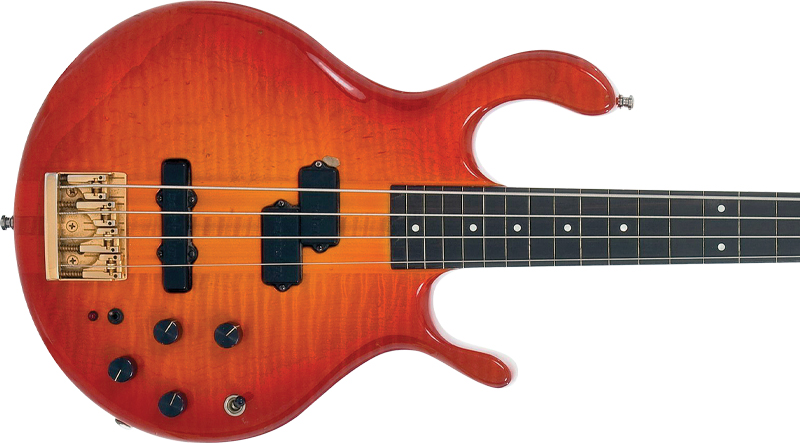
Introduced in 1980, the M.V. Pedulla Buzz Bass is one of the most-enduring examples of an upscale model offered fretless. Designed by luthier Michael Pedulla in Brockton, Massachusetts, it was created with the input of two notable locals.
And as with many innovations, it all started with a not-insignificant faux pas. Seeking to emulate the sound and approach of Jaco Pastorius, Mark Egan, who in the mid ’70s was making a name for himself in the original Pat Metheny Group, had removed the frets from the rosewood fingerboard on his ’64 Fender Jazz, then…
“I’d brushed epoxy on it,” he chuckled. “But I botched the job, and it came out uneven – and unplayable.”
But all was not lost; a friend and fellow bassist named Tim Landers knew of someone nearby who he thought might be able to help. So, Egan and his junked Jazz paid a visit to Pedulla’s shop, where the luthier sanded Egan’s DIY effort and applied a fresh coat of epoxy.
“The bass came to life,” Egan said. “I was incredibly happy, and I took it on tour with Pat.”
Egan and Landers soon after paid another visit to Pedulla’s shop, this time asking whether the builder could do a fretless model. Pedulla agreed to build a prototype that refined the body shape of his already-unique basses, and asked Egan and Landers to lend their input.
“I suggested a neck profile similar to a Jazz Bass neck, but even thinner from front to back and with less radius on the fingerboard,” Egan said. “I also wanted great sustain and a growl, more like a bass sitar.
“I also suggested Michael extend the cutaway deep enough that it could be played easily up to the 24th fret, and that he extend the upper horn for a better fit on the player’s body.”
The neck-through design is described in Pedulla’s early-’80s literature as a “capillary” style made with two or three pieces of maple. The neck is 1.55″ wide at the nut, and its scale is 34″. The lined ebony fretboard, marked with white inlay for 24 frets, was the obvious focal point in the design.
The back reveals the laminate neck-through build and uniquely integrated control-cavity cover.
“Michael developed this coating,” Egan recounted. “It was a very hard finish – long lasting – and at the same time created great sustain. His fretless fingerboard finishes are the finest and a very important feature for the Buzz Bass, giving it the growl much like a great upright bass sound.”
The text in a 1982 catalog also called attention to the fretboard and its Diamondkote finish, proclaiming, “The fingerboard has inlaid fret markers and is coated with our new superhard [sic] clear finish that holds up even under the punishment of roundwound strings. The combination of superhard finish, roundwound strings, and versatile electronics produces that ‘singing’ fretless sound so much in demand by fretless players today.”
The Buzz Bass was available with Bartolini active pickups or DiMarzio passive units. Variants included the JL (two Jazz-type Dimarzio pickups), JB (two Bartolini Jazz-type active pickups), PJL (DiMarzio pickups in a “P/J” array) or PJB (active Bartolinis in a P/J array, as seen on this 1987 example).
As for pickup brand choices, Egan detailed, “The Bartolinis were attractive to me, more so than the DiMarzios for a few reasons – I preferred their warmth and punchiness, and they produced less hum from interference. I’d replaced the pickups in my ’58 Precision Bass with Bartolini pickups while on the road with the Pat Metheny Group. For fretless, I prefer a P/J combination for punchy mids and a warm bottom-end, usually favoring the bridge pickup.”
Another unique feature is a compartment on the back for control access.
“That lid was Michael’s design, and another example of his fine woodwork detail,” said Egan. “It makes changing batteries a very simple process.”
The Buzz Bass’ tuners, bridge/tailpiece, and locking strap buttons were all made by Schaller, and the controls on this example with the PJB pickup array include separate Volume knobs, master Tone, a preamp/active Gain knob, and three-position pickup toggle. The mini-toggle engages the active electronics and has an LED indicator.
Pedulla later made the Buzz in five-string and fretted versions, and the affiliation with Egan, who remains an endorser, led to a signature model and the company’s first doubleneck (VG, September ’07).
Landers describes his own Buzz Bass as “…a close session partner for over 30 years. It’s on hundreds of recordings from Al Stewart to Tori Amos to Vince Neil.” He has since attained several other Pedulla models.
These days, Michael Pedulla has returned to crafting basses himself and enjoying the personal focus it allows him to give every instrument.
This article originally appeared in VG May 2018 issue. All copyrights are by the author and Vintage Guitar magazine. Unauthorized replication or use is strictly prohibited.
In 1833, C.F. Martin, Sr. and his family arrived in New York City. A trained luthier, Martin had studied under Johann Stauffer in Vienna and for more than five years ran a music store on Hudson Street.
But his family hated living in the city, and running a business kept him from his dream of being a guitarmaker. In 1839, they moved to Nazareth, Pennsylvania, but Martin continued to sell guitars almost entirely through agents in New York – Henry Schatz, Charles Bruno, and John B. Coupa. In the 1840s, the most active was Coupa, a Spanish-style concert guitarist, music teacher, and early endorser of the brand. So, it’s not surprising that the largest percentage of surviving Martin guitars from the period have a “Martin & Coupa” paper label and were sold through Coupa’s studio at 385 Broadway.
Martin used a dovetail joint to attach guitar necks, but in homage to Spanish classical design, he also created a purely decorative faux “Spanish foot” on the interior.Influenced by Spanish classical design, C.F. Martin, Sr. used elaborate wood marquetry on the sides of some instruments.
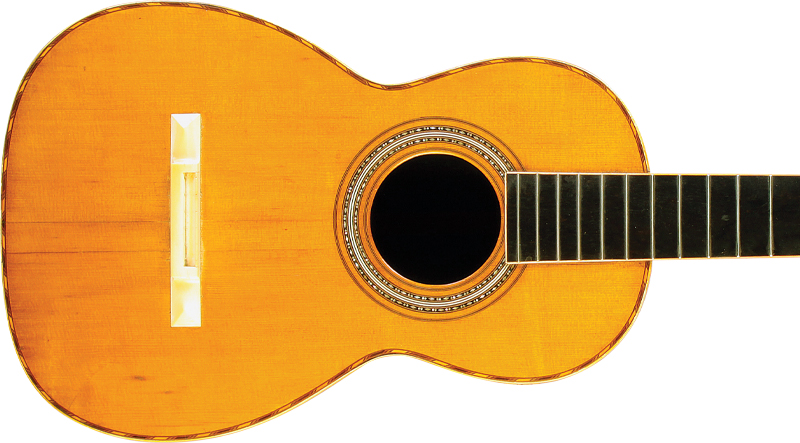
This is a rare Martin & Coupa with a body size midway between a Martin 1 (9.25″ upper bout, 12.75″ lower bout) and 2 (8″ upper bout, 12″ lower bout), and has a high level of ornamentation for the period. The top is braced in a five-strut fan pattern and has an ivory tie-style bridge (rather than bridge pins) – both features dating the instrument to about 1843. Today, we identify both features almost exclusively with classical guitars, but it’s important to remember that guitars of the period were not viewed as folk-music instruments and were played by people aspiring to learn classical compositions. In the late 1830s and ’40s, a number of talented Spanish performers toured the United States and influenced the New York guitar scene; the fancy wood marquetry on the middle of the sides is also found only on very early Martins with Spanish design features.
The “Spanish cedar” neck of this guitar is, in fact, not Spanish or cedar, but a South American wood related to mahogany. When cut, it smells remarkably like cedar, and it was used by Spanish builders of the period, so it earned the colloquial name.
The guitar’s squared-off peghead, seen today as typical Martin, was copied from Spanish designs used by makers in the city of Cadiz, including the diamond-shaped volute on its back. Most earlier Martins had a Stauffer-influenced peghead with all six tuners on one side, and its ivory friction pegs were preferred by professional musicians at that time because they made it easy to change strings quickly and because early metal gears were prone to rattle.
Spanish classical guitars did not have neck blocks, instead employed a one-piece design that extended the neck heel into the body, with a tab at the base to increase stability. Martin attached the neck to the body using a neck block and dovetail joint, but (in another concession to Spanish design) some of his earliest guitars (including this one) had a “pseudo” Spanish foot consisting of a small, flat piece of Spanish cedar added at the base of the block for the sake of appearance.
The 18-fret ebony fingerboard has no inlays, as was typical of Martins built prior to the 1890s. It’s theorized that Martin did not add inlays until competition forced the issue. At the turn of the 20th century, Lyon & Healy’s popular Washburn brand had fingerboard inlays, some of which were incredibly elaborate “tree-of-life” patterns. Based on estimated production numbers, it appears they successfully occupied a large market percentage at that time. It would be easy to ascribe Martin’s aversion to cost-saving measures, but in reality it was more likely to have been a reflection of a hardcore “purist” attitude, once again based on the Spanish classical design ethic in which fingerboard inlays were considered unprofessional and unnecessary. Perhaps the simple mother-of-pearl dot inlays adopted by Martin in the 1890s were a compromise.
The body bindings on this instrument are ivory, as well – a feature found only on Martin styles 26 and higher in that period. Lower models had wood binding (usually rosewood) and the least expensive had it only on the top edge. The guitar is hot-stamped on the Spanish foot and die-stamped on the peghead rear the pre-1867 “C.F. Martin New York” logo (lacking “& Co.”). The back and sides are Brazilian rosewood with an elaborate wood marquetry center back strip that matches the side and edge trim. Martin guitars of this period did not have standardized soundhole rosette trim, and this one is a custom mix of ivory, ebony, and mother of pearl.
The ivory “tie-style” pyramid bridge was used only on Martin guitars with a high level of ornamentation.
To read more, see “Border Crossing: C.F. Martin and the Influence of German and Spanish Guitar Designs,” in the September ’16 issue of Vintage Guitar.
This article originally appeared in VG May 2018 issue. All copyrights are by the author and Vintage Guitar magazine. Unauthorized replication or use is strictly prohibited.









 Deniz, did you grow up with anybody who ended up in the Stooges?
 What went through each of your minds while re-working songs originally sung by Iggy?






 Certainly, Dick Dale wasn’t the only artist who needed a louder amplifier, but he most famously urged Leo Fender to improve existing amps in order to achieve the pounding volume required to power his shows with the Del Tones at the Rendezvous Ballroom before a few thousand screaming, stomping surf teens. Throughout its front-end, the Showman was much like other medium- and large-sized Fenders of the blond Professional Series. It had two independent channels with Volume, Treble, and Bass for each, using the new preamp configuration that sandwiched the EQ stage between two gain stages supplied by a 7025 dual-triode (a 12AX7 equivalent), rather than the single gain stage and cathode-follower EQ stage of the late-’50s tweed amps. These Tolex amps also had Fender’s complex harmonic vibrato, something close to a true pitch-shifting vibrato, and they retained the Presence control from the tweed era, both of which would disappear by mid ’63 or so.
 The amp on display here is a gorgeous early-’61 Showman provided by collector and VG reader Tommie James, It’s a rare transitional model that carried the new OT and represents the first Showman to have resulted from a ground-up design of the output stage, rather than (as with the earliest examples) having been cobbled together using components from existing Fender amps. This 6G14-A has a tube chart stamped “KC,” denoting March of 1961, meaning it was likely assembled from parts acquired in January or February. Further examination reveals a new component – the Triad 45945, a larger OT that could produce more power and take the heat while doing so. According to Grabien, this transformer was rated at 80 watts into an 8-ohm load and would be the OT of choice for the single-speaker Showman heads.



 And as with many innovations, it all started with a not-insignificant faux pas. Seeking to emulate the sound and approach of Jaco Pastorius, Mark Egan, who in the mid ’70s was making a name for himself in the original Pat Metheny Group, had removed the frets from the rosewood fingerboard on his ’64 Fender Jazz, then…
 In 1833, C.F. Martin, Sr. and his family arrived in New York City. A trained luthier, Martin had studied under Johann Stauffer in Vienna and for more than five years ran a music store on Hudson Street.

 Spanish classical guitars did not have neck blocks, instead employed a one-piece design that extended the neck heel into the body, with a tab at the base to increase stability. Martin attached the neck to the body using a neck block and dovetail joint, but (in another concession to Spanish design) some of his earliest guitars (including this one) had a “pseudo” Spanish foot consisting of a small, flat piece of Spanish cedar added at the base of the block for the sake of appearance.