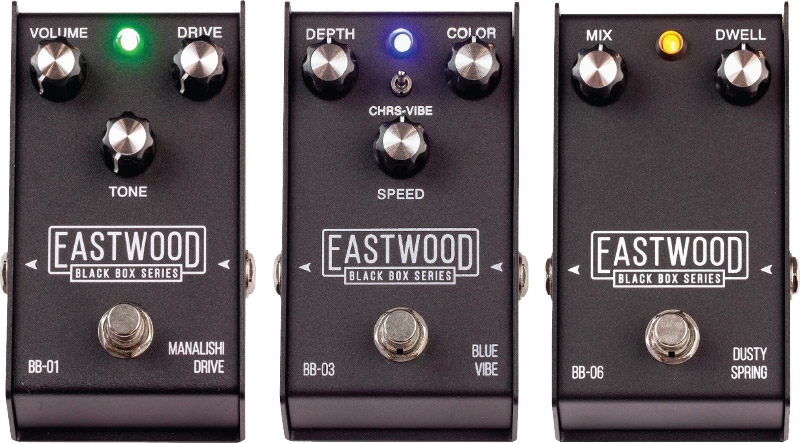
Eastwood Guitars promises retro-themed gear at wallet-reassuring prices, as seen in their new Black Box Series of stompboxes. Among the first flight are the BB-01 Manalishi Drive, BB-03 Blue Vibe, and BB-06 Dusty Spring reverb.
The Manalishi Drive is rife with Tube Screamer vibe, evoking the Japanese circuit that has powered thousands of albums and gigs. The Manalishi is all about potent overdrive, either to pump-up an already dirty tone or take a clean signal and give it a crunchy bath. There are simple controls for Volume, Drive, and Tone, for adding just a dab ’o dirt or full-on amp attitude. The resulting sounds are big and warm, improving the beefiness of tube, solid-state and – surprisingly – even modeling amps.
The Blue Vibe is inspired by the timeless Uni-Vibe; if you love the sounds of Hendrix and Trower, it evokes their swirling, aquatic tone. Knobs for Depth, Color, and Speed control the modulation parameters, while the Chorus/Vibrato switch lets you explore Jimi tones and edgy vibrato. Better yet, while many Uni-Vibe clones command big money, the Blue Vibe is affordable for most any player – and sounds like you’re onstage at Woodstock.
The Dusty Spring is a digital reverb with a Leo-style voicing, notably from pre-CBS Super Reverb circuits. The box has just two knobs, Mix and Dwell – one to combine dry guitar signal with reverb, the other to determine the depth of its cavernousa tone. If you want a full surf-rock effect, max the controls and dig the sopping-wet sound of the early ’60s. Or dial it back for subtler flavors, adding spacial dimension to your tone.
You’ll also find two delays and a compressor in the Black Box Series, all evoking a utilitarian sensibility and doing their jobs well. They’re all also true-bypass and won’t break the bank. Any questions?
This article originally appeared in VG’s September 2022 issue. All copyrights are by the author and Vintage Guitar magazine. Unauthorized replication or use is strictly prohibited.
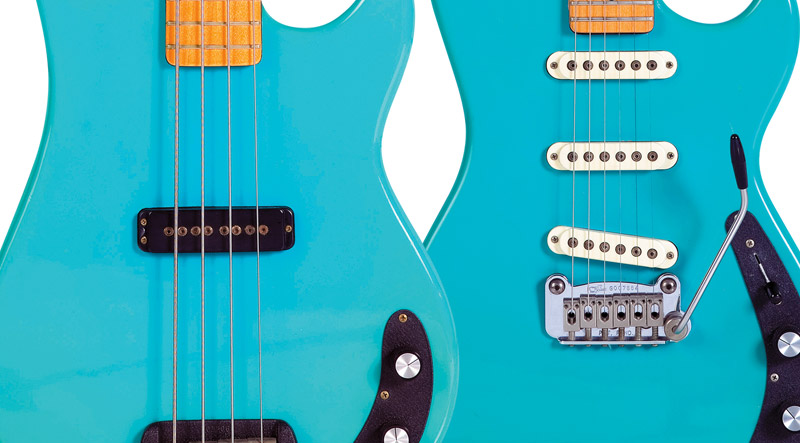
Early-’80s G&L SB-1 and SC-3. Photo: Bill Ingalls, Jr.
During the “guitar boom” of the 1960s, one method of getting a band noticed was to equip it with matching instruments and maybe matching amplifiers. Better still, add matching stage clothes!
Many instrumental surf bands followed such a notion. The Astronauts, for example, were notable for their use of white Fender instruments and matching suits. Likewise, the Ventures performed and posed for photos with three sunburst Fenders and, later, white Mosrites.
Matching guitars and basses always have an extra “cool” factor, but the early-’80s G&L SB-1 bass and SC-3 guitar shown here have interesting similarities beyond their looks. Part of the S series introduced in late 1982, other models included the one-pickup SC-1 and the two-pickup SC-2; the latter essentially paved the way for G&L’s Telecaster-shaped Broadcaster and ASAT models a few years later. The two-pickup SB-2 bass was also a part of this series. All pickups in SC/SB instruments were variants of G&L’s Magnetic Field Design pickup, which have adjustable polepieces.
Some might surmise the S designation implies student, but these are professional-grade instruments with fewer frills. The bodies and necks were made from maple, and the necks had full scales of 251/2″ (with 22 frets) on the guitars, 34″ (with 21 frets) on basses. They also sported the original six-on-a-side “non-barb” G&L headstock profile, as well as slightly enlarged fretboard dots.
The low-frills elements of the series included the lack of bevel on their bodies, and basic control knobs (one Volume and one Tone, regardless of the number of pickups) mounted in a banana-shaped plate that had a powder-coated crinkle finish that was also found on the bridge plates of basses and non-vibrato guitars.
When introduced in 1982, the SC/SB series was available in plain Red, White or Blue finishes. The SC-3 and SB-1 seen here are blue, but with age their finishes have yellowed slightly, giving them a teal-like color.
1984 G&L SB-1 and SC-2. Photo: Willie G. Moseley.
The SB-1 exemplifies simplicity and playability, coupled with a potent sound. When strapped on, its traditionally-shaped double-cutaway maple body (measuring 15/8″ deep, and 121/2″ at its widest point) gives the neck an upward tilt in terms of ergonomics/balance. And though not beveled, the rounded edges are comfortable.
This SC-3 has several other unique aspects. Its body silhouette is a cross between a traditional single-cutaway Fender Telecaster shape and a double-cut such as a Fender Stratocaster. Moreover, it may appear slightly small – or perhaps the headstock appears too big. Still, it’s very balanced.
Electronics include three pickups laid out in a traditional Stratocaster configuration. They’re controlled by a five-way toggle switch and master volume and tone knobs. What’s unusual is that these are rarer white pickup covers (most were black). Accounts vary as to how many early Leo-era G&L instruments were given white pickups, but Paul Bechtoldt, author of G&L: Leo’s Legacy, claims to have a hand-written note from G&L co-founder Dale Hyatt saying only a few dozen guitars or basses had such covers.
Another curiosity is the guitar’s serial number. According to Bechtoldt, the first SC was completed on August 31, 1982, but a serial-number list in his book indicates the number embossed on the bridge plate is from 1981. Thus it seems early on, at least, G&L didn’t use sequential serial number bridges (much like Fender in the early ’50s).
The SC/SB series lasted less than two years, but the SC-3, SB-1, and SB-2 continued longer, undergoing numerous changes in cosmetics and electronics. The 1984 examples shown here are in Black, a finish option added later.
Whether or not the owners of these color-coordinated instruments ever feel compelled to dress up in matching suits and crank out “Pipeline,” their early-’80s G&Ls are interesting beyond the fact they’re cosmetic siblings.
This article originally appeared in VG’s October 2009 issue. All copyrights are by the author and Vintage Guitar magazine. Unauthorized replication or use is strictly prohibited.
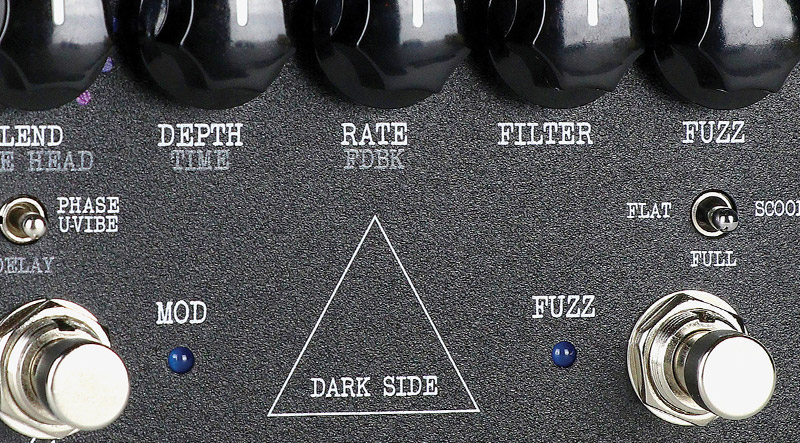
In the multi-verse of effects, Robert Keeley’s gizmos are a thing of beauty – particularly those that provide multiple sounds. Guitarists hankering for fuzz, delay, and modulation will dig the Dark Side, which mimics the sounds of Pink Floyd’s David Gilmour.
The fuzz is based on a 1977 op-amp analog fuzz with a 24-bit DSP engine. It mirrors the Big Muff circuit with the capacity for variations using Level, Filter, and Fuzz knobs for volume, tone control, and gain, respectively. A three-position EQ-voicing switch (Flat, Full, Scoop) offers more control. The delay and modulation effects use 12 Binson-style syncopated delays and four modulation sounds – flanger, rotary, phaser, and univibe. Level, Blend, Depth, and Rate knobs offer more flexibility; Delay cannot be used with modulation, but the button on the top of the unit allows the user to switch the order of effects.
The Dark Side shines, packing many malleable features within a small package. The modulation effects are rich and lustrous, and while the fuzz is an acquired taste, it can be dimed to achieve highly usable sustain, boost, and saturated grit. The delay is warm and flexible, but it’s lacking when used on the fly for live performances without a tap tempo. Aside from this, Keeley has created a super-cool musical product, invaluable for getting the most from a single enclosure.
This article originally appeared in VG’s September 2022 issue. All copyrights are by the author and Vintage Guitar magazine. Unauthorized replication or use is strictly prohibited.
Buying a guitar made by Kiesel starts with a visit to the company’s website, where you’ll find a bevy of custom options for its American-made instruments. The designs include solidbody and semi-hollow models that have impressed many high-profile players – think Craig Chaquico, Greg Howe, Allan Holdsworth, and Frank Gambale, all of whom helped create signature models.
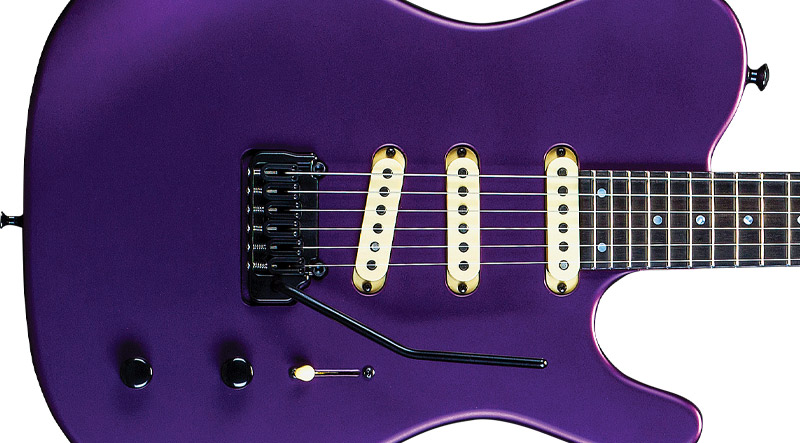
We recently took a turn on the S6 model from Kiesel’s Solo series, which starts with a one-piece Swamp ash single-cut body and a bolt-on maple neck. The S6 brings three Johnny Hiland Six Shooter signature single-coil pickups, ebony fretboard with 14″ radius and 24 stainless-steel jumbo frets, mother-of-pearl dot inlays, and a satin-matte finish called Grape Jelly Metallic. The Hipshot/Kiesel vibrato, locking tuners, and single Volume and Tone controls yield a clean, efficient appearance.
The Solo is sleek, sturdy, and has a smooth neck shape. Its “comfort cut” and easy-access neck joint with recessed ferrules make for effortless upper-fret access, and 14″ is a fairly flat radius.
The S6’s most significant departure from the regular Solo is its pickups. Hiland is a chicken pickin’ guitar monster, so it’s no surprise that when plugged into a clean amp, the Solo S6 yielded maximum-strength cluck, pluck, spank, and chime with a visceral punch that kicks without being piercing. And while essentially clean, they smack of testosterone; adding crunch yields SRV-adjacent colors complete with 60-cycle hum and Robert Cray/Mark Knopfler sounds from positions 2 and 4. It’s a unique single-coil presence that doesn’t stray, even when used with distortion pedals or crunchy amplifiers.
The Kiesel Solo will satisfy Tele cravings, handle Strat chores, and do it all with style, comfort, ease of use, and punchy tones galore.
This article originally appeared in VG’s September 2022 issue. All copyrights are by the author and Vintage Guitar magazine. Unauthorized replication or use is strictly prohibited.
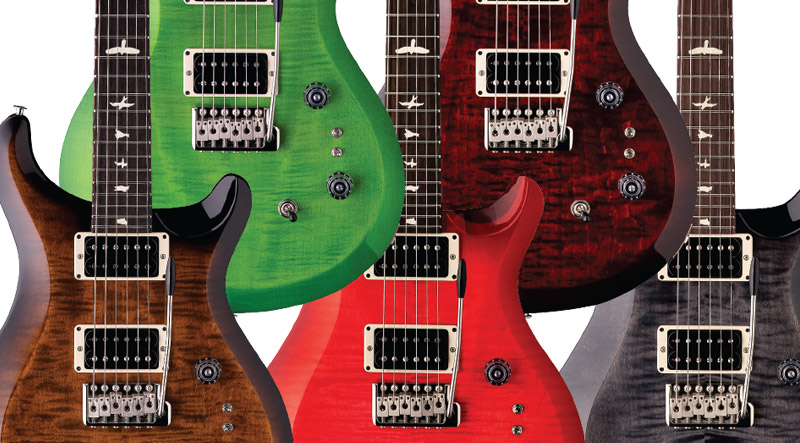
As the youngest of the big three guitar manufacturers, PRS Guitars has grown by leaps and bounds since its inception in 1985. Known for radiant tones, playability, and lofty MSRPs, the company expanded its product line to include lower-priced models. One of the latest is the S2 Custom 24-08.
Launched in 2013, S2 guitars are made on a secondary line at the company’s factory in Stevensville, Maryland, and dressed with as many features as possible for the money.
The S2 Custom is a solidbody with a two-piece/flame-maple top, mahogany back, and set mahogany neck with Pattern Thin shape. Its 10″-radius rosewood fretboard has bird inlays, 24 medium nickel frets, 25″ scale, and measures 111/16″ wide at the nut. Other features include a PRS vibrato and Volume and Tone controls with a three-way toggle and mini-toggle coil-split switches for each pickup.
Straight out of its gig bag, our tester was light and resonant. Plugged into a combo amp, it quickly and easily dialed up textures adjacent to a Les Paul, Strat, and Tele, as well as its own sweet thing.
Switching between a Deluxe Reverb, tweed reissues, a high-gain Peavey head, and an old Marshall plexi, the S2 Custom shined in its ability to display the idiosyncrasies of each amp without burying the guitar’s personality. The pickups offered a nice bit of muscle compared to their vintage counterparts; the neck yielded proper warmth and stayed clean even turned up, while the bridge bit hard when overdriven. Splitting the coils brightened things with jangle and only a slight drop in volume. The nifty switching system allowed humbuckers and single-coils to mingle. Splitting the humbuckers and experimenting with pickup combinations yielded interesting but subtle tonal flavors, though bonafide Stratocaster sounds are just out of reach (which is a good thing as the S2 Custom marks its own sonic territory).
The guitar screamed through the amp’s distortion settings and stayed in tune even after obnoxious whammy-bar usage. Single-note Santana-ness morphed into chicken pickin’ chime when switched to brighter, tangy-er tones.
With its unique body shape and choice of colors, the PRS S2 Custom 24-08 is a super-bad shred machine worth the price tag – perfect for big rock solos, spanky cleans, or spiky rhythm parts dressed with a sinewy punch.
This article originally appeared in VG’s September 2022 issue. All copyrights are by the author and Vintage Guitar magazine. Unauthorized replication or use is strictly prohibited.
Since the dawn of rock and roll, guitarists have (by accident or with intent) loosened tubes, sliced, or poked holes in their speakers to get low-fi natural distortion – think Link Wray’s “Rumble,” or early Kinks singles like “You Really Got Me.” Ike Turner’s “Rocket 88” was recorded with an amp that had fallen out of the van, resulting in damage that caused a fuzzy signal. A happy accident, indeed.
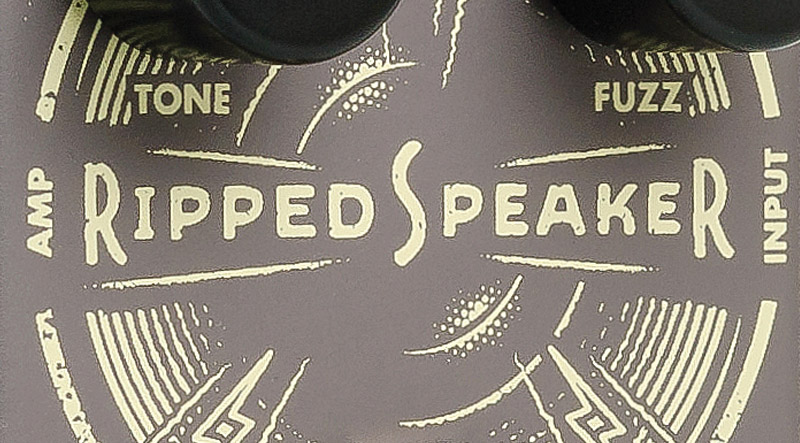
Electro-Harmonix has re-created the early sound of distortion with its Ripped Speaker, a fuzz box designed to deliver those desirable, grungy tones.
The pedal has four knobs – Tone and Volume, plus Fuzz and Rip. As you’d expect, Fuzz controls the amount of fuzz from light to heavy. Rip is the secret sauce; a bias control in disguise, it shapes the fuzz tone and controls the amount of clipping. Turning it counterclockwise darkens signal with pronounced lows. Adjusting it clockwise offers brighter tone with more highs. Deft use will also render a sputtering “dying battery” sound, useful in certain musical situations.
Hooked up to a vintage tube amp with a Les Paul, the Ripped Speaker accurately achieved the tones of yore, from mild distortion to balls-out grunge. And yes, it nailed Dave Davies’ “You Really Got Me” sound.
This article originally appeared in VG’s September 2022 issue. All copyrights are by the author and Vintage Guitar magazine. Unauthorized replication or use is strictly prohibited.
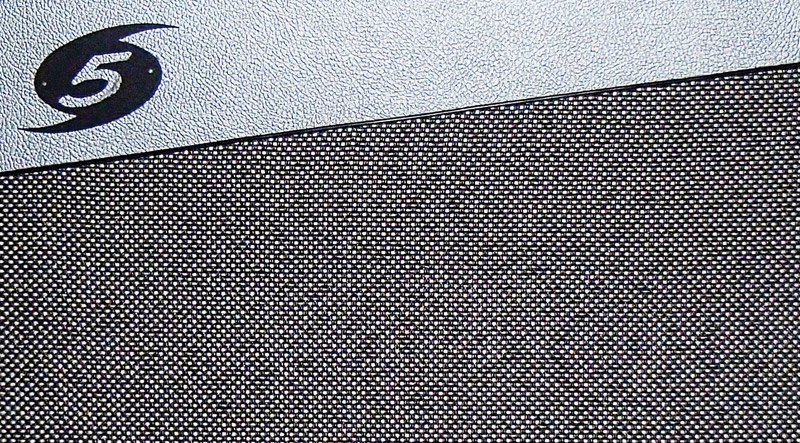
Blues-rocker Samantha Fish (VG, December ’21) electrifies audiences with her high-energy shows. A decade ago, she began favoring Category 5’s 50-watt/cathode-biased Andrew amp onstage. In 2021, she and builder Don Ritter started designing a signature model based on the Andrew’s blackface-inspired Channel 2 but with a slight emphasis on midrange, and tighter low-end response. The result is the Samantha, a 40-watt combo that launched in early ’22.
Loaded with a pair of 5881 power tubes and a 100-watt Jensen N12K speaker in a semi-closed cabinet, the Samantha’s controls include Bass, Mid and Treble along with Volume, Reverb, Drive, Boost switch and Power to adjust its overall output.
Using Tele and Les Paul reissues, and with the Power dimed, EQ controls at 12 o’clock and Volume at 9 o’clock, the Samantha produced a smooth, clear clean tone with bounce. Turning up the Treble and backing off the Bass gave it more edge and percussiveness, while dialing in a touch of its tube-driven reverb added warmth and space without sounding washed out.
Moving the Volume to 1 o’clock gave the amp more grit and presence – perfect for blues. Cranked, the Samantha offered glorious, open, punchy tones with teeth and attitude. Flipping the Boost switch and turning up the Drive brought a thicker tone, great for singing leads. Superb responsiveness, pick attack, and sustain make the Samantha fun to play, with a tactile feel at any gain or volume setting.
If 40 watts is too much, the Samantha’s power-scaling function can take the amp down to one watt or anything in-between. As power is reduced, volume becomes more manageable, with less punch and a bit more sag. The neodymium-magnet Jensen gives a bigger sound than you’d expect, regardless of output.
Other touches include a slave out and a jack to footswitch the boost. If hard-driving blues-rock is your thing, Category 5’s Samantha could be your next step up.
This article originally appeared in VG’s September 2022 issue. All copyrights are by the author and Vintage Guitar magazine. Unauthorized replication or use is strictly prohibited.
This month we feature Chris Duarte, Nickel Creek, Pink Floyd, J. Geils Band, Harvey Mandel, L.A. Guns, Lynyrd Skynyrd, Jackson Browne, David Lindley, Paul Gilbert, and more!
Spotify is free, or available without ads via paid subscription. Go to www.spotify.com and search “Vintage Guitar magazine,”or if you already have an account Listen to the complete list HERE.
Don’t miss Vintage Guitar magazine’s monthly playlist on the music-streaming service Spotify. Each month, Karl Markgraf curates a playlist featuring artists and songs mentioned in the pages of VG, arranged in order to play along as you read the issue, or just enjoy on its own! Karl holds bachelor’s degree in Jazz Guitar from the University of Northern Colorado, and works as a performing and recording artist, producer, and educator in New York.
Also On Spotify
Also on Spotify is VG’s “Have Guitar Will Travel” podcast, hosted by James Patrick Regan. The twice-monthly episodes feature guitar players, builders, dealers, and more, all sharing their personal stories, tales from the road, studio, or shop, and their love of great guitars and amps. CLICK HERE to listen.
Rhys Lewis & Chase Mitchell
HGWT episode 87 has host James Patrick Regan speaking with singer/songwriters Rhys Lewis and Chase Mitchell. Rhys grew up in England and studied at the London Center of Contemporary Music. He talks about touring and performing as a solo artist and with a band. One of his favorite places is Denmark Street, where he loves gazing at old guitars like his ’68 Gibson ES-150. Chase is a native of West Virginia and joined a band when he was nine years old. He “retired” from band life at 13 to launch a solo career. A fan of cool old guitars, he looks forward to one day scoring a ’68 Pink Paisley Telecaster. Please like, comment, and share this podcast! Listen Here!
Have Guitar Will Travel, hosted by James Patrick Regan, otherwise known as Jimmy from the Deadlies, is presented by Vintage Guitar magazine, the destination for guitar enthusiasts. Podcast episodes feature guitar players, builders, dealers and more – all with great experiences to share! Find all podcasts at www.vintageguitar.com/category/podcasts.
Each episode is available on Stitcher, iheartradio, Tune In, Apple Podcast, and Spotify!
Grammy-winning guitarist/producer Adrian Quesada and his band, Black Pumas, opened for the Stones on their last tour, providing a scintillating vision of modern rock and roll alongside the classics. Now, Quesada injects a similar electricity into vintage ’60s and ’70s Latin American music. The result is a tripped out, deeply soulful, super funky, and headspinningly delirious confection of tunes.
Quesada has proven himself a master collaborator, having worked with Prince, Los Lobos, and the Wu-Tang Clan’s GZA. So, for this album of mostly original compositions, he joined forces with an array of Latinx music vocalists. The opening track, “Mentiras Con Cariño” features iLe in a recasting of old-school boleros that’s at times suspensefully noirish, serpentine, and sexy, yet always thrilling. Other tracks include Gabriel Garzón-Montano, Girl Ultra, Angelica Garcia, and more.
“Hielo Seco” (“Dry Ice”) may just be the most out-there track, like an instrumental soundtrack to a freaky ’70s thriller. Quesada is joined on guitar by Marc Ribot and former Beastie Boys collaborator Money Mark. The scintillating cut is cinematic, with wacked-out stuttering and wah fretwork atop a slinky percussion backing and Mark’s smooth keyboards. Great music throughout.
This article originally appeared in VG’s September 2022 issue. All copyrights are by the author and Vintage Guitar magazine. Unauthorized replication or use is strictly prohibited.
In no apparent hurry, Jeff “Skunk” Baxter just released his first solo album – at age 73. The guitar flash from Steely Dan and The Doobie Brothers brings his six-stringing to the fore, even having the chutzpah to cover “My Old School.” Here, it’s a raucous jam, full of the wild-ass licks Skunk used so well to carve his reputation. Another homage to Donald Fagen and Walter Becker, “Do It Again” is revised as an instrumental, Skunk dropping tasty licks and guitar synthesizer over a cool urban vamp.
Another side of his oeuvre is instro/surf rock, evident in “Ladies from Hell.” It’s instro, yet funky and eclectic in fine Skunk tradition. The oft-covered “Apache” is given an update with synth-y tones and muscular twang. A secret talent, he plays lilting pedal-steel on Bette Midler’s “The Rose,” while Doobie mate Michael McDonald lends blue-eyed soul to “My Place in the Sun,” along with the guitarist’s fabled “orange squeezer” compression tone.
Closing with “Speed of Heat,” Baxter fuses heavy funk and Fagen-like jazz chords with abandon. Throughout this muscular album, you’ll find careening guitar riffs, runs, and twists throughout. Let’s hope it doesn’t take Skunk another 50 years to do it again.
This article originally appeared in VG’s September 2022 issue. All copyrights are by the author and Vintage Guitar magazine. Unauthorized replication or use is strictly prohibited.













 Don’t miss Vintage Guitar magazine’s monthly playlist on the music-streaming service Spotify. Each month,
 Have Guitar Will Travel, hosted by James Patrick Regan, otherwise known as Jimmy from the Deadlies, is presented by Vintage Guitar magazine, the destination for guitar enthusiasts. Podcast episodes feature guitar players, builders, dealers and more – all with great experiences to share! Find all podcasts at