The Show is back!After a hiatus starting in August 2011, with old band members leaving and new ones joining, this album was much anticipated by fans. Never fear. It’s every bit worth the wait.
In fact, Carry Me Back is like two albums in one. There are “old” songs and “new” songs here, the old ones being retro-sounding originals. The new ones are in a modern vein, from their chord progressions to their themes. Sometimes the mix of old and new is awkward, sometimes it seems natural born. But that’s all part of the show.
The band is a feast for old-time string fans. Most of the six members take at least a spell on guitar, with Gill Landry also playing banjo, Dobro, and resophonic guitar; Willie Watson adding banjo; Ketch Secor doubling on fiddle and banjo; and Cory Younts covering mandolin. Hard to ask for more strings than that.
The album kicks off with the title track, “Carry Me Back To Virginia,” which is a pure old-timey mountain holler. The fiddle and banjo solos are charging sprints full of vigor and enthusiasm. “Sewanee Mountain Catfight” is an all-out romp, as the title suggests.
“Levi” is a stellar track, an intriguing blend of a Civil War-era song form telling a tale of a Virginia hillbilly who died in a war – but in Baghdad in 2009. It’s a potent combination, accented by downhome fiddle.
Tunes like “Ain’t It Enough,” “Ways Of Man,” and “Genevieve” are modern in styling; label them “alt-bluegrass,” if there is such a category. Regardless, they’re strong tunes, with powerful vocals and songwriting, highlighted by stylish guitarwork throughout.
This article originally appeared in VG‘s Jan. ’13 issue. All copyrights are by the author and Vintage Guitar magazine. Unauthorized replication or use is strictly prohibited.
When designing a new guitar, builders often face a quandary. Some go to extremes to be original, while others tend to “re-create” the same ol’ thing. The Overture Guitars JS-Session is a departure; not a simple reissue or copy, instead, its body contours and edges give it a comfortable modern appeal while touches like an offset-double-cut style and lacquer finish offer a vintage feel.
The JS-S (named for guitarist Jeff Sheetz) can be purchased with one of two seven-piece necks – one mahogany, the other maple – laminated with accent woods. Overture offers several fretboard variations, as well; our tester had a 24-fret/251/2″-scale maple ’board with mother-of-pearl dot inlays and a Overture Cross inlay at the 12th fret.
Electronics on the JS-S make this guitar well-suited to session work or any player who needs a guitar that covers all the bases. Venturing from the norm, Overture uses a Lindy Fralin Blues Special single-coil in the neck position, a DiMarzio PAF humbucker in the middle, and a PAF Pro humbucker in the bridge. They’re controlled with a standard five-way switch with two Volumes and a master Tone.
Hardware on our tester included locking tuners and a Wilkinson VS-100 vibrato bridge; Overture offers options including a Ghost piezo. Among Overture’s many other options on the JS-S is a selection of body woods. Our tester’s maple body was a bit heavy, but as is usually the case, that weight equates to tone; the maple neck and fingerboard gave each note a healthy amount of snap and articulation. The D-shaped neck was easy to adapt to and overall playability up and down the fretboard was very good.
Plugging in, the DiMarzios added the right amount of drive and attitude whilst throwing in a dash of vintage flair. Dialing the Fralin pickup into the mix added clarity for rhythm and clean parts. Blending it and the middle P.A.F. gave way to blues tones, and stomping on a boutique overdrive with the PAF Pro Di-Marzio took the JS-S from smooth and rootsy to sonic domination.
A number of manufacturers have tried to marry modern and new. Overture’s is a valiant, effective effort.
This article originally appeared in VG January 2012 issue. All copyrights are by the author and Vintage Guitar magazine. Unauthorized replication or use is strictly prohibited.
To expect a record by the Outlaws to sound this good in 2012 would be folly. The band hasn’t released a studio album in more than two decades and two of the main guitarists from the original band – Hughie Thomasson and Billy Jones – are dead. The remaining original guitarist, Henry Paul, has resurrected the band with the help of original drummer Monte Yoho and former Charlie Daniels Band guitarist Billy Crain. And, against all odds, It’s About Pride captures all the things that were great about the original Outlaws.
The opener, “Tomorrow’s Another Night,” kicks in with the kind of harmonized vocals that dominated the first couple of Outlaws records from the 1970s. The a capella vocals give way to churning rhythm guitars and a tough melodic solo part that eventually finds Paul and Crain playing a harmonized guitar part. That formula works beautifully again and again on the record as the two guitarists display a perfect chemistry.
The Outlaws were introduced for years as “Florida’s Rock and Roll Guitar Army,” and fans won’t be disappointed today. From the stomping country tradeoff licks of “Hidin’ Out In Tennessee” to the stinging guitars of “The Flame,” there’s lots of playing going on.
Lyrically, many of the songs talk about the history of the band and the obvious rebirth. Vocally, Paul dominates the proceedings, singing most of the songs in a voice that is instantly familiar for the band’s original fans. In fact, songs Paul doesn’t sing don’t have the same zip.
It’s About Pride will go down as one of the surprise records of the year. Thomasson and Jones must be looking down and smiling happily at what their old pals have put together.
This article originally appeared in VG‘s Jan. ’13 issue. All copyrights are by the author and Vintage Guitar magazine. Unauthorized replication or use is strictly prohibited.
(LEFT) Donald “Duck” Dunn . (RIGHT) Jeff Dunn, a veteran live-sound engineer and tour manager who loves to play bass, with his dad’s ’58 Fender Precision. (LEFT) David Redfern/Redferns. (RIGHT) All other photos by Barry McCarthy.
Nearly every musician who plays popular music – be it soul, R&B, pop, or the others – has been influenced by Donald “Duck” Dunn. And certainly, every person who has listened to a radio since 1961 has heard his playing.
The revered bassist, who passed away in May of 2012, provided the groove on some of the most revered hits in the heyday of ’60s soul/R&B/pop, including Otis Redding’s “Dock Of The Bay” and “Respect,” Wilson Pickett’s “Midnight Hour,” and Sam & Dave’s “Hold On, I’m Coming.” Beyond hit singles, his resume includes stints backing Eric Clapton, John Fogerty, J.J. Cale, Albert King, Muddy Waters, Rod Stewart, Levon Helm, Bob Dylan, Tony Joe White, Freddie King, Elvis Presley, Neil Young, and Jerry Lee Lewis.
Dunn’s 1958 Precision Bass. “I usually held my thumb on the top edge of the pickguard and played with my first two fingers, and I wore the finish down to the wood where my thumb was,” Dunn told VG in 2006.
After his childhood friends Steve Cropper and Charlie Freeman started spending less time playing baseball with him and more time playing guitars together, Dunn grabbed a bass; his first was a Kay electric he ran through a Silvertone amp. Before long, however, he upgraded to one of the Fenders he oogled in the window of a music store in his home town of Memphis. A fan of Hank Ballard, Ray Charles, the 5 Royales and the like, he was self-taught, and took to playing with relative ease. While in high school, the three young men, along with drummer Terry Johnson, formed The Royal Spades. Shortly after graduating, they were signed to a local record label, for which they changed the band’s name to The Mar-Keys and recorded the 1961 hit “Last Night.” Shortly after, Dunn left the band when he was asked to join the big band fronted by saxophonist Ben Branch. In ’62, he was recruited by Cropper to play in the Stax Records rhythm section and also became a member of Booker T. & the MG’s.
Modest about his abilities, Dunn used his Fender to develop a tone and style unheard of in the days of the “doghouse” upright. Clear and articulate, his approach redefined the role of the bass; where the upright was used primarily to render “walking” lines, Dunn and other electric players changed pop music by adopting a more-syncopated style, more akin to a second/complementary rhythm guitar. His form applied an identity to the music the band made as it backed various Stax Records artists, with a feel many musicians today equate simply with doing it right. And regardless of the song or whether it had him playing in the pocket, just “on top” of, or just behind the beat, there was a physical element to Dunn’s style, applied with pronounced body English.
Through most of his career, Dunn played a ’58 Precision that became his trademark. Finished in sunburst and with an anodized pickguard, through the decades, it took on various accoutrements that set it apart, visually.
“There are places in the body and pickguard where dad dug out wood or wore down the metal of the pickguard,” said Dunn’s son, Jeff, who now cares for his father’s instruments. “The round sticker is the Gort character from The Day The Earth Stood Still, which was adopted by Creedence Clearwater Revival as backstage passes. He applied the Duck sticker years ago. The Blues Brothers sticker went on in the early ’80s.”
Dunn had retired the bass for fear some sort of misfortune would befall it at a gig or on the road – but there were exceptions. “Neil Young did persuade him to take it on tour, as Neil promised the techs would look after it,” said Jeff. The instrument was actually his second Precision; in old photos, he is seen with one with a rosewood fretboard. “That one, the story goes, went down in the plane crash with Otis Redding, as dad had loaned it to Otis’ bassist.”
Dunn’s first amp of choice for studio work was an Ampeg B-15, but, “The one I really wanted – which everybody wanted – was a (Fender) Bassman,” he told VG’s Willie Moseley in a 2006 interview. “And I got a piggyback version, but I never liked it much. In ’67, I got a Kustom tuck-and-roll.”
Dunn’s varied career included working with guitarists Mike Bloomfield, Duane Allman, Clapton, and he was there when John Belushi and Dan Ackroyd took a “Saturday Night Live” skit and converted it to a legitimate musical act and feature film – The Blue Brothers. Though the skit (which employed the show’s house band) was farcical in nature, the group (which included Dunn and Cropper) produced serious renditions of blues songs and had a major hit in ’78 with its cover of Sam & Dave’s “Soul Man.”
“I was kind of hesitant to do [The Blues Brothers], but my wife talked me into it, and other than Booker’s band, that’s the most-fun band I’ve ever been in,” Dunn said in ’06.
From 1983 to ’86, Dunn backed Clapton live and in the studio for two albums, Money and Cigarettes and Behind the Sun.
“Of course, many instruments came and went over the years,” Jeff Dunn said of his father’s gear. “If he had held on to them all, there would have been 30 instruments in his collection. A few I remember were a Rickenbacker 4001, a Gibson Grabber, and all the basses in Hard Rock Cafes across the globe.”
Dunn died while touring with Stax! Live, a package featuring Eddie Floyd and the MG’s, which also included longtime friend and bandmate, Cropper.
1) Fender Duck Dunn signature bass with serial number 0001. He played this in the film Blues Brothers 2000.
2) Dunn played this ’66 Fender Precision onscreen during the Holiday Inn/Murph and the Magitones scene in the 1980 film The Blues Brothers. The word “Demo” is stamped on the back of its body and on the original neck, which Dunn later replaced with a Jazz Bass neck. The instrument served as the basis for Dunn’s Fender signature model and inspired the later Lakland models.
3) Over the last several years, Dunn mostly played this Lakland signature model. “It has his favorite Labella flatwounds and will remain exactly as is,” said Jeff Dunn. “He played it only hours before he passed; it was still in tune when we got it back from Japan, where he played his last show.”
4) The prototype Dunn signature model by Lakland.
5) This Gibson Thunderbird was a gift to Dunn from Cliff Williams, bassist for AC/DC.
6) This heavily inlaid custom bass was a gift to Dunn from Steve Cropper. “It’s something I know Duck would never buy for himself – he just wasn’t into fancy stuff. So I got it for him. I had been looking at a PRS Dragon, which at the time was around $25,000 – just a bit out of my price range (laughs)! But this reminded me of it.” Jeff Dunn recalls that his dad often sat with it at home. “It plays great and has an active EQ,” he said.
7) Dunn received this Travis Bean in the ’70s as a gift from Steve Cropper.
This article originally appeared in VG April 2013 issue. All copyrights are by the author and Vintage Guitar magazine. Unauthorized replication or use is strictly prohibited.
Joe Bonamassa and Matt Abramovitz are set to host an original radio show, The Pickup, which will be streamed every Friday at www.thepickupradio.com. The show will blend music history, carefully curated songs, guitar facts, and insights into the world of a musician. Discussions will focus on artists and their work, instruments, and the music played on their instruments, peppered with segments like “Name That Guitar,” where Abramovitz will play three tracks and ask Bonamassa to identify the guitars heard on the recordings.
Featured music will focus on blues and classic rock from both sides of the pond including favorites like Eric Clapton, BB King, Freddie King, Johnny Winter and Jeff Beck, as well as deep tracks, new and little-known artists, up-and-comers, and more.
The Levy’s Leathers MP23 uke strap is available in seven designs.
Levy’s Hawaiian design ukulele straps are inspired by the designs found on the “loud” shirts for which the islands are famous. Each sublimation-printed polyester strap has a plastic soundhole hook and tri-glide adjustment. It is available in 1″ and 1/2′ width. Learn more at www.LevysLeathers.com.
In the late 1970s and early ’80s, Santana alumnus Neal Schon was not only known for his blazing guitar solos, he was equally famous for his ability to play with taste and restraint. He was one of the few heavy rock guitarists who wrote tuneful and memorable lines that were correct for the song, while still being able to burn when called for.
Schon’s tastefulness paid off and made Journey one of the most successful rock bands in history. Over the years, he has performed on a number of side projects and solo albums, but his latest solo effort, The Calling, has some of his most vibrant playing to date. It’s an eclectic rock fusion record with lush production, heavy riffs, epic textures, and some of the most stellar guitar tones Schon has ever recorded. As producer, he gets help from former Journey drummer Steve Smith and keyboard legend Jan Hammer.
What keeps this record from being just another instrumental overload is Schon’s sense of melody, dynamics, and the work of Igor Len on keys. The title track combines thick multi-tracked riffs with swirling melodies and Schon’s idiosyncratic blur style runs. The plaintive “Irish Field” offers Celtic melodies and counterpoint on two guitars. “Fifty Six (56)” takes us on a trip to India where tabla meets rock-fusion drumming with sitar wah interplay. But it’s on “Tumbleweeds” where the Schon/Hammer reunion showcases their special chemistry.
The Calling is fine piece of work demonstrating that Schon has still got it going on – and then some. The signature style and phrasing that made him an icon remains intact, while the years have expanded his touch, tonal palette, and compositional prowess. The songs are strong and his guitar tones are absolutely luxurious.
This article originally appeared in VG‘s Jan. ’13 issue. All copyrights are by the author and Vintage Guitar magazine. Unauthorized replication or use is strictly prohibited.
Doran Connell’s Challenger as it looked prior to restoration.
Reverend Guitars recently came to the rescue of Doran Connell, who was the victim of house fire in which he lost nearly everything, including his guitars. Amongst the ruins were Connell’s two charred Reverends – a Charger and a
The headstock of Doran Connell’s Reverend Challenger.
Flatroc – which still functioned in spite of their pickup housings having melted and their knobs being fused. Connell shipped the guitars back to Reverened, where guitar tech Zack Green opted to take on the Charger for restoration.
The Challenger after restoration.
The guitar’s neck was unplayable and its plastic had melted, but the body and metal hardware simply needed cleaning, so Green scraped and washed the body several times, then sealed it with five coats of clear, leaving it as scorched testament to what the guitar had survived. The tailpiece, control plate, jack plate, and neck plate were also cleaned but left imperfect, and Green replaced the pickups and the neck, giving it a special serial number, with flames, to commemorate the restoration. The guitar was re-named The Phoenix and it was sent back to Connell.
It’s one thing to be the offspring of a famous performer, but quite another to share his name and still be able to forge your own identity. After a number of years in the musical wilderness, John Lee Hooker Jr. found his identity and has been grooming it with CD releases over the past decade. On this, his fifth album, he co-writes all the music and lyrics.
Hook, Jr.’s musical approach has nothing in common with his famous father, he of the one-guitar-plustapping-foot boogie. Instead, he has much more in common with the big-band bluesmen such as Johnny “Guitar” Watson or B.B. King. For the most part, these numbers swing with brass horns punctuating the hooks and include sax and trombone solos. Hooker serves as chief vocalist while guitar work is handled by a number of six-stringers, including well-known guest Lucky Peterson.
Sonically, this is jump blues for the most part, with an uptempo beat and solid dance groove, yet featuring lyrics that reflect today’s social issues and concerns: paying the rent, broken relationships, serving in the military – even the distractions of texting and online porn. Hooker’s personal struggles and more recent religious conversion inform the songs.
Anticipating the obvious question: No, he does not sing like his father. Perhaps there is the occasional deeper baritone or slight inflection that may remind one of Hook, Sr. But Junior has carved a sound that is completely his own by drawing together some of the best elements of ’60s and ’70s funk, Motown, and Stax grooves along with tight arrangements resulting in a record that sparkles all the way through. Even the lone traditional 12-bar “Hard Times” is delivered soulfully, more in line with a Robert Cray tune than his famous dad’s one-chord drone.
This article originally appeared in VG‘s Jan. ’13 issue. All copyrights are by the author and Vintage Guitar magazine. Unauthorized replication or use is strictly prohibited.

 The Show is back!After a hiatus starting in August 2011, with old band members leaving and new ones joining, this album was much anticipated by fans. Never fear. It’s every bit worth the wait.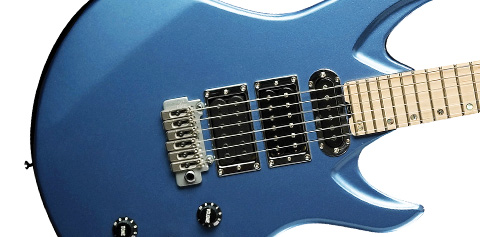




 and neck plate were also cleaned but left imperfect, and Green replaced the pickups and the neck, giving it a special serial number, with flames, to commemorate the restoration. The guitar was re-named The Phoenix and it was sent back to Connell.