Month: July 2005

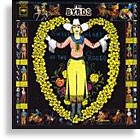
  • The Byrds – Sweetheart of the Rodeo – Deluxe Edition

    Sweetheart of the Rodeo  - Deluxe Edition

    With the exception of the Beatles’ Sgt. Pepper or Dylan’s’ Another Side of Bob Dylan, few albums were as influential to future trends in popular music as the Byrds Sweetheart of the Rodeo. This album single-handedly made country music hip by melding rock and roll and country into something even longhair hippie dope fiends could love. We can hear the fruits of the Byrds’ invention every time we turn on the radio and hear the latest “hot country” hits. At least the trend began with good intentions.

    As befits an album of such importance, Sweetheart of the Rodeo has been reissued in every format except Aramaic Braille 8-track. This latest deluxe CD edition from Columbia’s Legacy division includes 26 additional tracks besides those found on the original LP. Fourteen of the additional tracks are previously unreleased material. Two alternative versions of “All I Have is Memories” join rehearsal versions of “The Christian Life,” “Life in Prison,” “One Hundred Years from Now,” and You’re Still On My Mind. ” Six selections from Gram Parson’s recordings with The International Submarine Band, as well as six versions of Byrds’ tunes first released in 1990 complete this two CD extravaganza.

    Is the musical quality of the additional bonus material equal to the original LP? In large part, no. The International Submarine Band singles are especially dreary. Even a few of the alternative and rehearsal versions of Sweetheart of the Rodeo classics might perhaps have been better left buried in Columbia’s vaults. Still, hardcore fans prefer to hear for themselves that not everything the Byrds did was golden. But on the positive side, some of the rehearsal recordings are easily as good as final Sweetheart … recordings. Gram Parson’s lead vocals on “The Christian Life,” are sublime. His straight delivery coupled with Roger McGuinn’s florid harmony vocals work together beautifully.

    As you might expect when you combine well-polished studio tracks with rough mixes and outtakes, the audio quality here varies from damn fine for its time to quant to pretty bad. Again, the International Submarine Band cuts are the worst offenders. Fortunately, most CD players made in the last 15 years have provisions for programming skipped tracks. Still, even the lowest-fidelity selections are rendered at least listenable due to Vic Anesini’s fine remastering. Lavish packaging includes newly penned liner notes by no less than Rolling Stone senior editor David Fricke. Like I said earlier, this is a significant re-release.

    There may be some folks who don’t have a copy of Sweetheart of the Rodeo . You need to have one, of course. This particular incarnation delivers the original recording in all its glory, and some of the added tracks are certainly worthy of airplay. Still, I can’t help but wonder if Gram Parson’s legacy gains any stature from his early work with the International Submarine Band. But you can form your own opinion.


    This article originally appeared in VG‘s Nov. ’03 issue. All copyrights are by the author and Vintage Guitar magazine. Unauthorized replication or use is strictly prohibited.

  • KR Musical Purple Pedals

    Jimi Would Love 'Em!

    Efects builder Kevin Randall has done his homework on what makes vintage pedals sound the way they do. But most guys who build pedals do that… right? And we all know that quite often, that “knowledge” doesn’t translate into true vintage tones.

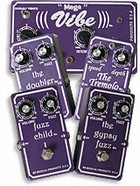
    Randall’s KR Musical Products pedals include three fuzz units (Fuzz Child, The Gypsy Fuzz, and The Doubler), a tremolo pedal called The Tremolo and the chorus/vibrato Mega Vibe. All are housed in heavy-duty aluminum chassis and sport true-bypass metal footswitches, Switchcraft chassis-mounted jacks, Alpha pots, vintage-style components, and cool purple paint!

    With the exception of the Mega Vibe, they measure 21/2″ x 41/2″ x 11/2″ and physically reminded us of early DOD pedals. The Mega Vibe is housed in a notably larger chassis that measured 71/2″ x 41/2″ x 21/2″. The smaller pedals use 9-volt batteries or an adapter, while the Mega Vibe requires a 12-volt wall wart.

    Randall is a big Hendrix fan (in fact, a stated goal is to “…produce pedals that honor Jimi’s legacy…”), so when we lined up our review rig, we decided to keep it simple, opting for a Fender ’62 reissue Strat and an all-tube combo.

    First up was The Tremolo, which is essentially a re-creation of a vintage Tremface. It features a speed control with a fast/slow switch and a depth control. The unit produced a deep, lush effect that was smooth and rich, with a nice swirl. No choppiness here. And it was just about completely transparent, taking only a tiny bit of the sparkle out of our tone.

    The Mega Vibe, which features the same circuit design as the ’69 Univox Univibe, also utilizes the same light frequency oscillator (LFO); Randall used the same incandescent lamp and four photo cells housed in a metal cover as the original Univibe. The Mega Vibe features controls for volume, intensity, speed, a chorus/vibrato switch, a footswitch with LED, and a speed/rate LED. The pedal has that authentic Univibe “underwater” tone, producing a liquid chorus effect that’s transparent and lush. We do have a nit, though – the only thing separating this unit from having all of the features of the classic Univibe is the lack of a foot pedal to control the speed.

    The three fuzz pedals scored big points with their authentic tones, also. The Doubler sounds like a vintage Octavia, producing a nearly dead-on “Purple Haze” solo tone with clean attack and good sustain. The Gypsy Fuzz has the brightest, most aggressive tone of all three, almost to the level of a regular distortion pedal; definitely a usable recreation of a Fuzz Face, but a slightly smoother top-end. The Fuzz Child is the darkest-sounding of the three, and certainly sports the Big Muff tone, with loads of sustain and compressed, muffled highs.

    All five KR pedals sound very authentic and are competitively priced in today’s “boutique” pedal maelstrom.


    KR Musical Products
    Type of effects Vintage-style fuzz, tremolo, and chorus/vibrato.
    Features Heavy duty housings, true-bypass circuitry, authentic, tranparent tones.
    Price $150 to $300 (retail).
    Contact KR Musical Products, 11872 NE 207th Court, Lake Butler, FL 32054, phone (253) 274-0629; www.krmusicalproducts.com.


    This article originally appeared in VG‘s Oct. ’03 issue. All copyrights are by the author and Vintage Guitar magazine. Unauthorized replication or use is strictly prohibited.

  • Charlie Musselwhite – Sanctuary

    Sanctuary

    With his debut album in 1966, harmonica vanguard Charlie Musselwhite met and set the standard for authenticity and adventurism in blues. But in the past few years,

  • Alvin Youngblood Hart – Down in the Alley

    Down in the Alley

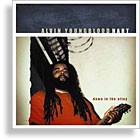
    I wasn’t prepared for how good this disc is. Hart’s mostly known for his work in country blues. Here, he does a program of good, old-fashioned country blues. And this Mississippi-Delta songfest is an amazing one-man effort!

    Hart sings while he plays guitar, mandolin, and banjo. And it’s one of the most soul-searing albums you’ll hear in this day and age.

    Hart inhabits every song and lyric as if in were born in him from day one. That’s saying something, seeing as how Hart didn’t write any of these. There are lots of traditional cuts, along with stuff from Leadbelly, Sleepy John Estes, Odetta, Charlie Patton, and plenty more.

    The intensity of the performances is at times joyful, many times scary, and a listen to the album gives you an amazing feeling. It may sound like grand hyperbole, but it’s not unlike when I first heard the Robert Johnson recordings, or the Blind Willie McTell recordings.

    One other very cool thing about Hart; he plays instruments that he repairs and restores himself, including a Bruno five-string banjo from the ’20s, a 12-string Stella guitar made in 1915, a ’28 National Triolian resonator, a mid-’30s Regal Resonator, and a Stella six-string from the ’30s.

    I don’t know what Hart will do next, or where his career wanderings may take him, but it wouldn’t be a bad thing if the country-blues bug continues to bite him.


    This article originally appeared in VG‘s May ’03 issue. All copyrights are by the author and Vintage Guitar magazine. Unauthorized replication or use is strictly prohibited.

  • Stromberg Master 400

    Stromberg Master 400

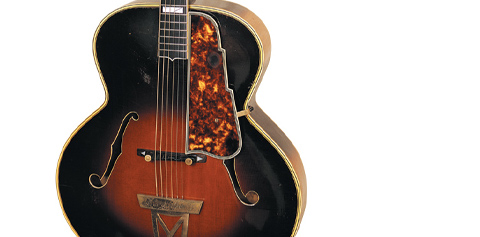
    Stromberg Master 400The Stromberg Master 400, measuring a gigantic 19″, is considered by many to be the ultimate orchestral rhythm guitar. The instrument of choice for Freddy Green with the Count Basie Orchestra and other players who needed the ultimate in power and projection to cut through a brass band or full orchestra without the benefit of electronic amplification. From 1940 onward, Stromberg’s top models, the 17 3/8″ (measured across the lower bout) Deluxe and 19″ Master 300 and Master 400, featured one diagonal brace on the underside of the top. These guitars are among the most sought-after of all rhythm guitars, and possess a sound of their own, epitomized by a power and projection unsurpassed by any other archtop acoustic.

    Stromberg guitars are exceedingly scarce. Charles Stromberg and his son, Elmer, worked alone in a small shop in Boston. They started building guitars in the early 1930s, about the same time as D’Angelico. But while D’Angelico produced approximately 1,100 guitars in his lifetime, Stromberg serial numbers only run up to 636 (a G-5 cutaway model finished at the time of Elmer’s death), but they appear to start at about 300.

    Prior to producing guitars, Charles made drums and banjos. Higher-grade Stromberg tenor banjos are very fine instruments with a distinct Stromberg Marimba-Tone sound quality, and fancy ornamentation. While these banjos are valuable, the Stromberg reputation today is based primarily on guitars.

    Early Strombergs employ pressed arched tops with two parallel top braces running lengthwise, transverse cross braces, and they have laminated backs and sides. The F holes on early models are three-piece, similar to the hole/slot/hole design used on early Epiphones. Makers such as Gibson, Epiphone, and D’Angelico were producing guitars with carved tops and backs, and all solid wood. It’s remarkable that a hand-builder such as Stromberg was using pressed tops and laminated backs in much the same manner as Kay or Harmony. But the tonal quality of early Strombergs, while not equal to their later productions, is so good that these instruments are still highly sought by collectors.

    Starting about 1940, Stromberg instruments went through radical design changes such that those produced from that time onward are notably different from earlier examples. The three-piece F holes were replaced by one-piece F holes and the tops were carved and graduated rather than pressed. The earliest examples with the one-piece F holes have two parallel top braces, but shortly thereafter the top models featured one diagonal brace. At least one Master 300 model, with a serial number in the mid 480s, has parallel top braces. The earliest diagonal-braced Stromberg I’m aware of is Master 300 serial number 497 with one diagonal brace. Serial number 498 is a Master 400 in natural finish with one diagonal brace, and serial number 500 is another diagonally braced Master 400. 501 is a diagonally braced Master 300. At about the same time, Stromberg introduced an adjustable truss rod in the neck with the adjustment nut located under the removable bone string nut.

    The Master 400 pictured here (SN 503) is typical of the period, with a 19″ body, carved top, with one diagonal brace, one-piece F holes, and pearl inlay on the peghead rather than the plastic engraved-and-painted peghead veneer with beveled edges used on earlier and later model Strombergs. This inlaid peghead was used only briefly on top-of-the-line Strombergs. At the time this guitar was made, though the top construction had evolved to being carved and graduated with one diagonal brace, the back and sides were still made in Stromberg’s earlier-style construction, since they are laminated rather than solid. Strombergs made shortly after this guitar feature carved graduated backs and tops, but the sound of this guitar is remarkably similar to those with the carved backs.

    Master 400 number 498 also has laminated back and sides, so it’s reasonable to assume this was standard construction at this time; the serial number of the first Stromberg to feature a solid-wood carved and graduated back would likely have been during (or not long after) 1940. But even after 1940, and quite late into his career, Stromberg used laminated backs on an almost random basis, such that some guitars from the same period have laminated backs, while others have solid backs.

    Unfortunately, Stromberg left virtually nothing in the way of written records, making it exceedingly difficult to know exactly what roles were played by Charles and Elmer, but their customers recall that Charles was primarily involved with drums and banjos while Elmer was the primary guitar builder. In fact, the radical change in construction was likely the result of Elmer taking over production.

    Unfortunately, Charles and Elmer died within a few months of each other in 1955, so the “golden age” of Stromberg guitars lasted only 15 years, during which time only about 150 guitars were made. Few were the top model Master 300 and Master 400. Of these, only a fraction were cutaway models. Stromberg’s greatest reputation was for orchestral rhythm guitars. The exceedingly scarce cutaway Strombergs are superb instruments and are among the most valuable of all vintage archtop guitars. Interestingly, the cutaway Master 400s measured 181?2″, while the non-cutaway version was 19″.

    While Stromberg guitars exhibit very fine craftsmanship, their binding, inlay, and finish work is not as slick and smooth as many modern makers. While Stromberg did pay attention to cosmetics, its guitars were designed to be working tools rather than strictly pieces of art. While many modern makers are rather obsessive about cosmetics, Stromberg was much more in the tradition of early violin makers, for whom it was acceptable to have a few visible chisel marks and asymmetry in work, as long as the end result showed artistic character and combined superb sound with great playability.

    Stromberg guitars produced from 1940 onward are very innovative instruments. No maker before or since has produced archtop guitars with one diagonal brace on the top. Many have made parallel-braced or X-braced archtops. Most modern archtop makers have strived for smooth, mellow sound with good sustain suitable for studio use, whereas Stromberg aimed for a more percussive sound with great projection, specifically to cut through a band or orchestra. For this purpose, not only are Strombergs unsurpassed, but no other maker has even come close. They don’t pretend to be solo lead guitars or “modern jazz” instruments, nor are they ideal instruments to be fitted with a pickup. They are superb acoustic projection machines, but they seem to fight amplification. Just as a Mac truck and a Ferrari are both superb for their intended function, but are clearly not interchangeable, a Stromberg guitar does not make any pretense of being a multi-purpose instrument. For its intended function, though, the Master 400 is unsurpassed.


    This article originally appeared in VG Dec 2004 issue. All copyrights are by the author and Vintage Guitar magazine. Unauthorized replication or use is strictly prohibited.


  • Joe Perry

    Rockin' On Bobo

    Although Honkin’ On Bobo has been labeled by some as a blues record, Aerosmith views its new release as being a true rock record – and perhaps the most rockin’ record they’ve made in years! Bobo marks a return to the high-energy blues-influenced rock sound that launched the group’s career over 30 years ago. Featuring covers of 11 blues classics and one new original tune, Bobo captures the essence of what Aerosmith is all about.

    A primary part of reviving the group’s uninhibited sound and attitude was bringing back producer Jack Douglas, who collaborated on many of Aerosmith’s earliest works through the 1970s, as well as the ’98 live release, A Little South Of Sanity. By tracking the bulk of Bobo in a live studio setting, Douglas helped rejuvenate Aerosmith’s early energy and renew the carefree improvisational interplay between the musicians. A winner with fans and the group itself, Bobo keeps the Aerosmith train a rollin’.

    “This was a record we needed to make, and we waited a long time before we were finally able to do it,” acknowledges guitarist Joe Perry. “And the single most important aspect of making this record was that we were playing live, with everybody putting out their best on every take.”

    VG spoke with Perry whom expressed his delight with the results of their latest effort, and explained how the retro recording process strengthened the bonds of musicianship between them.

    Vintage Guitar: You were introduced to the blues through British rock artists covering traditional blues songs. What was the first album that turned you on to the blues?
    Joe Perry: Definitely the [John Mayall’s Bluesbreakers with Eric Clapton]. That was the first stone-cold blues record I bought. Some songs sounded kind of hokey, like people played when the band was going to take a break. But others are absolutely incredible! There were these modern tones – it didn’t sound old. Muddy Waters, B.B. King, Robert Johnson and those guys sounded like old man’s music to me. There was little that was exciting in the rock sense. I was a 19-year-old wanting to hear wild electric guitars, and it didn’t occur on a lot of those blues records.

    So, for me it was the Bluesbreakers, then the Yardbirds’ Having A Rave Up, a couple of Stones records, then Chuck Berry Is On Top. Then I started listening to Muddy Waters, Bo Diddley, Johnny Winter, Buddy Guy.

    Were there techniques or tones you referenced for this record?
    No, not at all. I used everything at my disposal to change it around, to deconstruct and unlearn a lot of stuff, because I didn’t want it to have big, “plastic” solos. I just wanted good tone. I had this image of playing rhythm with a ’50s Gibson ES-350 through a GA-40 amp. I thought that if I could get that sound to work on the record, then we’d have something. So that’s what I was going for.

    Was that your foundation tone?
    An Epiphone Peacemaker and a Fender tweed Champ that I split with a VHT splitter box with a tube in it. I had a couple of pedals, and a Fatman compressor. I also had a César Diaz Vibramaster reverb and an old Fender reverb. For the pedals, I used a very hairy fuzz tone – one of those old red British Supa Fuzz pedals that’s kind of like what Townshend used. I used either that or this modern pedal by Chicago Iron called Octavian. It’s supposed to be an octave box, but it sounds like a cross between a really good Gibson Maestro and a Vox Tonebender. It’s got more bite and a tighter sound. It’s very close to that “Satisfaction” kind of sound. I also used an Electro-Harmonix Memory Man, a Digitech Whammy pedal into the Fatman, out to the splitter box, and then to the two amps.

    So that was the rig. Once in awhile I’d switch from the Epiphone to a Fender Deluxe Reverb because it was cleaner and had a little more bottom.

    I wouldn’t use the Diaz or Fender reverb in the line at that point. I used the Deluxe for the clean echo reverb, and I’d get all the dirt from the Champ. I have several Champs. I think I have two blackface and three tweed. The blackface seem to have a little more sustain, and the tweeds each have a different stage of dirt.

    I wanted to use the Peacemaker or the Deluxe because they give a cleaner tone. When you play, you can hold the chords together, and when you mix it together just right, you get the sustain and the nastiness from the Champ, but you still get that cohesiveness of the chords and the definition from the clean amp.

    My main guitars for the record were a ’66 Epiphone Casino and a late-’50s ES-175 with two P-90s, and it has a big crack in the neck. I think I used a Les Paul on “Stop Messin’ Around,” for old time’s sake. It was my original ’60 that I use onstage. I wanted to go with that one just for Fleetwood Mac’s sake, because that was how it was done. I had my Champ on a stool next to me, blowing right into the vocal mic.

    I played a lot of the record with fingerpicks or no pick. “Baby, Please Don’t Go,” “Temperature,” “I’m Ready,” and “Back Back Train” were done without a pick. I did “Shame, Shame, Shame,” “Road Runner,” and “Never Loved A Girl” with a pick. For “Jesus Is On The Main Line,” I used fingerpicks. I use them on three fingers – the thumb and the first two fingers.

    Playing without a pick makes you think a little differently about how you’re going to play things, and you can certainly play things right off the top different than you could with a pick. If you get real adventurous, you put fingerpicks on and you really realize that there’s a skill that you’ve got to spend some time learning. Jack had encouraged me to do that. So I got some metal ones and started working on it. But for a lot of the songs, I really wanted to get that sound where if you strum lightly, it’s just barely distorted. But when you start slapping the strings and pulling on them, it makes the speakers jump. It really contributes to the tone in a big way. You get a lot more dynamics when you use you fingers. And when you play an electric guitar without a pick, it’s a lot easier to get to the controls. My favorite thing is playing a Strat without a pick because then you can really go for it. You don’t have to worry about what you’re going to do with the pick when you go for the whammy bar or the controls and switches. All that stuff is just so much more automatic, so it’s a lot of fun.

    Did you do much overdubbing on this record?
    I did two overdubs – one for the slide lead answer-backs on “You Gotta Move” and a couple of leads on “The Grind.” That’s it.

    What was it like to be working with Jack again?
    It was great. He’s the only guy that knows us well enough to say things and push us in a certain direction. So it was great to have him there. I think he knew what we wanted. He’s been pretty outspoken about what he didn’t like about what Aerosmith has been sounding like over the last few years – much to the dismay of a few of the members of the band – but everybody’s allowed their opinion and he was really excited to get in there and make a record with us that was in the direction that he thought we should go.

    In what ways has your tone evolved over the years?
    I’ve kind of constantly gone cleaner, as a rule. When master volume amps came out, I thought it was wonderful, and now you’ve got an amp that you can get more hair out of without having to be cranking volume. But I think that what ends up happening is you trade off tone, at least for the kind of tone I like. To some people, the more distortion, and the fatter and richer, and multi-harmonics hairy tone, that’s tone. To me, hearing the strings and the organic sound of the guitar – the wood and all that – that is tone. In order to get that, you go with a lower output pickup and a cleaner amp. Then, if you want to add to it and get that kind of sustain and some distortion, you go with a little less distortion and you add a little compression in there. The guitar amp is a compressor, just by the nature of it. But I think that adding a little bit of compression can bring out some of that sustain without having to add distortion.

    So that’s how I’ve been changing over the years. I still like to let it get really hairy, especially when we’re playing some of the songs that call for that. There’s nothing like that ripping distorted guitar sound, but my basic setup is a lot cleaner. When my rig is turned up without my foot pedals plugged in, it’s a very clean, round sound, whereas five years ago, it would be a very dirty sound.

    What advice would you give to other musicians on developing their own style and tone?
    Try not to think about it too much and do what feels good. The best playing and the best sounds I get are when I’m not thinking about it. Take your mind out of the equation and let your ears go right to the subconscious, and right to your fingers.


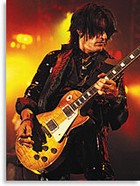
    Joe Perry on a Gibson Les Paul flametop reissue. Photo: Lisa Sharken.

    This article originally appeared in VG‘s July ’04 issue. All copyrights are by the author and Vintage Guitar magazine. Unauthorized replication or use is strictly prohibited.

  • Son House – Revisited

    Revisited

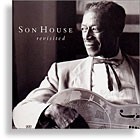
    There were blues guitarists before him – such as Charley Patton – and perhaps better blues guitarists that followed him, but there were few as soulful, deep, and downright bonechilling as Eddie “Son” House. A failed preacher tormented by the devil’s blues, House was the inspiration behind Robert Johnson, Muddy Waters, and countless others. “I’m just an old ordinary blues player,” he once said, yet as Muddy Waters invoked, “Son House was the greatest of all. “

    Sadly, House’s recorded output is slim and uneven. Arguably his best and most pure sides were those recorded for the Paramount label from 1928 to 1930, followed by the series for folklorist Alan Lomax and the Library of Congress in the early ’40s. His 1965 Columbia session – cut after his “rediscovery”- was also strong.

    The two-CD Revisited set re-releases two concerts by House from 1965 at Ohio’s Oberlin College and the Gaslight Cafe in New York City. Both have previously been issued on LP and CD, but this collection features more complete versions with improved sound.

    At both shows, House roars through his repertoire with his gravelly voice signifying the blues and his slide guitar howling in unison. Some of the songs are a tad bit rough-edged and the elderly House falters at moments, but these are still deep blues as few others have ever played them. And the most fascinating moments in the concerts may not be the blues, but House’s religious ramblings, monologues displaying his torments and intensity as strongly as his music.


    This article originally appeared in VG‘s Oct. ’03 issue. All copyrights are by the author and Vintage Guitar magazine. Unauthorized replication or use is strictly prohibited.

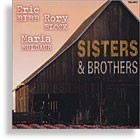
  • Eric Bibb, Rory Block, Maria Muldaur – Sisters and Brothers

    Sisters and Brothers

    I like this one for a couple of reasons. The first is it’s a perfect example of some vets getting together and just making good music. No ego involved, just three people who want to put good songs on tape, and make them sound good. Bibb’s been around since the late ’60s, performing as a solo blues and folk artist. Rory Block is a wonderful singer/guitarist who’s also had a long career. She’s recently been on the upswing, with a couple of excellent albums on the Telarc label. And Maria Muldaur has always been a wonderful singer who can cover a range of styles.

    On this, the three run through old songs, new songs, and some in-between. Listeners will recognize a swampy version of Bob Dylan’s “Gotta Serve Somebody” that lets Eric show his vocal chops, while the girls sing textbook gospel-tinged backgrounds. Funky acoustic guitar helps guide “Don’t Ever Let Nobody Drag Your Spirit Down.” “Maggie Campbell” is one of those 12-string blues tunes that always feel at home, whether recorded in 1935 or 2003. “Good Stuff” has fine finger-picked country blues to go along with a nice, gruff vocal from Eric. There’s lots of fine guitar from Bibb and Block, but my favorite, “Bessie’s Advice,” has very little guitar. Muldaur’s vocal on this one is as good as it gets. Seductive, self-assured, and (pardon the expression) ballsy, it’s a seven-minute gem by Bibb and Muldaur that has the singer talking about advice from Bessie Smith.

    If you’re a fan of any of these three as solo artists, or if you just love good, solid music done well, check out this one.


    This article originally appeared in VG‘s June ’04 issue. All copyrights are by the author and Vintage Guitar magazine. Unauthorized replication or use is strictly prohibited.

  • July 2005

    FEATURES

    76 WATTS THE HARD WAY
    The VG Low-Watt Tube Shootout ’05
    For guitarists, the richness and warmth of tube saturation is the key to nirvana. But big tube amps and small rooms don’t mix, so we gave a listen to handful of low-watt amps. Here’s what we found. By Bob Dragich

    IN DETAIL
    Fender’s 1951-’54 Telecaster
    Fender’s first Spanish-style guitar was a lesson in functional simplicity with its solid body, single pickup, and bolt-on neck. And it didn’t receive a welcome fit for the legend it would become. By Ward Meeker

    BASS SPACE
    The Gibson RD Artist
    Gibson’s oft-maligned RD solidbodies were introduced in 1977 with a body silhouette like a melted Firebird and active circuitry designed by a keyboard synthesizer guy. Did they deserve the bum rap? By Willie G. Moseley

    1934 MARTIN 12-FRET D-28
    Twelve-fret D-28s are extremely scarce – 17 were made. And this one appears to be a custom-order, with solid peghead, style 45 neck ornamentation, single-bound fingerboard, vertical peghead logo, and snowflake fingerboard inlays. By George Gruhn

    MIKE WILHELM
    The Saga (and Seeds) of The Charlatans
    In the early summer of ’65, The Charlatans played a gig that, along with its handbill, were harbingers of “psychedelic” music, or “acid rock.” Guitarist Mike Wilhelm was there to bear witness. By Willie G. Moseley

    1968 YAMAHA SG-3C
    From a guitar perspective, the Class of ’68 produced a true whack pack, including this SG-3C, perhaps the only guitar which the term “pulling your ear” might literally refer to playing its earlobe-shaped body! By Michael Wright

    BEYOND THE PARLOR
    Part 1: The Guitar in Non-Anglo America
    In the first of three features on the subject, we explore what was the arguably the most extensive and skillful guitar culture of the 19th century – that of non-English-speaking communities. By Tim Brookes

    THE DIFFERENT STRUMMER
    Back to the Future: Retro Guitars, Part 1
    Blame it on Kurt Cobain for releasing Nevermind, or us for making a fetish of old guitars. Whoever is to blame, several things came together in the early ’90s to create a category of guitars we now call “retro.” By Michael Wright

    DEPARTMENTS

    Vintage Guitar Price Guide

    Builder Profile
    Homebrew Electronics

    Upcoming Events

    Vintage Guitar Classified Ads

    Dealer Directory

    The Great VG Giveaway
    Win a Koch Twintone worth $2,150!

    Readers Gallery

    FIRST FRET

    Reader Mail

    News and Notes
    Les Paul Turns 90, Austin Slide Weekend, B.B. King monument, PRS Wins MIPA award, Schultz Retires, In Memoriam, more!

    Robert Cray
    Looking Forward
    By Willie G. Moseley

    Duke Robillard and Ronnie Ear
    Together Again
    By Eric C. Shoaf

    Victor Wooten
    No More “Octopus Arms”
    By Willie G. Moseley

    Sun0)))
    Rumbling Homage
    By Ken Johnson

    Ask Zac
    By Zac Childs

    The Sadies
    By John Heidt

    Greg V
    By John Heidt

    Mick Mars
    The Boys Are Back
    By Lisa Sharken

    Royce Campbell
    By John Heidt

    COLUMNS

    Q&A With George Gruhn

    Acousticville
    My Favorite
    By Steven Stone

    FretPrints
    Lee Ritenour
    By Wolf Marshall

    Guitars With Guts
    1967 Robert Bouchet
    By R.E. Bruné

    Gigmeister
    Bone Up Your Promo Pack
    By Riley Wilson

    TECH

    Dan’s Guitar Rx
    Rx For a Loose Fret Ends
    By Dan Erlewine

    Guitar Shop
    The Feel is The Deal
    By Tony Nobles

    Amps
    Cap Jobs Done Right
    By Gerald Weber

    Ask Gerald
    By Gerald Weber

    REVIEWS

    The VG Hit List
    Music, Book and Video Reviews: Bernard Allison, Joe Perry, Hubert Sumlin, John Scofield, Little Milton, The Guitar An American Life, more!

    Check This Action
    Never Too Country
    Dan Forte

    Vintage Guitar Gear Reviews
    Kendrick K Spot, Bixonic Expandora 2000R, E-H POG/English Muff’n, Framptone Talkbox, Talos Basic, Rigel G 110!

    Gearin’ Up!
    The latest cool new stuff!

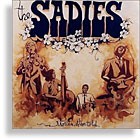
  • The Sadies – Stories Often Told

    Stories Often Told

    This quartet hails from Canada and (as often happens in rock and pop music) seems more American than most American bands (a la The Band and Neil Young).

    If you’ve been thinking about putting together a spaghetti western film, call these fellas immediately. There are at least three cuts here that would make amazing music for such a movie. And one – “Lay Down Your Arms” – almost begs to have a script written just so it can be used in the flick.

    Twangy guitars and majestic melodies dominate this wonderful instrumental. “Oak Ridges” is an incredible Lee Hazelwood-meets-Glen Campbell piece I’ve played about a million times.

    Guitarists/singers Dallas and Travis Good have an incredible feel for this sort of thing. With guest Margaret Good, they’ve re-created the classic Hazelwood/Nancy Sinatra sound from the ’60s on “A Steep Climb.” “Such a Little Word” is a killer country-rocker with classic pedal steel-type bends. It recalls the Byrds, circa Sweetheart of the Rodeo.
    The only cut you might call a “rocker” is “Tiger Tiger.” It’s full-tilt boogie with screaming solos and rockabilly-style seventh-chord hammer-ons.

    All told, there are four instrumentals here and six or seven vocals, and not a loser in the batch. If you like late-’60s/early-’70s country rock, you’ll love the Sadies. Add some eccentricity, and you have lots of fun.


    This article originally appeared in VG‘s May ’03 issue. All copyrights are by the author and Vintage Guitar magazine. Unauthorized replication or use is strictly prohibited.