Month: October 2003

  • Metropolitan Guitars Westport

    Series

    New from Metropolitan Guitars of Texas comes the Westport Series, a scaled-down version of their Tanglewood, reviewed last year in these pages. The Tanglewood is, if you recall, Dave Wintz’s homage to the old National Res-o-glas guitars, albeit more playable and prettier.

    “The response to the Tanglewood was so great, we felt we had to expand on the concept,” David relates.

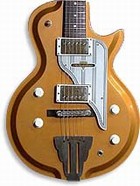
    The Westport has that same deco vibe, with a smaller body (Les Paul-sized, for you purists), the same cool plastic floating pickguards, potent Rio Grande humbucker pickups, and lush little inlays on the rosewood fretboard. The headstock and tailpiece are, by themselves, miniature works of art, and emphasize what this little guitar is all about – a true marriage of art and function, something that will play its little ass off and at the same time look real good. We tested the Super Custom Acoustic, meaning we got a guitar equipped with not only the pair of Rio Grande humbuckers, but a high-quality transducer built into the gold tune-o-matic bridge, with its own separate set of controls. The output is, in our case, a ring-tip sleeve that splits to the traditional magnetics and the piezo, enabling the user to put his acoustic-type signal into a separate amp (or the PA system), or mix it directly with the regular guitar signal.

    Our cosmetics on the Westport were to die for – an exquisite African Fakimba body with a mahogany set neck, deluxe rosewood fretboard with abalone and mother of pearl butterfly inlays running the length of the neck, and all gold plated parts. The finish makes a cherryburst Les Paul look a bit plain – quite showy and perfectly coated with a thin layer of lacquer. Minus any amplification, this guitar looked great, felt great in the hands, and wanted to play…bad (and I mean that in a good way)!

    Once we plugged in the Westport, there was no turning down. First through a new Fender Hot Rod Deluxe, then a 1965 Princeton Reverb, and finally through a great old Silvertone combo equipped with four 6L6s and twin 12″ Utahs, this guitar was like a Paul on steroids. Very fat, great sting and brilliance to its tone, and that lovely secret weapon of the acoustic transducer, judiciously mixed into the magnetic signal, lent a sheen most guitars can’t touch.

    The controls are simple and a bit on the fun side – on the lower bout are a series of three knobs, old fashioned in appearance, controlling volume for each pickup (the piezo control has an on/off setting to avoid excessive battery drain). Along the upper edge of the guitar are tone pots for each pickup, as well as a traditional three-way switch, giving typical settings of neck, bridge, or neck plus bridge (although the sounds we got were anything but typical)! Way to go, Metropolitan!

    “This is one beefy guitar…somebody needs to be playing this onstage!” Taco exclaims. “It makes quite a statement, and plays like a dream.” The levels of this guitar include the Westport Deluxe, which features deco custom colors like Pearl Green, Shell Pink, and four others, and the Custom Acoustic adds a bound fretboard, nickel parts, and the secret weapon – the transduced pickup. Prices on these instruments are $1,695 and $2,795, respectively. Our model, a Super Custom Acoustic, lists at $3,950 due to its superb appointments, and all models are discounted somewhat by the nationwide network of Metropolitan dealers.


    This article originally appeared in VG‘s Oct. ’97 issue. All copyrights are by the author and Vintage Guitar magazine. Unauthorized replication or use is strictly prohibited.

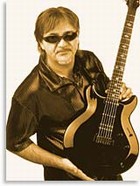
  • Steve Newman

    Springfield Roots, Bakersfield Attitude

    The dog died and the woman done me wrong! Such are the traditional pains of the country music songwriter.

    But as tired and trite as mainstream/top 40 country music can be nowadays, there are still times when a fan of the real deal can be convinced that, given the right boots, these themes can still be properly kicked around. You know, like Marty, Merle, Buck, Waylon, and The Man in Black used to do it.

    Enter The Domino Kings – and their size 12 Tony Lamas.

    The three-piece unit based in Springfield, Missouri, has been kicking around the countryside since 1994, and recently upped the anty with Life and 20, its second album. Featuring gutsy, down-to-earth tones and attitude by guitarist/vocalist Steve Newman, bassist/vocalist Brian Capps, and drummer Les Gallier, DK offers up country/rockabilly that oozes distinct originality despite its retro feel. Listening to DK music, at no time do you get the feeling they’re copying anyone, but there is something familiar.

    And New-man, whose playing hints at many stylistic influences, is a guitar show-goin’ equipment lover whose knowledge of gear, combined with his skill, makes DK music a hellaciously sweet listen for vintage tone lovers, regardless of their tastes.

    Vintage Guitar: At what age were you first exposed to music, who was responsible, and what effect do you think that exposure had?
    Steve Newman: I’ve been exposed to music – country music – since the day I came home from the maternity ward. My family is musical and it was natural to see guitars, fiddles, and mandolins in every corner of everybody’s living room. It was something we all did in some form or another and something we all still do every time we get together.

    Although I started later than most of them (I was 14 years old), music was always right in front of me. I think when music is presented to you like that, it’s bound to be more natural-sounding and feeling, even if you never play. It will always be just a little more familiar to you than to folks who didn’t get to grow up that way.

    You and the band hail from Springfield, Missouri, a place with notable musical history.
    I moved here from Hickory County, about an hour north of here, when I was 17, and man, I thought I was in the Big City!

    But yes, Springfield has a great musical history – it was the home of The Ozark Jubilee, hosted by Red Foley. They had folks on there like Chet Atkins and The Carter Family – a moment of silence, please. And Ronnie Self, who was on Sun Records and a great rockabilly songwriter and picker, was from here. We also got Robin Luke, who had a number one hit in 1957 with “Susie Darlin’.” I think he was on the Dot label.

    Springfield was just creepin’ with real-deal hillbilly music from the start. I don’t know how much it influenced me, but it sure is cool to be able to drive up and look at the house where The Carter Family used to live.

    What was in your first rig?
    The first rig I actually owned was a Teisco guitar and an old Silvertone amp. I broke ’em both and then my mother got me a Peavey Patriot and a Peavey amp with a 10″ speaker. That was after I started playing out.

    When I started, I was borrowing my uncle Donnie’s ’62 Stratocaster. My cousins didn’t like to play it, so I always got “stuck” with it! My uncle sold it to a dealer, and I’m told it belongs to Charlie Daniels now. I’d love to get that guitar back in my hands some day…

    Who or what most influenced you to start playing guitar?
    I guess that would have to be my family. Like I said, they were always playing together and visiting in between songs. Then after I started, I discovered that girls liked it!

    How did your influences evolve after you started playing?
    After my family, I listened to the radio. Country and gospel with the family, rock and roll with my friends. I was into anything that had a guitar in it – Roy Nichols, Luther Perkins, Don Rich, Grady Martin, Pete Anderson, John Jorgensen. At the same time, though, I liked rock guitar like The Eagles and The Allman Bros.

    There’s also a guy who was in The Fabulous Eels (Rick Springfield’s band) named Tim Pierce, who is a killer straight rock player. I know country music fans are choking right now, and I take a lot of crap for saying that, but that was a good band, and everybody can kiss my ass.

    Who do you now consider primary influences?
    It would be hard to pick now, because it seems that whatever I hear that strikes me today will come out in my playing, whether it’s a Pete Anderson guitar lick or a Floyd Cramer piano run. Sometimes it’s music from a TV commercial or a sitcom theme song.

    As a teenager, you kept busy playing professionally…
    Yeah, I played in Opry bands since just before I turned 15. They were music shows similar to the “Grand Ole Opry” or the “Louisiana Hayride.” The bands I played in on the side were everything from straight country to rock and roll, but my bread was buttered by the Opry bands.

    Then, after I moved to Springfield the first time, I had some auditions in Branson. On the way to there, I started thinking, “This is no different than the other shows, they’re just in a different place. If I’m gonna have to keep playing songs I don’t like. I think I’ll just quit.” And I did. I stopped at the first music store I saw, sold everything I had, and didn’t touch another guitar for almost two years.

    Burnout?
    I wouldn’t say I was burned out…I guess I just had a mad fit.

    And you went without a guitar for a couple of years, right?
    Right. But I thought about guitar constantly – all day, every day, no matter what I was doing, I was playing the guitar in my head. And somewhere in that time I reached a point where I learned how to learn. The notes became clear on the guitar neck in my head. I couldn’t tell what key a song was in, but I could tell where all the notes were in relation to whatever the root note was. So no matter the key, when I heard the progression of notes, I could play the song in any key. Kinda like theory made ignorant.

    When I finally bought another guitar, I suddenly knew all these songs. I learned more music in those two years than I ever had before or since.

    What was your first band called, and what sort of tunes did it do?
    I honestly don’t remember the names of most of the early bands I was in. I remember some of them being exceedingly bad, though! It seems like there were a few “Somebody and the Somethings” bands and a few girl singers. We’d play Dwight Yoakam, Highway 101, Don Williams, Don Gibson, Haggard and Jones, of course, and even Bill Monroe and the Stanley Bros.

    At the same time, I was in bands playing everything from Bill Haley to Bryan Adams and Paul Young. And I kept playing in those Opry bands with my family.

    What was in your rig back then?
    I used a bunch of different guitars (mostly Peavey) straight into one of several Peavey amps or into about a dozen Harmony and Silvertone amps chained together. More buzz than a dope smokin’ contest!

    Eventually, I graduated to Stratocasters and Super Reverbs. I never used any effects, then, other than reverb and tremolo.

    Were you in any other bands?
    From 1990 to ’94 I played in any band that would hire me, and some of ’em never even told me their name. I played country, rock and roll, gospel and everything in between.

    When and how did the Domino Kings get rolling?
    In ’94, I got hired to play in a band doing a high school reunion. The other guitar player was Brian Capps – he’s now the bass fiddle player in the DKs – who got my name from a music store employee who told him, “This guy will do the gig, but he doesn’t play in a steady band because he’s an ***hole!” Well, it turns out Brian’s as big an ***hole as me! We’ve played together, on and off, for six years now. We had a couple different drummers until Les Gallier came to the band. He really made a difference in our sound.

    We’ve played about a million club gigs and essentially lived together in my van when we were on the road, so we all know the other guys’ tricks, trademarks, and dirty little secrets…for the most part.

    When did you start writing your own stuff? Do you find the process fairly easy, extremely challenging, or somewhere in between?
    I’ve written songs from the start. It’s always been a real strange process where the song comes to me as fast as I can write it down. Very rarely will I use a song I’ve had to labor over. Sometimes I can save phrases or ideas, but mostly they work best if they just come to me. That’s just my method, though, and everybody writes differently.

    Apparently, songwriting is in your blood. Tell us about your Aunt Susie.
    Aunt Susie was a staff writer at Acuff-Rose in Nashvegas a few years ago, writing mostly, I think, for Loretta Lynn. I’m not sure how many of her songs were hits because she doesn’t talk about it like that. Her last big hit was “Far Side of the Bed” on Lorrie Morgan’s Leave the Light On album in ’89. She can write using any method she wants to – sometimes she snatches a song out of the air in a grand gesture of high art, and other times she carves them out of the big blocks of everyday we all have.

    The Domino Kings now have a couple albums to their credit – Lonesome Highway and the brand spankin’ new Life and 20. There are some major differences in tone from one to the next, and there are some stylistic changes. In your mind, how do they compare and how do they differ?
    I think one big difference is that we’re an older, more experienced band now. Now, we see the band as more of one big instrument. When we did the first record, Les had been in the band a for only a few weeks, and about half the songs were either written or learned in the studio.

    On the new record, we cut songs we’d been playing for a few months. We only learned two songs in the studio – “Time After Time” and “Steppin’ Out Again” – The song “Life and 20” was actually kicked off the first record. It just hadn’t grown up yet.

    As far as tones, I just tried to use guitars and amp sounds that fit the songs. I used hollowbodies on the last record, and when I play hollowbodies I always want to play hollowbody licks. I used a bunch of Teles on the new record, so I played Tele licks.

    Can you give us a breakdown of the gear we hear so much of on Life and 20?
    I used a slew of stuff – a ’63 Tele, ’54 Tele, ’74 Tele, a ’52 reissue Tele, a ’54 ES-175D with P-90s and a Bigsby, ’97 ES-5, ’60 Danelectro Shorthorn, ’67 and ’73 Martin D-18s, and a ’48 Gibson J-200.

    The amps were a ’59 Bassman, ’57 Pro, ’59 Tremolux, ’60 Champ, ’65 Vibrolux Reverb, ’64 Deluxe Reverb, ’59 Pac-Amp Troubador made by Magnatone, and a ’62 Fender reverb tank. I also used a Danelectro Danecho delay pedal.

    How about track-by-track?
    Sure. Let’s see…”Borrow A Lie” is a ’63 Tele through the Bassman, Vibrolux, and Deluxe. “Will He Be” is a ’63 Tele Vibrolux into the Pro cab Altec for the rhythm, and the ’52 reissue Tele through the Vibrolux and the Deluxe for the lead. “Where Your Lies Stop” is the ’63 Tele, the Vibrolux, and the reverb unit. “One More Day” is the ’54 Tele through the Deluxe. “Alice” is the ’63 Tele and the Bassman.

    On “Anything But You” the rhythm is the ’74 and ’63 Teles, and the ’52 reissue through the Vibrolux/Pro cab and the Bassman, and the lead is the ’63 Tele and the reissue through the Vibrolux, Deluxe, Pro, Bassman, and the reverb. “Deep & Black” is the ’74 Tele strung .012 to .064 (wound G) and tuned up a half-step, through the Vibrolux/Pro cab, Champ, and Troubador. “Life and 20,” “Don’t Be Indifferent,” “Time After Time,” and “Steppin’ Out Again” are all with the ES-5 through the Vibrolux/Pro cab. “The End of You” is the reissue Tele tuned up a half-step, through the Tremolux. “Tied to Trouble” is the ’63 Tele and the Bassman. “Letting Go of You” is the ’67 D-18. The other instrument is Les playing a mountain dulcimer handmade by his brother, Gary.

    I don’t remember where I used the Dano, but the ES-175 is on “I Think My Baby’s Talking to the Devil” on our website (www.dominokings.com) into the Bassman. Log on and download it for free.

    You wrote “Will He Be” after finding out your wife was getting you a Telecaster, right?
    Yeah, I knew she was getting me a Tele for Christmas, and I wanted to have a new song to go with it. One of the few songs I just made up out of nothing.

    It’s always good to have the support of loved ones. But what’s the deal with her running over a guitar?
    Actually, it was two guitars – a ’65 Strat with the small headstock, and a ’64 Gretsch Double Anniversary in two-tone green. She is, of course, dead now…(pauses). No, no, she’s not really dead!

    Actually, she didn’t even know she did it. We were getting ready to leave for a guitar show in Kansas City, and I had taken the guitars to the car, but couldn’t load them, because she had the keys. So I told her, as she came out the door, to load the guitars in the car. She still says she didn’t hear me. We got in – she was driving – backed up, and suddenly we heard some baaaad noises.

    I got out to find the Strat had fallen out of the case and was lying face down in the driveway with tire marks around the eighth fret. I know it’s hard to believe, but I picked the thing up and it was still in tune! The case was in three pieces – she ran over it with a Thunderbird – this weren’t no Yugo!

    Sadly, however, the Gretsch didn’t make it. I opened what was left of the case to find it dead, dead, dead. I couldn’t tell parts of the case from parts of the guitar.

    I remained fairly calm, though…considering. She sat in the car with the doors locked and I kicked what was left of my Gretsch around the neighborhood for 10 or 15 minutes, then I went in the house, got another case for the Strat, and we went to the guitar show.


    Steve Newman with his prized ’54 Gibson ES-175D. Photo: Rusty Russell.

    This article originally appeared in VG‘s March ’01 issue. All copyrights are by the author and Vintage Guitar magazine. Unauthorized replication or use is strictly prohibited.
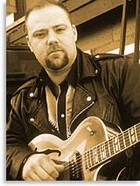
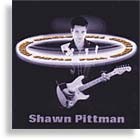
  • Shawn Pittman – Full Circle

    Full Circle

    I enjoyed Shawn’s last record, with its killer mix of rock and roll and blues. This new release takes things a step further, and really satisfies.

    Shawn spent time playing with Buddy Guy a while back, and that intensity shows on his own stuff. It also doesn’t hurt that he’s backed on a good part of this record by the Double Trouble rhythm section. As usual, Chris Layton and Tommy Shannon lay down an irresistible groove.

    Pittman’s guitar playing is always right on the money. If you want dirty rock and roll soloing to fit a rockin’ boogie, check out “New King In Town.” “I Smell Trouble” lets him showcase his slow blues; he’s the kind of player who knows where he’s going, and takes his time getting there. The dynamics are beautiful.

    The intro to “One of These Days” is him solo, nice and nasty. It might bring the old SRV chestnut “Cold Shot” to mind, but it has a mind of its own. “Can’t Take That Away” is a wonderful soul tune with killer changes and sliding fifths galore.

    You get the idea. Shawn’s a wonderful player, and really good songwriter (eight of the album’s 11 tunes are originals). Vocally, he’s got a gruff voice that’s not going to win him any awards in a sing-off, but it’s always heartfelt and gets the message of each tune across.


    This article originally appeared in VG‘s June ’02 issue. All copyrights are by the author and Vintage Guitar magazine. Unauthorized replication or use is strictly prohibited.
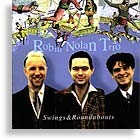
  • The Robin Nolan Trio – Swings & Roundabouts

    Swings & Roundabouts

    If you like gypsy jazz and you haven’t heard The Robin Nolan Trio, you should. Solo guitarist Nolan is joined by rhythm guitarist Jan P. Brouwer and bassist Paul Meader on Swings & Roundabouts (CD RNT3), the third CD from this fine Amsterdam-based band. Robin is an exceptional improviser which you can hear on each and every one of the 12 tracks on this CD. There are, naturally, Django Reinhardt covers, original compositions and pop/swing standards. A delightful version of “Django’s Tiger” kicks things off. This is a real toe tapper. I like the tasty chords that start and end this one and I also like Robin’s solo, which quotes the “Tiger Rag” in one spot. “Tea For Two” has an intro and an ending that borrows from Bireli Lagrene’s version of “C’est Si Bon” (on Bireli’s Standards CD). The overall pace on this one is wonderfully relaxed but there is an ebb and flow. Gershwin’s “Oh! Lady be Good” is perfectly lively. Robin’s solo begins with just rhythm guitar backing. The bass joins in and even gets a little slap work in at the 3:00 minute mark. “Minor Swing” (whose main melody isn’t all that obvious at times) features Robin playing a solo with double stops and chords and plenty of ‘out’ single notes. There’s a bluesy feel to this whole arrangement and I like it. The band is also fond of latin sounds and rhythms, heard to great effect on the Nolan original “Luna Tango.” Percussionist Nema Lopes backing adds substantially to this one. “Tony’s Tune” is a short composition (run time is 1:45) that features Robin on solo acoustic guitar. (I bet this one would sound great on an electric too.) Kudos to Mikel Le Roy for the exceptionally fine sound/mix. The band has three other CD’s available: Robin Nolan Trio, Street and The Latin Affair .


    This article originally appeared in VG‘s March ’01 issue. All copyrights are by the author and Vintage Guitar magazine. Unauthorized replication or use is strictly prohibited.
  • Trussart Steel

    Classic designs, never before seen

    James Trussart is a luthier who recently moved his headquarters from Paris to Los Angeles. A guitar builder since 1980, in recent years, he has upped his profile and reputation by crafting custom steel-bodied copies of Teles and Les Pauls in three finishes – rusty, chrome, and brushed. Though they offer a very distinct physical presence, the tones these instruments produce are every bit as flashy, throaty, and attention-commanding.
    La Méthode
    Trussart’s technique for rusting the finishes involves leaving the guitar body exposed to the elements for several weeks, allowing it to corrode before treating it to stop the corrosion, sanding it to replicate years of distress, and then finishing it with a clear satin coat. As the raw steel rusts, Trussart’s “touches” add patterns to the proceedings. One of test models had a distinct snakeskin look rusted right into its backside!
    “I’ve always like the look and feel of old guitars, believing them to have a life beyond that of their creator,” Trussart says in his literature. “And I wanted to somehow emulate that effect of age and history on my own guitars. I wanted to make a guitar that came with a history and a slight element of neglect, of decay, so it had a personality of its own.”
    And personality these guitars do have – in droves.
    Graphiques et Son
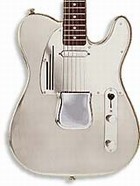
    Our test units included a rusty Steelcaster (Tele copy) and a chrome Steelpaul (Les Paul copy), both with traditional wood necks. The finish on our Steelcaster had a cool tie-dye pattern with heavily grunged bridge, tuners, knobs, and pickguard. The Koa neck had a very familiar early-’60s pre-CBS feel with a 7 1/4″ radius rosewood fingerboard topped off with Dunlop 6150 fret wire and a satin-like finish. We made minor adjustments to the action, dropping it about 1/16″ with no adjustment to the neck being necessary (which is a good thing because adjusting the truss rod requires pulling the neck).
    We tested the Duncan-Antiquity-loaded Steelcaster through our house Peavey Delta Blues and mid-’70s Marshall half-stack. The clean tone through the Peavey was bright, but not brash (like you might expect from a metal-bodied guitar); very well balanced, with great harmonics and sustain. The distorted tones had nice high-end bite that didn’t threaten to decapitate, though it did have a tendency to howl as it headed into feedback territory if we dialed in too much gain or stood too close to the amp.
    Our test Steelpaul had a high-polish mirror finish, chrome hardware, pickup rings, and pickup covers. The body is hollow with a block of mahogany under the bridge and tailpiece. It has a narrow bolt-on Koa neck with a 10″ compound radius fingerboard, super-low action, and a nice slinky feel. Equipped with Tom Holmes vintage-style humbuckers, it also has that great high-end spit and sustain. But where the Steelcaster got a bit antsy if we pushed the volume too hard, with the Steelpaul we were able to use more gain before it started to feed back, resulting in a very nice, crunchy rock/blues tone.
    En Conclusion
    In all, both guitars play and sound great, with excellent workmanship. Deciding on a favorite finish is obviously a matter of personal choice. Some of our testers preferred the rusted out Steelcaster not only for its dead-on vintage feel and playability, but also because each is unique. While others liked the flashiness of the Steelpaul and its up-to-the-task feel and tones.
    Trussart instruments aren’t necessarily every day instruments suited to everybody, but if what you want is a great-feeling, great-playing instrument with tones that live up to true classic/vintage expectations, you might want to give ’em a roll. Every Trussart comes with a certificate of authenticity signed by the luthier.


    Trussart Steelcaster/Steelpaul
    Features: Metal body with three finish options, Seymour Duncan Antiquity pickups (Steelcaster), Tom Holmes pickups (Steelpaul), Hawaiian Koa neck, rosewood fingerboard, 1 5/8″ nut width.
    Price: $2,650 to $2,900
    Info: www.jamestrussart.com.


    This article originally appeared in VG‘s Oct. ’01 issue. All copyrights are by the author and Vintage Guitar magazine. Unauthorized replication or use is strictly prohibited.
  • John Paul Jones

    John Paul Jones

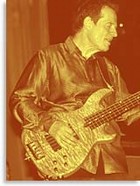
    Before teaming up with Jimmy Page in 1968 to form the soon-to-become greatest and most influential hard rock band of all time, John Paul Jones was an arranger, composer, and session player, working with many of the most prominent artists of the 1960.

    Though best known as a bassist, he’s also an accomplished multi-instrumentalist who had been exposed to a variety of musical styles at a very young age. This vast musical experience provided an extensive resource to draw from as both a player and writer, as he demonstrated in Led Zeppelin. In turn, it was the mixture of many influences brought in by each of the four members and their influence on each other which enabled the group to be so prolific, innovative and unique.

    After the mighty Zeppelin disbanded, Jones was not ready to rest on his laurels. Instead, he continued his work as an arranger and composer, but also began producing records with other artists and writing film scores. In ’82, he taught a class in electronic composition at Dartington College of Arts in Devon, England.

    While he’s played on and produced a slew of recordings since the ’60s and composed music for (and with) other artists, Jones didn’t release a full-fledged solo album (Zooma) until 1999. The album was received with rave reviews from both fans and critics. A successful solo tour followed with a three-piece band that spotlighted the virtuoso at work and brought new attributes to the classic rock power trio.

    With Chapman Stick player Nick Beggs and drummer Terl Bryant furnishing a solid foundation, Jones handles an array of instruments during the band’s live show, including some multi-string basses, electric and acoustic mandolins, ukelele, steel guitar, organ, piano and synthesizer. In addition to performing selections of his new material, Jones and his band also serve up revitalized instrumental versions of several Led Zep classics such as “Black Dog,” with Jones mirroring the legendary riffs on steel guitar, “No Quarter,” with Jones recreating his parts on organ and keyboard, and “When The Levee Breaks,” which he tackles on multi-string bass. For Zep fans, it’s quite a treat.

    Vintage Guitar caught up with Jones just after the U.S. release of his second solo work, The Thunderthief (Discipline Global Mobile), and he provided insight on his creative process and shared stories of his experience and education with Led Zeppelin.

    Vintage Guitar: Who are your main influences as a player and songwriter, and how have they changed over time?
    John Paul Jones: The first record I ever bought as a teenager was Jerry Lee Lewis’ “Great Balls Of Fire,” and then I was a big Everly Brothers fan. I was into “Cathy’s Clown,” “Bye Bye, Love,” and all of those songs. I was mainly getting into songs then, although I hadn’t actually started writing my own. I was just a player. I probably got my share of bluegrass and country music from them.

    I also discovered Ray Charles and Little Richard, and through them got into soul. I was a big fan of soul music and Motown in the ’60s, and I especially liked Marvin Gaye and Otis Redding.

    Instrumentally, I suppose I got a lot from James Jamerson, the Motown bass player, and Duck Dunn. They were very important. From rock, Jimi Hendrix was probably the biggest influence, although I don’t play guitar; his approach and sheer soulfulness was influential. For modern jazz, it was Charles Mingus, John Coltrane, Miles Davis, Gil Evans, Bill Evans, and all of those types of players.

    So it was the mixture of players and styles?
    I’m influenced by everything I hear. Not just by “names,” but any music that I hear. If I’m in a supermarket and I hear some horrible muzak, I’ll find myself [thinking about] why it’s horrible. Then I can file the information somewhere as, “Don’t do that.” So it’s all useful stuff.

    I had even earlier influences which gave me more interest in world music. My father was a musician, and was also in vaudeville with my mother. So we were always up against some Chinese acrobats, accordion acts, bear acts, and all this other stuff. Because I was always on tour with them, I heard music from everywhere in those days. My father was a pianist and trumpet player, and he was a fan of jazz and blues. He introduced me to Sonny Terry, Brownie McGhee, Bukka White, and Big Bill Broonzy, who all used to tour England in those days. He was also a big Latin music fan, so I became interested in a lot of Cuban music and Salsa. There was just a ton of stuff out there, and I absorbed most of it.

    You were exposed to many diverse styles at a very young age…
    I think it’s very important to be exposed to a variety of music. I worry about younger bands that only listen to their favorite band. They miss out on what made their favorite band so interesting – if indeed it was.

    In what ways have your writing and playing styles evolved? And where do you see the greatest changes in your music? And are these things that you’ve consciously worked to change, or just a natural evolution of your style?
    It’s all much simpler than that. One of the first things we discovered with Zeppelin was that it was what it was because of the different influences and different musical tastes of each member. We put everything into the mix. We could go a bit more folky or a bit Celtic or a bit Arabic or a bit rocky or bluesy and go in any direction because all the skills and the love of these musics were there. And so the plan was at the time, “There is no plan.” If it sounds good, then it doesn’t matter where it comes from and it doesn’t matter what the influence is. That formula has just stayed with me forever.

    Usually, I go for walks when I’m trying to write for a record. I’ll take a bit of manuscript paper and when something sets off an idea, I’ll just follow that idea. Whether it’s blues or bluegrass, it really doesn’t matter. In fact, I’ll probably just try and mix the two because it’s all the same to me. So my writing style has never changed.

    Are you ever influenced by the tone an instrument?
    Sometimes by the instrument, sometimes by its purpose. On The Thunderthief album, I really wanted to get Robert Fripp, who is my label boss, to do a guitar solo. I wanted him somewhere on the album. So I started thinking, and one little riff [from “Leafy Meadows”] just popped into my head.

    Then I just imagined what I thought he would play, if he did a solo. It was all guesswork and supposition driven by experience. Then Robert came in and did the solo I’d hoped he would do. He heard the track and nailed it, straight away. So that track arose out of a purpose.

    Another track, “Down To The River To Pray,” came from an instrument. I’d just had a triple-neck mandolin built by Andy Manson, the brother of Hugh Manson, who makes all of the basses, steel guitars, and electric mandolins I use now.

    Andy also built the triple-neck guitar I used to use in Zeppelin, so I had him build this beautiful F-5-style mandolin with a carved back and three necks; a regular mandolin at the top, octave mandola in the middle, and a bass mandolin on the lower neck. It’s a long, fat, neck with a gorgeous sound.

    I had to think of how I could use it on the record, and I chose “Down To The River To Pray,” which I’d seen in O Brother, Where Art Thou? I’m a big fan of Alison Krauss, and I really liked the arrangement. In the film, it starts with a few voices, then in the next verse, there are more added, and it finally ends up with this huge choir.

    So, using a computer sound design system called Kyma, I wrote a loop program that is programmable by footswitches. For each verse, I’d just put another layer down. I did one live take and then put about seven or eight layers on top. And that’s how that song came about.

    Usually, if I need a song for a purpose or a solo, I’ll hear the part, then choose the instrument.

    So you typically notate ideas on paper before you ever pick up an instrument?
    Right. I like to write when I’m walking; I’ll go for a walk and search for an idea that starts me off. I’ll play the idea in my head over and over again. Hopefully, it will get into the bridge section. If you let your mind go, you’ll suddenly find that it will go, and the ideas will come together. I take the staff paper along just so as I can notate the ideas really quickly, just to get the bones of it down.

    You’d be surprised at how you think you remembered something and then you get home and it’s actually quite different. I don’t need to carry tape machines around with me.

    My father taught me this real simple system, where you don’t even need staff paper. Basically, you put everything in the key of, say, C, then you number the notes, like from C to C is 1 to 8. So if it’s an E, you write a 3 and if it’s an Eb you write a 3 with a little minus sign. If it’s an F, you write a 4 and if it’s an F#, you write a 4 with a plus sign. Then for the rhythm, I use eighth and quarter note beams over the top of the numbers.

    So all I need is a blank piece of paper, or anything to write on. I’ve written stuff on my hand with a pencil, just to get down a quick riff. That’s how I did “Black Dog.” I was sitting in a train, and I wrote it on my arm just so I wouldn’t forget it. If you sing it over and over in your head, you’ll find that you change it and the idea might not sound as good as when you thought of it, just because of a minor change.

    One little change can make the whole thing different, so you have to get the idea down as soon as you think of it.

    Do you make demos?
    Yes.

    Are they just simple recordings to document the ideas, or more complex arrangements of the parts?
    I’ll usually go to the computer and put a quick loop down with an instrument, to get the sound, then play into a ProTools system using whatever instrument is required.

    For instance, on “Angry Angry,” you hear what sounds like a bass guitar, but it’s actually an electric bass mandolin. To get the sound and feel, I recorded a couple of bars to a click track, as a reference point. Then I’ll get a similar sound out of a synthesizer and write it in MIDI onto the computer using drum samples. That way, I can easily change key or change tempo. I can do anything and it’s still in MIDI. Because it’s not using samples, it’s very flexible. Then I just build the song in the computer and finalize the arrangement. Then, once I’m happy with tempo and pitch, I replace everything with real instruments.

    Do your demos ever become final tracks?
    I try not to elaborate the demo too much. I leave it in “drum machine world” and I don’t bother getting a good sound on drums. I get the kicks and snares in, to move the riff along. It’s very important that the drum part is correct; that’s something I learned in Zeppelin.

    But there was an instance where I had to use a demo track – the solo to “Daphne,” which is on an electric mandolin. I couldn’t ever get it as good as that demo. When I was playing the solo, I wasn’t thinking about playing, but of how I was going to record it. So my mind was elsewhere and it was like the damn instrument played itself! Then when it came time to do a solo on the final track, nothing was ever as good as the demo. Well, one trick I learned a long time ago, having been badly burned on this before, is that if I’m recording a live instrument on a demo, I record it at the best possible quality. I take a little time just to set it up so there are no buzzes or hums or anything horrible.

    So sure enough, I had to use the solo from the demo. I know I really screwed up a couple of bars. There’s one bar I made a complete mess of because I wasn’t in performance mode at the time. I might have tripped over a chair, who knows?! So I had this really great solo with just this one bar that was a total mess. Using ProTools, I was able to just sort that bar out. I reconstructed it from the notes, moved a little here and there, and was able to work out that one bar and save a solo with a great feel. In the old days, if you screw up a solo, you had to play it again or drop in with an overdub. I know that a lot of people say that by using computers and ProTools, you can actually take the life out of something. Well, you can also save the life of something, too. In the old days, you could play something and take the life out of it.

    Computers and ProTools are wonderful. You might get a drum fill that’s perfect in every way except it just laid back in one spot. Sometimes one off beat can spoil a whole intro to a chorus or something like that. The whole thing can lag just because that one beat is in the wrong place. So you shift it! It’s only one beat, so who cares? I love that flexibility.

    Tell us about your custom-built instruments made by the Mansons.
    I met Andy in the ’70s, and he built the triple-neck guitar in ’77 and the ukulele I use onstage. I looked inside it and it says “John Paul Jones 1979.” So that’s sort of a vintage instrument now, I guess. Andy also made me a little collapsible guitar that fits under an airplane seat; it folds in the middle, and all the strings stay on. It’s very impressive. For the next album, Andy just made me a baritone ukulele. I was looking on some website for ukulele strings and it said they carried baritone ukulele strings. I wondered what that was. I did a web search and I found a store selling baritone ukuleles, and I bought one.

    It was the first instrument I ever bought on the internet – a Chinese baritone ukulele, which was terrible. It was just barely in tune up to the fourth fret, but was only about $75 and at least I could try it out to get a better idea of the instrument’s sound and range.

    So I asked Andy to build a real one. He did some research and he managed to find a piece of koa, which is the traditional Hawaiian wood that is used for these instruments and made me this beautiful baritone ukulele. It’s kind of like an acoustic guitar except that the body is smaller, so it speaks very fast and it’s only got four strings.

    I met Hugh Manson in the early ’80s and I have a couple of basses that he made at that time. I’d had him start making me the multi-string basses around the time of the Diamanda Galas project (The Sporting Life), when I wanted to use eight-string bass again. I’d had an eight-string that I’d used in the ’70s on Zeppelin’s Presence album, but it was a bit worse for wear. But I wanted to use that sound again for the project with Diamanda, so I had Hugh build me an eight-string bass. Then he built me a 12-string bass, then I wanted a 10-string bass, then it was a 10-string bass strung differently.

    The next instrument he built was a lap steel because I wanted to use one with Diamanda. So he built me a beautiful bass lap steel, which has extra bass strings and goes to a low E.

    Is that the lap steel you play onstage?
    No. The one that I use onstage is the second one that Hugh built me, which is a gold twin-neck bass lap steel. It has a fantastic sound and I use different tunings on each neck.

    Which tunings do you use when you’re playing live?
    I have the necks tuned to open E and open A. But I’ve got those little Hipshot three-position levers on the bridge, so I can set them up for a modified A tuning, where I put a fourth into it, instead of a third. I can have them set up for all different stuff, and I can flip to different tunings.

    What types of woods are the Manson basses made from?
    The 10-string is maple, mainly. The old 12-string is Australian blackwood. That’s the big 12-string. I don’t play it onstage because it’s really heavy, but I did use it on record because it sounds wonderful.

    How do you mic and amplify the instruments you play?
    All of the basses have got twin pickups, and the neck pickup goes through a bass rig, usually the SWR SM900 and I’ve just started using the Mo’ Bass, which is great. Then onstage, the bridge pickup of the basses go through Marshall 100 watt guitar amps. But in the studio I use a Matchless amp for the bridge pickup. I usually use a Matchless for my steel guitar in the studio, too. I use the SWR rigs in the studio, as well.

    When I’m recording, I put a bunch of mics on everything. I have time and I have tracks – I’ve got a 48-track system. So I just put several mics up and then see what sounds I like. I’ll use close mics, distant mics, and a mixture of the two. I’ll also try putting some mics out of phase with other, and just experiment with the sounds.

    Do you also run a D.I. line?
    I do, but I hardly ever use it. Sometimes I’ll take the DI off and run it into an effect, if I want something with chorus or another effect. I hate to say, but I don’t really like the sound of the DI that much – there’s no air, and it’s just very dry. I might use it if I just need to add a little bit of center to an amp. I’ll put up an amp first, get a couple mics set up on the amp and then I’ll just move them around until I get a really good sound. Then I’ll put the D.I. up and see if it helps. If it doesn’t help, I won’t use it.

    Do you have any favorite mics?
    I use a Beyer M88 condenser mic on the bass. Sometimes I’ll use a Sennheiser 421 and a kick drum mic like an AKG D 112. I basically just move stuff around until it sounds good. Sometimes I’ll put a Neumann U87 up, too, or I’ll leave a mic on in another room, then open the door and let it pick up the leak-through. I’ll just mix it in and sometimes it sounds good. But then again, sometimes it’s horrible. I do different things just to experiment.

    As a player, you have a very unique sound and style. What are the most essential elements of your bass tone and technique?

    Well, my fingers probably account for most of it. I’ve had people pick up my bass after me and sound so completely different. It’s the way you play it. It really is. I play quite hard with my fingers and with a pick. I use a very heavy pick, if I’m using a pick for the multi-string basses. I use Jim Dunlop picks, the ones that are like 2 mm. I use them for everything because they have a softer tone than the real hard plastic ones.

    Do you use the same kind of pick on all instruments?
    Yes. I use the same pick for everything. I play ukulele fingerstyle and I use the same pick for mandolin and steel guitar. I find it easier than if you keep swapping picks for different styles. So I kind of force myself to use the same pick for everything.

    How are your basses set up?
    The action is quite low – just above rattle point. I still play them quite hard, but then I don’t mind if they’re rattling. That’s all part of it… or part of me, anyway.

    Do you have a preference for your brand and gauge of bass strings?
    Yes. I use Rotosound Swing Bass strings for everything. For the multi-string basses, I use the Rotosound Piano Bass strings, with the exposed center core, because they’d be too far apart if I were to use regular bass strings. I prefer Rotosound bass strings, but I was never that particular about string gauges. The gauge doesn’t really matter to me.

    Aside from the custom-built instruments, do you have a collection of vintage instruments?
    Yes, but nothing that’s that original or collectible. Even my old Fender bass that I used in Zeppelin has gone through many re-sprays and this and that. I was just never that particular about keeping things original. I probably shouldn’t have, but it’s a ’62 Jazz Bass which I bought new. I bought it to play, not to hang on the wall; I hate instruments hanging on walls. They’re hanging on all my walls, but I use them all. I pull them down off the walls and they get to work, otherwise they go. I use the shop racks with the extending arms that are angled to the walls. Then I can get to them easily and if I see them, it makes me think about playing them. For playing the odd backing guitar part, I have an old beaten-up SG. But things that sound like strummed guitars on the album are quite often electric mandolas. I try not to use guitar on my records, mainly because everybody else does. For solos, like “The Thunderthief” solo, I used the lap steel. Everything else, like “Hoediddle,” is all electric mandolin.

    When you play guitar parts on other instruments – for instance, when you’re playing “Black Dog” on your lap steel – are you thinking about the original guitar part or hearing the sound of Jimmy Page’s guitar in your head?
    No. However, sometimes I’ll do a quote from the original part. There are some little Jimmy bits that I do in the solo and little quotes that I’ll use in the song. Jimmy’s parts are quite fun to play because he’s playing with more fingers and I’m playing with a big lump of iron. It’s kind of interesting to see how I can do those little things sometimes. It’s a good challenge and it gets me moving.

    What’s the most interesting piece of gear that you’ve acquired in recent years?
    I think the triple-neck mandolin is pretty interesting.

    How do you typically warm up for a gig?
    Basically, I stretch my limbs, wave my arms around, and do a few bends to try to get energy going, rather than actually playing anything. The instruments are usually onstage, so I don’t have any backstage. We’ll sit around and tap on bottles and glasses, which is great. It really focuses your mind on playing along with what the other musicians are doing.

    Do you maintain any sort of practice routine when you aren’t touring or recording?
    No, but I’m always playing instruments.

    What advice would you give to other players on developing their own playing style?
    Listen to everything – every style of music, absolutely everything. It’s got to get your brain going, as well as your fingers. One thing that I like to do is to turn on the TV or the radio, sit there with an instrument and just play to whatever comes on, whether it’s Top 40 or anything. I’ll just fit in somewhere and play a meaningful part to whatever’s on. Sometimes you’ve go to tune up real quick and just get in there and try to make sense of it. There’s something to be learned from absolutely everything. I’ve played some killer parts over [Destiny Child’s] “I’m A Survivor.” I’ll do that on mandolin and I’ll get some great mandolin solos I could have recorded over that. But who’d have put mandolin together with Destiny’s Child? You don’t expect to play mandolin to it, so it gets your brain working in different ways, rather than getting set routines. You ambush your brain and your chops and it will help you to be more creative.

    What kind of music do you put on when you’re listening for enjoyment?
    When in the car, I’ve got Radiohead, Trent Reznor and Tool, but I also play a lot of bluegrass on the mandolin, like Alison Krauss, Rhonda Vincent, Nickel Creek and Chris Thile. I also enjoy world music, Cuban music, flamenco, blues, jazz, contemporary classical or whatever. I don’t care. I enjoy all music, as long as it’s good! Duke Ellington was right: There are only two types of music – good music and bad music.

    What are your plans for the next year?
    I want to tour The Thunderthief. We’re soliciting offers and seeing what we can put together, whether it’s a headlining tour or a support tour. I’ve got to play to more people and just get out there. After the tour, I’m going to do another album.

    Have you started writing material?
    No, I wait until it’s time to do an album. Otherwise, things kind of get out of sync. I don’t write constantly – I write when I need songs. It focuses the mind, and you get better cohesion.

    Even if the songs you’re writing are different styles, they feel as though they were done at the same time and you don’t get stale ideas. It’s more fun that way and you feel like you’re doing something where there’s a purpose. You start from nothing, write the songs, go in and put the tracks down and record them, mix them, master them, and you’re finished. You do the artwork, then there you go; you started from nothing and you’ve got something.

    So it’s one complete process. For me, it works that way. Recording is my hobby, as well, so I’m constantly updating the equipment in my studio and buying new toys. I can’t stop!


    Photo: Lisa Sharken.

    This article originally appeared in VG‘s Aug. ’02 issue. All copyrights are by the author and Vintage Guitar magazine. Unauthorized replication or use is strictly prohibited.
  • Slash

    Slash

    Life is Grand After Guns N' Roses

    Bursting onto the rock scene in 1987, Guns N’ Roses overthrew the shred and pop kings who’d previously ruled the decade. The group’s contrasting blues-based style revitalized classic rock and its bluesier, more groove-oriented sounds. Once GNR ruled rock radio, pointy guitars and Floyd Rose tremolos were out of fashion and players returned to a more traditional approach. Once again, the Les Paul became the guitar of fashion and players strived for a simpler sound, rig, and playing style. Guitarists began searching for more soulful riffs with better tone, rather than playing at light speed, with the gain knob jacked.

    And the fact he suddenly became a trendsetter surprised no one more than it did GNR guitarist Slash, nee Saul Hudson.

    “To me, the Les Paul was always there,” he relates. “All the guys who I dug played Les Pauls and that made me use one because I thought it looked cool and just sounded right for the music I wanted to play. There are a million guys out there who play Les Pauls and it’s sort of embarrassing to me that I’m the one who’s getting the credit for bringing back something that never went away.”

    As acknowledgment for his dedication to the instrument, Gibson honored Slash with a signature model Les Paul. Then Marshall presented him with the company’s first-ever signature model amplifier, introduced in limited production and manufactured in ’98.

    After leaving Guns N’ Roses over disagreements over the group’s musical direction, Slash blazed his own trail, but kept true to his musical roots and goals. First, he put together Slash’s Blues Ball, his realization of the ultimate touring garage band, which provided the opportunity to jam on some of his favorite cover tunes. All the jamming inspired the development of new material and marked the formation of Slash’s Snakepit with the guitarist’s acclaimed ’95 solo debut, It’s Five O’clock Somewhere (Geffen). Recently, the group released its second album, Ain’t Life Grand (Koch), a collection of hard-edged rockers with the same type of drive and intensity as Appetite-era GNR.

    While on tour to support his new release, Slash sat with VG to fill us in on what he’s been up to, and talk shop. He talked about his inspirations as a player, and about his guitar collection; particularly about how he acquired Joe Perry’s ’59 Les Paul (see sidebar).

    Vintage Guitar: Who or what sparked your interest to become a guitar player?
    Slash: Steven Adler, the original drummer for Guns N’ Roses, got me interested in playing, although I’d been raised on music. When we were about 15, we used to ditch school together. After his grandmother would leave for work, we would go back to his house and hang out until she got off work, then we’d split and act like we were at school all day! He had some piece of crap guitar and amp. We’d turn on Kiss records really loud and, even though he didn’t know how to play, he’d go through the motions. So I thought I’d start playing bass so we could jam together, although I didn’t even have an instrument. I went to a neighborhood music school and thought I’d take lessons. The guitar teacher started playing Eric Clapton and Jimmy Page stuff, and I told him that was really what I wanted to do. So I switched from the idea of playing bass to playing guitar. Then consequently, Steven went from playing guitar to playing drums. So that’s pretty much how it started.

    What was your first electric guitar?
    It was a Memphis Les Paul copy. But the first guitar I ever had my grandmother found in her closet. It was a one-string Spanish-style acoustic guitar. I learned how to play a lot of stuff on that one string!

    Was it a one-string because all of the other strings were missing or broken?
    Exactly! The low E string was still on it.

    Then how did you progress?
    I eventually got into learning from records. I also started buying everything I could on how to tune the guitar, how to string it up, and how to play. Once I got all that together, I started a band.

    What was your first amplifier?
    I can’t really remember! But the first < I>decent amp I remember having was a Sunn Beta Lead. It was solidstate.

    What was your first stompbox?
    In the beginning, I probably went through every MXR pedal. I was just searching for how to achieve whatever it was I wanted to achieve at that time. Playing with pedals was a very short phase for me, then I realized that I really didn’t need anything. The last pedalboard I ever had was one of those Boss BCB-6s. I kicked it off the stage during the first live gig Guns N’ Roses did. It just got in my way. I realized that I didn’t need anything except my wah wah pedal and my talk box.

    Did you use distortion pedals when you were younger?
    Oh, yeah. I had an MXR Distortion Plus, and it made “Cat Scratch Fever” sound good.

    Tell us about your guitar collection. What are some of your favorite instruments?
    I’ve always loved my ’58 Explorer and Flying V. Those are sort of priceless to me. There’s also Joe Perry’s tobacco sunburst ’59 Les Paul, which was one of only two made, and that’s priceless, too. I got that guitar back around the tail end of the first Japanese Guns N’ Roses tour. I got a call from a guy at a pawn shop who told me this guitar belonged to Duane Allman, then to Joe Perry. Because I had an Aerosmith poster on my wall when I was a kid, I thought I’d recognize it if I saw a photo, so I had him send one to me. I knew that guitar – the color, the nicks, and scratches. So I got the photo and knew it was the same guitar. I bought it for about $800. I also have some other ’59 Les Pauls that are all really cool. They aren’t mint condition, but I bought them because of the way they sounded. I have some Teles and Strats, and some Melody Makers. I love all my guitars!

    If I got into talking about every single guitar I have by year, make, and model, we’d be here all day! It’s pretty extensive.

    How many pieces would you estimate to be in your collection?
    I have about 80. I had 11 ripped off and I got five of them back, so the count is still up around 80-something.

    If you could only keep one of them, which one would it be?
    To make a record, I use one guitar. To do a live show, I use one guitar. I have two main guitars, but there’s one I use only in the studio, which used to be my main live guitar. I’ve beaten it up so badly that I can’t use it out on the road anymore, so it stays in the studio. And my live guitar was broken in half during a show I did with Nile Rodgers.

    So if I was on a desert island, I’d probably chose the one I use in the studio. But I’d definitely beg for the option of having two! My live guitar is an ’87 Standard, and the studio guitar is a handmade ’59 copy.

    Who built the ’59 copy?
    A guy from Redondo Beach, and he died before I got the guitar. It’s an immaculate copy. I have another ’59 copy, but there’s always some confusion about who made the guitar I used to record Appetite For Destruction. To clarify the mystery, it was definitely made by the guy from Redondo Beach. That guitar was used on practically everything I recorded.

    Tell us about your stage guitars.
    The main guitar I play live is one of two Les Paul Standards I bought in ’87, just after Guns N’ Roses was signed. This one has always been my main stage guitar. It just sounds good and feels right to me. It’s been broken and put back together, and I’m still playing it.

    The other ’87 Les Paul was stolen when my house was robbed. I lost a lot of stuff – mostly all practice guitars – but losing that one really hurt. I got back my Guild signature model doubleneck and Alvarez Flamenco guitars, but that’s it. It totally sucks when something like that happens! I took it as an omen and it was a major reality check. I realize I don’t need a lot of stuff, so I’ve cut it down, and I keep my guitar close by.

    How do you like your guitars set up?
    I really only get into those details when they need to be done. I had always set up my basic stuff. Then when Adam Day (his guitar tech) came into the picture, we really didn’t change anything. I just set it up so the action isn’t too low. I adjust it so it doesn’t buzz on the first and second frets, but it’s just high enough at the other end of the fingerboard so it’s got tone up in the higher registers.

    As far as the tension is concerned, I like it to be heavy, so I use heavy strings. I keep the pickups as close to the strings as possible, but the strings don’t hit the magnets, since I play pretty hard. It’s just common sense.

    All of my live guitars, and my main studio guitar, have Alnico pickups in them. I don’t change the pickups in my vintage guitars, because the original PAFs sound great. But the Seymour Duncan Alnico IIs came with the guitar, so I just stuck with it. I’m real simple that way. I hate fussing around with stuff. I went through it for so long, from when I started playing until I felt comfortable – about age 15 to 19. Those four years were such a struggle, and I never had the money to really mess around. I had to work hard to make the money to pay for anything I had, so I didn’t really screw around too much, but I tried different stuff. Finally, I realized simplicity was bliss. I just found one thing I liked and stuck with it. I haven’t really changed anything since.

    What kind of strings and picks do you use on electrics?
    Ernie Ball RPS .011 to .046 and Dunlop Tortex 1.14 mm picks.

    How does your approach to playing change with different guitars? For instance, do you notice any difference in your technique when you play a Fender?
    I’m most comfortable on a Gibson. But if I want to go with a Strat or a Tele, it has to be for a certain application, which means the song won’t be like the prototypical sound I get for the hard rock stuff. It means I’m playing some blues or some off-the-wall sort of Hendrix thing. That happens very rarely. I don’t take a Strat on the road. Those guitars are more for the studio and I don’t break that stuff out very often. But when I know something will sound great with a Tele, I pull it out.

    I do play everything different on a Tele because I’m not as familiar with it. I play with my fingers a lot when I start playing a Strat or a Tele, and I have to change the amps around, too. There are certain techniques to adjust to “the changing of the guard,” which is why I try to stick with my basic Les Paul and basic amp set up because it’s less of a pain in the ass.

    Tell us about playing acoustic guitar.
    I have a handful of Guild acoustics that all sound really good. In the studio, I just play along with the track and see which one fits best for what I’m doing. Depending on the song or the studio, or whichever guitar happens to be conveniently located at the time, I just use whichever one fits. I’m not really fussy.

    Do you like your acoustics set up to feel more like an electric?
    Actually, I think I spend more time making my electric guitars feel like an acoustic! I like the tension of the strings on the acoustic because it sounds and feels really solid. So I try to make the Les Paul have that same kind of big, solid feel. The only difference is that I’m playing through an amplifier. But even with the amp, if I’m using a clean sound on my electric, the richest sound you can go for is the sound of an acoustic guitar.

    What kind of strings do you use on acoustics?
    I use Ernie Ball acoustic strings, medium-to-heavy gauge.

    Do you have a favorite guitar for writing music?
    Yes, a Guild I’ve had for a long time. I’m not sure what model it is, but it’s got stickers all over it. I carry it around with me most of the time.

    Do you do more writing on acoustic than electric?
    When it comes down to it, yes. On the road I carry my electric with me, so if I’m on the bus or in my room, I’ll write on that. But for the most part, when I’m seriously getting into writing stuff and recording ideas, I’ll use my acoustic.

    What kinds of things inspire you to write? Do you find there are certain places or times of the day where you are more creative?
    No, there’s no formula for that. It’s usually at the most inconvenient time, like when you don’t have a guitar with you, that an idea pops into your head. But I think the most convenient time for writing is when you’re not necessarily trying to.

    Do you typically document your ideas on tape before going into the studio?
    I’ve tried to do things in a more responsible way in recent years, so I got a Tascam Portastudio to retain information. It was in a nifty roadcase and well, we spilled a lot of beers in it and it just never worked out. The first Snakepit record was a product of me trying to get an actual home studio together. Then we had an earthquake and it was trashed. After that, I built the studio where we actually did Ain’t Life Grand. That studio is a little bit more significant because it has some serious equipment and it’s designed more like a real recording studio.

    For the most part, I’m not into carrying around my guitar and a tape recorder. As soon as I break out the tape recorder, that’s when I don’t have any ideas. I just like to get thrown in what’s more or less a live situation and just go for it. I don’t like to do too much fussy pre-production. If the idea is good enough, I’ll remember it. I’ll go over things with the band and we’ll work on it until we get it right, but we don’t over-rehearse. Then we’ll go into the studio for pre-production to make sure everything sounds right. Once we get that together, we just go for it and make the record.

    Were the band’s main tracks for Ain’t Life Grand recorded live in the studio?
    We do everything as if it were a live gig. We record the drums while we’re all playing together. Then if there are any guitar parts I want to go over, I record in the control room. I’ve gotten to the point where I usually keep a lot of the stuff we do live. In the old days with Guns N’ Roses, I’d have to redo all the guitar parts in the control room after we recorded the basic tracks. But now I’m finding that when I’m listening to the live tracks we record as a band, I often think we play the parts really good, so there’s no reason to fix anything. That’s how this record was put together.

    Do you record the solos live, or go back and track them later?
    I’ll put the solo on live, because it’s part of the song. Then when I go back, I’ll fill in the rhythm guitar and keep the solo, if it’s a good one. If not, I’ll go over it and record a different solo. We just do whatever works best for each song and keep things simple.

    What were the main guitars on the record?
    The main guitar I used was my handmade ’59 Les Paul copy, which is the same guitar I used on Appetite For Destruction and for most of the basic structure of Use Your Illusion I and II, which had a lot of different guitars on it, but the underlying guitar is this one Les Paul. For the tremolo bar stuff on “Alien” and “The Truth,” I took out my B.C. Rich Mockingbird. For other sounds, like the slide part on “Shine,” I used a Travis Bean with a brass slide. There was also an ES-335 I used for a clean tone on “Back To The Moment.” But everything else is that Les Paul.

    What was your amp setup for the studio?
    I used my Marshall Slash head and one 4×12 cabinet, which is the same rig I always play through. That’s all that I really use onstage – a half stack. Even though I’m on a big stage and opening for AC/DC, all I’m really playing through is a half stack. I’ve got two heads and two 4x12s, which I use to switch from clean to dirty sounds, but only one half stack is used at a time. There’s also an identical rig ready for backup, and there are more cabs, but the other cabs onstage are just spares. But no matter how many amps you ever see out there onstage, I’m really just playing through a half stack.

    Do you record with effects, or add them in the mixing stage?
    I really wanted the record to have a live ambience and (producer) Jack Douglas captured the band in its purest form. I kept things pretty raw, and Jack helped shape my guitar sound in the mix. For different parts, I’d tell him what I was looking for and he’d add the right reverb, delay, or whatever to get the ambience. Jack has his own style. I’m not exactly sure how he goes about it, but the way he panned the parts, it sounds like you were listening to the band playing in front of you.

    The funny thing about having Jack work on this record is that Jack was the guy I wanted to produce Guns N’ Roses when we started. But that was a different time and we were a little too ****** up back then, so the record company didn’t go with that idea. But now I’ve come full-circle and all of a sudden, I’m finally getting the opportunity to work with the guy who had been my first choice.

    What do you like and dislike most about working in the studio, and playing onstage?
    I hate recording with headphones, so that’s the major difference in the studio. I’m forced to wear headphones in the studio. But the only way to get that live vibe in the studio is for the whole band to play live together, and no matter what, you have to use headphones to hear each other.

    After years of frustration, when we built the Snakepit Studios at my house, we worked out a way that we could play live together, and record it without any bleed. But not all of the finished tracks on the record were done that way because in order to get feedback and certain tones at the right volume, I would go into the control room. Also, if I wanted to do any overdubs or fixing, it would be in the control room.

    So I was raised on recording the guitars in the control room, and always did the basic tracks with headphones on, which is really irritating! But I’ve gotten better, and now I’ll listen back to it and think it doesn’t sound half bad.

    But that’s the huge difference between playing live and in the studio – the headphones and the confined feeling of not being able to run from one side of the stage to the other. Otherwise, my approach to playing is pretty much the same in both situations.

    Do you use ear plugs when you play live?
    No. I tried it, and it just mutes everything. I don’t think I could ever get used to it. The tone is different, and it’s just too much of a bother.

    How frequently do you practice when you’re on and off the road?
    I don’t really practice in the sense of diligently going over scholastic exercises. I’m not really into that because it’s boring and I don’t really get anything out of it.

    On the road, in the bus or dressing room, I usually turn on the local rock radio station and play along. Or I’ll jam to whatever the band is listening to, if it’s a CD. That’s usually how I warm up before a gig.

    At home, I’m usually either recording or jamming, and that’s how I practice. I don’t like to just sit around and work on scales. Although I’ll play licks, it’s usually when I’m playing along with something, unless I have an idea in my head that I want to execute. That’s probably the best way for me to actually explore the guitar – I’ll hear something I want to write or record, then I’ll pick the guitar up and try to learn it by ear. Sometimes I do that and find I’ve been playing for six or seven hours. I don’t have any set rules, it just depends on what’s going on at the time. But I always play before shows, so I’m warmed up and familiar with the guitar.

    Which players inspire you most today?
    The guitar players who inspire me most are still Mick Taylor, Rory Gallagher, B.B. King, Joe Perry and Brad Whitford, Angus Young, old Eric Clapton and Jimmy Page stuff, and other music like that. I could go on, but as far as the current rock bands, I don’t really think there are too many players out there right now who are that inspiring. Many of the new bands have the guitar in the background. The guy from Rage Against The Machine (Tom Morello) is probably the only one I can think of who’s actually doing anything with the guitar. I really haven’t been too inspired by anything current.

    Do you enjoy listening to your own music?
    I enjoy it when I do hear it, but I don’t go out of my way to listen to it. I spend enough time recording, mixing, and playing it live, so I don’t necessarily want to have to go back and listen to it. But sometimes I’m forced to, like when I have to go back and listen to music I haven’t played in a long time, just to make sure I have it down before I go into rehearsal with the band. So that’s the only time I ever go back and listen to my own recordings, unless I hear it on the radio, which is always cool.

    How did it feel the first time you ever heard your music on the radio?
    I can tell you exactly how it felt. The first time I ever heard myself on the radio, Duff [McKagan, GNR bass player] and I were driving from our manager’s house back into Hollywood and “Move To The City” came on KNAC. It was an exciting moment, a euphoric kind of feeling. To this day, every time something comes on that I actually played on, I have to stop for a moment and think about how cool that is to hear it on the radio.

    What do you feel is most misunderstood about you, as a musician?
    Back in the “old days,” I was never really recognized as a musician. I was seen more as a punk than anything else. That was always a weird feeling because I was so into guitar playing, but my lifestyle just didn’t show it. Now, since I’ve been doing it for so long, everybody knows that I play guitar.

    I think the worst impression people get now is that I have total control over my playing, but I really don’t. From doing it, obviously, I have a certain amount of technique that makes me approach the guitar in a particular way. But at the same time, I don’t have total control. I’m still working on it. You know what I mean?

    I put a lot more effort into it than people think. They probably think I just get up there and do it, and that’s all there is to it. But it’s not that way. That’s definitely a misinterpretation people seem to get.

    Another thing is that whenever people put my name together with a style, it’s usually very loud and brash, which is true in a way. But when I go off and I do some side projects that are completely different, that surprises people. I don’t think my image as a musician or guitar player is as varied as it actually is.


    Axe Grindin’ Good Karma

    As a huge fan of Aerosmith and Joe Perry, Slash was thrilled to have the opportunity to own one of his mentor’s most famous guitars – the 1959 Gibson Les Paul Standard Perry used to record Aerosmith’s Rocks album and write such revered tunes as “Walk This Way.” However, even though he was the rightful owner, Slash always viewed the instrument as “Joe’s guitar.”

    As much as he loved the instrument, after many of his guitars were stolen from his home, Slash felt this precious gem truly belonged back with Perry.

    “I know it’s the right thing to do,” Slash said of giving the guitar back. “I was lucky, because at the time of the robbery, all of the guitars I really cherished were with me in the studio. I knew how much Joe loved this guitar and after that happened, it was time the guitar was returned to him.”

    Slash met with Aerosmith singer Steven Tyler after Slash’s performance at Madison Square Garden, and learned that the band was hosting a party for Perry, in honor of his 50th birthday on September 10. Slash decided to send the Les Paul as a surprise gift. He wanted to be certain the guitar would go directly to Perry, without his hero knowing how it arrived or who it came from. Fortunately, VG was able to put him directly in touch with Perry’s tech, and a few days later the guitar was packed up and on it’s way to Massachusetts. It arrived just in time for a surprise presentation. Just before Aerosmith was set to perform, Perry’s tech gave an unexpected intro and handed him the guitar – freshly strung, tuned up, and ready to go. Needless to say, Perry was elated.

    For Slash, it was a gift of good karma, and the opportunity to give something back to a player who gave him so much inspiration.


    Slash in action, preferred piece in his hands… Photo: Ken Settle.

    This article originally appeared in VG‘s April ’01 issue. All copyrights are by the author and Vintage Guitar magazine. Unauthorized replication or use is strictly prohibited.
  • Seks Bomba – Somewhere In This Town

    Somewhere In This Town

    This is one of the most fun, most clever, and downright best CDs I’ve heard in a long time. I can’t even begin to describe what this Boston band does. Let’s say you took a big pan and threw in the Ventures, Burt Bacharach, Antonio Carlos Jobim, any number of late-’60s East and West Coast rock bands, and maybe a little Tom Jones, and you’ve only begun to explain what’s on this disc.

    Describing some of the cuts… How about a pop instrumental with surf guitar, a quote from “Day Tripper,” and some trippy beatnik flute (“Bomba Au Go Go”). Then there’s the jazz-meets-blues-in-a-honky-tonk of “Happy Hour” with a swingin’ vocal and guitar solo. The title cut is a pop tune of sorts. Gorgeous changes, killer singing, and an arpeggiated solo that breaks into single-line rock. In a slightly off-kilter radio world, this would be number one on all charts next week.

    “Love Me Pts. 1 &2” is a crazy late-’60s-style rocker mixed with a funny spoken middle that competes with some wah guitar, nasty organ, and a pumping rhythm section. “Casino Royale” sounds like Booker T. and the M.G.s mixing classical music with their normal sound. “Fresh Perked” is just what the title says; an instrumental with jazzy swing and country-styled guitars. And topping it off is an on-target cover of Jobim’s “Agua De Beber” that’s to kill for.

    George Hall produces the band, plays guitar, and sings some. Chris Cote also sings and plays guitar. Lori Perkins handles flute and organ. Brett Campbell is the drummer, and Matt Silbert is the bassist. I don’t usually mention all the players in a band in my reviews, but felt I should here. This band has such a unique and fresh outlook that I want to share them with everyone. This CD is as good and original as any major or minor label release I’ve heard in a long time. Please, for your own good, check them out. Fans of good playing, cool melodies, and off-the-wall behavior will love this.


    This article originally appeared in VG‘s May ’02 issue. All copyrights are by the author and Vintage Guitar magazine. Unauthorized replication or use is strictly prohibited.
  • Tim Sparks – Tanz

    Tanz

    Tanz is guitarist Tim Sparks’ second album of “Jewish Blues” – a collection of Jewish songs and dances from Yiddish, Sephardic, and Oriental traditions he has translated into acoustic fingerstyle guitar. This album follows on the dancing heels of last year’s Neshamah, which VG‘s review noted as “…a truly stunning album created with vision.” Tanz offers more of a good thing.

    To any true believer in the guitar, Sparks needs little introduction. He began playing guitar as a kid in Winston/Salem, North Carolina, picking out melodies by ear on an ancient Stella flat-top. He received his first guitar at age 11, when encephalitis kept him out of school for a year. He taught himself country blues and the gospel tunes his grandma played on piano in a Blue Ridge Mountains church. He later studied classical music with Jesus Silva and Andres Segovia.

    These diverse influences prepped Sparks to win the ’93 National Fingerstyle Guitar Championship. His first two albums, ’94’s The Nutcracker and ’96’s Guitar Bazaar, won him praise from luminaries such as Leo Kottke and Bill Frisell. These were followed last year by One String Leads to Another and Neshamah.

    On Tanz, Sparks’ well-traveled ’54 Martin 00-17 is joined by the bass of Greg Cohen and world-wise percussion of Cyro Baptista. Together the trio creates a mutli-layered sound that fills the ears.

    Among the stellar cuts are Sparks’ transcriptions of three numbers by legendary Klezmer clarinetist Naftule Brandwein, crafting bittersweet dance tunes with a darkly nostalgic sound. Other pieces ride on intricate interweavings of time structures, syncopating the guitar, bass, and drum lines on top of each other.

    Sparks has done himself proud yet again. Tanz is an innovative collection of guitar music that is staggering in its creativity. This is what guitar playing is all about.


    This article originally appeared in VG‘s April ’01 issue. All copyrights are by the author and Vintage Guitar magazine. Unauthorized replication or use is strictly prohibited.
  • Frank Gambale

    Thunder From Down Under

    Frank Gambale is enjoying a busy life these days. He recently spent a week playing the Blue Note, in Las Vegas, with Vital Information in support of the recently released Show ‘Em Where You Live. The album is Gambale’s seventh with the quartet that also features keyboardist Tom Coster (Santana), bassist Baron Browne (Jean-Luc Ponty, Steps Ahead, Billy Cobham, Mike Stern), and Vital-founder/drummer Steve Smith (Journey, Steps Ahead, Jean-Luc Ponty).

    Smith and Gambale have also collaborated on two fusion-trio barn-burners with bassist Stu Hamm, Show Me What You Can Do and The Light Beyond. If those lineups aren’t head-spinning enough, in August, the jazz/fusion stalwart plans to hook up with his old friends from the first incarnation of Chick Corea’s Elektric Band (drummer Dave Weckl, bassist John Patitucci, and saxophonist Eric Marienthal), in honor of Chick’s 60th birthday.

    While all of the lineage suggests that Gambale is a huge jazz or fusion fanatic (and he certainly is), early on he really weaned himself on the electric blues of Mayall, Clapton, and Hendrix. Growing up in Canberra, Australia (“a fairly small town, about 300,000 people,” he deadpans), he picked up the guitar at seven, and began playing serious gigs at 13. Years of clubbing with his two brothers, playing everything from rock to disco to country/western, he saved up enough to come to America in 1982 and enroll at the Guitar Institute of Technology (GIT) in Los Angeles.

    He graduated with Student of the Year honors, and from there it’s a blur. Four years of instructing at GIT, his first major-level gig with Jean-Luc Ponty, a five-album, Grammy-laden stint with Corea’s legendary Elektric Band, Vital Information, and 11 solo albums including Coming To Your Senses (the first release from Steve Vai’s Favored Nations label) and his latest, Resident Alien – Live Bootlegs, on his own Wombat label.

    And besides the busy touring and recording schedules, he has remained active on the educational front. He currently heads the Guitar Department at the L.A. Music Academy, and has authored various videos and books, including Monster Licks And Speed Picking, Modes: No More Mystery, and Chopbuilder: The Ultimate Guitar Workout.
    Gambale recently hooked up with Yamaha to design and produce a signature solidbody electric guitar, the AESFG, and there’s talk of a signature amplifier from Carvin.

    Vintage Guitar: When did you first pick up a guitar?
    Frank Gambale: I started when I was seven. I had two older brothers in their early teens, and of course they got distracted being more into girls than guitar. Which is understandable. But I was seven – too young to get into girls, I think. So guitar was it for me.

    Were you taking lessons?
    No, just learning by ear, off of records. Just simply copying and watching people play. No formal lessons, that’s for sure.

    What were some of the records?
    Some of my earliest were John Mayall and the Bluesbreakers Blues From Laurel Canyon. My brothers were really into blues. I remember East West, the Paul Butterfield record with Mike Bloomfield on it. And Hendrix, of course, was a huge influence. More of the rock and blues kind of thing, at the time. And Jerry Garcia; the Grateful Dead were a huge influence, too. I really dug the idea of a whole side of the record being one song. And then I couldn’t believe that you’d flip it over, and it was a continuation.

    What was your first guitar?
    My oldest brother wanted a trumpet, and mom couldn’t afford one, so she bought a $10 classical guitar, which was obviously a piece of junk. Nylon strings. We all started out on that.

    Then my brother ended up getting a much nicer, maybe $100 classical guitar. We had those two, which was good because it meant a little less fighting amongst the siblings.

    Our first electric was a no-name that we’d plug it into our home stereo. We used to take turns, because you had to hold the guitar jack, one end of it against these two points to get it to work through the stereo system. One of us would have to hold it, from underneath, on our back while the other played. It was hilarious.

    My first good guitar was a real surprise on my 13th birthday. I was expecting a cheesy SG copy. My family chipped in; they could see that I was serious about the guitar, and bought me a nice, old, white L-series Strat – a ’63 or ’64. And that became my main guitar for quite a while, because it looked like Hendrix’s Strat. I thought it was the coolest thing in the world.

    You still have it?
    Oh no, it’s long gone.

    Sold it?
    Yeah, I sold it to buy a black Les Paul Custom that I used for a number of years. I went through various Gibson and Fender guitars, all of which I sold before I left Australia to go to the states, which was in about ’82.

    Do you regret selling the first guitar?
    A long time ago I was sentimental, but I certainly am not anymore (laughs).

    What was your first amp?
    I think a Fender Twin, which was a terrific clean amp. But for distortion, it didn’t really sound that good. So from there I went to Marshall, and I love those amps to this day. I think they’re the ultimate rock guitar sound, and great for fusion guitar sounds, too. They’re a lot more versatile than people give them credit for.

    I used to find that most of the amp heads that a lot of people like to use, I just couldn’t get enough head room out of those combo amps. So fairly early on I went for the preamp/power amp situation. I know the majority of guitar players prefer combo amps, so I’m sort of not in the mainstream when it comes to amplification.

    I went through some Boogie gear at some point, but now I’m stuck on this setup of a JMP-1 Marshall pre-amp, with a Stuart power-amp. Stuart makes a beautiful one-space power-amp. And I use a G-Force TC Electronics box for multi-effects, a mini-pedal, and a couple of volume pedals. That’s it. And I use a nice quad box, usually a Marshall.

    The latest setup is with some Carvin speakers, and we’re talking about designing a signature amp, which is quite exciting. It’ll probably be a preamp with an amp head, and also a combo.

    Early on, were you a Strat guy or a Les Paul guy?
    Well, there have always been the two camps. Now, I use a variety of guitars, and then there’s the new guitar I’ve designed with Yamaha, which has a Strat scale.

    The thing about vintage guitars is they’re interesting. But to me, the design is so old. I mean the Strat, God love it, but when you look at it from a design standpoint, the way the neck joins the body is really clumsy. And it was done that way because that it was the absolute cheapest way to put neck to body. It was a successful design, obviously, nobody can fault it. But for me, as a serious player, when I get to the 12th fret on that guitar, there’s so much wood that hits the palm of your hand – to me, it’s just not very ergonomic. When you’re on the higher frets, it’s like holding an L.A. phone book.

    So with my new guitar, we’ve retained the string length and put the pickups in the same place as a Strat, but made the guitar much more ergonomic. There’s nothing between the first fret and where the frets join the body – it’s all neck. To me, that makes more sense. The old Strat design is like having speed bumps in the road. It’s like driving down the Audubon and hitting a cow at the 12th fret.

    You also worked with Ibanez a while back.
    Yeah, when I was playing with Chick Corea, the Ibanez company approached me with a guitar that’s called the “S-body.”

    And you were the Saber poster boy for awhile…
    I was a Saber guy for a long time. I put a lot of my ideas into that guitar, and we ended up making four versions over a 13-year period. They all sold very well. I didn’t really design the shape of that guitar, but for my version I did the low profile, something Ibanez has done with several other models. Basically, the top of the pickup was flush with the top of the guitar, and the bridge was recessed. A low-profile bridge means the angle that the string comes through the body and over the bridge is greatly reduced. So you just never break strings. And it felt really felt slick. I also had a lot of input on the way the neck joins the body.

    But it wasn’t until I got this deal that I really got to design a guitar, and Yamaha gave me carte blanche. I designed it with a guy named Dave Cervantes, who now works for Fender. I feel really connected to this guitar, it’s our own concept.

    You know, it’s harder than you think to sit down and make a guitar; you can’t reinvent the wheel. Most shapes have been done. I just set out to make a great guitar, I didn’t expect it to be earth-shatteringly new in any way. But it’s funny that when we started out with just the expectations of making a great guitar, we actually found some things that make it unique, and that’s hard to do.

    One of the things was the construction. I wanted to have the whole neck, with all the frets, free and clear from the body. And I always wanted pickups mounted from the rear. I always liked the way that looks, without all the hardware around the pickups [visible] from the face of the guitar. The pickups just look like they’re part of the body, you can’t even tell they’re there.

    How did you attach the neck?
    Well, when you have pickups mounted from the rear, attaching the neck becomes a bit awkward. So when we attached the neck, getting the rigidity we needed was quite a labor. We really went to the absolute extreme with the way this neck joins the body. The neck goes about half-way down the body, and that’s no big deal, really. Except that when we went to put the bridge on – you know, with a tremolo you’ve got the block and springs under that, and the springs are attached like a claw, like on a Stratocaster, and that usually goes straight into the body. But we didn’t have any body left, really. So the only place to put it was on the end of the neck. So as far as we know, in about 50 years of electric guitar design, that’s never been done, where the tremolo-arm assembly returns straight to the neck.

    We didn’t really think much of it, because it was sort of our only option. But the result surprised us once we plugged the guitar in. The sustain and brightness are uncanny. Something happened when we returned the bridge to the neck, it sort of created a string loop. So when you play the guitar, you immediately notice something bizarre is going on.

    What types of woods did you use?
    I’m kind of traditional in that all of my guitars have had mahogany bodies, and this is no exception. There’s something about mahogany that I just love, it’s a very warm tone. The neck is maple with an ebony board. So it’s basically a Les Paul in terms of materials, but it has a Strat scale. So I’ve tried to combine the best of both camps. I wanted to end up with a guitar that was somewhat in the middle, and I think we achieved that. Whoever plays the guitar, whether you like it or not, couldn’t dispute the fact that it’s a high-quality instrument. And that’s important to me.

    With all this talk about solidbody guitars, on the Live Around The World tour with Vital Information, you used some hollowbody jazz guitars. What are your leanings there?
    With Vital Information, basically Steve wanted us to look more like a jazz group, so he was insisting that I play a hollowbody. But I’ve since been playing my own solidbody with the band.

    But there’s pros and cons of endorsements, right? One of the pros is that you have a very strong company that’s interested in having you play their guitars, and if they don’t have something, they’ll build it for you. One of the guitars I’ve been playing a lot is an AS-2200, which is basically a 335. It’s a beautifully made guitar. But before that I was using a GB10 George Benson model, which I really love.

    Do you lean more toward solidbodies?
    I love jazz guitars. In fact, I recently bought a ’68 Johnny Smith, absolutely mint. I’ve always wanted some classic guitars. I do love the way jazz guitars sound. I use flat-wound strings for a very traditional sound. I recorded the entire album, Thinking Out Loud, with the GB10. A lot of people want me to play that style more, but I’m still more into my fusion mode at the moment. Which means a solidbody. Maybe when I’m older (laughs), I’ll mellow out a little bit.

    What other projects are you keeping yourself busy with?
    I do various things; I tour a bit with a famous classical guitar player named Maurizio Colonna. That’s a wonderful acoustic duet… people love that in Italy. There’s a possibility of dates with Alain Caron, the French-Canadian bass player from UZEB. Dennis Chambers usually plays drums with that group. And there’s also an Elektric Band reunion planned for later in the year.

    It’s Chick’s 60th birthday this year. He played the Blue Note in New York in December with various people; every week was a different ensemble. I went on the 22nd and 23rd, and Brecker, Steve Gadd, and Eddie Gomez were there. I had to go. Plus, I wanted to go to Ground Zero. Not long before September 11th, I was at the top of the Trade Center. I have digital from up there on my website. It was just eerie.

    But anyway, regarding the Elektric Band, Chick called us all up in January and said, “You guys free in August?” I said, “Sure, what’s going on?” On the west coast he’s planning it all in one night, he’s booked the Hollywood Bowl on August 28th. And it’s going to be various ensembles, and the Elektric Band is slated to play. And that led to, “Well, I’ve been offered this festival in October, you guys got a couple of weeks free?” So it’s just evolving, we’ll see what comes up. It would be what I would consider a real supergroup, because everybody’s gone off to have pretty good careers.

    It seems the only difficult thing would be scheduling – you guys are all pretty busy.
    Yeah, but the thing is, when Chick calls, we all jump. We love Chick, man. He’s one of the greatest composers who ever lived.

    Earlier, you said that with a guitar it’s difficult to reinvent the wheel. With the prospect of doing an amp with Carvin, what are you doing differently here?
    I’m going to go into this the same way I went into the Yamaha guitar. I want to create a really great-sounding amplifier, bottom line. I really want to work with them to dial in what I consider to be some great basic tones. I want it to be very versatile, I want to be able to use it with a jazz guitar, with a lot of headroom clean, as well as great distortion tones. I don’t like one- or two-channel amplifiers. The thing I like about the Marshall preamp, is you have about four presets, two clean and two distortion, and those have basic EQ starting points. Then you go from there with the tone controls to dial in something else.

    I love the Yamaha DGAT, which has eight starting points. Two clean, two crunch, two drive, and two overdrive or distortion. I’d love to have at least that many starting points [in the Carvin] and of course have it all completely programmable. I don’t know if I want any effects built into the amplifier, because I tend not to use that kind of stuff. It just takes up space inside the thing. Basically, we’re all after a great tone, and that’s going to be the most important thing. I want it to sound brilliant right from having everything at zero. I want the presets to sound awesome.

    I’m all for the idea of having tremendous range of equalization. You know, there’s all these modeling amps and stuff, I can’t get into those amps for some reason. They sound like a bad simulation of a lot of amps. I don’t know, I guess they’ve pulled the wool over the eyes of a lot of people, they’re tremendously popular amps. The thing is, I dial in a Fender Twin Reverb Blackface and I go, “I don’t think so.” If you believe enough, a lot of people are into this blind faith, “Oh yes, it really does sound like a Marshall.” Sorry, I don’t think so.

    If you’ve ever played a Marshall cranked, and you listen to that against an EQ preset, it just doesn’t hold water for me. I’m hard to convince. McDonald’s is popular, but is it good food? I’m not saying that something can’t be great and popular, but that’s what I’m shooting for. I don’t want [my amp] to be a McDonald’s amplifier.

    For more info on Gambale, visit www.frankgambale.com.


    Gambale with the Yamaha AESFG he designed.

    This article originally appeared in VG‘s Aug. ’02 issue. All copyrights are by the author and Vintage Guitar magazine. Unauthorized replication or use is strictly prohibited.