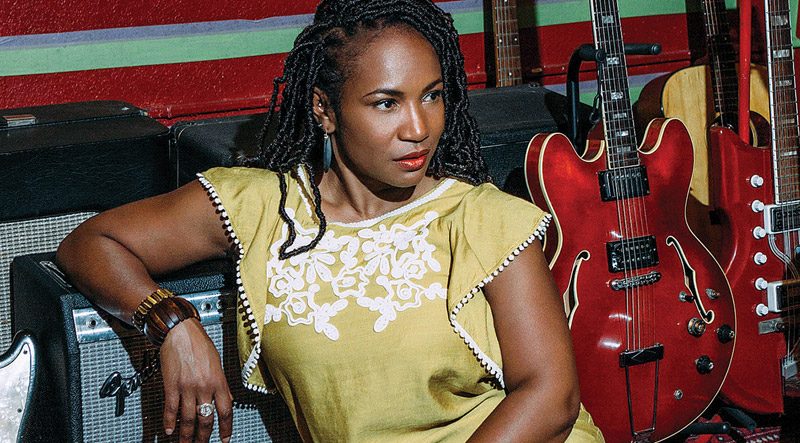
Miko Marks can sing the hell out of country, blues, and soul. And with guitarist/songwriter/producer Steve Wyreman again at her side, this new studio album may be her best yet.
The lead single “This Time” should be a starmaker; with rays of country and R&B, Marks’ impassioned vocals are accented by Wyreman’s guitar, organ, bass, and lap steel. The title track contains echoes of Creedence, the Stones, and maybe even Aretha, Wyreman’s guitar channeling a powerful Mick Taylor aura. “Trouble” rolls and tumbles like a lost ’50s Muddy Waters gem.
Live, Marks and the Resurrectors scorch. Playing an acoustic set as openers on Little Feat’s latest tour, the band left nothing on the table, with Wyreman unleashing funky rhythms and stirring leads from a way-vintage Martin, Justin Phipps on harmonica, and Effie Zilch adding harmony vocals. Playing electric, the ensemble can transform from Chicago blues drive to Muscle Shoals R&B. Side note: If you want to get the chills, check out Marks’ stellar cover of CCR’s “Long As I Can See The Light” on Youtube. And seek out Wyreman’s other projects; he’s a guitarist to watch.
This article originally appeared in VG’s February 2023 issue. All copyrights are by the author and Vintage Guitar magazine. Unauthorized replication or use is strictly prohibited.
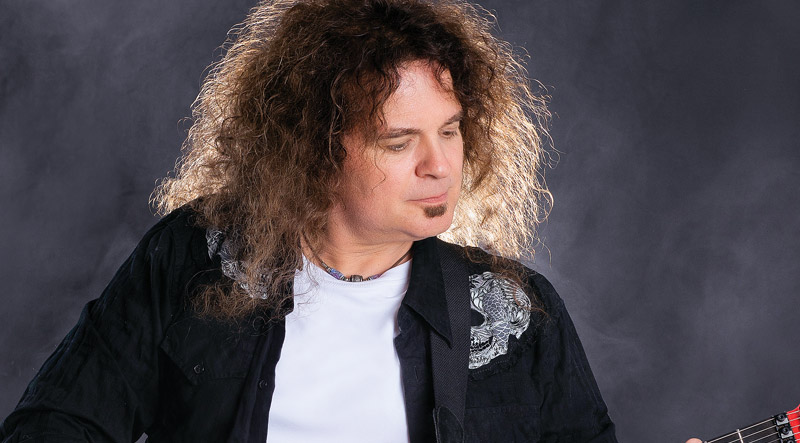
Neoclassical shredder Vinnie Moore’s latest features vocals for the first time. Double Exposure is a heavy-rock record saturated with funky overtones and a high degree of guitarmanship. Joined by vocalists Keith Slack, Ed Terry, Mike DiMeo, and Brian Stephenson, the album is divided into half vocal and half instrumental; Moore stays on point for longtime fans while expanding his purview. With a history of exploring the commonalities between classical music and rock-fusion, longtime fans are well aware of Moore’s guitar prowess from solo records and stints with Alice Cooper and UFO.
Vinnie Moore Double Exposure
“Vertical Horizon” and “Rise” offer ’90s-style hard-rock funkiness where catchy riffs mingle with melodicism and tasteful whammy-pedal flourishes. Moore goes full beast mode on “Paid My Dues” and “Rocket,” utilizing massive riff density, diminuendos, and hyper-fluent rock improvisation. The guest vocals are killer.
“Southern Highway,” ‘Hummingbird,” and “River Flow” display Moore’s hankering for Southern rock, while his Seattle influence rears its head on “Still Waters Run Deep” and “Breaking Through.” Moore’s super mutant powers are employed for good as he puts aside his Bach pedal-point licks, speedy harmonic-minor runs, and sweep-picked arpeggios in favor of soulfully executed pentatonic fury.
This article originally appeared in VG’s February 2023 issue. All copyrights are by the author and Vintage Guitar magazine. Unauthorized replication or use is strictly prohibited.
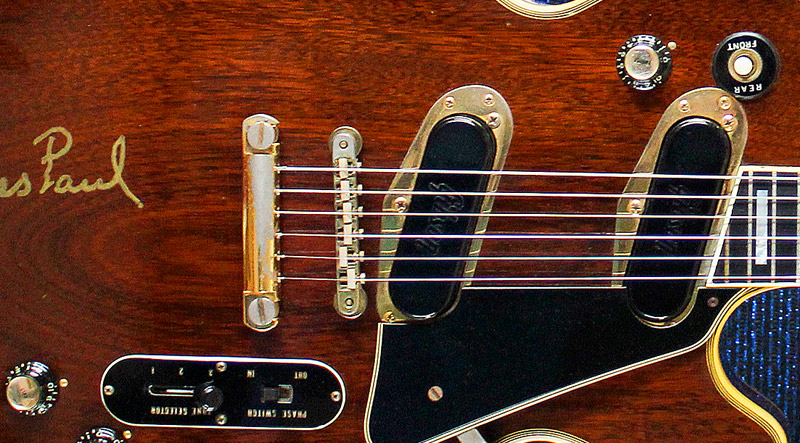
Billy Soutar loves the vibe of his 1969 Les Paul Personal and matching LP-12 amp. While the guitar’s mahogany body, Les Paul Custom touches, three-piece quartersawn neck, and Fretless Wonder frets make it a great player, it mostly serves as a reminder of another guitar – and a great friendship.
“In 1991, I saw a newspaper ad for Les Paul’s Monday-night gigs at the Fat Tuesday’s Jazz Club, in Manhattan,” Soutar said. “I’d been a fan since I was a kid, so my friend, Steve, and I were soon off to New York City, hoping to get Les to autograph my ’52 goldtop and Steve’s ’79 Les Paul 25/50 Anniversary.”
Les Paul and Billy Soutar during their 1991 meeting, with Soutar’s ’52 goldtop. Paul in his kitchen with his and Soutar’s LP Personals.
Driving from Chicago, they arrived in time to enjoy a meal in Fat Tuesday’s dining room, then ambled downstairs early enough to find an empty venue.
“Out of nowhere, Les walks up behind us and says, ‘Watcha’ got in them cases, boys?’ And before we could open them, he stopped us and said, ‘Let’s chat after the first set.’ Then he vanished into the green room.
“Being the first ones there, we grabbed the best table, of course. The club filled around us, and Les’ trio played an incredible set just a few feet away. The energy radiating from him filled the room.”
The LP-12 head in Gibson’s 1970 catalog.
After the set, Les signed autographs and posed for pictures. Once everyone had their turn, he approached Soutar’s table.
“He signed Steve’s guitar with ‘Keep Pickin’,’ but instead of signing mine, he grabbed it and started talking about it as if it were his first offspring,” Soutar laughed. “I tried to hand him the black marker, but he kept changing the subject, then said we would chat more after the second set.”
They later talked until the club closed, then moved the discussion to the sidewalk, where Soutar fielded Les’ increasing offers to buy the ’52. Very attached to the guitar, he kept deferring – until an idea hit.
“I told him I’d feel better trading for one of his guitars, maybe the one he played that night,” Soutar said.
Les declined, but countered…
“He told me the guitar he had that night was one of two Heritage 80 Les Paul Custom Recording models that had been hand-made by Chuck Burge at Gibson, and that he would trade the other one. I agreed, and handed over the ’52.”
The Les Paul Personal/Professional in the ’69 catalog.
Paul wrote his phone number on a piece of paper, then climbed into the passenger seat of an old GMC Jimmy driven by his son, Rusty, and they were off.
The evening was the start of a friendship. In the years that followed, Soutar returned to Les’ gigs several times, bringing friends and family. In ’97, he paid his first visit to Les’ home, where he broached the subject of the trade. Again, though, Les deferred, offering guitars other than the Heritage 80 Custom.
“It turns out the two Burge guitars were insured for a million dollars apiece, and Les had been advised to hold on to them,” Soutar said. “So, he returned the ’52.”
Soutar visited Les and his family several more times before the legend’s passing in 2009, including once to have Rusty install a transformer in the guitar you see here, which Soutar found in an ad in Vintage Guitar. Made for Gibson’s “75 Years of Excellence” Diamond Jubilee Celebration, it’s one of the first Les Paul Personals ever made – one of two in ’69 – and has features of the era like a holly headstock veneer and pearl logo without the dot on the lower-case letter I.
Among Billy Soutar’s Les Paul memorabilia is an autographed invitation to Les’ 1997 birthday party and picks made (and used) by Les.
Getting the full “Hi-Fi” sound Les intended with the Personal model required either plugging straight into a recording console or getting Gibson’s LP-12 amp like the one Soutar bought in 2015. Its cab has a solid state 190-watt amp running two 12″ speakers and two treble horns. The head could power up to 10 of the cabinets, delivering nearly 2,000 watts of the clean power.
“Thanks to a setup done by Rusty to Les’ liking, this guitar plays precisely and sounds incredible,” Soutar said. “It can mimic many sounds at the flip of a switch and does Les’ 1940s ‘New Sounds’ beautifully. I am really lucky! It reminds me of him and Rusty.”
This article originally appeared in VG’s November 2021 issue. All copyrights are by the author and Vintage Guitar magazine. Unauthorized replication or use is strictly prohibited.
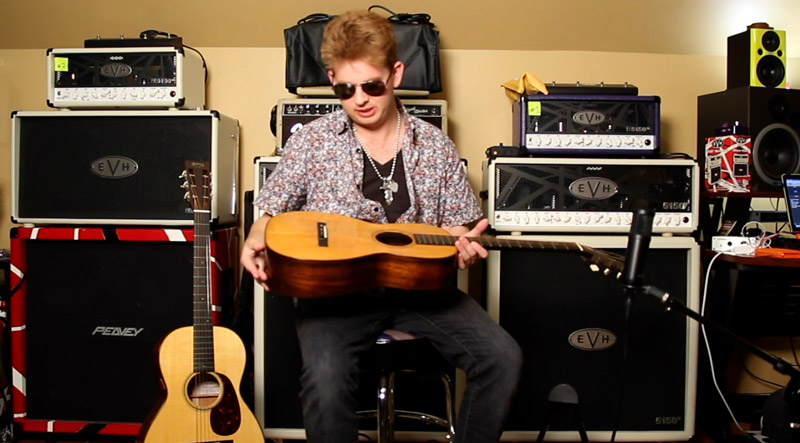
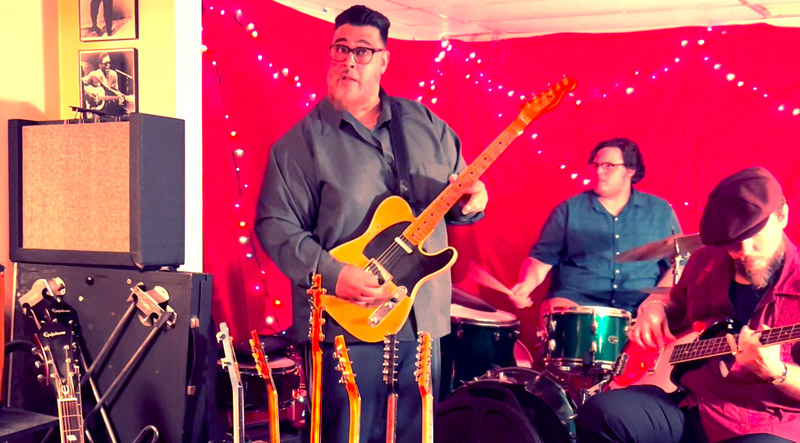
Get ready to have your funtime socks knocked off, ‘cuz this exclusive Nick Moss run through “Scratch N Sniff” is dangerous! A track from his latest album, “Get Your Back Into It!,” he’s doing it with his Fender Custom Shop ’53 Tele plugged into a ’57 Valco Tonemaster (in black and tan, on the shelf in front of him) with a Catalinbread Topanga Spring Reverb doin’ work. Bassist Rodrigo Mantovani is playing a ’60s St. George running through a ’70s Ampeg, and drummer Pierce Downer is using his ’60s Rogers kit with ’50s Zildjians. Keen-eyed guitarheads will also spy a reissue Epi Casino, a late-’60s Riviera, a Grez copy of Nick’s ’54 ES-350, a Dano Longhorn Bass reissue, ’53 Les Paul, ’57-reissue P Bass, ’58 Les Paul Special, a Talion, and a parts Tele. Catch our review of the album and an interview with Nick in the October issue. Read Now!
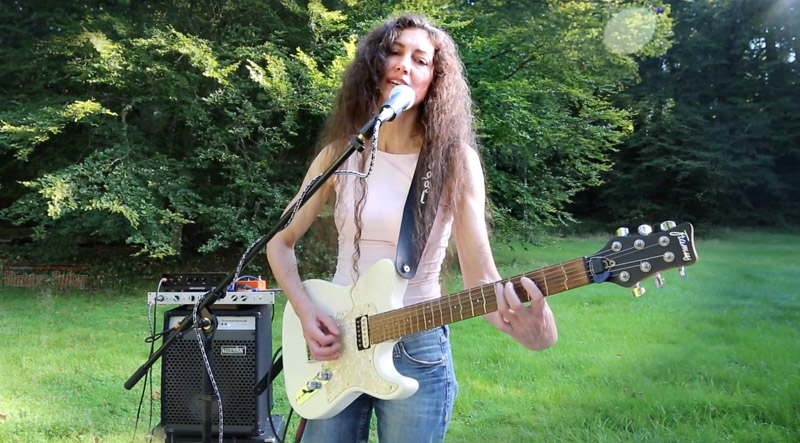
From her home deep in a forest in Sweden, Ana Patan and her Framus Renegade perform “General Conspiracy,” the second track from her album, “Spice, Gold and Tales Untold.” The backing track is Jonas Hellborg (formerly with Ginger Baker and Mahavishnu Orchestra) on bass and Zoltan Csörsz on drums. “My Renegade isn’t old, but Framus has been making guitars since the ’50s and this one is heavily modified,” Ana said. “Its True-Temperament frets were created in Sweden by Anders Thidell.” Catch our review of the album in the October issue. Read Now!
In early 1997, Tom Petty was unsure what the future held for him or his band, the Heartbreakers. But he was searching for something new on the heels of his hit solo album, Wildflowers, and the enormously popular tour that followed.
“I just want to play and get away from the land of videos and records for a while,” the 46-year-old told San Francisco Chronicle writer Joel Selvin. “We want to get back to what we understand. If we went out on an arena tour right now, I don’t think we’d be real inspired. We’re musicians and we want to play. We’ve made so many records in the past five years, I think the best thing for us to do is just go out and play and it will lead us to our next place, wherever that may be.”
“Wherever” proved to be San Francisco’s iconic Fillmore Auditorium – a venue Petty had never even entered, let alone to perform. Once he did, however, he went big with a 20-show residency billed as “The Fillmore House Band,” doing intimate shows before audiences of 1,100.
The stand, which began January 10 and concluded February 7, tossed away the proverbial script; instead of running through faithful deliveries of obligatory hits, Petty and company worked up an array of covers and rarities, re-cast his biggest solo hits, and embraced a freewheeling, spontaneous musical spirit that came to define the event.
With the band rejuvenated and recognizing that something special was happening, they decided to make multi-track recordings of the last six shows. Those performances have just been released as Tom Petty & the Heartbreakers: Live at the Fillmore, 1997.
“It was very kinetic and uncharted territory,” remembers longtime Heartbreakers guitarist Mike Campbell. “For a player used to playing to, for lack of a better word, a ‘script’ every night, it was freedom and an opportunity to just take a chance here and there, and be brave enough to be like, ‘Well, I don’t really know what I’m going to play next, but I’m going to really dig in.’ I would hope something magical happened, and it usually did because of the room and
Like Petty years before, Campbell acknowledges the pre-Fillmore routine of playing large venues, and the strong sense of obligation that came with it.
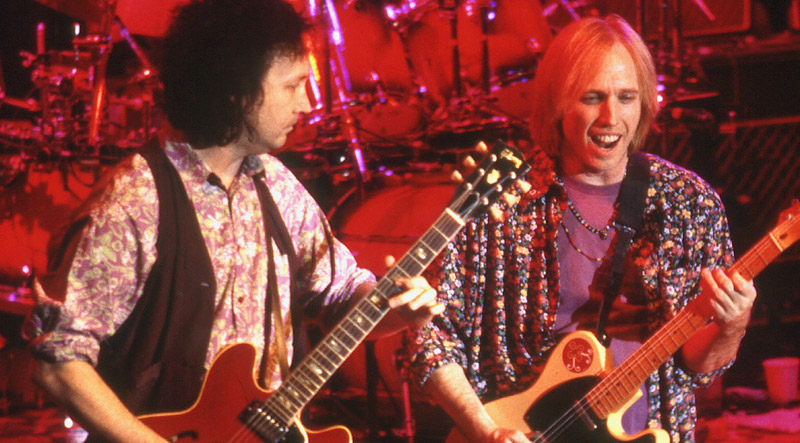
Mike Campbell and Tom Petty onstage at the Fillmore in 1997 (left); Petty has a Tele copy made by Toru Nittono, while Campbell plays a late-’60s ES-335 he found at a swap meet in Pasadena. “I bought it because it reminded me of Chuck Berry,” he said. “I didn’t play it often, but it’s a great guitar.” Petty enjoying himself at the mic during a Fillmore set.
“People spent a lot of money on tickets and parking, and they were used to hearing songs they like,” he said. “We figured it was our job to give them what they want. We would sometimes throw a surprise in here and there, but we didn’t want to take advantage of the crowd, so we gave them the songs they were familiar with – most of the time.”
But those rules didn’t apply at the Fillmore. Freed from convention, the performances preserved on the new live album find the band exploring the kaleidoscope of American music – interpreting songs by J.J. Cale (“Crazy Mama”), Bill Withers (“Ain’t No Sunshine”), The Kinks (“You Really Got Me”), Chuck Berry (“Around and Around”), Booker T & the M.G.’s (“Green Onions”) and the Grateful Dead (“Friend of the Devil”), among others. More than half of the tracks on the new release are covers.
Another notable component of the 20-show run was the stream of guests; performances by blues legend John Lee Hooker and Roger McGuinn are included (though he’s not part of the album, Carl Perkins appeared early in the run).
Some of the finest guitar interplay is found on Petty’s solo hits; “It’s Good to Be King,” “Runnin’ Down a Dream,” “Free Fallin’,” and “You Wreck Me” all feature extended guitar parts, with Petty taking his share of solos. “Jammin’ Me” is played with a fury and immediacy that threatens to upstage the 1987 studio version. And “Mary Jane’s Last Dance,” a track added to the band’s 1993 greatest hits package, became a guitar-centric centerpiece of the Fillmore shows. While the studio version clocked in at less than five minutes, live versions routinely pushed 10.
“It was the Fillmore, ya know?,” Campbell quips. “Before I met Tom, I was in a three-piece band that did a lot of free-form playing like that. Ben (Tench, Heartbreakers’ keyboardist) and I are really good at thinking on our feet and extending songs, and at the big concerts there wasn’t much room for that. But at the Fillmore we could do it and they embraced that approach. Tom and I had this ability to play harmonically together, to complement each other. It was just a great fit. There was just a freedom at those gigs to do whatever popped into our heads, and the other guy would fill in the blanks or join in. It’s magic when that happens.”
Underscoring the free-spirited nature, Campbell did a nightly surf-guitar set, tackling “Goldfinger” (on a Fender Jaguar with loads of reverb) before turning to the Ventures, most notably the 1964 chestnut “Slaughter On Tenth Avenue.”
“[“Slaughter”] was Tom’s idea,” Campbell recalls. “I had the idea for ‘Goldfinger’ because I loved the melody and I love surf music, so I brought that in one afternoon. We learned it, then Tom said, ‘Why don’t we do ‘Slaughter On Tenth Avenue?’ I remembered it from a Ventures record, and I like surf guitar; I like rock, I like blues, I like all kinds of stuff, but surf guitar has a space where the guitar can be the lead voice. I enjoy that quite a bit.”
Another of what Campbell calls the “oddball” selections on Live at the Fillmore, 1997 is “The Date I Had with That Ugly Old Homecoming Queen,” a song anchored by a hard-rock riff. “It’s not much of a song,” Campbell says with a laugh. “It was a riff I played at the sound check, and Tom said, ‘I’ll make something up to that.’ We put it in the show that night, and that’s what he came up with. It was all very loosey-goosey, spontaneous, and exciting.”
While recalling the energy and musical boldness of the Fillmore stand, Campbell also paused to recollect his instrument and amp choices.
“I played my late-’60s Les Paul goldtop with P-90s… I probably played the 1950 Broadcaster, a Rickenbacker 360, and a Vox Mark II we used on a Zombies song.
“I had an interesting amp setup, with a Kustom, a blond Bassman, and something else I don’t remember. It’s been a long time (laughs).”
Campbell hadn’t heard the Fillmore tapes until work began on the new release. But revisiting them provided another opportunity to marvel at Petty’s artistry – the songs, the lyrics, the remarkable power to communicate through music.
“As a guitar player, he was like John Lennon,” Campbell explains. “He was the foundation of the rhythm, and he was great at the rhythm. Occasionally, he would play licks here and there, but mostly he could lay down the rhythm and sing over it like John might do, and it just worked.
“He had a solid feel, good voicings on his chords, and he always had to get a good tone. He was just really good at what he did – very solid, tight, and creative. But mostly he had an exuberance and feel nobody else has. [When] a songwriter writes a song on the guitar and sings it to himself, they go together – the voice and the guitar create this thing – and Tom’s was really special.”
Mike Campbell’s modded late-’60s Les Paul has been with him since the earliest days of the Heartbreakers.
The final night of the Fillmore stand, February 7, was a blowout three-hour show with 40 songs including 10 encores and was broadcast over the radio in addition to an early version of streaming; “We’re also live on the internet… whatever that is,” Petty tells the crowd.
“Everybody should do this,” Petty said when it had ended. “It’s going to be tough to go back to the arenas. I’m not saying we won’t – I’m sure we will – but it’ll never be the same. I wouldn’t be surprised if we did this again next year.”
The band did indeed return to the Fillmore for seven shows in March of ’99 and replicated the experience several times in the ensuing years, including five shows at the Vic Theatre, in Chicago, in April of ’03. In May and June of ’13, they did five shows at New York City’s Beacon Theatre, followed by six at the Henry Fonda Theatre, in Hollywood.
Petty died October 2, 2017. Much has been written about his death, and life on for Campbell and the other members of the Heartbreakers. In ’18 and ’19, he toured with Fleetwood Mac. His current band, The Dirty Knobs, is a hard-rocking, ’60s-inspired outfit that in 2021 released its second album External Combustion, and last year opened a string of dates for The Who. A gig at The Hollywood Bowl on November 1, 2022, was particularly emotional, given the fabled venue where Petty and the Heartbreakers played their final gig on September 25, 2017 – a week before Petty’s death.
“I never dreamed I’d be back on that stage in any way, shape or form,” Campbell says. “But there I was, opening for The Who. The last time I saw Tom was standing onstage at that gig. It felt very sweet to be near him in that sense again. It was closure in a little way, I guess. Very spiritual.”
For the 73-year-old who first met Petty in their native Florida in 1971, revisiting tapes like those that make up Live at the Fillmore, 1997 stirs mixed emotions.
“Of course there’s melancholy because I lost my friend,” he says. “But mostly I’m just so proud and happy that we did what we did. I like revisiting the joy of it. And if there’s a tinge of missing my brother, that goes along with it. But mostly it’s just the joy of celebrating the music we made together. I’m very proud of it.”
Be sure to enter this month’s giveaway for a chance to win a Live at the Fillmore box set. Go to www.vintageguitar.com/category/giveaway.
This article originally appeared in VG’s February 2023 issue. All copyrights are by the author and Vintage Guitar magazine. Unauthorized replication or use is strictly prohibited.
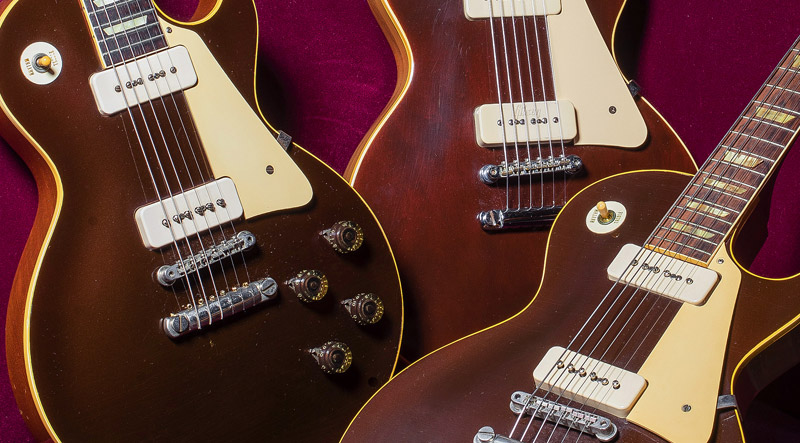
Like large celestial bodies, some guitar collectors have a gravity that draws objects to them. In 2016, rare custom-color Les Pauls began entering Joe Bonamassa’s orbit.
Like large celestial bodies, some guitar collectors have a gravity that draws objects to them. In 2016, rare custom-color Les Pauls began entering Joe Bonamassa’s orbit.
Brought to Gruhn Guitars, an oddball brown Les Paul consigned by its owner in Minnesota caught the attention of a web-surfing Bonamassa. More fascinated than interested, he sent a link to his friend, Mat Koehler, guitarist/collector and Senior Director of Product Development at Gibson Guitars’ Nashville headquarters.
“Joe asked if I thought it was real, and at a glance I figured there was no reason to doubt it, especially since the knobs were painted to match the finish,” Koehler said. “I’m never fully confident judging only by photos, but the asking price seemed low for a custom guitar. I figured that even if it was a refinish, it was a cool refinish.”
The curio was soon on its way to Bonamassa’s Nerdville headquarters in Los Angeles.
“At first glance on the website, of course, I was thinking it was a refin,” Bonamassa recalled. “But once I had it in my hands, there was no doubt it’s original.”
Fast-forward one year. Gibson archives curator Jason Davidson is scanning shipping ledgers on behalf of Cheap Trick guitarist Rick Nielsen, when, in the 1955 book, he stumbles upon consecutive entries in unusual penmanship, with no serial numbers and listing colors he had never heard about – Nugget Gold, Platinum, Samoan Beige, Viceroy Brown, and Copper Iridescent. Wondering if they might have a connection to Bonamassa’s brown guitar, Davidson fired off a note.
Mysterious shades in Gibson’s 1955 shipping ledger.
“When I saw that, I started researching the color names,” Koehler said. “Gibson was using Duco and DuPont car paints in the ’50s, and Rick Gould, a friend of Joe’s who’s very into vintage instruments, went online and matched some to Cadillac and Chevy colors.”
Old color charts are part of the game for guitar collectors, but none of these had been seen on a guitar.
“I recognized Viceroy Brown as a sunburst finish from the 1960s,” said Koehler. “But it appears to have been an opaque walnut-brown, according to ’50s car-manufacturer paint chips.”
His informed speculation was that Gibson had sprayed experimental finishes on five instruments bound for the National Association of Music Merchants (NAMM) show, which would help explain their oddball ledger entries.
The first ’55 to emerge had no serial number while the second did. Truss-cover engraving on the ’72 hints at its status.
A new chapter in the mystery opened in 2018. Koehler was surfing the web one day when up popped an ad for a “1970s Les Paul Deluxe in Custom Brown.” Judging by the small photos, he thought it could be the same color as Bonamassa’s ’55. The seller listed little info, but the guitar looked to be in very good condition, its embossed pickup covers signaling it was from ’72. And like on the ’55, the knobs were painted.
“That was the 20th anniversary of the Les Paul, and Gibson did all sorts of special runs that year – Les Pauls, in particular,” Koehler said. “I guessed it was a nod to something they’d done in the past – maybe the same employee who helped create the brown ’50s guitars had something to do with this one. Or maybe someone in sales ordered it, perhaps as a tribute to the late Clarence Havega, who was beloved at Gibson and would’ve shown those first brown guitars at NAMM in 55.
“Sales guys dictated more product changes and one-offs than people realize, including with neck profiles and fretboard widths. There were changes driven outside of sales, but most of the major ones in the ’50s and ’60s came from the sales team.”
Anyway, as with the first brown guitar, the asking price for the ’72 was reasonable and posed little risk even if it wasn’t exactly as advertised. Besides, Koehler reasoned, if anything in the world belonged at Nerdville, it’s a pair of funky Les Pauls. For the next few years, all was right in guitardom.
Then, in 2021, Bonamassa got an e-mail from his friends Jay and Trevor Boone at Emerald City Guitars, Seattle, telling him they’d found a brown Les Paul with a 1955 serial number in Yuma, Arizona.
After its appearance at NAMM, this ’55 Les Paul was shipped to a retailer, likely in Minnesota. Before its emergence in 2016, few were aware of Copper Iridescent finish.
“Joe told me about it right away, and I was skep tical, because what are the chances?” Koehler said. “It was just strange that we found those entries listing these bizarre special orders… then they start to appear? But we went back to the ledger and there it was – ‘Special order, Copper, Hi Fi strings.’ I thought, ‘How much more provenance do you need?’ The whole thing was just too cool.”
Bonamassa certainly won’t argue.
“I would’ve thought a guitar made for a trade show was a unicorn,” he said. “But of course it was thrilling when the second one showed up and was exactly the same color. It just makes you go, ‘Holy cow!’ It’s a really odd story. One doesn’t have a serial number and was first sold in Minnesota, the other was found in Arizona after its owner moved from Minnesota…”
Describing Copper Iridescent, Bonamassa says, “From five feet, it looks brown. But in direct light, you see gold metalflake in the finish, and it’s just so cool. And it’s fascinating to think they kept the color around even though it never appeared on their custom-color charts. It’s just crazy how all three of the guitars came in different ways. They’re identical, and it’s the coolest trio you’ll ever see.”
Bonamassa was recently contacted by a nephew of the original owner of the first ’55, saying he had the amp his uncle bought with the guitar; the two-tone GA-20 is once again sitting alongside its partner.
Coaxing the guitars’ true color poses a challenge; in most light and from most angles, Copper Iridescent is an underwhelming brown. Intense direct light, though, reveals a dramatic metalflake.
“For mere mortals, stumbling upon a guitar like any one of these would be life-changing. But finding all three? It’s just another day in the life of Joe,” Koehler said with a chuckle.
Bonamassa adds that they offer a lesson for all guitar collectors.
“Never say you have the only one of something,” he laughed. “Because the chances are good you’ll be wrong.”
Speaking of, Koehler recently found a Copper Iridescent guitar listed in the 1956 ledger, prompting him to clown with Bonamassa.
“I texted an animated gif of Yoda saying, ‘No, there is another’ and a photo of the entry.”
Bonamassa says, “We have no idea where it is,” and insists he’s not on the hunt. If he waits, though, it’ll probably drift its way through time and space to land at Nerdville.
This article originally appeared in VG’s February 2023 issue. All copyrights are by the author and Vintage Guitar magazine. Unauthorized replication or use is strictly prohibited.
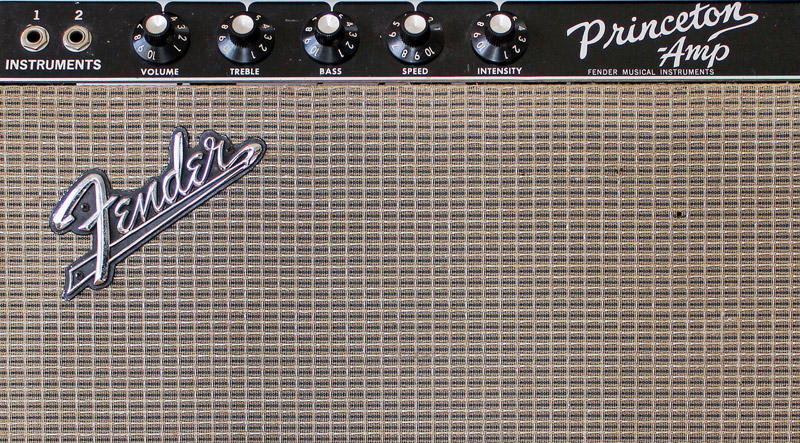
Getting the job done – five simple knobs on the Princeton’s control panel.
1966 Fender Princeton
• Preamp tubes: one 7025, one 12AX7
• Output tubes: two 6V6GT
• Rectifier: GZ34
• Controls: Volume, Treble, Bass, Tremolo Speed and Intensity
• Speaker: Single 10″ Jensen C10R or Oxford 10J4 (modern replacement seen in this example)
• Output: approximately 12 watts RMS
Fender’s Princeton Reverb combo has long been considered one of the best all-round amps, while its non-reverb sibling languished in its shadow. The humbler ’60s classic, though, presents bountiful charms of its own, and can even be the preferred vehicle in some situations.
Maybe you just couldn’t afford the reverb model, or maybe you never liked reverb in the first place. Whatever the rationale, Fender saw the desirability of including both versions of some amps throughout its glory years. The fabled Deluxe had a non-reverb version, as did the Pro and Bandmaster, but for all the bias toward reverb-laden small Fenders, the Princeton might be the most utilitarian.
Of course, the Princeton was born without reverb. Among Fender’s very first amp models, it arrived in 1946 as the smallest combo in a trio that included the Deluxe and Professional in ascending order, all birthed when the delay-based effect wasn’t even a glimmer in Leo Fender’s eye – or anyone’s for that matter.
Arriving with Fender’s primitive “woody” cabinet, the Princeton took on the seminal tweed covering (a type of aircraft linen) in the TV-front cabinet of 1948. Through this period and until the end of the ’50s, it remained a single-ended amp, meaning it had just one output tube, a configuration more familiar in the form of the diminutive Champ, which also joined the lineup in ’48. At that time, the Princeton gained both a Volume and Tone control, which was two more knobs than it had been born with – the original theory being that players could use their lap-steel guitar’s own controls to govern this “student” amp’s volume.
The non-reverb Princeton generates a lot of tone from simple ingredients, with just two preamp tubes, two 6V6GT output tubes, and a GZ34 rectifier.
Evolving into the wide-panel tweed cabinet circa late ’52 and the narrow-panel in ’55 (alongside the rest of the Fender amp lineup) the Princeton remained the second combo up the ladder. Though its circuit was virtually the same, barring the added Tone control, the Princeton was in a larger cabinet that helped its sound bloom, and had an 8″ speaker versus the Champ’s 6″, before it too was upsized later in the ’50s. Otherwise, through nearly the first decade and a half of its existence the Princeton had kind of remained “a Champ with benefits,” and little more than a lower-rung student or beginner’s amp.
All that changed in 1961. Along with revamping its entire amp lineup, Fender kicked the Princeton into the big leagues… or medium leagues, at least. The brown-panel 6G2 Princeton of 1961-’63 carried two 6V6GTs in a fixed-bias, push/pull output stage that generated about 12 watts – all elements and specs we can apply to the black-panel Princeton you see here. The preamp had two 12AX7s (technically, the first position held an equivalent 7025), which is also the topology of the non-reverb Princeton that followed in black Tolex with black panel and black skirted knobs with silver-inserts in ’63. From ’61 onward, the Princeton jumped into a slightly larger cabinet with a single 10″ speaker.
The result of all this was that, while it still made a great student amp, the combo was capable of cutting it on the club stage alongside a moderate drummer, and was arguably the ideal size and power for studio use.
Though it was built about a year after CBS’ purchase of Fender, the ’66 Princeton has the same circuit and carries all the laudable black-panel components as the pre-CBS examples. The adjustable bias control (with twisted gray/red wires extending behind the faceplate) is a modification.
Though the brown 6G2 Princeton of 1961-’63 and the black AA964 Princeton of ’64-’67 had two preamp tubes for gain stages, tremolo, and phase inverter, and they outwardly appeared to have been applied to similar duties, a few differences in the configuration brought notable changes to the way these successive amps sounded. While the signal chain for each went input to gain stage to controls to gain stage to output stage, the single Tone control on the 6G2 drained less gain, leaving it hotter as it hit the output stage compared to the signal loss imposed by the AA964’s two controls and circuit with Bass and Treble pots.
Whereas the AA1164 Princeton Reverb included another half of a 12AX7 post-reverb – a full third gain stage – to bring the gain back up to 6G2-like levels after the tone stack, the second and final gain stage of the non-reverb AA964 Princeton merely restored what the EQ circuit took away. This kept it all crisp and pristine on the way to the phase inverter, with little in line to push the amp into overdrive; therein lies the beauty of this circuit for certain playing styles.
In all of these ’60s variations, the final preamp tube is split into two uses – half powers the simple-but-effective tremolo effect, the other forms a simple split-load phase inverter much like on the earlier tweed Deluxe and the larger tweed Super, Pro, Bandmaster, and low-powered Twin.
Put all of this together and the non-reverb Princeton doesn’t sing with the gusto of its gained-up sibling, but that tendency can be used to a player’s advantage; where the AA1164 Princeton Reverb can sound a little raw and haggard when pushed hard (especially with humbuckers), the AA964 remains throaty and articulate right up to 10 on the Volume control, delivering the early signs of succulent breakup when hit with a humbucker guitar or a set of P-90s, but barely edging beyond clean with single-coils, as on a traditional Strat or Tele or any vintage-voiced Gretsch. This also means the non-reverb Princeton retains impressive headroom for its size and rating, but it pairs very well with a good overdrive pedal or two in front, enabling a near-symbiotic merging of clean and overdrive tones, and arguably delivering more of the good stuff from each than the quicker-to-fold reverb amp. All that, and its luscious bias-modulated tremolo suffers not in the least from the amp’s lack of reverb.
Though so often the underdog on the vintage market, the non-reverb Princeton ultimately reveals a thing of sonic beauty, and displays more of the characteristic that helped make black-panel Fenders legendary performers in the first place – some of the sweetest, liveliest clean tones ever produced this side of the Atlantic.
This article originally appeared in VG’s February 2023 issue. All copyrights are by the author and Vintage Guitar magazine. Unauthorized replication or use is strictly prohibited.
Tyler Morris grabbed his 19th-century Martin Style 2 1/2-17 to play a medley of 20th-century licks. He also digs into the history of the instrument and notes its similarities to his modern Martin. Keep up with Tyler HERE!
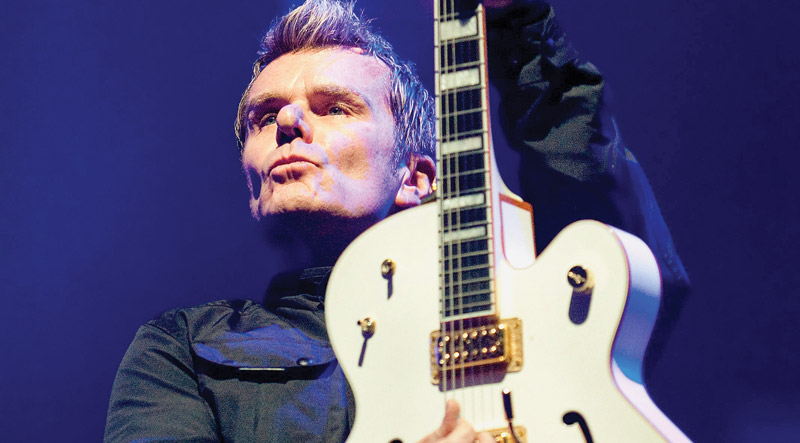
Co-founder of The Cult, Billy Duffy was Britain’s last ’80s guitar hero, with an attitude and sound that embodied the essence of rock guitar. While lauded, that X factor was misunderstood by critics.
Historically, Duffy bridged gaps between hard rock, melodic metal, punk, and alternative in an era fraught with conformity by adhering to the audacious mindset and swagger of rock, in the process giving music a much-needed kick in the bum.
William Henry Duffy, born in Manchester, England, on May 12, 1961, began playing guitar at 15 and was bred on hard rock and glam before gravitating to punk in ’76. He played with local punk band The Nosebleeds, which also included Steven Morrissey, in the process inspiring neighborhood guitarist Johnny Marr to pursue greater aspirations and encouraging Morrissey to become a frontman. Morrissey and Marr subsequently realized their goals in The Smiths.
Duffy moved to London in ’79 and immersed himself in its alternative scene while joining Theater of Hate. He met vocalist and future songwriting partner Ian Astbury when Astbury’s band, Southern Death Cult, preceded Hate at a gig. They became a musical team and by ’83, as co-leaders of the abbreviated Death Cult, and finally, The Cult, built a following on post-punk/goth-rock circuits and recorded an EP, Death Cult. Dreamtime, their debut album, was released on Beggars Banquet in August ’84. Laced with psychedelia, Duffy’s textural processed guitar parts (drawing favorable comparisons to U2 and Big Country) and references to mythology and shamanism, the record reached #21 in England and sported the single “Spiritwalker,” which hit #1 on the indie charts. Their power-rock sound and ostentatious guitar solos were at odds with alternative-inclined critics and peers but created momentum toward Love (1985), a breakthrough album produced by Steve Brown that reached #15 in the U.K. Despite subliminal goth elements and Duffy’s vestigial jangle-pop tones, Love made no pretensions about being anything other than a guitar-dominated rock effort. Viewed as anachronistic by the British music press, it nonetheless was a commercial success and trumpeted Cult’s evolving sound with the popular singles “She Sells Sanctuary,” “Rain,” and “Revolution,” and fan favorites “Love” and “Phoenix.”
Duffy is a formidable arranger. These excerpts from “Love Removal Machine” (Electric) present three aspects of his guitar-layering approach. 1) The main riff played in verses is a tight rhythm figure made of triad-based voicings and sus4 suspensions on D and C. G5 is rendered as a larger power-chord sonority exploiting open strings. Note the effective use of space (rests) throughout. 2) The chorus riff conveys a lead/rhythm approach with his mixture of first-position open chords and lower-register single-note melody. Check out Duffy’s emblematic Csus2 in the phrase. 3) His lead solo is filled with definitive Duffy elements. This sample features a cycling ostinato pattern of repeated blues-rock bends and pentatonic melody contrasted by a languorous tortured bend and a zigzagging intervallic line in D minor pentatonic that twists his blues content into a modernistic shape.
Electric (1987) continued their ascent and cemented inclusion in the ’80s classic-rock renaissance. Sessions that started in England with Brown proved unsatisfying and Duffy and Astbury found more sympathetic ears with Rick Rubin, an American producer known for rap and hip-hop but relatively inexperienced with live drums and rock guitar. Enamored of Aerosmith, Led Zeppelin, and AC/DC, Rubin found common cause with The Cult’s increasing heaviness and primal rhythms; opting for a straightforward sound with less coloration completed their shift to hard rock. They also shifted to a classic British quartet a la Zep and The Who (albeit with rotating bass/drums sidemen) and arena stars with landmark pieces like “Love Removal Machine,” “Lil’ Devil,” “Wild Flower” and remake of “Born to Be Wild.” The aptly-titled album hit #4, spending 27 weeks on U.K. charts, and cracked the U.S. Top 40.
Sonic Temple (’89) enlisted the production services of Bob Rock and proved to be their masterpiece, the realization of Duffy’s aim to “capture the essence of what a power chord felt like,” depicted boldly with the cover’s emblematic guitar-hero stance.
A balanced opus combining punk sensibilities and classic-rock intentions with improved sonics and heavier timbres spread across the stereo spectrum, it epitomizes how a Les Paul could be used, with only hints of Duffy’s previous signal processing. The album rankled critics but propelled the band into mainstream rock circles, yielding a string of hits, selling more than 1.5 million copies in the U.S., cracking Billboard’s Top 10, and reaching #3 in England, all while sidestepping hair-band formulas and misogynistic cliches in songs like “Sun King,” “Fire Woman,” “Edie (Ciao Baby)” and “Sweet Soul Sister.”
Ceremony (’91), produced by Richie Zito, reflected tensions between Duffy and Astbury and portended The Cult’s waning popularity, exacerbated by the arrival of grunge and a lawsuit over cover art delaying release. Nevertheless, it garnered Gold status in America, with Astbury’s story lines revisiting the Native-American mythos of Dreamtime while Duffy’s guitar bombast and diversity were reprised on “Hearted Son,” “If,” “Heart Full of Soul,” “Sweet Salvation” and “Ceremony.”
The Cult (’94) reinstated Rock as producer and made greater use of sonic diversity, terraced dynamics and light/dark shades. The juxtaposing of hard-rock timbres with retro and acoustic sounds reinforced the Zep connection, emphasized by the acoustic-driven “Sacred Life,” layering in “Saints Are Down,” uncommon instrumentation, wah, and fuzz in “Gone,” and heavy riffing of “Be Free.” The album reached #69 in the U.S. and #21 in Britain, prompting Duffy and Astbury to disband in ’95. With varying personnel backing, Duffy and Astbury reunited for a run (1999-2002), toured, and released three albums spaced several years apart (’07, ’12, ’16), and returned with Under the Midnight Sun in 2022.
“Sun King” is the powerful opening track on Sonic Temple. A masterful example of Duffy’s riffmaking in song context, it embodies his strategy of harnessing guitar parts to build a rock arrangement with forward motion to the chorus. 1)The verse figure is made of simple power chords and emphasizes syncopation and space. 2) The pre-chorus shifts gears with a driving hard-rock pattern of power chords broken into dyads posed above bass notes in steady eighth rhythm. 3) The chorus riff is a contrasting jangley affair with more-animated sustained arpeggiations and thematic melody lines woven into a textural phrase.
INFLUENCES
Duffy enjoys numerous influences. His playlist includes The Who, Mott the Hoople, Status Quo, Sweet, Slade, Thin Lizzy, Alice Cooper, David Bowie, Be Bop Deluxe, Roxy Music, Led Zep, Queen, AC/DC, Sex Pistols, The Clash, The Damned, New York Dolls, Montrose, and guitarists who “weren’t so obvious” including Mick Ralphs, Mick Ronson, Bill Nelson, Paul Kossoff, Johnny Thunders, Steve Jones, and James Williamson.
STYLE
In the age of high-gain noodling, two-hand-tapping, and neoclassic shred, Duffy stood as a proud emissary of classic rock. His riffs and power chording are definitive nods to the genre, while his lead lines re-shaped the stylistic DNA of Chuck Berry, Jimmy Page, and Angus Young. Consider the relentless wah assault of “Phoenix” (Love) reminiscent of Clapton’s live-Cream solos in “White Room” and “Brave Ulysses.” Or the AC/DC-inspired rhythmic pocket of “Wild Flower” and dynamic Zep-like riffs of “Automatic Blues.” The Cult was a riff-driven band since its earliest post-punk incarnations, but Duffy’s transcendent thrashing was guided by his credo that a riff must function within the song’s context and took many forms, like the ethnically-tinged theme of “American Heroes.” Self-evident are the driving rhythm phrases and punchy bass-register figures in the repertoire, but what about his strong melodic hooks played over intros, verses and choruses of songs like “Rain” and “Fire Woman”? Solid rhythm playing is a cornerstone of Duffy’s style extant in power chording, decorative (often droning) chordal arpeggiations, and single-note theme riffs – each representing a central facet of his ensemble work. He often expands root-5th power chords with colorful suspended or add2 voicings, as in “Sun King,” “Fire Woman” and “Love Removal Machine.” An evolving player, by Electric, Duffy had moved past his punk/goth influences to exploit the ethos of AC/DC, Free and Zep, eschewing the processed texturalism of Love in favor of leaner, drier hard-rock tones.
As a soloist, he is blues-based like rockers Page or Kossoff rather than a scholarly disciple of B.B. King or Buddy Guy. His solos incorporate requisite pentatonic cliches and idiomatic string bending of blues guitar, but convey an alternative attitude informed by punk and hard rock underscored by his aggressive attack, pinch harmonics, and whammy-bar dips and dives. He modifies his pentatonic mannerisms with extensions (typically adding tones from the Dorian mode), chromatic passing tones, and diatonic scalar content, all present in his “Sun King” solo. Many solos harness purposeful repetition as ostinato patterns (“Love Removal Machine”) and cycling double-stops, a tactic synonymous with rock improvisation.
Reflecting a period of deliberate practicing, Duffy’s lead work on Sonic Temple flaunted L.A.-honed technical advances, faster runs, expanded whammy-bar zaniness, and more-conspicuous metal harmonics mingled with blues-rock staples.
Onstage, he prefers to be sole guitarist, but in the studio regularly multi-tracks parts to produce his trademark wall of sound and develop orchestrations, which necessitated adding a rhythm-guitar sideman on some tours. Saturated distortion and high volume versus clean electric and lighter acoustic colors are shades he alternates consistently and thoughtfully. Case in point is the web of harmonized melody guitars, overdriven rhythm guitars, chorused lead soloing, and acoustic timbres in “Edie (Ciao Baby),” woven into a driving rock arrangement containing string parts. Also notable is his layering of three processed guitar voices in “Fire Woman”: electric arpeggiation (with slap-back echo) in the intro, 12-string chording (with modulation and delay) and slide guitar (with echo effects).
“Fire Woman” contains one of Duffy’s most emotional and memorable solos, and was a highlight of the Sonic Temple sessions. This example, played over a half-time change in feel, demonstrates technical advances permeating his lead work on the album. Notice the faster, more-complex passages incorporating the hexatonic sound (E added to expand D minor pentatonic) as well as variations in phrasing: blues-rock strandedness and vibrato, slippery legato lines contrasted by choppy staccato articulation, and extensive slurring on a single string. The transition from 2/4 to 4/4 meter and return to tempo are emphasized with a quick flurry into the highest register, producing a dramatic climax to the solo.
Effects play a substantial role in Duffy’s style. The intro to “She Sells Sanctuary” is a definitive early example with its background sci-fi soundscape featuring a heavily processed orchestration created with opulent distortion and modulation/delay effects over which he plays a chiming arpeggiated theme colored with delay and modulation.
ESSENTIAL LISTENING Sonic Temple, Electric, and Love are undisputed Cult classics of the ‘80s. Pure Cult is a serviceable collection while Rare Cult provides a deeper dive.
ESSENTIAL VIEWING
Cult fans will want to compare two live versions (MTV awards ’89 and Milwaukee ’22) of “Fire Woman” online. Also recommended are Live at the Ritz (’85), Live on BBC (’87) and Duffy’s 2014 Sweetwater interview.
SOUND
Duffy adopted and exploited a hollowbody Gretsch with Bigsby tailpiece as a hard-rock instrument on The Cult’s early albums, when his sound emanated from a ’75 White Falcon acquired in ’81. He stuffed its body with cloth or foam, taped the sound holes from inside to reduce feedback, and pinned the floating bridge. By ’89, he favored Gibson Les Paul Customs (some with Floyd Rose vibrato systems) fitted with Duncan Jeff Beck pickups. His primary instrument was a stripped-finish ’78. More recently, he has preferred a black Les Paul Custom, reissues of a ’58 Standard, TV Junior, and ’57 goldtop, silver-sparkle Gretsch White Falcon and Black Falcon G7593T Duffy signature models, or Stephen Stern-built copies of his “Sanctuary” Falcon, all strung with Ernie Ball .011-.048 Power Slinkys. His recording guitars include an early-’60s Strat for clean tones, Nash relic Esquires, a Performance Guitar “Stonehenge model” superstrat for alternate lead sounds, and Gibson J-200 and Guild F-412 acoustics.
Duffy has used a variety of amps. Early on, Marshalls were the norm for distorted tones while cleans (“Fire Woman”) came from a Roland JC-120. On The Cult, he employed gems from Rock’s collection – a Gibson Skylark, Fender Champ, tweed Bassman, Matchless DC-30, Peavey 5150, and modified Marshall JCM 800s. In 2015, he played a Marshall 1973X combo in the studio, and onstage incorporated a Chinese-built Vox AC30 along with his JC-120 (miked for stereo chorusing) and favored Friedman heads with Marshall slant cabs.
An exponent of effects pedals (analog and digital), Duffy employed Boss and MXR delay/phasing/modulation stompboxes and Crybaby wah during Dreamtime, Love, and Electric. After Sonic Temple, he consolidated effects in a Bradshaw system, using only a Boss Super Overdrive, Crybaby and Morley wahs (the second as an EQ/filter) and other processors for clean/dirty amp signal paths with a MIDI switcher. His distortion came from a Harry Colby-modded 100-watt Marshall head and 4×12 cab while his clean path utilized a stock Marshall head and 4×12 into racked units – two Korg 2000 delays, two Yamaha SPX90s, TC chorus, Boss Flanger, MXR Phase 100, and 400-watt H&H power amp driving four cabinets in stereo. In ’94, he experimented with vintage Vox wahs and Fuzz Face (prominent on “Gone”), and in the 2000s reverted to a simpler pedalboard with Boss stompboxes, Dunlop Duffy Cry Baby wah with 10db boost, Uchida treble booster, Ibanez Tube Screamer and Kalamazoo overdrives, and a Tripler amp selector.
Wolf Marshall is the founder and original editor-in-chief of GuitarOne magazine. A respected author and columnist, he has been influential in contemporary music education since the early 1980s. His books include 101 Must-Know Rock Licks, B.B. King: the Definitive Collection, and Best of Jazz Guitar, and a list credits can be found at wolfmarshall.com.
This article originally appeared in VG’s February 2023 issue. All copyrights are by the author and Vintage Guitar magazine. Unauthorized replication or use is strictly prohibited.











 Getting the job done – five simple knobs on the Princeton’s control panel.