Though Diamond Head never achieved the same worldwide commercial success enjoyed by some of its fellow New Wave of British Heavy Metal compadres (namely Iron Maiden and Def Leppard), their influence on one of metal’s biggest bands is undeniable. Metallica has covered four of the band’s tunes, and while members have come and gone, guitarist Brian Tatler has remained a constant from the beginning – and is featured once more on the band’s first new album in eight years, Diamond Head.
The new album sounds reminiscent of the band’s early work.
I think it was kind of a conscious decision. It’s difficult to imagine yourself back in the old days, and try and write something like the first album, Lightning to the Nations, but it does seem to be the one people like the best. And of course, you’ve got the “Metallica connection” – the four songs they covered were all from our first album. So there is a bit of thought behind the new album, that it should sound like a Diamond Head album and not like we’re trying to sound like anybody else or trying to be modern. The way I write and the chords I use and the riffs I come up with… we had a discussion about it and thought that would be the way to go, to make that kind of record.
From a guitar standpoint, which are your favorite songs?
I like the opening track, “Bones.” It’s got great riffs and I thought that would be a good opener to the album. And then I think my second favorite track would be “All the Reasons You Live,” which is a slower track, and that’s detuned – that’s in C#. I think it grooves and the [Rasmus Bom Andersen] vocal is fantastic on there.
What do you recall about writing “Am I Evil?,” from Nations?
It started with the riff, as they so often do. So I had this big, heavy riff – which I suppose is a little bit like a Black Sabbath riff – and we decided to work on it. We would have been in my bedroom; we used to have a weekly rehearsal there, and we built it until it grew to be seven minutes and 40 seconds long. We’d stick a bit on the end and a bit on the intro, and the solo evolved over time. We got very good at working on arrangements, rather than it just be a simple verse/chorus, three-minute song.
We somehow got into the idea of making long, epic songs, that kept the listener’s interest for six or seven minutes. I find it very difficult to do now, but at the time, we were brimming with confidence, and you’re on this journey to see what’s possible, and anything goes.
What was your initial impression of Metallica’s cover?
I was flattered. I knew Lars [Ulrich] because he had come to see us. So to me, it was, “Lars’ band has covered ‘Am I Evil?’’’ They weren’t what they are today – the biggest metal band of all time. They were on a little label, Music for Nations. I hadn’t seen them yet; this was 1984, and it was a B-side to “Creeping Death.” When I listened to it, I thought, “They’ve gone through so much trouble to learn it and play it properly and work out the solo.” I thought it was more aggressive than our version. James [Hetfield] has got more of an aggressive style of singing than Sean.
What was your setup then?
In the early ’80s, I had the white Gibson Flying V, which is always my main guitar, and that would be going into a Morley Power Wah Boost and a Marshall – probably an early Master Volume JMP-1 from ’77. Lightning to the Nations is recorded with just that – it was all we had.
Do you give guitar lessons?
Yeah, I’ve been giving lessons for eight years. I do them from home, and a lot of times it’s young kids coming after school. You have to start with an E chord and build from there. Sometimes, it’s older guys, and they’re in a rut, and they want to get out of the rut. Sometimes they say they don’t know how to play all over the neck. It’s very interesting to see other people’s styles and to analyze your picking style and the way you hold your hand and fingers. It’s taught me quite a lot, teaching.
This article originally appeared in VG August 2016 issue. All copyrights are by the author and Vintage Guitar magazine. Unauthorized replication or use is strictly prohibited.
In early 2009, VG columnist Peter Stuart Kohman turned his focus on Burns, the pioneering British guitar builder. We’ve compiled installments 9, 10, and 11 for this special edition of VG Overdrive. See the complete history.
Many who own Burns and Baldwin guitars are curious to date their instrument, and wonder just how rare these guitars really are. While no official records appear to have survived, there is enough information available to make educated guesses. Most (but not all) Burns and Baldwin guitars made from 1961 to ’70 carry serial numbers progressing in a single series. The early Artists, Vibra Artists, and Sonic series never bore serial numbers and can only be roughly dated by features. The Artists were phased out in 1962, and the Sonics in early ’64.
With the introduction of the original Black Bison, serial numbers come into use starting at 01 and were applied to the many subsequent bolt-neck models. This series appears to run up to just over 22,000 during the next seven to eight years. It’s possible that not all numbers were used when new, and many leftover pre-numbered plates are reportedly still extant.
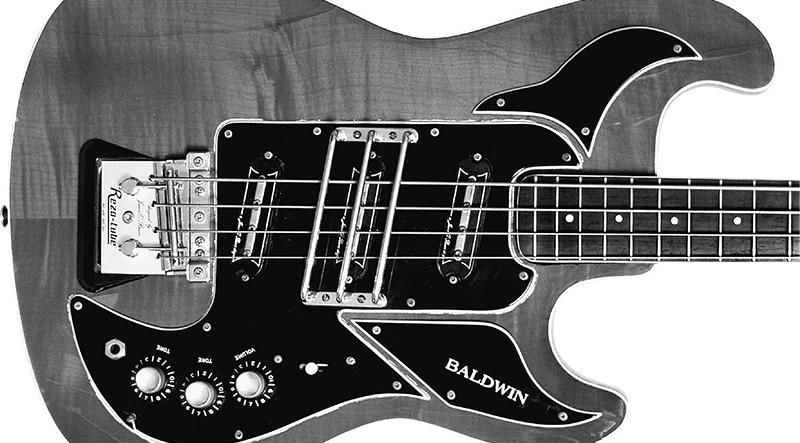
The Shadows “S” bass.
Burns serial numbers are much like Fender’s; they were engraved by an outside supplier, presumably in order, but were not applied to instruments in sequence. The digits are found on the plastic plate covering the neck-mounting screws on the back (except for the earliest Black Bisons, which carry theirs in the vibrato cradle). This neck plate (which bore an ever-increasing plethora of patent numbers) is easily removed, exchanged, lost, or broken, so sometimes, the number is missing. The situation is further complicated because, by ’64, there were several different-sized neck plates in use, and they were not interchangeable. As these were engraved before installation, different instruments’ production schedules got out of sync, resulting in the series not progressing in an orderly manner. The guitars do tend to cluster in batches, especially the more popular models. If a certain number is found on a Jazz Split Sound, many adjacent ones will be the same model – or at least one using the same size plate. They often progress in batches of 100 but seem to often switch at the “XX50” point in a sequence. Remember that by mid ’66, instruments were being assembled both in the U.K. and in the U.S., so by that time even the hope of a cohesive order was gone!
Various forms of Burns neck plates.
Many Burns and Baldwins from 1963 through ’67 carry a signed inspection tag with a stamped date inside. While useful, the date is not the day the guitar was assembled – it’s the date the pickup rig was wired up and tested. Many of early Baldwin-logo’d instruments from fall ’65 carry stamps dating back as much as six months; or more obviously, production of components and the guitars being assembled was seriously out of synch by 1965! Some stamps have faded to illegibility or are missing altogether, but those still visible give a useful (if unreliable) correlation to the serial number series. Numbers 01 to approximately 1,200 appear to have been used in 1962 through early ’63. By the end of that year, Burns was up to about 4,000, though ’63 numbers often run wildly out of sequence within this grouping. By the end of ’64, the series showed a huge uptick in production, with numbers in the 9,500 to 9,800s appearing before January ’65. As the un-numbered Sonic budget instruments were discontinued by early/mid ’64, the increase in factory output was not as dramatic as it appears, but still impressive! 1965 numbers progress from the last of the 9,000s up through around 13,000 – the sequence of transition to the Baldwin logo is far from strict. 1966 dates appear in instruments numbered way up through 19,000, but again the sequencing seems wildly out of order by this point – the transition to the newer Baldwin styles (i.e. mid ’66) occurs on many models around 15,000. Instruments with numbers from 18,000 to 22,000 sometimes carry 1967 dates, but the stamped dating becomes haphazard by this point, and it appears production slowed. Some production – or maybe just assembly of existing parts – reportedly continued through around 1970.
Among production Baldwin models, only the 700 series hollowbodies built with Italian components do not follow this sequence. They debut in late ’66 and carry two number series, neither of which correlate with the main line. The first examples use four digits, which may begin at 1000 or possibly 0100. Someone soon figured out that these numbers duplicate those issued earlier by Burns, so this was changed to a more commonly seen new series starting at 71,000. These guitars were built from 1966 to ’69, and pretty much date themselves! The 700s are fairly common, and must have been made quickly in some quantity. Overall, the most common guitar from the Burns era is the Jazz Split Sound, which maintains its preponderance until ’66, when the re-styled Baldwin Vibraslim was also sold in comparatively large numbers. Marvins, Bisons, and the like are much rarer, with only occasional batches assembled after the Baldwin takeover. Adding up the outside possible total figure for the serially numbered run of 22,000, a few thousand early un-numbered Sonic and Artist instruments and possibly several thousand 700-series models yields a highest total probable production estimate for the entire ’60s of 25,000 to 30,000 instruments total – but that’s a guess. The figure represents only a fraction of what Fender or Gibson could produce in a single year of the 1960s, so by those standards any Burns/Baldwin instrument is fairly rare!
So now, here are some serious rarities!
Baldwin’s doomed Model 601.
An interesting example of a serial number/date mismatch, the Shadows S (Special) Bass shown here emerged earlier this year in a pawn shop in Maine. Two matching Marvins are known in the same style, reportedly built for The Shadows in mid ’66 as an experimental Mark II version of their regular instruments. The bodies are flat-topped with bound edges and hollow acoustic pockets, while the necks feature the original Burns scroll, not the newer “lump” Baldwin version. A Marvin S guitar featured in Per Gjorde’s Pearls and Crazy Diamonds reportedly belonged to Hank himself; this bass matches that guitar in all its specific eccentricities, including the bound/green-finished body, lack of headstock logo, laminate black scratchplate, and apparently leftover 1962-’63 serial number plate only a few digits apart. It’s not known for sure if this bass was actually made for or used by John Rostill, of the Shadows. Some accounts say the set was supplied to the band and used on their ’67 Australian tour, but footage shows a pair of differently appointed (but equally odd) white Baldwin prototypes in the hands of Marvin and Welch, and Rostill playing his normal solidbody bass. Whatever its history, the bass shows signs of use, but remains in excellent condition except for typical Baldwin-era heavy checking in the heavy polyester overcoat, which is practically peeling off in spots.
“The Shadows S bass is wonderful and a real find,” said Burns guru Paul Day. “I mentioned it to Barry Gibson (head of Burns U.K.) and he, too, was surprised and impressed.”
Around the same time as these Romford-built artist one-offs, a uniquely American line of Baldwin models was designed in Arkansas, but not produced in quantity. Still, some interesting prototype examples have surfaced. This would have been the 600 series, a Baldwin concept using some Burns parts. As reported several years ago by Michael Wright in VG, “About this time… Baldwin hooked up with a luthier by the name of Clyde Edwards, and hired him to design a line of U.S.-made guitars at the Booneville plant… sometime in late ’66. They never appeared in Baldwin catalogs or advertising. Basically, the Edwards was a single-cutaway hollowbody with a pair of f-holes and one of those shoulder profiles where the upper bout made an S-curve through the neck into the pointed Florentine cutaway. Despite the fact these models never entered production, the company was apparently pleased with Edwards, because he went on to work for the Gretsch division as their ‘Master String-Instrument Designer.’ In fact, the S-curve shoulders showed up again in Edwards’ designs for Gretsch.”
The 600 series designation makes sense; existing Burns models got 500s numbers in Baldwin’s catalog, while the subsequent Italo-Baldwins were the 700s. The Edwards design was likely the earlier attempt at a non-Burns made Baldwin guitar line.
The Prismatone prototype.
Oddly enough, an interesting Edwards prototype turned up recently in the U.K., labeled Baldwin Model 601 and with serial number 628012, which fits no Burns series. The flat-topped body is fully hollow, in the unique Edwards shape. Pickups are the Burns bar magnet units used on most guitars by ’66. The neck looks like the flat-scroll Romford-made Baldwin style but has a center laminate and different carving pattern unlike any known Burns-made neck. It is mounted with an unusual three-bolt triangular plate, with an open access hole in the middle for the geared truss rod. The Vibrato is from the recently discontinued Nu-Sonic guitar, while the adjustable bridge was used on several Burns hollowbody models. The knobs are standard “catalog” parts in the U.S., similar to those on some Coral guitars. The pots are U.S. components – the wiring is set up with a master Volume on the cutaway, individual Volume for each pickup, and a master Tone in the middle. This control scheme is very “un-Burns,” but the multi-volume knob set up oddly Gretsch-like. The pickguard with the engraved Baldwin logo appears to be made of the traditional laminated hard plastic used by Burns, unlike the few other extant 600s that have a clear plastic fitting. Glen Forde, in Scotland, recently purchased the guitar from the daughter of the original owner. She remembers her father, John Johns-Hunt (born in Willenhall, England, in March 1925), bought it new in the ’60s and played it in bands until he died in January ’08. Despite having been gigged for 40 years, this unique Baldwin is in exceptional condition and still plays perfectly. The only modification is a new switch tip – a child’s rubber toy! How this apparently Arkansas-made guitar ended up being originally sold in the U.K. is anyone’s guess; it may have been sent to Romford as a sample, or displayed at a trade show and disposed of afterwards
Another unique and interesting guitar from this prototype batch is in Temecula, California – a Baldwin 600 series Prismatone. This guitar carries a Baldwin paper label inside that reads (peering through the upper f-hole) “Model 113301” and “Serial number 606006.” In this case, the Edwards body is fitted out with one Burns Tri-Sonic pickup at the neck, and the old Burns Mk. 9 vibrato. It also has an unusual neck with a block-inlay fingerboard and conventional truss rod that bears no resemblance to any Burns style, but constructed with a three-way laminate like the previous Style 601. The headstock logo is a raised-style, also unique to this guitar, while the knobs are the same style as the previous example.
The rare “600” label.
The most fascinating component is the Prismatone bridge. This under-saddle pickup uses piezo-electric crystals encased in a ceramic damper, and would have been very advanced for 1965… If Baldwin had marketed it aggressively, they could have beaten Ovation to the punch! Jim Burns was working on an electrified classical guitar in ’65 (to be called The Elizabethan), but the Prismatone was a pre-existing Baldwin USA project. A patent application for a bridge/pickup assembly nearly identical to this was filed in August ’65 by Robert C. Scherer, assignor to the D.H. Baldwin company, Cincinnati. While this was just before the Burns purchase was finalized, it shows that development of this unit had been underway for some time. The patent also shows a flat-topped cutaway electric guitar not unlike this prototype, and the bridge/pickup appears intended for conventional electric guitars. The patent mentions only in passing that the system is suitable for nylon strings. This begs the question why Baldwin, a company with no guitar operation, was apparently paying someone to design guitar pickups! The patent was granted in August ’68, almost three years after the application. The ’68 Baldwin Electric Classic which finally made use of a version of this pickup was the last guitar marketed by the company, and this 600-style Prismatone prototype was never developed. The Prismatone pickup is remembered today primarily because of a single player’s career-long affection for it… one still resides inside Willie Nelson’s battered Martin classical.
The Prismatone bridge.
“I was blown away when the guitar got here and it was like made yesterday mint,” said Chance Wilson, who owns this Baldwin. “Everything on it said ‘Pat Pend’ or ‘PAF.’ I was also surprised at the HZ response and the setup – this is a pro-grade guitar with excellent fit and finish, much nicer than the Fender semi-hollows from the same period. The Prismatone looks just like Willie’s, with a white ceramic chunk, except it’s inside an adjustable bridge. And the Tri-Sonic is an amazing-sounding pickup – especially combined with the Prismatone.”
While Baldwin is generally remembered as having done little with its guitar division, these three instruments show that both in the U.S. and the U.K., the company was capable of creating interesting concepts. Hopefully, we’ve shed light on the sometimes quixotic – but always creative – world of Burns/Baldwin, and bring these often under-appreciated fretted curios a little overdue respect!
This article originally appeared in VG December 2009 issue. All copyrights are by the author and Vintage Guitar magazine. Unauthorized replication or use is strictly prohibited.
Dig into VG’s vast article archive!
Be notified when the next “Overdrive” and other great offers from VG become available! Simply submit this form.
In early 2009, VG columnist Peter Stuart Kohman turned his focus on Burns, the pioneering British guitar builder. We’ve compiled installments 9, 10, and 11 for this special edition of VG Overdrive. See the complete history.
Electric guitars date back less than a century, but the stories of their development sometimes seem as lost as those of antiquity! Then a forgotten closet will open and out will tumble dusty skeletons of wood and wire, offering new insights, and often posing new questions.
Just over a year ago, a basement in Cheltenham, England, yielded a box of mostly uncompleted guitars that had lain forgotten for almost 50 years, opening a window into the beginnings of Jim Burns’ career, and the birth of solidbody guitars in the U.K.
Guy Mackenzie and the lost Supersounds.
By ’58, solidbodies were common in the U.S., mostly due to Fender. In Europe and the U.K., though, they were a rarely-glimpsed rumor and players stuck with the electrified archtops introduced after World War II. Jim Burns was one of the few home-grown visionaries working to change that…
Early details of Burns’ guitar-making activities are obscure. A Hawaiian-style player, he was a solidbody convert from the beginning. No hand-built Jim Burns guitars from the ’50s are known to exist. The first serially produced instruments of his design are from 1958-’59 and carried the Supersound brand name – not his trademark, but that of an electronics firm founded by Alan Wootton in ’52. Even more than the substantiation of Burns and Wootton’s pioneer status in the development of electric guitars in the U.K., the instruments have proved, at least theoretically, to be a veritable Rosetta Stone, unlocking the mysteries of the earliest English solidbodies.
While Burns was a former pro guitarist and cabinet maker, Wootton was a gifted electrical engineer. Supersound began as a home business in Wilmington, near Dartford, Kent. Besides building custom-made amps, radios, and the like, Alan worked in Dartford with Tom Jennings (founder of JMI, future maker of Vox amps) working on the Univox keyboard. By his wife’s account, he became disenchanted when his design work on an amplifier went unrewarded, and they decided to make their small company a full-time concern. They did contract work for Jennings but found that getting paid was less than certain, and broke with JMI. With several of Alan’s ex-Jennings colleagues onboard, Supersound found success building amplifiers for the U.K.’s first generation of electric guitarists. A subsequent product was proprietary electric pickups, so the next logical step for Supersound was to market complete instruments.
This led to a brief and apparently not particularly happy association between the Woottons and Burns, who Alan’s wife, Mary, remembers with little fondness. Jim was hired in mid ’58 to supply finished and fretted body/neck assemblies Supersound would fit with electronics and scratchplates made in-house. Alan would fetch Jim back to the factory with the semi-completed guitars, as Jim had no car!
The only Supersound ad.
The Supersound/Burns connection may have come about because Jim had built an instrument for pro guitarist Pete Dyke, who knew the Woottons and had them equip the guitar with electronics.
Interviewed by Paul Day in 1977, Dyke recalled, “I first met Jimmy Burns in 1946 or ’47, when he working behind a bar, hashing food, lunchtime nosh, and all that business! Then much later, I saw him in Jennings’ shop, Charing Cross Road; he said he was interested in making solidbody guitars, and I fell over laughing! No way, we were all playing big hollowbodied guitars with screwed or strapped on pickups. Jim said, ‘I’ll make you a guitar.’ And he did… the late Alan Wootton made the electronics. That was the original Supersound Company of Wilmington, just outside Dartford. A very advanced engineer for his day and he had these incredible pickups. Jim built a short 22 3/8” scale guitar, solid bodied and it was an absolute gorgeous instrument to play. Two pickups, I think it cost me about £25 around 1957. No adjustable truss rod; single cutaway Les Paul sort of basic configuration – no one had heard of a Les Paul in those days. Two Tone and Volume controls, a single selection switch, a natural finish, and it had a Perspex back… Jim built it with a Perspex back!”
This description is similar to the one “production” guitar credited to Supersound, the Ike Isaacs Shortscale Model, named for one of Britain’s top players in ’58.
The first Supersound guitar and bass were played on U.K. TV in mid/late ’58 on the “Jack Jackson Show” by Teddy Wadmore and Bob Rogers of the Ted Taylor Trio, who were already using the company’s amps. Unfortunately, the glued-in neck of the guitar came loose almost immediately, and Wootton got an earful of feedback as a result! Subsequent Supersounds had the glued neck joint reinforced by four screws under the fingerboard – a method carried through in the Burns-Weil, Fenton Weill, and early Burns instruments, including the first Black Bisons. Even the Burns Vibraslim of 1964 still hid this legacy under its neckplate. After this embarrassing mishap, Jim Burns seemingly never trusted glue again! This minor disaster strained relations between Jim and the Woottons. In Mary’s recollection, they had given Jim “a lot of money” to build that first guitar, and its failure in action was a personal affront. Still, plans were laid for serial production. A solitary Supersound advertisement appeared in Melody Maker in December, 1958, picturing the Ike Isaacs Short Scale signature model. “Another Supersound First,” it trumpeted – a “New all-British shortscale guitar.” A “Standard Scale” guitar and bass were listed as available “shortly.” Perhaps a handful of these models were actually sold; Jim Burns years later claimed to have made “about 20,” but none have surfaced.
Boxed in a dusty basement.Guy Mackenzie and the brown prototype.
The story then gets rather murky… Supersound moved from London to Hastings in June, 1959. By all accounts, the liason with Jim Burns was by then history. The Woottons continued their successful line of amps, echo units, and other products sold under their brand, and by others like Rosetti and B&H under the names Lucky 7, Zenith, and Ivor Maraints. The guitar line seems to have been stillborn; how many were actually assembled or sold being an unresolved question. A website detailing the history of Supersound (trevormidgley.com) includes commentary from Mary Wootton. In her recollection, Supersound built “hunderds” of guitars from 1959 to ’62, yet virtually none are known to exist. These 12 basement relics are the only known survivors, and despite memories to the contrary, may well represent the bulk of production. They remain in mostly unfinished condition, with hardware partially or wholly unfitted, as if abandoned in progress. Four identical basses await their tuners and simple aluminum block bridges and tailpieces. Mary herself claims Jim Burns left after making just one guitar, but this is strongly contradicted by accounts from Pete Dyke and Jim Burns. These instruments – which definitely bear Burn’s aesthetic signature – were never completed. Perhaps each was finished only if there was an order, or the line simply fell by the wayside and it was not considered worth the effort.
At least one escaped into the outside world – a double-cutaway Supersound bass is known to have been bought in Cardiff, Wales, in 1959 by 19-year-old Brian “Rockhouse” Davies. He was pictured playing it in the local newspaper with his group, The Raiders, alongside the guitarist – a very young Dave Edmunds! Davies later sold the bass and it has never resurfaced, but proves some Supersounds got as far as a retail shop! No catalog listing for the guitars has ever been found, though Supersound amplification and accessories were commonly offered by U.K. jobbers. Whatever the truth about guitar production, Supersound soon changed focus. Finding it harder to turn a profit in the competitive music industry of the early 1960s, Supersound moved into film sound, and despite pioneering work in equipping the pre-beat electric guitarist was soon a forgotten name in guitar industry. Alan Wootton died suddenly in 1973 and the firm closed down the next year, its status as a musical innovator seemingly lost forever. To the family’s later annoyance, the Supersound name became remembered primarily a footnote in the Burns story!
There it might have stayed, but for an unlikely series of circumstances last year. Guy Mackenzie, one of the U.K.’s most avid acquirers of oddball guitars, heard through the guitar grapevine that some Supersound guitars had been located, but nobody seemed particularly interested.
A highly enthusiastic lover of fretted arcania, Guy is not a dealer; his collection is entirely a hobby. “I collect because I love their shapes and styles, in the same way that people collect paintings,” he said. “I found a love of guitars that I could never quite understand – because I can barely play one! But for me, that’s a bonus – I can appreciate them without being hampered by the sound or action or whatever. I have some guitars that no player would ever think of buying other than for a wall decoration! My other interest is the part they play in the history of popular music. So with that, how could I resist becoming a guitar collector; they give me great pleasure!”
Basses in a row.The unique single-cutaway bass.
It should be noted that Guy is a lifetime musician, having drummed in rock bands since ’64. His discovery and “rescue” of the lost Supersounds was motivated by pure curiosity, not profit, but has landed him and the guitars on TV and in the national press in the U.K.
“After Supersound folded in ’74, the guitars ended up in Alan Wootton’s son’s garage. Years later, he was preparing a move to Spain, and sold off the stuff he didn’t want to take. By chance, he sold an old Höfner guitar Supersound had used to test its amps, and the person who bought them was told about the Supersounds. I had to meet the owner… he’d bought them years before and kept them virtually untouched. They were stored in cardboard boxes in the basement, despite this, they’d stood the test of time surprisingly well. I couldn’t leave without buying the lot; a dozen examples in various stages of completion.”
One guitar had been sold to a well-known Burns collector prior to Guy’s intervention, but otherwise the stash was complete and undisturbed. “There is one complete six-string and two complete basses – one with a single cutaway and one with a twin-cutaway. I’d like to leave them as found, as they are a real piece of history. I did get three boxes of parts – machine heads, knobs, scratchplates, pick-ups, etc. So perhaps two or three more could be completed.”
The instruments in this musty time capsule show signs of ongoing experimentation. Most are visually striking, especially for ’58, with dramatic sharp contours on their single or double cutaways. Several have a headstock too thick to mount the imported tuners without countersinking, while on others the problem is corrected. Some unfinished guitars have a cutout in the lower waist, mounting a bank of pushbutton switches; this is likely a Wootton install, as any guitarist would point out that if you attempted to play this instrument sitting down, they would rest on the leg and you’d constantly be turning things on and off! The pointy “horns” on the bodies are typical of Jim Burns’ aesthetic, as seen on the Black Bison several years on. The lower bouts are nearly identical in contour and thickness to the Burns Vibra-Artist of 1960, another “family resemblance.” The only complete guitar – the “Brown Prototype” – is much different from the rest, appearing more handmade, with different woods. This appears to be the earliest of the bunch, most similar to the Ike Isaacs model. The unfinished double-cutaway models are far more dramatic in appearance.
The bass guitars – both complete and left in progress – are particularly interesting. They appear to be not only the first solidbody basses in the U.K., but some of the most advanced basses available in ’58. The double-cutaway models, in particular, show the direct influence of the Fender bass. The anecdotal story is that Supersound endorsers Wadmore and Rodgers saw a Precision in use at a U.S.A.F. base and were able to borrow it for a day and demonstrate it to Supersound, asking for a similar design! The only electric basses in Europe at the time were hollow archtops from Höfner and Framus; essentially guitars with four-string necks. The only other solidbody bass available in the England by ’59 was the Dallas Tuxedo, a cheap and rather shoddy instrument with a lumpy single-cutaway body that is far less appealing, visually and sonically, than the Supersound basses.
By any standard, these are the most progressive basses in Europe in 1958/’59, and look modernistic, even now! With their single pickup placed in Leo Fender’s “sweet spot” and simple wiring they are quite practical, although the European standard 30″ short scale is the one distinctly “non-Fender” feature
“In nearly 50 years of playing and writing about the electric guitar, this is the first time I have actually seen one Supersound instrument, let alone 12!” said Paul Day. “Thinking about the bass in particular it’s more of a first than I initially realized. If it pre-dates the Dallas Tuxedo as I believe, then it must have been designed before any other solid bass available in the U.K., regardless of origin! I think it’s worth emphasizing the pioneering status of Supersound’s design in the solidbody field, as I’m not aware of any imported or U.K.-made competition, which makes it that much more important.”
With the evidence of these newly-discovered Supersounds in-hand, Paul has developed a theory about the relationship between all these early U.K. solidbodies. While fairly crude, the Supersounds do not appear handmade by Jim; rather they look designed by him, but built in a workshop. After carefully examining examples of each, Day believes the early instruments by Supersound, Burns-Weil, Fenton Weil, and Dallas Tuxedo were all made in one factory – Stewart Darkins & Co. Woodworking, known also as Empire Works. This obscure Essex cabinetry firm may be the lost connection between these seemingly unrelated brands, which on close inspection reveal similar traits. “The place looked like a bomb site,” laughs Day, who has found workplace photos. “You can see Dallas and Fenton-Weil bodies stacked up next to each other, like rubble.”
The Darkins firm may well have been the only workshop in London set up to accept this sort of contract work. It appears likely that finding his relationship with the Woottons souring, Jim Burns simply approached (or was approached by) another electronics provider – Henry Weill and entered into a more lucrative formal partnership, using the same contractor for the woodworking. Under their oval metal covers, the Weill-supplied pickups even look very much like Supersound units, and a certain unusual brass fretwire on the Supersounds – reportedly specially ordered by the Woottons – appears to have been also used on the first Burns-Weill guitars! All have the Burns “glued and screwed” neck joints, the legacy of that nearly televised “collapsing” guitar! Neck contours and heel profiles also establish a common lineage, as well as confirming Burns’ hand in construction of the Supersounds.
While this unlikely surfacing of “lost” Supersound instruments after 50 years in some ways poses more questions than it answers, for anyone interested in the history of the solidbody guitar, this is an intriguing glimpse back to the time when it was a new and imperfect concept, at least in Europe. American guitarists in ’59 could choose between a sunburst Les Paul or a Stratocaster, while the U.K. player struggled with the limits of cottage industry, seemingly cut off from modern developments. The efforts of small-time visionaries like Wootton, Burns, Jennings, and others helped set the stage for the guitar explosion that became the Beat Era, and left behind a fascinating – if eccentric – trail of artifacts.
Guy Mackenzie’s delightfully eccentric instrument stash can be seen at: theguitarcollection.org.U.K.
This article originally appeared in VG November 2009 issue. All copyrights are by the author and Vintage Guitar magazine. Unauthorized replication or use is strictly prohibited.
Dig into VG’s vast article archive!
Be notified when the next “Overdrive” and other great offers from VG become available! Simply submit this form.
In early 2009, VG columnist Peter Stuart Kohman turned his focus on Burns, the pioneering British guitar builder. We’ve compiled installments 9, 10, and 11 for this special edition of VG Overdrive. See the complete history.
Despite Ormston Burns Ltd’s many successes, by 1965 the chronically under-capitalized English company was in a precarious financial situation. Jim Burns needed a savior with deep pockets, and fast.
The transition begins…
At the same time, American piano and organ builders Baldwin were concerned that the boom in the guitar sales was passing them by. With years of explosive growth, guitars were the “in” trend, as pianos and organs slipped. The company made a bid for Fender in 1964, but were beaten out by CBS. By the summer of ’65, Burns approached Baldwin to distribute his products in the U.S. but the deal turned into an outright purchase. Paperwork was signed September 30, and Baldwin had its guitar division, while Burns was spared from bankruptcy (details on this can be found in an extensive feature by Michael Wright and Baldwin’s own Steve Krueger in VG’s February ’01 issue, and can be seen at vintageguitar.com).
The U.K. company was called Baldwin-Burns LTD; in the U.S. and Canada, simply Baldwin Piano and Organ Company. English promotional materials carried the tagline, “Baldwin guitars designed by James O. Burns”; presumably, the Burns name was still considered an asset in the U.K.. Soon after the takeover, Baldwin issued a series of brochures showcasing the “new” line. Each showed two re-branded instruments from Burns, all models receiving a new three-digit stock number beginning with 5. Baldwin initially seemed concerned with supplying as many guitars as possible to get their U.S. sales program running, and any existing instruments and parts were fair game. The U.K.’s Beat Instrumental magazine from January ’66 carried a news item that said, “Because of the vast amount of exporting to the states, nearly all models of Burns guitars are practically out of stock. Solids are doing extremely well in the states, especially the Marvin.” Considering the lack of time to market them and scarcity of Marvins in the U.S., this is likely just PR fluff! Baldwin shipped a large number of their new babies to the U.S. as soon as they could, especially the designed-for-export Baby Bison – quite a few early-’66 models can still be found here.
Baldwin: Fab, Gear… And groovy, man!
Production was ramped up for the much larger U.S. market, but initially the “transition” instruments were made at the Burns factory in Romford the same as they had been. Many early Baldwins carry dated inspection stickers under the pickguard; these can have dates reaching back six months or more; obviously all available parts were being assembled into guitars, even the slower-selling ones! These first Burns-to-Baldwin instruments were re-branded any way they could be. As most carried the company logo on the pickguard, the easiest solution was to rout that section of the guard and glue a “Baldwin” plaque over it. Collectors refer to this as the “cut-in” logo. Instruments Like the Marvin and Bison with “segmented” pickguard were particularly easy to re-brand – the logo plate was a separate piece anyway!
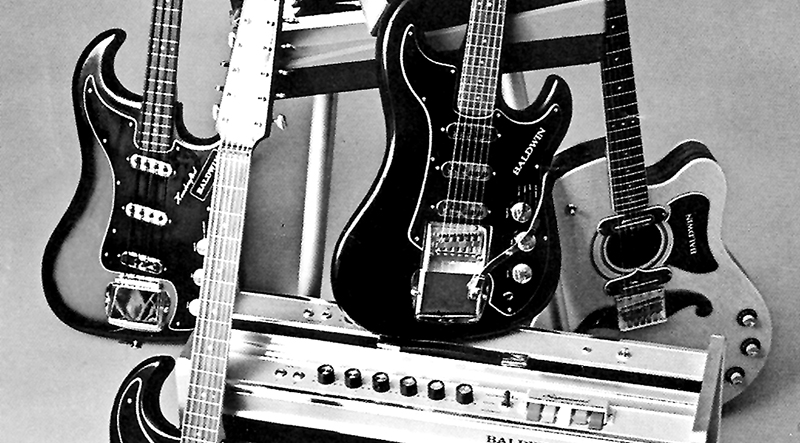
An early Baldwin sales one-sheet included a nice assemblage of transition instruments. The ad was for the Howard combo organ, but tellingly, the guitars are up front! All the instruments are Burns-built models with the new company logo – the Jazz bass features the “cut in” logo, while the Double Six and Virginian have new “Baldwin” guards. The rare black-finished Jazz Split Sound in the center has the second stage “Baldwin” engraved pickguard, but is early enough to still have an unbound fingerboard – a feature usually seen on Burns instruments, and a good example of the mixed parts you see on these half-and-half models. Collectors, note: very few, if any production instruments were double-logo’d “Baldwin-Burns”; a Marvin S prototype reportedly built for Hank himself is one of the few verifiable examples. I have seen several instruments over the years where “Burns” has been cleverly engraved directly above “Baldwin” on the logo plate; as with all collectible guitars examine carefully, and caveat emptor!
The first overall change made by Baldwin was to put binding on all necks, which became common by early ’66. Another mostly unnoticed feature was a neck-tilt adjustment similar to what Nathan Daniel had developed several years earlier and CBS/Fender would add to some instruments in the early ’70s. A large screw under the plastic neckplate on the back (just below the gearbox truss rod adjustor) can be turned to raise or lower the neck angle, provided you remember to loosen the lower two neck screws first! This feature was not mentioned in Baldwin literature and may have been added to speed final assembly by eliminating the need to shim poorly fitted necks.
The Marvin evolves.
This would become a concern because by mid ’66, the relatively small Burns Romford facility was clearly overtaxed. Sufficient for the home market, the line couldn’t cope with the projected numbers needed for the U.S. Baldwin also quickly discovered that the tariff and shipping costs were astronomical – the same problem that stymied Burns itself! The solution was to keep the Romford facility building complete guitars only for the U.K. and foreign markets, while ramping up the fabrication of parts. Instruments for sale in the U.S. would be sent to Baldwin’s Arkansas organ plant as unassembled components. There were tax and efficiency advantages to this plan, but this is where U.K.- and U.S.-built instruments start to diverge; Arkansas-assembled guitars most U.S. players are familiar with often display a poorer fit and generally sloppier feel than those finished by the “old guard” at Romford.
Jim Burns had been retained in a managing director position as part of the purchase agreement. As the larger company’s focus moved away from creating new products to making and selling existing ones, Jim himself became a redundancy. Like Leo Fender, he was an “ideas” man, only happy when working on new products. Ironically, both men became superfluous to the companies they’d founded in 1965-’66, when the corporate mindset took over. Burns stayed at Baldwin/Burns for the contracted year, redesigning some hardware, but further new product development was abandoned. Perhaps as a last gesture, his final designs for the company – the six-pole bar-magnet pickups and newer short Rez-O-Tube units – had “Designed by James O. Burns” written directly on them.
In the meantime, Baldwin threw more money into promotion. The initial slogan was “The Best Sound Around” and quite a number of trade ads were taken in the U.K. and U.S. music press featuring different models. By early ’67, the company issued a large, complete, and colorful catalog (the cover was featured in our guitar cheesecake celebration some months back). This touted the instruments’ supposed “Fundamental Features” and the extensive prose was in many ways straightforward and more convincing than Burns’ earlier florid (if prosaic) sales material, even if it was groaningly pseudo-hip in spots! All models were pictured in full-page living color and there was some nifty Peter Max-style flower-power artwork, as well. Unfortunately, Baldwin’s sales force seemed to have little clue how to tap into the guitar market, which was actually just past peaking as they were gearing up to sell the new line. The company’s piano and organ dealerships were hoplessly ill-equipped to sell guitars and amps, and Baldwin sales did not have the jobber connections to effectively market the line elsewhere. Meanwhile, all those guitars shipped to the U.S. started to pile up in the warehouses…
The Vibraslim takes a free ride.
The guitar line presented in ’67 was more streamlined, the herd having been culled and eccentric/eclectic features tamed so production could be more standardized – a strategy some longtime Burns employees applauded.Indeed, the Romford team seemed to have had generally good relations with their Baldwin overlords, unlike the situation developing at CBS/Fender. Still, the instruments began to lose their Burnsian character.
The flagship Marvin (Baldwin Model# 524, seen in the ’66 ad) and Shadows Bass (Model# 528) now featured a new redesigned neck – the original carved scroll headstock (Hank Marvin’s request) had been a bear to produce. Factory manager Jack Golder designed a new, streamlined head with a sort of lump at the top that was far easier to carve, and wasted less wood as well. This neck became the “standard” Baldwin pattern, and the instruments’ de facto trademark; although not all necks were exactly the same. The varying scale lengths persisted on different models and necessitated at least three distinct but similar necks be produced. For the most part, the Marvin was otherwise unaltered, although fit and finish sometimes seemed to suffer. A few late Marvins appear fitted with the “bar magnet” pickups used on most other models. The Shadows’ Bass got a redesigned Rezo-Tube tailpiece, and the pickups were changed to a four-pole model of the new “bar magnet” unit first seen on the Baby Bison; this pickup soon appeared on nearly all Baldwin basses. Metal-button Van Ghent tuners – soon used across the line – replaced the plastic variety on the new headstock.
This use of universal parts became Baldwin strategy; it made sense from a production standpoint, but robbed the instruments of individual character. The Double Six (Baldwin Model# 525) was the only Burns design that survived the transition unchanged, gaining only a bound fingerboard in early ’66. The Bison guitar (Model# 511) and bass (Model# 516) remained the most distinctive Burns creations, but were hardly promoted and appear to have been built in small quantities after mid ’66. The bass received the same alterations as the Shadows Bass; the guitar adopted the new flat-scroll headstock, and the Jazz Split Sound (now Model# 503) was adapted to the new standard neck but kept its trademark short scale. The electronics were simplified somewhat (one internal coil was deleted) but the sound little altered. The matching Jazz Bass (Model# 519) underwent a more radical revision to adapt it to the standard 30″-scale “lump scroll” bass neck, losing its distinctive medium-scale format and gaining a squatter, less attractive appearance. It, too, was made in very limited numbers from this point, but the guitar remained a good seller, and one of the most common Baldwin instruments today. The Baby Bison (Model# 560) also saw some revisions, with the standard headstock replacing the idiosyncratic V shape of earlier models and a new short-plate Rez-O-Tube unit. Extra-small pickguard plates were added to the previously uncluttered face. A matching bass using standard components was introduced at this point (Model# 561); this was the final piece to round out the solid line. An early casualty was the budget solidbody Nu-Sonic; the guitar (model 500) and bass (Model 522) were both gone by mid ’66.
Donna and Shot Pick’n’Grin.
The hollowbody line changed far more radically. The Vibra-Slim (Baldwin Model# 548) was totally rethought; whether Jim Burns had much hand in this is unknown, but it seems likely. The model lost its set neck, semi-hollow body, and pickguard-mounted controls, and essentially became a hollowbody Baby Bison, with the same style bolt-on lump-scroll neck, Bar Magnet pickups, Density wiring, and short Rez-O-Tube vibrato. The now-cheaper Vibra-Slim became one of Baldwin’s most popular models, though there was already trouble selling the model at full price by ’67! The Vibraslim bass (Model# 549) was similarly re-styled, and built in fairly large numbers. Jim Burns’ more jazz-oriented GB-65, GB-66, and GB-66 Deluxe were all early casualties; introduced in ’65, only the Deluxe model lasted even into late ’66, and it was gone by ’67. Interestingly, the Virginian (which looked like an amplified flat-top, even though it was really a semi-hollow electric) prospered under Baldwin, albeit with several design changes. The neck went to the standard style, pickups were changed and the “short” Rez-O-Tube vibrato was fitted – the Virginian became essentially a flat-top Vibraslim! Baldwin also continued production of some of the ill-fated transistor Burns amps for the U.K. and introduced an extensive U.S.-built line of amplifiers for the home market, including the E-1 Exterminator, famous as a component of Neil Young’s stage rig.
At the time, Baldwin didn’t have much professional endorsement. In the U.K., the Shadows remained faithful, but their influence was reduced. Among U.S. groups, The American Breed, best remembered for the hit “Bend Me Shape Me” appear to have been the top standard bearer. The band appeared with Baldwin instruments on their first LP (a Marvin, an earlier-style Vibraslim, and a later Jazz Bass) and in advertisements in ’67 with the Marvin and 700-series hollowbodies. Spanky & Our Gang appeared on “The Ed Sullivan Show” performing “Sunday Will Never Be The Same” with a nice collection of early Baldwin – a Double Six, Jazz Bass, and Vibraslim in red sunburst. They don’t appear to have done any print promo for the company, so it’s hard to know if this constitutes an endorsement.
Some success came in country music. Baldwin began to distribute Sho-Bud pedal steel guitars, and moved into their Nashville office. A promo shot (suitable for framing!) features Sho-Bud founder Shot Jackson and his wife, Donna Darlene, pickin’ and grinnin’, Donna on an early-’66 Baldwin Virginian with Burns features. Willie Nelson was also a Baldwin endorser who used several products, especially the proprietary electric classical pickup patented by Baldwin (not Burns) in ’65, but not commercialized until later. Long after Baldwin had packed in its guitar operation, Nelson remained faithful to the pickup, which was later installed in his Martin! There also exists a late Vibraslim bass with a “Willie Nelson’s Bass Guitar – Presented to Terry Bock” plaque on it!
The Generic 700s…”Velvety Perfection”?
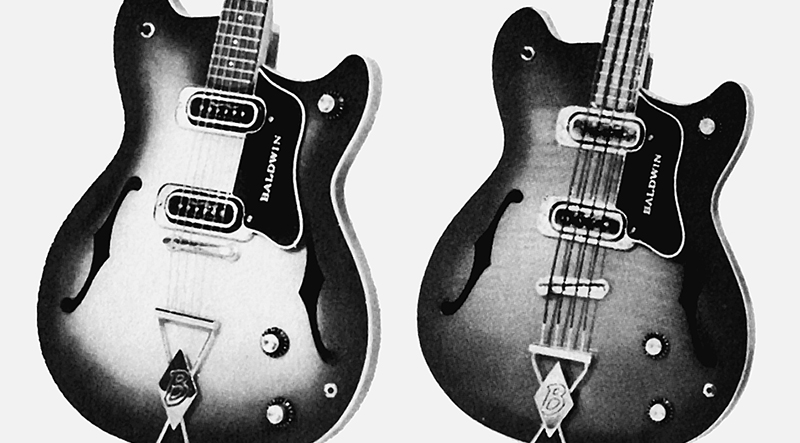
Despite standardized production, the ex-Burns guitars were still expensive to build, so Baldwin made attempts at designing instruments for a lower price point. The first was an ill-fated 600 series which never made it to production, designed in Fayetville using Burns parts. What did emerge in some numbers by ’67 was the 700 series. These double-cutaway thinline hollowbodies had hardly any Burns bloodline, just Italian-made bodies and electronics fitted with the Baldwin neck. Two six strings, two 12-strings, and a bass were offered with identical styling. A U.K. ad for the models still claims “Designed by James O. Burns,” which is spurious. These were sold at the lowest price of any Baldwin guitars, and thus fulfilled their purpose, though they added little to the company’s legacy.
Further troubles plagued the line. Burns’ polyester finish often cracked soon after application, a worsening of issues seen even before the transition. Sales remained below expectations, but the entry into the guitar business had given Baldwin an overall boost. Then in May of ’67, Baldwin got the sort of guitar operation they really wanted – Gretsch. Once Baldwin owned a well-known high-profile guitar (and drum) company, their own brand mattered less. Insiders recall Baldwin demanding the Gretsch sales force “get rid of Baldwin guitars” before selling their own product. A Gretsch price list from ’69 still shows the full line of Baldwins; by this point, a serious general decline of the market was affecting all guitar sales. Most accounts say the Romford factory finally closed circa 1970, but few guitars have surfaced with stamped dates past ’67. In all, a sad end for the fretted dream started by Jim Burns in a Victorian basement 10 years earlier, and an all-too-typical tale from the ’60s.
As noted early in this series, the Burns brand was revived in 1991 under the guidance of Barry Gibson, with Jim Burns’ involvement. Burns passed away in ’98.
This article originally appeared in VG October 2009 issue. All copyrights are by the author and Vintage Guitar magazine. Unauthorized replication or use is strictly prohibited.
Dig into VG’s vast article archive!
Be notified when the next “Overdrive” and other great offers from VG become available! Simply submit this form.
In early 2009, VG columnist Peter Stuart Kohman turned his focus on Burns, the pioneering British guitar builder. We’ve compiled installments 7 and 8 for this special edition of VG Overdrive. Watch for the complete history in the upcoming weeks.
By 1965, Ormston-Burns Ltd. had become the major guitarmaker in the U.K. and, to a lesser extent, in Europe. Jim Burns’ guitars were in the hands of prominent British artists, and were being exported and used in ever greater numbers all over the world. Still, it’s no surprise that in the U.S. – homeland of Fender, Gibson, Rickenbacker, and Gretsch – players showed little interest in his creations.
The deal that led to small numbers of Burns models being issued here, branded as Ampegs, had run out of steam… and no better offers seemed likely. The constant expansion to meet demand had also strained the company’s financing, and despite (or in many ways because of) his considerable success, Jim Burns’ future was shakier than it might have appeared!
Printed Circuits and Transistors!Introducing the Orbit.
One product line, in particular, had a negative affect on the company, and may well have forced Burns to seek financial support. To see how this developed, we’ll need to backtrack a few years.
In the early ’60s, English makers had prospered with amplifiers even more than guitars; Vox became a worldwide name thanks to the incredible level of success their amps had with the top echelon of British beat musicians, starting with the Shadows. When the Beatles became a household name in early ’64, Vox amps were along for the ride. Watkins and Selmer also found much success with the Beat boom; each built full lines of tube amps that, while not as well-remembered, were quite successful and highly regarded in their day. Many are collector’s items now, as well. Most were designed with proven components; after all “valve” guitar amplifiers were hardly new technology at the time!
The story of the Burns amplifier line is less happy – a small, neglected, but important sideline of the company’s history. Jim Burns himself was no stranger to amps. After all, as one of the earliest builders of solidbody instruments in England, he was more dependent on the “little box on the floor” than most; Burns himself actually built a few simple amps in the ’50s to sell with his earliest guitars. But his personal interest seemingly laid in areas other than electronics. The Supersound and Burns-Weill instrument lines used pickups supplied by Jim Burns’ partners. Early-’60s attempts to offer Burns-branded amplification were spotty; the company built a number of amps in 1961 and ’62, using surplus television cabinets. These early “Tele Amps” reportedly sometimes feature a grillecloth intended to simulate a TV test pattern! For a more professional-looking rig, the company briefly imported American-made Supro amps, re-branded Bison with an added logo plate and offered in guitar and bass models.
These were only stop-gaps until the rollout of product that probably did the most damage to Ormston Burns’ long-term future – the all-transistor Orbit Amplifier line. Orbit was a radical departure from anything available in the U.K., with truly original design work. They constituted a full-blown (and, as it turned out, rather blind) leap into the space-age future. JMI/Vox had a fling with early transistor designs in 1962-’63 with the T50 and outrageously wacky Transonic 60. But after that dismal, if colorful, failure, backed out for a couple of years (see the interview with Pete “Buzz” Miller, VG, July ’08, for a first-hand account of the “joys” of the Transonic 60). Deciding that the existing transistors were not reliable enough, in late 1965/early ’66, Vox experimented with hybrid amps using transistor preamp sections and “Valve” output stages. This created some interesting (and now collectible) amplifiers, but nothing that would compete long-term with the AC30. Vox continued in 1966-’67 with a line of all-transistor amps, but by then many other troubles were brewing for the company – another story entirely! Back in 1962-’63, the boffins at Burns had apparent faith in available technology (and perhaps no one with Vox designer Dick Denney’s ears) so Burns jumped in whole hog and by mid ’63 committed itself to a transistor-only amp line.
Orbit 2; the Baby Brother.
By ’63, transistors had been around for some time; the team at Bell Labs that developed the earliest version (in 1948) had won a Nobel prize for their efforts. More modern Silicon transistors followed in ’54. Still, throughout the ’50s, the vaccum tube (“valve” in U.K. parlance) reigned supreme in most home electronics and musical amplification. By the late ’50s, the transistor had been accepted into mass commercial electronics at the low end, with the small transistor radio (often “Made in Japan”) providing the soundtrack to teen life… albeit playing music recorded with tube amps and tape machines! Sony had introduced the first of these in 1952, but musical instrument amplification continued along tried-and-true lines for years beyond. Still, by the early ’60s, the transistor was considered the wave of the future. Burns was not alone in predicting that transistors would replace tubes as the basis of guitar amplification; nearly all the big names would jump on the bandwagon eventually – and most would jump off after dismal failures! CMI/Gibson and CBS/Fender had similar experiences in the mid ’60s, but Burns in ’63 was a very early adaptor, and unlike most competitors, had no traditional tube-amp operation – or experience – on which to fall back.
Two Amps In One!
The flyer that introduced the Orbit line is one of Burns’ most detailed pieces of promotion, surprisingly candid in spots and full of chatty philosophizing. It’s worth quoting at length, as it offers an interesting insight into the overall Burns psychology and development process. “Built With the Musician In Mind” was the operating slogan… meaningless really; suggesting that somehow Vox, Watkins, or Selmer were not thinking of musicians when designing their extensive (and highly successful!) lines of amps but yet somehow endearing, in a typically Burnsian way!
“‘You’re not business people,’ one of our American business visitors laughingly told us recently… and we took it as a compliment,” began the Orbit’s introduction. “Of course, we’re not business men… we’re musicians… who like countless other musicians throughout the ages have given thought to the production of more sensitive instruments that would give that elusive extra, something extra in the split second of transmission from brain to keyboard (sic). We decided to do something about it, and the result was the Burns guitar range. We made a few mistakes… but we made a lot of guitars and a host of friends throughout the world. The truth is that we just drifted into this development business… and we say development because ‘manufacturing’ has a commercial tang which doesn’t fit our way of life. Electric guitars were, in the main, sub-standard in relation to their potential. We set out to develop instruments that would be easier to finger, give more sensitive response, and have a wider range of tonal colour. The first models were by no means our ultimate aim but the boys said they were an improvement on existing instruments and we found ourselves with many more orders than we could execute. During this period we learned a great deal, not only about guitars but about electronics and strings. We talked with experts in wood, metal and electronics technology. We accepted their experience with an open mind but we kept on developing. Then came a point when the boys asked us to develop an amplifier in the same way… with the musician in mind. Again we met up with the experts in hi-fi who freely admitted that amplification of the guitar had some ‘Special Problems.’ What an understatement! Some of these electronic experts became so interested in our ideas they joined the Burns team and began to work our way.
“With the musician in mind we started out on this idea of building a better amp. Basic requirements were a machine that would be light enough in weight to carry conveniently; have enough power for any class of work; give that power without distortion, and give trouble free service. In nine months of experiment, working thirteen hours a day the Burns team of dedicated enthusiasts consumed 50,000 cigarettes, 7,000 black coffees and an unrecorded amount of aspirin. The final design was not evolved on hi-fi lines by electronic engineers. It was developed with their cooperation and their original specifications were married to the requirements of the musician. ‘Throw away the book’ we told our electronic bods. ‘Forget the specifications…let’s have some new thinking with the musician in mind. The new sound of the Orbit will convince you more than words.”
The Budget Sonic.
In the same circular Burns touts “Printed Circuts” as well and listed these apparent advantages of the “Mighty Atoms” of the “Tiny transistors which eliminate all valve troubles”: “1) Your amplifier is half the weight of the conventional valve type. 2) Total absense makes ‘microphony’ (noisiness) a thing of the past. 3) One light compact unit uncluttered with components or cables eliminates danger of ‘baking’ the speaker cones. 4) No warm-up time as in valve amps. Full performance immediately when you switch on! 5) No aging… or falling off in performance as with valves… and much less maintenance. 6) Transistors… unlike valves… cannot fall out in transit. Transistors are soldered direct into the circuit and are not prone to mechanical damage.”
The Massive Double B.
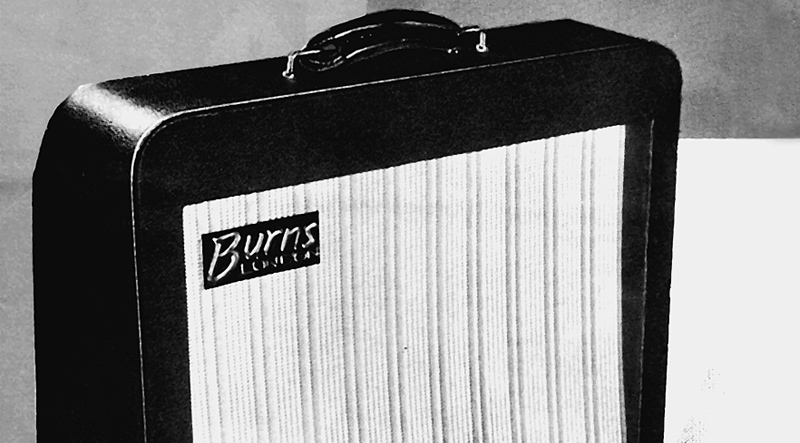
The amps themselves looked good – sleek, rounded-edge cabinets with gleaming inset-metal speaker grilles and angled/back-mounted control panels proudly emblazoned “All Transistor.” The cabinetry was described as “Aircraft resin bonded kiln dried ply.” Components were claimed to be the finest available. The Orbit amps used the same elaborate double-stage knobs as the 1963-’64 Bison guitars.
The first production models, from mid/late ’63, were the Orbit III and Orbit VI, also offered with onboard reverb as the Orbit III-R and VI-R. The Orbit III claimed 60 watts output and three 10″ speakers… all at 37 pounds in weight and at a price of 100 Guineas. The big brother Orbit VI boasted 120 watts and six 10″ speakers, weighing in at a whopping 75 pounds and costing 132 Guineas, then quickly up to 150 Guineas. This amp was modified soon after being introduced to a more manageable unit with 100 watts output and three 12″ speakers. The reverb versions ran an extra £18. The next addition was the smaller Orbit II with 40 watts and one 12″ speaker, at 75 Guineas and finally by mid ’64 came the Orbit Double 12, an obvious attempt at an AC30 beater with (you guessed it) two 12s at 131 Guineas. The Orbit 12 was described as having “Tone-shaped bass-coloured sounds with a buoyant musical beat to eliminate that dead tub-thumping sound.” Uhhhh… okay! This amp also soon featured the “Studio Switch – Two amps in one!” This was essentially a dual-position power selector, intended to cut output to enable quieter operation in the sterile recording studio. This model soon replaced the more unwieldy Orbit VI as the standard bearer of the line, and appears to have been built in the largest numbers, if survivors are any indication. Sadly, survivors of any model are few. The prices generally were competitive with tube Vox amps; most were actually a bit cheaper than the roughly equivalent Vox.
These professional amps were soon supplemented by the Sonic series, a cheaper line without the curved-corner cabs, fancy knobs, or deluxe touches (like “hand-stiched (sic) English leather handle”). “Sonic” was Burns code for budget; this lower-end line included the Sonic 20, 30, and 50 models with those name specs represent their output ratings. These amps mounted single 10″, 12″, or double 12″ speakers. Oddly, these were described as having the “American sound,” assumedly a reference to more Fender-like treble response compared to the typically warm Vox output. “Building Burns standard gear at a lower price was not so easy,” the company noted. “But we overcame this by using a simple functional case design without ornate trimmings.” The Sonics came in plain rectangular boxes with top-mounted controls and minimal styling.
“Valves Are Vintage”!
To complement the line, Burns offered a full-sized bass rig of similar styling. The Double B bass amp was a boxy-looking 80-watt head with simple controls mated to an elaborate ported double 18″ speaker cab. This imposing (and very heavy) 52″-high rig was initially priced at a hefty 195 Guineas. While transistor amplification would eventually prove more popular for bass than guitar, the Double B does not seem to have made many friends and is rarely seen, either in old footage or in actuality today. Burns also produced several models of “Orbital Stage One” transistor PA rigs that look to have been fairly well-thought-out; again few seem to have survived long. These various equipments are rarely seen today, and almost never in the U.S., where they were sold minimally (if at all). Reliability was not great by the few accounts available, and the line achieved little success with professional musicians. It’s rare to find a fully functional example of any Burns amp today; most were likely abandoned as not worth repairing when they failed.
Burns was extremely proud of these amps and promoted them avidly. The most amusing ad – at least in retrospect – is from a 1965 Beat Instrumental featuring a graffiti “Transistors” emblazoned on a brick wall and the slogan “Valves Are Vintage.” That was certainly proved correct, but not in the way anticipated! Ironically, this was published not long before the storied “Clapton is God” graffiti started appearing on London walls, enshrining not only Slowhand, but his searingly overdriven tube-amp tone, another factor in spelling the ultimate end of the trend toward “clean and efficient” transistor amplification! As most guitarists know, when transistor amps are pushed to distortion, the sound tends to be a harsh, grating edge that few musicians find attractive. Still, Burns carefully warned against investing in “Obsolete” equipment!
In a way, it’s too bad the Orbit saga didn’t turn out better. Taken on their own terms they are well-conceived, strongly built, attractive amps with a distinctive style. Unfortunately, the electronic developments required to make transistor amplification reliable were still in the teething stage in 1963… and guitarists were just beginning to figure out that they liked, even loved the sonic inefficiencies of tube amp tone far better than the clean “Hi-Fi” sound offered by transistors!
These amps were by no means an instant failure; some appear to have sold well for a time but the huge expense of getting the full line into production, coupled with their relatively limited success, played havoc with the company’s receivables. The production (from scratch) of an extensive and unique line of amplifiers represented a huge investment of both capital and resources… the operation “bled the guitar side dry” in the words of ex-employee Norman Houlder, as interviewed by Per Gjorde. “We entered into frantic negotiation for a second factory,” said Burns’ own publicity. This is not an uncommon problem with fast-expanding businesses; the money needed to keep ramping up production is supposed to come from the increased sales, but the time lag involved often means the funds needed to build the product already on order are not available. JMI/Vox suffered these problems well before Burns, when Tom Jennings was forced to look for outside financing by mid ’63 and sold controlling interest in JMI to the Royston Group in September. The move eventually cost him his company.
The financial mess at Burns was not apparent to the casual observer, however; with a full line of guitars, amps, strings, and accessories and a large retail store in London Burns appeared to have truly “made it” in the beat-happy Britain of 1965. Most likely only Jim and his close associates knew how precarious the company’s situation was. At the same time, Baldwin, the American piano and organ giant, was looking enviously at the booming guitar market. They approached Fender, but the CBS corporation had deeper pockets and won the company with a bid of 13 million… reportedly 12 million more than Baldwin’s offer! It seems likely Jim Burns approached Baldwin to distribute his products in the U.S., but the deal turned into an outright sale. The purchase was finalized September 30; less than a year after failing to buy Fender, Baldwin had its guitar division, at a bargain. Reportedly, little cash was involved – Baldwin simply assumed the company’s outstanding debts. The news seems to have been taken rather glumly in England; a simple, almost obituary-like notice in Beat Instrumental #31 from November of ’65 read, “Burns taken over.” We’ll take a look at what happened next… next time.
This article originally appeared in VG September 2009 issue. All copyrights are by the author and Vintage Guitar magazine. Unauthorized replication or use is strictly prohibited.
Dig into VG’s vast article archive!
Be notified when the next “Overdrive” and other great offers from VG become available! Simply submit this form.
The Way Back Beat survey of instruments designed by James Ormston Burns continues with the final products developed by his company before it was bought out by U.S. keyboard manufacturer Baldwin in late 1965.
Despite the preponderance of Beat groups in the U.K., Burns’ heart seemingly retained a soft spot for the jazz players who had been his first customers, and in mid/late 1964, he returned to designing guitars for that much smaller market. After all, by that point his solidbody rock-and-roll line was extensive, so perhaps Burns felt it was time to cater to the “quality” end of the market. Of course, he already offered a nominal “Jazz” range, but those short-scale, Fenderesque solidbodies looked (and sounded) less like traditional jazz guitars than even Leo’s Jazzmaster! Many of these later Burns designs appear to follow a train of thought, and in retrospect it can be interesting to watch the design process play out.
Burns had entered the world of semi-hollow guitars in 1963 with the TR2 and subsequent Vibraslim models, two variations on a theme detailed last month. These double-cutaway thinlines were aimed at players of all styles who preferred the likes of Gibson’s ES-335 or typical Gretsch and Guild offerings. While well-made and interesting, they were not hugely successful, nor as distinctively eyecatching as the solidbody Bison and Marvin instruments that were the company’s flagships. The same late-’64 press announcement that introduced the Vibraslim contained the line “Burns also announce they will shortly be manufacturing a range of acoustic guitars.” Whether they actually meant “acoustic” guitars is a matter of doubt – what Burns would shortly introduce were “Electro Acoustic” instruments, fully hollow, but definitely electric in intention. The first of these would be the GB65, another eccentric but certainly original design.
Announced in Beat Instrumental in February, 1965, and labeled as the “JB65” – which may not be an error – it’s possible the GB65 guitar was intended to be named for Jim Burns himself. “A new six-string Burns Jumbo will be on sale before the end of January,” reads the blurb. “It will have very sensitive pickups to provide more treble tonal quality than can be obtained from most solids. Price is reported to be just over the £100 mark.” This was fairly inexpensive for a full-line Burns instrument… especially a nominally prestigious hollowbody. The reference to a “Jumbo” implied that the guitar was intended to serve as an amplified acoustic, like the Beatles-approved Gibson J-160E. The next month’s BI prominently displays the GB65 in the “Instrumental Corner” section with a prototype pictured; it reads, “GB Stands for Great Britain,” and Jim Burns is quoted, “We’re proud of it.” The characteristically Burnsian text continues; “Indeed this new semi-acoustic is typically British. Without flashy finish or sweeping lines, the verdict on the instrument is left to the player who makes sound his first consideration and takes the trouble to put the electronics through their paces. The Burns back-room boys are especially proud of the new technique they have used for the internal bracing of the ’65. They maintain that this method completely does away with the weird unwanted sound affects that can be generated when an acoustic guitar is amplified. On this model, two specially developed Rez-O-Matic pickups are used. With these down-to-Earth features, it’s quite possible that the Burns GB65 will notch up record sales both here and overseas.”
Interestingly, Burns is listed as the distributor – a move away from past reliance on jobbers like Rose-Morris.
The GB65… ”Controlled Resonance”?
The company’s catalog text for the new model read, “New Thinking… A departure from the concept of adapting acoustic models for electric work paved the way for the development of a semi-acoustic design which would eliminate unwanted resonances and use the acoustic chamber to enhance the performance of high-sensitivity pick-ups.” Burns (now fully schooled in the art of snazzy slogans) called it “Controlled Resonance.” In the case of the GB65, this seems to consist of not much more than a single solid block under the bridge! In practice, the system does work, to an extent – at high volume it will still feed back, but far less than the likes of even a thin ES-330.
The GB’s jumbo single rounded cutaway flat-topped body was 16 ½” wide and 25/8” thick with two very eccentrically shaped two-part soundholes and an almost Gaudi-esque fluid pickguard and control plate. The laminated body has a dark mahogany back and sides and clear-finished “flamed sycamore” top, often beautifully grained. It was fitted with a trapeze tailpiece and simple metal floating bridge…which can be the same unit as on a Nu-Sonic or Double Six, probably depending on what was in the parts bin that day! Despite its acoustic look, the GB65 really does have a fully realized electric sound, and is indeed capable of surprisingly bright tones…especially compared to the usual amplified flat-top. “Specially developed Rez-O-Matic pickups are used,” claimed Burns, though the units actually used resemble the cheaper Nu-Sonic pickups more than the fancier Rez-O-Matics on the Marvin. The neck used the simple direct-drive truss rod recently developed for the Nu-Sonic, along with a flat-cut headstock (with no back-angle or scroll) all of which made neck production easier, but necessitated a string tensioner behind the nut. These measures doubtless reduced the production cost of the new model.
It appears only a few production batches of GB65s were completed beginning in early ’65, straddling the Burns/Baldwin takeover timeline. They appear with both logos – the only physical difference is the engraving on the pickguard. A couple of early (possibly prototype) examples have a different headstock logo and tailpiece. Otherwise, variations appear confined to random substitutions of bridges and switches. Despite Burns’ enthusiasm, the GB65 in practice is a slightly awkward guitar to play, at least in the standing up and shimmyin’ Beat-group style. It was certainly a more useful and practical electric at high volume than a standard amplified flat-top – or even many large body archtops – but its unusual styling does not seem to have won it many friends. In overall dimensions and character, it’s vaguely reminiscent of the Kay Thin Twin of the ’50s, but the GB65 remains a pretty singular guitar. A bit of an evolutionary dead end, perhaps, although a look at some recently introduced Taylor electrics reveals a ghostly similarity! The only notable “Top Of The Pops” GB65 user was rhythm guitarist David Meikle of Unit 4+2, one of Burns’ more faithful endorsers.
The Virginian rides out.
Even after sending the GB65 out into the world, Jim Burns kept tweaking the design. Another model soon followed, built along the same lines, but with more distinctly Burnsian character. “A further development in ‘Controlled Resonance’ technology is seen in the Virginian, which incorporates the Burns Reso-tube bridge/tailpiece unit first developed for the instruments used by the Shadows group,” read the ad copy in April of ’65. The unmistakably odd but somehow stylish Virginian looks even more like an electrified flat top ala the J-160E, but again is a fully electric instrument. The Virginian uses the same body size and shape as the GB 65 but with a (barely functional) round soundhole in place of the eccentric twin f-holes, and heftier solid blocking inside. Instead of a conventional bridge the Virginian uses the Rezo-Tube unit, in a new short-plate version with no vibrato arm. This is where things get a bit counterintuitive; it means there’s a solid block in the center of the hollow body, but with a large hole cut in it and six strings encased in individual hollow tubes hanging down therein. And the whole unit is sprung suspended on a knife-edge, but is not intended to move. Compared to the GB65’s simple trapeze tailpiece/floating bridge setup this introduces a world of construction and setup complication, but does seem to give the guitar a more distinctive sound and feel.
The new model used the Bison/Marvin-style scroll-head neck and geared truss rod, with the Bison’s shorter 24 ¾” scale length – the GB65 utilized the Marvin’s Fenderlike 25 ½” scale. Burns’ newest pickups were featured; called the “Bar-O-Matic” these featured adjustable polepiece screws mounted in an exposed metal bar and would be further developed as the year went on. The simple-looking circuitry included a major innovation – the “Presence” control – which blended in the second coil of a stacked humbucker in the neck position (the internally different but identical looking pickups are often found marked on the underside with a sticker for the convenience of the assembler!). This was a really interesting and original development, but when left unexplained can be confusing for the contemporary user, as the controls behave in subtle and eccentric style. The three knobs function as master Volume, “Density,” and Tone, which also works only on the neck pickup. Thus there are effectively two tone controls working on one pickup, no tone on the other, and a three way switch. And you thought Gretsch’s ’60s wiring was obtuse…
The name “Virginian” implies this model was intended for the country/western market, but it was the supposed “jazz” sound emphasized in the initial publicity! “…the greatest sound of all is true jazz guitar tone! A real thick full sound that explodes without ‘wooly’ trimmings… new tonal shadings with the unique density control.”
Well… okay. Despite Jim’s best intentions, it’s unlikely much serious jazz ever got played on Virginians; still the model did find some fans. The Virginian went on into the Baldwin line, where someone deduced that if you’re going to all the trouble to put an elaborate vibrato system into a guitar, you might as well give folks an arm to shake it with, so later Virginians do feature a whammy bar, among other changes. The Virginian even at £134 was far and away the most successful of the ’65 hollowbody models, remaining in production nearly until the end. There’s something endearingly goofy about the guitar’s hybrid appearance, especially with the vibrato – it can appear to the unsuspecting observer to be a horribly mutilated flat-top acoustic, but it really is a solid player. The same flat top/fully electric concept was further developed by Jim in the ’70s and early ’80s into the Steer, a cult favorite still offered by Burns U.K.
1965 was the high summer of Ormston Burns Ltd; the firm had seen five years of non-stop expansion and was undisputibly the most successful guitar maker in the U.K. Their only real competition was Vox, but JMI was an amplifier maker first and their guitar line was really a secondary operation. Like Jennings, Burns had, by late ’64, opened its own retail showroom on St Giles High Street in London, around the corner from Denmark Street – the heart of the British music-publishing business and today still the center of guitar retail in London. While the picture looked rosy from the outside, all this expansion had come at the cost of massive financial outlays, and the company’s balance sheet was tilting precariously toward a red sea! Still, through the summer of ’65, Jim Burns, ever the creative thinker and not the business man, was busy working on new guitar designs.
The GB66 Line, early 1966.
The next to appear was the GB66, one of the most conventional of Burns instruments and one of the least-remembered. This was a slightly lopsided double-cutaway 16″ hollowbody with a bolt-on neck that had neither the eccentric charm of the best Burns creations nor the elegance of a Gibson or Guild. The tailpiece, bridge, and headstock shape were continued from the GB65 but the top and back were arched, the f-holes traditionally shaped and the controls mounted directly to the body. The GB66 was the last guitar to use the original 1962-style Ultra-Sonic pickups, albeit in the re-wound high-impedance version with adjustable polepieces. This was certainly not a bad instrument, but had little to offer in the way of innovation. Unsurprizingly few jazz players were tempted to put down their ES-175s or L-5s to give it a try, and beat group musicians showed little interest. It was introduced in the summer of ’65 and was gone from the Baldwin line by the summer of ’66. Few illustrations even exist of this model… the catalog clipping shown here is from the earliest Baldwin brochure.
Even Jim himself may have felt this was an unfinished design as issued. He had further plans for the model and quickly followed up with a GB66 “Deluxe.” Using the same overall design but a deeper body, this was intended as Burns’ ultimate jazz box and offered an elaborate new electronics rig developed from the Virginian. It was first listed in August 1965 at £160; described as “…Aimed at jazz guitarists. There are two double-coil pickups, styled after the famous Charlie Christian models.” The earliest versions of the Deluxe feature a large plastic plate mounted to the face of the guitar, covering the extended magnet structure. The 1966 Baldwin model shown here dispensed with that fitting, mounting the rig through the back. No GB66 featured a vibrato tailpiece, further emphasizing their “jazz” pedigree. A September ’65 write-up of the 1965 British Musical Trade Fair (held the week of August 23) made special mention of the GB66 Deluxe (136 Guineas) GB66 (120 Guineas) and GB 66 Bass (125 Guineas) “Burns were extremely proud of their GB66 guitars… This one (the Deluxe) includes a density control, which Burns introduced on their Virginian, and employs a pickup system which produces a wide magnetic field all around the two pickups and the space between them.” As noted, there was an odd (though predictable) addition to the line was the GB66 Bass. This probably gets the nod as Burns’ least-inspired four-string, with the neck extending far from the fully hollow body, and making for an awkward instrument. In any event, it was built in such small numbers few had the chance to render a verdict!
The Burns GB66 Deluxe, second version.
This Music Fair display also showcased an instrument intended as a weapon to to crack the elusive U.S. market – a special guitar with Burns’ distinctive styling but at a lower price point to make it more attractive to importers. BI reported, “The Burns Baby Bison also made an appearance at the show. This is a straight forward two-pickup guitar with sharp lines and again, a density control. Unfortunately, the Baby won’t be available in this country because it is being made solely for export to America.” This new model introduced several features that would soon become familiar on subsequent Baldwin instruments, including a redesigned simplified Rezo-Tube vibrato tailpiece and re-worked “bar magnet” pickups. Electronics-wise, it was virtually a solidbody Virginian with the same stacked-coil humbucker in the neck position blended by the “Density” control – a neat trick for a “Budget” guitar. The Burns – logo’d Baby Bison is probably the rarest of all the company’s products; I have only encountered two examples in 30 years. Production got underway in earnest after the takeover, and the Baldwin model was built in considerable numbers before being somewhat modified in mid ’66. Baldwin Baby Bisons – both the guitar and inevitable matching bass – are still fairly common finds today, particularly in their original target market of the U.S. Also featured at that same trade fair booth was the Burns Mini-Bass, an electric upright that was not taken at the time beyond the prototype stage.
Throughout ’65, Jim Burns continued to seek full-scale entry into the giant U.S. market. He had been attending trade shows there for some time, but despite some spotty success (notably the Ampeg-labeled line, which had pretty much run down by this point) had not made a major breakthrough. In June of ’65, a special Melody Maker supplement distributed to U.S. music industry professionals at the summer NAMM show was dedicated to promoting U.K. interests. This carried a full-page advert from Burns highlighting in particular the new semi-acoustic line. It also announced, “Jim Burns and Jim Farrell will be delighted to meet old friends and make new friends at their exhibition at the Hilton, Chicago, Room 754A.” It would be most interesting to know if some of those “new friends” represented Baldwin, the American piano and organ giant. Burns may well have approached Baldwin to distribute his product line; as a music industry powerhouse sorely lacking any guitar operation in the Beat-mad summer of ’65 they would have been an obvious candidate. On paper, it would seem to have been a promising match, but as things developed, neither Jim Burns or the Baldwin organization would end up particularly happy with subsequent developments. And that, as you may have guessed, will be our next installment…
This article originally appeared in VG August 2009 issue. All copyrights are by the author and Vintage Guitar magazine. Unauthorized replication or use is strictly prohibited.
Dig into VG’s vast article archive!
Be notified when the next “Overdrive” and other great offers from VG become available! Simply submit this form.
In early 2009, VG columnist Peter Stuart Kohman turned his focus on Burns, the pioneering British guitar builder. We’ve compiled installments 4, 5, and 6 for this special edition of VG Overdrive. Watch for the complete history in the upcoming weeks.
The TR2 debuts.
Recent installments of “The (Way) Back Beat” have followed the London-based Ormston Burns Ltd. from its 1960 beginnings, hand-carving guitars in a Victorian basement, to worldwide success… except, of course, in the U.S.A.!
By spring, 1964, Burns had discontinued its low-priced Sonic series, last remnants of the original line. Replacing these venerable creations were… wait for it – the Nu-Sonics! A snappy, typically Burnsian trade name! These were bolt-neck guitars, less eccentric than the set-neck/small-bodied Sonics, which looked somewhat archaic by ’64. Nu-Sonics, like their similar (in concept anyway) U.S. contemporary, the Fender Mustang, were intended as a quality budget-line guitar for students or aspiring pros. They were not particularly cheap (beginner-grade Vox guitars started at 1/3 the price) but offered a simple professional instrument in a budget guise.
The Nu model was handy and functional, if not groundbreaking. Swooping, asymmetrical body cutaways echoed by the pickguard gave a stylish, modern look. Thin bodies were cut from very light African hardwood with none of the sculpted contouring of the upmarket solids. The 23 3/8"-scale neck had a new truss rod adjusted with an Allen key from the body end. Electronics were conventional; two pickups without adjustable poles, and a three-way switch. Oddly, catalogs specify the wiring as two Tone controls with a master Volume; many (i.e. every one I’ve tried!) actually have two Volumes and a single Tone; perhaps changed for production with no one informing the sales department! The guitar also sported a new, simple but effective adjustable-tension vibrato sunk into the body, and a floating bridge with rocking solid-metal saddle.
The “NU” Sonic pair.
The Nu-Sonics were listed in two finishes, a translucent cherry called Cherry Red Lustre, or solid black. The great majority appear in the Cherry Red Lustre that today is often faded to soft orange. A few custom-color examples have turned up; white and sunburst are known, but as with most budget guitars special orders, they were scarce. All kept the old-style hard-plastic black pickguard with 1962’s block-letter “Burns London” logo. Despite being Burns’ cheapest offering (around £60 initially) the Nu-Sonics were more expensive than U.K. competitors. The Watkins Rapier 44 offered four pickups and tremolo for 35 Guineas and Vox’s Super Ace was £46 with three pickups and vibrato. At least one Nu-Sonic was given away by Beat Instrumental magazine in their April ’65 reader’s competition! A few Nu-Sonic guitars made it to the U.S. branded Ampeg, but by that time they the partnership was winding down and the numbers were very small.
Typically, a matching bass was offered and proved particularly useful for its £52 price – light and compact, with an extremely punchy sound. Very easy to play even for a small aspirant, the Nu-Sonic Bass remains one of the most user-friendly four-strings ever. The bass had some similarities to the recently developed Shadows bass – the pickups were a close relative (though labeled “Nu Sonic” instead of “Rez-O-Matic” the covers, coil, and baseplate are practically identical) and the simple bar bridge saddle was the same fitting used with the early Rez-O-Tube unit. Screwed to the body without the elaborate tubes and springs, this solid bridge may actually sound better! The bass’ body is very similar – but not identical to – the guitar, complicating production more than necessary! The 30″ scale neck had a small Fenderish headstock with guitar-sized Van Ghent tuners.
Win this guitar!
The Nu-Sonic Bass has one grand, though unlikely, claim to fame; studio pictures from April, 1966, show George Harrison playing a Nu-Sonic Bass with the Beatles during the “Paperback Writer/Rain” session, part of the recording that produced that 45 and the Revolver LP. Despite strong evidence to the contrary, some accounts persist in crediting that day’s phenomenal bass tracks to George and this little bass. Recent information suggests that it had been supplied by Burns in ’64 to EMI Abbey Road as a studio loaner. The almost toy-like Nu-Sonic basses do have a powerful tone and are very comfortable to the average guitarist… presumably if found laying about, it would have been more useful to Harrison than one of Paul’s “upside-down” basses! The bass tracks to Lennon’s “Dr. Robert,” cut a couple of days later, and “Taxman,” are also sometimes credited to George and his Burns. Beatle historians still debate whether there is any solid evidence of its appearance on released tracks. Few other “star” sightings of Nu-Sonics are evident… years later Captain Sensible of the Damned sometimes employed a stripped and battered bass in the band’s early days.
The introduction of the Nu-Sonics essentially completed the 1964 Burns solidbody line. The Stratocaster had dominated the U.K. guitar scene when Burns began, but by ’63, the popularity of Gibson, Gretsch, Epiphone, and Rickenbacker hollow thinlines was exploding. Liverpool bands, in particular, were often wholly equipped with this type, which carried over into London’s R&B scene as well – both the Beatles and Rolling Stones being prime examples. Before ’63, the Burns line had consisted entirely of solidbodies. “We grew up with the business and started off accepting the difference between the guitar and the electric guitar… consequently we built Solids,” reads a ’64 blurb. “Which would have a rigid base to carry the electrical and mechanical gear. Rigid assemblies that would hold the neck and maintain the close-set action demanded by skilled players. Our solids sold themselves in 26 countries… and we turned to semi-acoustics. Once again we did not adapt; we started from scratch to make a braced semi-acoustic body that would stand up in the same way as the solid.”
Rudy Van Dalm rocks!
Of course, that doesn’t mention that it is also much easier to build solidbodies… especially when you’re starting in a basement! Still, Jim applied himself to the task and produced original, if rather whiffy-looking, prototypes. The earliest known handbuilt Burns semi-acoustic (circa 1961) was a symmetrical double cutaway something like an elongated ES-335 with three Ultra-Sonic pickups and Bison-like switching. The second version used more Strat-like uneven cutaways, and this prototype’s refined body and headstock shape would continue into production. This test guitar still fitted three pickups, with a solidbody-style floating bridge/vibrato unit that must have necessitated an uncomfortably flat neck angle! Still, the design was coming together, and this was the direct ancestor of the production-version, the TR2. “More than a Guitar… A New Musical Experience” was the catalog introduction. “The TR2 has been designed to meet the requirements of those who demand a guitar conventional in styling yet having the tonal characteristics of the Burns solid models. The body is a compromise between semi-acoustic and solid types. The arched top and back are built and stressed to kill extraneous resonances and the instrument articulates with the same alacrity as the Burns Solids.”
Introduced in mid/late ’63, the TR2 was an original creation, most memorably being the earliest guitar to carry a transistorized onboard preamp. The name signified “TRansistorised 2-pickup” and with it, Burns stepped boldly, if perhaps prematurely, into the ’60s miracle of miniaturized electronics. The 1962-’64 Bison used tacitly low-impedance pickups, with tiny transformer coils mounted under the pickguard. The TR2 used two of the same Ultra-Sonic units but without adjustable polepieces, mated to the battery-operated preamp. To allow easy battery-changing, the entire pickguard assembly “floated” off the top of the guitar, secured by two screws. The rotary pots attached to the underside of the pickguard rim, with knobs protruding horizontally for adjustment along the lower edge. Volume, Treble and Bass controls were provided along with a three-way selector. Unfortunately, this arrangement is somewhat awkward to operate while playing, and the raised pickguard allows dust, dirt and the like into the electronics’ cavity which probably didn’t help reliability in action!
The body looked rather like an ES-335 mated with a Stratocaster, with a whiff of Bison thrown in. With an “offset waist,” like a Jazzmaster, the design presages Fender’s Starcaster by a decade. The top and back (initially listed as carved) mount to rims attached to a center block, although the back was not fully in contact with it and there was plenty of “hollow” in this body! Unlike contemporary Burns solids, the neck is glued in, but with a couple of screws added for good measure! The TR2 carried Burns’ standby Mk. 9 vibrato unit, usually fitted with an additional tension bar. The strings then run over a solid-saddle floating bridge – a missed opportunity, perhaps, as a bridge anchored to the center block would have been more in keeping with Burns’ “solid” tone goals.
The Trends… and trendy English Guitars?
The model was available in several finishes; most often sunburst, blond, and cherry. In its own off-kilter way, the TR2 was a fairly classy guitar, though admittedly not a match for an ES-335. Still, it was the most sophisticated semi-hollow built in Europe, a far more advanced design than any contemporary Höfner, Framus, or Levin instruments. The “space-age” TR2 rather lacks the old-world charm of these, however, and the jazzy class of Gibson or even Gretsch. Compared to the Burns solids, it must have been a bear to build, but, priced at around £140 (close to the cost of the Bison), seems like a real deal! The very early example pictured in an introductory flyer has Burns’ familiar Bison-head marking on the headstock; production models soon substituted a “Burns TR2” plastic logo.
The guitar did catch on with some users, though no notable stars took it up. A TR2 is displayed front-and-center in a shot of up-and-coming (and quickly going) foursome The Trends, from early ’64. Note also the already outdated Burns Artist Bass beside it. This group may have been partial to English guitars, as the third instrument is a Grimshaw! A successful Danish band called The Rocking Ghosts used two blond TR2s and a Black Bison Bass… and sometimes performed in ghost costumes that to the U.S. observer look uncomfortably like Ku Klux Klan uniforms! Some of these guitars seem to have gone far afield. Noted ’60s Indonesian guitarist Rudy Van Dalm is pictured on an EP cover with the sunburst TR2 that became his trademark for a while. The TR2 was listed as available in the U.S. by Ampeg in ’64 as the Thinline. So few have ever surfaced it’s doubtful more than a handful were even imported.
The TR2 was discontinued after a year or so around early fall 1964; not exactly a failure, as its replacement the “Vibra-Slim” was essentially the same guitar without the TR-ansistor boost unit! The preamp must have been a disappointment in practice; they often turn up today gutted or simply non-functional. It was probably too early for these new-fangled electronics to be reliable enough to be a viable concept, and transistors would soon cause Burns far more serious headaches. The company tacitly admitted the disappointment by simply deleting it and re-naming the model; the new Vibra Slim had rewound (now high-impedance) Ultra-Sonic pickups with adjustable poles and a similar electronic layout, but adding a Presence knob – another developing Burns obsession! Other differences were subtle, including a longer headstock logo plate and a slightly different pickguard shape. For some reason, the pickup height adjustment was eliminated… at least without first removing the chrome surrounds. Some Vibra Slims were not fitted with the string tension bar for the vibrato, an oversight sometimes making them more difficult to set up. Another oddity is the rim-mounted output jack unusually close to the guitar’s waist, making seated playing positions awkward. Sometimes these features overlap, suggesting a sloppy production transition!
Transistors be gone! The Vibra Slims.
The December ’64 issue of Beat Instrumental read, “The newest guitar from the Burns range is the Vibra Slim. Selling at 140/-14/-10 it has an ultra slim neck, the finger tip controls are fitted into the pickguard and it also boasts a special ‘Presence’ control for subtle blending of tones.” The guitar pictured in the September ’64 catalog (with oddly blacked-out pickups) is not the production model, suggesting it was not yet perfected. This generally well-designed guitar was not a big seller, perhaps overshadowed by the flashier Marvin and Bison. Today, they are less common than TR2s, and despite some promotional work by (again!) the Brit-pop band Unit 4+2, failed to attract much professional use. Once again, some seem to have made it out to the Pacific rim – Phil Key of New Zealand legends the La-De-Das played a blond Vibra Slim during the group’s breakout.
Of course, a matching bass followed for the TR2 and Vibra Slim. While most Burns basses are very well-designed, these two seem like afterthoughts built for marketing reasons. The guitar-like layout, putting the bridge at the body’s center with the long neck extended outwards, made for a somewhat awkward feel. Neither offered much competition to the Gibson EB-2/Epiphone Rivoli, though their higher-fi sound might win them acclaim today! These original semi-hollow Burns basses are extremely rare. The TR2 Bass was not mentioned in the company’s literature until the summer of ’64, many months after the guitar. “Four-string bass model now available” read a discreet blurb in July ’64, “The new Thin Line Bass, with the exception of the 30″-scale neck resembles the TR2 in appearance.” No picture was shown or price quoted, suggesting production had not begun. By September, the Vibra Slim Bass was offered instead, described as, “The answer… and with an outstanding performance.” The picture shown, however, was of the older TR2 bass – artwork apparently was not ready in July!
The press release for the Vibra Slim further stated, “Burns also announce they will shortly be manufacturing a range of acoustic guitars.” Whether that actually meant “acoustic” guitars is a matter of doubt. What would shortly follow they would term “Electro Acoustic” instruments, hollow but definitely electric in intention.
Despite the dominance of the beat groups in the UK, Jim Burns’ heart seemingly remained with the jazz players who had been his first customers, and at the height of the “beat” era he returned to designing guitars for that smaller market. Burns existing Jazz range of short-scale solidbodies looked less like traditional jazz guitars than even Fender’s Jazzmaster… his next creations would move in yet more oblique directions!
This article originally appeared in VG July 2009 issue. All copyrights are by the author and Vintage Guitar magazine. Unauthorized replication or use is strictly prohibited.
Dig into VG’s vast article archive!
Be notified when the next “Overdrive” and other great offers from VG become available! Simply submit this form.
In early 2009, VG columnist Peter Stuart Kohman turned his focus on Burns, the pioneering British guitar builder. We’ve compiled installments 4, 5, and 6 for this special edition of VG Overdrive. Watch for the complete history in the upcoming weeks.
In Beat Portraits: Burns Volume 4, we looked at Burns’ best-remembered instruments – the signature guitars of Hank Marvin and the Shadows. The same year – 1964 – saw the full flowering of Jim Burns and his associates’ creativity, and their greatest success. In the wake of the Marvin, new designs were introduced that defined the Burns aesthetic for the Beat Age; flashy, space age in a particularly English way, and as distinctive looking and sounding as any in the world.
The Honeycombs Bison herd
The first was the Double Six solidbody 12-string guitar – a truly classic Burns design. This was in development before George Harrison’s Rickenbacker 360/12 in A Hard Day’s Night made electric 12s the next big thing in the spring of ’64, giving Burns a jump on nearly every other guitarmaker. But there was a caveat; the guitar’s original design was not for a standard 12-string. The name Double Six was a clue that it was originally envisioned as a combined six-string bass and guitar, with special “strung under” strings playing at bass-guitar pitch. Hank Marvin was an early tester and recorded with one months before its official introduction, prior to finalization of his signature design. The Double Six used the same Strat-with-sharper-horns body shape as the Marvin and Shadows bass, with the older hard-laminated black plastic for the pickguard(s) instead of the Marvin’s tortoise celluloid. Early prototypes had a single-piece ’guard like the Jazz range, Split Sound wiring (with Wild Dog) and a full-floating cradle bridge (fortunately without the vibrato!). Production models used the pickguard shape and wiring layout of the new Marvin, though the pickups were the old Tri-Sonics, not the Strat-like Rez-O-Matics. The guitar appears to have been in production by spring, 1964.
Enrico Ciacci; Double Six Italiano.
Burns’ catalog introduction, as usual, is a masterpiece of chatty pseudo-scientific fluff. “The Double Six is a 12-string with a difference. All double strings are tuned in octaves which means that the bottom string on the low E takes you down to a fat 40 cycles… the lowest note on the string bass or bass guitar… Research and development… included test recordings… still the no. 1 topic of conversation when the recording boys have a coffee break. Everyone kicked in; the electronic team came up with a circuit to give multi-tonal orchestral sounds from a three-position selector… The body team beat the added stress problems with a piano-pin-type tailpiece and a new balanced strain reinforced head. Defying orthodox ideas the finishing boys produced a Venetian glass lustre coating in shaded green which ‘sold’ us all at a glance.” Never mind that custom Burns guitars from as early as ’62 had been finished that way! And they finished with, “Take up the challenge of handling the Double Six… it’s quite a technique!”
Notwithstanding this oversell, the Double Six was rather straightforward and simple – for a Burns. It was the last design to use the great-sounding Tri-Sonic pickup, but the earlier complex wiring schemes were abandoned; like the Marvin, the new 12-string was wired Strat-style with a single three-way switch, master Volume and two Tone controls. This rather limits potential sounds available; the fancy lever-activated slider needs some finessing to achieve those magic in-between multi-pickup combinations. In place of the prototype’s complex open-cradle bridge, the production model’s simple heavy-pin tailpiece was screwed to the top, concealed under a chrome cover. The floating bridge was simply a bar of metal, with no intonation adjustment possible except getting the slant just right! Of course, this meant that changing to or from the special “bass under” string set was simplified. One user-friendly feature is the big neck with a nearly 2″ wide fingerboard… easier to navigate for many players than the skinny Rick neck. The unmistakable visual signature is a huge extended headstock that looks like the head of some sort of primordial crocodile, especially in the guitar’s standard green/black sunburst finish! Some were finished in Burns’ familiar red/black, but the eyecatching “Martian-burst” is standard.
The “other” Jazz Bass.
The Double Six is a large, imposing and heavy instrument, especially compared to the sleek Rickenbacker. It was also fairly expensive, initially advertised at £131 and later raised to over £152, which seems high for a guitar not festooned with the Rezo-tube or other fancy Burns gadgets. The nearest home-made competitor, Vox’s Phantom XII, listed in 1965 for £99 (£115 for the Teardrop-shaped Mark III). The Rickenbacker 360-12S (Rose morris Model 1997) cost a whopping £222, 12 shillings. Compared to that, the Burns was a bargain!
The original Octave Under stringing concept seems to have died a quick death, though Burns listed the string set for some time. Hollies bassist Eric Haydock was pictured in ’65 with a bass Double Six; whether he made much use of it is unknown. A possibility for hearing this unusual creation is an obscure Reg Guest Syndicate LP Underworld. Issued on Fontana in ’66, it’s a delightfully cheesy compilation of Bond themes and the like. The liner notes mention the Syndicate’s “Curious, little known weapons: six- and 12 String Electric Bass Guitars.” As this LP was cut in London, it’s almost certain that this is a rare example of the Strung-Under Double Six in action.
The Double Six in regular 12-string configuration became one of the most popular and best-remembered Burns guitars. Many “beat” groups recorded and toured with them. Curt Cresswell of The Naturals posed for photos with one in the fall of ’64. While little remembered today, the young band were briefly U.K. Top 30 contenders with “I Should Have Known Better,” one of the obligatory Beatle covers of ’64. The guitar was a mainstay with the Searchers, though Mike Pender eventually preferred his Rickenbacker. It was also later used by Chris Britton the Troggs, almost certainly on one of their most popular discs “Love Is All Around.” The Zombies’ Paul Atkinson employed a Double Six, though he was not the most enthusiastic user. “We used 12-string on some records,” he recalled in the ’90s. “But I gave up because the damn thing kept going out of tune. I had a Burns, which in the studio sounded good but on the road it was terrible. I think I took it to Sweden a couple of times.” One made it to Italy; local guitar star Enrico Ciacci played a Double Six during the sessions for his 1966 instrumental album Chitarra Sessantasette, one of the great cheesy twang LPs of all time. A most unlikely Double Six player (or at least wearer) was Elvis Presley, who appears with one for lip-synch numbers in the film Spinout – alongside his double-necked Gibson! This guitar is still displayed at Graceland in the King’s royal collection, and allows Burns fans to claim Elvis as an endorser!.
Introducing the Double Six.
This model continued to sell well in its Baldwin incarnation, at least until electric 12-strings fell from favor in the late ’60s. Second-generation examples are little-changed from the original, making the Double Six the least “Baldwinized” of Burns instruments. The neck gained a bound fingerboard in early ’66, and shortly after, the practice of finishing it to match the body ceased (except, oddly enough, on black ones) making it easier to assemble guitars from pre-existing parts. Baldwin Double Sixes have turned up in a number of finish variants beyond the standard green ’burst – red sunburst, black, white, and translucent cherry all being documented. Original examples, though far from the rarest of Burns guitars, have steadily become pricier and more difficult to locate despite some fairly accurate reissues being produced recently by Burns U.K.
The next big Burns development of ’64 was a re-style of the Bison guitar and bass, re-cast in the Shadows’ mode. The company’s flagship product until the Marvin’s debut, they now seemed old-fashioned by comparison. The new “Marvin” design elements were grafted onto the Bison; the forward-sloped, curving body horns were retained but nearly everything else changed. In some ways, the new version of the Bison offered less guitar for the money with an unbound rosewood (instead of bound ebony) fingerboard, Burns also appears to have abandoned the Bison’s sycamore body for cheaper African hardwood. The body became slimmer and lighter, if a bit less sculpted, losing its Fender-like contours. These guitars tend to be much lighter, but lack some of the solid feel of earlier instruments. The softer wood can allow the neck joints to creep, and the body’s polyurethane finish doesn’t always adhere well; on survivors, it has often heavily checked. The scroll headstock appears identical to the Marvin; the neck however was not quite the same as the Bison retained its shorter 24 ¾" scale length. At least it kept the enigmatic cartoon Bison head on the badge! Three new Strat-like Rez-O-Matic pickups were fitted, and the complex wiring with the internal transformers and Wild Dog setting was abandoned. The Rez-O-Tube knife-edge bridge/vibrato system replaced the Series II cradle, and the hard black plastic pickguard gave way to a three-segment version made of celluloid in a cool grey pearloid pattern. This “Marvin in another guise” did offer a second selector switch, allowing a greater range of tones and more sonic versatility, at about 15 quid less.
The new Bisons were still visually striking guitars compared to other makers’ offerings. The revamped line was introduced at the British Musical Instrument trade fair at the end of summer that year. “Ormston Burns demonstrated the new Black Bison Guitar – it has a scroll neck with a resonating tube bridge system,” read one contemporary account. “This gives a remarkable sustained note to strings. This was designed by Jim Burns and described as ‘…to the guitar world what the jet engine was to aviation.’” Really?! The September ’64 catalog introduced the new Bison models, and was probably rushed to print given that the descriptive text is not fully updated. Wild Dog sound and other outdated features like the sycamore body and ebony fingerboard are still listed.
The second-generation Bison Bass appears to have been marginally more successful than the guitar, at least among professional users. The bass was revamped with the same fittings as the Shadows bass, including the Rezo-Tube bridge, Rez-O-Matic pickups and centrally-mounted “cage” handrest. The body became much lighter and less contoured. The scroll-head necks have the same 33 ½" scale, but a less-rounded profile than the old Bison, also losing the ebony fingerboard. The bass has only a single three-way switch, but it sometimes will sit between settings to combine pickups. Even with these changes, the Bison was still one of the most impressive (or at least imposing) bass guitars in ’64. The Rezo-Tube tailpiece remains a strange fitting for a bass – spring-balanced on a knife-edge despite having no vibrato mechanism! String vibrations are supposedly isolated from each other and the body, theoretically enhancing sustain (“sostenuto,” as Burns’ catalog scribes love to put it), though the bass also has an “adjustable bridge damping unit” rather negating that supposed advantage! The new Bison Bass generally had a less-solid feel and sound compared to earlier ones, though at least the reduction in weight made the large instrument a bit handier.
The new Bison Brothers
In mid ’64, one other Burns bass received a face lift and a new name – the Jazz Bass. Simply the Vista-Sonic bass adapted to the Marvin/Double Six body, all other fittings remained the same. It was mated to the Jazz Split Sound guitar, and all Vista-Sonics were gone from the line by late ’64. The Jazz Bass did not get the new three-part pickguard, and the instrument’s neck and hardware stylings were unchanged from ’62, with the huge, sculpted single-sided-head-with-plastic-button Van Ghent tuners. It did receive the new snazzier “Handcrafted By Burns London” pickguard logo, while the JSS guitar kept the old block-letter version. With a handy medium-scale neck and three punchy Tri-Sonic bass pickups, this mid-priced (£94, later up to £114) bass should have been a winner. Troggs’ bassist Pete Staples played one extensively in ’66-’67, but few other players seem to have discovered it. The Burns bass’ percussive, edgy tone was a major part of the Troggs’ aural signature, prominently heard on many of their discs.
The Searchers Burnsfest.
Perhaps taking a lesson from JMI/Vox, by ’64 Burns was more active in encouraging popular beat groups to feature its gear. Burns guitars were always distinctive; a Bison Bass or Double Six on “Ready Steady Go” or “Top Of the Pops” really stood out on a small black-and-white TV! The white finish, especially, against the dark suits commonly worn by groups at the time, made a fabulous visual impression. Beyond The Shadows, the foremost Burns endorsers were The Searchers; it appears the company was quite generous with this popular foursome. By late ’64, both singer/guitarist Mike Pender and bassist Frank Allen were performing with a Double Six and Bison Bass in a very striking matching white finish, though Pender appeared with a green sunburst 12-string and, briefly, a white Jazz Split Sound, as well. Rhythm guitarist John McNally seemed to be the least interested in Burns’ creations; despite appearing with a Marvin and Double Six, he generally preferred his trusty Telecaster. Frank Allen – not a physically large man – often appears dwarfed by his giant white bass with its enormous swooping horns and scroll head! Asked about the Burns instruments in the 1980s, he said they, “…looked great, but didn’t really play.” Still, they’re a part of the Searchers’ legacy, appearing in many of the group’s TV and live appearances. Accounts differ as to whether they were much used for recording, or whether the groups’ Fenders and Gibsons “spelled” them in the studio.
The next most visible company act was The Honeycombs – reported as “all Burns” by September of ’64. “The group uses a three-guitar lineup from the Burns range,” read a contemporary blurb. Their stomping debut single “Have I The Right” was a huge hit in mid/late ’64, and put the group at least briefly at the top of the pop world. The Honeycombs’ most popular asset was female drummer Honey Lantree, who endorsed Carlton drums. Lead guitarist Allan Ward (“the dreamy one”) played an older (circa ’63) Black Bison, and before long, the band was a virtual Bison showcase. Bassist John Lantree is nearly always seen with a ’64 Bison Bass, and rhythm guitarist Martin Murray sported not only several Bison guitars, but posed, at least, with a Burns TR-2. He was replaced by Peter Pye in ’65, and this young left-handed guitarist appeared with several different southpaw Burns items likely built for him. The group was produced by eccentric legend Joe Meek, so how much of their recorded sound is Burns and how much is Joe is a matter of conjecture – their guitar sounds do have a trebly, echo-laden Wild Dog edge! The Honeycombs never matched the success of that first hit (even after having a song written for them by Ray Davies) and their career eventually stalled. But for a year or two, they were a showpiece for Burns gear.
Even with these high-profile endorsements, by ’65, pop groups rather than musicians bands were most associated with Burns, with the arguable exception of the Shadows. The company’s instruments were seldom seen with the new breed of R&B bands that came to prominence in ’65, with a couple of exceptions, like bassist Paul Williams with Zoot Money. Alan Henderson of Them sometimes used a newer-style Black Bison Bass along with his Fender Jazz. His clipped, trebly tone on record is typical of both instruments (Henderson by most accounts is one of the few Them musicians – alongside Van Morrison – to actually appear on at least some of the groups records). The up-and-coming Spencer Davis Group were photographed with Burns Orbit Amplifiers in ’65; whether they made much use of them is unknown.
Next month, we’ll look at these and other Burns product lines from 1964-’65, the true heyday for Burns, with major endorsers appearing on records and TV on a regular basis, and sales up markedly from the year before. Despite (or in some ways because of) this success, the firm would end the year nearly bankrupt, and the creative spark that characterized these quirky but unique products would shortly be extinguished.
This article originally appeared in VG June 2009 issue. All copyrights are by the author and Vintage Guitar magazine. Unauthorized replication or use is strictly prohibited.
Dig into VG’s vast article archive!
Be notified when the next “Overdrive” and other great offers from VG become available! Simply submit this form.
In Beat-era England, before The Beatles, one band reigned supreme – The Shadows. Starting as Cliff Richard’s backing group, this foursome launched an incredibly successful string of guitar instrumental hits with “Apache” in 1960.
Far and away the most influential musical act in Britain, their trademark sound was achieved with Fender Guitars and Vox amplifiers. This iconic image was the apex of desire for thousands of aspiring guitarists who especially fixated on bespectacled lead guitarist Hank B. Marvin and his red Fender Stratocaster.
The Mersey explosion of 1963 broadened the U.K. music scene tremendously; though the Shadows were no longer the phenomenon they had been, they were still highly successful and (above all) respected musicians. When the group appeared in early ’64 with a new lineup of signature guitars built by Burns of Romford, Essex, the shock was felt in every guitar enclave in Blighty! At roughly the same time in the U.S., the Ventures made similar waves by switching from Fender to tiny upstart Mosrite (Fender survived the twin blows well enough, apparently!) but even that West Coast combo never had the concentrated influence of the Shadows.
The linkup with the Shadows cemented Burns’ position as the U.K.’s top guitar maker. The band was already well acquainted with the benefits of a relationship with the builders of their gear – since 1959 they had been collaborating with JMI as the premier artists endorsing the Vox amplifier (those interested in the history of this era should check out Jim Elyea’s Vox Amplifiers, The JMI Years, reviewed in VG’s March issue). Indeed, the classic Vox AC30 Twin owes its existence to the interaction of the Shadows and JMI. Fender guitars were also supplied by (at the time) U.K. distributor Jennings and Marvin’s signature had been inscribed on the Vox guitar’s “Hank B. Marvin” tremolo unit, rather a Bigsby knockoff and no real relation to anything he actually used! A “Shadows Supermatic” string set had appeared as well. Although they had their pick of Fenders through JMI, the Shadows had no real contact with or influence on the maker’s operation in California.
The Shadows step out.
Marvin and rhythm guitarist Bruce Welch, perhaps amazingly, in retrospect, felt the Strats they were using were not precisely tunable – the infamous “magnet suck” which causes low strings to note flat up the neck if the bass pickup is too high may have been a problem. Also, Hank’s trademark constant whammy bar use probably taxed his Strat’s capabilities. Welch had become increasingly obsessive about maintaining the band’s instruments in perfect tuning. Toward the end of 1963, Bruce was so consumed by this he announced that he was leaving the band – though he soon reconsidered. Both felt the white Strats with tortoiseshell plastic pickguards they had recently been using were somewhat deficient in this regard. Jim Burns was approached through Ike Isaacs, his “technical director” and Hank’s onetime teacher, and agreed to collaborate on a design. Why JMI-Vox was not the first choice is an interesting question; the quality of guitar Vox was capable of building in 1963 may simply have been beneath consideration!
Marvin makes the catalog.
The length of the design/prototype process is variously remembered; Hank originally reported that it took nearly two years before he – and Welch – felt they had a winner. “The fellows up at Romford must have loved me!” he wrote in ’64. “Over 30 models were completed before the final job appeared. I just had to keep sending them back, because if I didn’t find something wrong, a certain rhythm guitarist would!”
This timetable would set the initial approach well back into ’62, around the time the second-generation Bisons were being introduced. In other reminiscences, Hank mentions mid ’63 as a starting point, which seems more likely. Prototypes were definitely in use by late ’63 – a Marvin without the upper pickguard can be clearly seen in studio pictures from early November. Hank also used a prototype Burns Double Six 12-string in studio prior to finalization of the Marvin design… showing that instrument in development well before George Harrison’s Rickenbacker made the electric 12 the “flavor of the day” in ’64.
The first complete set of “signature” Burns guitars was in full use by early ’64, and widely seen on that spring’s European tour. Strangely, the Marvin guitar was not introduced in a huge blaze of publicity (by Burns, anyway); in fact the instrument seems to have been in use for some time as details “leaked” out!
Marvin was “player of the month” in a June, 1964, Beat Instrumental article that says, “…he has now at last achieved one of his ambitions, that of having a guitar named after him… He perfected the guitar with the help of Jim Burns and has produced a really great sounding, good looking guitar. If you have seen the Shadows in action recently you will know what I mean.” The next month’s “Talking Guitars” feature also mentions the model in passing; “Another new model has been designed By Hank B. Marvin and is naturally called the Marvin… it has the typical Burns shape, plus a new sound.”
The Shadows meet the Thunderbirds.
Oddly, BI’s October ’64 cover features Hank in what is quite obviously a seriously outdated photo, holding the red Stratocaster that was his trademark two years before… so much for being up-to-date! The issue introduces (without much fanfare) “Hank’s Column” where the veteran Shadow talks directly to fans about his life at the “Top Of the Pops.” Musing on his career, he does see fit to mention “…now here I am playing a Burns solid costing £163!” The guitar appears in Burns literature by July ’64. Finally, Beat Instrumental #21 (issued in December of ’64) is a virtual Burns/Shadows bonanza, featuring a full-page Marvin advertisement, Hank’s column dedicated to the instrument, and the “Instrumental News” section mentions the Shadow’s service arrangement and special green Marvins. Finally, Burns was featured in “Men Behind The Instruments,” which also partially explained the workings of the mysterious Rezo-tube!
The Burns-slinging half of Unit 4+2.
Later references are few – Mike Read’s amusing The Story Of The Shadows (1983) completely bypasses this crucial (to guitar fans!) development, and lists Hank’s guitars in ’65 as “…a battered old Zenith… a Ramirez… a Gretsch Country Gentleman, Gibson Jumbo, six-string Fender bass, Burns 12-string electric, a Burns Double Six… and two Burns Marvin guitars, one in green and one in white.” Fortunately, a nifty little booklet published by (apparently!) Burns in 2007 entitled, “The Shadows – The Burns Years” tells the story in exacting detail. Some of this material also appears in Per Gjorde’s Pearls and Crazy Diamonds, published in 2001.
The Marvin is generally seen as Burns’ defining design. Burns U.K.’s Legend, Marquee, and similar contemporary models are its direct descendants. In many ways, the Marvin is the least original of Burns designs, but being built to Hank’s specifications, much is obviously derived from the Stratocaster. The Marvin is very striking, visually, with its Strat-ish body showing a curvier upper horn. The eye-catching (especially on black-and-white TV) scheme of brilliant white with a red tortoise pickguard was borrowed from the band’s final set of Fenders. The three-and-three scroll head was Hank’s idea, and if nothing else, gave the production team an extra headache laying out carving procedures! Another welcome lift from the Stratocaster was the 25 ½” scale length, albeit with an extra fret; the Marvin was the first Burns guitar with this feature. The bolt-on neck was finished in natural, usually with an unbound rosewood fingerboard. The Marvin was the first Burns to use a new, fancier “Handcrafted by Burns London” pickguard markings.
Shouldn’t that be “Hank with his ‘Marvin’?”
Patents were filed August 14, 1964, for the Marvin’s overall design and the new Rezo Tube Tailpiece; production was seemingly well underway by then. The Rezo-Tube is often considered the instrument’s defining feature, sometimes termed the “Rolls-Royce of vibrato units.” Burns touted this feature highly, though in the ad they call it “Rez-O-Matic,” which according to actual markings was the designation for the pickups! The unit works on a completely different principle from the earlier Series I and II vibratos, which employ a laterally moving bridge. The Rezo-Tube’s long aluminum plate has a knife-edge-bearing front edge which pivots on a block screwed to the body. The entire assembly raises and lowers, sprung from beneath with sensitive adjustment possibilities. In place of the Strat vibrato block, the strings pass through individual tubes (hence the name) inside the recess in the body, isolated from the wood completely! This “gives the string tone a new degree of resonance and sostenuto,” according to the catalog blurb. It also required a strange-looking “cage” armrest over the long plate to avoid having the player’s arm interfere. The unit was engraved, “Designed and handcrafted for Hank B. Marvin by Burns.”
The Shadows Bass.
The actual Rez-O-Matic Pickups are very much Stratocaster-influenced, built unlike earlier Burns units and a move away from elaborate switching and low-impedance experiments. With a simple three-way lever, the guitar is far less versatile, sonically, than the Black Bison, though more powerful-sounding.
A further development was the Marvin “S” prototype; a semi-acoustic version with a bound flat-top body incorporating tone chambers. Hank and Bruce received samples, but the idea was not developed at the time. Indeed, after September of ’65 the new Baldwin regime showed little interest in developing anything except ways to speed production and cheapen existing products.
In later interviews, Marvin professed less than total satisfaction with the guitars, but continued to use up them through the early ’70s, after the Shadows initial dissolution. He thought they looked “cluttered” with “the profusion of plastic” and said his first one was very heavy. Early on, he encountered an inexplicable problem – the Rezo-Tube would occasionally lock in an out-of-tune position. After much headscratching, he and Burns discovered that his jacket button was getting caught in the string-feed slot on the guitar’s backside!
Subtle variations can be seen on the personal instruments Marvin and Welch played in the ’60s, and the nameplates changed from Burns to Baldwin – then back again! A special set of green-sunburst Marvins were used to promote Rhythm & Greens, both on TV and in a short film of the same title, and used sparingly thereafter. A more amusing cinematic appearance was the Mini Marvins built for the puppet Shadows in the 1966 film Thunderbirds Are Go. Oddly enough, Marvin guitars have a distinctively English “space age” aesthetic which visually fits very well in the Thunderbirds’ fantasy universe! The marionette Cliff “Jr” and the Shadows perform “Shooting Star” at a rather bizarre nightmare nightclub setting with the “Alan Tracy” character, fraught with Freudian sexual anxiety over his desire for Lady Penelope… surely one of the stranger scenes ever filmed with puppets! Apparently, Burns provided the mini-guitars and Vox the amps, assuring an authentic “performance!”
Exactly which records the Shadows’ Burns guitars were first used on is a much-debated fan topic – at the latest the early-1964 single “The Rise And Fall Of Flingel Bunt” was definitely cut with the new lineup. This jaunty, chunky neo-12-bar number charted higher than other recent offerings and seemed to mark a return to confidence for the group… though its number five placing in the U.K. charts would be the last time they would rank that high. The market success of the Marvin Guitar is harder to gauge… it was reported as a good seller but informed estimates put the number built at around 300 to 350. Considering that between early ’64 and late ’65, Burns ran through something like 6,000 serial numbers that represents a very small percentage of the company’s output. The Marvin’s list price in June ’65 was over £173, almost exactly the same price as the Stratocaster with which it was obviously competing. A Gibson ES-335 could also be had for about that, so the Marvin was absolutely priced as a professional-grade guitar. The nearest UK-built competitor, the Vox Phantom, listed at only £84!
Original Burns-labeled Marvins have long been collected and played worldwide, especially in Europe and Japan. Many Continental fans revere the later-’60s Shadows; a Burns Marvin is an essential part of that mystique. Although sold as far afield as Canada, Australia and New Zealand they remain a rarity nearly everywhere. For the US, the Shadows’ name didn’t mean much and Hank Marvin’s even less; in 1965 Burns had virtually no distribution stateside for these guitars anyway. The Marvin is rarely seen here, and nearly always in the later Baldwin version. Collectors beware: re-worked, re-badged or re-numbered Baldwin Marvins have sometimes been sold as “True Burns” guitars!
Like most Burns guitars, the Marvin had a matching four-string issued alongside: The Shadows Bass. While less dramatic than the Bison Bass this is still an imposing piece of machinery. By this time the Shadows had changed bassists twice – the new bass arrived around the same time as the new player, John Rostill, who replaced Brian “Licorice” Locking as 1963 ended. Rostill’s prototype had certain differences from production models: The pickups were mounted at a straighter angle, switching was more complicated and the head badge read “Marvin.” These quirks were lovingly re-created in the recent 2006 Burns U.K. reissue. The original seems to have followed the guitar into production by some months; only first cataloged in September, 1964.
The bass’s salient feature was also the Rezo-tube bridge/tailpiece…without the vibrato, but still sprung floating on a knife edge! This unit included the rather backwards step of a straight bar bridge in place of Burns’ previous micro-intonatable bass saddles. Suspending bass strings inside the body in hollow tubes has unsurprisingly never been followed up – the idea is still as lavish and unusual (and counter-intuitive!) as in 1964. The three Rez-O-Matic bass pickups are quite different from the guitar versions: with no pole pieces and a much different coil, they look suspiciously like budget Nu-Sonic units with differently-marked covers! The three-way switch was not intended to allow multi-pickup combinations… another retrograde step compared to the sonically versatile Bison Bass. Burns mutated Fender’s concept of a handrest into a rather bizarre metal “cage” assembly covering the center of the body (similar to the fitting used on the guitar’s Rezo-Tube, but more complex with three individual bars). It’s a distinctively odd-looking feature, almost seeming plucked from one of the Thunderbirds’ puppet spaceships! The bass sported plastic button Van Ghent tuners on a massive scroll headstock looking large enough to use as a weapon!
A 1965 picture shows pop group Unit 4+2 (well, the Burns-endorsing half, anyway!) with a Shadows Bass, but the instrument was rarely seen in bands other than its namesake. It was a fine instrument, but very expensive at £162, more than any other Burns four-string. A custom-color Fender Precision retailed in mid ’65 at just under £145, with a sunburst Jazz Bass at £165. With such competition, the Shadows Bass does not appear to have sold in the quantities of the Marvin, and an original is a rare find. Despite this, 1964 into ’65 was truly the high water mark for the original Burns company, with the endorsement of Britain’s top instrumental band and a range of instruments second to none, at least in Europe.
We’ll meet more of these sometimes dazzling, sometimes baffling creations in next month’s “Way Back Beat.”
This article originally appeared in VG May 2009 issue. All copyrights are by the author and Vintage Guitar magazine. Unauthorized replication or use is strictly prohibited.
Dig into VG’s vast article archive!
Be notified when the next “Overdrive” and other great offers from VG become available! Simply submit this form.
In early 2009, VG columnist Peter Stuart Kohman turned his focus on Burns, the pioneering British guitar builder. We’ve compiled the first three installments for a special edition of VG Overdrive. Watch for the complete history in the upcoming weeks.
The Vista Sonic makes its bow.
The striking Black Bison was Ormston Burns’ flagship instrument, but was expensive and, let’s say, “over-styled” for more conservative players! A new, more affordable series of models was offered at the end of ’62 that were simpler and plainer. Being designed by Jim Burns, though, they weren’t too generic.
The early set-neck Vibra Artist models were being phased out and the instruments that replaced them shared many features with the re-styled Bison, including modular construction suited to mass production. Jim Burns’ hand-built aesthetic had been modified by necessity, and he appears to have learned from the Fender component-assembly playbook.
Vista Sonics and short-scale jazz guitar.Three sensational new models! Page from the Burns catalog, December ‘62.
First out of the gate were the Vista Sonic and Split Sonic guitars, two variations on a theme. Aesthetically, it was one of the less-appealing Burns designs, homely in a particularly British way. With a fluidly shaped (if slightly squat) body featuring a rounded lump top cutaway and deep contours back and front, they look somewhat like a Telecaster half-mutated into a Strat. The 243/4"-scale bolt-on neck has the same lines and headstock shape as the Bison, but with a plain rosewood fingerboard in place of bound ebony. The patented Burns gearbox truss rod was employed, and these cheaper instruments sacrifice nothing in playability. Most hardware, including tuners and vibrato units, were shared with the Bison – metal-covered Van-Ghents for the former and the Series 1 and, later, Series 2 units for the latter. This standardization helped Ormston Burns Ltd. increase output while lowering costs. Another feature allowed for more convenient production; the entire pre-wired electronics unit mounted to the underside of the pickguard allowed easier assembly (the Artists and Sonics mounted pickups above the pickguard and required threading the pickup wires through small holes in the guard prior to attachment).
The only difference between these two models was the electronics. The less expensive Vista Sonic uses three older-style Tri-Sonic pickups, while the more “advanced” Split Sonic is equipped with new low-impedence split-coil versions; both had a master Tone and rather inconveniently placed master Volume knob. This was a simplified version of the Bison’s circuitry, less versatile and without the fancy Ultra-Sonic pickups. The new “Split-Sound” version of the Tri-Sonic feature two separate coils under the small metal cover, with each half-pickup’s group of three staggered polepieces feeding a discrete signal into small transformers mounted in the body. The four-way selector offered settings labeled Jazz or Bass (neck pickup), Treble (bridge pickup), Wild Dog (bridge and middle, out of phase) and Split Sound (bass half of the neck pickup, the treble half of the bridge). The Split Sound concept was not unlike Gretsch’s Jimmy Webster-designed Project-O-Sonic stereo; the three low strings would have a bass tone character, without impacting the “sparkle” of the treble strings. Burns dispensed with the stereo aspect, running the split signal to a mono output. While the Bison included a second two-way selector allowing each of these positions to be additionally modified, the Split Sonic guitar offered only the four basic settings, which also vary widely in output volume, making in-song tone changes awkward. This Split-Sound option cost about an extra 10 pounds, but the bulk of surviving guitars seem to be Split Sonics, so it must have seemed a good value to most buyers!
A Trogg on Vista Sonic bass.
The Vista Sonic had an even more limited tone selection via a three-way flip switch giving only bridge, neck, or middle positions… and that was still the skanky Wild Dog combination! Simply naming a tone selection “Wild Dog” was an outrageous Burns conceit. Strangely, their advertising made little mention of it, preferring to concentrate on the supposed advantages of the Split Sound system. As we shall see, Ampeg’s copywriters were more taken with it!
Standard finish for both models was a red-to-black sunburst, but various custom finishes were offered, including the rare “greenburst” and a number of different solid colors. Particularly attractive are the all-white examples, called Albinos, with a matching white pickguard. An illustration from a September, 1962, Bell’s catalog introduced the new guitars alongside the older Sonic; the heavily doctored image appearing to be a prototype or mockup. This artist’s rendition carries an Ormston Burns logo on the pickguard and the “OB” headstock badge used on the original Black Bison; if any guitars were actually produced like this they are exceedingly rare. Production instruments have a layered black hard plastic pickguard with “Burns, London” engraved near the cutaway. This typical version can be seen in a Bell’s catalog from September of ’64 – right at the end of the model’s lifespan. By that point, the Vista Sonics seemed a bit long in the tooth, and were not included in the Burns catalog issued the same month.
The Four Pennies, 1964.
As usual, Jim Burns thoughtfully considered bass guitarists’ needs, and the Vista Sonic guitars had two big-brother basses issued alongside, shown in a “3 Sensational New Models from Burns” ad published in December of ’62 and showing one of the rarest Burns instruments – the Split-Sound Six-String Bass. This was nothing more than a Split Sonic guitar with an older open-topped bridge cradle fitted with bass strings. The neck profile was a bit chunkier, and the fingerboard was usually bound. Most everything else was the same as the guitar – in fact, the ad illustration introducing the new model pictures the standard guitar! Guitar-like six-string basses were very much a flavor of the day in 1962-’63, but most makers gave them at least a 30″ scale length. This instrument was not one of Burns’ greater glories, despite a much-reproduced publicity shot of future Led Zeppelin member (and respected session man) John Paul Jones playing one. The guitar scale length has never worked particularly well on bass instruments, and simply fitting extra-heavy strings to a guitar does not a bass make! If played carefully, a nice growly tone can be had, but even with the heavy tapewound strings supplied, the scale was simply too short to provide much resonance. The price of the Split Sound Bass was higher than the guitars, so few were produced and the model is almost never seen outside of collections.
Far more useful was the standard four-string Vista Sonic Bass, which was quite successful despite its rather homely appearance. A well-conceived medium-scale (311/2") instrument, it shared some fittings with the more massive Black Bison Bass. Instead of that instrument’s low-impedence Ultra-Sonic pickups, the Vista Sonic carried three Tri-Sonic bass pickups controlled via a four-way selector. Tone settings were Contra Bass, Bass, Treble, and Wild Dog – obviously “Split Sound” would be redundant on a bass, and the Tri-Sonic pickups did not feature the low-impedence multi-coil circuitry. Sometimes, Contra Bass was absent and Tenor added, but the actual settings sounded the same! The bass’ body was, if anything, less attractive than the guitar with less-defined and somewhat lumpy cutaways. Still, the instrument played well with its unusual medium scale, and the Tri-Sonic bass pickups provided a powerful tone… well, if you didn’t select Wild Dog anyway!
The Jazz Split Sound.
While the guitars were rarely seen in top level bands, some professional users were seen with this style bass in the 1960s; bassist Friz Freyer is pictured in ’64, Vista Sonic held high with his band, Four Pennies, miming their hit “Juliet.” Alan Lancaster of The Spectres (soon to be Status Quo) played one well into the Pictures of Matchstick Men era. Most interesting is a rare shot of Troggs singer Reg Presley playing the Vista Sonic Bass; the group’s usual bassist, Pete Staples, played the Vista Sonic bass’ restyled descendant – the Burns Jazz Bass – but again, we’re getting ahead of ourselves!
Also introduced in this three-for-one ad was another successful Burns model – the Shortscale Jazz Guitar. A bit of a throwback to Jim Burns’ first production instrument, the 1958 Ike Isaacs Shortscale Model, the concept of the shorter neck (233/8" scale) as convenient for jazz artist’s fingering seems to have engaged Burns’ continued interest; as evidenced by these instruments as well as the earlier Artists. “For the progressive guitarist… easy control of modern harmonies” reads the ad copy! Most players find the trade-off for easy reach in the low positions is canceled by cramped fingering high on the fingerboard. But in the early ’60s, there were still a number of “professional-grade” short-scale guitars like the Rickenbacker 325 and Gibson Byrdland. Overall, the Jazz Model follows the general design of the Vista Sonic, with a generous helping of Stratocaster thrown in. Exactly why Jim Burns chose to dub this snappy little Fenderish solidbody a “jazz” instrument is anyone’s guess, but perhaps he didn’t subscribe to the cliché that jazz players used only hollowbody guitars! The earliest ’62 Shortscale Jazz Guitars have both bodies and necks of mahogany (perhaps using timber stock leftover from the discontinued Artists), but this soon gave way to the same English hardwood construction as the rest of the range. This model used two of the cheaper blank-polepiece version of the Tri-Sonic pickup originally employed on the budget Sonic guitars, with a simple three-way switch and master tone and volume. The rest of the hardware was common to the previously discussed instruments, but as the Jazz model retailed at a lower price point, the tuner buttons were often plastic; this is sometimes seen on the Vista Sonic, as well.
Very soon after its introduction, the Shortscale Jazz Guitar gained a slightly more upscale brother that would go on to be the most common Burns instrument, and the one most familiar to American players – the Jazz Split Sound guitar. The JSS is a stylish little guitar, much sleeker than the Split Sonic. As might be expected, it is simply the Shortscale Jazz model fitted with three pickups and the full Split Sound circuitry. Perhaps proving the advantage of a well-styled instrument, the Jazz Split Sound appears to have easily outsold the rest of the range, despite the shorter neck that some players – at least now – can find a bit limiting. Like the Split Sonic, the JSS’s sound potential is also somewhat limited by its four-way selector knob, which only allows a fraction of the possible pickup combinations. It’s not unusual to find these guitars rewired, sometimes disastrously, by frustrated owners. Oddly enough, the JSS is seldom pictured in Burns promotional materials of it era; usually the two-pickup Jazz guitar is shown with the simple notation that it is additionally available with the Split Sound option. The ad is on page 76 from a supplement to Melody Maker from mid ’65, by which time the two-pickup guitar had been phased out and the JSS was the sole survivor of the ’62 line. Based on existing examples, the Jazz Split Sound seems to have started off slowly, but by ’64 was being produced in larger numbers than any other Burns. After the Baldwin takeover, the Jazz Split Sound was eventually altered to conform to general styling changes, the major difference being a new neck with a double-sided “flat scroll” headstock. It appears to have sold well through 1966 or so, then lost ground to the Baldwin hollowbody instruments.
Ampeg introduces Burns.
All of these guitars went through evolutionary changes over their production lives. The earliest examples feature the “Series 1” vibrato unit, replaced after a year or so by the more elegant “Series 2” with a much heavier reciprocating bridge unit and smoother, more positive spring operation. The later-style tailpiece cover affixed by knurled screws appears before the new bridge unit, and the transition is inexact. Like all Burns guitars, a lot of hand fitting was used in their construction; screwed-down parts like neck backplates or pickguards from one guitar often will not fit exactly on another! These elaborate bridge units require care – and understanding – to string properly… many turn up today with all sorts of mangled setups, missing or damaged parts, or the vibrato crudely disabled. This is rather a shame, as when set up properly, these Burns “adjustable tremolo tension units” are among the best of their time. Burns even dedicated an entire page in its July ’64 catalog just to the wonders of the Series 2 unit!
Many Americans are passingly familiar with at least this next small part of the Burns story – the distribution deal with U.S amplifier maker Ampeg. The contact between the companies may have been made through Rose-Morris, a U.K. distributor for both Burns and the amp maker, or simply by Jim Burns meeting Everett Hull at a trade show… both were proud men with a hands-on approach to their companies, ever concerned with making the best product possible. One imagines they would have gotten on very well! Burns and Everett were photographed together at the 1963 NAMM show, promoting the joint line. Ampeg was founded to serve bass players, and one can imagine it may have partially been Burns’ bass offerings that appealed to Hull. Certainly the quality of original design and engineering of the Burns instruments seemed compatible with Ampeg’s own high standards. Two “Ampeg by Burns of London” instruments were being promoted by mid ’63 at the latest, both in full-page magazine ads and a snazzy full-color one-sheet. This initial campaign includes only the Wild Dog Guitar EG-1s (the Split Sonic) and the Wild Dog Bass EB-1 (the Vista Sonic Bass). Strangely, the overwhelming number of instruments imported and sold by Ampeg were neither, but the Jazz Split Sound – based on the number of surviving examples the vast majority of Ampeg-branded guitars were this model.
Ampeg’s magazine advertising discreetly mentioned the obvious hurdle to these instruments’ success in the U.S.: “Price? Slightly higher than the best American counterparts.” This was wishful obfuscation on Ampeg’s part… at an initial list of $399.50 (Plus $45 for the case) the Wild Dog EG-1 guitar was considerably more expensive than the Stratocaster it generally resembled ($289.50 in November ’63). The amount on the Ampeg’s price tag would get you a top-of-the-line Fender Jaguar – in a custom-color finish – or any but the very fanciest solidbody Gibsons. The list price of the EB-1 Wild Dog Bass was even more out of sync with the U.S. market. Listed at $449.50, the Ampeg dog was wild alright. But a custom-color Fender Jazz Bass could be had for less than $300, and you could buy two sunburst Precision Basses for just under $460! Even the traditionally higher-priced Gibson EB-3 and Thunderbird IV (introduced a few months later) were significantly cheaper than the unfortunate Burns/Ampeg. True, the Wild Dog Bass offered three pickups, but as the most expensive bass guitar on the U.S. market, that would not be enough! One shudders to think what a Black Bison would have been priced at!
With freight and tariffs, the cost of importing guitars was simply too high to make the scheme entirely practical. No wonder the cheapest model was the one that sold! Some basses seem to have made it to the Ampeg factory at least – there are pictures of them being used to test Ampeg amps – but very few Ampeg-logo basses appear to have been actually sold; they almost never appear in period pictures or on the used market! The Wild Dog Split Sonic is similarly scarce. Ampeg’s model designations changed by 1964 as the line expanded, but strangely, the Jazz Split Sound is barely mentioned even in the ’64 catalog.
Talk of pricing brings up another lingering question: Were there quality differences between the Burns instruments destined for the U.S. market and those sold elsewhere? According to some ex-Burns employees, guitars destined for Ampeg were built with cheaper materials to lower their price as much as possible. Surviving examples don’t seem to bear this out, but it’s possible that material choices made at the factory aren’t readily apparent on finished guitars 40-plus years later.
The first batch of Ampeg-logo Jazz Split Sound guitars (with serial numbers in the 1400 to 2500 range) were finished in a transparent light cherry; some even having the earliest style mahogany body and neck. This color is unusual for Burns-labeled examples, though it was standard on the Nu-Sonic and Baby Bison, and may have been specific to Ampeg’s order. Later batches are the standard red/black sunburst. A couple of models may have been offered to Ampeg but not put into production; several aberrant Ampeg-logo pickguards have turned up over the years for models that apparently never existed – it’s possible these were simply run as tests. By late ’64, Ampeg was offering the new Burns Nu-Sonic guitar and hollowbody TR-2, as well, but these are also quite rare.
It’s hard to deduce if Ampeg’s relationship with Burns lasted up until the Baldwin purchase in September, 1965, or ended sometime before; the latest Ampeg instruments tend to date to the end of ’64, suggesting the romance was over before a new suitor had arrived! Even before this, though, Ormston Burns Ltd. had forged a new connection and introduced the guitar that in many ways assured the brand’s long term survival, and insured the brand would be forever tied to one of the U.K.’s (and the world’s) most beloved bands. Next up, the Burns Marvin saga!
This article originally appeared in VG April 2009 issue. All copyrights are by the author and Vintage Guitar magazine. Unauthorized replication or use is strictly prohibited.
Dig into VG’s vast article archive!
Be notified when the next “Overdrive” and other great offers from VG become available! Simply submit this form.