
Month: March 2014

  • Sebago Sound DT50

    Sebago Sound DT50

    SEBAGO-01

    Sebago Sound DT50
    Price: $1,999
    Contact: sebagosound.com

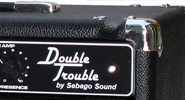
    The DT50 is the 50-watt version of Sebago Sound’s acclaime d Double Trouble amp line. Its mission? To capture classic Texas tone – and then some.

    The DT50 is packed with many high-end features that complement the quality tube tone provided by its circuitry.

    From left to right across the front panel, the first features one sees are two input jacks; Normal connects the guitar directly to the first tube stage, while the FET input inserts a transistor gain stage before the first tube. The FET can be used to add gain to either the clean or Overdrive channel, while also providing the extra gain some piezo-electric guitars need. Most of the time, however, Normal will serve just fine. It should be noted that the DT50 employs four cascading gain stages fueled by three 12AX7 preamp tubes and two 6L6 power tubes. The first two stages are used for the clean channel and, when the Overdrive channel is activated, these first two gain stages are fed into the final two gain stages, for maximum crunchola.

    Following the two input jacks on the front panel is the preamp’s Volume knob succeeded by three mini-switches and three EQ knobs; Treble, Middle, and Bass. The first mini-switch is a Bright switch, which boosts the top end. The second is a Mid boost, which bumps up mid frequencies. The final is a Mode switch, which chooses between Jazz and Rock voices. When the Rock mode is selected, there is a boost in the mid frequencies. As a result, the Bass and Middle knobs become less responsive, because the boost in gain is achieved by partly bypassing the tone stack. Jazz mode is considered the norm, while Rock is activated only when a higher degree of gain is needed.

    SEBAGO-02

    On the back of the DT50 are a standard on/off switch, standby switch, and two speaker outputs wired in parallel. A selector switch allows the user to choose between 4, 8, and 16 Ohms. There’s also an unbuffered effects loop labeled Signal Access. By connecting the Preamp Output jack to the input of an effects signal chain and the Power Amp Input jack to the output of that signal chain, a user is able to insert effects between the preamp and power section, which is particularly useful for time-based effects, which can sound mushy when plugged into an overdriven amp. Finally, there are two mini-switches and the input jack for the DT50’s pedal. The switches select whether or not the Boost and Overdrive functions are activated manually via the front panel or using the footswitch.

    We tested the DT50 with a Strat and Les Paul through a 2×12 cabinet. Playing with DT50 in Jazz mode on the clean channel, the clean tone was reminiscent of Fender blackface combos, without the overwhelming brightness sometimes associated with those amps. The clean sound was full, rich, and responsive to pick dynamics. The Bright and Mid mini-switches are effective for precisely dialing in tone. The Overdrive channel was also impressive. The Drive and Volume knobs provide a range of possibilities ranging from gritty blues-rock tone in Stevie Ray territory to hot-rodded distortion. With the Drive at about 3 o’clock and the Volume dimed, we got tones eerily close to Paranoid-era Tony Iommi. And with the Drive maxed out and the Volume and Mids scooped a bit, the amp can do convincing metal sounds.

    We were happily surprised at the versatility and dynamic tone offered by the DT50. It’s a powerful workhorse.


    This article originally appeared in VG August 2012 issue. All copyrights are by the author and Vintage Guitar magazine. Unauthorized replication or use is strictly prohibited.

  • New Orleans Guitar Company Model 8

    New Orleans Guitar Company Model 8

    NEW-ORLEANDS-MODEL-8-01

    New Orleans Guitar Company Model 8
    Price: $2,999
    Contact: neworleansguitar.com

    For over a decade, the New Orleans Guitar Company has been producing handcrafted electrics with an attention to design and detail possible only in a small shop. The vision of sculptor/luthier Vincent Guidroz was most eloquently conveyed in his Voodoo Custom and JB Custom guitars, with their figured tonewoods, neck-through construction, and fancy inlays.

    But in the real world, less can lead to more. And when dealers and players started asking Guidroz for a high-quality New Orleans Guitar at a lower price, he devised the Model 8.

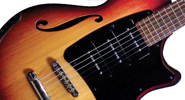
    Made with the help of the modern luthier’s assistant – the CNC machine – the Model 8 has a four-bolt neck, six-on-a-side headstock, flat top, various pickup configurations, and a hardwood armrest. Holdover construction details include prime tonewoods for the top and back, a stainless-steel zero fret, multi-laminate neck, and an impressive polished finish.

    Our Model 8 test guitar had a tobaccoburst, urethane finish that enhanced the grain of its one-piece ash top, bound in black. The three-piece korina back was untinted and the neck lightly shaded to amber, while the maker’s signature was visible under the finish at the back of the headstock. The circular lower bout has slightly offset waists and a graceful cutaway (with a barely perceptible point), attesting to the tasteful aesthetic of the guitarmaker.

    Looks aside, the Model 8 design represents an opportunity to observe the fundamentals of guitar design. The body is hollow on the bass side, reducing weight and enhancing resonance, while the figured-maple neck is assembled from grain-aligned quartersawn stock, promoting stability and sustain. The headstock is tilted back 10 degrees, eliminating the need for string trees. The zero fret sits 3/8 of an inch from the expertly cut and beveled bone nut. The 22 German nickel-silver frets are medium jumbo sized and sit on a 251/2″-scale rosewood fingerboard with a 12″ radius.

    Chrome Grover tuners, and matching Tone Pros tune-o-matic-style bridge and stop tailpiece are standard. DiMarzio pickups are mounted on the body with two screws through a black-plastic pickguard. Knurled chrome flat-top knobs, a three-way toggle, and an on/off mini switch for the middle pickup complete the visible hardware. Inside, a shielded control cavity houses carefully wired 250k CTS potentiometers with a 0.033-mF capacitor for the tone pot.

    The layout of the black DiMarzio pickups has been thoughtfully considered; the middle is reverse-wound in reverse polarity to create a humbucking effect when added to the mix. The bridge pickup is mounted 17/8″ from the high-E saddle, allowing for plenty of bite but greater exposure to the singing part of the string. The bridge pickup is stock-wound, the middle is five percent under-wound and the neck pickup is 10 percent under-wound, creating a balanced output.

    Strumming the Model 8 unplugged produced a gratifying ring, and plugging it into a late-’50s Ampeg Jet with a reissue Jensen speaker made a nice sonic platform.

    Played clean, the neck P-90 is warm, yet articulate, and the bridge pickup rings with authority for blues and rock leads. But the secret weapon of this design is the middle pickup; kicking in the third P-90 unleashes the guitar’s inner twang. The frequency cancellation achieved with the middle pickup engaged in any combination brings out voices suitable for country chicken pickin’, funk rhythm, and rockabilly sizzle. Employing the full roar of an Ibanez TS-9 in-line, big chords pulsed with audible harmonics, and the taper of the Volume pot allowed for effective volume swells.

    The New Orleans Guitar Company Model 8 offers a broad aural spectrum of satisfying, serviceable tones. Its weight and balance make it comfortable hanging on a strap, while the offset waist helps it rest well on a knee. The soft-shouldered D-profile neck is easy on the hand, and the setup makes for a pleasing playing experience. Designed for the working guitarist, it’s actually much more.


    This article originally appeared in VG August 2012 issue. All copyrights are by the author and Vintage Guitar magazine. Unauthorized replication or use is strictly prohibited.


  • Cort Z44

    Cort Z44

    CORT-Z-44-01

    Cort Z44
    Price: $569 list/under $400 street
    Contact: cortguitars.com

    Just about everywhere you look these days, manufacturers are devising new spins on the single-cutaway solidbody. Cort has been a player on the import scene for decades and, with its Zenox-series Z44, shows it’s serious about being a player in the world of the single-cut.

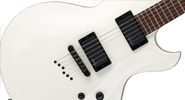
    The Z44 is a stylish, modern take on the Les Paul archetype. It has a beefier cutaway, a slightly elongated upper bout, and it adds modern flair with a stylish headstock that has a natural-wood “scoop” at its tip and minimal ornamentation on the fretboard, aside from a composite/mother-of-pearl Z inlay at the 12th fret. Black EMG pickups, natural-wood faux binding, an array of recessed knobs and an unusual, slanted cable-jack insert give it a sleek look and feel. The body is contoured with a gently arched top and back, and comfort cuts provide an ergonomic feel.

    This Cort has a set-neck construction and an almost-seamless heel. Materials include a mahogany neck and body, rosewood fingerboard with 22 large frets and a 12″ radius, and a Gibsonesque 243/4″ scale. Other treats include a bridge licensed by Tone Pros, a string-through-body setup, die-cast tuners, and two Volumes, plus a Tone knob with a push/pull coil-tap function. The EMG HZ-H4 is a passive humbucker, unlike its active-powered cousins.

    Plugged into a tube head and 2×12 cabinet, the Z44 proved a hard-rockin’ guitar. Its neck is flat and wide, like an ’80s shred axe, but where you might have paid over $1,000 for this guitar 25 years ago, you can get a Z44 with a similar setup for under $400. It’s impressive, and further evidence of the triumph of mid-priced Asian guitars (the Z44 is built in Indonesia). Certainly, it’s made for the heavy rock/metal crowd and performs extremely well in that context. The humbuckers do their job and, with the liquid-fast fretboard, shred runs and drop-D riffing are a breeze. Bring on your favorite metals riffs!

    The guitar’s debits are minor; some rough finish edges around the input jack. The coil-tap’s effect is modest – don’t expect real single-coil twang; it’s more just a simple midrange cut. Also, the guitar has a bit of heft, but that’s to be expected from a single-cut. All told, the Cort Z44 is a fine guitar, especially considering its affordable price. Add its killer looks and hairy tones, and you have a winner.


    This article originally appeared in VG August 2012 issue. All copyrights are by the author and Vintage Guitar magazine. Unauthorized replication or use is strictly prohibited.