Hard Rock International will launch its Jimi Hendrix Signature Series Edition 29 merchandise in Seattle during a media-only event February 9. Pieces on display include a Fender Stratocaster with a visual representation of the legend’s most recognizable songs on a guitar image designed collaboratively in 1970 by Hendrix and artist Alan Aldridge. Also on exhibit will be a pair of boots worn by Hendrix circa 1967-69 during performances in New York, the Gibson Flying V Hendrix reportedly referred to as the “Flying Angel” (most guitar aficionados know it as the “Red House” guitar), a contract for the Experience regarding performances at The Fillmore and Winterland Ballroom in San Francisco in 1968, and a contract between RSVP Music and “Jimmy” Hendrix for the song “No Such Animal,” dated June 21, 1966, prior to Hendrix changing the spelling of his first name.
The members of the Swedish internet forum ljudbojen.com recently commissioned the construction of a guitar set for sale at auction to benefit the Doctors Without Borders organization and its work at the Horn of Africa. The solidbody guitar has a single-cutaway shape and body made of Black Ash, a maple neck with 22 frets and a rosewood board, a saddle made from aged reindeer antler, Wilkinson bridge with compensated brass saddles, Lundgren Vertigo pickups, and the neck was given the Plek treatment by Guitar Labs Scandinavia.
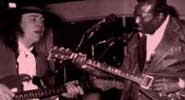
Every blues fan – and especially every Stevie Ray Vaughan fan – knows of this famous studio summit, which has long been available in various audio formats. Now, with a DVD, the package takes on new life – and becomes an absolute essential.
The story of this meeting is legend among SRV enthusiasts. Blues great Albert King was booked to appear on the live television show “In Session” at CHCH Studios in Hamilton, Ontario, on December 6, 1983. But to add to the spectacle, producers brought in King’s disciple, the 29-year-old Mr. Vaughan. As he testifies, King remembered meeting him as Little Stevie when he sat in with the master in Austin years before. Now, SRV had released Texas Flood six months prior and his playing was at a peak – especially here, in the presence of his favorite bluesman. Together, they turned up the heat in that Canadian studio.
While portions of the TV show footage have made the rounds as bootlegs or via youtube.com, the DVD presents the whole show, plus three tracks previously unavailable on past audio discs – a scorching version of King’s trademark tune “Born Under A Bad Sign,” Louis Jordan’s “I’m Gonna Move To The Outskirts Of Town,” and SRV’s newly minted classic, “Texas Flood.”
The video is presented in gorgeous, clear color, and watching the two trade licks brings the music alive as never before. You can see both musicians’ obvious respect for the other as they dig deep to play their best.
Sadly, this was the last time King and Vaughan shared a stage. Fortunately, though, it’s all here.
This article originally appeared in VG‘s Mar. ’11 issue. All copyrights are by the author and Vintage Guitar magazine. Unauthorized replication or use is strictly prohibited.
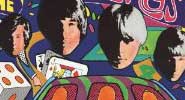
The Yardbirds issued only three truly distinct albums – Five Live (with Eric Clapton), The Yardbirds (a.k.a. “Roger The Engineer,” with Jeff Beck), and Little Games (featuring their final lineup of Jimmy Page, singer Keith Relf, drummer Jim McCarty, and Chris Dreja moving from rhythm guitar to bass). American releases ForYour Love and Having A Rave Up were essentially compilations of singles and live cuts from 1964’s Five Live Yardbirds, not initially issued stateside.
Following the departure of bassist/ producer Paul Samwell-Smith, their ’67 swan song was produced by Mickie Most, who’d helmed the Animals, Donovan, and Herman’s Hermits – although, according to McCarty, Most was only present for the title track/single (and some other failed, non-LP singles), where he used session players on bass and drums.
The album may be even more eclectic than its Beck-fueled predecessor – ricocheting from lowdown blues (“Drinking Muddy Water”) to jugband (“Stealing, Stealing”) to folk balladry (“Only The Black Rose”). Page excels on “Smile On Me,” which shifts from a swirling, Indian-tinged rhythm to blues shuffle a la Otis Rush’s “All Your Love.” His acoustic DADGAD vehicle, “White Summer,” is actually the traditional “She Moved Through The Fair,” previously recorded by Davey Graham, whose style Page lifts liberally. The psychedelic “Glimpses” and “Tinker, Tailor, Soldier, Sailor” anticipate Zeppelin, incorporating Page’s violin-bow technique.
This reissue – the first ever taken from the original mono masters (a dedicated, unique mix that, to producer Bob Irwin’s ears, is much more revealing and cohesive than the stereo) – contains two bonus cuts – “Puzzles” and the pub-fueled waltz “I Remember The Night,” which McCarty reveals most nixed because so many groups were including “funny” songs at the time. He says Most didn’t really get the Yardbirds. Fortunately, a legion of fans still do.
This article originally appeared in VG‘sApril ’11 issue. All copyrights are by the author and Vintage Guitar magazine. Unauthorized replication or use is strictly prohibited.
Even though there are probably more instrumental surf bands active today than during the genre’s early-’60s heyday, it’s very much an underground movement, populated by indie labels, mostly younger players, and a few originators and predecessors, like Dick Dale and the surviving members of the Ventures.
So what happens when former members of two established bands get together to dip their toes in the surf? Will they overshadow those toiling in obscurity with their disproportionate share of the spotlight, or will they help raise the entire idiom’s profile – maybe even swell into mainstream outlets?
With three-fifths ofAustralia’s Midnight Oil and one-third ofMilwaukee’s Violent Femmes comprising the Break, the experiment is already underway. The opening “Squintro,” featuring a riff reminiscent of “Out Of Limits” over crushing drums, leaves no doubt that the years spent together paid off for guitarists Jim Moginie and Martin Rotsey and drummer Rob Hirst – whether the Oils’ music bore any resemblance to surf or not. Likewise, Femmes bassist Brian Ritchie is right at home here, maybe because this is as fresh as it is retro.
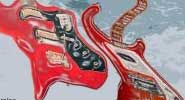
With Moginie’s organ, “Winkipop” is a nod to Joe Meek’s productions, with an angular left turn from Rotsey’s Jazzmaster. “Five Rocks” refers to a Queensland surf spot as well as its time signature – with Hirst playing 5/4 top over 4/4 kick, while Rotsey adds some slide and Moginie supplies ultra-high, reverbed splatters. Elsewhere, Yardbirds bends, Theremin, Rotsey’s Fender Bass VI, chanting monks (oops – the Break again), and “pulsing Soviet synths” crop up. This debut by veterans raises the bar, as if to say, “It’s not enough to just get up there and play ‘Mr. Moto’ anymore.”
The eclectic bent of fellow Aussie Ben Rogers (who also plays acoustic folk with Vipers Dream and Djangostyle swing with the Ben Rogers Trio) serves him well in his Instrumental Asylum surf outlet.
This is his trio’s third CD since its 2005 debut. Whereas Welcome To InstrumentalAsylum was more than half covers, Rogers writes all but three of the tunes here (with an occasional assist from drummer Nikki Scarlett and drummer Denis Close) – the covers being an overdriven take on Reinhardt’s “Anouman,” an unexpected ukulele/ guitar reading of “Beyond The Sea” (Ian Whitcomb meets Peter Green?), and a deconstructed ride on “Tell Him” by the girl group the Exciters.
“Last Coffee On Union Road” has a sort of vaudeville blues feel, with Rogers trading solos (on a Gibson Johnny A electric and National Tri-cone) with Martin Cilia of the early-’60s Australian surf combo the Atlantics.
Like most non-American lead guitarists in instro combos, Rogers’ most obvious influence is the Shadows’ Hank Marvin (as on “Never Seize To Amaze”), although he cops Duane Eddy’s deep tone perfectly for the intro to “Shuffle,” and his jazz influence is back on “Eddie’s Hip Joint” – presented in both final and equally charming demo versions.
Who knows? Maybe these dinki-di bands from Down Under will lead the charge for surf music everywhere. Oy!
This article originally appeared in VG‘sApril ’11 issue. All copyrights are by the author and Vintage Guitar magazine. Unauthorized replication or use is strictly prohibited.
Damon Fowler has a smokyMemphis-like style of soul and blues at its peak on his third album. The combination infuses his originals (“After The Rain”) with a Southern rock feel that recalls Lynyrd Skynyrd (“Once In Awhile”), Little Feat (“Cypress In The Pines”), early Leon Russell, and even a touch of Lee Michaels, in “You Go Your Way” and the title cut.
Fowler plays all the guitars here, including righteously funky steel on “Fruit Stand Lady,” but shows a lot of self-discipline by avoiding indulgent solos. Instead, he follows the example of the best players, notably session greats like Steve Cropper, by working in service to the song. That attitude shows in the restrained-but-evocative solo in “After The Rain” (one of the albums – and Fowler’s – finest songs), the groove-heavy “28 Degrees” and the jamworthy “Cypress” and “Don’t Call Me.” It’s a lesson some artists are a long time learning, but it turns a good song into a good record.
This article originally appeared in VG‘sApril ’11 issue. All copyrights are by the author and Vintage Guitar magazine. Unauthorized replication or use is strictly prohibited.
Folkie Dondero ranges from eclectic originals (“Not Everybody Loves Your Doggie Like You Do”) to uniquely interpreted covers including Lowell George’s hippie trucker ballad “Willin.’” Though it’s been done in just about every coffeehouse across America, it – and the rest of this disc – are quirky and likeable. Much of Dondero’s music owes a debt to oldtime bluegrass; it shows its best face in his own “Please Hand Me Over To The Undertaker” and a no frills version of Woody Guthrie’s “Pretty Boy Floyd.” But there’s a strong country folk feel, as in his unhurried version of “Is Anybody Going To San Antone.” That one (Dondero also does the Charlie Pride hit “Kiss An Angel Good Morning”) and “Undertaker” would be the album’s most appealing cuts if he hadn’t included Neil Young’s “Don’t Cry No Tears.” It was an inspired choice and, having been written when Young was still in high school, also shows that little beats talent and teen lovesickness as a combination for inspiring songs.
This article originally appeared in VG‘sApril ’11 issue. All copyrights are by the author and Vintage Guitar magazine. Unauthorized replication or use is strictly prohibited.


 The members of the Swedish internet forum ljudbojen.com recently commissioned the construction of a guitar set for sale at auction to benefit the Doctors Without Borders organization and its work at the Horn of Africa. The solidbody guitar has a single-cutaway shape and body made of Black Ash, a maple neck with 22 frets and a rosewood board, a saddle made from aged reindeer antler, Wilkinson bridge with compensated brass saddles, Lundgren Vertigo pickups, and the neck was given the Plek treatment by Guitar Labs Scandinavia.