Month: February 2010

  • February 2010

    FEATURES

    Billy Sheehan
    New Music, Old-School basses
    Accompanied by a 1970 Fender Precision Bass, he has been a standout in four decades, including tapping toe-to-toe with Steve Vai. He harbors a special love for baritone instruments, which have become the musical foundation for his solo work. By Lisa Sharken

    The Supro S6651 Big Star
    When it comes to ’60s kitchen kitsch, this amp, with its Formica styling, gas-cooker knobs, chrome, and an emblem seemingly lifted off a fridge door, is hard to beat. And being a Valco product, it naturally sounds great. By Dave Hunter

    The Rosewood Dobro In the ’30s, Dobro went through a series of ownership changes and did not strictly follow specifications. So it’s not surprising to find birch, mahogany, walnut, spruce, or faux-grain wood on its pre-war models. But rosewood is out of character! By George Gruhn and Walter Carter

    Dennis Kager
    techy’s brain, musician’s heart
    Amplifiers became his passion 45 years ago, and he has witnessed the zeitgeist surrounding the combination of guitar and amp. Player first, then builder, the duality strengthened and shaped his concept of sound and how to achieve it. By P.J. Cotroneo

    Tiny Moore’s 1952 Bigbsy Mandolin
    Born into a musical family, as a child he played fiddle. But as a young man, he saw Leo Raley and his electric mandolin in the Texas Wanderers – and his focus then changed! By Deke Dickerson

    The Guild M-85-II
    Founded by a “jazz guy,” Guild’s early guitars were designed to suit the form, so it didn’t begin making solidbody electrics until the early ’60s. In ’67, it launched this instrument, sibling of its popular M-75 BluesBird. By Willie G. Moseley

    The B.C. Rich Seagull
    Until companies like B.C. Rich came along,electric guitars were mostly just ergonomically stretched Spanish-style guitars. But this guitar fits a continuum that mirrors a wider evolution. By Michael Wright

    DEPARTMENTS

    Vintage Guitar Price Guide

    Builder Profile
    Manndolins

    Upcoming Events

    Vintage Guitar Classified Ads

    Dealer Directory

    Readers Gallery

    FIRST FRET

    Reader Mail

    News and Notes
    Santana, GC help food banks, Gibbons Stuck in Tube, Arlington ’09, Stolen Gear, more!

    the house that rock built Rock HoF Jams on DVD
    By Dan Forte

    billy pittman
    Staying Grounded in Tilt-A-Whirl
    By Rob Roberge

    Ask Zac
    By Zac Childs

    rusty anderson
    The Long and Winding Road
    By John Heidt

    ace frehley
    Back From Space
    By Lisa Sharken

    doug lubahn
    Four Strings for The Doors
    By Willie G. Moseley

    david wilcox
    Olson Devotee
    By Steven Stone

    COLUMNS

    The (Way) Back Beat
    Rickenbacker’s Art Deco Plastic Family
    By Peter S. Kohman

    Q&A With George Gruhn

    Fretprints
    Richie Blackmore: The Rainbow Years
    By Wolf Marshall

    Guitars with Guts
    Bridging the Gap
    By R.E. Bruné

    Acousticville
    Arlington ’09: How Do You Start a Flood?
    By Steven Stone

    “401K” Guitars
    In Search of the “Market Bottom”
    By Gil Hembree

    TECH

    Talkin’ Amps With…
    Blackie Pagano: Secrets to Vintage Tone, Part II
    By David Jung

    Dan’s Guitar Rx
    Something Old, Something New, Part IV
    By Dan Erlewine

    Shop of Hard Knocks
    Meet the “Omnicaster”
    By Will Kelly

    REVIEWS

    The VG Hit List
    CD, DVD, and Book Reviews: Brian Setzer, Steve Morse, Wilco, Kentucky Headhunters, Sean Costello, Jim Weider, Arlen Roth, Six-String Heroes, more!

    Check This Action
    The New Lost City Ramblers
    By Dan Forte

    Vintage Guitar Gear Reviews
    BC Audio Amplifier No. 7, Squier Jagmaster, Eastwood RS-II, SWR Marcus Miller Preamp, Gold Tone BT-2000/GM-6, Seagull Coastline S12, Takamine G Series, Bluesman ’62 Stack Knob J Style, Mojotone Convertible Strat Pickups, Planet Waves Humidipak

    Gearin’ Up!
    The latest cool new stuff!
  • Alembic Distillate DMSB

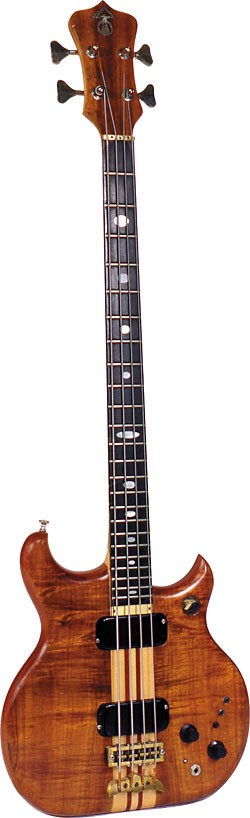
    1982 Alembic Distillate DMSB

    1982 Alembic Distillate DMSB. Photo: Bill Ingalls Jr.

    Active pickups in electric guitars and basses have been around for more than four decades; in 1962, British guitar builder Burns offered its TR2 model, which used a preamp that boosted bass or treble response.

    But it wasn’t until 1969 that active electronics came into prominence, when the California-based builder Alembic began hot-rodding guitars and basses for the Grateful Dead.

    Alembic was founded by recording engineer Ron Wickersham and his wife, Susan, who were soon joined by Bob Matthews (also a recording engineer) and luthier/guitarist Rick Turner, and they got their start modifying Guild Starfire basses for the Dead’s Phil Lesh and Jefferson Airplane’s Jack Casady. Ultimately, the company progressed to making its own bodies and necks, which led to Lesh’s Starfire ultimately becoming almost unrecognizable as a Guild, with its Alembic neck, low-impedance pickups, and 13 control knobs!

    The first bass bearing the Alembic logo was made for Casady in 1971. A solidbody with a 32″ scale and neck-through design, it laid the foundation for the company’s approach – that is, creating hand-built high-end instruments with exotic woods, artistic inlays, and state-of-the-art electronics.

    Turner departed Alembic in the late ’70s, and went on to make his own guitars and basses (see VG‘s December ’08 issue for a profile of his Model 1 bass). Before he left, however, the company began creating new models aimed at a lower-cost segment of the market. The Distillate, introduced in 1981, was one of the earliest of those “more accessible” Alembics.

    A 1981 Alembic catalog hyped the Distillate by noting that it incorporated “…several of the most requested features of Alembic’s custom basses into a single, production instrument. The result is an instrument with an uncompromising look, sound, and feel that will satisfy the perfectionistic player while simultaneously impressing even the most discriminating listener.”

    The Distillate was the first standard Alembic bass offered in mono only. Early examples, made for the Japanese market, were single-pickup models with top-mounted control plates made of brass. The two-pickup version, designated for the United States, came along in ’82.

    Standard features on the Distillate included a five-ply laminated maple-and-purpleheart neck-through design, and a Honduras mahogany body topped by a choice of Maple (options included plain, flamed, quilted, burled, and birdseye), Walnut (plain, burled, and figured), Bubinga, Bocate, Coco Bola, Pinstripe Zebrawood, Erratic Zebrawood, Flame Koa, Tulipwood, Lacewood, Rosewood, Maccassar Ebony, or Vemillion.

    The one shown here has a Flame Koa top and a multi-laminate headstock in the original/standard Alembic silhouette, topped with koa laminate. The neck has an ebony fretboard with the company’s standard oval-shaped inlays.

    Alembic’s metal parts were intriguing, as well. The sterling silver headstock emblem is the company logo.

    Not surprisingly, the nut, bridge, and tailpiece are all made of brass, part of the design that helped Alembics attain their signature sound, which was noted for being huge and resonant. Truss-rod adjustment was accomplished by removing the brass plate between the neck-position pickup and the end of the fretboard. Even the control plate on the back is made of brass.

    The Distillate’s electronics included two hum-canceling active pickups controlled by a rotary switch as well as master Volume and master Tone knobs. On early examples, the rotary switch was on the treble cutaway, while on later versions, pickup switches were placed in front of three mini-toggles that controlled bass boost/cut, treble boost/cut, and a “Q” switch that converted the Tone control to an onboard wah.

    The active electronics are turned on when a cord is plugged into the jack, and the LED near the jack illuminates red to indicate the battery is on. This LED wasn’t on later Distillates.

    Alembic did, of course, offer special-order options on the Distillate. This one has a custom neck width, pickup location, and a deeper treble cutaway. Other options included various scale length, side-position LED markers, fingerboard LED markers, laser LED fret markers, and custom fingerboard inlay. It was available in four-string, five-string, six-string, and eight-string variants, and could also be ordered in a left-handed configuration.

    The Distillate was discontinued as a production instrument in 1990, but remained available as a special-order bass. And as with most Alembics, the one shown here is one of a kind. While it was designed as a lower-priced model, it nonetheless has plenty of the unique elements that made the Golden State builder a legend in high-end luthiery.


    This article originally appeared in VG‘s September 2009 issue. All copyrights are by the author and Vintage Guitar magazine. Unauthorized replication or use is strictly prohibited.

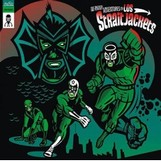
  • Los Straitjackets – Further Adventures

    Surf music has often been all about the schtick. Whether it’s the melodies or the bands’ personas, surf is often part gimmick, part great music. Los Straitjackets just know how to turn it all up to 11.

    Take twang-laden guitars, add fuzzedout bass and rock-solid drums – plus the Mexican luchadores masks, dark suits, and choreographed stage moves – and you have Los Straitjackets. The band is three guitarists strong – Danny Amis, Eddie Angel, and Pete Curry (who also plays bass as well as “lead bass” on “Mercury”). The powerhouse drumming comes courtesy of Jason Smay.

    Their music reverberates with a retro vibe in the melodies and solos, as well as the song titles. “Cal-Speed” is a hotrodder’s dream, with its driving guitar lines. “Challenger 64” has a Hemi under the hood in its accelerated, trebly solos. “Teen Beast” sounds like it’s coming to get you in the after-dark shadows of a beach party.

    This is pure fun, played good and loud.


    This article originally appeared in VG‘s Sept. ’09 issue. All copyrights are by the author and Vintage Guitar magazine. Unauthorized replication or use is strictly prohibited.

  • H&D, Running Dog, and Gibson L-Style Guitars

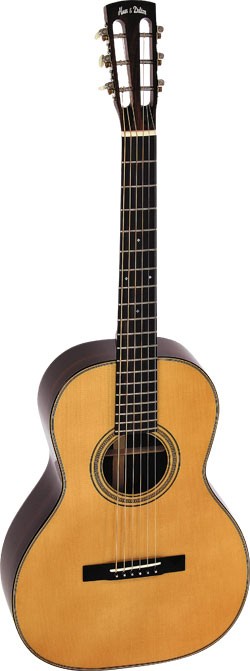
    Huss & Dalton 00-SP

    Huss & Dalton 00-SP

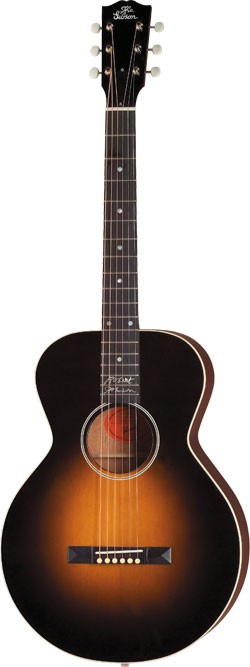
    Gibson Robert Johnson L-1

    Gibson Robert Johnson L-1

    In the July issue we looked at affordable L-style flat-tops for the acoustic blues player. This month, we look at similarly inspired instruments, but at a premium price point. All three are American-made, one comes from a cadre of skilled workers, one was made by the hands of a solo luthier, and the third is the product of an industry stalwart.

    Huss & Dalton’s 00-SP casts a first impression of striking simplicity, with its natural-finish spruce top with cross-grained figure – a sign of quality, quartersawn timbers. Trimmed with wooden purfling, bindings, and a herringbone rosette, a quick look reveals fine detail such as the perfectly sculpted pyramid bridge, figured Brazilian rosewood headstock veneer, and quadrangular, slotted-diamond pearl inlay at frets 5, 7, and 9.

    In the simple strum of a few chords, the 00-SP offers a loud, full-spectrum sound that’s almost unnerving coming from its diminutive 141/8″ body. With back and sides of Indian rosewood, domed Engleman spruce top braced with Adirondack red spruce, a slotted headstock for enhanced string tension, and hefty Honduran mahogany 12-frets-to-the-body neck all working together, the 00-SP is orchestral in its response and even in its tone, with well-defined highs and mids and a rumbling bass. The subtly V-shaped neck, with a 24.9″-scale ebony fingerboard, 17/8″-wide nut, and 16″ radius, might take some getting used to for a small-handed player (Huss & Dalton offers several options, including neck and fingerboard details). But the setup was ideal for the fingerstylist, and the craftsmanship of the fretwork, nut, and saddle is impeccable.

    It’s easy to understand why H&D has risen to the level of one of America’s premium guitar makers in just over 10 years; virtually all elements of craft, playability, materials and sound put the 00-SP among the finest modern L-style guitars.

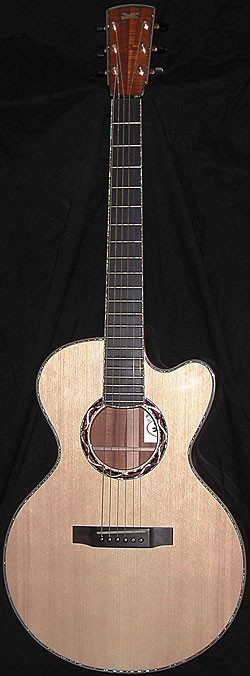
    The Running Dog Mini Jumbo by Seattle-based luthier Rick Davis is a showcase for the inspired options only an indie builder can provide – Adirondack top, flamed koa back and sides, spiral rosette, thin abalone “micro-pearl” purfling, and sycamore binding. Blue-dyed wooden purfling tastefully enhances the color of the shell, and the sycamore exhibits an attractive, reflective fleck.

    Davis’ mahogany/maple neck with two-way truss rod is reinforced with two lengths of carbon graphite, adding to its stability and stiffness and allowing more vibration to pass to the body. An ebony fingerboard with 25.4″ scale, 14″ radius, and 13/4″ nut is fitted with artfully dressed medium-small frets and an unbleached bone nut.

    Rounded at the tailblock with soft waist curves, the Mini Jumbo body has an optional wedge design attributed to luthier Linda Manzer. Deeper on the treble side, the ergonomic body makes it easier for any juke-joint blues man to knock out hours of dance music.

    Running Dog Mini Jumbo

    Running Dog Mini Jumbo

    The Mini Jumbo inspires blues, ragtime, jazz and Latin styles, both pick and fingerstyle, with its direct attack and even voicing. Even the most emphatic right hand histrionics explode under a heavy touch without compressing, with fine single-note sustain and superior chord articulation. One wonders if the Manzer wedge enhances the sound by eliminating sympathetic hot/dead spots created when backs and tops are too close to parallel. The reinforced neck, the fine tonewoods, and the unique care and craft all add up to a noteworthy example of a 1930s-inspired guitar with a contemporary character.

    Among L-style guitars, it makes sense that the ultimate reissue would come from Gibson – the Robert Johnson L-1. Strung with .011s, the Robert Johnson L-1 shows the extra work that the Gibson’s crew in Bozeman (Montana) puts into the Signature Artist Series. Feather-light, the L-1 is predictably responsive, with an acoustic shimmer that would make it a fine choice for old blues or new-age fingerstyle playing. The V neck with 13/4″ nut width and 25″ scale makes for a very easy playing experience.

    The quality materials – Sitka spruce, mahogany, and ebony (bridge and fingerboard) are a step up from what Gibson of the late ’30s might have used on a budget model, but the white-button Gotoh tuners and old-style “The Gibson” logo bring it all home, appearance-wise. The tone braces look familiar to anyone accustomed to peering into old Gibsons, although we sort of missed the occasional saw kerf marks often visible inside the original models. The dovetail neck joints and nitrocellulose lacquer finishes will please old school purists.

    Does the Robert Johnson L-1 have the legendary mojo – that almost indefinable quality of mysterious allure that helps a musician connect with both music and audience? Period-authentic vibe aside, it carries a right-hand thumb/bass thump with a round, satisfying sound a solo bluesman would appreciate as jukejoint dancers start swaying. The ebony bridge and fingerboard help with the treble punch for slide and single-note work.

    In the same way that access to the internet doesn’t necessarily impart a user with the spiritual wisdom of the ages, possession (not that midnight/Delta crossroads type!) of an RJ L-1 is not going to suddenly give any player the sudden ability to translate left- and right-hand movements into a powerful, hypnotic expression of the blues. That mojo is in a player’s mind, heart, and fingers, and could certainly be expressed in any of these L-style guitars.


    Special thanks to International Vintage Guitars, New Orleans.


    Huss & Dalton 00-SP
    Price $3,795
    Contact Huss & Dalton Musical Instruments, 420 Bridge Street, Staunton, VA 24401; phone (540) 887-2313; hussanddalton.com.

    Running Dog Mini Jumbo
    Price $3,950
    Contact Running Dog Guitars, 118 North 35th Street, Suite 105, Seattle, WA 98103; phone (206) 547-1407; vtguitars.com.

    Gibson Robert Johnson L-1
    Price $3,171
    Contact gibson.com.


    This article originally appeared in VG‘s December 2008 issue. All opyrights are by the author and Vintage Guitar magazine. Unauthorized replication or use is strictly prohibited.

  • Marc Ford

    MARC Ford

    Marc Ford: Matt Wignall.

    Whenever Marc Ford has held down the guitar chair in a band, whether it’s with the Black Crowes, Ben Harper, or Blue Floyd, people talk about one thing – his sound.

    “If you got the tone together, you kind of got half the battle won,” Ford acknowledges. “I think over time, through knowledge and experience, I’ve learned to dial one in really quick. People say no matter what I’m playing, it sounds like me.”

    Ford’s sounds are all over his latest solo release, Weary and Wired. For the most part, it’s trio-rock heaven dominated by the former Black Crowes’ blistering guitar playing. That’s not unusual for a record distributed by a division of Mike Varney’s Shrapnel Records. Still, Ford says, Varney let him take a different approach.

    “Mike makes a particular kind of record, and I just wasn’t interested in making that, and I told him. He kept coming back and I told him ‘You know, Mike, to be honest, I’m not going to make that many records in my life and I just can’t make one I’m not happy with.’ After some discussion and a few struggles, well… he didn’t hear a note until the end. He pretty much let go and let me do my own thing. I just said ‘Look, I promise I’ll give you a great record.’ And he just said, ‘As long as there’s a lot of guitar.’ And I was ready to make that kind of record.”

    One reason Ford was ready was a reunion with Burning Tree bandmates Doni Gray and Mark “Muddy” Dutton. Burning Tree was a trio Ford played with before he joined the Black Crowes. Also contributing to the record was Ford’s son, Elijah, who was 17 when Marc walked in and heard him playing the guitar riff that would drive “1000 Ways” on the new record. “I said, ‘Hey, hey, hey… What was that?’ And I told him he was way too young to be messing with licks like that. ‘I need it!’ So I took it, wrote some more to go with it, and we recorded it the next day.”

    Ford’s reputation as a guitar player came from his two stints in the Black Crowes. Some were surprised when he left the second time, but he has made it known he didn’t want the touring and lifestyle to become a threat to his sobriety, which he has had to fight for in the past.

    One of the unfortunate aspects of leaving a famous rock band is income levels tend to go down. For that reason, Ford got his famous tone on this record by using different, sometimes unusual, guitars. “Most of my stuff was hung up, so I used what I had at home. I used a nice guitar Bill Asher built for me, and this Höfner I found; I think it’s a Club 40. It’s like a chambered Les Paul, with P-90s and a Bigsby. That guitar just gets some fantastic sounds. I was very limited in what I could use, and it really worked for me. I didn’t worry. It was just like it’s either that one, that one, or that one.”

    Ford also uses Reverend guitars on the road, and a ’59 Historic Les Paul. Asked which of his old guitars he misses, he points to his ’63 Tele. “I dearly love that guitar, but it’s hung up somewhere. Over the years, whether I’ve had money or haven’t had money, equipment was always what I bought and it was as an investment so that when times got rough, I’d sell some things off. And there were some phenomenal guitars I’ve had and had to let go… But, you know, they make more.”

    He used Roccaforte and Schreyer amps in the studio, as well as his old 50-watt Marshall, and a late-’60s Fender Showman strung together with two or three other amps to get a blend. Effects on the disc include a Fuzz Face, Octavia, and a wah.

    Ford and his band are hitting the road, touring Europe first and then the U.S., hoping to capitalize on the buzz the record has created in guitar circles. He’s also hoping to do some more producing in the future; he has produced recent records by the Pawnshop Kings and Ryan Bingham, and says he’s looking forward to doing more.

    “It’s something I love, and I’d like to generate more money and not have to be on the road my whole life.”

    Listeners will also notice the blossoming of a fine singer and songwriter as they listen to Weary and Wired. Ford’s influences in those fields are as strong as his guitar influences.

    “I listen to songwriters more than singers. I love Dylan, Neil Young, and people who have wonderful lyrics and can convey a mood and are honest. As a singer, though, I finally have come to a place where I can enjoy singing.” And fronting the new group is a marked departure from his days in the Crowes. “I was a sideman, and really just stayed out of the way. I didn’t think about being out front. This is very dear to me and there are some songs that have been waiting around to have a home. You know, with my sobriety, it just came to a point where I was totally prepared to do this. I’m playing better and just being so much more productive.”


    This article originally appeared in VG‘s July 2007 issue. All copyrights are by the author and Vintage Guitar magazine. Unauthorized replication or use is strictly prohibited.


    Marc Ford Band