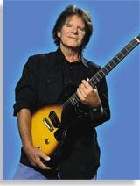
It would seem that, for decades, John Fogerty has had his finger on the pulse of the record-buying public. After all, Creedence Clearwater Revival, the band he formed as the Blue Velvets in 1959, was considered the “American Beatles” for its ability to crack the Top 10 time after time. From 1969 to 1971, Creedence placed an astonishing 13 songs in the Top 10 of Billboard magazine’s Pop Singles chart, with three more in the Top 40 – all penned by Fogerty.
Ironically, being commercial wasn’t hip in the era of psychedelic concept albums and ballrooms like San Francisco’s Fillmore Auditorium, where Fogerty, his brother Tom on rhythm, bassist Stu Cook, and drummer Doug Clifford often played, across the Bay from their home town of El Cerrito. Likewise, Fogerty worked out simple, hook-filled solos echoing influences like Duane Eddy and Steve Cropper. They were a far cry from the extended improvisations and pyrotechnics of Clapton, Beck, Bloomfield, Page, Hendrix, and other “guitar heroes” – an appellation never applied to Fogerty.
But one would be hard-pressed to find music more rooted in the guitar than John Fogerty’s, then or now. Creedence’s lead/rhythm/bass/drums instrumentation mirrored that of the Ventures and had its genesis in Elvis Presley’s Sun sessions, with Scotty Moore’s lead, Bill Black’s bass, D.J. Fontana’s drums, and Elvis’ acoustic rhythm. And songs like “Bad Moon Rising,” “Green River,” “Up Around The Bend,” and “Proud Mary” straddled blues and country in the tradition of Elvis, Carl Perkins, and Chuck Berry.
It’s interesting to note that the five albums Creedence released in that three-year run (Bayou Country, Green River, Willy And The Poor Boys, Cosmo’s Factory, and Pendulum) all landed in Billboard‘s Pop Albums Top 10, but also placed respectably on Billboard‘s Black Albums chart. Ironically, in today’s radio climate, Creedence would probably be considered a country act (unless songs like “Down On The Corner” and “Lookin’ Out My Back Door” were deemed “too country”) – a fact Fogerty illustrated when he came out of hiding 13 years after CCR’s breakup, with 1985’s Centerfield, a #1 Pop album that climbed to #7 on Billboard‘s Country chart.
For most of the interim, Fogerty stayed on the sidelines, locked in contractual battles with his label, Fantasy Records. To get out of his contract, he signed over all future artist royalties, though he continued to receive songwriting royalties. As he stated in ’85, “It was like cutting off your leg to save the rest of your body.” In interviews, he was vocal about his disdain for Fantasy, and refused to perform Creedence material, reasoning that it would spur catalog sales and line the label’s pockets, not his.
The bad blood between the two parties rose to a boil when Fantasy sued Fogerty for copyright infringement because of similarities between “Old Man” and “Run Through The Jungle,” which was still owned by Fantasy’s publishing division. In November, 1988, a jury ruled in Fogerty’s favor after he testified in court, guitar in hand.
On July 4 of the previous year, at Washington, D.C.’s “Welcome Home” concert for Vietnam veterans, John played Creedence hits for the first time in public since the band’s breakup. They eventually became a fixture of his live shows, and shortly after the Grammy-winning Blue Moon Swamp (which came 11 years after 1986’s Eye Of The Zombie), his live Premonition album combined Creedence and solo material.
Whereas Fogerty played all the guitars on Blue Moon Swamp, for 2004’s Déjà Vu All Over Again, he enlisted players like Dean Park, Dobro great Jerry Douglas, and even Mark Knopfler on one track. It was his first studio album in seven years, but the lapse this time wasn’t the result of legal entanglements, but “just life,” as he put it. “My family and I moved to Nashville, and lived there for a year,” he explains. “But it just didn’t suit us, so we moved back to California. We really missed home and the familiarity. It was very disruptive because we sold everything and were committed to the move. We moved back in 2000, and it took me a while to get a new writing studio going. But seven years… in my career that’s short, but still, it’s way too long.”
But the biggest news of late came when Fogerty signed with, of all labels, Fantasy Records, after it was acquired by Concord. This made possible the release of the first collection combining Creedence and Fogerty material – The Long Road Home, featuring four smoking Creedence remakes, recorded during his Summer tour in ’05. A live DVD from that tour is planned for ’06.
Fogerty recently granted Vintage Guitar unprecedented access to his sizable guitar collection, letting us peruse his inventory list of 181 stringed instruments. The guitars pictured here were chosen by the magazine or by Fogerty himself, for their collectibility and the role they played in his music – part of rock and roll history.
Vintage Guitar: Between Eye Of The Zombie and Blue Moon Swamp, you talked about “becoming a real guitar player.” After having so much success doing what you’d been doing, why change a good thing?
John Fogerty: I got reacquainted with the Dobro around 1992. It was kind of a result of trips I’d taken to Mississippi. And I started hearing that buzz in my head – what slide does and that whole area of the sonic palette. Mississippi is so full of slide, though it’s coming from a little different direction. At the first guitar show in Pomona [California], a guy walked by, and I said, “What’s in that case?” It was a Dobro, and before I knew it, I bought it – you know how that is. That got the whole thing going. And once you’re tickling a Dobro, you eventually find Jerry Douglas. In that whole process, I realized that Jerry Douglas is my favorite musician of all time. He just does it to my entire psyche – my heart, my memory, the whole thing. You’re trying to get inspiration; you’re trying to learn things; you’re kicking yourself in the butt. And Jerry surrounds himself with all these great musicians. One day, I just realized, “God, listen to Sam Bush there! Wow, listen to Russ Barenberg, or Edgar Meyer, or Eddie Bayers.” All those cats are just so incredible.
And at that moment the little searchlight down in the dark, dark cavern in my brain finds that molecule that I’d tucked away – the one where I was 13 and promised myself I was going to grow up and be really good, right? So it’s sitting there illuminated. I’m going, “Oh, sheesh!” I’m remembering that I said that to myself, and I’m hearing Jerry Douglas, and there’s a nanosecond of revelation, I guess. Basically, at that moment, you’ve got two choices. You’re on the tightrope. You go, “I’m gonna do it,” or you go, “Nah, it’s too late. Screw it.” I had that moment, and it was embarrassing. I was 48 years old, and I said to myself, “You were supposed to be good. What did you do?” So that kicked me in the butt.
But it’s not like you were inept on the guitar.
No, but there’s a difference. There are the people like Chet Atkins and Brent Mason and Mark Knopfler, Bryan Sutton, Vince Gill, and I don’t know all of his work, but Brad Paisley. Monsters. Mofos. People like James Burton, Albert Lee, Ray Flacke. You’re just in awe. And, of course, Jerry Douglas. And I certainly wasn’t one of them – the guys who are the men among men. I had fondly told myself over the years, “Well, John, you have emotion. You don’t have all the chops, but you can get emotion out of the guitar, and the part in the tune on the record works okay.” And Lord knows I’ve had a few of those. But that other thing, where I now saw what I’d promised myself; I don’t know how to say it other than it was a revelation. I could remember what I thought that meant when I was 13. So you’re forward and backward in time all at once. Here I am in the future, a shaking, pale shadow of what my childish mind had projected for me [laughs].
Once you make the decision to pursue that, what’s the process?
I can’t say that it was necessarily a straight line. First, I was working on the Dobro. Playing, playing, playing – eight hours a day or more – trying to get proficient enough just to make this record. I guess my shining moment was “110 In The Shade.” It’s certainly not the chops of Jerry Douglas, but at least it was knowledgeable to the instrument. It made it speak, and it was the right choice of notes. I would call Jerry, but I was too afraid [laughs]. Then in 1998, I was on a flight to Scandinavia, and I made up my mind that, “I want to learn how to do the free-hand thing on guitar.” I’m a huge fan of Bill Monroe and the way he played the mandolin. That whole effortless cascade of notes. They sound like rippling water off a waterfall, yet they all are part of the tonal palette. It’s so incredibly colorful, and yet you hear the melody within. It isn’t just noodling, like a lot of guys do. It’s taking you somewhere. And he’d pause at the place where you’re supposed to hear the melody. And there are some guitar players who play that way, too. Jerry Douglas plays the Dobro that way – such a high level. For me, on the guitar, it meant the free hand – not resting or anchoring my hand on the guitar. Just free, where the wrist is moving and rolling.
So you actually changed your technique.
I’ve had to work on it ever since. You know, bluegrass guys play that way. You have to have chops. To play guitar in a bluegrass band, they expect that of you. But in a rock and roll band, everybody’d go, “Stop playing!” [laughs]
David Lindley plays with a loose hand, like he’s playing an oud.
There ya go. The way I was defining myself, with the emotion and the right few notes – he can do all that. He gets such great texture out of all the lap and slide stringed instruments, and traditional guitar. But he’s also got incredible chops, because when he plays something, it’s not just blap, blap; it’s etched out of stone. It’s all in the exact right places, with strength and assuredness. Yeah, he’s funky.
How did “Nobody’s Here Anymore” with Mark Knopfler (from Déjà Vu) come about?
I’d written the song, and the arrangement kind of settled itself there. I guess I could have had sitar, flute, and bongos, but it just sounded right. I played a demo for my wife and a few people, and everyone said, “That sure sounds like Mark Knopfler.” Having long been a Mark Knopfler fan, once I heard that it was so obvious, I kind of went, “Gee, that’s a good idea. I think I’ll just call Mark Knopfler.” He graciously agreed to participate, and I was very happy about that. Mark’s great. My own position in the world – where I reside in the universe – I’m a huge fan of the guitar and great players, and obviously, Mark Knopfler is one of those. I’m bowled over by people who can play great and have something to say.
The intro on the live version of “Keep On Chooglin’,” with some two-handed tapping, is a long way from the sort of “compositional” solos on “Green River” and “Proud Mary” – as cool as they were.
Well, don’t get me wrong. Certain things of rock and roll have to be played with rock and roll technique. In a way, I’m fortunate; in a way I was cursed that I grew up, what I consider, a normal, rock and roll, middle-of-the-AM, Top-40-radio kind of kid. Elvis, Carl Perkins – that stuff happened, and I went with that. I didn’t grow up in the Appalachians with a granddaddy who played fiddle and banjo and all the stringed instruments. I might have been a different guy, because I love all that stuff, and I loved it as a kid. But I wasn’t around anybody who had a clue what that was. So I didn’t get taught. Especially slide instruments like the Dobro and lap steel – it was a total mojo mystery to me. That’s why I was so proud and happy with Blue Moon Swamp in that regard; I finally got some of that stuff under my fingers.
But the rock and roll thing, like the intro on “Rock And Roll Girls” – sort of my take on “Wild Weekend” – it’s simple, but it just hits you right in your solar plexus. My kids are learning that right now; they’re 12 and they played a little showcase for a few people in a local club with some other kids. It’s great experience. But one of their songs was “Wild Thing” by the Troggs, and it’s still wonderful to hear. It isn’t like I’ve abandoned that and I’m now going to play jazz or something. And jazz guys are also the free-hand, loose thing, but I’m not there. Emotionally, I basically don’t get it.
Any pockets of jazz you are into?
Yes. Django Reinhardt is a knowledge I’ve come to much later in life. But even as a kid, maybe 13, I was very aware of Charlie Christian. My mother liked Benny Goodman, and I had the Carnegie Hall 1938 concert on LP, and a lot of Benny Goodman small-group records, and Charlie Christian was in a lot of those settings. “Flying Home” is one of my favorite records of all time. I was curiously delighted that Chuck Berry played that song on his Live At the Fillmore Auditorium album. Kind of blew my mind. So I couldn’t play like Charlie, but it was a revelation and an inspiration. That, again, was the loose-hand thing, but it was beyond me; I couldn’t do it. I heard a description later of, “Well, I walked into a gymnasium and heard this guitar player playing like a saxophone player” – describing first hearing Charlie Christian. And I guess that’s kind of true.
Much later – not that I could have even conceived of what Django was doing – I got into Gypsy jazz. I love the three-note chords that are all over what Django does. I’ve actually watched a few videos to learn – I guess it’s kind of a poor man’s Freddy Green thing. Same good feel, but Freddy probably used more notes. Then you learn that, “Well, Django had to do that because he only had two fingers!” What a genius. What an overcoming of obstacles. You end up with this wonderful harmony thing. I’ve learned to kind of do a little bit of those. The chords I use are the bottom four strings of the guitar. I basically mute the fifth string most of the time and sound the sixth, fourth and third strings. This provides a spooky, kind of mysterious sound. Say you’re playing an A6 – which has an A [Ed. Note: the root, on the sixth string, which Django would play with his thumb], a third on the third string, and then a sixth on fourth string – then you can walk your way up to the fifth chord, then the major third chord above that, and then the IV chord above that. It’s a whole other way. Brian Wilson would have never looked at it that way [laughs]. But it’s stuff I used to hear on old-fashioned records. I haven’t used it, but it’s fun to know.
I must say, if Django Reinhardt had been born 35 years later, he would have been the king of rock and roll – I’m totally convinced. That’s the kind of guy it sounds like he was. He would have been Hendrix.
As amazing as their technique was, it never sounded like you were “hearing technique” with either of those guys. It was pure music, and it just seemed to flow out of them.
Yes! When I was describing Bill Monroe on the guitar, that’s really what I want to be able to do – which I’ve kind of got one foot in the door now. Again, I’m not going to forsake other stuff that I love, but I do want to be able to do that. On Django’s records, it’s still fire. It takes you. Jazz guys, in general, seem to be so… what’s that word? Deep, thoughtful, preoccupied…
Cerebral?
Yeah. “What is he thinking about, man?” Rock and roll, even up through the end of the ’60s, was pretty straightforward – just on the emotional level. You turned it on and you liked it, and everyone knew why you liked it. It was obvious. And if you didn’t like the Cowsills, that was obvious, too. And everybody who liked Zeppelin probably didn’t like the Cowsills – or the Partridge Family. Jazz gets into all those other things – the writing or the structure or the blah, blah, blah. And for the past 30 years – maybe a little less – rock and roll has had far too much of that same language attached to it. There’s where I go, “What the hell is that?” Then I’ll read some critic loving it, and they’re saying all these things, and I’m going, “Huh?” The simple rule, I’d say, is, doesn’t a song have to have a melody, and not just poetry, to be called a song? But the critic will be raving over the poetry, even though the melody has maybe one and a half notes.
Did the change in your guitar playing, having more facility at your disposal, have any effect on your songwriting process?
I would say absolutely. I think it actually made me veer in one direction maybe too much or too often. Apparently Déjà Vu is more acoustic than electric. I’ve had a lot of people say, “That’s an acoustic album,” I think because the acoustic stuff seems to be so definitive. Even a song like “Honey Do” or “Rhubarb Pie,” it’s not like a rock guy playing acoustic. It’s kind of more like a country guy or, dare I say it, folk. It really pulled me in that direction, and it’s something I’m going to have to watch out for. I wanted to present that facet of myself, but I may have emphasized it too much.
There was a PBS documentary called “Get Up, Stand Up: The Story Of Pop And Protest,” and in it there’s an interview with a Vietnam vet, talking about hearing “Run Through The Jungle” and how it mirrored what he was feeling at the time.
I didn’t see the show, and this is the first time I’ve heard that story. I’m a much older guy, and a dad. I’m not 22, with that take on the world; I’m a 60-year-old guy. But I must say that, just hearing the part about the vet hearing “Run Through The Jungle,” that’s profoundly humbling to be part of that guy’s memories. I was in the Army Reserves during Vietnam. I didn’t fight (I was not in Vietnam), but I was aware of the military, obviously. But my commitment was not like those guys. The older you get, the more you realize and appreciate what those guys did, and do. To have your song be somehow linked, it’s just… Wow! It’s very humbling.
You’re not someone people immediately associate with the term “protest singer,” but there’s an element of that in your catalog.
Well, part of my life, you may not be aware of. My first guitar lessons were from a guy named Barry Olivier, in Berkeley, at Live Oak Park. He was one of the organizers of the Berkeley Folk Festival, and I was there at that time – ’58, ’59, ’60. I was 13 or so, and my mom arranged to take me to the festival, which was a week-long thing. During the day there’d be workshops at halls on the U.C. campus, where you’d have Pete Seeger or Ramblin’ Jack Elliott or Sam Hinton talking and giving bits of information. I remember Alan and John Lomax at different times. Then every night there were concerts with two or three artists. Then, on the final day was a barbecue – and you all the people were there. You could just walk up like a picnic-goer. I met Lightnin’ Hopkins that way. I met Pete Seeger, whom I’d seen at several workshops. He’d show up with movies of Leadbelly singing “Midnight Special” and “Cotton Fields” – gee, I wonder where I got those from – and Pete doing his thing. At the time I didn’t realize that Pete was writing all those songs – “If I Had A Hammer” and “Where Have All The Flowers Gone” and “Turn, Turn, Turn,” “Bells Of Rhymney.” I just thought these were folk songs.
I had a very deep imprint of folk music as I was taking up the guitar. So the protest oeuvres was in me, although I wasn’t trying to necessarily write a protest song. And Bob Dylan happened as an electric guy before I realized that there was something before. He had a hit by Peter, Paul & Mary – “Blowin’ In The Wind” – and then the whole thing got going with the Byrds doing “Tambourine Man.” “Oh, yeah, there’s this Bob Dylan character; he’s a folkie.” So it all made perfect sense to me, because he was a kid; he wasn’t an old guy like Pete Seeger. You dig? He was doing what a kid would do – he got a Strat. I was not offended like folk purists were. To me, it was like, “Yeah, that’s what you do.” And a lot more people heard his music.
Folk music gets kind of a bad rap – like the “Folk Scare.” There was the commercial side, like the Kingston Trio and Peter, Paul & Mary, but the traditional artists like Doc Watson or Sonny Terry and Brownie McGhee were suddenly exposed to this new audience.
It created a movement, yeah. I remember sitting in my guitar lesson, and Barry Olivier – he wasn’t sarcastic, but there was an undertone that the Kingston Trio were too popular. And I loved them during that time – especially “Tom Dooley.” Years later, I remember thinking, “If the Kingston Trio hadn’t done that….” They opened the door, and then all the other people came through. But the Kingston Trio was able to translate that music for the masses. And not all, but many, went on to learn about people like Jesse Fuller or Lightnin’ Hopkins or Brownie and Sonny, and on and on. And I may not have gotten exposed to them except for what you call “the scare.” And of all of them, Pete Seeger was one of the great entertainers of all time. He engaged the audience. I mean, you just came along. I’ve always tried to remember that as a rock and roll guy – that just, “Everybody sing it!” He had his head throwed back, and he was playing that banjo for all it’s worth. That was Hendrix, you know, except much more accessible. I bought the Pete Seeger banjo book in Australia – with a banjo – in 1972. I know the Yankees aren’t going to call me up – I let go of that one when I turned 35 – but somewhere in the recesses of my brain there’s mandolin and banjo, waiting for “that old guy Fogerty” to take some time off on the porch.
Well, you’ve got the instruments. By and large, most players aren’t collectors – at least not to this extent.
When I lived Nashville, I sold a bunch. It used to be about 250, but I sold a bunch through George Gruhn. Percentage-wise, I probably sold more Dobros – so you can only imagine what was there before [laughs]. When I was leaving Nashville, I just kind of felt like, “Gosh, John, you let this get out of control.” And of all places. The simple statement is, I absolutely love the guitar. You’re talking to a guy who committed his musical life to the guitar long ago. I love the sound of it; I love playing it; I love the music that it makes and the records that come from it. And I know I’ll never master it, but I love the journey and trying to get to go into the room where all the real men are. Also, talking about the multi-instrument thing, with me it’s like Curly in City Slickers, talking to Billy Crystal. “You should concentrate on one thing.” It takes a lifetime to master any instrument. I mean, I really, really wish I had all those years back where I sat on the drums, and could pour that into the guitar instead. The way a major-league hitter, learning to hit the curveball and the fastball and all the rest – he shouldn’t be worrying about golf [laughs].
At a certain point, you could obviously afford to indulge yourself and buy collectible guitars. But when you were younger, did you have that bug? Would you switch to the newest models when they came out?
No. I think because I was too poor. The very first guitar that was around our house was an old Stella acoustic built like a 1948 Ford. Of course, the strings were a 1/2″ off the neck, and all the stuff I’ve read other people talk about; I say, “Yeah, they had my guitar!” I didn’t really have a good guitar, like a Fender or a Rickenbacker, until minutes before Creedence was successful. I was so proud of the Supro I had in high school; I just thought that was a great guitar. My first guitar was a Sears Roebuck Silvertone, with the single lipstick-tube pickup – you know, a Danelectro – and I bought a cheap Supro with one bridge pickup. I believe the model was later called an Ozark – kind of a small-scale thing. Eventually I had the Res-O-Glas Supro, made out of fiberglass – white, with two pickups and some kind of bridge pickup.
They called that the “Silver-Sound.”
I actually made a couple of my little recordings in those days with that guitar. And at some point I had the Val-Trol wooden model, basically like a Les Paul Custom. We were starting to tour as the Golliwogs, and Tom went somewhere and traded in two or three of those Supros and got me a 3/4-size Rickenbacker – the John Lennon model – with Rickenbacker’s whammy, which gave me two or three years of headaches [laughs]. I eventually put a Bigsby on it, and that was a pretty good guitar, once I got the Bigsby on it. That’s the way I recorded “Susie Q,” I think. Then on its evil twin – not that guitar, but one just like it – I put a humbucking pickup in the bridge position. It had a Bigsby, a bridge humbucker… that’s a guy on his way to a Les Paul. After that, I got my first Les Paul, which was a Custom, black; that’s what I recorded “Bad Moon Rising” and some others on. So it was that late in my career. And the other answer to all this is, when I was a kid, I didn’t know what made one sound or another sound. I couldn’t afford a Fender or a Gibson, so I didn’t really know about single-coil pickups, humbuckers, different scale lengths, and all that.
Well, Fender made a Jazzmaster thinking it was a jazz guitar, and the only people who played it were in surf bands.
Exactly. I tried to play one a couple of times, and then I was having a meeting with Seymour Duncan over pickups, and he said, “Well, you know, ‘Walk, Don’t Run’ is played on a Jazzmaster.” I got all excited! “Where’s Vintage Guitar? I’ve got to find one!” Your magazine has been the downfall of my wallet – that’s for sure [laughs]. You open the pages innocently, with nothing in mind, and by the time you’ve thumbed – like I do sometimes – from the back to the front, the heavenly choir speaks to you, and there’s some rare old thing that looks so enticing and funky and full of mojo.
Do you have any feelings regarding vintage guitars versus guitars made now versus custom-made things? Is your collection kind of a mix?
Yeah. I’m not inventing this phrase, but I’ve seen it, and I agree: we live in the “golden age of guitar making.” Although the price for a guitar is $2,000 instead of $200 for a kid, now. But I’ve gotten together with the Ernie Ball company, who’ve made me some incredible guitars, and so has PRS. Again, those are kind of pricey, but you can walk into Guitar Center and pick one up and play, and it’s just a great guitar, right now. With both of those companies, you can go anywhere in the world with one of those, and they’re great guitars. Dudley Gimple at Ernie Ball has made me some outstanding guitars over the years. At PRS, Joe Naggs and his staff have also made me some great instruments. Going back even further, the Fender Custom Shop has made me some very nice instruments, and, of course, way back, I played Rickenbackers, and that company has made instruments for me.
Over the years, I have been seen often with a black Custom Les Paul. Gibson and the Custom Shop, particularly Mike McGuire, have made some great instruments for me. Collings has made me some wonderful guitars; Steve McCreary and Bill Collings are great! And I have a great relationship with Taylor Guitars; Bob Taylor and Bob Bourbonis always take care of me! Pickup-wise, Seymour Duncan has been helping me for years, and I consider him a friend. More recently, I’m a fan of Tom Holmes and Jason Lollar. I should also mention that Phillip Kubicki built my baseball-bat guitar. It’s called “Slugger,” and it only knows one song – “Centerfield.” It’s nearly 20 years old, so I suppose it qualifies as vintage [laughs].
In the opposite end, when somebody tells me there’s an old Dano somewhere, if you’re in that right mood, and you know all the history – yeah, it’s a little clunky maybe, but you pick it up and it makes that beautiful sound that no other guitar makes. If you’re not careful, it’ll start saying, “You’ve gotta have it, you’ve gotta have it.”
Tell us about some of the instruments pictured here.
I’ve got a wonderful old Gibson ES-175 with a single P-90, but it’s right in the middle; it’s not neck, it’s not bridge. When I first picked it up, I had a thumbpick on, and the strap was adjusted just right, and it just fell into my hands. I started doing kind of a rockabilly thing, and I plugged it in, and it made you go there, of course. Vintage guitars tend to do that. You already have a preconceived notion, perhaps, of what you would do with that guitar – so where I went was rockabilly. Man, the next time I looked at my watch, four hours had gone by. That was the end of the audition; it was time to buy the guitar.
Then there’s a 1952 Gibson Southern Jumbo – the one with the P-90 on it. I actually acquired that one early on in my vintage collecting. It’s kind of a skinny P-90, but that’s what it is – which I don’t use at all. I used that guitar a lot on Blue Moon Swamp. It’s on “Southern Streamline,” a little bit on “110 In The Shade” – whenever I was using the kind of country-rhythm acoustic sound, I was using that guitar. It’s kind of dark and big sounding; it just sounded like a train to me. When I first strummed a chord, I went, “Oh, my God.” It just does that spooky, woody thing. There are a lot of great acoustic guitars being made now. Again, I did not grow up with Martins. I appreciate them now, but I just didn’t have them in my loop. I distinctly remember walking into a mom and pop store in the early ’60s, and there was a Gibson acoustic – some godawful thing. It was called a “Western” maybe? It’s an acoustic guitar, but it’s got an electric-type Tune-O-Matic bridge. Other than the Stella, this was my first experience walking in and trying a guitar, and it sounded like a cardboard box – I gotta tell you. That’s why I kind of had an aversion to acoustic guitars through much of my early life. I bought a J-200 right around the early Creedence days, and that’s on “Green River” and some of the other ones where I’m strumming an acoustic. On “Bootleg,” that’s Tom playing a Fender Kingman.
A J-200 seems like the perfect guitar for Elvis to have been beating on, because that’s when a J-200 really speaks – if you really strum it. Which is a big part of your sound, and Creedence’s sound.
I agree. Anymore, I’m not a big fan of J-200s. They’re not mellow. I love Taylors. The strummy guitar on “Déjà Vu” is a Taylor.
What about the Tele pictured on the back of Blue Moon Swamp?
That one’s incredible. It’s a ’62. That was the guitar wherein I got introduced to Tele Customs; I didn’t know about those before. I know the Nashville guys just play simple, basic Teles, but the Custom is alder instead of ash. Leo Fender visited the Martin factory, because he wanted to make a fancy guitar, and he learned how to do the body binding, and found that the alder wood lent itself to cutting that groove much easier than ash. But it’s a much darker sound, as a result. That’s the guitar I used to play all that kind of Tele stuff on Blue Moon Swamp.
What about Les Pauls?
The goldtop is a ’68. On the road, I have two goldtops that I kind of switch around. I bought them in the early to middle ’90s as “old guitars.” But apparently Gibson made them in ’68, ’69, and ’70 as reissues of their guitars from the ’50s. I wasn’t familiar with them in those days. But the late-’60s versions of the goldtop P-90s are just a great, bluesy sound on the neck position. As far as I know, they’ve all aged really well. I’ve never met one of these guitars that didn’t sound great.
The black one is my real one I’ve owned since early 1969. It’s a ’68 Custom that’s on “Heard It Through The Grapevine,” “Feelin’ Blue,” and several of that-era Creedence songs. I actually had a Custom before that – that first one I bought in February, 1969 – which I recorded “Bad Moon Rising” on. I had a 175 I recorded “Proud Mary” on, and had every intent of doing “Bad Moon Rising” on it, too. But it got stolen out of my car, and I quickly went down to the guitar shop, and said, “Now’s my chance; I’m getting a Les Paul.” So I bought a Les Paul and toured with it, and the airlines cracked the neck. So I got that Les Paul turned into a 3/4-size, and it became my E-tuning guitar for “Up Around The Bend” – standard tuning with a whammy. That guitar is now in the Rock And Roll Hall Of Fame, but I painted it kind of a car-colors sunburst – red and orange.
Didn’t you have one Les Paul that you’d tune up higher?
No, I tuned the full-sized black one down to D. Not open – standard tuning, but down a whole step. That’s why you get that opening chord on “Midnight Special.” I’m playing an E, and it comes out D.
You’ve got four Les Paul Juniors.
I used the ’57 Junior on the solo of “Blue Boy” on Blue Moon Swamp. I always think of Steve Cropper when I pick one up – with just a little bit more slinkiness, and a little darker. In fact, there was an old R&B record when I was a kid, called “Slummer The Slum” by the “5” Royales. I didn’t know who it was then, but the guy’s name in Lowman Pauling. The flipside was “Don’t Let It Be In Vain.” But on “Slummer The Slum,” he sounds like he’s got rubber bands on there or something. The tone is that Steve Cropper-ish sound. So every time I pick up the Junior, that’s what I picture myself playing.
That makes sense, because Cropper cites Pauling as one of his primary influences.
Wow. I only know him from about three records. I didn’t know that Steve had him as a major influence, but that makes total sense. That “Slummer The Slum” was just mindblowing [on Monkey Hips & Rice, Rhino]. A lot of hammer-ons and a lot of bending through about three or four semi-tones – all over the place. Wild.
What about the 1945 D’Angelico New Yorker? I don’t think of you as an archtop kind of guy.
That guitar was a Christmas gift from my wife. We were at some friends’ house that season, and one of the people was a playwright, and there was a musician character in his script. So he asked me, “John, if this character is walking down the street, and is going to look into a shop window and see something, what is the most fabulous guitar that you would see sitting there?” And this wasn’t a setup; it wasn’t like my wife implanted this story so she could find out. But I said, “The most treasured thing he would see, because he’d never do it for himself, because there’s too many other things he should do – he’d look in there and see an old D’Angelico and go, “Oh, my God!’” Because it’s such a beautiful and well-made guitar, and he’d never buy that for himself – he’d go out and buy a Strat or something that’s more suitable to his music. My wife heard that and remembered the story! What I have to tell you is, as archtops go – and a lot of companies have made some great ones – I use this guitar. It’s actually on Déjà Vu. There’s a song I wrote for my daughter called “I Will Walk With You,” and there’s a backbeat part where I’m just plucking with my fingers on that guitar. The other song I used it on was “Rhubard Pie.” It really does that nice, percussive thing better than any guitar I’ve heard.
The reason I came to that way of thinking was, one day I was upstairs at Gruhn’s, and I said, “Oh, you’ve got a D’Angelico,” and one of the guys sat down and proceeded to play fingerstyle. This guy had great technique. He said, “Sit out there, where you hear the guitar.” I sat in front of him and said, “My God.” Then he played a couple of other “lesser” archtops that were still expensive guitars, and I went, “So that’s what it is about D’Angelicos.” I’d gotten my lesson.
Are your Dobros square-necks?
They’re not all square-necks, but the ’37 is. It was the Dobro that pulled me into what I call that “mojo world” of lap instruments. It was just foreign to me, and I wanted to understand how you make music and how you make those sounds. And a Dobro is still relevant. Maybe some of the old, steel-bodied Nationals are pretty quirky. They sound like what they sound like; if that’s what you want, fine. But Dobro is very useful all over modern music. I’ve got an old square-neck tri-cone that’s really cool, and then I’ve got a new tri-cone that the modern National company made for me, and it’s a beautiful guitar.
Is your Buck Owens model one of the red, white, and blue acoustics?
Yeah. I treasure it. It’s a later one, I believe made by Sears. Buck gave it to me as a gift, around ’96. The early ones that he had were made by Gibson.
Now for the tough question. The flood is coming, and you can grab one acoustic from the collection and one electric. If you had to pare the collection down to just one of each type, what would they be?
Well, because even though I have some great modern guitars that have been made for me, I know that those are duplicatable. You’d have a hard time tearing them away from me, but because they can be duplicated, I’d go for the vintage guitars. With that in mind, I would probably grab the ’62 Tele Custom. That would be easy. As far as the acoustics, I would have a heck of a time between the Southern Jumbo we talked about and the D’Angelico. I’d have a heck of a struggle there. I might drown while trying to make up my mind!
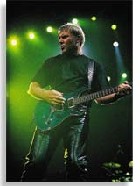
Above Photo: Neil Zlozower
This article originally appeared in VG‘s Feb. ’06 issue. All copyrights are by the author and Vintage Guitar magazine. Unauthorized replication or use is strictly prohibited.


.jpg "Uncovered")