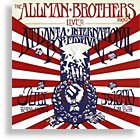
I’ve had the argument many times that the original version of the Allman Brothers Band was the best blues-rock band in the history of rock. Many insist it’s Led Zeppelin. Others have their favorites. But I go with this batch of fellas, captured live here when it was really coming together for them.
This double disc was recorded over two days in Atlanta in 1970. The venue was only 14 miles from the Allmans “Big House” in Macon, Georgia. So they feel at home.
Day one features some fine excursions, including a stompin’ version of “Hoochie Coochie Man” with Berry Oakley on vocals. It’s nasty. No other way to describe it. There’s a very nice version of the underrated “Dreams” that clocks in at almost 10 minutes and features solos by Duane and Dickey, and Gregg on vocal and organ. Even though Duane has been dead for more than 30 years, it would be hard to find a rock guitarist who sounds this sweet, but still plays with such incredible power. It’s an easy thing to forget what a magnificent player he was. Easy, that is, until you dial up on a tune with him playing. Anyway, disc one has some great music on it, including a “Mountain Jam” that gets interrupted by the rain.
But it’s disc two that lets you hear the Allman Brothers at their finest. Recorded two days after the first, on this disc they seem more comfortable, and they expand ideas throughout the set. Some of the songs are repeated from the first set, but, as you’d expect from a band that jams this much, things get changed around.
This version of “Statesboro Blues” is guaranteed to knock your socks off and make your rear end move. To really catch what this band is all about at their best, check out July 5th’s “In Memory of Elizabeth Reed.” It’s a journey that has a lot of fun stops, and highlights each player’s strengths. It’s a shame some of today’s so-called jam bands can’t capture this feeling. No meandering. Everything, even when it appears to be found by chance, has a purpose.
Disc two also features a very cool version of “Stormy Monday,” a classic take on “Whipping Post,” and a 28-minute “Mountain Jam” with guest Johnny Winter.
Some of this has been bootlegged before, but the sound here is terrific. Kirk West’s liner notes are informative and fun, and there are some great photos in the small booklet.
If you’re a fan of this band, you gotta have this.
This article originally appeared in VG‘s Feb. ’04 issue. All copyrights are by the author and Vintage Guitar magazine. Unauthorized replication or use is strictly prohibited.
Webster’s latest defines the word “deluxe” as “…notably luxurious, elegant, or expensive.” The Epiphone Deluxe archtop guitar was certainly luxurious. When introduced in 1931, it sported a triple-bound top with rope-pattern purfling, fancy diamond-and-triangle position markers on the neck, a bound “Masterbilt” headstock inlaid with flowers, gold-plated parts, curly maple back and sides, and a carved spruce top.
The Deluxe was also an elegant design, marketed to compete with Gibson’s L-5, and to offer the guitarist just a little extra. At 163/8″ across the lower bout, it was a tad wider than the L-5. Fingerboards were rosewood and necks noticeably chunky. All the better for comping to jazz standards, except that this music was still in its infancy. Sales figures were low for the new model, no doubt due to the raging depression that swallowed up every last dollar.
Because of the difficult economic times, at least upon its introduction, the Deluxe was expensive, being the top-of-the-line acoustic guitar made by Epiphone. And over time, it was improved to near perfection.
By 1934, the more familiar Epiphone vine inlay had replaced the “Masterbilt” headstock design, and in 1936 the body was enlarged by one inch in response to the new larger “Advanced” model Gibson L-5. This new Deluxe had standard f-holes and a new “cloud” inlay at the fingerboard positions. The proprietary “Frequensator” tailpiece was added in 1937 as Epiphone sought to further differentiate its offerings from Gibson.
By now the Deluxe had been overtaken by the mighty 181/2″ Emperor, which was introduced in late 1935, and was second in the archtop range. But it was no second banana. Many players found the slightly smaller size (one inch narrower across the lower bout) easier to handle, and at no loss of volume or tone. Period photos and film of jazz orchestras reveal many an Epiphone logo peeking out among the horns. All indications are that the Deluxe outsold the L-5 through the 1940s.
However, Gibson managed a coup in releasing its cutaway body design before the war, and Epiphone, perhaps believing that real jazz players never go beyond the 12th fret, did not add a cutaway to the Deluxe until ’48. By then, Epiphone was falling behind and control of the company was turned over to Conn in 1953. Epiphone was sold to CMI (who owned Gibson) in ’57.
Production of the Deluxe officially ceased in ’58, though it is unlikely any were made even in ’57 (there’s no sign of them in the inventory Gibson shipped to Kalamazoo) as Gibson overhauled the line and eliminated obvious threats to its own archtops.
Special thanks to George Gruhn and Walter Carter for their consultation on this piece.
1953 Deluxe
1953 Deluxe photo courtesy of Joe Vinikow, archtop.com.
This article originally appeared in VG‘s Feb. ’03 issue. All copyrights are by the author and Vintage Guitar magazine. Unauthorized replication or use is strictly prohibited.
THE DIFFERENT STRUMMER
Sparkle & Glitter: Guitars Made in Italy, Part 1
Most American guitar aficionados are familiar with EKO guitars, while other Italian brands flew below our radar in the ’60s. Thus, the real tradition of their guitars remains misty for most of us. Here begins a tribute. By Michael Wright
BASS SPACE
Fritz Brothers Bass
Renowned luthier Roger Fritz’s latest axe is a retro-look model inspired by the first Kay electric basses of the 1950s. Here’s why he’s trying to get “…as close to the original as possible.” By Willie G. Moseley
40 EPIPHONE RIVIERA
It helped reinvent Epiphone in the 1960s as a modern guitar builder whose instruments sported contemporary features like thinline, semi-hollow, double-cutaway bodies and humbucking pickups. If only the Beatles had grabbed it instead of a Casino… By George Gruhn
NICK MOSS
Big Blues, Legit Tattoos
He got his start backing some of Chicago’s iconic blues masters, such as Jimmy Dawkins, Willie “Big Eyes” Smith, and Jimmy Rogers. He now fronts a band and records on his family-owned label. By Willie G. Moseley
J. HOWARD FOOTE PARLOR GUITAR
Most people are aware of P.T. Barnum and his circus. But few know that he was arguably the greatest promotion man who ever lived, and that he had a huge impact on American pop culture in the 19th century. But what has he got to do with this guitar? By Michael Wright
BOLT-ON NECKS, BLACK ’GUARDS
The First Fender Single-Cut Guitars
In The Blackguard: Telecaster-Style Guitars from 1950-1954, Nacho Banos displays his devotion to non-truss-rod Esquires, as well as Nocasters and ‘50s Esquires and Telecasters. Here’s a preview. By Nacho Banos
BEYOND THE PARLOR
Part 2: Man and Machine
The author continues his assault on the common belief that the guitar in the 19th century was strictly a ladies’ parlor instrument by finding guitars being made – and played – by men. By Tim Brookes
DEPARTMENTS
Vintage Guitar Price Guide
Builder Profile
Sound Garage
Upcoming Events
Vintage Guitar Classified Ads
Dealer Directory
The Great VG Giveaway
Win a Kendric K Spot amplifier
Readers Gallery
FIRST FRET
Reader Mail
News and Notes
Billy Gibbons book, PRS Wins Appeal, B.B. King, AMA Honors, Hard Rock Guitar Smash, In Memoriam, more!
Tone Poets
Two Great Instruments, Endless Possibilities
By Dan Forte
R.L. Burnside, 1926-2005
By Dan Forte
Burton’s Big Guns
Guitar Hero Gathers Heavey-Hitter Friends
By Willie G. Moseley
Ask Zac
By Zac Childs
Debbie Davies
On The Road With All I Found
By John Heidt
Susan Tedeschi
Crackin’ the Boys Club
By Elliot Stephen Cohen
Freddy Koella
Blues (and more)
By Way of France By Frank Moriarity
COLUMNS
Q&A With George Gruhn
Acousticville
I Tale of a Modern Flat-top
By Steven Stone
FretPrints
Allen Holdsworth
By Wolf Marshall
Gigmeister
More Pedalboard Mania
By Riley Wilson
TECH
Dan’s Guitar Rx
Dumpster Diving
By Dan Erlewine
Guitar Shop
The Devil in the Details
By Tony Nobles
Amps
Re-covering Your Vintage Amp
By Gerald Weber
Ask Gerald
By Gerald Weber
REVIEWS
The VG Hit List
Reviews: Johnny “Guitar” Watson, James McMurtry, Nickel Creek, Elvin Bishop, The Domino Kings, Play Acoustic, more!
Check This Action
The City That Care Forgot
Dan Forte
Every once in a while, someone who has “genius” written all over him hits the music scene.
In James Demeter’s case, it’s a moniker he earned through years of behind-the-scenes gear design, from his groundbreaking DI boxes to the Tremulator and a host of other innovations, all produced in a tiny factory in the San Fernando Valley.
We bumped into James at the Demeter booth at NAMM, and when he replied to my “What’s new?” query with a conspiratorial grin, we were certain good things were in the works…
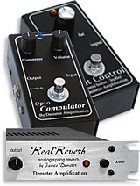
First into my hands was the Fat Control, secret weapon of the highest caliber and originally produced as an onboard effect for guitarists, and now available as a stand-alone floor box.
Got a boring, flat sound from your Strat? Whine no more; the Fat Control adds a chunky, verrry musical mid boost with variable gain that lifts the sound out of the mix, adding a touch of subtle warmth and distortion that’s just killer.
We tried it in James’ little studio through a Demeter amp, using a standard Strat, and the pleasing-but-predictable guitar tones came to startling life with a little tweaking of the tiny black box. Not in-your-face obvious grunge, but subtle, musical, and real natural sounds that made rhythm chunky and fun, and lead playing a total gas. Onstage at local venues, it was just as dramatic, to the point where several people in the audience (guitarists – what else?) came up to comment on the sound and marvel at the itty-bitty box that did it.
Telecasters also are enhanced by the Fat Control, and although I’m not a huge humbucking fan, we did experiment with a ’59 reissue Les Paul, which already had a big, weighty sound. With a bit of adjusting, the mids did get more obvious, and the usefulness was quite a fine thing.
But, being a Fender guy, I loved the effect it had on my Tele. The construction, as with all of the Demeter gear, is meticulous, with a box that could stand up to an elephant, and fine wiring throughout.
The guitarist’s dream box, I am convinced, is the perfect compressor – one that doesn’t suck. Or breathe. Just transparent sound, with a hint of compression (no squashing of ze guitar, please!) and relatively quiet.
The model for this has always been the huge, old optical compressors used in the studio in the ’70s to great effect, and here James and his team have yet again excelled, producing the new Opto-Compulator (Comp 1).
The unit delivers a wonderful compression in a little black box, with gain matching (and further gain, if desired). The housing is, as usual, bulletproof, and the operation disarmingly simple, with volume and level of compression. The results, in aforementioned studio, were just about the best compression one could wish for – from a fine rhythm to singing solo sound, with sustain out the rear.
A great, great pedal. Nothing obvious about this effect, which is the whole point – it still sounds like your guitar, just better. Bigger, with mo sustain.
Last but not least is a piece initially designed for the studio, that has found its way into some sophisticated racks as well – the Demeter RV-1 Real Reverb.
This is a stereo, spring reverb that takes up one rack space, is built to last, and creates some of the most lush, authentic reverb you can imagine.
The two-channel/eight-input unit is only 10″ deep, but houses two spring sets, with delays of 1.5 and 3.5 seconds. The front panel is fairly detailed, but easy to understand, with an overload indicator for signal strength, and the ability to link or use the stereo feature. XLR and 1/4″ inputs are accessible, and the toroidal transformer design minimizes distortion and background noise – this sucker is dead quiet.
Its applications are so diverse – guitars, sure. But how ’bout voice, acoustic guitars, synths? An amazing tool, with the higher-end guy in mind, but what a find for a home studio or a studio cat who has a big rack in mind. At $699, it’s no light-weight, but well worth the price.
Demeter Fat Control/Opto-Compulator/RV-Real Reverb Type of Effect: Mid boost/Compressor/Reverb Features: Quality construction, professional-grade capabilities. Price: $200/$249/$699 (list) Contact: Demeter Amplification, 15730 Stagg St., Van Nuys, CA 91406, www.demeteramps.com.
This article originally appeared in VG‘s Aug. ’03 issue. All copyrights are by the author and Vintage Guitar magazine. Unauthorized replication or use is strictly prohibited.
St. Louis Music has been building Crate amplifiers since the late 1970s, and straight out of the chute, they gained a reputation for being well-designed, good-sounding, affordable, and oh-so-cute in their little crate-like cabinets.
Through the years, the Crate lines has evolved. The latest progression in the line is, in terms of design, something of a step back. Cognizant of the ever-growing popuarity of tube amps, Crate recently launched its all-tube V series combo amps, the V1512 and the V5212. These are different from the company’s Vintage Club series in that they offer much more gain and, on the 50-watt model, feature built-in effects.
These amps are very solidly built, as their weight bears testament. Aesthetically, they offer a crossover look between vintage and modern.
The V1512 features 15 class A watts and a 12″ speaker. The top-loaded control panel has the stanard 1/4″ input, plus controls for gain, low-end boost, treble, mid, bass level indicator, and on/off switch. The internal speaker can be disconnected and a 16-ohm cabinet may be plugged in via a 1/4″ jack. Three Groove Tubes 12AX7s and two EL84 power tubes provide the heart of the operation. For test guitars, we used a ’70s Strat, a ’59 Esquire and a ’70s Ibanez Artist.
Setting the amp to clean, and playing the Esquire, we dialed in a downright decent country tone that was very punchy and sparkly, with nice low-end response. We had to keep the gain control way low, as it would start to break up as we pushed it. Same with the Strat and Artist… but keep in mind, this is a high-gain amp.
As we pushed the gain, though, we easily found great blues tones that were again very punchy and responsive. We kept the treble backed off, as it tended to get a little fussy when cranked! And as we cranked the master volume, the tone stayed tight, even with the bass dimed.
As we drove the gain progressively harder, it came on strong, but was never brittle or soft. Smooth and tight was still the order of the day. With theArtist we had plenty of gain for metal. Wherever we set the gain it was smooth and tight with the speaker almost wanting to jump out of the cabinet at higher gain settings.
The reverb, for being a small tank, was very nice. Yes, you can get decent surf tones by cranking the reverb. Volumewise, this is a loud little amp that would work well onstage and in the studio. It has one channel, so you’ll have to mix it to your liking.
The V5212 features 50 class A/B all-tube watts with two 12″ speakers. It uses four 12AX7 preamp tubes and two EL34 output tubes, all supplied by Groove Tubes. The amp features channel switching and digital effects, and includes a footswitch for channel selection and selecting between two effects presets. Control-wise, the first channel features volume, treble, middle, and bass.
The second channel features gain, treble, middle, bass, and level. The master section which affects both channels includes DSP selection, DSP master level and presence controls. Standby and on/off switches are next to the indicator.
The digital signal processor features the most commonly used effects and presets for a handful of combinations – very cool, and very useful!
For our test run, we started with clean settings on the first channel. With the Esquire, we again were able to achieve fat, punchy, and sparkly country sounds; a desirable clean tone found in much more expensive boutique amps. With the Artist, we got the same clean tones, and with a slight edge when the volume was boosted. Very fat blues tone.
The presence control allowed us to dial in that right amount of sparkle.
We set channel two for various amounts of distortion. With the Esquire, the V5212 produced a smooth, fat distortion. We were even able to make the Strat sing with considerable fat by simply backing off the treble – it produced plenty of pleasing sparkle while retaining the low-end. The 5212 sounded very wet and tubey with the Strat. Very pure.
Using the Artist, we toyed with the gain and were able to get a great very responsive blues tone.
When we cranked the master, the amp really stepped into its own, typical of pushing the output tubes. Again, we had to watch our treble settings.
Then we toyed with the effects processor, which colors the way it should, and did not color the amp’s overall tone. You can switch between two effects presets via the footswitch – all effects are very usable. Volume-wise, this amp will fill almost any situation you encounter, and an extension speaker cab can be tagged on.
The V5212 covers three important bases – great clean tone, great overdrive tone, and great value. In short, it may be one of the most versatile and affordable amps on the market.
Both V amps are screamin’ tube units with the affordability any player can partake of.
Crate V1512 Type of amp15-watt 1×12″ combo. Features Class A tube circuitry, V series 12″ speaker, 15 watts – all tube, class A design, three Groove Tubes 12AX7 preamp tubes, two Groove Tubes EL34 power tubes, external speaker jack, 16-ohm operation, spring reverb. Price $599.
Crate V5212 Type of amp 50-watt 2×12″ combo. Features Four Groove Tubes 12AX7 preamp tubes, two Groove Tubes EL34 power tubes, external speaker jack, 16/8-ohm operation, 15 built-in digital effects effects level, line in/out. Price $1,099. Contact Crate/St.Louis Music, 1400 Ferguson, St. Louis, MO 63133, phone 800-738-7563, crateamps.com.
This article originally appeared in VG‘s Jan. ’04 issue. All copyrights are by the author and Vintage Guitar magazine. Unauthorized replication or use is strictly prohibited.
Wishbone Ash guitarist Andy Powell isn’t caught in a time warp. True, he’s the sole remaining member of the English foursome that proffered a twin-lead guitar sound that took the band to acclaim in the early 1970s, but under the aegis of Powell (VG June/July ’92, April ’98), Wishbone Ash has toured incessantly and released new recordings.
“The Ash” formed in 1969 under the management guidance of music entrepreneur Miles Copeland, who placed an ad in England’s Melody Maker on behalf of bassist Martin Turner and drummer Steve Upton, in search of a guitar player. Ultimately, two guitarists were tapped, and Powell and Ted Turner began forging their twin-lead arrangements.
The original foursome recorded four studio albums, a self-titled debut (1970), Pilgrimage (1971), Argus (1972), and Wishbone Four (1973). A live album, Live Dates, was released in late 1973.
In ’71, Powell acquired a mid-’60s Gibson Flying V. The first time many American fans became aware of the Ash and Powell’s Flying V was in a 1972 ad in Rolling Stone that showed Ted Turner with a Strat and Powell with his V; the text proclaimed Wishbone Ash to be “The world’s greatest twin-lead-guitar band.”
Powell still has the Flying V, and its image has become the band’s unofficial logo to many observers (see sidebar).
Ted Turner left the band in ’74, and was replaced by Laurie Wisefield. This lineup of the Ash stayed intact until the latter half of 1980, and released seven studio albums, from 1974’s There’s the Rub through 1981’s Number the Brave, which hit the racks after Martin Turner had departed. A live double album, Live Dates II, released outside the U.S., was culled to a single album release in America titled Hot Ash.
Wishbone Ash is (clockwise from right) Andy Powell, Ben Granfelt, Bob Skeat, and Ray Weston. Photo courtesy of Guy Roberts.
Subsequent bassists included John Wetton (King Crimson, Roxy Music) and Trevor Bolder (between stints with Uriah Heep). Numerous personnel changes have occurred since that era, although the original quartet reunited in the late ’80s at the behest of Copeland for an instrument album, Nouveau Calls, for his Nospeak series of recordings, and a subsequent studio album, Here to Hear (both on I.R.S.). Then the personnel turnover began again while a studio album (1991’s Strange Affair) and a live album (1992’s Live in Chicago) were released. By late ’93, however, Powell was the only original member of the band inclined to continue recording and touring under the Wishbone Ash banner.
Live In Geneva and a studio album called Illuminations were released in ’96. However, around the time of Powell’s second VG interview, two unusual albums credited to Wishbone Ash were marketed. Powell was technically the only participant on the first effort, Trance Visionary, while the followup, Psychic Terrorism, included Powell and other then-band members. Both were dance-mix efforts… and an “acquired taste” for longtime Ash fans.
“Those were done with samples,” Powell said. “In the mid ’90s, there was this explosion of dance/club music, and we were having trouble getting a record deal, so I tried this. I think it worked pretty well for what it was supposed to be. And we actually tried to take it on the road, but it didn’t work out.”
Further personnel changes were in the offing for the Ash at the time, as well. Former guitar tech/roadie/guitarist Roger Filgate and vocalist/bassist Tony Kishman departed, to be supplanted in early ’98 by guitarist Mark Birch and bassist Bob Skeat. Filgate was a neighbor of Powell’s, and he tired of touring, which Powell said was “… understandable, but I’m a road rat.”
They’ve remained friends. As for Kishman, Powell cited complicated logistics (Kishamn lived in Arizona, Powell in Connecticut). Later that year, drummer Mike Sturgis departed and was replaced by the returning Ray Weston, whom Sturgis had himself replaced in late ’91.
The first release by the Wishbone Ash lineup of Powell/Birch/Skeat/Weston was the “unplugged” Bare Bones, which debuted in ’99 on HTD Records/Castle Music.
Produced by Powell, the album included various acoustic and quasi-acoustic versions of Wishbone Ash favorites.
“I used my ’60s vintage Epiphone Texan, which has been on many of the classic Ash albums,” Powell recalled. “As well as Takamine guitars, including a great koa model Takamine gave me in Japan. I also played my 1919 Gibson A-2 mandolin. A couple of songs had some electric guitar parts; I used my Flying V and a Music Man.”
In April of 2000, the band staged a 30th anniversary concert at the Shepherd’s Bush, in London. Among the participants was Laurie Wisefield, who was in the band from 1974 through ’85, and longtime Ash “associate vocalist” Claire Hamill. As for the other three founding members, Powell said, “Martin Turner was on holiday in Florida, Steve Upton wasn’t interested, and we couldn’t get in contact with Ted Turner.”
Also that year, a chronicle of the first three decades of the Ash saga was published. Blowin’ Free: Thirty Years of Wishbone Ash (Firefly) was written by Gary Carter and Mark Chatterton, and Powell described his association with the project as “overseer,” noting, “I added some anecdotes. It’s a good academic look at the history of the band, without trying to dig out any so-called ‘scandalous’ stories.”
Soon after, Mark Birch opted for an alternate career, according to Powell, who described the other guitarist as “…in the nicest possible way, a computer geek. He enjoys designing programs, and that’s what he wanted to get into. He’s very talented in that field, as well, and we’ve remained good friends.”
To fill the vacancy, Powell turned to Ben Granfelt because, “I knew he was a great singer and songwriter, and a powerful guitarist.”
The Finnish guitarist’s installation yielded a bonanza in songwriting, as seven of the 10 tracks on ’02’s Bona Fide were written or co-written by Granfelt, including the complex, twin-lead-guitar instrumental title track.
Ben Granfelt and Andy Powell hammer out a harmonized lead. Andy with one of his Music Man Silhouette guitars. Left photo by Willie G. Moseley. Right photo by Elyse Shapiro.
At its outset, Bona Fide avers the musical viability of the Ash; the opening track, “Almighty Blues,” is a raucous, boogie-based number that will delight longtime fans by interpolating a trademark ethereal twin-lead guitar interlude. Powell is particularly fond of the reflective Granfelt-Powell composition “Faith, Hope and Love,” which opens with another example of Wishbone Ash harmony guitar riffs.
“It’s not exactly a flat-out rocker,” he remarked with a chuckle. “But it’s got a great sound and feel to it.”
Asked about any sociopolitical significance to “Come Rain, Come Shine”, which was also co-written by Powell and Granfelt and includes segments of news broadcasts about September 11, Powell said, “We were recording the album when that happened. It was horrifying, and it affected everyone, so we felt like we had to write about it.”
The next album was a live two-CD anthology titled Tracks, also on Talking Elephant. Researching the vaults of live Wishbone Ash material, Powell delivered 26 songs dating from ’72 to ’01.
Included are acoustic treatments of “Wings of Desire” (from Strange Affair) and “Ballad of the Beacon” (from Wishbone Four). While an unplugged studio version of “Wings of Desire” does lead off Bare Bones, “Ballad of the Beacon” does not appear on the ’99 effort, so its appearance on Tracks marks the first time that song has been heard in an acoustic arrangement on a Wishbone Ash CD, though both were performed with acoustic guitars, accordion, and violin on the 30th Anniversary DVD.
“We’ve put out a lot of live albums, and people are into ’em,” Powell said. “I had a request from the label, asking if there was anything that could be released to help support the (Bona Fide) tour, before the next studio album. We got live material from different sources, and there’s still more. A lot of people have recorded us over the years, and there’s stuff continually coming to light.”
Other happenings over the last several have included the advent of the “AshCon” fan conventions in England, Germany, and the U.S. Following the format of other bands’ intimate get-togethers for fans, they often include question-and-answer sessions, as well as acoustic and electric concerts.
“If your fans have been around a long time, you get to know each other, and we started doing fan club conventions,” said Powell. “Fans get to have more of a hands-on approach; they get to hang with the band, and they get more behind-the-scenes, and they can trade memorabilia.
“When we did conventions in England and Germany, people have come from all over the world,” he added. “Singapore, Korea, the United States, Canada. That was another thing that made us think ‘Gee, we’ve got to tour the U.S.’ It was the least we could do to return the honor.
“It’s been an amazing thing, and I don’t see every band being able to do [conventions]; I think it’s a sign of maturity when you can meet with your fans like that.”
The initial American AshCon was held in Chicago in May, 1999. Subsequent AshCons took place on cruises to Mexico and the Caribbean.
The band tours extensively in England and Europe, and in 2002 performed in the U.S., culminating in AshCon at sea. The band played 160 shows that year, and ’03 saw the expected tour of Europe and an more concerts in the U.S. Still, its primary opportunities are in the United Kingdom and Europe.
“That’s the main ‘engine’ for our road work,” he confirmed. “The U.S. is a difficult place to tour on our level. It’s tough to do, economically. We’ve done several exploratory [U.S.] tours. We really appreciate it when people make the effort to come out and hear us.”
Powell’s road instruments include his mid-’60s Gibson Flying V, as well as Music Man Silhouette guitars. But he also noted, “When I play local gigs on my own, I still use my old 1952 Telecaster, but I don’t take it out on the road.”
Andy Powell with his trademark Gibson Flying V.
In ’02, Granfelt utilized a Finnish-made Duck guitar, backed with Fender Stratocasters. In ’03 his main backup road guitar was a ’90 Gibson Les Paul Standard with a Seymour Duncan “JB” humbucker in the bridge position. Bob Skeat holds down the bottom-end with a Music Man five-string bass and Warwick four-string basses. The stage amps for Powell and Granfelt are quite similar, consisting of Fenders and Boogies, while Skeat runs through a Gallien-Krueger stack.
“My Boogie is the same one I’ve used for a long time – an original ’74 Mark I,” Powell said. “I’ve got a reissue that Ben uses. I use Boogies quite clean, for a foundation sound, then use something a bit rougher like a (Fender) Hot Rod DeVille. In the U.K., I’m using a Fender ProSonic as well; I think they’ve been discontinued, and I really like those! We just did a big festival in Europe for 30,000 people, and we used Fender combos. It can be anything – Hot Rod DeVilles, ProSonics, and even a vintage Bassman I’ll put out sometimes. I’ve also got a reissue Bassman. With a compilation of small combo amps we can cover just about any gig as long as they’re maintained well and the tubes are biased correctly. I used to use two 200-watt Orange amps with JBL speakers, and I don’t want to lose any more of my hearing. I can get plenty of power with these.”
The most recent projects for Wishbone Ash included the release of Almighty Blues – London and Beyond (Classic Rock Productions), a limited edition DVD set recorded in London by the current incarnation of the band, and a concert from ’89 by the original lineup. Late ’03 also saw the release of Tracks 2, another double CD of previously unreleased live recordings that date to ’72. This time, however, there’s a healthy dose of concert material from the current lineup, as well as two tracks from ’02 (“Mercury Blues” and “Steppin’ Out”) described as a “rare audience recording” from Holland.
As for the band’s future, Powell said, “We’ll also probably be releasing one or two more archive albums, we’re contracted to do another studio album [this year], and we’ve got a lot to touring to do, including South America.”
The latest lineup of Wishbone Ash has been intact for over three years, and all of its road work has molded it into a cohesive unit. These days, the band is still potent and viable – the classic/signature songs sound as good as ever, while the recent material is assertive and confident.
Powell and his musical associates could now be considered journeymen, but for the bulk of its history, Wishbone Ash was a “player’s band.” Its chronology has surpassed a third of a century, and the modern “Mark XVI” version stays active, demonstrating that the Ash still has a lot of great guitar-based music to offer.
Andy Powells ca. 1967 Gibson Flying V
Photo by Elyse Shapiro
Wishbone Ash’s Andy Powell is the proverbial “road warrior,” and this is the primary weapon he has used more than 30 years.
In the band’s early days, Powell relied on homemade guitars and a Gibson SG Jr. In 1971, he purchased this ca. 1967 Gibson Flying V (serial #000951) as new old stock (N.O.S.) from England’s Orange Music.
“I liked the way it played, and how ‘vibrant’ it felt, even before I plugged it in,” Andy recalled in his 1992 interview with Vintage Guitar. “I bought it, took it home, put it in a chair, and stared at it.”
An example of the second generation of Flying Vs (Powell has owned two ’50s korina Vs, as well) proffered by Gibson in the mid ’60s, with a mahogany body, cherry finish, and white pickguard, the V has an original Gibson Vibrola tailpiece that Powell uses extensively. He attributes its smooth, hassle-free operation to the original height-adjustment wheels on the Tune-O-Matic bridge posts.
The instrument has experienced numerous modifications. In 1973, Powell purchased a ’59 Gibson ES-335 and replaced the V’s original humbuckers with the 335’s Patent Applied For (PAF) humbuckers. The bridge pickup later developed problems was replaced with a Seymour Duncan JB.
Grover tuning machines were also added, and in the guitar was refinished in the 1980s. At that time, an old-style Gibson logo was installed on the headstock, supplanting the logo of the original large white truss rod cover, which was replaced with a small black cover.
Rugged, refinished, and roadworthy, Powell’s V has been traveling around the world for over three decades, purveying terrific twin-lead guitar music for fans in nations across the globe. Any modification has been undertaken to improve its sound, which (like Wishbone Ash itself) is still very potent. Vintage purists might turn up their noses at all the mods, but this V has simply served – and continues to serve – its owner well, as the Ash continues its musical
saga.
This article originally appeared in VG‘s May. ’04 issue. All copyrights are by the author and Vintage Guitar magazine. Unauthorized replication or use is strictly prohibited.
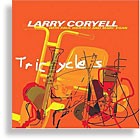
Anyone remember when Larry Coryell was one of the youngbloods of jazz guitar? Sheesh, I must be getting a bit “advanced” in age, eh? Through the years, there’s never been a doubt in my mind that Larry’s chops were as strong as anyone’s. There were times when I couldn’t follow, though, usually because the tunes weren’t that strong. Well, here the songs, the band, and Larry’s playing are as strong as can be.
There are six Coryell originals, and every one of them is interesting with fine changes and themes running through them. There are nice covers, too. Thelonius Monk’s “Well You Needn’t” has a great feel, with wonderful playing all the way around. The oddest piece, and the one that at first seems out of place, is the Lennon and McCartney chestnut, “She’s Leaving Home.” Larry’s acoustic work shines on the familiar melody, and the soloing is created from that melody. His electric playing is slightly chorused, not unlike some players who came up right after him, like Metheny and Scofield. The solos, though, are pure Coryell. Listen to him navigate the changes of “Immer Geradeaus,” where he solos around them wonderfully, and then lets loose with an impeccable chord solo.
And we should mention the band; on bass is Mark Egan and Paul Wertico mans the drums. The trio setting is perfect, whether it’s bop heaven like “Dragon Gate” or a beautiful, light, ballad like the title cut. The interplay between Egan and Coryell is real fun to listen to. They double each other on occasion, and all three lock in on pretty much every cut to create great music.
This is one of the best jazz guitar albums of the year so far. Great songs, great band, and great soloing.
This article originally appeared in VG‘s Aug ’04 issue. All copyrights are by the author and Vintage Guitar magazine. Unauthorized replication or use is strictly prohibited.
Tom Principato is probably familiar to many VG readers. A fine player in his own right, he’s also responsible for some fine books that teach about guitar, and he’s also been known lately for his release of material from his old buddy, Roy Buchanan.
Anyway, this one is Tom’s first new record in a long time, and it sizzles with the intensity of someone who couldn’t wait to get in the studio and just burn. Check out the big, fat chunky Fender chords, and the honking, squawking, and bending of the solo in the opener “‘Til I Get What I Came Here For.” You know he means business right off the bat.
There’s a couple of excellent shuffles here too. “Crazy Mixed Up World” has one of those solos where the notes appear to be “singing.” They hang in mid-air, just asking to be plucked down. “Shuffle-50” lets him use the Leslie, and also take it off to give a demonstration on blues soloing for all listening. “Break Out!” is an uptown shuffle that lets Tom add a little jazz spice to his playing. A song usually associated with Buchanan gets a nice workout here too. “Done Your Daddy Dirty” is served up as an instrumental, with nasty solos that include big string bends and chords all mixed together. Tom even reworks a song I haven’t heard in about 25 years; the very funky “Apricot Brandy” has nice chickin’ pickin’ and big-time soloing. That tune was a minor hit in the late ’60s for a band called Rhinocerous.
All in all, this is a fine record with fine guitar playing. Tom’s playing is smart, without sounding too studied. His vocals are always adequate, if not distinctive. And his cohorts, John Perry (bass) and Joe Wells (drums) keep things moving along nicely.
This article originally appeared in VG‘s April ’04 issue. All copyrights are by the author and Vintage Guitar magazine. Unauthorized replication or use is strictly prohibited.

.jpg "Demeter Trio")