His name rhymes with “wine” and it’s not as well-known as others, but Ohio-born guitarist Robert Quine played a crucial role in the New York punk scene of the 1970s; his work on Richard Hell and the Voidoids’ Blank Generation – an acclaimed record of the original punk era – is the highlight of a distinguished career.
Far from the three-chord wonders typifying the punk scene, Quine impressed with a highly original style typified by adventuresome technique and an aggressive, slashing edge. His trademark black sportscoat and daddy-o shades always made him look more beatnik than punk, further adding to the enigma.
His illustrious (if low-key) post-Voidoids life has included recording with Lou Reed, Tom Waits, Brian Eno, Matthew Sweet, Lloyd Cole, and John Zorn, among others.
Vintage Guitar: You have an interesting range of influences, from early rock/rockabilly pioneers to jazz musicians to ’60s proto-punkers. Who are some of the most influential?
Robert Quine: I was 12 years old when I first heard the term “rock and roll” in the summer of ’55. Disc jockeys were using the term to describe Bill Haley’s “Rock Around the Clock” (which, by the way, I never liked). Around ’52 I had listened to a few of Alan Freed’s Moondog shows out of Cleveland but wasn’t ready for it yet. I was mostly into stuff like Frank Sinatra’s “Wee Small Hours,” that kind of thing. I was converted around late ’55 by “Why Do Fools Fall in Love” (Frankie Lyman & the Teenagers) and “Speedo” (the Cadillacs).
Then in early ’56 everything exploded; there was Elvis, Fats Domino, Little Richard, Chuck Berry, Bo Diddley, etc. It was a very exciting era musically and it lasted, for me at least, until early ’61. I often forget to mention some of the major influences, such as Scotty Moore with Elvis, since I assume anyone familiar with this period knows about their importance. And there’s really no point in going on at length about Chuck Berry, since almost any kid who played guitar in the late ’50s was inevitably influenced by him. So I tend to concentrate on some of the lesser-known guitarists. With that “disclaimer” out of the way, I’ll go into some of my major influences, more or less chronologically.
1 Mickey Baker: From ’52 until ’62, when he moved to Paris, he was on countless New York R&B and rock and roll sessions. He’s best known for his incredible playing on “Love Is Strange” (Mickey & Sylvia), and you can hear his influence on a lot of rock and roll pioneers such as Buddy Holly, Eddie Cochran, etc. He had unlimited technique; a very aggressive, bluesy style; and an amazing, unique touch.
It’s interesting to hear his sound evolve. Around ’52, he used the first Les Paul model. Then around ’55 he started using a Les Paul Custom Black Beauty. The rock-and-roll thing was starting to take off, and he was a major part of it, starting to get more aggressive and using more distortion.
In ’58 he switched to a Jazzmaster, and you can hear the difference. Jazzmasters had a lot less output and sustain than what he had been using, but he managed to get a great sound out of it, the best I’ve heard from a Jazzmaster. In ’87, I met Dr. John on a Marianne Faithfull session we both played on. After it was over he told me he dug my playing and that he heard a lot of Mickey Baker in my approach. Receiving that compliment was a really great experience – one I’ll always appreciate.
2. Ritchie Valens: In the late ’50s and early ’60s, I learned to play the guitar using his three Del-Fi albums as textbooks. He was only 17 when he died, but he was an incredible talent. The instrumental “Fast Freight” is a great example of his lead guitar style.
Another thing is the sound of the Valens records, which is totally unique. The setup was usually two electric guitars, an electric six-string Danelectro bass, plus an acoustic bass playing completely independent parts, and the great Earl Palmer on drums. The stuff was recorded in the legendary Gold Star Studio, which had a beautiful echo chamber, later used on the classic Phil Spector records.
3. James Burton: A household name to guitarists, so there’s no need to go on at length about him.
4 Al Casey: Not a household name, but a great player who did a lot of amazing stuff – countless sessions in the ’50s and ’60s. Some of his finest stuff was in the late ’50s; Sanford Clark’s “The Fool,” Jody Reynold’s “Endless Sleep” and “Tight Capris,” plus some singles under his own name.
5 Link Wray: A real pioneer of raw, menacing rock guitar with plenty of distortion. In 1958, the single “Rumble” changed a lot of lives. I spent a lot of time learning stuff off his Epic album from 1960.
What about influences from the ’60s and beyond?
In early ’61, rock and roll was entering a pretty bleak period, for me at least. So I started listening to more blues and jazz records. Among the blues artists, Jimmy Reed is my absolute favorite influence. He wasn’t what you’d call a virtuoso, but I found his relaxed approach quite hypnotic. The great jazz artists – Charlie Parker, Lester Young, Bill Evans, Jimmy Raney, and Albert Ayler with bassist Gary Peacock – have had a tremendous musical influence on me, though I would hasten to add that I can’t remotely play jazz. It’s more of an “osmosis” thing; hearing interesting chord substitutions and how a real master can structure a solo.
In the mid to late ’60s, rock and roll became more interesting again – the early Rolling Stones, Byrds, and Velvet Underground influenced me a lot.
My influences from that time are Jeff Beck, specifically with the Yardbirds and his first two solo albums. His use of feedback, his tone, his wild imagination and endless creativity during this period continue to amaze me. There were a lot of incredible, innovative guitarists during this period, Jimi Hendrix, for example. It’s nearly impossible for any rock guitarist to not be influenced by his genius. But Jeff Beck was the biggest influence for me. It’s not about his licks – it’s his wild creativity. You never know what he’s going to try next.
Roger McGuinn; the first five Byrds albums continue to inspire me, but my favorite period is 1966. “Eight Miles High” backed with “Why” is incredible. And then there’s his amazing rhythm guitar – that orchestral 12-string sound epitomized on “Turn! Turn! Turn!”
Albert King and Harvey Mandel; I learned a lot about stringbending and the use of sustain from them.
Lou Reed’s guitar playing on “White Light/White Heat” was far ahead of its time and still isn’t appreciated as much as it should be. You can hear a lot of influences ranging from Bo Diddley to Ornette Coleman in there. The Velvet Underground was one of the last truly great rock and roll bands.
After the Velvet Underground, there hasn’t been much that influenced my playing. There are three, however – Iggy & the Stooges, Raw Power; Miles Davis from ’72 to ’75, and Brian Eno’s On Land from ’82.
What was crowd reaction like for the Voidoids? The band, along with Television, definitely didn’t fit the stripped-down punk format of the late ’70s. Television was often compared to the Grateful Dead, while your work with Ivan Julian in the Voidoids was light years ahead of the stuff that typifies the punk era. How did the punk crowds react?
Well, I started playing guitar in ’58 and was in various bands throughout the ’60s, in college, and later, in law school. From late ’69 until ’76, I gave up playing in public for various reasons. But I kept playing, kept developing. In ’75 I worked in a book store where Tom Verlaine, Richard Hell, and other musicians were working. This eventually led to the formation of the Voidoids in early ’76. The band lasted until ’79, and by then “punk” had pretty well run its course. Whoever was destined to “make it” had done so, and that scene slowly dissolved. A lot of things happened so fast that it’s sort of a blur to me.
How was the reaction? Varied. The Voidoids had a pretty rabid following in New York. Audiences were enthusiastic and put up with our excessively loud volume. We did two tours of England, and the audiences over there were generally less enthusiastic, to say the least. Some people – and other local bands – thought we couldn’t play at all. Others liked us. But we were unique, partly because of the unlikely combination of musicians. But mostly because of the unique musical structure of Hell’s songs, which created a lot of jerky rhythms and some dissonant playing. I guess this is why a lot of people compared us to Captain Beefheart. But there was no Beefheart influence. At any rate, we were happy with the one album we did, Blank Generation. A lot of people loved it, some didn’t. One thing for sure – it’s appreciated far more now than when it was released.
You sound like a madman on a lot of the Voidoids tracks. Were you frustrated, angry, etc., at that time – was it a pissed-off punk thing or was it the music/songs dictating your playing?
As far as my playing sounding frustrated or angry, sometimes it was. For example, a lot of people think the Voidoids “Betrayal Takes Two” has one of my best solos. The song started off as a nice, quiet ballad with somewhat twisted lyrics. We had done the basic track, and then Hell wanted me to “make a lot of noise” on it. I liked the song the way it was and didn’t know what he was talking about. We argued about it, and by the time I recorded my part, I was pissed off. And you can hear it.
But he was right, and it all worked out for the best. On “Blank Generation,” he made me do about 40 takes of my solo. So by that time, I was angry and frustrated, and again, it all worked out for the best.
But as a general rule, the emotional tone of my playing is simply guided by the lyrics and the musical context of the song. A good example of this is “Waves of Fear” from Lou Reed’s The Blue Mask. In this song the guy is terrified, having a nervous breakdown, whatever. So I approached my solo with that in mind. We did two takes of that song, and when I improvised that solo I attempted to emotionally put myself in that person’s place and communicate it to the listener. And it worked. A lot of people think it’s the best solo I ever did.
Basically, I make a point of knowing the lyrics of the song and respecting them. I’m very primitive musically, in many ways, but I’m proficient enough to communicate emotionally. At least I hope so.
All of us have had good and bad experiences, broken hearts, etc., and whether you like it or not, the experiences you’ve had become a part of you. So they’re in you – in your music. Take the song “Don’t Go” from Matthew Sweet’s album, Girlfriend. He’s dealing with the fact that someone he cares about is dying, and he’s feeling desperate. So I took it from there, and the solo happened to work. On “Girlfriend,” my solo may sound angry, but it’s not meant to.
I realize that I’m primarily known for my intense, frantic stuff. But I’m capable of communicating other kinds of emotions. I worked a lot with Lloyd Cole, and I’m very proud of some of the stuff I’ve done with him. Two songs in particular – “Don’t Look Back” and “Like Lovers Do” – are pretty lyrical stuff, and I think reflect pretty well the bittersweet tone of the lyrics.
Some of my fans appreciate these songs as some of my best stuff, and that’s gratifying. But others don’t. They only want me to do crazed, angry stuff and they dismiss those songs as pop “fluff.” I think they’re missing something, but that’s the way it goes.
The years following the Voids brought a lot of project/session work. How did you make the transition? Do you enjoy session work?
After the Voidoids dissolved, I was pretty inactive for a year or so. But then the Lou Reed thing came along and kept me busy for about four years. After that I settled down to doing more session work – Tom Waits, Marianne Faithfull, John Zorn, etc. I did a lot of work with Zorn, and it covered a lot of ground.
One day I’d be working with Bill Frisell or Marc Ribot on a soundtrack for a cartoon show for Japanese TV. A few weeks later I might be jamming with Albert Collins and organist John Patton. A movie soundtrack one day, maybe a jingle a week later. It was a lot of fun, and stretched my creativity to its limits. Very exhausting!
Around ’89 I started working on more overtly “pop” stuff, such as Matthew Sweet and Lloyd Cole. And that was a whole other thing. I really enjoyed it. I like trying to come up with riffs, hooks, different chord voicings, to enhance the song.
When I approached a Lloyd Cole song, I was generally faced with a song that was 90 percent complete. Lloyd would have already recorded a lot of nice interlocking rhythm guitar parts, so it was a real challenge to come up with another rhythm guitar part that would fit in and enhance the song. About 70 percent of the time, after a lot of trial and error, I’d realize that there really wasn’t any need for another rhythm guitar part and I’d end up just doing a solo. But that was okay. On “Don’t Look Back” and “Like Lovers Do,” I’m soloing throughout, responding to the lyrics where there’s enough space. And it works. As I said, I’m very proud of those two tracks, in particular.
Recording with Matthew Sweet was different. Matthew wouldn’t have as many rhythm guitar tracks laid down when I came in, so there was more space for me if I did come up with a good rhythm part. And it worked out pretty well. The track “Winona” from Girlfriend is a nice example of that.
At any rate, doing session work is my favorite thing. I’ve had more than my share of touring and generally don’t enjoy playing live. Touring is exhausting, period.
As for playing live – it’s often a problem hearing yourself or the other members of the band. You can only hope that the music the audience is hearing is coming across okay. But I have to admit that playing for a live audience can be a special experience.
Details on your recent work?
Work has generally slowed down for me, and it’s sometimes been discouraging. I’ve done a lot of demos, some soundtracks and jingle work, and have contributed a track or two on various albums.
I did a few tracks on a Lloyd Cole album called The Negatives. There’s a song, “Man on the Verge,” that has one of my best solos. The last long tour I did was with Lloyd Cole in 1990, and it pretty well did me in. Since then, I’ve avoided touring as much as possible. In the last 10 years I’ve done two tours in Japan. The first was in ’93 with an artist named Sion, whom I also recorded with. In ’99 I was in Japan for five weeks touring with Kazuyoshi Saito. He’s a great musician, the band was the best I’ve ever worked with, and we all got along together musically and personally. It was a very positive experience for me in every way. I’ve also recorded with Kazuyoshi.
There were a few especially nice experiences in 2000. The original Voidoids got together to record one song, something for the internet. We hadn’t played together in 22 years, but it worked pretty well. Who knows, we may get together again for another project.
I also recorded a few tracks on an upcoming album by R&B great Andre Williams, and it was a thrill to work with him. And I played on an album by a friend of mine, bassist Michael DuClos. It’s a spoken-word thing with lots of sick-but-musical ambient noises underneath. I had a lot of fun using my digital looping machines, etc. Also, Marc Ribot called me in to work on two different Sion CDs last year. The first, Songs, was especially fun.
Let’s talk gear. Early years?
Between 1958 and ’62 I went through a lot of stuff. I started with an Orpheum f-hole acoustic, then in ’60 got a Danelectro guitar and amp. In ’61, I moved up to a new Stratocaster and Tremolux amp and started playing in bands. In ’62, I briefly moved to bass – got a nice Jazz Bass and Bassman amp. Later that year I traded the bass for a Jazzmaster, and that was pretty much it for the next 10 years – Jazzmaster and a white-tolex Bassman piggyback amp.
What was your standard rig for the Voidoids?
With the original Voidoids I used a ’76 Strat with a 100-watt Marshall head and 4×12 cabinet. I used an MXR Dynacomp, and once in a while an MXR Distortion+.
Current equipment?
I have a lot of guitars, amps, and effect pedals, but right now my guitar is a ’96 ’52 Telecaster reissue that Chris Cush of Mojo Guitars helped me modify. It has two Seymour Duncan Antiquity pickups and is wired with a four-way switch, which gives you the option of having both pickups on at once, wired either in series or parallel. And the rhythm pickup is reverse wound/reverse polarity. The parallel and series positions are hum-canceling.
The amp I generally use is a Fender reissue Deluxe Reverb, which is perfect for most situations. It’s versatile and isn’t that heavy. I replaced the ceramic-magnet speaker with an alnico one, which distorts much more smoothly.
Effects are a Boss TU-2 tuner, Prescription Electronics’ Yardbox and Experience pedals, Electro-Harmonix Deluxe Memory Man, and some variety of a Tube Screamer. At the moment my favorites are the Maxon OD 808 and Voodoo Lab’s Sparkle Drive. There are a few other things I use quite often, like a Voodoo Labs Analog Chorus and Pedal Power, Prescription Electronics Germ, and either a Carl Martin compressor/limiter or Boss CS-3 compressor/sustainer.
In a 1996 interview with Perfect Sound Forever, you said you had just “conquered” the Telecaster. What does that mean?
Sooner or later, most guitarists, after much trial and error, come to the conclusion that a particular guitar is the guitar for them. In ’96 I realized that for me it’s the Telecaster. By the early ’80s I knew that they were the best-sounding guitars ever, but I mostly stuck with Stratocasters because I thought they were more versatile; three pickups, vibrato bar, etc.
Anyway, in ’96 I locked myself in my apartment with a great Telecaster and a lot of Roy Buchanan albums. It took about six months, but I emerged a much better player – not doing anything especially new, stylistically, but playing with more authority.
Everybody has his or her own opinions, but for me the Telecaster will always be the ultimate guitar.
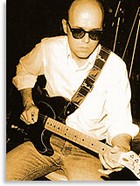
Photo courtesy of Robert Quine.
This article originally appeared in VG‘s May ’02 issue. All copyrights are by the author and Vintage Guitar magazine. Unauthorized replication or use is strictly prohibited.