
Month: January 2003

  • Django Reinhardt

    Django!
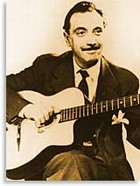
    Django Reinhardt with his fabled Selmer. Photo courtesy of Frank Driggs collection.

    A favorite photograph of Django Reinhardt pictures him standing alongside Stéphane Grappelli, the duo looking suave and sophisticated in white tuxedos. The photograph is steeped in the aura of 1930s Paris (the home of Quintette du Hot Club de France): charming, cool, classy.

    Grappelli – Django’s musical partner, foil, rival and co-composer – holds his magic violin under his arm. Django leans casually on his famous Selmer guitar, his left hand carefully placed in his suit pocket, hiding the disfigured hand that he not only learned to play in spite of, but which shaped his style.

    But it’s the look on Django’s face that always makes you examine this picture closely. It’s a look that comes through in many photographs of the gypsy guitarist: his dark eyes seem to twinkle, his pencil-thin mustache seems slightly devilish. And his smile – happy-go-lucky, mysterious, and omniscient.

    Above all, Django’s smile seems to hold the key to his music.

    The Music
    Counts vary, but from 1928 to 1953, Django recorded some 750 to 1,000 sides. Much of his music is readily available today on numerous compact disc reissues and complete chronological sets. Add to this the alternate takes, unissued sides, radio broadcasts, and live recordings recently issued, and you soon realize that Django was the definition of prolific.

    Ironically, many people’s first impressions of Django’s music are often negative, due to the medium. Most people first hear him via his recordings on 78-rpm discs – or LP or CD collections made from the 78s instead of the master recordings (which are 45 to 60 years old).

    Listening to the QHCF for the first time, the first sound one hears is hiss and static as the recording begins. Then, the full band erupts into the first chorus with three acoustic guitars, Grappelli’s violin soaring above, and string bass below, the band’s sound often pushing the sonic limits of the era’s single-mic mono recording technology. The sound is akin to the cacophony of the modern civilization of the 1930s: the new sound of automobile traffic, machines, airplanes, street noises, a growing population.

    Then Django’s guitar cuts through, and the music blossoms. He takes the lead as the rhythm guitars fall back into the famous boom-chick, boom-chick of la pompe – the jazz manouche rhythm. Django’s guitar is sublime and pure, unhurried in its cascades of elegant diminished arpeggios. It’s the sound of one man’s genius breaking through the chaos of the modern world.

    When Django begins to play, the listener is hooked.

    The Legend
    The story of Jean Baptiste “Django” Reinhardt has all the makings of legend.

    He was born in a gypsy caravan on January 23, 1910, near the Belgian town of Liverchies. His unmarried mother, known to audiences as “La Belle Laurence,” was a dancer and acrobat working with a wandering troupe of Gypsy comedians and musicians.

    Many have since referred to Django as a Belgian gypsy, due to his place of birth, or a French gypsy, as he lived most of his life in France. But the nationality was never important; his cultural background as a gypsy was.

    Some 2,000 years ago, the gypsy tribe known as the Sinti are believed to have migrated from the banks of the Sinti River, in India (from which they derived their name), to the Persian court, where they found work as musicians. From Persia, the gypsies traveled what is known as the Romany trail, leading through the Middle East into North Africa and Europe. Europeans, believing these wandering people to come from Egypt, corrupted their name into “gypsy.”

    Often chased away from “civilization,” the gypsies have become nomadic of necessity more than desire. Forced to live a transitory life, they managed to survive on their skills as musicians, entertainers, metalsmiths, and traders. They have become a people of the diaspora, without a homeland and without a promised land. But through the centuries, their love for song has endured.

    Django grew up a wanderer. Living in a caravan – “la verdine,” in the language of the Rom – Django’s mother led him and his younger brother, Joseph (known affectionately as “Nin-Nin,”) through France, south to Nice, across to Italy, Corsica, Algeria, and then back to Paris. The family occasionally spent time in caravans on the nether zones at the edge of Paris by one of the old city gates.

    Django learned to play banjo – the prime rhythm instrument before the ascendance of the guitar – because the banjo’s unamplified resonator blessed it with volume and the cutting, trebly tone gave it the power to accompany an accordion. In his teens, Django played banjo and guitar with Vetese Guérino, the popular gypsy accordionist, and others, in the cafes, dance halls, night clubs, and at the bals des Auvergnats (named for the people of the French province of Auvergne who migrated to the city), bringing the folk music that became a source of musette.

    Django had a rare talent as a musician, an ability respected and admired among gypsies. As Charles Delaunay, Django’s French friend and manager, wrote in his colorful biography of the guitarist; “As water is a fish’s element and the air a bird’s, music was Django’s.”

    The Tragedy
    Then tragedy struck. At 1:00 a.m. on November 2, 1928, Django returned from a club to his caravan. He lit a candle to provide some light, and the flame ignited a bouquet of flowers his wife, Sophie “Naguine” Ziegler, had fashioned from celluloid, a highly flammable plastic. In minutes, the caravan was aflame. Django and Naguine escaped, but Django suffered horrible burns over half his body.

    His left hand was disfigured from the burns: his two smallest fingers were twisted and thus limited in use; his ring and index fingers still functioned. His family thought he would never play guitar again, and as Delaunay writes, the men of the caravan wept.

    But while bedridden and recovering, Django taught himself, slowly and surely, to play again. Grappelli explained the process best in a 1954 interview with the British music magazine Melody Maker, which appeared after Django’s death.

    “He acquired amazing dexterity with those first two fingers,” Grappelli said. “But that didn’t mean he never employed the others. He learned to grip the guitar with his little finger on the E string and the next finger on the B. That accounts for some of those chord progressions which Django was probably the first to perform on the guitar.”

    The Jazz
    A new epoch in European jazz dawned when Django met Stéphane Grappelli, and the two began jamming on American swing tunes. In late 1934, they formed the Hot Club quintet, naming it after the Hot Club of France, a Paris meeting place for jazz musicians and fans. They were an inspired pair, similar to the American guitar/violin duo of Eddie Lang and Joe Venuti. Django’s playing with the QHCF in its glory years (1937 to 1939) was a modern amalgam of French folk music, accordion-lead musette, traditional gypsy music, and even the Argentine tango that was all the rage in 1920s Paris. Added into this strange brew was the wild, free, exciting sound of American jazz that transformed the old into the new. Swing supercharged the music, and the sound of the QHCF came to define an era.

    It’s important to note that Django was not a solitary gypsy guitar genius, but part of a style. Gypsy guitarist/composer Gusti Malha was the patriarch of gypsy guitarists at the time when Django first starting playing in the bals-musette and jazz hot clubs of Paris. Malha played with gypsy accordionist Guerino, and others, composing and recording early musette classics such as “La Valse des Niglos,” or “The Waltz of the Hedgehogs,” named for a favored delicacy of gypsy cuisine. Malha’s style set the tone of the times and caught Django’s ear.

    Django, however, was an audacious pioneer, infusing musette with jazz. Initially, musette and swing were two camps of musical styles that did not want to mix, as the great accordionist, Jo Privat, recalled.

    “There were ‘No Swing Dancing’ signs in musette ballrooms,” he said. “Swing could provoke brawls. Guys who like to hold their girls tight didn’t like that.”

    But to Django, swing made it mean something. As Delaunay quotes Django himself: “Jazz attracted me, because in it I found a formal perfection and instrumental precision that I admire in classical music, but which popular music doesn’t have.”

    Django wasn’t the only young gypsy guitarist following in Malha’s footsteps. Lulu Galopin, and later Paul “Tchan Tchou” Vidal, of Alsace, Patotte Bousquet, of Marseilles, Didi Duprat, Francis-Alfred Moerman, and others were all drawn to musette.

    But it is the brothers Baro, Sarane, and Matelo Ferret who remain the most famous of the other gypsy guitarists. The Ferrets also were self-taught on banjo, then guitar, and played in and recorded with Parisian musette bands, offering daring and inventive solos, and blending bebop with waltzes to create a unique style. Django’s career was intermixed with the Ferret brothers’. At times, Matelo played rhythm in the QHCF, but it was Baro who recorded numerous sides and played with the quintet, on and off, for many years.

    The Man
    Stories about Django are many. As a reviewer of the Hot Club’s concert premiere in 1934 in Jazz Tango magazine hinted.

    “It might be said that he was the revelation of the concert. He is a curious musician, with a style like no one else’s…Moreover, Reinhardt is a charming fellow who seems to offer in his mode of existence the same whimsical imagination that illumines his solos….”

    And there are stories that illuminate Django, the man. He apparently was terrified of ghosts. He could not stop himself from gambling. He adored movies, particularly American gangster films, and from them developed a fondness for wide-brimmed hats that he liked to perch askew on his head and tuck over one eye. He was amazingly adept at games, from pinball to pool. He had a pet monkey.

    And then there was the time he met Andrés Segovia. He played a short jazz crepuscule on his Selmer guitar for the Spanish classical maestro. Segovia was dazzled by the piece and asked for a transcription. Django laughed and shrugged, saying that it was merely an improvisation.

    And there was Django’s pride, illustrated by the story of how the Hot Club quartet became a quintet.

    “I could see something was worrying Django,” Grappelli said. “And when I asked him what the trouble was one day, he replied, ‘It doesn’t matter all that much. It’s just that when you’re playing, Stéphane, you’ve got both [QHCF guitarist Roger] Chaput and me backing you, but when I’m soloing I’ve only got one guitar behind me!’”

    With that, Django’s brother, Joseph, was hired as a second rhythm guitarist. Grappelli also talked about Django’s sense of style.

    “I shall never forget the first day Django put on evening dress – with bright red socks. It took some time to explain, without injuring his feelings, that red socks were not the right thing. Django insisted that he liked it that way, because red looked so well with black.”

    And finally there was his innocence – a gypsy out of step with the modern world. Again, Grappelli told the story of how the Hot Club, while touring Belgium, was invited to dine with the King. Django, not knowing better, ate his lettuce with his fingers – but, as Grappelli remembered, he somehow did it with great style and class so it seemed alright.

    The New Beginning
    World War II split the cornerstones of the Hot Club. Django stayed in France, while Grappelli was in England. Freed from the confines of the Hot Club, Django could explore other venues and band arrangements, setting the stage for a second era of Django’s music, as he broadened his stylistic vocabulary.

    Django replaced Grappelli and his violin with the clarinet of Hubert Rostaing, creating a band sound no doubt influenced by recordings of Benny Goodman and Charlie Christian. Django also played with Fud Candrix’s big band. In 1946, Django regrouped with Grappelli for a short time before setting sail to tour the U.S. with Duke Ellington and his orchestra.

    In the ’40s, Django experimented with electric instruments. Devoted to his acoustic Selmer, but having trouble cutting through the sound of the larger bands, he affixed a magnetic pickup to the petit bouche soundhole. The sound created a new style, heard on his later recordings, which are infused with the bebop he heard in America.

    The Coda
    At the dawn of the 1950s, Django moved his family from Paris to the town of Samois-sur-Seine, just south of the capital.

    “I think he ended up living in Samois because it was a retreat for him where he could relax and rethink his music,” his second son, Babik, recalled. “He was very inspired at the time and listened to everything from Beethoven to bebop…especially bebop.”

    Django was in semi-retirement, playing now and then, but spending more time fishing. On May 15, 1953, he suffered a fatal stroke. He was 43 years old.


    Django Reinhardt lived a long life in his 43 years. Today, it’s impossible to sum up his influence on jazz because it continues. Matelo Ferret’s sons, Boulou and Elios Ferré, still carry Django’s torch to the extremes of musical creativity, and jazz manouche is currently in a renaissance with bands such as Latcho Drom, of France, the Rosenberg Trio, of the Netherlands, and Hot Club bands in Japan, Norway, San Francisco, and almost anywhere else jazz is heard.

    Perhaps it’s best for Django’s old cohort, Stéphane Grappelli, to have the final word. Now 89, Grappelli is still going strong at this writing. He summed up Django’s playing in the 1954 Melody Maker interview.

    “He did more for the guitar than any other man in jazz. His way of playing was unlike anyone else’s, and jazz is different because of him. There can be many other fine guitarists, but never can there be another Reinhardt. I am sure of that.”


    This article originally appeared in VG‘s Dec. ’97 issue. All copyrights are by the author and Vintage Guitar magazine. Unauthorized replication or use is strictly prohibited.
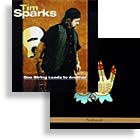
  • Tim Sparks – One String Leads to Another and Neshamah

    One String Leads to Another and Neshamah

    Tim Sparks is not a mere guitarist; he’s a musician. In fact, at times on these two new releases, he seems to transcend mere music to become a magician.

    Sparks began playing guitar as a kid in Winston/Salem, North Carolina, picking out melodies by ear on an ancient Stella flat-top. He received his first guitar at age 11, when encephalitis kept him out of school for a full year. He taught himself country blues as well as the gospel tunes his grandma played on piano in a Blue Ridge Mountains church. He later studied classical music with Jesus Silva and Andres Segovia. These diverse influences helped him win the ’93 National Fingerstyle Guitar Championship.

    Sparks had released two prior albums, ’94’s The Nutcracker and ’96’s Guitar Bazaar, winning him laudatory praise by luminaries such as Leo Kottke and Bill Frisell.

    These two new releases expand Sparks’ horizons in many directions. One String Leads to Another follows the tradition Sparks established in his earlier releases of blending rhythms, melodies, and tunings from numerous world sounds into a musical melting pot. A stellar cut from the album, “Pata Negra,” was inspired by a Portuguese sojourn and named after a local prosciutto. The song riffs on northeastern Brazilian musical styles, a fitting and fascinating musical intersection with Portuguese Fado as Brazil was once Portugal’s colony. Other cuts trade on similar world-wise connections – blending bluegrass, Turkish scales, Mexican melodies, Moroccan tunings, and especially Balkan sounds, one of Sparks’ favorite influences.

    Neshamah, on the other hand, focuses solely on Jewish musical traditions, but circumnavigates the globe in its breadth through the Near and Middle East, Mediterranean, Europe, North Africa, and the Americas. Sparks comments in his liner notes that in his experience, no other musical genre – except Gypsy music – “is found in such far-flung regions while retaining a core harmonic vocabulary.”

    This is a truly stunning album created with vision. Sparks melds elements of flamenco, Middle-Eastern oud, Tchaikovsky and Bart”k, as well as good old American jazz. The tone he draws from his well-traveled 1954 Martin 00-17 is otherworldly, so warm and deep that at times you feel as though you can reach out and grasp the melody as it floats by.

    You owe it to yourself to listen to these two albums.


    This article originally appeared in VG‘s March ’00 issue. All copyrights are by the author and Vintage Guitar magazine. Unauthorized replication or use is strictly prohibited.
  • Gibson Super Goldtone GA-30RV

    Contemporary Classic

    Gibson returned to the ampli-fier business in the late ’90s with its Goldtone amps, de-rived from the ’50s-era Trace Elliot/Vellocette line. The original models – the GA-15, GA-15RV, and GA-30RVS – were all covered in brown tolex.

    Then, taking things a step further, Gibson developed the Super Goldtone amps, which are a totally new design that expand on the original Goldtone circuitry. We recently visited Gibson’s New York City artist relations showroom to test drive one of the new Super Goldtone GA-30RV combos.

    Features and Controls
    The GA-30RV is a vintage-style two-speaker combo with a variety of useful features. And one of the first things you notice is its unusual speaker configuration – one 12″ Celestion Vintage 30, and one 10″ Celestion Vintage 10.

    While this is certainly not a new concept (some of the originals were similarly configured), it isn’t really common; few mainstream manufacturers offer combos with this setup.

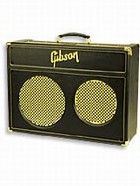
    Retaining a vintage-style appearance that pays homage to the ’50s amps, the GA-30RV’s cabinet is covered with black tolex framed by gold piping and fitted with an attractive brass-plated steel speaker grill with matching ventilation grills. A thick leather handle is attached on top, in front of the control panel. A gold-plated Gibson logo finishes the front. And tying this design to the rest of the Gibson family are amber-colored tophat control knobs, just like on a reissue Les Paul!

    Juice
    The GA-30RV features Class A-style circuitry and uses four EL34 power tubes, as well as five ECC83 and two ECC81 preamp tubes. The GA-30RV includes a three-spring Accutronics reverb tank. The amp’s chassis is mounted sideways and attached to the back of the cabinet, so the tubes face forward, lying horizontally.

    The chassis sits just below the main control panel and runs to the middle of the cabinet, so only a small section of the back is open. So the cab does breathe a bit, but sound is very much thrust forward.

    The back panel features are located at the bottom of the chassis, which sits a bit low, so they aren’t easily visible. While it’s not terribly convenient, it’s not necessarily a bad thing, either, because it’s unlikely something could be accidentally unplugged or changed.

    The top panel includes a single input jack and an on/off/standby switch for power. The controls are sectioned into separate preamp channels with reverb level controls for each, and a Master Volume. Preamp 1 includes controls for volume, treble, middle and bass, while the second preamp includes controls for gain, level, treble, middle and bass.

    Each preamp also has switches to engage them and activate their boost circuits. LEDs indicate which is in use and when the boost has been activated. These features can be controlled from the top panel or via footswitch.

    The back panel contains the power cable connector, fuse, the two 8-ohm speaker output jacks (for the internal speakers) and a 16-ohm speaker jack. Either speaker can be used by itself and plugged into the 16-ohm jack, or another extension cabinet(s) – just be sure to abide by the laws of impedance!

    The benefit of having different-sized speakers is that you can achieve a wider range of sounds with two different tonal textures by blending together the sounds of the two speakers. This can be a great feature for recording, as well as for providing a more varied sound in a live situation when the two speakers are separately mic’ed and split to different channels on a console, and/or sent to separate tracks for recording. A single line out jack is also provided.

    The back panel also includes jacks and controls for the built-in effects loop, and jacks for appropriate footswitches. In addition to the send and return jacks for the effects loop, there are separate level control knobs for each, as well as a series/parallel switch to select the placement of the effects loop within the amp’s circuit.

    Two jacks are included for footswitching features: a 1/4″ stereo jack for the standard Preamp 1/2 Boost footswitch (included) and a DIN jack for an optional controller. A basic two-button footswitch is included, and lets you bounce between preamps and turn the reverb on and off. There’s also an optional five-button foot controller, with five buttons and LEDs indicating which section you’re using (Preamp 1, 2, or both), and activating Boost Select, Effects Loop, and Reverb.

    Sounds
    First, we listened to each preamp individually. Preamp 1 delivers cleaner tones, while Preamp 2 delivers the dirty and nasty. However, a fuller-bodied tone is achieved when both preamps are combined. The tone, gain, and boost controls can be set for an assortment of sounds.

    With two preamps (each with boost, and overdrive features) there are essentially six possible combinations. The tonal textures of the GA-30RV are very much characteristic of British amps like a Vox AC30 or an old Marshall Super Lead 20, due to the EL84 tubes and class A design. The amp delivers a range of sounds that work well for blues, classic rock, as well as for cleaner styles like jazz or country.

    Overdriven tones range from slightly gritty to a fuzzier classic rock-type of dirt. The dirty sounds are not nearly as saturated as amps with more modern voicing, like the overdrive in a Boogie amp; think Chuck Berry or Yardbirds. If you’re prone to preamping, a Tube Screamer, Super Overdrive, Fuzzface, Gibson Maestro Fuzz, or any similar effect would provide favorable results.

    The combo’s Vintage 30 provides a deep, warm tone with smooth low-end, while the Vintage 10 delivers brighter tones with accentuated highs and slightly punchier mids. The combination yields a pleasing mix.

    The amp’s built-in reverb can be adjusted for an array of subtle to intense effects that nicely complement the amp’s inherent tones. The reverb produced by the three-spring Accutronics tank is not quite as splashy as typical Fender reverb, but it is a fairly long-trailed, ambient effect.

    The Low-Down
    The GA-30RV is a nice-sounding amp with a range of tonal textures and an extensive assortment of cool and useful features. It’s excellent for recording or gigging varying styles (especially rock, blues or jazz) and it’s clean enough to use with an acoustic or piezo/electric guitar. The cabinet is super solid, which helps deliver the formidable tone, but does require some muscle to haul around, so eat your Wheaties beforehand!


    Gibson Super Goldtone GA-30RV
    Type Of Amp: 30-watt Class A tube combo.
    Features: Four EL84 power tubes; five ECC83 and two ECC81 preamp tubes; single input jack; preamp select switches; boost select switches; preamp one controls for volume, treble, middle, bass; preamp two controls for gain, level, treble, middle, bass; separate reverb level controls; master volume; line out; loop select; series/parallel switch for loop; separate level controls for send and return; send and return jacks for loop; three-spring reverb tank; 12″ Celestion Vintage 30 speaker, 10″ Celestion Vintage 10 speaker; footswitch jacks for preamp 1/2 Boost (two-button footswitch, included with amp).
    Price: $2,395 w/ standard footswitch.
    Contact: Gibson Musical Instruments, 309 Plus Park, Nashville, TN 37217, 800-444-2766, gibson.com.


    CS1 electric 6-string courtesy of Citron.

    This article originally appeared in VG‘s Feb. ’02 issue. All copyrights are by the author and Vintage Guitar magazine. Unauthorized replication or use is strictly prohibited.
  • Tony Iommi and Geezer Butler

    The Masters of Reality Return

    In the late ’60s, in Birm-ingham, England, guitarist Tony Iommi, bassist Geezer Butler, vocalist Ozzy Osbourne and drummer Bill Ward first united as a group, calling themselves Earth. By ’69 the band changed its name to Black Sabbath and its mystical stage antics and dark, tuned-down heavy rock music played at ear-splitting volume, soon became legendary.

    The original lineup recorded seven studio albums between 1970 and ’78, including Black Sabbath, Paranoid, Master Of Reality, Vol. 4, Sabbath, Bloody Sabbath, Sabotage, and Never Say Die. A greatest hits compilation, We Sold Our Soul For Rock And Roll, was released in ’76. In ’79, the group split when Osbourne departed. But the band continued making music and touring, undergoing several lineup changes until Iommi was the sole original member. Nevertheless, no incarnation of Sabbath or any of the members’ own endeavors ever matched the legacy of the band’s original lineup.

    Together, the original Black Sabbath created the style that became known as heavy metal. Its music has been a primary influence on many ’80s and ’90s metal and grunge bands, including everyone from Metallica to Soundgarden to Smashing Pumpkins. Early Sabbath records continue to inspire new listeners.

    The original Sabbath reunited at the Live Aid concert in July of ’85 and then again for the encore of what was supposed to have been Osbourne’s farewell performance with his solo band in ’92. The response was tremendous. Although Osbourne has achieved considerable success with his own records, it was clear Sabbath fans longed to hear those classic tunes played by the original band. And they still want more.

    Until recently, Osbourne, Iommi, Butler, and Ward were unsuccessful in their attempts to reunite. But in late ’97 the four finally got together to play two sold-out shows in Birmingham, England. Both were recorded and tracks from the second were recently released as a double live album, Reunion, the original lineup’s first full-length concert since ’79. The new disc includes 16 classics and two new studio tracks, “Psycho Man” and “Selling My Soul.” The reunited Black Sabbath embarks on a six-week American tour kicking off New Year’s Eve in Phoenix, Arizona.

    As advance copies of Reunion began to circulate, Vintage Guitar sat with Iommi and Butler in New York City to talk about the reunion, as well as its musical past, present, and future.

    Vintage Guitar: Before ’98, when was the last time Sabbath played together with Ozzy?
    Geezer Butler: We did something in ’92, which was allegedly Ozzy’s last gig [with his solo band]. It was supposed to be the ultimate farewell concert and he wanted to finish the whole thing with us. We went on and did three songs for the encore and that sort of started the ball rolling. At that time it just fell through.

    What inspired the reunion this time?
    GB: Bill [Ward] (laughs). Well, this time Ozzy and Tony had already agreed to it. Sharon [Osbourne, Ozzy’s wife and personal manager] called and asked me if I wanted to do it. She wanted to have us as the headliners with Ozzy at this year’s Ozzfest because of the festival’s success last year. I said yes, then it had to be put together quickly because there were only two months to rehearse.

    The house you rehearsed in, was that the same one you worked in when the band started?
    Tony Iommi: That house [in Monmouth in Wales], it was where we used to rehearse when we first started. We went back and it was like going back to the beginning, to the same place we started.

    Did it feel as if no time had been lost?
    TI: It was really good. We took time and all lived together in the house and just got familiar again. We had a laugh, joked, and had food. Then we started playing again and it was great because it all fit in.

    What was the first song you played?
    Iommi and Butler [simultaneously]: “War Pigs.”

    Did the music naturally come back or did you have to work out any of the original parts?
    GB: It was all natural, really. We hadn’t played together with Bill on a full set for 18 or 20 years from the original days. He had the most difficult job, so we had to go over stuff with Bill again just to make sure that he was alright with it.

    What happened to Bill after the shows in Birmingham? There were reports he suffered a heart attack.
    TI: We had done the two shows and recorded them, and that was fine. Then we were due to headline some European festivals. So we got back together in the house in Monmouth and started rehearsing. On the second day he had a heart attack.
    GB: Because he was so shocked he got it right (laughs)!
    TI: I’ll tell you, we were all shocked! Then we opened our mouths and said, “Oh, blimy. It’s going quicker than we expected!” And of course, the next thing, Bill had a bloody heart attack. We thought it was all going too good.

    With different members coming into Black Sabbath, how had that affected the music over the years?
    TI: Funny enough, when we got back together we realized how different things were in between. Nobody plays those songs like the original lineup. You can’t replace anybody, you just carry on. And that’s what happened. It was only when we all played together again that we realized how those songs should sound and we went back to the way we played them. It just felt nice having the songs sound the way they should. It’s funny, playing the solos again and all those particular riffs. We had it sounding much the same as it was when we’d originally done it. All through the years we had done different albums where there was more solo stuff going on, but there’s probably less solo stuff in this, and more riffs.

    How did that affect you as a guitar player?
    TI: I got worse (laughs).

    What was it like going back in and working together on the new material? How did you approach it?
    TI: When we went in to do the mix they asked us if we could come up with two new tracks as a bonus for the album. It was totally out of the blue while we were in the middle of doing the mix. It had to be done quickly, so we didn’t really have any time to think about it. We just came up with some ideas and put them down. Then Ozzy came up with a melody line and we all played it and it was as simple with that, really. They wanted it that quick and it was done in just a couple of days.

    What is the standard Black Sabbath formula for writing songs?
    TI: I’d come up with a riff, then Ozzy would come up with the melody line and we’d just built it up. The new songs were done just like we had always did them.
    GB: I didn’t contribute anything to these two new songs (laughs). They’d already done it by the time I’d got there and there was nothing to change about it.

    How long did it take to get the new tracks on tape? Did you record anything else at that time?
    TI: Do you want more, then (laughs)? We wrote just those two songs in the studio and, overall, it took about four days in the studio to write and record them from start to finish.

    Is there a possibility we may see a new Sabbath studio album with the reunited band?
    GB: There might be. It just depends, but we’re not going to force it. It’s got to be marvelous – it either happens or it doesn’t.
    TI: There is a possibility. I’d just rather think that when we’re ready to do that, we will. We’d love to do it, but until that happens, we stand to whatever else we’re going to be doing.

    Let’s talk a bit about your gear. Tony, how have your choices in guitars and amplifiers changed over the years?
    TI: My guitar has pretty much remained a Gibson SG. I also had some made in England by J.D., the same chap who built them for Gibson. I played those for a while and then went back to Gibsons. It’s more or less been the same as when I started.

    I’ve tried different amplifiers over the years. I started out using Marshall amplifiers and then I switched to Laney – we were both using Laneys then. I used Laneys for quite a while and then started trying others, like a Boogie 300-watt head, which I didn’t like because it was too large-sounding. Then I went back to Marshalls again, then back to Laneys. The Laneys I use now are designed the way I would want to have an amplifier sound. They’re my own model Laney amp and they’re a bit different from the regular models they do. We worked on getting the sound right where I wanted it, so they’ve got a lot more highs and they’re very loud. While my sound used to be a bit fuzzy, it’s not quite so fuzzy now. I want a sound that’s solid and powerful. I like a cleaner sound, not a fuzzy one. There are a few other changes from the original amps, including the way it’s wired up.

    What are you currently using for outboard effects?
    TI: I have a Pete Cornish pedalboard, but I only use wah wah and chorus. The wah is an old Tycobrahe. I haven’t found one to beat it, although I have loads of different ones. I have no idea what the chorus pedal is and I have no idea what’s in the rack. I’ve got two or three different ones and backup systems in the rack, but I don’t know which unit we’re using at this minute.

    How do you usually set your amp?
    TI: I don’t have it full up. I have the drive up to about 7 and the master volume up to about 7, too. The other controls – the tone controls – are quite responsive, so they’re set about halfway. I used to turn everything full up years ago, on the original amplifiers, and I used to use a treble booster to drive the input. I’d turn everything full up and turn the middle off. Now I have that treble booster built in to the amp.

    What are your preferences for your guitar’s neck shape, frets, and the setup?
    TI: I like a thinner neck than the regular Gibson because it’s easier for me to hold. I like 24-fret necks, too. I also prefer thin fretwire, like the old ’61 Gibson-type. I don’t like the chunky type. I like the strings to be set low, as well.

    What kind of strings and picks do you use?
    TI: I use LaBella strings and black Dunlop picks. My strings are different custom-gauge sets, and they’re not always the same. I’ve used strings ranging from a very light .008 set to a heavier .010-.052 set.

    How many guitars do you generally take on the road?
    TI: Probably about six or eight, but I use two throughout the show. We use different tunings because some of the albums were played in different tunings in the early days. We never went by the rules and just tuned the way that sounded right for that track or that album. We’ve always tuned a semi-tone down, but on the Paranoid and Black Sabbath albums we tuned to pitch. On Master Of Reality we tuned down three steps. We didn’t have any rules, because everybody else made the rules up. We just broke them. Onstage we tune down a semi-tone.

    VG: Did you tune down because of Ozzy’s vocals?
    TI: We had always experimented with Black Sabbath. That was the greatest thing we’d done. We had always tried things that weren’t the norm. We were the first to tune down, and nobody could understand that. I also went to many guitar companies years ago when I wanted light-gauge strings and was told they couldn’t make them because they wouldn’t work the same. I had to explain that I’d already been using them and that I’d made up the sets myself.

    It was the same with 24-fret necks. I put money into a company because I couldn’t get guitars built the way I wanted them. I had to prove it to the manufacturers. So I put money into John Birch guitars, and he built my guitars. I had to prove it worked. All of this was done by experimenting and trial and error. I paid for that myself in the early days to show it could be done. And I paid for all these companies to get the benefits nowadays. Back then they all said it couldn’t be done. I also used locking nuts years and years ago without a tremolo, before locking nuts were the norm.

    I also came up with a guitar with interchangeable pickups you could slot in from the back. It was a John Birch guitar. We only sold one, and Roy Orbison bought it. I came up with that years ago and the first one was made for me to use in the studio. At the time I had a lot of problems tuning guitars because of the neck and the light strings on the Gibson. I decided to come up with a guitar that I could use in the studio with different sounds so that I didn’t have to keep changing guitars. You could slot a pickup in it and get a Fender sound, then slot a different pickup in it and get a Gibson sound. That was the idea. I did use it for a while, but they were too expensive to mass-produce.

    Do you still hold the patent on that design?
    TI: I did years ago, but I probably lost it now. That was about 28 years ago. I had just done it for my own interest. If it was successful I knew people would rip it off.

    Speaking of pickups, what’s different about your signature model Gibson pickups from the stock pickups in a typical SG?
    TI: You can turn them up more without feeding back. Gibson said it’s entirely different from anything else they’ve done. My original Gibson pickups used to feed back and squeal all the time and I couldn’t control it. I wanted pickups that wouldn’t feed back when the volume was up, but when you turn down they sound clean. If you turn up, you get all the guts without any squealing.

    Being left-handed, has it always been difficult for you to find gear ?
    TI: Yes, and even more so in those days. You couldn’t find anything. I’d see maybe one left-handed guitar in a store. I had a Burns guitar because you could find them easily in those days, but I had always wanted a Strat. Then I eventually saw a Strat and bought it. I used it on “Wicked World.”

    Geezer, tell us about the equipment you’ve used through the years.
    GB: I was using Fender Precision Basses on the first two or three records. Then I had a Dan Armstrong bass. After that I used a John Birch and basses made by J.D. and B.C. Rich. Then I was playing Spector basses, and now Vigier. The basses I’m using live are Vigier XS models.

    When I started playing, the very first amp rig I had was a 70-watt Laney head and a Park cabinet with three speakers in it because I couldn’t afford four. That’s what I did the first album with. Then, when I could afford it, I got two Laney 4 X 12s and two Laney 100-watt bass amps. From there, I went to using Ampeg SVTs with various combinations of speakers. Now I’m using the newer SVTs.

    For outboard gear, I use an old Tycobrahe wah wah on “N.I.B.” There’s nothing to replace them. You just cannot get that bass sound with anything else because you’ve got the sub-bass control on the back of the wah wah, as well. I also have a DigiTech digital EQ, and that’s it.

    How are your basses set up?
    GB: They have a wide neck with very shallow depth because I want the neck to be as thin as possible with the strings a bit further apart. They have 24 frets and are set up with incredibly low action. I also use built-in active electronics set on full blast.

    Do you play with a pick or with your fingers?
    GB: I use my fingers, but I sometimes play with a pick. It depends on what the song needs. If it’s fast and needs a lot of clarity, I’ll use a pick, but I normally use my fingers.

    What kind of strings and picks do you use?
    GB: I use DR strings and black Dunlop picks – the same ones as Tony.

    What are your typical amp settings?
    GB: I set the amp with loads of bass, no mid, and the treble set about 7. My volume is set on about three. My stage volume is incredibly loud.

    Do either of you wear earplugs?
    GB: No. I just got so used to the volume over the years that I don’t need them. If I go on with ear plugs or without that volume, it just sounds horrible to me and I can’t play.
    TI: I don’t wear them, either. Since we first started we were always loud and we’ve always done it like that. It’s always been a major part of the band’s sound. I’ve just gotten used to the volume.

    Do you use wireless systems?
    GB: Yes, for sure.
    TI: I use a wireless, as well, but it took me years to use one. I never liked them because I tried a lot of systems and thought many of them changed your sound. I’ve used them on and off. But now Shure has come out with one that I like. I used it on the last tour.

    Do your live rigs differ from the gear you use in the studio?
    TI: I use much of the same stuff I’m using onstage. I use a Laney amp and cabinet. That’s what I used on the last studio album. In the past, I never used to use the same gear onstage and in the studio. I used to always use something different in the studio because I could never seem to get the sound I wanted with the stuff I was using onstage. So I’d end up using a different amp, anything from a small Boogie amp to a Marshall – whatever sounded right. In fact, PRS built an amp I liked. It sounded good and I used it on a couple of things.
    GB: For me, it varied with every album. On the last couple of albums I ran three signals. I used a total bass sound through a 15 set on full bass. Then I’d run a direct sound to give it clarity, and another signal through a Marshall 4 X 12 with a Marshall guitar amp so it has an ultra distorted sound at the top. When I mix the three sounds I’ve got the ultimate live bass sound with the clarity of the direct signal and the ultra distortion, as well.

    Do you stand in the same room as your amp when your record your guitars?
    TI: Not anymore, but we used to in the early days. I usually do everything in the control room.
    GB: In the old days I stood in the same room, as if it was a live gig, especially on the first two albums. We’d mic everything and literally play live in the studio as if it was a gig, because that was all we knew. We had never been in the studio before and we only had 12 hours to do the first album.
    TI: Not only that, but in those days they had nowhere to stand in the control room. The control rooms were very small.

    VG: When did things start to change?
    GB: Probably on the third album. We started experimenting and that record was made in about 10 days. It wasn’t until Vol. 4 that we really took ages, and that took all of six weeks. It seemed like ages for us.

    Were there any tricks you used in the studio to get different sounds in the early days?
    GB: Yes. We used a producer (laughs).
    TI: We tried different things. We’d spend all day farting about and end up with nothing usable. We’d end up making things, making all these cabinets and coming up with all these brilliant ideas, like trying things going off the piano, into the piano and then micing up the piano strings to hear different sounds. In those days we’d make up ideas and try things. Now you just go buy a box and press a button and you’ve got that sound.
    GB: This was before samplers and synthesizers. If you wanted anything different or any weird sounds you had to do it yourself from scratch. You had to sit down and work them out and make something that sounded different. Like the track called “FX.” That’s Tony standing and playing his guitar in the nude (laughs). He took all his clothes off in the studio and his was hitting on his guitar strings with the crosses that he wore around his neck. That’s what it was on the whole track (laughs). Bill used to throw things in barrels of water and put a mic on them.
    TI: Like the anvil that time. Bill threw an anvil into a big barrel of water. He liked to make sounds on the mic.
    GB: One time we brought some sitars in and tried them on some tracks.
    TI: We tried violins and cellos, bagpipes – and tried to get sounds out of them, too. We tried all sorts of stuff, but it was just ideas. Sometimes it worked, sometimes it didn’t, but it was fun. It used to take a long time, but at least it was original. You wouldn’t hear it anywhere else.

    Have you continued to apply anything you learned in the old studio days on the new recording?
    TI: Yes. We’ve learned not to do that kind of stuff in the studio or we’d be there forever (laughs). The formula we used to write songs, that’s remained the same. But again, this time the studio was more of a mix room and we just miced up the guitar amp.

    What tips do you have for other players on developing their own style?
    TI: I think everybody has a unique style – it’s just that certain way you play. I imagine people try to sound like somebody else, but it’s hard to do because you have a unique way of playing and how you create that sound. You should try to develop your own style and go from there. We’re players from the heart, we play from within. We didn’t learn the music side of it – we never learned all the scales and all the stuff they say you’re supposed to. We learned by sound and feel. If it sounded good, then it was right for us. We went against the grain in the early days and we always stuck to that. It was a lot of listening to each other. We didn’t listen to people telling us that we couldn’t do something or that we shouldn’t be doing something a particular way. We developed a unique style that worked perfectly together and we played off of each other. We had to make it sound big since there were only two guitar players – a guitar and a bass – to make it sound that way. And that’s the way we’ve always worked it.

    It’s probable Geezer is responsible for creating the distorted bass sound popular among bands today.
    GB: I didn’t even play bass before we got together. I was a rhythm guitar player first, but we didn’t need a rhythm player in this band so I switched to bass. A lot of people think a bass player is supposed to be more melodic, like Paul McCartney, playing all these nice things to give everything more depth. But I couldn’t do it that way so I just followed along with Tony’s riffs. In addition, when we used to go into the studio they’d say I couldn’t have this much distortion on bass, because bass players don’t do that. But that’s me, that’s my sound. We used to have battles with producers and engineers about distortion and what a bass is supposed to sound like. It was always an argument on every album.
    TI: In the studio they would always try and separate the guitar and bass sound. They’d get into the control room and listen to our tracks separately and complain that Geezer’s bass sounded so distorted. They didn’t understand that what we had together was the sound we wanted. You just can’t start listening to the parts individually, because together it created our sound.

    Of course, we have to give Tony credit for developing the fifth-chord technique [playing the root and fifth notes of a chord] that’s become the legendary power chord used by every guitarist today.
    TI: I did it purely because I had to. But to make it sound bigger, I developed a vibrato technique and put it on the whole chord.

    Tony, how do your fingertips affect your technique? (Ed note: Iommi has prosthetic fingertips on the middle and ring fingers of his right hand.)
    TI: My technique is different. I was already playing guitar for three years when the accident happened, but I had to completely relearn. I was playing with two fingers for a long time and that’s how the fifth chords came about. I can’t feel a thing, so I just have to do it by ear. It is hard and it took a lot of getting used to. Put a sewing thimble on your finger and that would be the equivalent.

    Which Sabbath songs best define the scope of the band’s music?
    GB: I’d say “Black Sabbath,” “Paranoid,” “Iron Man,” and “War Pigs” are the essentials. We’ve had so many facets to the sound from heavy slow things like “Black Sabbath” to nice ballads like “Changes.” When the song “Black Sabbath” came out it was so different from anything else before, and that was probably what made people listen. Nobody else sounded like that.
    TI: I would agree. The track “Sabbath, Bloody Sabbath” is another level we went on and I thought Sabbath, Bloody Sabbath was a good album. There are other tracks, like “Solitude,” “Changes,” and “She’s Gone,” which no one would think of as us. In fact, some of those tracks were being played on the radio and nobody had a clue it was Black Sabbath. At the time it came out, nobody would have guessed “Changes” was us.
    GB: In Poland, Sabbath is banned, but the government used to use “Laguna Sunrise,” one of Tony’s instrumentals, as the background music for its propaganda speeches, not even realizing it was us.
    TI: There is also a guy who recorded “Into The Void” for a Russian rap record and he didn’t know it was one of our songs. I guess it’s safe as long as no one finds out it’s us.


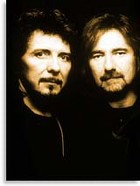
    Photo: Kevin Westenberg.

    This article originally appeared in VG‘s Jan. ’99 issue. All copyrights are by the author and Vintage Guitar magazine. Unauthorized replication or use is strictly prohibited.
  • Johnny A. – Sometime Tuesday Morning

    Sometime Tuesday Morning

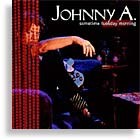
    I say it three or four times a year. Every so often, a CD arrives from an artist I’ve never heard of, and it blows me away. Here’s one of those. This is easily one of my favorite records of the year.

    Johnny’s a Boston guy who’s spent some time on the road with Peter Wolf. This all-instrumental CD covers the gamut, from R&B to country to rock, and everything in between.

    The highlight is a beautiful cover of one of my all-time favorite melodies, Jimmy Webb’s “Witchita Lineman.” Killer chordal work, subtle melodies, and yes, even a quote from Glen Campbell’s Marlboro-man sound are mixed up to make this four of the lovliest minutes you’ll hear this year. In fact, all the covers on the CD work really well, including a very nice-sounding “Yes It Is” (the Beatles song), and a funky, jazzy version of “You Don’t Love Me” that features some nasty wah work, and chordal and octave work that show us what this blues chestnut might have sounded like if Wes Montgomery had covered it.

    Johnny’s originals are great, too. The title cut sounds like the theme from some long-lost spy movie. “Oh Yeah” is a roof raiser that lets him show off his chops. “Up In the Attic” showcases his country side with some fun chickin’ pickin’ and killer banjo-style roles. The wonderfully-titled “Tex Critter” is a rockabilly workout, and “Lullabye for Nicole” is a very pretty ballad.

    You get the idea. This is a marvelous CD. It’s available on the web at www.cdbaby.com, phone 800-448-6369, or on Johnny’s website, www.johnnya .com. Do yourself a favor and check it out.


    This article originally appeared in VG‘s March ’00 issue. All copyrights are by the author and Vintage Guitar magazine. Unauthorized replication or use is strictly prohibited.
  • Gibson’s First Cherry Red 335

    It came from the Books

    Gibson introduced the ES-335T in the spring of 1958 as the progenitor to its double-cutaway,semi-hollow body “thinline” series of guitars. Characterized by the maple block running down their centers, most of the guitars in the series – the ES-335 (and its many variations), the 340, 345, 347, 355, 320, 325, and later Artist, B.B. King, and ES-369 models – are today considered classics in the Gibson line.

    Initially, the model was called the 335T, the T making the customary reference to the thinline designation. Shortly after introduction, the company decided to denote another feature of the line – dual humbucking pickups – by adding the D to its name.

    According to Gruhn’s Guide to Vintage Guitars (GPI Books/Miller-Freeman, 1991), the basic specs are the same for all guitars in the family; 16″ bodies, 1 5/8″ in depth, 24 3/4″ scale. All were equipped with some variant of the humbucking pickup, with the exception of the 320, which received Melody Maker pickups, and the 325, which got mini-humbuckers.

    The 335’s body was made of laminated maple on top, back and sides, while its 22-fret neck (19 frets at neck/body joint) was one-piece mahogany containing the famous dot markers.

    Helping shape the famous sound put forth by the 335 was Gibson’s familiar two-volume, two-tone control knob configuration and the single three-way pickup selector switch. Standard equipment included a Tune-O-Matic bridge, top-mounted jack, and stop tailpiece, but a Bigsby vibrato was optional from the model’s inception.

    Cosmetically, the original 335 featured more familiar markings; single-bound top, back and fretboard, unbound headstock with Gibson logo inlaid in pearl, five-ply beveled-edge pickguard, pearl crown peghead inlay, unbound f-holes, and choice of two finishes – sunburst or natural.

    A series of “refinements” saw the guitar evolve until it was replaced by the 335 DOT in 1982. This is a basically a reissue of the model as it appeared in 1960, before the replacement of the dot inlays with pearloid blocks or parallelograms. That version is still in production today.

    Gibson factory records indicate the first 335Ts were built and registered on company logs in February, 1958, with the TD designation beginning in ’60. The majority shipped the first year (267 of the 317 total) were finished in sunburst, with just 50 going out in natural.

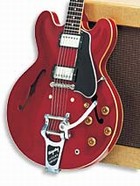
    According to Gibson Electrics, The Classic Years, by A.R. Duchossoir (Hal Leonard, 1994), Gibson records also indicate that one guitar – completed December 15, 1958 – was finished in cherry red more than a year before the color was officially offered as an option (cherry red replaced natural in 1960). That cherry red was given serial #A28800.

    Ladies and gentlemen, meet #A28800!

    Equipped as noted, including factory stereo wiring, this guitar turned up recently in northern California. The guitar was apparently quite new when the original purchaser used it as collateral for a loan that was never repaid.

    It was eventually sold to St. Louis dealer Dave Hinson (Hazardware), and he reports it is in excellent condition, complete with tags and instructions for maintaining the pickups and bridge.

    “I’d consider it near mint,” Hinson said. “There is only slight checking on the back and even less on front.”

    The guitar has the pearl dots used by the factory to cover the original bridge stud holes left by installation of the Bigsby.

    “The guitar has no fret wear and only slight fading on the back of the neck,” Hinson added. “It obviously spent most of its 39 years in its case.”

    The case is also interesting. Hinson reports it, too, is in very good condition, except a covering is missing from the handle.

    “It was made by Stone Case Co. Gibson used those cases in ’58 for 335s. It’s also known as the California Girl case, which were used for some Les Pauls of the era, as well.”

    While we’re at it, let’s not forget the amp! It’s Gibson’s GA-83s Stereo-Vib Amp, serial number 118180. And it is complete with owners manual and schematic.

    The guitar is resting in its new home in a private collection in England.

    But what other original LP Standards can be had for 1/10 the price of a ‘Burst?


    Cherry Red 335 photo: Mark Pfister, courtesy of Dave Hinson/Killer Vintage.

    This article originally appeared in VG‘s Feb. ’98 issue. All copyrights are by the author and Vintage Guitar magazine. Unauthorized replication or use is strictly prohibited.
  • Kid Ramos – Kid Ramos

    Kid Ramos

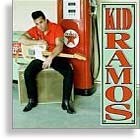
    If you can call his ongoing stint with the Fabulous Thunderbirds “woodshedding,” then guitarist David “Kid” Ramos has definitely paid his dues. He replaced Jimmie Vaughan – Texas-sized shoes to fill, if ever there was – in the quintessential blues combo in 1995 after playing with James Harman, the Blasters, Roomful of Blues, and others. All of that woodshedding has paid off on this solo album.

    With this type of resumé, Ramos has been able to call on some friends to play along. The T-Birds’ Kim Wilson adds vocals, Harman sings and blows his harp, Los Lobos’ Cesar Rosas and swingman Lynwood Slim sing a number or two, and other well-known buddies play everything from Hammond B3 to sax. The result is a top-notch backing band and a full horn section.

    Ramos’ blues here range from T-Bone Walker-inflected swing to B.B. King’s singing lines to Albert Collins’ chilling solos. Above all, however, Vaughan appears to play a big part in Ramos’ fretwork, as his lines are spare, tasty, and waste no notes.

    On this album, Ramos was armed with an arsenal that included his trusty 1959 Fender Esquire, a 1952 Gibson ES-5, 1957 Mary Kay Custom Shop reissue, and a 1961 Supro Reso-Glas resonator played through a 1959 Bassman, 3 X 10 Bandmaster, Vox AC-30 and assorted other amps. His tone is as impeccable as one would expect given the means to the end.

    This is one fun album. It’s packed with finger-lickin’ good guitar and hot blues that will make your mouth water for more.


    This article originally appeared in VG‘s Nov. ’99 issue. All copyrights are by the author and Vintage Guitar magazine. Unauthorized replication or use is strictly prohibited.
  • Rodney Jones – Soul Manifesto

    Soul Manifesto

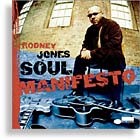
    Okay, it’s not like Rodney Jones doesn’t have the pedigree. He spent lots of time on the road with Maceo Parker, so it’s not like funk would be foreign to him. But on his previous solo work, the funk/soul element was there, but not strong – certainly not strong enough to prepare the listener for the blistering, white-hot groove of this album. It’s like Grant Green and James Brown had an accident at the corner of funk and soul. And through it all, Rodney navigates the twists and turns of every song with imagination and feeling.

    The CD’s first cut, “Groove Bone, Part 1” sets the tone. The band sets up a (as you might infer from the title) killer groove allowing everyone to solo heartily. Rodney starts with short, crisp octave blasts that give way to single lines and double-stops that show off his chops and soul.

    Oh yeah… did I mention the band? We’ve got Maceo Parker and Arthur Blythe on alto saxes, Dr. Lonnie Smith on organ, Lonnie Plaxico on bass, and the marvelous Idris Muhammad on drums. Muhammad has fueled some of my favorite jazz guitar albums in recent years, and this one’s no different. Anyway, this is a wonderful all-star group that plays incredibly well together.

    The overwhelming feel here is hard funk, but some other things slide through, too. “One Turnip Green” sounds like an organ trio swinging through the night. Jones, as expected, flies high on this one. There’s a really nice version of the Bill Withers classic “Ain’t No Sunshine” that features a gorgeous tone and nasty solo by Jones. Same for “Soul Eyes,” which is ballad work of this nature at its best. And “Soup Bone” is pretty much a jazz-tinged blues shuffle that makes you stand up and yell “Ow.”

    But the main emphasis here is funk. And it’s done in classic J.B. style. That’s not to say it’s clichéd or boring, because it’s not. In fact, Jones soloing is imaginative and takes lots of turns and corners you don’t expect. It would be real easy for a lot of players to fall into standard licks and phrases playing this kind of stuff. But that doesn’t happen.

    This one’s highly recommended. Along with John Scofield’s work over the past 10 years or so, this is at the top of my list for jazz guitar albums. If you like funk, jazz, guitar, or anything in between, pick this up.


    This article originally appeared in VG‘s Jan. ’02 issue. All copyrights are by the author and Vintage Guitar magazine. Unauthorized replication or use is strictly prohibited.
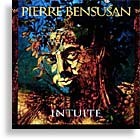
  • Pierre Bensusan – Intuite

    Intuite

    There are guitarists, and then there are guitarists’ guitarists. Pierre Benusan is the sort of musician who inspires awe among even other musical luminaries. Leo Kotke admits that, “Pierre’s music gives me the shakes. No other guitarist shares his strange gifts of sophistication, accessibility, and downright joy.” Since his first album, Pres de Paris in 1976, Bensusan has released eight CDs. Intuite is his first release on his own label, Dadgad Music.

    Unlike most fingerstyle guitarists, who favor nylon string classical-style guitars, Bensusan plays a steel-stringed 1978 Lowden S22 flat-top acoustic. In the 11 original compositions on Intuite, Bensusan coaxes a remarkable variety of tones and musical textures from this instrument. While some, like “So Long Michael,” have a floating, dreamy quality, others, like “Agadiramadin,” have an almost manic drive. “En Route from Scarborough” displays Bensusan’s melodic inventiveness through his variations on the traditional English theme “Scarborough Fair.” Not only is the music ravishingly beautiful, the sound is its equal. Bensusan’s guitar sounds startlingly natural, with just the perfect amount of natural reverberation.

    Pierre Bensusan manages to be both lyrical, quiet, dynamic, and virtuosic all at the same time. No serious lover of solo acoustic guitar music can consider their collection complete without a copy of Intuite.


    This article originally appeared in VG‘s Dec. ’01 issue. All copyrights are by the author and Vintage Guitar magazine. Unauthorized replication or use is strictly prohibited.

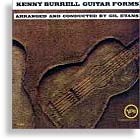
  • Kenny Burrell/Gil Evans – Guitar Forms

    Guitar Forms

    If I’ve said it once, I’ve said it a million times. One of the great things about CDs is great albums have become available at a cost you can afford. Here is an example.

    Blue Note had done a terrific job of repackaging this album. 1965’s Guitar Forms is a bona fide classic. It shows Burrell at his finest, with arrangements by the legendary Gil Evans. Plus, there’s some interesting alternate takes. As with all of these, the original liner notes are here. The Blue Note Burrell albums were late-’50s efforts that feature a young Burrell playing with the likes of Sam Jones, Duke Jordan, Bobby Timmons, and Art Blakey. Great stuff, both from a historical standpoint, and just for the wonderful playing. And, the cover reproduces Andy Warhol’s original artwork.


    This article originally appeared in VG‘s Nov. ’97 issue. All copyrights are by the author and Vintage Guitar magazine. Unauthorized replication or use is strictly prohibited.