Month: August 2002

  • J.W. Black and Albert Molinaro – The Fender Bass: An Illustrated History

    J.W. Black and Albert Molinaro

    Bass players have always been somewhat taken for granted. It’s almost as if they didn’t have to be good, merely profi-cient, for the music of the band to come across.

    Of course, anybody who has been in a band knows that’s not true; a great band has a bassist and drummer who can forge a cohesive groove, staying in the pocket and keeping time. And the best bassists aren’t necessarily showmen (although there have been a few), but rather masters of keeping up the bottom end without undue flash: these are the Bill Wymans and Duck Dunns of the music world.

    As a collectible instrument, the bass lags well behind the guitar among many collectors. A simple reason is that there are fewer bass players, but more to the point is that most basses were used as intended – “run hard and put away wet,” as the saying goes. There aren’t nearly as many collector-grade basses as there are guitars. Few seem to have been forgotten under the bed without first being heavily played.

    Fortunately, this state of affairs does not extend to books on bass guitars. There have been a number over the years, and this newest from Hal Leonard may be the best. Researched with care and attention to detail, the book is full of facts about the Fender bass, arguably the best-known and most influential electric bass of all time.

    Leo Fender began work on an electric bass not long after finishing the production model Telecaster. The “Precision Bass,” as this new instrument was called, was officially introduced in ’52, although the authors have photographed an excellent example from late ’51. This was followed by the Jazz Bass in ’60, Mustang Bass in ’66, and Telecaster Bass in ’68, as well as the Bass VI in ’61.

    Perhaps the best part is that this book is chock full of photos, photos, and more photos, including many early and original instruments, catalogs and advertisements, diagrams, paint chips, tuners, electronics, and various other parts important in identifying originality. Also included is a decade-by-decade history of changes in the lines, custom color availability, serial numbering system, and more. Paper quality and binding are first-rate. Highly recommended to all guitar collectors.

    Hal Leonard 2001, Softbound 128 pages, ISBN 0-634-02640-2, $24.95.


    This article originally appeared in VG‘s April ’02 issue. All copyrights are by the author and Vintage Guitar magazine. Unauthorized replication or use is strictly prohibited.


  • Juke 1210

    Tonal Treat

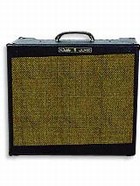
    Amp purists may have a tough time dealing with Warbler/Juke’s 1210. Until they hear it!

    The 1210 is unique both for its 2×10/1×12 speaker layout and lack of a distortion/overdrive. And though the amp shares many characteristics often seen in high-end boutique amps (i.e. point-to-point wiring, EL34s for power, a 5AR4 rectifier, 12AX7s in the preamp, 12AU7 reverb, pine cabinet, vintage-style speakers) it also changes things up a good bit.

    At first glance, the amp’s top-mounted control panel can be a bit intimidating. Compared to most single-channel amps, it has a ton of knobs. Intimidation quickly gives way to curiosity, and then familiarity as you gander through the owner’s manual.

    The 1210’s input section has hi and low-gain 1/4″ input jacks with a 3db boost (via footswitch), Contour (mids), Tone (overall highs), Bass, Treble, and Level. The effects section consists of Reverb with the standard Fender-like Dwell, Color (tone), and Depth knobs, and Vibrato with width (pitch-shift) and depth (tremolo) control (marked “FM” and “AM”), and speed knobs, both footswitchable.

    The output section has volume, the Pentode/Triode power output switch, a Presence control, power/standby switches, and an ultra/linear mode switch (for the pentode output) that gives you either a tight, clean, 6L6 sound, or a warm, fat, EL34 sound.

    After reading the somewhat technical (and very thorough) manual, we selected two appropriate guitars for our test; an ’80s Strings-n-Things Bluesmaster (Telecaster-style), and a Godin Standard HSS (Superstrat).

    Grabbing the Bluesmaster, we set the amp per manufacturer’s recommendations, and soon discovered that even though the Juke has no distortion mode, it’s not exactly a squeaky-clean surf amp, either. Instead, it offers an outstanding natural harmonic tone that makes the notes simply jump out of the amp, with loads of sustain and a little bit of drive. Even at high volume, the tone is smooth and pleasing, not at all harsh or brittle. And at low volume, the 1210 retains all of its lively character, and reacts well to the guitar’s volume and tone controls.

    While searching for various tones and complimentary settings, we spent a good bit of time noodling with the amp’s tone controls, and found the best settings to be between 10 and 2 o’clock. For example, venturing too far past 2 o’clock on the bass control made the low-end fart out just a bit. And the ultra/linear switch did exactly what the manual claimed it would – tighten up the low-end (like a 6L6-equipped Fender) or fatten up the mids.

    With the Godin, we tweaked the tone and contour knobs to accommodate. The single-coil pickups sounded good, but with the humbucker things were a bit flat. The amp’s reverb was very warm and clean and didn’t get in the way of the notes. It had a sort of in-the-distance ringing. The FM control gave us a pitch-shifting Magnatone-like vibrato with a Lonnie Mack vibe. The AM knob offered up more of a standard tremolo sound ranging from smooth and wide to short and choppy.

    We also toyed with distortion pedals and found they kind of got in the way of this amp’s pure sound. Used sparingly for solos (not overdriven chording), however, they work fine.

    In terms of workmanship and quality, this amp performed in superior fashion. One of our boutique amp junkie friends absolutely loved the sound of this amp – and he has tried them all! We concurred.

    The 1210 doesn’t come cheap, but if you want some of the best natural sounds around, it’s worth every penny (and that’s no juke!) – Phil Feser and Bob Tekippe


    Juke 1210
    Type of Amp: All tube with pentode/triode operation and ultra/linear output selection.
    Features: USA-made, point-to-point wiring, all-tube circuits, pitch-shifting vibrato, tremolo, sidebanded type C reverb, Alnico speakers.
    Price: $2,000.
    Contact: Sold directly through Juke Amplification, PO Box 951, Troy, NH 03465, (603) 242-6478, jukeamps.com.


    This article originally appeared in VG‘s March ’02 issue. All copyrights are by the author and Vintage Guitar magazine. Unauthorized replication or use is strictly prohibited.
  • Hillbilly Idol

    Hillbilly Idol

    I love this record. You don’t really think of great country music as coming out of Cleveland, but this would be the exception to that rule. Whether it’s honky-tonk, country swing, pop-like country, or even a polka, these boys can do it up right. I guess in this day and age, this is called alternative country, which I find somewhat ironic since it just sounds like the real deal to me.

    The band features Paul Kovac on vocals, acoustic guitars, banjo and mandolin, Dave Huddleston on vocal and lead guitar, and Al Moss on pedal steel. A quick listen to stuff like “No Time Like the Past” shows they know what they’re doing. An intro that has the guitar and pedal steel intertwining like they were born together leads to a great lyric and vocal. By the time it’s done, Huddleston’s taken a solo that would make Don Rich smile. You get the idea.

    And they’re well-schooled in lots of areas; “Dixie Highway Home” features their bluegrass side. An instrumental cover of the jazz chestnut “Four Brothers” lets Moss shine on pedal steel, while the rhythm section of Bill Watson on bass and Scott Flowers on drums lead the way. “Hillbilly Polka” is a charming tale that highlights guitar – and yes, accordion. “Hurt Heart Broke” is swingin’ rockabilly with a great lyric, and for good measure there’s even an instrumental thrown in that sounds like the theme from a spy flick (“Sirocco”). An excellent CD by fellas with an obvious love of country music.


    This article originally appeared in VG‘s July ’02 issue. All copyrights are by the author and Vintage Guitar magazine. Unauthorized replication or use is strictly prohibited.

  • Lee Ranaldo

    Alt-tuned Youth

    Sonic Youth was one of the most unlikely success stories of underground American rock in the 1980s. And while success and longevity probably weren’t on the minds of Thurston Moore and Lee Ranaldo when they formed the band with bassist Kim Gordon in 1981, the post-punk scene in Manhattan was looking for an icon. Sonic Youth arrived just in time.

    But how could they have known that by the late ’80s, their collective would serve as the godfathers of the grunge movement, supporting acts like Nirvana before it pushed grunge down the throat of America’s MTV-generation-of-the-week? Especially when Sonic Youth was so different: here was a band that started its career by abandoning rock and roll convention and borrowing heavily from the experimental attitude of the Velvet Underground. Its sound employed heavy feedback and alternate tunings to create a sonic landscape that redefined rock guitar.

    As their careers progressed, they turned to shorter works with a harder, more defined rock sound. Their breakthrough album was the double-disc Daydream Nation, released in 1988. The album was a huge critical success and generated a college radio hit with “Teenage Riot.” But Enigma, their label at the time, suffered from poor distribution and eventually folded, which created availability problems for the record-buying masses. In 1990, the band decided to forsake such hassles and signed with a major label, DGC. Doing so established a precedent for alternative bands moving to majors, proving it was possible to make the leap while preserving indie credibility.

    The band had no problem maintaining its inertia in the ’90s. 1990’s Goo was its first major-label effort, boasting a more focused sound that didn’t abandon the band’s noise aesthetic. 1994’s Experimental Jet Set, Trash and No Star, entered the U.S. charts at 34 and the U.K. charts at number 10, making it their highest-charting album ever. The band resurfaced this year with A Thousand Leaves, released in early May, and is on tour in support (in Europe late June through July). VG caught up with Ranaldo to get the lowdown on the stuff that helps create all the dissonance Sonic Youth fans have come to love.

    Vintage Guitar: What determined the direction the new album, A Thousand Leaves?
    Lee Ranaldo: Well, it’s kind of hard to say. We had a bunch of beautiful tracks. They weren’t very commercial-sounding to my ears, although they weren’t harsh or dissonant, either. A lot of the tracks were quite long – eight or 10 minutes, and were not, for the most part, super uptempo rockers. They were a little bit on the slower side. We’ve been sort of kicking back and stretching out on some of the material.

    Similar to “The Diamond Sea” (from 1994’s Washing Machine)?
    Yeah, pretty much. That was actually the initial way I was describing the new stuff, “Beyond ‘The Diamond Sea,’” taking what we did with that song, which was a long, epic-kind of thing with a lot of instrumental changes and just going even further. We’d been writing all these instrumental, some of which are included in those EPs. And we’d been doing concerts that were almost all instrumental.

    How did that instrumental direction come about?
    Things just evolve. We always write the music before the lyrics are ready and it just turned out we wrote three or four of these long instrumentals. In the past we’ve tried songs like that before they had lyrics live. At this point we just had enough of ’em that we could almost do a whole set of things like that and we just said let’s just try it – go out and play them and see how they fly. I guess we’re comfortable enough we decided to explore other avenues and let the chips fall where they may, figuring people who are interested in what we do will come along for the ride and people looking for the next MTV hit won’t worry about it.

    What’s been the reaction from “the suits?”
    The people at Geffen are pretty supportive of what we do, and their general reaction is, “We respect what you guys do, just keep doing it.” We just re-signed our deal with them – on their initiative, not ours. I think they’re very happy to have us around in spite of the fact we don’t sell a million records. They’ve been surprisingly supportive.

    Let’s switch to gear. What are your main guitars these days?
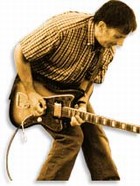
    Pretty much Jazzmasters and Jaguars. We’ve got racks of guitars in the studio, but I think all the material we’ve worked on for the last six or eight months is just Jaguars and Jazzmasters, and even then only a couple of specific ones for me and Thurston. Most of the ones we use are early-’60s. But we do have some of the reissues. We like their scale length. I think both of us have gotten super-comfortable with the body shape and the tremolo bar, and the fact you can play behind the bridge on the string and all that kind of stuff. I’ve been modifying mine for the last year or so.

    My favorite guitar sound has been from the Fender Tele Deluxes, because they’ve got the big Fender humbucking pickup on ’em. I was augmenting that with a couple of Travis Bean aluminum-neck guitars. Oddly enough, they have very similar-sounding pickups, to my ears. So for the last few years when we’ve seen a good Tele or Travis, we’ve bought it. And whenever we’ve seen those pickups for sale we’ve brought them. We’ve collected a little stash of those pickups and I’ve started putting them in the Jazzmasters and Jaguars, so I’ve pretty much got the best of both worlds. We call it the Jazzblaster.

    Sonic Youth is commonly associated with Jazzmasters, perhaps to the point of being somewhat responsible for the renewed interest in model in the early ’90s.
    It’s hard to say, but there was a point, after we were getting popular in England, when every band that came out had Jazzmasters and Jaguars around their necks; My Bloody Valentine, whoever. There was a time when outside of us and J. Mascis (from Dinosaur), you really didn’t see anybody playing those guitars.

    What about amps these days?
    I use Fender Custom Shop amps; a Tonemaster head and a 4 X 12 and a 2 X 12 cabinet.

    What do you like in an amp?
    Ultimately what I like is an amp with as few choices and combinations of knobs as possible. The Fender has two positions. It’s just perfect for me. It’s kind of like the amps we grew up with, where they were really simple, you could play them low or you could play them loud or you could make them more trebly or more bass, and that was pretty much all you needed to do.

    Do you use your Custom Shop gear to record with?
    Yeah, it’s set up in the studio and goes out on the road when we play live. We have a bunch of smaller amps around we fool with for recording, but that’s the basic setup I do stuff with. I have a ’50s Fender Deluxe, a Concert, a Super Reverb from the pre-CBS days, and a bunch of weird little amps, like a souped-up old Princeton, one of these new Prosonics, some Ampeg Gemini IIs, an old Silvertone amplifier, some real cheapo 5-watt amps. They’re all useful for different things and they’re fun to have around. But we record and rehearse with our touring gear.

    Let’s talk about pedals; I have to ask about your ring modulator.
    (laughs) Okay. Outer-space kind of sounds, real high-pitched, real low-pitched? Sometimes it sounds like a crazy synthesizer or alien bleeps and blips. I’ve been having a lot of fun with that pedal. It’s a Maestro. We’ve generally been using a lot of vintage ’70s pedals (conversation switches to Ranaldo’s Mu-Tron Phasor). I shouldn’t talk about that pedal, because I love it so much. It’s the coolest thing going. I use it all over the place on the new material. Unfortunately it’s a huge monstrosity that necessitates its own little suitcase.

    Is that the thing that stands upright onstage?
    No. That’s a thing we were using pretty heavily around the time of Washing Machine. It’s the wa-wa-wa-wa-wa sound at the beginning of “The Diamond Sea.” It’s the Ludwig Phase II guitar synthesizer, I think is what it’s called. It’s a big suitcase-like affair that stands straight up.

    Anything else?
    There are a couple more modern things. And a DOD 2-second delay. A Real Tube distortion.

    Sonic Youth has been pioneers as far as alternate tunings go. When did you start experimenting with alternate tunings?
    The first release has mostly-normal tuned guitar in it. I’d played in-tune guitars long before that, actually, when I first learned how to play acoustic. Right around the time Sonic Youth was starting, myself and Thurston were playing with Glenn Branca, who was doing all these specific-tuned, more orchestral kind of things. When we started the band, we immediately started gathering guitars. Most of them were not very good and they didn’t really hold their regular tuning very well.

    So, in the spirit of the experimentation of the day, we started to do different things with ’em. We took all the frets off one and put bass strings on it and took other ones and strung ’em to an open chord or one note, whatever we could do to get these funky guitars to do something dramatic and interesting. And it just kind of evolved from there. We immediately found that once we started tuning the guitars, we had all these new avenues to go down that set us apart from everybody else. It almost made our guitars different instruments. It was a real easy pull for us right from the beginning, especially not being super-technical players. The tunings have allowed us to work in different areas and reinvent ourselves.

    I’ve got this image of you and Thurston sitting down to work on some weird tuning, taking a few hours or an entire day to figure something out…
    It doesn’t usually take very long. Sometimes it’ll happen when you pick up a guitar that hasn’t been played in six months. You strum it, and there’s a grain of something and you spend 10 minutes tweaking the pegs until it’s something a little more realized, and there you have it. Or one of us will come in with some changes in a tuning. Like, Thurston will come in and he’s got a tuning going, I’ll hear it and figure out what the root notes are basically and grab something I have in it. We play a lot of stuff in G and F sharp, and E and C. We have some guitars that are in tandem already, where he’s playing guitar X, I immediately pick up guitar Y. They’re not in the same tunings, but they’re in two tunings that work well together.

    Sounds like a lot of time and effort.
    Well, I guess it has been. But it’s been over such a long period that it’s been basically effortless. We’ve been luckily enough to have a road crew that’s gotten deeply involved in it, knows how the stuff goes, and has made further refinements for us.

    How many guitars does the band take on the road?
    On the last bunch of tours, we’ve taken 25 to 30 guitars for the three of us. The reason for taking them all is because they’re all differently tuned. A couple of basses, Kim’s two or three guitars and then maybe 10 guitars for Thurston and 12 for me. And sometimes there’ll be a backup of a certain tuning if it’s one you rely on a lot, or if it’s a finicky tuning where you tend to break strings. Like “The Diamond Sea” tuning, which is a really crucial tuning and it’s used in a few different things. If that breaks in the middle of that insane middle section of “The Diamond Sea,” when you come back to the end you’re kind of lost.

    Let’s wrap up on a philosophical note. Something I’ve always admired about Sonic Youth is the way the band has operated in a “punk or DIY” approach while still staking out new musical territory and holding on to a desire to explore new avenues with guitars, something folks might not normally associate with a punk or indie band.
    We started with that kind of punk spirit and I think we maintain it in the way we operate today. We’re lucky we’ve had the career we’ve had. In the early indie days we learned how to be self-sufficient through touring and figuring out how to deal with the major labels, and we’re in a pretty nice position.

    We’ve always felt the most important thing was the music – pure and simple – and let that sort of guide where we wanted to go. That’s definitely served us well as an overriding philosophy. We always let the music dictate what was going on, and we tried not to let the economic factors come into sway. That was pretty important to us.


    Photos courtesy of Lee Ranaldo.

    This article originally appeared in VG‘s Aug. ’98 issue. All copyrights are by the author and Vintage Guitar magazine. Unauthorized replication or use is strictly prohibited.
  • Nick Lowe – Dig My Mood

    Dig My Mood

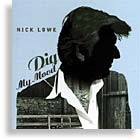
    It’s extremely tempting to start this review with something like…”I knew Nick Lowe when he used to rock and roll…,” but I won’t because it might make you think I don’t like this album. I love this album, but there’s not much on it that is rock and roll.

    What you’ll find here is a heady mixture of R&B, country, jazz, and a little rockabilly. It reminds me of a Charlie Rich album at times, a Johnny Cash album at other times. Anyway, the songs are all wonderfully written, the execution by Lowe and his band is very nice, his vocals match the weary maturity of the songs, and the packaging matches the album’s feel. If you’re a fan of this multi-talented man, or just a fan of good music, you’ll love this. Recommended.


    This article originally appeared in VG‘s July ’98 issue. All copyrights are by the author and Vintage Guitar magazine. Unauthorized replication or use is strictly prohibited.
  • Audiovox and Serenader Amps

    We dedicate this month’s column to the “legendary” Seattle line. Having never had the opportunity to play through one or take one apart, we’ll have to let catalog descriptions suffice (thanks to Peter Blecha for the early info and Bud Tutmarc for the late-’30s flyer).

    The earliest known flyer for Audiovox showed only a single amp available, the Model 236. Guesstimates on year seem to be 1935-’36, a time when most other companies only offered one amp for use with their assortments of instruments. Five tubes with a pair of 6F6s for the outputs, a 5Z4 rectifier, plus a 6F5 single-triode and a 6N7 twin-triode for the preamp/driver stages. Twelve watts at three percent distortion powered a single speaker, apparently a 10″ (cabinet dimensions were 11 1/2″ high by 14 1/2″ wide by 5 1/2″ deep). The speaker opening was square, with a lattice grille. One to five inputs could be ordered and like most amps of the era, the back panel had only the input jack, a volume control and a fuse. A second flyer from slightly later described the same amp.

    In the later years, the line grew to include three amps, including the Model 236, now equipped with a 12″ Lansing speaker. The rectifier changed to the popular 80 and the 6F5 was replaced with the similar 6SF5. Power increased to 15 watts at three percent distortion and a new cabinet with a round speaker opening and less-rectangular shape was shown (14 1/2″ x 13″ x 7 1/2″). No mention was made of a tone control.

    A more powerful amp, the Model 936, was pictured with the Model 736 bass guitar and listed as having 18 watts and a “…heavy duty, High Fidelity, Concert Type, 12″ Jensen Speaker.” “Has three different tones,” implies some extra controls as became popular in the late ’30s. Striped Airplane Linen covered a larger cabinet, measuring 13 1/2″ x 17″ x 8″. Bud Tutmarc remembers the bass amps having a 15″ speaker, so perhaps the later top-of-the-line models did. He also mentioned 6L6 output tubes used for the larger amps, unfortunately, the specs for the 936 were not given.

    At the bottom of the line sat the model 200, looking like a miniature 236, having an 11 1/2″ x 7 1/2″ x 10 1/2″ cabinet housing an 8″ Lansing speaker. Tubes were the new 6V6 beam power style for output, a 6SC7 twin-triode for the preamp, and an 80 rectifier.

    Fortunately, the man who built a good portion of the amps and pickups (starting before he reached his teens) is alive and well and was open for a number of interviews over the last six months. Here are the highlights, as they relate to the amps and pickups.

    Vintage Guitar: Many of the pioneers in electric guitars got there start with crystal radio sets. Did your dad build his own radios?
    Bud Tutmarc: No, but I did. I was building those three tube amps when I was 12 years old.

    How about the earlier amps, like the bass amp with the lightning bolts.
    When he made the electric bass, he already had his amplifiers going. He was making amps for Hawaiians before the bass, making them for the steel guitars.

    Any idea what happened to that first bass amp?
    Oh, he made a lot of those. That’s where he got the name Audiovox – “loud voice.”

    Who built the cabinets for the amps.
    For my dad, Frank Galianese.

    Who designed the circuits?
    Bob Wisner. He made a radio into a guitar amplifier for my dad. Wisner worked on the atom bomb and then in Florida on the lunar mission, the man on the moon. He was there and it took off on a Monday and Friday it landed. He died on Wednesday -never knew they made it. He worked at Boeing, too.

    He was trained, I take it?
    Oh, boy. He graduated from high school when he was 13! He worked for General Electric, they sent him to New York for three days and he came back, they said he was a genius and could work in any department he wanted! He was an opera buff, knew everything about opera.

    Did he play an instrument?
    Nope, not a lick. But he and I became partners in my Bud-Electro company.

    How about Arthur Stimson?
    No, he didn’t play; I don’t think he had any electronic background, either.

    Did you have any formal training in electronics?
    Not in electronics, no. Just experimenting.

    So when you were wiring these things up, how did you know what to do?
    I was wiring ’em up just like the one in front of me! I got so that I knew the whole circuit, I didn’t have to look at it after a while. We had the big five-tube amps and the small one, too. We used the 6F6s in the small ones and the 6L6s, two of them, in the others. That was when the metal tubes first came out. The small amp sold with a guitar for $39.50.

    We sold the guitar and a case and the three tube amp together. I was the one making all those amplifiers for him.

    How was the reliability of the old amps.
    Real good, that was Wisner’s design. I remember we had our group and we went out for two months, to New York and back and -we had the electric bass, if we didn’t, we wouldn’t have been able to carry anything anyway, five days out of Seattle we wrecked our car, ruined it, went around a corner too fast at four in the morning. The top was smashed, the windshield came right down on top of the steering wheel and we all got out, three guys in the front seat, two guys in the back and a trailer behind us.

    And we never missed one of our concerts. We chartered a plane that afternoon to Minnesota, and then we took a train, a bus, finally I bought a new car in New York. Having the electric bass along really helped, with a regular bass we’d have never made it. All our instruments got out. Our luggage was torn apart and our P.A. got smashed, but most places had them anyway. And the records, 78s, about 400 of the 800 didn’t make it. But the amps worked great.

    Were these the Serenader amps?
    Yeah. The Serenader amps were about the same as my dad’s.

    Did they have a little more power than the earlier amps?
    Yeah, and better speakers, the Jensen A-12 and A-15s. Those were permanent magnet speakers, before the Alnico V. And they weighed a ton! The magnets were about six inches across and about three inches thick.

    Did you use field coils for everything before the war?
    Yeah. The Alnico V changed everything, they were so much lighter.

    Do you know how many Serenader amps you made?
    No. We had two styles, one for the steel and one for the bass. I wasn’t selling many of the amps to Heater, but I was selling the basses.

    I notice the steel guitar and amp weren’t pictured with the bass in the L.D. Heater ad.
    No. That ad is from 1947, they distributed them up and down the coast.

    I remember Bob Wisner and I would drive down to Portland and deliver a bunch of them, about 10 basses at a time.

    How many of the basses did you make?
    I have no idea, maybe 75?

    How about the amps for your dad’s basses. Were most of those sold with an amp.
    Yeah, with the 15″ speaker.

    Did you take over the business from your dad?
    No. I just went on my own. He married Bonnie Guitar, a recording artist, his second wife, and that kinda separated the whole family for a few years. That ended the association building guitars in our house. Then I got married in ’45 and got into the business making my own in 1946.

    How about during the war? Did you guys do much building?
    No, not much. But again, I wasn’t working with my dad at the time. Now, I remember him coming down right at the start of the war, down to where I was working, at Fulton Machine, and saying, “What about this draft business?” And I said I was okay because I was working on the line, so he says, “Alright, that’s all I wanted to know.” He was worried about me and then later, we got back together and stayed close for the rest of our days.

    Do you know where your dad got the idea for his pickup?
    Probably out of a telephone (laughs)! Of course, Wisner was around. I remember they had to make the two polepieces so they didn’t connect. What we ended up doing was just soldering them, so they wouldn’t carry the magnetic field (between the two coils).

    On the early ones, they were split in two sections, right?
    Yeah, they had to be split. Later on we soldered ’em together and then could sand it to look like one solid piece of steel.

    From the patent, it looks like it’s a humbucking design.
    The only way you can make it hum is to hook it up wrong. It’s all in how you join the coils together, the outside to the outside and then the other ends go to the ground and the volume control. When I go into the recording studio, they say “Okay. Bud, turn your guitar up.” And I say it is and they say “It can’t be, we don’t hear any hum!’ It’s the most quiet pickup they’ve ever run across.

    Were the coils all wound the same?
    Yeah, it’s just how you connect them. I wound all those pickups, I have all that wire here still.

    Did you change the design much over the years?
    No. I record with my Serenader guitar; go direct into the board! And then I take my dad’s on the road with me, the Audiovox.

    That’s great, you take a 60-year-old guitar on the road!
    I’ve played it all over the world.

    Have you had to put a new pickup in it over the years?
    No! The volume control I had a little trouble with, so I replaced that.

    What was it like trying to get electrical parts back in the early days?
    I have more trouble getting the magnets now than I did then! The one my dad used was big and made a “U” shape. There were holes where you could put in a brace that held the polepieces. And it worked perfectly. I sure made a lot of those. I had about 50 of them out in the garage and my wife let ’em go to the junk man (laughs)!

    Did you get all the parts locally?
    Yeah, you could get anything. I still have a bunch of parts, the same ones I was working with 50 years ago!

    Any big difference between the Audiovox pickup and the Serenader’s?
    I slanted my pickup on the bass side, so you’d get more power in the bass notes. I put the pickup about four inches away from the bridge and got tremendous response from the bass strings; all my dad’s were right by the bridge.

    Which was standard back then. My theory is that people put the pickups back there because there were no amps that could take that kind of bass output; and that’s for guitars! Gibson did their ES-150 with the pickup at the neck for a few years, but even that changed back to the bridge before the war.
    Well, some players preferred a deeper sound.

    How does it feel to see your dad finally getting his well deserved credit internationally, instead of just locally.
    He deserves it and I’m very pleased.

    Was it something you thought you’d see in your lifetime?
    I’ve seen it in my lifetime – every time I’d see somebody playing an electric bass! I’d say, “I know where that came from.” That always meant something to me.

    What would people say when you told them who created the bass, that it was your dad and not Leo Fender.
    Oh, they’d kind of yell at me and that was it (laughs)! I don’t think I convinced everybody.

    Which was my initial reaction, I must admit.
    It was too big a thing to claim in some people’s minds, but that was it; I was there when it happened.


    Bud Tutmarc playing his father’s Audiovox lapsteel. Photos courtesy of Bud Tutmarc.

    This article originally appeared in VG‘s March ’99 issue. All copyrights are by the author and Vintage Guitar magazine. Unauthorized replication or use is strictly prohibited.

  • Audiovox and Serenader Amps

    We dedicate this month’s column to the “legendary” Seattle line. Having never had the opportunity to play through one or take one apart, we’ll have to let catalog descriptions suffice (thanks to Peter Blecha for the early info and Bud Tutmarc for the late-’30s flyer).

    The earliest known flyer for Audiovox showed only a single amp available, the Model 236. Guesstimates on year seem to be 1935-’36, a time when most other companies only offered one amp for use with their assortments of instruments. Five tubes with a pair of 6F6s for the outputs, a 5Z4 rectifier, plus a 6F5 single-triode and a 6N7 twin-triode for the preamp/driver stages. Twelve watts at three percent distortion powered a single speaker, apparently a 10″ (cabinet dimensions were 11 1/2″ high by 14 1/2″ wide by 5 1/2″ deep). The speaker opening was square, with a lattice grille. One to five inputs could be ordered and like most amps of the era, the back panel had only the input jack, a volume control and a fuse. A second flyer from slightly later described the same amp.

    In the later years, the line grew to include three amps, including the Model 236, now equipped with a 12″ Lansing speaker. The rectifier changed to the popular 80 and the 6F5 was replaced with the similar 6SF5. Power increased to 15 watts at three percent distortion and a new cabinet with a round speaker opening and less-rectangular shape was shown (14 1/2″ x 13″ x 7 1/2″). No mention was made of a tone control.

    A more powerful amp, the Model 936, was pictured with the Model 736 bass guitar and listed as having 18 watts and a “…heavy duty, High Fidelity, Concert Type, 12″ Jensen Speaker.” “Has three different tones,” implies some extra controls as became popular in the late ’30s. Striped Airplane Linen covered a larger cabinet, measuring 13 1/2″ x 17″ x 8″. Bud Tutmarc remembers the bass amps having a 15″ speaker, so perhaps the later top-of-the-line models did. He also mentioned 6L6 output tubes used for the larger amps, unfortunately, the specs for the 936 were not given.

    At the bottom of the line sat the model 200, looking like a miniature 236, having an 11 1/2″ x 7 1/2″ x 10 1/2″ cabinet housing an 8″ Lansing speaker. Tubes were the new 6V6 beam power style for output, a 6SC7 twin-triode for the preamp, and an 80 rectifier.

    Fortunately, the man who built a good portion of the amps and pickups (starting before he reached his teens) is alive and well and was open for a number of interviews over the last six months. Here are the highlights, as they relate to the amps and pickups.

    Vintage Guitar: Many of the pioneers in electric guitars got there start with crystal radio sets. Did your dad build his own radios?
    Bud Tutmarc: No, but I did. I was building those three tube amps when I was 12 years old.

    How about the earlier amps, like the bass amp with the lightning bolts.
    When he made the electric bass, he already had his amplifiers going. He was making amps for Hawaiians before the bass, making them for the steel guitars.

    Any idea what happened to that first bass amp?
    Oh, he made a lot of those. That’s where he got the name Audiovox – “loud voice.”

    Who built the cabinets for the amps.
    For my dad, Frank Galianese.

    Who designed the circuits?
    Bob Wisner. He made a radio into a guitar amplifier for my dad. Wisner worked on the atom bomb and then in Florida on the lunar mission, the man on the moon. He was there and it took off on a Monday and Friday it landed. He died on Wednesday -never knew they made it. He worked at Boeing, too.

    He was trained, I take it?
    Oh, boy. He graduated from high school when he was 13! He worked for General Electric, they sent him to New York for three days and he came back, they said he was a genius and could work in any department he wanted! He was an opera buff, knew everything about opera.

    Did he play an instrument?
    Nope, not a lick. But he and I became partners in my Bud-Electro company.

    How about Arthur Stimson?
    No, he didn’t play; I don’t think he had any electronic background, either.

    Did you have any formal training in electronics?
    Not in electronics, no. Just experimenting.

    So when you were wiring these things up, how did you know what to do?
    I was wiring ’em up just like the one in front of me! I got so that I knew the whole circuit, I didn’t have to look at it after a while. We had the big five-tube amps and the small one, too. We used the 6F6s in the small ones and the 6L6s, two of them, in the others. That was when the metal tubes first came out. The small amp sold with a guitar for $39.50.

    We sold the guitar and a case and the three tube amp together. I was the one making all those amplifiers for him.

    How was the reliability of the old amps.
    Real good, that was Wisner’s design. I remember we had our group and we went out for two months, to New York and back and -we had the electric bass, if we didn’t, we wouldn’t have been able to carry anything anyway, five days out of Seattle we wrecked our car, ruined it, went around a corner too fast at four in the morning. The top was smashed, the windshield came right down on top of the steering wheel and we all got out, three guys in the front seat, two guys in the back and a trailer behind us.

    And we never missed one of our concerts. We chartered a plane that afternoon to Minnesota, and then we took a train, a bus, finally I bought a new car in New York. Having the electric bass along really helped, with a regular bass we’d have never made it. All our instruments got out. Our luggage was torn apart and our P.A. got smashed, but most places had them anyway. And the records, 78s, about 400 of the 800 didn’t make it. But the amps worked great.

    Were these the Serenader amps?
    Yeah. The Serenader amps were about the same as my dad’s.

    Did they have a little more power than the earlier amps?
    Yeah, and better speakers, the Jensen A-12 and A-15s. Those were permanent magnet speakers, before the Alnico V. And they weighed a ton! The magnets were about six inches across and about three inches thick.

    Did you use field coils for everything before the war?
    Yeah. The Alnico V changed everything, they were so much lighter.

    Do you know how many Serenader amps you made?
    No. We had two styles, one for the steel and one for the bass. I wasn’t selling many of the amps to Heater, but I was selling the basses.

    I notice the steel guitar and amp weren’t pictured with the bass in the L.D. Heater ad.
    No. That ad is from 1947, they distributed them up and down the coast.

    I remember Bob Wisner and I would drive down to Portland and deliver a bunch of them, about 10 basses at a time.

    How many of the basses did you make?
    I have no idea, maybe 75?

    How about the amps for your dad’s basses. Were most of those sold with an amp.
    Yeah, with the 15″ speaker.

    Did you take over the business from your dad?
    No. I just went on my own. He married Bonnie Guitar, a recording artist, his second wife, and that kinda separated the whole family for a few years. That ended the association building guitars in our house. Then I got married in ’45 and got into the business making my own in 1946.

    How about during the war? Did you guys do much building?
    No, not much. But again, I wasn’t working with my dad at the time. Now, I remember him coming down right at the start of the war, down to where I was working, at Fulton Machine, and saying, “What about this draft business?” And I said I was okay because I was working on the line, so he says, “Alright, that’s all I wanted to know.” He was worried about me and then later, we got back together and stayed close for the rest of our days.

    Do you know where your dad got the idea for his pickup?
    Probably out of a telephone (laughs)! Of course, Wisner was around. I remember they had to make the two polepieces so they didn’t connect. What we ended up doing was just soldering them, so they wouldn’t carry the magnetic field (between the two coils).

    On the early ones, they were split in two sections, right?
    Yeah, they had to be split. Later on we soldered ’em together and then could sand it to look like one solid piece of steel.

    From the patent, it looks like it’s a humbucking design.
    The only way you can make it hum is to hook it up wrong. It’s all in how you join the coils together, the outside to the outside and then the other ends go to the ground and the volume control. When I go into the recording studio, they say “Okay. Bud, turn your guitar up.” And I say it is and they say “It can’t be, we don’t hear any hum!’ It’s the most quiet pickup they’ve ever run across.

    Were the coils all wound the same?
    Yeah, it’s just how you connect them. I wound all those pickups, I have all that wire here still.

    Did you change the design much over the years?
    No. I record with my Serenader guitar; go direct into the board! And then I take my dad’s on the road with me, the Audiovox.

    That’s great, you take a 60-year-old guitar on the road!
    I’ve played it all over the world.

    Have you had to put a new pickup in it over the years?
    No! The volume control I had a little trouble with, so I replaced that.

    What was it like trying to get electrical parts back in the early days?
    I have more trouble getting the magnets now than I did then! The one my dad used was big and made a “U” shape. There were holes where you could put in a brace that held the polepieces. And it worked perfectly. I sure made a lot of those. I had about 50 of them out in the garage and my wife let ’em go to the junk man (laughs)!

    Did you get all the parts locally?
    Yeah, you could get anything. I still have a bunch of parts, the same ones I was working with 50 years ago!

    Any big difference between the Audiovox pickup and the Serenader’s?
    I slanted my pickup on the bass side, so you’d get more power in the bass notes. I put the pickup about four inches away from the bridge and got tremendous response from the bass strings; all my dad’s were right by the bridge.

    Which was standard back then. My theory is that people put the pickups back there because there were no amps that could take that kind of bass output; and that’s for guitars! Gibson did their ES-150 with the pickup at the neck for a few years, but even that changed back to the bridge before the war.
    Well, some players preferred a deeper sound.

    How does it feel to see your dad finally getting his well deserved credit internationally, instead of just locally.
    He deserves it and I’m very pleased.

    Was it something you thought you’d see in your lifetime?
    I’ve seen it in my lifetime – every time I’d see somebody playing an electric bass! I’d say, “I know where that came from.” That always meant something to me.

    What would people say when you told them who created the bass, that it was your dad and not Leo Fender.
    Oh, they’d kind of yell at me and that was it (laughs)! I don’t think I convinced everybody.

    Which was my initial reaction, I must admit.
    It was too big a thing to claim in some people’s minds, but that was it; I was there when it happened.


    Bud Tutmarc playing his father’s Audiovox lapsteel. Photos courtesy of Bud Tutmarc.

    This article originally appeared in VG‘s March ’99 issue. All copyrights are by the author and Vintage Guitar magazine. Unauthorized replication or use is strictly prohibited.

  • August 2002

    FEATURES

    Three Sevens, Revisited
    Gibson’s L-7C, L-7P, and L-12 Introduced in 1948 as the cutaway version of the successful L-7, it set the course for fancier versions – all of which met with limited interest despite their beauty. By L.B. Fred

    The Different Strummer
    ’60s Short Stories Excelsior, Cipher, and the Shaggs: three interesting chapters in guitar history. By Michael Wright

    Frank Gambale
    Thunder From Down Under Weaned on the electric blues of Mayall, Clapton, and Hendrix, he went from GIT grad of the year to fame as one of the heavy hitters of jazz fusion. By Don Zulaica

    John Paul Jones
    An accomplished multi-instrumentalist, he was an arranger, composer, and session player who worked with many of the most prominent artists of the ’60s before teaming with Jimmy Page to form Led Zeppelin. By Lisa Sharken

    Tony Levin
    Stickin’ With the Low-End From his experiences with upright basses in classical and jazz, through his ongoing efforts with a Chapman Stick and Music Man electric basses, he has been a force to be reckoned with for decades. By Willie G. Moseley

    Dave Davies
    Bitten By the Bug They say good things are worth the wait. The Kinks co-founder’s first solo studio album in nearly 20 years is a good example. By Arlene R. Weiss

    Glen Burtnik
    Styx Southpaw (and much more!) His assimilation into Styx is only the tip of the iceberg concerning his musical experience. By Willie G. Moseley

    Dealer Profile
    Art Wiggs: An Itch for Gretsch Art Wiggs is best known for his relationship with Gretsch guitars. This is the story behind a vintage guitar renaissance man. By Preston L. Gratiot

    Dad and His Strat: A Reunion
    VG’s deference to fathers and the guitar, including one exceptional story of the reuniting of a father and his ’55 Fender Stratocaster.

    DEPARTMENTS

    Reader Mail

    First Fret
    – Remembering César Díaz
    – In Memoriam
    – New Wishbone Ash album
    – FDP Jams in NYC
    – Stolen Gear

    The Great VG Giveaway 2002 Win a Brian Moore i2p guitar!

    Vintage Guitar Price Guide

    Upcoming Events

    Vintage Guitar Classified Ads

    Readers’ Gallery

    Advertising Index

    COLUMNS

    Viewpoints
    Am I An Artist or a Craftsman?
    By Jeff Walz

    Executive Rock
    Tommy: Words and Chronology
    By Willie G. Moseley

    Q&A With George Gruhn
    The All-Gold Goldtop

    Acousticville
    Michael Kelly
    Dragonfly Mandolin
    By Steven Stone

    FretPrints
    Tal Farlow
    By Wolf Marshall

    Gigmeister
    Seagull S6+
    By Riley Wilson

    The Bitter Old Guitar Curmudgeon
    Demon Wang Bar Redux
    By Stephen White

    TECH

    Amps
    Vintage Tube Amp Design Flaws
    By Gerald Weber

    Guitar Shop
    Helpful Shop Pointers
    By Tony Nobles

    Pickup Questions
    By Seymour Duncan

    Ask Gerald
    By Gerald Weber

    REVIEWS

    Vintage Guitar Gear Reviews
    Bad Cat Hot Cat amp, Rivera Fandango, Frantone Peachfuzz, Summit Guitar Pack, eMedia Guitar Songs

    Gearin’ Up!
    The latest cool new stuff!

    The VG Hit List
    Record, Video, and Book Reviews

    Check This Action!
    Steel Drivin’ Men
    By Dan Forte