Month: April 2002

  • Reverend Rumblefish Bass

    Striking semi-acoustic

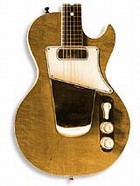
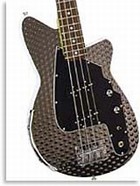
    The Rumblefish is an electric bass model from Reverend Guitars, out of Michigan. This is a striking semi-acoustic in the best tradition of Danos and Silvertones, but has the finesse and feel of a $2,000 guitar – really impressive ergonomic body design, light and resonant due to its hollow design and phenolic composition, with twin jazz-type pickups and a definite ’50s vibe. Listing in the under-$800 range, our off-white beauty came with a gorgeous rosewood fretboard that played flawlessly. Played unamplified, it rang with sweet clarity, and put through its paces in a studio using an Ampeg SVT, the Rumblefish revealed a nice match of tones by blending the two pickups, from straight P-bass to a Jazz-bass sound. The neck was close to the Fender A-profile, very playable and friendly.

    Altogether a fine experience, and light as it could be.

    The pickguard is almost an homage to the National Map guitars…what they’ve nailed with this design is the retro feel and look, the cool odd shape, and the great satin-finished neck that feels 30 years old, and it all works. The banjo rest on the lower bout is a bit different, it’s comfortable to use, and I guess I’d rather have it than cut a slot in my arm from resting on the edge.


    This review originally appeared in VG‘s Oct. ’98 issue.

  • Howard Roberts

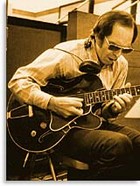
    Howard Roberts and the Black Guitar

    Webster’s Dictionary defines genius as “…a person gifted with extraordinary powers of intellect, imagination or invention.”

    The definition could as easily be applied to describe Howard Roberts – virtuoso guitarist, innovative educator, and indefatigable inventor. Roberts was a guitarist’s guitarist, many things to many people, and enjoyed three highly distinguished and influential careers.

    He was an eclectic recording artist with an incredible aesthetic depth that readily embraced jazz, funk, rock, blues, pop, and all manners of experimental music. H.R. was first heard as an inventive and proficient jazz player of the first order, as demonstrated on his straight-ahead Verve releases of the 1950s and slightly more commercial Capitol records of the early ’60s, before embarking on one of the most successful and productive session stints in history.

    In Roberts’ second career he was a dominant force in the busy recording studios of Hollywood, playing on literally thousands of auspicious dates; imparting his unique touch and talents to iconic pieces of the American soundtrack like “The Twilight Zone” (H.R. played the series’ haunting and immediately recognizable theme), “M.A.S.H.” (H.R. and Bob Bain laid down the memorable guitar intro), “The Beverly Hillbillies” (H.R. ad-libbing on banjo because the hired banjoist couldn’t read music), “The Sandpiper” (H.R. sightread the gorgeous gut-string parts cold, on a soaking-wet classical guitar), “I Dream of Jeannie,” “The Munsters,” and countless others. Singular among the jazz-based session players of the day, he could rock with the best of them. He even earned the title of “Fifth Monkee” via his participation on a string of Top 40 hits and albums by the Beatle-inspired rock band.

    Roberts’ third career was as an educator. In the early ’70s he founded Playback Music and wrote the first modern guitar method books to address topics at the professional level for aspiring players. He went on to write Praxis, created the epic-length Guitarist’s Compendium, and developed the revolutionary Chroma system using color-coded strings to teach basic guitar. Arguably, his most notable contribution to the field of pedagogy was the founding of Musician’s Institute, which evolved from the Guitarists Institute of Technology (G.I.T.), which in turn grew out of his earlier Howard Roberts Guitar Seminars of the late ’60s.

    By Fall ’91, H.R. was broadening his educator’s scope to include computers and distance learning, presaging the innovations now surfacing in the medium. In a very memorable conversation, Roberts brainstormed a correspondence course accessed with computer networks (he was talking about information exchange via cyberspace), virtual libraries (the forerunner of music content websites), and interactive components (real-time music instructional devices akin to the Riff Lick interface).

    A visionary in all things musical, Roberts was also active in pioneering instrument and amplifier technology. He designed the unusual and highly soughtafter Howard Roberts signature model archtop for Epiphone in the mid ’60s. He later redesigned them for Gibson in the early ’70s. His Gibson Howard Roberts Fusion model has become a favorite for many crossover and rock players including Alex Lifeson of Rush. Roberts and Ron Benson designed and produced the first boutique amps in history with their Benson line of the ’60s. These became a studio standard of the era, presaging the Boogies, Soldanos, Bogners, and Evans of the future.

    The Black Guitar
    The Black Guitar is a truly historic instrument. It was Roberts’ trademark instrument of the ’60s and ’70s, despite the namesake models produced by Epiphone and Gibson. H.R. seemed to prefer this highly-modified and unusually appointed archtop electric during his most active recording and performing years. How many studio dates the Black Guitar graced is a question best answered by archivists; suffice it to say, a great many – and all are important. The instrument is an unmistakable and undeniable voice in the American soundtrack. In the H.R. discography, the Black Guitar can be seen (and heard) on several current CD reissues, including the important two-disc set The Howard Roberts Quartet: Dirty ‘N’ Funky (a compilation of his first two Capitol albums, Color Him Funky and H.R. Is A Dirty Guitar Player on Guitarchives/E.M.I.-Capitol), and the live V.S.O.P. jazz recordings Howard Roberts: The Magic Band, Live At Donte’s and Howard Roberts: The Magic Band II.
    The Black Guitar has an extraordinary lineage. It began life as a pre-war Gibson ES-150 (“Charlie Christian” model) of the late ’30s; the first officially marketed electric Spanish guitar. Howard confirmed this fact and in a radio interview of the mid ’60s to promote Color Him Funky, figured its age at about 30 years (his comments and impromptu playing can be heard at www.utstat.utoronto.ca). H.R. acquired the guitar in the ’50s from jazz giant Herb Ellis (VG, August ’96) who remembers buying it when it was new, keeping it as a spare, and finally selling it to Roberts because “…he liked it very much.”

    Madeline Roberts (Howard’s daughter, president of the Phoenix Musician’s Union, and a superb guitarist in her own right) recently told us, “That black guitar was the sweetest guitar I ever played. I’ll bet Herb wishes he still had it.”

    Despite its innate endearing musical qualities, Roberts subsequently made a number of significant structural changes to the ES-150, reflecting his personal tastes and sonic preferences. The most dramatic are the slimming of the body, the creation of a unique double-cutaway shape, the extension and repositioning of the neck, the replacement of the fingerboard, and the addition of different electronics.

    Famed luthier James Mapson (who has built guitars for Mundell Lowe, Ron Eschete, Frank Potenza, and others) recently gave the Black Guitar a professional examination. He studied the guitar for several hours, taking measurements and detailed notes regarding the modifications. His comments presented a fascinating look into the inventive mind of Howard Roberts, the guitarist.

    The original Gibson ES-150 was 33/8″ in depth, had a carved spruce top and maple sides and back with a non-cutaway shape, and a 243/4″ scale length on a rosewood fingerboard. Howard had the body reworked into a thinner, more comfortable 23/4″ profile. The labor was done by Nick Esposito, master guitar repairman to the stars of the era, and is verified by a rectangular label glued inside the body, which reads “Esposito Guitar Mfg.” The label also bears the red handwritten serial number HE 500 1957, a possible reference to Herb Ellis and the year 1957. The perimeter of the body, back, and sides has layers of binding under the black lacquer.

    “It appears to be a piece of white inner binding, a middle layer of snakewood, finally joined to the outer white binding,” said Mapson. “They probably masked it, originally. The back was cut off to make the guitar thinner – this is the most expedient way. Most likely, the builder needed to fill space around the rims, and since it wasn’t going to show, they used binding.”

    These suppositions are substantiated by the fact the original ES-150 had a flat back. The Black Guitar has an arched back (possibly a re-worked arched top) of laminated maple. The solid spruce top and slimmed maple sides are from the original ES-150.

    The guitar is further distinguished by its uncommon double-cutaway shape with improved access to the upper register. The top bout (bass side) has a distinctive thumb notch and the lower horn has a more standard Venetian cutaway.

    “My guess would be Howard wanted it to look like a conventional single-cutaway guitar yet allow him to reach in with his thumb around the side of the fingerboard. This would be valuable to a thumb-style player (as Howard was), especially one who used the higher frets,” Mapson added.

    Interestingly, a similar thumb-notch cutaway has recently been incorporated into the Ibanez Pat Metheny model.

    “Normally an archtop of this era would have a 14th-fret neck joint, this guitar has a 17th-fret joint. The block at the neck/body junction is modified and has a larger hunk of maple, which is what would be needed to stabilize the deeper cutaway and joint.”

    The original ES-150 fingerboard has been replaced by a longer board with pearl dot inlays and 20 frets.
    “I believe this was the original mahogany neck and is now a collage of materials spliced at both ends to accommodate the different position of the fingerboard,” Mapson said.

    At one point, Roberts himself re-contoured the neck in stages by applying a material comparable to automotive body putty to the surface. This could be easily shaped and sanded. He would then play the reshaped neck in the dark to fine-tune its feel.

    “The new scale length is 251/4″, similar to a concert classical guitar,” Mapson added. “The fingerboard is fairly flat with a slight radius, but takes a pretty dramatic dive after the 12th fret. The board is made from a fine-quality piece of ebony and is very well-built. The width at the nut is 111/16″ and 23/8″ at the 12th fret, which is a little wider than normal. The fret wire is .093″ wide, a slightly wider modern style. The frets have been milled down to 33 height.”

    The fingerboard and fret work were performed after the body modifications by master luthier Jack Willock, one of the original artisans of the Gibson Kalamazoo factory, who recognized his craftsmanship when he saw the Black Guitar in April 2000.

    The headstock retains the Gibson silhouette, and is fitted with five chrome-plated Grover Imperial tuning keys and one older nickel-plated Imperial. Howard had a liking for these keys, having previously fitted an ES-175 with Imperials in the mid ’50s. The guitar has a custom-made cone-shaped truss rod cover, with no ornamentation or script.

    “The top part of the headstock, roughly 1/2″, was fabricated to keep a Gibson look and grafted on just above the top tuning pegs, as indicated by the change in woodgrain patterns,” noted Mapson. “It looks like the side wings of the headstock were also grafted. A lot of surgery was involved here. It’s a miracle guitars like this play as well as they do without buzzing or rattling.”

    Part of this miracle must be attributed to Seattle-based luthier/guitarist Jim Greeninger, who recalls doing restoration work on the guitar around 1986. Three tiny holes in the face of the headstock suggest the possibility the guitar had a Van Eps string damper at one point. This further suggests the possibility of George Van Eps having contributed to the final building phases of the neck, as recalled by Patty Roberts. The backward pitch at the headstock is 14 degrees, typical of mid-’60s Gibsons. The headstock shows visible signs of wear (down to the wood) at the top edge. This is probably due to Roberts’ habit of leaning his guitar against a wall on its face.

    The entire guitar received a glossy black nitrocellulose lacquer finish, now soulfully checked. According to Greeninger, Roberts painted the guitar himself. Further cosmetic appointments include single binding on the headstock, fingerboard, body edges, and f-holes. Other replacements include Gibson “speed king” barrel knobs for the tone and volume, a ’50s-style Gibson Brazilian rosewood bridge with compensated saddle, and a multiple-bound tortoise shell pickguard (L-5 type) with a gold-plated fastener. The trapeze tailpiece is most likely the only original ES-150 part.

    The ES-150 electronics originally consisted of a single bar pickup (the “Charlie Christian pickup”) with two controls – tone and volume – and an output jack at the tailpiece. H.R. replaced the bar pickup in the early ’60s with a quieter P-90 single-coil unit with a black plastic cover that suits the aesthetic. Roberts modified the pickup cover by enlarging the polepiece holes on the neck side so the coil could be moved closer to the fingerboard, no doubt for sonic reasons.

    “They probably also ran into interference with the larger neck block and had to fudge it a little to make it fit. However, the position it’s in should give the guitar a nice fat sound.”

    The resistance of the pickup measured 8.67 megohms (8,670 ohms), slightly greater than a new Gibson P-90 reissue in an A/B comparison, but probably not perceptible to the ear. The output jack was relocated to the side rim. In the late ’60s, H.R. briefly experimented with a dual-pickup configuration on the guitar. At this point, a Gibson humbucker was surface-mounted and screwed directly onto the top in the bridge position (the body was never routed for this addition). It was accessed via a switching system (two toggle switches) temporarily attached under the pickguard.

    Roberts played the guitar through a variety of amps, beginning with a Gibson GA-50, but most often favoring his small Benson 300HR model with a single 12″ JBL speaker for jazz playing, and a larger Benson with a 15″ JBL for other studio dates. According to Ron Benson, the amps were initially conceived as an attempt to improve on the Gibson GA Roberts played and loved in the ’50s.

    Today, the guitar has a very woody, live acoustic sound that sings with resplendent harmonics despite the numerous surgeries. The Black Guitar is more than a vintage guitar; it is an historic one-of-a-kind instrument that is part of the American musical legacy of the Twentieth Century.


    Memories of H.R.
    Howard Roberts was one of my earliest guitar heroes. I was introduced to his music as a young teenager through some of my more discerning rock and roll guitar buddies who had acquired an appreciation for his particular style of funky, blues-inflected jazz. I first heard him on the Capitol recording H.R. Is A Dirty Guitar Player and a track called “Dirty Old Bossa Nova.” I was hooked, and I was not alone; Howard’s music crossed over, reaching a plethora of rock players in the ’60s, including Jeff “Skunk” Baxter, Joe Walsh, and Jerry Miller chief among them.

    A couple of years later I happened across Roberts’ first Capitol album, Color Him Funky. It sent me scurrying to my ’60s catalogs to identify the “weird guitar” on the back cover. It looked kind of like a Gibson hollowbody, but was unlike any I’d ever seen. And to compound the mystery, it had no name on the headstock. After scouring every available catalog, it remained a mystery. Nothing like H.R.’s instrument could be found anywhere. A couple of years later I bought The Howard Roberts Guitar Book, his first instruction manual, with that unmistakable black guitar conspicuously displayed on the cover and in several interior photos. The mystery continued.

    H.R. permanently relocated to the Pacific Northwest in the ’70s, and I lost touch with him until 1986, when we happened to be judges at a local guitar contest in Portland. I was just starting my career as a guitar educator and musicologist, and Howard was an instant mentor – forthcoming, insightful, and encouraging about the field of modern music pedagogy. We spent memorable hours hanging out, but never talked about the Black Guitar. Apparently, he had retired the instrument from live performance some years earlier and at the time was using a Gibson archtop (a special-order red model now owned by Mitch Holder).

    Howard passed away unexpectedly in June of ’92. His remaining instruments were retained by the family until last year, when his widow, Patty, was ready to see that his equipment found good homes. I purchased the Black Guitar from her in March of ’99; marking a significant closing of a personal musical circle in my life. I immediately began a campaign to investigate and document its origins, with intriguing results. On a related tack, one of the greatest joys and thrills of my life was performing and re-recording Howard’s music for a new generation (“Satin Doll” on the upcoming Best of Jazz Guitar Signature Licks book/CD from Hal Leonard Corp., due out late 2000) on this extraordinary guitar. A mystery for 40 years, now the first installment of the Black Guitar saga can be told.


    Photo courtesy of Patty Roberts.

    This article originally appeared in VG‘s Aug. ’00 issue. All copyrights are by the author and Vintage Guitar magazine. Unauthorized replication or use is strictly prohibited.

  • INXS – Shine Like It Does: The Anthology 1979-1997

    Shine Like It Does: The Anthology  1979-1997

    A completely beautiful package for a band that really deserves the recognition. In the 1980s and ’90s, these Australian rockers made perfect pop/rock records that were laced with funk, soul, and R&B. They weren’t always like that. The first parts of disc one of this two-disc set show a band that appears to want to be the next Cars. But by the time of their first U.S. hit, “The One Thing,” in ’83, they’re well on their way to mixing the various genres into a beautiful stew that provided them with hits up until the tragic death of vocalist Michael Hutchence.

    These two discs have all the hits and more. You’ll be amazed as you listen to the number of songs you recall. The blistering dance-floor funk of “What You Need.” The loud rock and roll of “Good Times” with guest vocalist Jimmy Barnes. Or how about the rigid, skeletal pop-funk of “Need You Tonight.” And that’s just the start. Eighties rock didn’t get a whole lot better than “Devil Inside.” “Never Tear Us Apart” was a retro-rock ballad that didn’t sound old. “Suicide Blonde” cooked, and cooked hard. There are other brilliant pieces too; “Beautiful Girl,” and “Not Enough Time” to name just a couple.

    This set also shows off some stuff you may not have run across. “Please,” with Ray Charles, lets Hutchence sing with the master, and he does fine. Guitar-wise, the Farris brothers (Andrew and Tim) and Kirk Pengilly prove equally adept at interlocking funk parts, or big ol’ giant power chords.

    This was a great band. If you missed out on their stuff somehow, pick up this anthology. It’s irresistible pop-rock from guys who did it as well as anyone in their time.


    This review originally appeared in VG‘s Nov. ’01 issue.

  • The Jayhawks – Sound of Lies

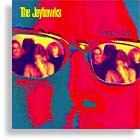
    Sound of Lies

    Everyone assumed with the departure of Mark Olson the Jayhawks would fold up their tent and go their own ways. Well, this terrific CD takes care of any such rumor. The band carries on fine. The sound is a little more pop/rock, even Beatle-esque, in some areas.

    As always, Gary Louris has written some great songs and the band makes ’em all sound wonderful. The guitar solos by Louris reflect the usual Neil Young influence and the very dry clean sound on occasion brings Abbey Road-period guitars to mind. Louris is a minimalist in the best sense of the word. The notes played, and the sound, are all on the money.

    Highlights here include the wonderful “Big Star,” “Trouble,” and “Dying on the Vine.” Here’s hoping this CD will serve as some sort of breakthrough and the ‘Hawks will have a hit record.


    This review originally appeared in VG‘s July ’97 issue.

  • Teisco Guitars, Part I

    Rock 'n' Roll Dreams, Part I

    Few non-American guitar brands have meant so much to so many American guitar buffs as Teisco guitars. Indeed, through their mid-’60s connection with the Sears and Roebuck company, many a modern guitar player learned his or her first chops on a Silvertone made in Japan by the Teisco company. Nevertheless, for years Teiscos were the object of ridicule, the penultimate examples of “cheap Japanese guitars” (a reputation more based on cultural chauvinism than objective analysis, truth to tell). Even Dan Forte, who essentially began the category of writing about off-brand guitars (and who has given me many an entertaining moment in my life), chose Teisco Del Rey as his nom de plume, with more than a little tongue-in-cheek humor in the selection, no doubt.

    Times change, of course, and so do perceptions. No longer regarded with complete disdain, Teisco guitars

  • Otis Rush

    Widest Sweep in the Blues

    All Your Love, I Miss The Lovin’.”

    The year was 1956, the label was Cobra, and all of Chicago was rocking to the deft little tune, along with blues hipsters all over the country. This came smokin’ in right on the heels of other smashes like “I Can’t Quit You Baby,” “My Love Will Never Die,” and “Groaning The Blues,” all of which were chartbusters for Mr. Otis Rush, the man many guitarists acknowledge as the father and progenitor of the tough, snarly, minor-keyed blues that hint at the darkness and celebration of the human condition.

    To this day, Rush remains that rare artist – the true-to-his-soul and unsparingly emotional individual who can pour out every iota on stage while remaining a very private individual off stage. This ability to voice feeling, love, pain, and despair, all within the confines of a measured 12-bar blues has led some of the record-buying public and even a few reporters into thinking Rush must be even more expansive and opinionated when not in the spotlight. But again, he is a true believer in the ability of getting out angst through the purity of song.

    “Yes, that’s right,” Rush says. “Sometimes I feel the happiest – or I should say the most content – when I’m sitting around in my empty house playing the blues on my guitar. Don’t matter plugged in or not, I like it both ways, so sometimes I’ll be quite loud and others, why, you can hardly hear me. But for me, anyway, that’s when I play and sing my very best.

    “See, I moved up from Philadelphia, Mississippi (to Chicago), in like 1949 or ’50. I had a fairly big family, too – four brothers and two sisters. And you could say I was trying to find me, you know, find that part of yourself that ain’t nobody else has, that little something special that makes a person who they are.

    “Well, we was livin’ in Chicago around 31st and Wentworth in an apartment, and I bought myself my first guitar, a cheap little Sears thing, I think, and someone took me down to hear a band play at a club. This is something very hard to understand these days, so explain this to your readers; I mean the first group I ever heard in my life was Muddy Waters, with Jimmy Rogers on guitar and Junior Wells on harp! Now, how are you supposed to beat that?”

    Rush can talk at length about the revelatory experience of hearing the first phase of the original Chicago blues as it was being formulated. Rush was born in 1934, so he was 16 years old at the time. And it wasn’t just him.

    “No, that’s right. Take a look at Eric Clapton and Keith Richards and all those English cats,” he says. “They were just babies when this was going down, and it hit them hard, too. You could say that music changed all of their lives, also. But I was there, man. I saw it and felt it and set out to capture that ability to transform your life through song.”

    His patented vibrato technique – that slow, sultry sweep that quavers and pulsates with just the right shake, can fool a listener at first. One might think they’re hearing amp vibrato or tremolo, but watching Rush up close, you see it’s all right there, in his hands.

    If, like most current blues fans, you missed Rush’s big string of Cobra hits in the late ’50s and ’60s, don’t worry – there’s still time! Rush is one artist who is at the peak of his game right now. It’s still all there, along with the wisdom and maturity of age that graces his performances with all of the fire and dynamics of his best singles laid out side-by-side with some newly-penned tunes and enough breathing space to give you an occasional break.

    All too often, familiar performers tour with sort of a reconstituted greatest hits package; a little window dressing, but not much going on in terms of audience connection and emotion. But this man works out like he’s trying to come to terms with something, and when he’s really on, there is no stopping him.

    “Well, that really is true,” Rush confides. “I try to talk through the method of a song and I’m also still looking for something. I don’t know…a feeling, I guess. See, when I started out, I loved Earl Hooker (John Lee’s cousin), he was my man and he played slide. I wasn’t comfortable with that bit of pipe on my finger and I also really liked B.B. King, you know? His sound was, still is, so articulate and defined. So, really, I tried to combine that slidin’ sound, which is harsh and heavy, with B.B.’s style of vibrato. And I came up with me!”

    Sitting next to Rush as he fingers chords and goes to town on his lead work is a good lesson in sparseness and controlled fervor. He can grab the neck and shake it firmly, yet he retains a gentleness and sensitivity that gives his vibrato clarity and control. In terms of gear, Rush says, “Well, there’s two guitars I really like – my Gibson semi-hollows and Fender Strats. I can go with the Gibson 345 or 355, but any of the semi-hollows do it for me. Actually, with either heavy strings or sometimes lighter ones like a 10-46 set. But, like with anything, there’s always something else out there. And for me, well, the Strats just can do some things and feel a bit differently than the Gibson, and sometimes I’ll trade-off.

    “For amps, I can’t deny I really liked those old 4 X 10 Bassmans. That was all I ever needed. These days, sometimes I run through a Mesa Boogie for that extra oomph, and sometimes I use a Victoria, which sounds to my ears pretty much like the old Bassman I used to have.

    “But we were also trying to find something out there on the stage. See, a lot of times I feel I play a tune too long. Now I know it’s standard to extend a piece in concert, as opposed to how it is on the record, but that’s not how it is with me. At home, when it’s just me and my guitar, I swear at times it’s perfect. The notes come out just right, my singing feels good, and I’m content. But get me under those lights and people are screamin’ and the band’s all jumpin’ around and sometimes, to me, I just don’t get the tone and the feelin’ the way I want; the way I can feel it wants to come through.

    “You know, I’ll blow through a solo, 12 bars or whatever, and I’ll be thinkin’ ‘I know this come out better at home last night.’ So I’ll bide my time, take another pass at it, and try to do it better. It goes both ways. I play reactionary, so I move with the crowd. But that can be distractin’, too.”

    Rush also feels being left-handed is a definite advantage for his chosen instrument, and points to guys like Albert King and Jimi Hendrix, who also developed signature sounds.

    “See, when you play lefty, (upside down right-handed guitars), you’re pulling that vibrato down to the floor. That makes things a lot easier in terms of pressure and control. It only makes sense,” he said. “It’s a lot less stress to tear a house down than to build it up, right? Pulling down makes more sense, to me anyway, and I can work it stronger and get it to sustain better. ‘Course, besides all that, I kinda like doing things backwards, anyway.”

    Rush is also a typical example of the consummate artist who is all about his music, and not involved in the cooperate aspects of marketing “soul.” He had a great jump start at Cobra, under the tutelage of Eli Toscano, who was murdered during Rush’s major hit streak with the label.

    “Yeah, he was a sweet man who hung too much with gamblers like Shakey Jake and all them. And he ended up in real serious trouble.”

    Though he received a Grammy for his recording “Right Place, Wrong Time,” it took six or seven years for it to be released on Hightone.

    “It’s just a thing with me,” he said. “I do what I do as best as I can, but I don’t stump around arguing with label owners. If they don’t like what I put out, I guess I just sit back and wait to see what happens.”

    Apparently an awful lot of people like what Rush does best, and besides players like Clapton and Richards, Duane Allman and Mick Taylor list him as a mentor. If you want a fine sampling of Rush holding court in front of a captivated audience, get Otis Rush Tops, a recording on the Blind Pig label that features live versions of songs like “Right Place, Wrong Time,” “Crosscut Saw,” and “Keep On Lovin’ Me Baby.”

    If you’re hungry to hear how the man works when he has the studio to himself, pick up Lost In The Blues, on the Alligator label, and listen to the special spin he puts on standards like “Little Red Rooster” and “You Don’t Have To Go.”

    Onstage, Rush provides a full, lusty sound, augmented by a lot of people, including Bobby Neely on sax.

    “Yeah, I always liked a horn brace, you know? It gives you something else to bounce off of, and it really rounds the sound.”

    Alan Lomax, author of The Land Where The Blues Began, maintains that the subtleties of true blues music are as varied and precise as the most finely-honed and carefully crafted opera. The book, a carefully researched documentary, was inspired by years spent combing the Mississippi Delta in the days of segregation, trying desperately to unravel the mysteries and driving forces behind the American music we have come to know as “the blues.”

    Without getting into the oft-quoted argument about how “you can’t play the blues if you never had ’em,” the simple fact is certain music rings true. Perhaps Joe Moss, a Chicago-area blues guitarist, said it best when he recently opened for Rush at Buddy Guy’s Legends.

    “I’d like to thank Buddy Guy for having us here,” he said. “It’s great to be playing. But, actually, the biggest thrill is taking the stage before Mr. Otis Rush, because he is really the *#@!!”

    Buddy’s smile, from the back of the room, was easily visible onstage. And everyone in the room shook their heads in agreement. ‘Cause there are speed-freak polynote players all over town, but when Rush starts squeezing that neck, nobody can touch him!


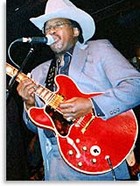
    Otis Rush photo by Frank Falduto.

    This article originally appeared in VG‘s July ’98 issue.

  • The Halibuts/Jon and the Nightriders – Life on the Bottom/Fiberglass Rocket

    Life on the Bottom/Fiberglass Rocket

    If you haven’t noticed, there’s a Surfin’ comeback goin’ on. We get tons of CDs from bands that play it; some good, some not-so-good, and some in-between. Here are two excellent ones.

    The Halibuts are from Southern California and play great reverb-drenched surf stuff like “Caldera,” “Suicide Bay,” and “Fire One!” But, they do vary the proceedings too. “Hombre De Palabra” features some nice south-of-the-border sounds and fine acoustic playing. Same with the inspired goofiness of “Madcap.” The jewel box is very cool, too. It looks like an aquarium. No, really.

    Jon and the Nightriders are led by surf historian John Blair and they know surf music when they hear it. From cut one, they burn. “Depth Charge” kicks off the proceedings with balls-to-the-wall guitar and drums. Things stay at that level throughout.

    If you have an interest in surf music, check out either or both of these. You won’t be disappointed.


    This review originally appeared in VG‘s Jan. ’97 issue.

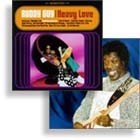
  • Buddy Guy – Heavy Love & Buddy’s Blues 1979-82

    Heavy Love & Buddy's Blues 1979-82

    Buddy Guy’s latest CD, Heavy Love, sounds like he’s doing his darndest to wrestle the blues guitarslinger crown back from the late, great Luther Allison. Before his death, Allison proved himself the hardest working blues guitarist around, even eclipsing the famous Guy by sweeping the W.C. Handy awards the past three years. Buddy now serves notice that he is back – and back with a vengeance.

    This new album is chock full of a fusion of rock and blues sounds, and the result is definitely heavy. Naturally, Guy’s guitar plays the center role, and his fretwork is classic Buddy, burning with the wildman licks that made Eric Clapton go back to the woodshed. His tone is saturated with wah, overdrive, and other effects, and the overall feel is closer to rock than blues – but that’s always been Buddy’s style.

    Buddy’s Blues 1979-82 prove it. This greatest hits collection includes some far-out jams from the three albums he cut for the English label JSP. Backed on guitar by his brother, Phil Guy, Buddy and his bands rock and rollick through some classic cuts that will leave you breathless.


    This review originally appeared in VG‘s July ’98 issue.

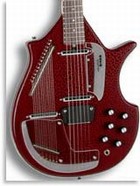
  • Jerry Jones Master Electric Sitar

    High-quality build, authentic groove

    If you’ve always wanted to learn the sitar, but could never quite scrape up the cash to fly to India and study with the Maharishi for several years, then you’ll be happy to know that with the skills you already have and a Jerry Jones Master Electric Sitar, you can chase such famous riffs as B.J. Thomas’ “Hooked On A Feelin’,” Steely Dan’s “Do It Again,” The Beatles’ “Norwegian Wood” (of course), and even Spinal Tap’s “Listen To The Flower People.”

    Nuts, Bolts, Strings…and More Strings
    Modeled after the original ’60s Vincent Bell Coral Sitar built by Danelectro, the Jerry Jones sitar is constructed like most of Jones’ guitars – with a poplar wood frame sandwiched between two pieces of Masonite, leaving a hollow chamber. It has a 25″-scale maple neck with flat 141/2″-radius Indian rosewood fingerboard, six-on-a-side Gotoh tuners, 21 medium jumbo frets, and an intonated “buzz bridge.”

    Electronics-wise, Jones keeps it close to the cuff, employing his own lipstick pickups – two for the sitar, one for the 13-string sympathetic harp that can be tuned to any key or scale – each with its own volume and tone control. The cool red “gator” finish, along with the etched plexiglass pickguard and tailpiece cover, complete the instrument’s very psychedelic look. The smooth satin-finished neck and low action make it a breeze to play.

    In terms of quality of construction, Jones’ instruments are certainly a couple notches above the vintage ones.

    Play That Funky Music
    We grabbed a small recent-issue Peavey tube amp and turned it up; suddenly, we were awash in a ton of sweet whirring and buzzing…what a blast! We liked the tone best with both pickups turned up, where it delivered a sweet out-of-phase sound that enhanced the authentic sitar groove…man.

    It looks cool, it sounds cool, it’s a blast to play, and it rivals guitars costing double, which might lead one to ask why other U.S. builders can’t do the same!


    Jerry Jones Master Sitar
    Type of Guitar: Electric Sitar.
    Features: Laminated poplar/masonite body, 25″-scale maple neck, 141/2″ radius Indian rosewood fingerboard, six-on-a-side Gotoh tuners, 21 medium jumbo frets, intonated “buzz bridge,” 13-string sympathetic harp, lipstick tube pickups.
    Price: $795
    Contact: Jerry Jones Guitars, PO Box 22507, Nashville, TN 37202, (615) 255-0088, jerryjonesguitars.com


    This review originally appeared in VG‘s Oct. ’01 issue.

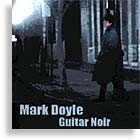
  • Mark Doyle – Guitar Noir

    Guitar Noir

    I love this. Doyle has been in the music biz for some time. His first band, Jukin’ Bone, made a couple of obscure albums for RCA in the early ’70s and in the ’80s he did tons of session dates for the likes of Hall and Oates, Judy Collins, Leo Sayer, and others. He’s toured and recorded with Meatloaf, Bryan Adams, and was a string arranger for Maurice Starr.

    That said, here’s a really cool instrumental album that features lots of nice guitar work, a nice original tune, and odd covers that work really well. Case in point, the opener, “The Perry Mason Theme,” sounds like you remember it from TV. But after the intro, it breaks into a modern funk groove where Doyle lays down some nasty notes and tones. A gorgeous cover of “When I Fall In Love” shows him to be master of volume swells and sweet, stinging sustain. This one might bring Larry Carlton or Robben Ford to the mind of some listeners. His version of Brian Wilson’s “Warmth of the Sun” brings everything you’d want to a classic tune.

    As I said, his original stuff is pretty cool, too. The title cut’s biting Strat tone will leave you smiling. Doyle takes time to show off his chordal chops on “Spring Is Here,” and gets fairly adventurous toward the end of the CD, doing a nice job with Thelonius Monk’s “Pannonica” and Ornette Coleman’s “Lonely Woman.” And one you’d think would never work – a beautiful instrumental of the Streisand tune “The Way We Were.” You get the idea. This is a killer album from a monster guitarist (who also plays tons of keyboard). If you like instrumental guitar music that leans heavily on pop and jazz, check this out. If you are interested, contact Mark at http://markdoyle.com


    This review originally appeared in VG‘s Nov. ’99 issue.