Charles Kaman, founder of a multi-faceted manufacturing corporation that bears his name, died January 31. He was 91.
Kaman was known primarily for his innovations in the helicopter industry, having started Kaman Aircraft Company in 1945. He also played guitar, and applied unique manufacturing techniques to create the round-back Ovation acoustic guitars that debuted in the late ’60s. His son, Bill, ran the Kaman Music Company for years, and the firm acquired Hamer Guitars and other lines before being sold to the Fender Musical Instrument Corporation in late 2007.
Kaman was also a breeder of German Shepherds who in 1960 founded a non-profit organization that trained guide dogs. He was preceded in death by his first wife, Helen, and second wife, Roberta. Survivors include two sons, William and Steven, a daughter, Cathleen K. Wood, three grandchildren, and two great-grandchildren.
Composer, vocalist & guitarist Glenn Patrik has released <em>Original Blues</em>, the followup to his <em>Nuthin’ But A Thang!</em>, on Shakehouse Records).
"I took this CD a little more contemporary (in sound & style) than the previous two albums" explains Patrik. "The Juke Joint pictured on the cover of the CD is the very spot where I got my first blues credibility. It was variously known as H&M BBQ, Harris BBQ, Grace’s (what I called it) and to some, simply, after hours. It was on Wood Ave in a very rough section of Kansas City, Kansas and featured live Blues every Friday and Saturday night, beginning around 10 P.M., from 1968 until 1993. Anybody that was anybody came through that joint. Albert Collins, Bobby Bland, The Temptations, Otis Clay, Duke Robillard, Guns ‘N Roses etc…When I first started hanging out, there was one other fair-skin man that was a regular, but I was the only fair-skin musician. Years later, that all changed. I took that picture on my way out of town moving to California, and the building was demolished soon after. Track 3, "Down To The BBQ," is about Grace’s Blues Party. The last track, "Dance The Blues," is about the last juke joint to close in Kansas City, Kansas (in 2006), the Club Paradox, in an even <em>more</em> dangerous part of town. Ah, home sweet home."
<em>Original Blues</em> features Patrik on vocals and guitars; Bob Gross (bass), longtime Patrik bandmates Rusty Hall (keyboards), Thomas "Freight Train" Walker (drums, vocals), and "Downtown" Michael Brown (of legendary doo-wop band Sha Na Na) on saxophone and vocals. Learn more at glennpatrik.com.
Mack Amps’ new Gem 2G is a cathode-biased Class A guitar amp that uses Mack’s power-switching feature, which lowers output from 4 watts to 0.4 watts, It has controls for Volume, Gain, and Tone, and footswitchable preamp gain stages/channels. The 2G’s tones come from a 6AC10 triple-triode preamp tube and an EL84 power tube. For more, visit mackamps.com.
Singer, songwriter, guitarist and Rock & Roll Hall of Fame member BOB WEIR has announced plans for a special once-in-a-lifetime performance of Grateful Dead music with the Marin Symphony Orchestra to be heldMay 7 at the Marin Center in San Rafael, CA. Pre-sale tickets will be available January 31 via www.gdtstoo.com and the public on-sale is February 4 and will be available through the Marin Center Box Office (11am-4pm PT, 415-499-6800) and through www.ticketmaster.com
The "First Fusion" performance, orchestrated by WEIR and Stanford University’s Dr. Giancarlo Aquilanti, is a benefit for the Marin Symphony Orchestra and will feature over 50 musicians interpreting Grateful Dead music, the band WEIR co-founded in 1965.
The Marin Symphony Orchestra has been around for 58 years, bringing the area (just north of San Francisco) together and supporting a variety of programs including two youth orchestras representing 15 cities and 30 schools; an in-school music education program; a professional 100-member orchestra; special family and holiday concerts; and outreach to local businesses, senior living facilities and hospitals by bringing music to those who cannot travel to the concert hall.
A Bay Area native, Weir co-founded the Grateful Dead in 1965 in San Francisco’s Haight-Ashbury neighborhood with Jerry Garcia, Phil Lesh, Ron "Pigpen" McKernan and Bill Kreutzmann. The band made an indelible mark in music history and were always sonic and technological adventurers, combining their love of bluegrass, country, electric rock and jazz to create one of the most iconic repertoires in rock music. By touring continuously and never relying on radio hits or latest trends, the Dead and Dead Heads created an unparalleled bond. Fans were turned on to the group by live bootlegs and word of mouth, with many following the band on the road for whole tours. The group performed thousands of shows until the passing of Garcia in 1995. Since then, WEIR has performed with his own group RatDog and toured with various members of the Grateful Dead, including the 2009 Dead tour and his current group Further with Phil Lesh. Learn more at marinsymphony.org.
John (Dr.) Duck has revived his Guitar Prescription Radio Show. Now being broadcast every Saturday at 8 p.m. on KUNV 91.5 FM in Las Vegas, the show is also streamed at kunv.unlv.edu. Episodes are archived at ducksdeluxe.com/ddgpradioshow.html.
Duck calls the show, "A one-hour celebration of guitar players and guitar music, in general with commentary, quotes, historical perspective, and trivia on the evolution of guitar playing tying it all together.
"The show is a multi-genre, multigenerational, multi-decade salute to the greatest guitar players of all time, and covers everyone from Wes Montgomery to Eric Clapton to Kenny Wayne Shepherd and everyone in-between."
Anyone interested in submitting music for consideration can reach Duck at ducks@ducksdeluxe.com.
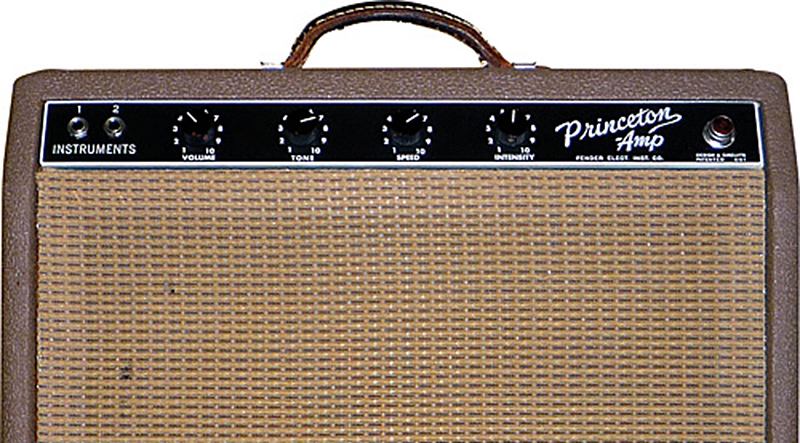
1962 6G2 Fender Princeton
Preamp tubes: One 7025, one 12AX7
Output tubes: two 6V6GT in fixed bias
Rectifier: 5Y3
Controls: Volume, Tone, Speed, Intensity
Speaker: one 10” Oxford 10J4
Output: approximately 12 watts RMS
For the past couple decades the Fender Deluxe of the ’60s and early ’70s – in its several variants – held the title of “favorite small vintage combo.” Lately, however, the smaller Princeton has finagled its way into that position. Whether this is a factor of the continuing decline in stage volumes tolerated at smaller venues, or simply one of a growing recognition of the Princeton’s singular sonic virtues, is difficult to say. Either way, the trend behooves a look at a lesser-seen “tweeny” of a Princeton that offers a slightly alternative flavor from this popular menu.
While it isn’t always entirely accurate to describe the brownface/tan-Tolex amps of 1960-’63 as “somewhere between a tweed and a blackface,” this ’62 Princeton fits that billing rather well. In this case, though, the 6G2 Princeton circuit is perhaps closer to the 5E3 Deluxe in several ways (including tone) than it is to its single-ended tweed forebear, or it would be if not for its rather underpowered 10″ speaker.
In 1960, the Princeton went from being the larger of the beginner’s bedroom amps in the Fender lineup to being the smaller of the performance amps. With two 6V6GT output tubes in push/pull fixed bias for a robust 12 watts, it was suddenly too loud for the average kid’s bedroom, but graduated successfully to the basement or garage, where it could hit the sweet spot perfectly with a couple pals on drums and bass. This is the status the brown Princeton maintained for many years – underrated as a performance amp compared to the versatile Princeton Reverb, long a studio favorite of many pros – and it’s a situation for which any player likely to have acquired one lately can be thankful. Like our example here, many 6G2 Princetons exist in outstanding original condition, having seen only light duty for a few years, then a quiet life in the closet, awaiting eventual rediscovery and a second coming as an unassuming little tone monster. And that she is. While the 6G2 packs plenty of snappy chime and twang at lower settings on the Volume dial, anything in the noon to 2 o’clock region reveals toothsome growl and snarl, and settings up into late afternoon unveils a surprisingly gutsy roar.
The 6G2 Princeton’s fixed-bias output stage takes it out of the nominal-class-A camp of the cathode-biased tweed Deluxe and the like, but its cathodyne inverter (a.k.a. split-phase inverter) puts it in sort of two-steps-forward, one-step-back situation. With this PI configuration, it will never have the clarity and fidelity to make it merely “a smaller brown 6G3 Deluxe,” a definition its specs might otherwise imply, but will instead offer a certain grit and swagger in its tonal signature, even at cleaner settings, with some voices that do at least tip their hat to the 5E3.
Like Fender’s big boys of the early ’60s, the little 6G2 Princeton was also a fixed-bias amp – a status flagged by the bias circuit rendered on its own little board in the upper-left corner of the chassis. The immaculate condition of this example and the presence of all those lovely blue “molded” Mallory signal caps make it a great, yet affordable, find.
The 6G2’s 5Y3 rectifier tube also keeps this amp tweedily brown, providing just around 315 volts DC on the plates of the 6V6s (though often a little more with today’s higher domestic AC line voltages). That, coupled with readings of around 135 volts DC on the plates of the first triode of the 7025 (a.k.a. 12AX7) in the front end, the lone gain stage in the Princeton’s preamp if you exclude the front half of the PI, makes for a chewy, tactile playing feel that can come off as being a lot more touch-sensitive than many larger brown amps and later blackface amps. A leap to the top of the ladder in the rectifier stakes would give the blackface AA964 Princeton a GZ34 rectifier and a whopping 420 volts DC on the plates of the 6V6s (a 5U4GB and 410 volts DC in the AA1164 Princeton Reverb), and while the cathodyne PI meant these models retained some signature bite, they were also a little crisper and more aggressive.
It’s a bit surprising that Fender went to fixed bias at all for the 6G2, but one of this amp’s other standout features offers a clue to the thinking behind this move. Other than the first-generation tweed Tremolux, the 5G9 and 5G9-A, Fender always preferred to mount its bias-modulated tremolo circuit on a fixed-bias output stage. This was, perhaps, for reasons of output-tube stability, although other designs have functioned smoothly with bias-wiggle tremolo acting on cathode-biased output tubes. Either way, this preference saw the Princeton upgraded to fixed-bias, and other than the single-ended Champ there was no longer a cathode-biased amp in the Fender line.
Whatever the thinking, this tremolo is an utter joy, and we can thank Leo for doing it this way. While players often rave about the lush, deep “harmonic vibrato” of the bigger early brown amps, such as the 6G4 Super (as discussed in the October ’10 issue of VG – wouldn’t they make a sweet pair?), the tremolo on the 6G2 Princeton is achieved with just half a 12AX7 and a mere handful of caps and resistors. As simple as it is, however, it modulates the output tubes in a smooth, organic manner that sounds utterly dreamy, providing one of the most evocative tremolo effects around (the harmonic vibrato of the larger brown amps is undoubtedly impressive, but sometimes you just want pure volume-modulating tremolo like our Princeton carries, not the wetter warble of the Super, Pro, or Concert). As with many bias-modulated tremolos, it’s a very playable effect, too; hit the strings hard and it steps aside so your note attack pops out proudly – allowing you to solo without switching out the effect – then makes itself known again as it throbs back into action on the decay of the note.
All in all, with its bumped-up specs and gutsier tone, the 6G2 Princeton can still find itself stuck between two stools; is it a club amp with an underpowered speaker, or a practice amp with an overpowered output stage? Make one simple change and it can be neither – and both – if you catch our drift. As sweet as the original 10″ Oxford 10J4 speaker can sound in this amp, a decent 12″ (or even a more robust 10″) makes a big difference. If you want that bigger driver right in the amp, please don’t hack a bigger hole in the original baffle; good and authentic-looking replacement baffles with 12″ cut-outs are readily available. Alternatively, use this little sweety as a “head” perched on top of the 8-ohm cab of your choice to reduce the inherent “boxiness” in the smaller combo cab. Bedroom amp? Hah! They won’t be laughing for long.
This article originally appeared in VG February 2011 issue. All copyrights are by the author and Vintage Guitar magazine. Unauthorized replication or use is strictly prohibited.
Jay Jacus, New Jersey Guitar and Bass Center, informed <em>VG</em> that his store, located in Edison, was the the victim of theft January 19. He is offering a reward for their return. Anyone with information is asked to contact Jacus at (732) 225-4444.
The guitars are:
1. Fender 1971 Telecaster, blond, maple fingerboard. serial # 325067
2. Fender 1978 Telecaster, sunburst, maple fingerboard. serial # S831998
3. Fender 1966 Mustang guitar, sonic blue. serial # 179856
4. Almebic Jerry Garcia Tribute guitar, dark wood (cocobola). serial # 02T12758
5. Music Man Van Halen Guitar, faded purple, looks charcoal. serial # 80859
6. Mosrite 1967 Ventures model 12 string, sunburst. serial # T590
7. Sadowsky MV5PJ 5 string bass, sunburst. serial # M4594
8. F Bass BN5 5 string bass, sunburst. 560305
Photos of the instruments can be viewed at newjerseyguitarandbasscenter.com/Stolen.html.
Traveler Guitar’s Escape EG-2 is a 25½"-scale electric guitar with a double-cutaway body, three-ply pickguard, maple neck and fretboard and two-tone sunburst finish.
At 29 ½" long, the EG-2 stows easily in airline overhead compartments and weighs less than five pounds. Two single-coil pickups feed into the EG-2’s built-in Pocket RockIt headphone amp, which is designed to produce classic clean and distortion sounds through headphones or when plugged into an amplifier. Players can also go passive into their amp of choice. Additional controls include Tone & Volume knobs and a 3-way pickup selector.
The Traveler Guitar Escape EG-2 also boasts more traditional guitar features such as an alder body, standard strap pins and a fully adjustable truss rod. Learn more at travelerguitar.com.
DBZ Guitars is unveiling its Z-Glide reduced-friction neck at next week’s NAMM show in Anaheim, California.
Available as an option on DBZ USA Custom Shop Guitars, the new neck utilizes a surface designed to let the player’s hand move more easily on the neck, eliminating the sticky/clammy feeling gloss-lacquered necks are known to produce.
Invented by company founder Dean Zelinsky, the Z-Glide is achieved by precisely engraving carefully tested patterns into the back of the neck which reduce surface area while trapping moisture and sweat. To learn more, visit dbzguitars.com.
Orange Amplifiers will debut its all-in-one computer amplifier speaker, the OPC, at this week’s NAMM show.
The OPC is a guitar amplifier and recording studio workstation designed for musicians and songwriters, offering one-stop playing, recording, editing and computing capabilities with pre-installed software.
The OPC has an integrated audio interface, enabling the user to plug in a guitar or microphone using a standard 1/4" jack plug. It also has built-in speakers. Learn more at orangeamps.com.


 Like Fender’s big boys of the early ’60s, the little 6G2 Princeton was also a fixed-bias amp – a status flagged by the bias circuit rendered on its own little board in the upper-left corner of the chassis. The immaculate condition of this example and the presence of all those lovely blue “molded” Mallory signal caps make it a great, yet affordable, find.