Month: March 2005

  • The Subdudes – Miracle Mule

    Miracle Mule

    Most contemporary bands can’t help but sound somewhat like another band. The Subdudes manage to avoid this pitfall by drawing from so many musical influences that their final synthesis becomes unique. They blend Cajun roots with an urbane mixture of rock, country, folk, blues, and gospel to create some of the freshest music I’ve heard in ages.

    Formed in 1987 by pianist and accordionist John Magnie and guitarist Tommy Malone, and disbanded for a period in the late ’90s, the current roster includes Steve Amedee on percussion, Tim Cook on bass, and Jimmy Mesa on guitar. Everyone sings, giving the vocal harmonies a musical density and complexity not often found in today’s pop music. On the second cut on Miracle Mule, “If Wishin’ Made It So,” Tommy Malone’s rich slide guitar part foreshadows the wonderful wall of harmony vocals that open the song. The third tune, “I’m Angry,” features a spectacular double slide guitar solo featuring producer Freddy Koella’s guitar chasing Tommy Malone’s slinky slide.

    Even with electric guitars in mix, the primary sound on Miracle Mule is acoustic. According to the album notes, engineer Warren Dewy recorded most of the parts at once, in a live situation. The live recording technique lets the music stay fresh, but this recording method also tends to homogenize parts as the sound from each instrument leaks into the other microphones. But due to Warren Dewey’s mastery, the sound remains clean and articulate. It’s also a tribute to the Subdudes’ musicianship that they could perform so spontaneously in such a technically constricting recording situation.

    When a band with special personal chemistry disbands, you can’t help but wonder what additional music they could have created if they’d stayed together. On Miracle Mule we have the opportunity to discover that the Subdudes had some of their best material still in their heads and hearts. Now we can all share the magic.


    This article originally appeared in VG‘s July ’04 issue. All copyrights are by the author and Vintage Guitar magazine. Unauthorized replication or use is strictly prohibited.

  • Deep Seven – Rapid Serve

    Rapid Serve

    I love stuff like this. Deep Seven is a quartet of very odd designs. With guitar (Paul Diethelm, Johnny Lang’s touring rhythm guitarist), keyboards (the wonderful Jeff Olson), bass(Mike Zeleny), and drums(Jay O’Donnell), you’d expect standard stuff from a standard lineup. Well, you’d be wrong. The 12 instrumentals here range from Latin-tinged surf music(?) to bluesy bebop to straight rock. Riding rein over the whole affair is Diethelm, whose playing veers the same crooked roads as do the songs. At one moment, he’s deep into a blues run, the next he’s flying through changes like Tal Farlow, and then playing a scary tremoloed chord on a mutated surf tune. What’s really cool about that is he has deep country roots that shine through all those styles. It’s a hybrid that’s very cool and keeps you interested.

    The other soloist who’ll grab you is Olson. Check out the bluesy club jazz of “Minor Mood.” His piano solo is a lesson in chops and taste; which can be said of both soloists throughout the record. “My Benevolent Triplet” has not only a great name, but memorable playing. There’s very nice guest sax work on three cuts from Al Asmus, who locks right in. He obviously gets what they’re trying to do.

    It sounds a bit silly, but I also love the design of the CD. I won’t try to explain it, but it centers around a restaurant and its owner.

    If you have any interest in instrumental music a bit off the beaten path, with great playing, this one’s for you.


    This article originally appeared in VG‘s June ’04 issue. All copyrights are by the author and Vintage Guitar magazine. Unauthorized replication or use is strictly prohibited.
  • Parker NiteFly Mojo Flame

    Get Yer Mojo Workin'!

    When Parker Fly guitars were introduced in July, 1993, they were strange aliens from a distant guitar planet, sporting a radical design, composite body, and neck, and one of the most original headstocks in history. I loved the concept, but just couldn’t get jiggy with the composite body, which only weighed about five pounds – it just didn’t feel heavy enough to be a serious guitar, I felt.

    My, how times have changed. Since then, Parker has extensively employed traditional wood for its bodies (though necks are still composite), as well as create the more affordable NiteFly line, with bolt-on necks.

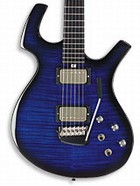
    To that end, this month we’re looking at the NiteFly Mojo Flame, a drop-dead gorgeous solidbody. In my mind, it’s kind of like a “Les Parker,” with its a AAA flamed-maple top, brilliant cherry-sunburst finish, and chrome-covered humbuckers. So on one hand you’ve got this classic retro vibe, but on the other are all these cool Parker appointments, such the slick composite neck and fingerboard, dual piezo/magnetic-pickup systems, and that fabulous body design. If the original Fly struck you as too futuristic, this one should appeal to your more traditional, time-honored guitar inclinations.

    For features, the Nitefly Mojo Flame has a solid mahogany body with maple cap, bolt-on neck (22 frets, 25″ scale), Sperzel locking tuners, GraphTech nut, Fishman 6-Element piezo system for acoustic tones, and a pair of Seymour Duncan humbuckers (Jazz in the neck and JB in the bridge). There’s also a non-floating, dive-only tremolo system also stays in tune extremely well.

    Unlike my typical in-studio tests, I gave the Nitefly Mojo Flame an immediate “gig test,” since it showed up at my house two hours before my band was to take the stage. Normally, I wouldn’t have taken the chance, but this Parker felt so good right out of the box that I just went for it. I was not disappointed, either. The tuning was dead-on, and the guitar just felt great onstage – the body’s ergonomic shape is comfortable and the neck lay comfortably in the palm of my hand. Running through a Marshall tube combo, the Nitefly roared for the bluesy lead parts, but also shined on cleaner rhythm sections – good choice on the Duncans. This axe definitely helped make the gig a rousing success.

    There are huge number of tones one can conjure up from the Nitefly Mojo Flame. The toggle switch closest to the neck allows for either neck only, bridge only, or the inner coils of each humbucker. There’s also a push/pull knob for coil taps, which is a little on the noisy side when there’s too much gain on the signal. I would use this circuit mostly for clean Strat-type sounds, but if you’re looking for a full-bore Stevie Ray sound, I’d use a real Stratocaster.

    On the acoustic side, the Nitefly also has an active piezo system, often used onstage. Personally, I like to just add a smidge of acoustic to my electric solos, as well – it gives my overdriven tone a crispness I really like. Conversely, you can play a mostly acoustic part, but just have a dash of electric in the background. There a lots of tonal possibilities here.

    The piezo system is activated via a second toggle switch on the body, allowing you to jump between magnetic pickups only, piezo only, or a combination of the two. (The bottom knob works as a master volume for the acoustic pickup.) You separate the electric and acoustic signals coming out of the guitar via a Y cable – for best results, plug the electric into a conventional amp and the acoustic into a mixer or acoustic amp. The whole shebang runs on a 9-volt battery that should give about 200 hours of use.

    The Parker NiteFly Mojo Flame is a formidable axe for the 21st century. Traditionalists won’t be able to keep their eyes of that cherry flametop finish and chromed ‘buckers, while modernists will groove on the super-fast neck and awesome electronics. What’s not to like here? No question, this sweet guitar got my mojo workin’ overtime.


    Parker NiteFly Mojo Flame
    Features Solid mahogany body with maple cap, Sperzel locking tuners, GraphTech nut, Fishman 6-Element piezo, Seymour Duncan Jazz and JB pickups, non-floating tremolo system.
    Price $2,498 (list), $1,789 (street).
    Contact Parker Guitars, PO Box 388, Wilmington, MA 01887, phone 978-988-0102, www.parkerguitars.com.


    This article originally appeared in VG‘s July. ’04 issue. All copyrights are by the author and Vintage Guitar magazine. Unauthorized replication or use is strictly prohibited.
  • Rodney Crowell – Fate’s Right Hand

    Fate's Right Hand

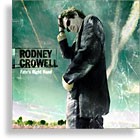
    Rodney Crowell’s new album, Fate’s Right Hand, explores personal landscapes similar to those he first examined in his 2002 release The Houston Kid, but the final results are less musically satisfying. Perhaps the differences between this new album and his last release stem from his change of residence. Living in Los Angeles encourages the sort of self-absorbed navel-gazing that never happens in Texas or Nashville. It’s the difference between admitting your failures and dwelling on them.

    Rodney Crowell has long been an exceptionally talented tunesmith. His early work produced a string of successful and influential albums for Columbia in the ’80s. His early music combined equal doses of country and rock in a way that revitalized contemporary country music. Without Rodney Crowell I seriously doubt that “Hot Country Radio” would exist today. By the late ’80s, Crowell’s string of mega hits ceased and his label dropped him in a manner that has become all too common in the shark-infested waters of Nashville’s music scene. After three albums co-produced by Tony Brown on MCA, Crowell left to pursue a more personal musical vision. His 2001 release on Sugarhill Records, The Houston Kid, proved that he could make intensely personal music that still appealed to his fans. Critics were also smitten by his combination of infectious melody lines and frank lyrics.

    While Fate’s Right Hand shares many of the best traits of The Houston Kid, including catchy melodies and clever musical hooks and bridges, its lyrics are less involving. Instead of stories, Fate’s Right Hand delivers sermons. The title song comes off like a country rap song, complete with jivy X-rated lyrics. “Time To Go Inward” describes Crowell’s difficulty facing himself across a meditation mat. Don’t get me wrong, not a single song on Fate’s Right Hand is bad, but none of the tunes here have the accessibility or universality of the material on The Houston Kid. Everyone enjoys hearing stories, even sad ones, but few feel comfortable being subjected to personal confessions. It’s the difference between a late night campfire conversation and a 12-step meeting.

    Fate’s Right Hand features impeccable musicianship from the likes of Jerry Douglas on dobro, John Jorgenson on mandolin and electric guitar, Steuart Smith on electric guitar and organ, Pat Buchanan and Will Kimbrough on electric guitar, Bela Fleck on banjo, and John Cowen, Carl Jackson, David Rawlings, Gillian Welch, and Marcia Ramirez on background vocals. Crowell shared production credits with recording engineer Pete Coleman, who worked with Crowell on The Houston Kid. The final sonic results have a similar perspective, honest, yet beautiful sounding.

    While I can’t fault the music on Rodney Crowell’s latest offering, I think that Fate’s Right Hand will be a more difficult album for most people to enjoy than The Houston Kid. Perhaps at the end of Rodney Crowell’s period of introspection he will once more examine the outer world with the same candor he brings to his internal landscape. Here’s hoping, anyway.


    This article originally appeared in VG‘s Dec. ’03 issue. All copyrights are by the author and Vintage Guitar magazine. Unauthorized replication or use is strictly prohibited.
  • Gil Parris – Blue Thumb

    Blue Thumb

    I first ran across Gil Parris on his 1998 self-titled release. It was a doozy that showed off his considerable guitar skills covering the gamut of jazz, blues, and country. This release does more of the same. Parris has got the goods, and all seven cuts here show it.

    Fans of ’50s and ’60s jazz guitar will flip over the title cut, which has Parris soloing nicely over a light latin feel. The parenthetical title of the song is “For Wes,” and it’s not hard to see why. His octave work and trips through the changes pay more than a little debt to Mr. Montgomery. “Tears of Goodbye” lets him show off a bit, as his playing winds around the great changes, and even strays a little outside in a very interesting fashion. On “New Beginning,” Gil shows off a more ’70s fusion style than the rest of the album. The biting, big tone highlights the slightly-off-kilter blues wonderfully. “An Ardent Man” is bop heaven. “Soul Fathers” has as imaginative a solo in this type of setting as you’re likely to hear. And the smoky nightclub feel of “Curved Corners” lets Parris bend to his heart’s delight and shows off dazzling runs.

    The support here is wonderful, too. The rhythm section is just right, and various saxophone players add great solos to pretty much every cut.


    This article originally appeared in VG‘s April ’03 issue. All copyrights are by the author and Vintage Guitar magazine. Unauthorized replication or use is strictly prohibited.
  • 1952 Bigsby Doubleneck

    Few instruments combine excellent craftsmanship, historical significance in the development and evolution of the guitar, and memorabilia appeal as much as this Bigsby guitar, custom made in 1952 for the late, great Nashville session player Grady Martin.

    Paul Bigsby was not the first man to make a solidbody guitar. Rickenbacker introduced a Spanish-neck version of its style B Bakelite guitar in 1936. While this instrument had small, hollow chambers to reduce weight, it functioned essentially as a solidbody guitar. Slingerland had a wood solidbody Songster model in its catalog in the late ’30s. The prototype Rickenbacker Frying Pan made in 1932 had a round neck with functional frets. The fact that there is wear on the fingerboard of the guitar indicates somebody was well aware that it could be played Spanish-style as well as being used as a steel. Bigsby, however, built the first modern-looking solidbody guitar used onstage by a major performer when he built Merle Travis’ Bigsby guitar, circa 1947. Merle had sketched a pattern and had Bigsby produce the instrument. This guitar was seen by numerous other performers as well as by makers such as Leo Fender.

    While Paul Bigsby (1899-1968), Merle Travis, and Leo Fender are no longer with us to tell their stories, it seems more than a bit of coincidence that the Fender Broadcaster solidbody, with six tuners in a line on the peghead, came out soon after Merle got his Bigsby solidbody. It was not long before well-known performers such as Billy Byrd, Hank Garland, and Grady Martin were playing Bigsby guitars in Nashville.

    Exact production totals are not available for Bigsby instruments, however, they are very rare. Bigsby is known to have made more pedal steels than Spanish-neck guitars. Estimates of Spanish-neck guitar production indicate that he probably made no more than about 50 such instruments of which hardly any two were alike. Whereas Fender, Gibson, Rickenbacker, and other large-scale manufacturers produced standardized models, Bigsby was a machinist who operated a one-man shop specializing in custom orders. His one standardized production item was the Bigsby vibrato tailpiece. If he had accomplished nothing besides this tailpiece, his name would have gone down in history. But he was a creative genius who also has come to be known as the father of the modern pedal steel. Although Harlin Brothers, of Indianapolis, and Gibson both developed pedal steels in the late ’30s, their pedal system was not nearly as versatile as Bigsby’s. Modern pedal steels to this day use a system directly evolved from Bigsby’s designs rather than from the early Gibson or Harlin Brothers models.

    When I acquired this instrument from Grady Martin in ’95, he told me that he drew the body outline on a piece of cardboard and submitted the design to Paul Bigsby. Bigsby took the pattern and proceeded to build the instrument. The five-string mandolin neck is angled to provide the player sufficient clearance away from the guitar neck such that both necks can be played comfortably. There’s a three-position neck selector switch with guitar in the up position, middle position being a standby, and mandolin in the down position. The guitar neck has three pickups, each with an independent volume control. The remaining knob is a master volume. The five-string mandolin neck is one of the first of its kind. The guitar side, with three pickups and a vibrato tailpiece, is also a historic breakthrough. Leo Fender introduced the Stratocaster in ’54. This Bigsby is significantly earlier and features many of the concepts later standardized in the Stratocaster.

    While this instrument looks like a solidbody guitar, it is in fact a semi-hollow instrument, as are most other Bigsby Spanish-neck guitars. While Bigsby is no longer with us to question on the subject, I suspect the semi-hollow construction was intended to reduce weight. The workmanship of this guitar is very fine and its design is extremely sophisticated, especially in view of the fact that Bigsby had virtually no other guitars of similar design to study or copy when he made his early instruments.

    Bigsby was a guitar builder in the truest sense of the term. Today, many luthiers who construct solidbody guitars purchase pickups or wiring harnesses from manufacturers such as Seymour Duncan, DiMarzio, or EMG, and buy bridges, tailpieces, tuners, and virtually all other hardware. Paul Bigsby made his own pickups, bridges, and vibrato tailpieces such that virtually the only outsourced components on a Bigsby guitar are the tuners and tone and volume pots. While today it is possible to buy a solidbody guitar from a dozen or more makers with virtually the same sound and function, due to identical electronics and hardware, a Bigsby guitar offered the player a truly unique look, feel, sound, and function. Bigsby didn’t work cheaply. His guitars cost $500 or more for a custom instrument in the early/mid ’50s. By contrast, a Gibson Les Paul Standard listed for $265 in ’59. But when the player got a Bigsby guitar, he was assured of a fine instrument which, especially during the early ’50s, offered options simply not available elsewhere.

    Grady Martin used this guitar to record his track on Red Foley’s great hit, “Chattanoogie Shoe Shine Boy” as well as numerous other tunes.

    Today, Martin is considered one of the most creative players to have ever worked the Nashville studio circuit, as evidenced by his recordings with a variety of artists from Red Foley, Marty Robbins (“El Paso” and “Don’t Worry”), Merle Haggard (“That’s The Way It Goes”), Roy Orbinson (“Oh, Pretty Woman”), Sammi Smith (“Help Me Make It Through The Night”), and Willie Nelson (“On The Road Again” – Grady toured with him for 16 years).

    While Bigsby produced very few guitars, each was a masterpiece of design, craftsmanship, and function such that their importance is far out of proportion to their sheer numbers. The vast majority of instruments made by large-scale manufacturers such as Martin, Fender, Gibson, Rickenbacker, and Gretsch were purchased by amateur musicians, but virtually all Bigsby guitars were ordered by professionals who used them prominently onstage and in the studio. These guitars and the music performed and recorded on them were at the cutting edge of a musical revolution.


    This article originally appeared in VG‘s June ’04 issue. All copyrights are by the author and Vintage Guitar magazine. Unauthorized replication or use is strictly prohibited.
  • March 2005

    FEATURES

    50 YEARS OF CRUNCHY, CLEAN DIRT
    Gibson advanced electric guitar technology with the introduction of the humbucking pickup in 1955. Patented in ’59, it changed the world of popular music and the electric guitar. Plus, a new PAF shoot-out! By Gil Hembree

    THE BASS SPACE
    Carvin DN640K
    Doubleneck instruments have always been a unique niche in the guitar market, and even carried an air of superiority. Carvin’s DN640 is special in part because its bass neck is on the bottom. By Willie G. Moseley

    JEFF CARLISI
    Goes to Camp
    It has been close to a decade since he departed .38 Special, and he has since played with many other notable musicians and been involved in other musical ventures. By Willie G. Moseley

    THE FENDER JAGUAR
    When Fender’s Jaguar was introduced in 1962, Telecasters and Stratocasters were considered “outdated.” So even though it cost more than the “old” models, it and its predecessor, the Jazzmaster, sold better thanks to musical tastes of the time. By George Gruhn

    ALLISON ROBERTSON
    Propels One Riffin’ Rock Unit
    Armed with an assortment of Gibson solidbodies – from Les Pauls to an L6-S to a Spirit – she is using The Donnas’ new album, Gold Medal, as proof positive that good-time party rock can survive. By Ward Meeker

    1983 ELECTRA LADY
    In 1983, Costello was out, Ratt was in, and guitarists built their images around the weird guitars they played. Naturally, guitar builders tripped over themselves trying to put out unusual designs like this Electra Lady XV1RD. By Michael Wright

    MARSHALL CRENSHAW
    Rock and Roll Renaissance Man
    The press calls his style “pop,” but he’s nothing if not an enigma – which is ironic, since his music (whether played and sung by him, or covered by other artists) is so infectious and accessible. By Dan Forte

    THE DIFFERENT STRUMMER
    ’80s Charvel Guitars
    Kramer was the biggest guitar company in the age of the pointy headstock. But Charvel was also an innovator, and today has a devoted following among collectors. Its saga has yet to be fully elucidated. By Michael Wright

    DEPARTMENTS

    Dealer News

    Vintage Guitar Price Guide

    Builder Profile
    DeTemple Guitars

    Upcoming Events

    Vintage Guitar Classified Ads

    Dealer Directory

    Readers Gallery

    FIRST FRET

    Reader Mail

    News and Notes
    PRS Turns 20, Harrison SG Sells, Nokie Nominated, Notable New Releases, In Memoriam, more!

    Executive Rock
    Leap Before You Look
    By Willie G. Moseley

    Dimebag Darrell Abbott 1966-2004
    Heavy Metal Icon
    By Pete Prown

    Redd Volkaert
    Noodler With a Telecaster
    By Michael Dregni

    “Ask Zac”
    By Zac Childs

    Classic Shots
    A Hendrix Fan’s Dream
    By Dan Forte

    Classic Concerts
    Bo Diddley
    By Ron Courtney

    Supersuckers
    Goldtops Across the Globe
    By Ken Johnson

    COLUMNS

    Q&A With George Gruhn

    Acousticville
    How Much Does Finish Matter?
    By Steven Stone

    FretPrints
    Stevie Ray Vaughan
    By Wolf Marshall

    Dan’s Guitar Rx
    Fixing Tuffy, Part III
    By Dan Erlewine

    Gigmeister
    Schecter Omen 6
    By Riley Wilson

    TECH

    Guitar Shop
    Nuts and Cones
    By Tony Nobles

    Amps
    Keys to Safety
    By Gerald Weber

    Ask Gerald
    By Gerald Weber

    REVIEWS

    The VG Hit List
    Music, Book and Video Reviews: Sonny Landreth, Tommy Castro, David Lindley, Santana, Billy Joe Shaver, Crossroads Festival on DVD,
    Hippie, more!

    Check This Action
    Pure & Unfiltered
    Dan Forte

    Vintage Guitar Gear Reviews
    Speedster 25 Watt and Class A 40, Guyatone FR3000V and Micro Effects, Peterson StroboStomp, Snider New Jersey amplifier!

    Gearin’ Up!
    The latest cool new stuff!

  • Line 6 Variax Acoustic

    Line 6 Variax Acoustic

    After proving my love for luthiery from both sides of the workbench, as a builder of 25 years and a buyer/player, why have I ordered a Variax Acoustic 700 modeling guitar? It’s not really an acoustic or even an acoustic/electric. It’s not a real instrument, is it? It’s a computer in a guitar-like container!

    When the Variax Acoustic arrived double-boxed, I opened the package to discover a sturdy gig bag, a high quality stereo cable, a powered direct box and power cable. Unveiling the guitar, I could see one slight binding flaw but otherwise, I was visually pleased except for the modernistic logo on the otherwise attractive headstock. They modeled the sound of a D’Angelico, but that aesthetic was lost in the cosmetic presentation. Still, overall, it’s a nice-looking instrument.

    A few minutes of playing revealed that the truss rod needed to be loosened. That adjustment is smooth and easy, and a small hex wrench lowered the bridge saddle to compensate for the stiffer feel. The Line 6 “Pilot’s Handbook” has clear instructions: setup is simple and effective. The information and videos available on the Line 6 website are also very helpful in learning how to operate the guitar.

    The modeled collection includes three Martins, two Gibsons, Maccaferri Selmer, D’Angelico New Yorker, Velasquez classical, two resophonics, Guild and Stella 12-strings, and the exotics: sitar, mandocello, Gibson Mastertone banjo, and Japanese shamisen. I couldn’t afford many of them now, but I’ve owned several Martins and Gibsons, resonator guitars, 5- and 6-string banjos, cheapo nylon strings, petite and grande bouche Selmer copies, and even a 1949 D’Angelico Special. It seems this instrument was made for me!

    My immediate conclusions, though favorable, were that extensive experimentation was going to be necessary to maximize the models for my use. The alternate tunings (eight presets and multiple programmable possibilities) and virtual capo settings (up a fifth, down an octave) are convenient, although a perceptible delay was apparent on detuned strings. Also, the 12-string settings differed from the 6-string settings, upping the angle of the learning curve.

    Still, I felt comfortable enough in an hour of set up and play to bring the Variax to my gig. It performed well and listeners commented favorably on my guitar sound.

    After four gigs with the Variax, I decided to record a slide guitar track.

    Just prior to receiving the Variax, I’d recorded seven songs with bassist Tony Markellis (currently with the Trey Anastasio Band). I played four different flat-tops, using three condensor mics through tube preamps. Pickup signals, into a Mackie 1402-VLZ, were split to stereo, totaling five simultaneous guitar inputs into a Fostex VF160 hard disc recorder. Each guitar required slightly different mic placement and sound level adjustments, necessitating a setup period averaging at least 30 minutes per instrument.

    The Variax offers both 1?4″ and XLR outs. I opted to run in from the Variax direct box 1?4″ output, direct, no tube preamp, no nuthin’. The online promotional video makes a big deal of recording the guitar with no EQ, effects (except reverb on one track of one demo song), and with no mastering done after the recording. “If they can do it,” I reasoned, “so can I.”

    I plugged in, dialed in a sound utilizing the round-neck resophonic guitar modeled from a ’39 National Style O single-cone biscuit-style resonator. My song starts with an E minor, so I programmed the model for standard tuning and open E. Over the E minor, I used standard tuning with a metal slide, and easily and noiselessly changed to open E as I approached the major four chord. Cool!

    I had a useable slide track in 40 minutes, but more significantly, I was ready to record in under five minutes with a very pleasing guitar sound.

    I now had recorded and gigged with the Variax, after owning it for less than a week. Basically, here’s what I bought.

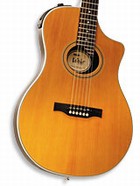
    The neck measures 15/8″ at the nut; fingerstylists might like a wider neck option. The 24-fret rosewood fingerboard with pearl “snowflake” inlays has a 253?4″ scale length, 17″ radius, and medium, well-dressed frets. The mahogany neck, carved with a volute, is a hefty D shape, nicely rounded at the fingerboard for a very pleasant feel.

    A laminated cedar top is glued over a chambered mahogany body. Online reviews of the Variax Electric suggested its modeled acoustic guitar voices were overly compressed sounding, a likely function of the solidbody construction. Presumably, the chambered body lends the Variax Acoustic a more natural response. The body measures 19″ long by 1315/16″ wide, with a deep cutaway for easy upper fret access, and the guitar plays in tune up the neck very nicely. Five layers of black-and-white binding and a matching rosette surrouding the oval soundhole make for a conservative but attractive guitar, with a glossy natural finish also available in black. Weight is approximately 7 pounds.

    How does it work? Designers put two mics on a selection of highly desirable instruments, carefully documented, in an acoustically well-designed room, and, to quote the “Pilot’s Handbook,” “…we then process the signals through software algorithms that capture the physical properties of the guitars that we’ve modeled.”

    I know a lot about guitar acoustics, wood, and construction techniques, but this algorithm stuff is Greek to me. The designers even modeled some movement into the mic placement to simulate the movement of a guitar in the lap of a player. The body resonance of Brazilian rosewood on the 1960 Martin D28 and 1946 Triple O models is clearly audible, and controllable with the mic placement slider.

    The metal-and-biscuit resonator of the ’39 National Style O is easily discernible from the wood-bodied, spider-bridge setup of the ’37 Dobro Model 27. I especially like the parlor guitar model – a ’41 Martin 5-17 – and the guitar voices that are less satisfying, such as the Selmer D-Hole and Velasquez models, are still useable.

    The idea of hearing a 12-string without having to tune one is very appealing, and the Stella model drips Leadbelly vibe. I’d gladly trade the exotics for a Robert Johnson-y L-1, a Richard Thompson-esque Lowden, even an Ovation Adamas.

    The modeled sounds were impacted like an actual acoustic by string deterioration, and were spiced up nicely with new strings. Percussive playing, slide, and harmonics all respond normally, and on my gigs the Variax stayed in tune like a rock.

    As natural as the sounds and response are, the strangest thing about the Variax Acoustic is… well, it’s not acoustic. I miss the sensation of having a vibrating guitar in my lap. Also, if a player is accustomed to performing with piezo pickups, it’ll take time to adjust to the decay and attack of the Variax. It’s more natural-sounding than a great acoustic amplified with any combination of the most popular saddle, surface-mount, or soundhole pickups.

    Line 6 has created a third category to add to the acoustic and acoustic/electric categories. And, instant access to several easily amplified and recorded vintage guitar models is a great boon to a working acoustic guitarist.


    Line 6 Variax Acoustic
    Features Software-driven models of 16 acoustic instruments, including jumbos, 12-strings, nylon-string classical, resonators, banjo, sitar, and more. Also, ability to play in programmed or custom open tunings, de-tunings, capo tunings, etc.
    Price $1,679 (retail).
    Contact Line 6, 29901,Agoura Road, Agoura Hills, CA 91301-2513, www.line6.com.


    This article originally appeared in VG‘s Sept. ’04 issue. All copyrights are by the author and Vintage Guitar magazine. Unauthorized replication or use is strictly prohibited.
  • Shawn Lane – All For Today

    All For Today

    Being part of a successful band can be a mixed blessing. You work regularly and play your music for a large audience, but because it is a band, you can only stray so far from the group’s core sound. Solo albums supply a way for talented musicians to stretch beyond the confines of their band’s focus.

    All For Today showcases the scope and talent of Blue Highway’s lead singer and mandolinist Shawn Lane. His arresting voice, solid mandolin playing, and fine musical taste display wide-ranging interests and influences. For those unfamiliar with Shawn Lane, he played with Ricky Skaggs’ Kentucky Thunder band when they were still a country outfit, worked with Larry Sparks, and then formed Blue Highway in the mid ’90s.

    Blue Highway bandmates (guitarist Tim Stafford, dobro player Rob Ickes, and banjo player Tom Adams) join guests Jerry Douglas on dobro, Barry Bales and Jason Moore on bass, Jason Burlson on banjo, and Ronnie Bowman, Larry Sparks, and Garcia Lane on vocals.

    Eight Shawn Lane originals join material by A.P. Carter, Carl Jackson, M.H. Malone, and Mark Vissage. While the album is definitely bluegrass, it shows that bluegrass is not limited to one kind of song or one particular orchestration. Highpoints include Shawn’s “When I See Your Face” featuring his wife, Gracia, whose voice is reminiscent of Alison Krauss. “Sawmill Man,” with Larry Sparks on lead vocal, showcases Shawn on guitar, fiddle, mandolin, and tenor vocal. On “When It’s All Said and Done” Shawn’s voice displays a soulful sonority that is arresting and intimate.

    Produced by Shawn and engineered by Mark Howard and Tim Roberts, All For Today sounds warm and natural. Nashville’s Signal Path Studio captures the vibrancy of the myriad of acoustic instruments without any antiseptic digital edges. If some old audiophile complains about how new recordings sound slick and soulless, make ’em listen to All For Today. That should change their minds.

    According to most music historians, the golden age of bluegrass was in the late 1940s through the ’50s. With artists like Lane, Ronnie Bowman, Larry Sparks, Carl Jackson, Tim O’Brien, and bands like Blue Highway, Lonesome River Band, Nashville Bluegrass Band, Del McCoury and the Boys, Hot Rize, and Open Road producing such compelling music, the last 10 years may prove to be an even more fertile period for Bluegrass. All For Today typifies the new energy and boundless creativity of today’s contemporary bluegrass.


    This article originally appeared in VG‘s Aug. ’04 issue. All copyrights are by the author and Vintage Guitar magazine. Unauthorized replication or use is strictly prohibited.
  • Larry Coryell – Tricycles

    Tricycles

    Anyone remember when Larry Coryell was one of the youngbloods of jazz guitar? Sheesh, I must be getting a bit “advanced” in age, eh? Through the years, there’s never been a doubt in my mind that Larry’s chops were as strong as anyone’s. There were times when I couldn’t follow, though, usually because the tunes weren’t that strong. Well, here the songs, the band, and Larry’s playing are as strong as can be.

    There are six Coryell originals, and every one of them is interesting with fine changes and themes running through them. There are nice covers, too. Thelonius Monk’s “Well You Needn’t” has a great feel, with wonderful playing all the way around. The oddest piece, and the one that at first seems out of place, is the Lennon and McCartney chestnut, “She’s Leaving Home.” Larry’s acoustic work shines on the familiar melody, and the soloing is created from that melody. His electric playing is slightly chorused, not unlike some players who came up right after him, like Metheny and Scofield. The solos, though, are pure Coryell. Listen to him navigate the changes of “Immer Geradeaus,” where he solos around them wonderfully, and then lets loose with an impeccable chord solo.

    And we should mention the band; on bass is Mark Egan and Paul Wertico mans the drums. The trio setting is perfect, whether it’s bop heaven like “Dragon Gate” or a beautiful, light, ballad like the title cut. The interplay between Egan and Coryell is real fun to listen to. They double each other on occasion, and all three lock in on pretty much every cut to create great music.

    This is one of the best jazz guitar albums of the year so far. Great songs, great band, and great soloing.


    This article originally appeared in VG‘s Aug. ’04 issue. All copyrights are by the author and Vintage Guitar magazine. Unauthorized replication or use is strictly prohibited.