Month: April 2003

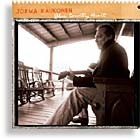
  • Jorma Kaukonen – Blue Country Heart

    Blue Country Heart

    The original lead guitarist with Jefferson Airplane and co-founder of Hot Tuna has come full circle in recent years, back to the acoustic folk-blues he was fingerpicking before the Summer of Love. Backed here by the cream of country’s acoustic pickers, he lends his “Piedmont” style of Eastern Seaboard blues (a la Blind Blake, Brownie McGhee, and Rev. Gary Davis) to a baker’s dozen Depression-era hillbilly covers – in doing so, illustrating how permeable the “wall” between black blues and white country music is. (The fact that six of these country chestnuts have the word “blues” in their titles should be another tip.)

    It’s a testament to the maturity of the virtuoso players involved – Jerry Douglas on Dobro, Sam Bush on fiddle and mandolin, Byron House on upright bass, Jorma and his 1936 Advanced Jumbo Gibson, and banjoist Bela Fleck on two numbers – that they create an atmosphere akin to a relaxed backporch song-swap instead of a picking contest. As often as not, Kaukonen’s rhythm keeps things rolling while the others trade tasteful solos and fills, although Jorma kicks up some dust on Cliff Carlyle’s “Tom Cat Blues” and executes some snaky curlicues on Jimmie Rodgers’ “You and My Old Guitar.” The all-acoustic affair was recorded live and warm by engineer/co-producer Roger Moutenot, and it sure sounds like it must have been fun.

    The only drawback is that the repertoire could have been less predictable. Two-thirds of the songs come from Rodgers or the Delmore Brothers – including tried-and-true standards such as the former’s “Waiting For a Train” and the latter’s “Blues Stay Away From Me.” And Rodgers’ “Gambler’s Blues” (with a nice bowed solo from House) is pleasant, but I guess Dave Van Ronk’s emotional version (a variation on “St. James Infirmary”) spoiled me.

    That said, the warhorse “Just Because” comes alive with some energetic trade-offs between Fleck and Douglas, then Bush and Douglas, Fleck and Bush, etc. Also, the more standard fare serves to highlight the lesser-known numbers, such as “Breadline Blues” and “In From the Chain Gang.” This is especially true on Washington Phillips’ gospel tune, “What Are They Doing in Heaven Today?” – where Jorma’s voice (which has mellowed into a sort of deeper, less angular Leon Russell) takes on a softer, gentler quality, and the ensemble lays back, as Jerry Douglas throws in a few perfectly placed slides. The perfect close to a most listenable set.


    This article originally appeared in VG‘s July ’02 issue. All copyrights are by the author and Vintage Guitar magazine. Unauthorized replication or use is strictly prohibited.

  • Long John Baldry – Remembering Leadbelly

    Remembering Leadbelly

    The Brits, in at least as far as the blues is concerned, have always been our archivists. With a few exceptions in the ’60s, including John Hammond, Butterfield and Bloomfield, Taj Mahal, and a select few equally articulate (but lesser-known), it wasn’t until the ’80s and the re-emergence of the West Coast and Texas and Gulf Coast schools that we really rejoined the blues roots party. It took perhaps a number of British invasions to hand back to the USA what we at least take for granted.

    It comes as no surprise that Chris Barber disciple Long John Baldry, would choose Leadbelly as a vehicle to whom he would repay a musical debt. That Baldry would choose an artist so well documented will certainly invite comparisons, and perhaps give rise to the question, what would be the need for this transplanted Canadians interpretations? This effort is obviously a labor of love from someone who’s musical career has been significantly influenced by Huddie. Attention to detail is a big reason for this CDs attraction.

    Baldry does a laudable job on this Stoney Plain effort, attaining the field recording ambience in a context that was certainly intended. One doesn’t need to read the liner notes to realize Bill Broonzy and Huddie Leadbetter were certainly strong influences on the early British interpreters. Young enthusiasts that included Alexis Corner, Lonnie Donegan, John Mayall, and even Page and Plant have recognized the inspirational credentials that those two American artists wielded.

    This release represents one man’s tribute to an artist he loves and respects, and the affection comes shining through.


    This article originally appeared in VG‘s Aug. ’02 issue. All copyrights are by the author and Vintage Guitar magazine. Unauthorized replication or use is strictly prohibited.

  • Gittler Guitar

    Avraham Bar Rashi

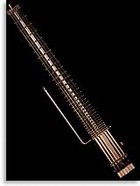
    One of the most intriguing electric stringed instruments to ever appear on the American amplified music landscape was the rare and starkly-minimalist Gittler. Simply an electric guitar constructed with as few parts as needed to render it fully functional, the original Gittler guitar (a total of 60 were made in New York) turned a lot of heads when one was played or even seen, due to “reverse aesthetics;” i.e., given the fact that the instrument was made with only the “bare essentials,” what a Gittler didn’t have on it attracted a lot of attention, and many viewers of the Police video for “Synchronicity III” probably thought the small, stringed gizmo Andy Summers was manipulating was some kind of movie prop, when in reality it was an early Gittler.

    The musician/inventor formerly known as Allan Gittler now resides in a Jewish enclave of the city of Hebron in Israel, and prefers to be known as Avraham Bar Rashi. Several hundred Gittlers were also made in Israel, under name licensing, but those are somewhat of a sore point with Bar Rashi; he felt so strongly that their quality was not up to what he had envisioned for his creation that he sent out a form letter to musical instrument dealers, disassociating himself from those items. He also created other unusual electric guitars after he emigrated to the Holy Land, and he still plays a solid mahogany instrument he crafted.

    In a recent conversation with VG, Avraham Bar Rashi discussed his unique position in the world of electric guitar building and the unique instruments that placed him in such a position. And he didn’t hesitate to “tell it like it is” regarding certain facets of his guitarmaking history. Included with photos and the aforementioned form letter sent to VG‘s Southern office was a short, self-written profile that included the phrase “dropped out” at more than one juncture. The former Allan Gittler’s personal history also included many years in the movie making industry, so our first question concerned how Bar Rashi thought he should be described when his legacy is discussed among guitar lovers.

    Vintage Guitar: I’ve heard you referred to as an “inventor,” “musician” and “artist.” Which term or terms do you think are the most appropriate
    Avraham Bar Rashi: Musician, composer, writer, director, auteur, moviemaker, artist, poet, film editor, photographer, inventor – they are all appropriate, but if you would like to spare your readers a tour of my vanities, just label me “retro-Renaissance,” or simply “guitar player.”

    Tell me about the jazz players who inspired you, as well as some of those you played with.
    Remo Palmieri – his chord changes were inspirational to the American standard idiom. Elvin Jones – we made an incredible recording – just the two of us – after only 10 minutes of our initial meeting. Gil Evans – to me, he epitomized the American Big Band sound. I was privileged to have him arrange my music for my movie Parachute to Paradise. Bobby Durough – an exquisite singer and piano player who sang the title song, “Parachute to Paradise,” which I wrote on-camera. Lloyd McNeil – a most sophisticated flute player; for about a year, we electrified the streets of New York with our music. Gengi Ito Shakuhachi on percussion – he brought a samurai precision to his beautiful sound.

    What kind of traditional guitars – acoustic and electric – did you play?
    As a kid, the usual junk. Then a series of Gibsons, then a series of D’Angelicos, then a Velasquez classic guitar. I only wanted to own one at a time, so as to focus my playing discipline. I have found that anything is playable, even a cigar box, if it motivates you to love it.

    When did you start considering traditional guitars too “bulky,” for lack of a better term?
    When I realized that pure electronic enhancement is not dependent on sentimental design references to traditional guitar shapes. Shapes and materials – traditional and otherwise – do color a string’s sound, but the fundamental beauty of a stringed instrument – through its classic, and now electronic era – is that your flesh – your “vibes” – are in direct contact with its linear motor, the string. And the only thing I need to remind me that I’m playing a guitar is the classic pitch of its six strings, so I prefer to be holding as little as possible when I’m searching the nuances of my sound through the vastness of the electronic sea.

    You spent two decades in the cinema business, and invented and patented several items in that field. Details?
    I worked 15 years as a top film editor. During that period I was awarded patents for a photographic printer, a motion picture reel, and a motion picture container. I wrote a novel, The Rose-Colored View, and made an 18-minute short titled “New York, New York, New York,” comprised of 700 stills shot with a Minox, and the track of Elvin Jones and myself.

    I had had enough of my editing career, and quit to ride my track bike through Central Park, and write the script of my movie, Parachute to Paradise.

    After the heartiness of 15 weeks of pre-production, casting the principle players and 200 extras, seven weeks of principle photography, writing the music, and seven months of editing and enormous publicity, a fallout with my producer relegated the production to a couple of cans in the laboratory vault. I was now in the streets, playing my Velasquez through a battery-powered amp. This beautiful guitar was not designed for this, so I started thinking about designing a guitar.

    To what extent did the “art factor” influence your design?
    With any machine, form should follow function. I chose a discipline of only three sizes in milled stock-5/8″, for the body, 3/8″ for the pickups and tuners, 1/4″ for the frets, bridge, nut, and string anchors. The lengths of these parts were based strictly on the minimum needed for their operability within the instrument. The elegant geometry of a guitar’s fret system became incredibly intensified in this configuration. The purely poetic “art” lies only at the head of the guitar; this is a random length and could theoretically be cut off right after the nut.

    When were you satisfied enough to seek a patent?
    When I found I could take nothing more off!

    What was the reaction to your instrument from musicians, artists, and others? Didn’t you pretty much begin making and selling them due to word of mouth?
    Musicians hated it, as would anybody whose preconceptions are rattled.

    Artists said it should be in a museum, and one other came up to me and said, “Thank you for creating another need.”

    I started having them machined in New York. Forty of them were sold through the mail, and 20 from my apartment on the Lower East Side, where Andy Summers bought his.

    Why did you design it to have a unique strap system? Was it to maintain the symmetry?
    My guitar was designed as its own entity – how to support it was a secondary consideration. For example, the structure of a violin evolved toward optimizing the vibrations of a double column of air for its particular pitch and timbre. Holding an instrument under your chin – which is rather strange – would be more a discovered posture than a point of departure for designing an instrument.

    The central rod or “spine” is intriguing, because if a player’s thumb is placed there – as many guitar instructors would tell students to do – it could have a good “training” effect, versus the tendency of untutored players to squeeze both E strings from each side of the frets. Was that part of your design intentional?
    The legitimate position – centering the thumb behind the first finger is what enables a player to fly, but I have seen players who clutch and drag their hand over the neck fly, too. But that position, and how it shifts up the shoulder, always looked gross to me. So, happily, the legitimate position is what enabled my design to fly.

    How many instruments were U.S.-made? Did you ever show them at a NAMM show?
    A total of 60. I did show once at a NAMM show; the guitar was lying on black velvet, under a single spotlight. Of course, it stopped everybody, and one player came up to me and asked, “What’s different about this guitar?” I had to answer, “It’s playable underwater.” Not recommended, but possible.

    Three Gittler basses also exist. They were made in New York and numbered 1, 2, 3, respectively.

    Were all of the U.S. Gittlers simply the stainless portion with the six phono plugs?
    The stainless “portion” is the guitar, incorporating a pickup and output for each string that could be amplified and modified through a separate system for each string, and sextra-phonically arpeggiated over an entire stage. They were released with an inline battery-operated mixer the size of a cigarette pack – six inputs, six outputs, a master output, and a slide pot for each.

    The master output carried all six signals to one amp. Plugging into any string would disconnect it from the master and send it to its own amp, and this could be done until you reached to full sextraphonic freakout and blowout of six separate power systems.

    All add-on boxes and bodies to the guitars made in Israel are an abomination to the original design – a result of my producers’ misguided attempt to make a radical design immediately “user-friendly;” initially, mastering a musical instrument has never been a user-friendly affair.

    How did you feel when the Museum of Modern Art, in New York City, purchased an instrument?
    I always enjoyed having a cup of coffee and hanging out at the museum. And later, after meeting with their board of trustees and the cogniscenti for a perusal of the instrument, they bought one. I was delighted.

    Right or wrong, a lot of people became aware of your instrument due to an early ’80s – video by the Police, on which Andy Summers played a Gittler. What was your reaction to seeing it in a rock video?
    In my reclusive manner, we had just come to Israel quietly, without fanfare, without money. Three small cartons, three small kids, and no phone. I had no idea the video was running, and that a hundred people were trying to reach me; a short while before, I had cut off all communication with my machinist in New York, due to Ned Steinberger mysteriously finding his way to him and getting an intimate look at my tuner.

    I was amused to hear that he brought Washburn Guitars to court for infringing on what he was already considering to be his tuner design. Washburn’s attorney introduced a copy of the Gittler patent; the judge threw the case out.

    Do you feel like discussing your name change, and your move to Israel?
    When I was a child, my grandfather told me I was a descendant of Rashill, the eleventh-century commentator par excellence on Torah and Talmud. This went in one ear and out the other, until I met my wife, a WASP, coming from an illustrious heritage including John Adams and her grandfather, John McGuire, the Royal Professor of Law at Harvard University. She had never known a Jew before, and through no proselytizing of mine, began a most zealous course of study that’s been going on for 24 years. She wanted to be a Jew; she became a Jew. She wanted to go to Israel; we came to Israel. I changed my name to Bar Rashi, meaning “from Rashill. I now sit in the Creator’s designated land for his priestly people. I want to be a Jew, too.

    It’s been reported that other instruments were licensed by you to be manufactured, and that you were dissatisfied with those. Can you offer a synopsis of the Bar Rashi Company and/or Astron Enterprises efforts? What does the Hebrew inscription say?
    The only license – and it was immediately violated – went to Astron Machine. They were to produce the first guitar for my inspection, but in the blinding glow of potential big dollars, computer-machined 500 of them, all with an extra hole, and drifting off-scale fret spacing. They hoped the metal box and plastic body would work as a cover for their sloppy machining. Their serial numbers continue from number 61, and the Hebrew inscription says “Bar Rashi, Israel.”

    Then there were the plywood instruments with wing nut tuners. Details about their construction and why they were designed?
    After recovering from my misplaced trust, I decided to design the simplest guitar I could, without the aid of “big business.” The wing nut ones were made on the way to this objective. They were experiments in plywood, and even MDF – I believe they have all warped, but I reached my objective with the guitar I play now, made from beautiful solid mahogany, incorporating only 12 pieces of identical hardware that serve as nut, bridge, and tuner. It is the only one I play now, and can be heard on my CD, Deep Hip. I personally supervise their construction, and sell them.

    What keeps you busy these days?
    I am presently contemplating the elements for another CD.

    These days, your original-design stainless instruments are usually referred to as “Gittlers,” not “Gittler guitars.” In other words, not as a brand name, but as a unique electric stringed instrument. Comment?
    I am honored.

    It’s not surprising that a conversation with Avraham Bar Rashi would end up being as intriguing as the instruments he has designed. One can use as many terms as desired in describing the individual, his history, and the instruments he’s created, but the fact remains that Bar Rashi and his creations occupy one of the most unique and interesting facets of electric guitar history. The man, the chronology, and the instruments are unconventional, to say the least.

    VG would like to thank Bob Elswick for his assistance obtaining this interview.


    Gitler photo: Ward Meeker

    This article originally appeared in VG‘s Mar ’00 issue. All copyrights are by the author and Vintage Guitar magazine. Unauthorized replication or use is strictly prohibited.
  • The Gittler Guitar

    Avraham Bar Rashi

    One of the most intriguing instruments to appear on the amplified-music landscape was the starkly-minimalist Gittler. An electric guitar constructed with as few parts as needed to render it fully functional, the original Gittler (a total of 60 were made in New York) turned a lot of heads when one was played or even seen, due to “reverse aesthetics;” i.e., given the fact that the instrument was made with only the “bare essentials,” what a Gittler didn’t have on it attracted a lot of attention, and many viewers of the Police video for “Synchronicity III” probably thought the small, stringed gizmo Andy Summers was manipulating was some kind of movie prop, when in reality it was an early Gittler.

    The musician/inventor formerly known as Allan Gittler now resides in a Jewish enclave of the city of Hebron in Israel, and prefers to be known as Avraham Bar Rashi. Several hundred Gittlers were also made in Israel, under name licensing, but those are somewhat of a sore point with Bar Rashi; he felt so strongly that their quality was not up to what he had envisioned for his creation that he sent out a form letter to musical instrument dealers, disassociating himself from those items. He also created other unusual electric guitars after he emigrated to the Holy Land, and he still plays a solid mahogany instrument he crafted.

    In a recent conversation with VG, Avraham Bar Rashi discussed his unique position in the world of electric guitar building and the unique instruments that placed him in such a position. And he didn’t hesitate to “tell it like it is” regarding certain facets of his guitarmaking history. Included with photos and the aforementioned form letter sent to VG‘s Southern office was a short, self-written profile that included the phrase “dropped out” at more than one juncture. The former Allan Gittler’s personal history also included many years in the movie making industry, so our first question concerned how Bar Rashi thought he should be described when his legacy is discussed among guitar lovers.

    Vintage Guitar: I’ve heard you referred to as an “inventor,” “musician” and “artist.” Which term or terms do you think are the most appropriate
    Avraham Bar Rashi: Musician, composer, writer, director, auteur, moviemaker, artist, poet, film editor, photographer, inventor – they are all appropriate, but if you would like to spare your readers a tour of my vanities, just label me “retro-Renaissance,” or simply “guitar player.”

    Tell me about the jazz players who inspired you, as well as some of those you played with.
    Remo Palmieri – his chord changes were inspirational to the American standard idiom. Elvin Jones – we made an incredible recording – just the two of us – after only 10 minutes of our initial meeting. Gil Evans – to me, he epitomized the American Big Band sound. I was privileged to have him arrange my music for my movie Parachute to Paradise. Bobby Durough – an exquisite singer and piano player who sang the title song, “Parachute to Paradise,” which I wrote on-camera. Lloyd McNeil – a most sophisticated flute player; for about a year, we electrified the streets of New York with our music. Gengi Ito Shakuhachi on percussion – he brought a samurai precision to his beautiful sound.

    What kind of traditional guitars – acoustic and electric – did you play?
    As a kid, the usual junk. Then a series of Gibsons, then a series of D’Angelicos, then a Velasquez classic guitar. I only wanted to own one at a time, so as to focus my playing discipline. I have found that anything is playable, even a cigar box, if it motivates you to love it.

    When did you start considering traditional guitars too “bulky,” for lack of a better term?
    When I realized that pure electronic enhancement is not dependent on sentimental design references to traditional guitar shapes. Shapes and materials – traditional and otherwise – do color a string’s sound, but the fundamental beauty of a stringed instrument – through its classic, and now electronic era – is that your flesh – your “vibes” – are in direct contact with its linear motor, the string. And the only thing I need to remind me that I’m playing a guitar is the classic pitch of its six strings, so I prefer to be holding as little as possible when I’m searching the nuances of my sound through the vastness of the electronic sea.

    You spent two decades in the cinema business, and invented and patented several items in that field. Details?
    I worked 15 years as a top film editor. During that period I was awarded patents for a photographic printer, a motion picture reel, and a motion picture container. I wrote a novel, The Rose-Colored View, and made an 18-minute short titled “New York, New York, New York,” comprised of 700 stills shot with a Minox, and the track of Elvin Jones and myself.

    I had had enough of my editing career, and quit to ride my track bike through Central Park, and write the script of my movie, Parachute to Paradise.

    After the heartiness of 15 weeks of pre-production, casting the principle players and 200 extras, seven weeks of principle photography, writing the music, and seven months of editing and enormous publicity, a fallout with my producer relegated the production to a couple of cans in the laboratory vault. I was now in the streets, playing my Velasquez through a battery-powered amp. This beautiful guitar was not designed for this, so I started thinking about designing a guitar.

    To what extent did the “art factor” influence your design?
    With any machine, form should follow function. I chose a discipline of only three sizes in milled stock-5/8″, for the body, 3/8″ for the pickups and tuners, 1/4″ for the frets, bridge, nut, and string anchors. The lengths of these parts were based strictly on the minimum needed for their operability within the instrument. The elegant geometry of a guitar’s fret system became incredibly intensified in this configuration. The purely poetic “art” lies only at the head of the guitar; this is a random length and could theoretically be cut off right after the nut.

    When were you satisfied enough to seek a patent?
    When I found I could take nothing more off!

    What was the reaction to your instrument from musicians, artists, and others? Didn’t you pretty much begin making and selling them due to word of mouth?
    Musicians hated it, as would anybody whose preconceptions are rattled.

    Artists said it should be in a museum, and one other came up to me and said, “Thank you for creating another need.”

    I started having them machined in New York. Forty of them were sold through the mail, and 20 from my apartment on the Lower East Side, where Andy Summers bought his.

    Why did you design it to have a unique strap system? Was it to maintain the symmetry?
    My guitar was designed as its own entity – how to support it was a secondary consideration. For example, the structure of a violin evolved toward optimizing the vibrations of a double column of air for its particular pitch and timbre. Holding an instrument under your chin – which is rather strange – would be more a discovered posture than a point of departure for designing an instrument.

    The central rod or “spine” is intriguing, because if a player’s thumb is placed there – as many guitar instructors would tell students to do – it could have a good “training” effect, versus the tendency of untutored players to squeeze both E strings from each side of the frets. Was that part of your design intentional?
    The legitimate position – centering the thumb behind the first finger is what enables a player to fly, but I have seen players who clutch and drag their hand over the neck fly, too. But that position, and how it shifts up the shoulder, always looked gross to me. So, happily, the legitimate position is what enabled my design to fly.

    How many instruments were U.S.-made? Did you ever show them at a NAMM show?
    A total of 60. I did show once at a NAMM show; the guitar was lying on black velvet, under a single spotlight. Of course, it stopped everybody, and one player came up to me and asked, “What’s different about this guitar?” I had to answer, “It’s playable underwater.” Not recommended, but possible.

    Three Gittler basses also exist. They were made in New York and numbered 1, 2, 3, respectively.

    Were all of the U.S. Gittlers simply the stainless portion with the six phono plugs?
    The stainless “portion” is the guitar, incorporating a pickup and output for each string that could be amplified and modified through a separate system for each string, and sextra-phonically arpeggiated over an entire stage. They were released with an inline battery-operated mixer the size of a cigarette pack – six inputs, six outputs, a master output, and a slide pot for each.

    The master output carried all six signals to one amp. Plugging into any string would disconnect it from the master and send it to its own amp, and this could be done until you reached to full sextraphonic freakout and blowout of six separate power systems.

    All add-on boxes and bodies to the guitars made in Israel are an abomination to the original design – a result of my producers’ misguided attempt to make a radical design immediately “user-friendly;” initially, mastering a musical instrument has never been a user-friendly affair.

    How did you feel when the Museum of Modern Art, in New York City, purchased an instrument?
    I always enjoyed having a cup of coffee and hanging out at the museum. And later, after meeting with their board of trustees and the cogniscenti for a perusal of the instrument, they bought one. I was delighted.

    Right or wrong, a lot of people became aware of your instrument due to an early ’80s – video by the Police, on which Andy Summers played a Gittler. What was your reaction to seeing it in a rock video?
    In my reclusive manner, we had just come to Israel quietly, without fanfare, without money. Three small cartons, three small kids, and no phone. I had no idea the video was running, and that a hundred people were trying to reach me; a short while before, I had cut off all communication with my machinist in New York, due to Ned Steinberger mysteriously finding his way to him and getting an intimate look at my tuner.

    I was amused to hear that he brought Washburn Guitars to court for infringing on what he was already considering to be his tuner design. Washburn’s attorney introduced a copy of the Gittler patent; the judge threw the case out.

    Do you feel like discussing your name change, and your move to Israel?
    When I was a child, my grandfather told me I was a descendant of Rashill, the eleventh-century commentator par excellence on Torah and Talmud. This went in one ear and out the other, until I met my wife, a WASP, coming from an illustrious heritage including John Adams and her grandfather, John McGuire, the Royal Professor of Law at Harvard University. She had never known a Jew before, and through no proselytizing of mine, began a most zealous course of study that’s been going on for 24 years. She wanted to be a Jew; she became a Jew. She wanted to go to Israel; we came to Israel. I changed my name to Bar Rashi, meaning “from Rashill. I now sit in the Creator’s designated land for his priestly people. I want to be a Jew, too.

    It’s been reported that other instruments were licensed by you to be manufactured, and that you were dissatisfied with those. Can you offer a synopsis of the Bar Rashi Company and/or Astron Enterprises efforts? What does the Hebrew inscription say?
    The only license – and it was immediately violated – went to Astron Machine. They were to produce the first guitar for my inspection, but in the blinding glow of potential big dollars, computer-machined 500 of them, all with an extra hole, and drifting off-scale fret spacing. They hoped the metal box and plastic body would work as a cover for their sloppy machining. Their serial numbers continue from number 61, and the Hebrew inscription says “Bar Rashi, Israel.”

    Then there were the plywood instruments with wing nut tuners. Details about their construction and why they were designed?
    After recovering from my misplaced trust, I decided to design the simplest guitar I could, without the aid of “big business.” The wing nut ones were made on the way to this objective. They were experiments in plywood, and even MDF – I believe they have all warped, but I reached my objective with the guitar I play now, made from beautiful solid mahogany, incorporating only 12 pieces of identical hardware that serve as nut, bridge, and tuner. It is the only one I play now, and can be heard on my CD, Deep Hip. I personally supervise their construction, and sell them.

    What keeps you busy these days?
    I am presently contemplating the elements for another CD.

    These days, your original-design stainless instruments are usually referred to as “Gittlers,” not “Gittler guitars.” In other words, not as a brand name, but as a unique electric stringed instrument. Comment?
    I am honored.

    It’s not surprising that a conversation with Avraham Bar Rashi would end up being as intriguing as the instruments he has designed. One can use as many terms as desired in describing the individual, his history, and the instruments he’s created, but the fact remains that Bar Rashi and his creations occupy one of the most unique and interesting facets of electric guitar history. The man, the chronology, and the instruments are unconventional, to say the least.

    VG would like to thank Bob Elswick for his assistance obtaining this interview.


    Gitler photo: Ward Meeker

    This article originally appeared in VG‘s Mar ’00 issue. All copyrights are by the author and Vintage Guitar magazine. Unauthorized replication or use is strictly prohibited.

  • Steve Herberman – Thoughtlines

    Thoughtlines

    As I struggle to make it through even one version of a standard without screwing up the chords, it never ceases to amaze me how many really good traditional jazz guitarists are out there. And I’m talking fellas you may never have heard of, like Steve Herberman.

    Playing a seven-string guitar, Herberman shows himself to be a wonderful player with a great touch, a first-rate interpreter, and a composer of originals that stick in your mind and allow him and his band ample room to stretch out and showcase their skills.

    The title cut is a nice ballad that lets Herberman show off his harmonic talents. Beautiful changes frame the song, and his soloing follows lots of trails but always finds its way back home. In fact, solos throughout the record are like that. He’s extremely imaginative and plays with the fire that’s needed. Check out the band’s take on Duke Pearson’s “Jeanine.” It swings hard, and gives everybody, especially Herberman a chance to blow through changes wonderfully. The classic “A Smooth One” gets a bluesy take with Herberman mixing chords, octaves, and single-line work. “I Wish I Knew” lets Steve fly both as a soloist and as a guitarist supplying smooth comping for saxophonist Bruce Swaim. Swaim, by the way also shines as a soloist throughout. And bassist Victor Dvoskin and drummer Dominic Smith as solid as rocks, whether laying down the background or soloing.

    If you love traditional jazz guitar, you’ll love Herberman. He’s a stylist a la Jim Hall, Kenny Burrell, and Wes Montgomery.


    This article originally appeared in VG‘s Nov. ’02 issue. All copyrights are by the author and Vintage Guitar magazine. Unauthorized replication or use is strictly prohibited.

  • Wishbone Ash – Argus: Remastered and Revisited

    Argus: Remastered and Revisited

    Wishbone Ash has always held a special place in my heart, because of this album and Live Dates. Andy Powell’s Flying V led me to a lifelong fascination with that guitar. I am currently without one, but have owned two. And, even though it might look odd that an old guy like me would play one, I’ll own another eventually. Powell’s playing, and that of his partner, Ted Turner, is truly a thing of beauty.

    When this was originally released back in ’72, a couple of cuts really captured me. The first was “Blowin’ Free,” which never fails to bring a smile to my face. It’s simple stuff, but put together so well, with great rhythm guitars, a blazing solo, and some monster rhythm section playing that it’s hard not to be drawn into it. Throw in excellent vocals and you’ve got a song that was a staple to a lot of rock bands in the ’70s. My other favorite was (and is) “Time Was,” an epic that goes through what almost seem like movements. From folkey acoustic bits to power chord mayhem, it’s all here. And the solo out by Powell still ranks as one of my favorites.

    There are five other excellent cuts here, too. The stately, haunting “Sometime World” ends up a rowdy rocker. There’s the majestic “Warrior.” And many folks still point to “Throw Down the Sword” as one of their favorites.

    MCA has upped the ante nicely on this disc. There are three bonus tracks from a “Live From Memphis” EP that have never appeared commercially until now. “Jail Bait” is basically a blues that showcases how nicely the two guitarists play together. “The Pilgrim” has always been one of my favorite songs by them, and this live workout shows why. Monster solos, killer rhythm section work, and a tightness beyond compare show why this was such a great band.

    This band was one of the best at creating an atmosphere in their music. And this was their best total effort. Great songs, monster playing, and the bonus live cuts make it a must for fans of ’70s rock and roll.


    This article originally appeared in VG‘s July ’02 issue. All copyrights are by the author and Vintage Guitar magazine. Unauthorized replication or use is strictly prohibited.

  • April 2003

    FEATURES

    STEVE HOWE
    More Midnight Musings We go on the record again, talking about the guitarist’s non-stop efforts and solo projects, including his latest, Skyline. By Willie G. Moseley

    MOTOWN’S FUNK BROTHERS
    And the greatest hit-making guitarists of all time A session guitarist and record producer brings to the surface the story of six musicians you’ve likely never heard of, but heard a lot of. By Dan Forte

    JOHNNY HILAND
    One of Nashville’s hottest new players, he defied the odds to become an inspirational source of pride for his family and friends, and a force to be reckoned with among his peers. By Ann Wickstrom

    1962 NATIONAL WESTWOOD 77
    One of the more conservative of a group of guitars that showed off National’s innovative heritage, it was an eye-catcher in the dry days before guitarmania. By Michael Wright

    THE BASS SPACE
    The one that started it all Attempts at designing and amplifying an upright had been going on for decades, but there isn’t much debate that when it hit the market in 1951, Fender’s Precision was the first successful electric bass. By Willie G. Moseley

    MOSSMAN SOUTHWIND
    As the guitar market exploded in the ’60s, demand was met mostly by the major makers; individuals had neither the distribution nor manpower to make an impact. That is, until the arrival of Stuart Mossman. By Eric C. Shoaf

    Harmony Guitars
    The War Years (1941-’45) World War II was not kind to guitars, as wood and metal were diverted to other industries. But some were still being made, and Harmony fared better than others. By Michael Wright

    DEPARTMENTS

    Reader Mail

    First Fret: News and Notes
    – Randy Bachman’s Ode to Breau
    – Peter Frampton
    – Fender’s Plans for Guild
    – Schuffert marks Hank’s passing
    – Stolen gear

    Vintage Guitar Price Guide

    Builder Profile
    Marchione Guitars

    Upcoming Events

    Vintage GuitarClassified Ads

    Readers’ Gallery

    Dealer Directory

    COLUMNS

    B>Viewpoints
    Take My Money… Please!
    By Eric C. Shoaf

    Executive Rock
    The 60-Percent-of-a-Lifetime Difference
    By Willie G. Moseley

    The Sheryl Bailey Trio
    By Kelly Hagen

    Q&A With George Gruhn

    Acousticville
    Some Old Guitar Stories
    By Steven Stone

    FretPrints
    Duane Allman
    By Wolf Marshall

    Gigmeister
    Washburn D100S
    By Riley Wilson

    Guitars With Guts
    Heads Up! Part II
    By R.E. Bruné

    TECH

    Amps
    Classic Tube Guitar Amp Circuits
    By Gerald Weber

    Ask Gerald
    By Gerald Weber

    REVIEWS

    The VG Hit List
    Record, Video, and Book Reviews

    Check This Action
    By Dan Forte

    Vintage Guitar Gear Reviews
    SMF 15 Watter, Warrior 55 Vintage Throwback, Siegmund Double Drive

    Gearin’ Up!
    The latest cool new stuff!

  • Electro-Harmonix Holy Grail

    Authentic surf-soaked reverb that'd make Dick prou

    We’ve long been fans of Electro-Harmonix’s cool reissue pedals. With their inspired looks, feel, and construction, E-H has never steered us wrong.

    But recently, they threw us a curveball with their new digital Holy Grail Reverb pedal. Featuring all the goods we’ve come to expect from E-H (plywood storage box, brushed steel case with silkscreening, vintage-style footswitch, and case-mounted jacks and controls), the Grail is cleverly disguised as an analog unit.

    The Grail’s controls are sparse and include a “Reverb” knob for wet/dry mix, a three-position slide switch for selecting reverb algorithms (spring/hall/flerb), and an on/off switch.

    The first setting we tried was the “spring” algorithm, and we were immediately impressed with its warm, authentic sound. With the mix at about 30 percent, it gave a clear, ambient sound that was still dark and mellow enough that it didn’t have the ubiquitous, sterile digital tone. At 80 percent, it drenched us in that ultra-wet, puddling surf sound (makes you almost want to give it a shake to see if there aren’t really springs in it!).

    The “hall” setting also proved impressive, with its clear, tight, controlled reflections. As we turned the Reverb knob clockwise, it seemed to move us further and further away, without losing definition – a great effect for acoustic instruments.

    Finally, the “Flerb” algorithm offered a mix of flange and reverb. We weren’t quite sure what to make of this, but it’s unique, and certainly has some possibilities.

    Overall, the Holy Grail is one of the best reverb pedals we’ve tred. And it’s bargain-priced compared to most others, which don’t give nearly the same authentic spring reverb sound.

    If your dull, reverb-less amp is in need of some springy saturation, the Holy Grail just might be the dousing it needs.


    Electro-Harmonix Holy Grail pedal
    Type of Pedal: Digital reverb.
    Features: Made in the U.S., authentic spring reverb sounds, plywood storage box, power supply included.
    Price: $136.
    Contact: Electro-Harmonix, 32-33 47th Ave., Long Island City, NY 11011, 800-633-5477, www.ehx.com.


    This article originally appeared in VG‘s June ’02 issue. All copyrights are by the author and Vintage Guitar magazine. Unauthorized replication or use is strictly prohibited.