Month: May 2002

  • PAF Test Run

    From VG's

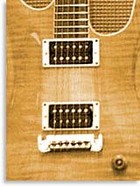
    Sorry the shop is a little crowded today, but I’ve invited some friends over to listen to a few PAFs. I have some Gibsons, Tom Holmes, and Lindy Fralins loaded into some really cool Les Pauls. Before we get loud, let me introduce my friends.

    Terry Oubre, from Kendrick Amps, Dave Hazlett, from Guitar Resurrection, Les Paul connoisseur Bill Webb of Fullton-Webb amps, Black Dog Electronics’ Mac Pfieffer, who just plays guitar really well, and Jim Wilson, from Cedar Creek Recording.

    We are going to compare Gibson patent number PAFs, ’63 humbuckers, ’78 reissue PAFs, ’57 Classic and Classic Plus PAFs, Tom Holmes PAFs, and Lindy Fralin PAFs, and pass the results directly on to you. We are playing through a Fullton-Webb 18-watt amp. It sounds like a cross between a good plexi Marshall and a new Bogner; in other words, it retains more clarity in the midrange than a Marshall, especially when overdriven. And it is surprisingly loud for an amp that uses two EL84s and approaches the volume of many 50-watt amps. Anyone concerned about their hearing may want to step outside…here we go!

    All these pickups are pretty cool, and each its own personality. The old Gibsons were great for reference, but believe it or not the panel preferred most of the new pickups to the old ones. This may sound unbelievable, but the opinions of the panel were very consistent and differences in the pickups were fairly substantial. This is what we heard, along with the DC resistance of each pickup measured while it was in the guitar:

    Patent Number PAF (9.3K) – (a very early one, identical to an original PAF). This one was on the brighter side and was fairly loud. It was smooth, but lost mids when pushed hard. It was a little harsh when played clean, but the highs were useful when overdriven. It contributed little texture or compression. One panelist termed it “quacky.”

    ’63 PAF (7.3K) – This pickup was low in output and otherwise had little character. It was very smooth and again turned bright when pushed hard.

    ’78 PAF (7.1K) – This was almost identical to the ’63 but with a little more compression and warmth. The clean sound was good but was somewhat muddy when overdriven.

    ’57 Classic (8.1K) – This pickup has a very nice texture and a medium output. The complexity of the high end is very cool, but hard to describe. It is fairly smooth, but tended to lose mids when pushed hard. It works well for a clean sound and also overdrives fairly well. May be a little bright for some.

    ’57 Classic Plus (8.5K) – This was almost identical to the Patent Number pickup. It is a little louder than the ’57 Classic but more harsh with less character.

    Tom Holmes PAF (8.3K) – This pickup is similar to the ’57 Classic but with a little more character. Rich high-end without being too bright. It compresses smoothly when played hard, again with disappearing mids.

    Lindy Fralin PAF (8.9K) – This pickup had the most output, most character, and most pleasant compression. It has a smooth response and had great clean and overdriven tones.

    Since the verbage may mean little to most, here are the results in a very easy-to-understand format, best to not-as-good. I didn’t say worst because none are bad, some are just better.
    Grand Prize Lindy Fralin in a unanimous decision. Biggest and smoothest, hands down. This was the obvious favorite. Double fat.
    2nd Tom Holmes by a nose. A very cool pickup that defies description. Good vintage tone.
    3rd ’57 Classic. This was preferred to the Holmes by two members who wish to remain anonymous. Not quite as complex, but very similar.
    4th Patent Number PAF. Good, but a little sterile.
    5th ’57 Classic. Almost fourth, but a little less character.
    6th ’78 Reissue. Smooth with good clean tones.
    Last ’63 PAF. Still good, but unremarkable.

    There you have it. I hope you enjoyed your stay. I have to take that Patent Number out of Terry’s Townhouse and put in a Fralin. See you next time.


    A host of humbuckers and media in which they were tested. Photo: Tony Nobles

    This article originally appeared in VG‘s Sep. ’98 issue. All copyrights are by the author and Vintage Guitar magazine. Unauthorized replication or use is strictly prohibited.

  • Eric Johnson – Austin City Limits Episode # 2614

    Austin City Limits Episode # 2614

    OnEric Johnson’s forthcoming fourth headlining appearance on PBS’ “Austin City Limits” (taped in late 2000) the Texas tonemaster breaks out an original and innovative set. Show-cased are five of Johnson’s more eclectic songs, each a gem from his catalog that proves his skills as a composer, vocalist, and guitarist.

    While the guitar is what has brought Johnson acclaim, his broader musical gifts have been overshadowed by it. This performance should silence naysayers.

    Opening with the instrumental “Zenland,” the first cut off Live And Beyond and backed by his band, Alien Love Child, its signature chord voicings and the tones that emanate from his Strat are obvious EJ. A fluid, straight-ahead rocker, Johnson’s application of seamless and fiery with dynamic finesse.

    “Friends,” from 1986’s Tones, is rarely performed but grasps the intensity of Johnson’s emotional depth as a singer/songwriter, designing melodies and contemplative lyrics. Harmonics lead into and out of the song, as the song climaxes with searing riffs supporting his expressive vocals.

    The phrasing and interpretation is equaled as he segues into “Nothing Can Keep Me From You,” a gorgeous quasi rock/pop piece from Ah Via Musicom. With lionesque guitar voicings, again Johnson treats the audience to his blend of vocals entwined with a rock guitar chorus that repeats in a round, lyrical calliope. Here, his playing actually takes on greater precision and spirit when singing.

    Johnson then straps on his Gibson SG to perform the subdued jazz instrumental, “Rain” off Live And Beyond. Pay attention to his intricate thumb and picking techniques, evoking Johnson’s inspired studies of Wes Montgomery, while staying true to his own sound.

    Last is a show-stopping cover of Hendrix’s “Spanish Castle Magic” with Johnson back on Strat, and a stage-stealing Malford Milligan guesting on vocals. Johnson and Milligan spar off of in an incendiary firestorm that is as exhilarating to watch as it is to hear, each admiring and pushing the other to great heights in a crescendo of virtuosity. Once more, Johnson pays homage to one an inspirations, but his tones and riffs are trademark.

    Watching Johnson perform live is a real treat, and to the credit of “Austin City Limits” directors, producers, and crew, this is a fascinating chance to observe his technique, range, and above all, talent – in full closeup. His fingerings, picking, speed, control, and mastery of the instrument is captured in detail.

    But that’s not all, as “Austin City Limits” adds a very special treat for its viewers: after Johnson ends the performance and the credits begin to roll, a joyful Johnson sits relaxed among his guitars with an obvious look of childlike wonder, talks about his artistic challenges, thoughts, and the satisfaction he derives when at one with his guitar.

    Check with local PBS stations for air and repeat broadcast dates.


    This article originally appeared in VG‘s May ’01 issue. All copyrights are by the author and Vintage Guitar magazine. Unauthorized replication or use is strictly prohibited.
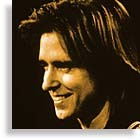
  • Jools Holland & his Rhythm & Blues Orchestra – Jools Holland’s Big Band Rhythm & Blues

    Jools Holland's Big Band Rhythm & Blues

    If the term “big band,” especially tied to a pop star, conjures the dreaded image of one of those zoot-suited groups with the word “Daddy” in its name, fear not. Ex-Squeeze keyboardist Holland’s 16-piece outfit (give or take) churns out an eclectic mishmash that rarely resorts to nostalgia, and in fact shows that the roots of rock and roll could well be its future.

    With Holland’s two-fisted piano playing and impressive songwriting range matched by saxophonist Phil Veacock’s stellar arranging, that would be enough to ensure a solid album. But Holland is more bandleader and emcee (still hosting his own music show on BBC) than frontman or singer, so he enlisted a couple dozen friends to take center stage on the 22 tracks here – friends like Eric Clapton, Dr. John, Taj Mahal, Mark Knopfler, Van Morrison, David Gilmour, Jamiroquai, and George Harrison, in his last recorded session.

    That “Horse To Water,” co-written by Harrison and his son, Dhani, was cut less than two months before George’s death is astonishing, given the ex-Beatle’s spot-on delivery. It, in fact, ranks among the best items in his all-too-sparse catalog of the past 20 years.

    Guitar chores on that and most of the CD are handled by the versatile Mark Flanagan, and while much of the focus is on Holland’s piano and the horn arrangements, he shines when he gets the spotlight – on the infectious Paul Carrack turn “It’s So Blue;” on Paul Weller’s superb take on Billy Preston’s “Will It Go Round In Circles;” and the tasteful fills behind Eric Bibb’s beautiful vocal on “All That You Are.” For balance, some of the CD’s highest highs have no guitar to speak of – Dr. John and Holland’s boogie duo, “The Hand That Changed Its Mind;” “Town and Country Rhythm and Blues,” featuring ex-Squeeze mate Chris Difford; and Knopfler’s rockabilly romp, “Mademoiselle Will Decide.” Yes, rockabilly, not to mention Chicago blues, ska, soundtracky pop – all get the big band treatment; it’s not just for swing anymore.

    Histrionic vocalist Mica Paris does her best to destroy “I Put a Spell On You,” but David Gilmour’s stinging solo redeems it, as does a great string/horn arrangement. Some covers seem a bit uninspired; certainly Taj Mahal’s talents could be put to better use than yet another version of “Outskirts of Town,” and it’s too bad Mick “Simply Red” Hucknall had to settle for “T-Bone Shuffle.” One would have assumed the same of “I’m Ready,” the Willie Dixon chestnut, but Steve Winwood sounds great here (but when doesn’t he?).

    Others better forgotten are a too-loungy ska attempt at “I’m In the Mood For Love” by Jamiroquai; Stereophonics’ nothing-special rendition of the Beatles’ “Revolution;” and John Cale’s hackneyed stab at Johnny Mercer’s “I Wanna Be Around” – the only time, thankfully, the CD resorts to kitsch. Another Willie Dixon retread that needn’t have been mounted is “Seventh Son,” featuring – as if you didn’t expect him – Sting. Can we all just agree to a two-year moratorium on guest appearances by Sting? (Do I hear three?)

    The album’s closer, Ray Charles’ “What Would I Do Without You,” features Eric Clapton on guitar and vocals, sounding considerably more inspired than he does on his own records. Which may be Holland’s real role here. After being rocketed from style to style, singer to singer – perusing a CD booklet filled with pictures of Jools with this legend and that (as if having them on his CD wasn’t proof enough that he knows them) – one may well ask, “What’s the unifying thread?” Well, Jools Holland is – the guy whose name is on the CD. He brings all this talent together and, usually, brings out the best in it. And it may be a stylistic crazy quilt, but it’s his crazy quilt.


    This article originally appeared in VG‘s April ’02 issue. All copyrights are by the author and Vintage Guitar magazine. Unauthorized replication or use is strictly prohibited.

  • César Diaz

    Amp Doc Sounds Off!

    Ed. Note: César D

  • Joe Pass – The Best of Joe Pass

    The Best of Joe Pass

    Here’s a set of music from the early ’60s from the brilliant Joe Pass. It starts with some tunes recorded with fellow musicians from the drug rehab center Synanon House and carries through to some nice work with Les McCann. Throughout, the late guitarist shines. Whether he’s tearing things up on the likes of “C.E.D.,” or highlighting a nice version of “Django” with a beautiful one-minute chord intro, his skills are evident.

    No, this really isn’t the best of Joe Pass. But it does feature great playing as a sideman on tunes that run the gamut, as jazz styles go. And, it showcases Pass getting back into the playing groove after his stint in drug rehab. A valuable addition to any Pass fan’s collection.


    This article originally appeared in VG‘s Sep. ’97 issue. All copyrights are by the author and Vintage Guitar magazine. Unauthorized replication or use is strictly prohibited.
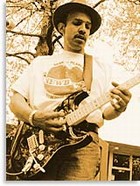
  • Jim Beloff – Jim’s Dog Has Fleas

    Jim's Dog Has Fleas

    Jim Beloff has a love affair with the ukulele. Ever since he stumbled on one at a flea market, he has devoted his life to the instrument’s legacy.

    Beloff has organized several collections of ukulele songbooks and a single method book. In addition, his colorful, stylish, and thoroughly enjoyable history, The Ukulele: A Visual History, (Miller Freeman, Inc.) received rave reviews. The book is chock full of uke lore, history, famous artists, virtuosi, and recordings, as well as a guide to famous uke makers and their elfin ware, from Kamaka pineapple ukes to Martins.

    Beloff’s prowess on the uke is best represented by his CD Jim’s Dog Has Fleas. The songs are catchy melodies with crafty lyrics highlighted by that special ukulele sound that make you yearn for carefree days under a palm tree sipping umbrella drinks. His instrumental “Ukulear Powered” is a propulsive hula jump that will get the grass skirts swaying.

    Last but not least, uke tech heads will, of course, want to know what axes (or hatchets) Beloff plays on this CD:, he strums a Martin tenor and concert, as well as a National soprano.


    This article originally appeared in VG‘s Feb. ’98 issue. All copyrights are by the author and Vintage Guitar magazine. Unauthorized replication or use is strictly prohibited.
  • Monster Mike Welch – Ax To Grind…

    Ax To Grind...

    As a parent of a 15-year-old boy, I would hope that “Monster” Mike’s music packs a message that belies his 17 years. Perhaps he has a ghost writer lurking nearby with 40 years or so of heartbreak to his/her credit. I certainly hope so, if that’s not the case, it will be very interesting to see the chronological development of Mike’s lyrics as the years pass.

    The musicianship is most certainly there. On this his second Tone-Cool release, Axe To Grind, Welch again benefits from a well-seasoned rhythm section. The aggregation includes George Leroy Lewis’ great Leslie/Magnatone influenced guitar work, his presence continually provides a beyond-solid rhythmic base for Mike, who leans very heavily on tried (sometimes tired) SRV and Ronnie Earl themes. The CD doesn’t lack energy, there’s plenty to go around, the whole package comes off sounding like a real good second set on a five-set night.

    As “Sleepy” Reed pointed out so adroitly the other night; “Shakey,” he said. “It’s been 15 years since Stevie hit.” He’s right, this all has to lead somewhere. With youthful energy abounding, I’m curious to see where “Monster” Mike heads with his gift. With his obvious respect for the masters, it should be an intriguing ride as he pays tribute to a greater array of influences.


    This article originally appeared in VG‘s April ’97 issue. All copyrights are by the author and Vintage Guitar magazine. Unauthorized replication or use is strictly prohibited.

  • Fender Ltd & Montego

    Jazz Guitars

    The Ltd was introduced as CBS Fender’s entry into the archtop jazz guitar market. It was to be a prestigious example of Fender’s ability to produce a highly crafted, handmade, unique jazz guitar to stand up to the long-established archtops of the day, particularly the Gibson Citation. The Ltd was the most expensive guitar Fender was making at the time.

    Roger Rossmeisl began his career at Fender designing and producing the acoustic King and Concert guitars in 1962. When production of acoustics was transferred to Babe Simoni, Roger became the head of R&D for acoustic guitars, ca. ’66. His job was to design a jazz guitar line with several models to fill the market needs. Roger hired me in 1964 as a production worker in the acoustic guitar division. I continued there after Roger was transferred to R&D and we lost touch for about a year and a half during that period.

    After CBS purchased Fender in ’65, a 120,000-square-foot building was erected adjacent to the original nine Fender buildings. The entire acoustic division was moved to the new plant, including the banjo department headed by Dean Markel.

    The employee entrance to the main plant was at the rear of the building. As you entered through one of the two sets of glass doors, there was a spacious lobby with the personnel offices to one side and several security people guarding the entrance. There were hundreds of people working there at the time. One morning, in the entrance lobby, there was a large glass case on a pedestal housing Roger’s first carved archtop sunburst jazz guitar. It was a beautiful sunburst with all gold-plated parts. I thought, “So that’s what you have been doing all this time, Roger!”

    The guitar was on display because it did not have a name yet. The idea was to ask employees for suggestions. Although I could have submitted as many names as I wanted, I only submitted one – Carousel. The guitar was eventually called the Ltd.

    Soon after, I got a call from Roger. He knew I was going to college at night and majoring in metallurgy. He had questions about aging, a metallurgical term. I did not understand why he would call me, perhaps he was just making contact because shortly after he asked me to visit his otherwise-off-limits R&D department. He had just finished designing the Ltd and the Montego jazz guitar, and asked if I would like to be his assistant in the department. I had been honing my skills as a production worker for five years, so this was a great opportunity. In two days I had my own parking space next to Roger, Freddie Tavares, Seth Lover (who shared space in Roger’s building), Harold Rhoads, Gene Fields, and others. This was ca. 1968.

    The department was housed in Building 3, one of nine original buildings. Roger had constructed a nice woodworking facility with all the machines necessary for manufacturing the Ltd. There were two large imported German workbenches with 5″ thick solid maple tops with huge built in vices, specially made for violin, cello, guitar making, etc. Fender still has them. We had a buffer, edge sander, shaper, jointer, spray booth, band saw, table saw, and a host of hand tools, many of them Roger’s. There was also a Northstar machine for carving tops and backs for Ltds. We also had carte blanche on any machine in the production department, like the wide-belt sander.

    The R&D department was actually titled “Acoustic Guitar Research and Development.” But the department actually did much more than that and was used for any prototype woodwork – electric or acoustic. The main focus was Ltd and Montego production, but we always seemed to have a special project going on the side.

    Roger was finishing a project called the Zebra guitar and bass. The Beatles and Stones were major forces, and two groups began to form in London around two styles of music, known as the mods and rockers. These were the names given to the Zebra guitar and bass, the Mod bass and Rocker guitar. The guitars were never produced, only prototyped by Roger. The photograph of Roger talking to Wes Montgomery in front of Roger’s workbench in R&D shows a Zebra guitar prototype on the workbench. The body was solid zebrawood carved like the Ltd jazz guitar. Wes and his brother, Monk, used to visit occasionally.

    When I arrived, Roger was ready to begin the production aspects of the Montego and Ltd. He was having the Montego bodies made in Germany. They came in completely glued up with binding installed. They were well-crafted with European woods, spruce and flamed maple that was whiter than American varieties. Montego bodies had arched tops of select laminated spruce. The backs and rims were white European flamed maple, bodies were unfinished, and all painting was done in R&D.

    The LTD was a carved archtop with the same rim shape as the Montego. Top and back carving was uniquely Roger’s and was used by his father. The arch shape took place in an area 2″ from the edge of the rim. From the binding the top dipped down .150″, then curved up .350″ all within 2″ from the rim, leaving the raised portion of the top flat. The f holes were machined but not bound, to show the top was solid spruce. The back was carved in a similar manner. Rough carving was done on the Northstar machine, a typical method for rough-carving archtop guitars. The machine has two stations, one for holding the work and one for holding a pattern. The operator controls a hand-held stylus arm that moves around the pattern. A motorized cutter mounted to another arm is connected to the stylus arm. As the stylus arm is moved, the cutter arm responds in exactly the same manner. So a pattern of the top of the guitar would be installed on the stylus side and the wood block for the top appropriately beside it. The operator holds the stylus with two hands, guiding it over the pattern, and the cutter responds, carving the top exactly like the pattern.

    My problem was that we had no carving patterns. Roger made the prototype by hand, and making the carving patterns (inside and outside) was a particularly challenging project because of the tolerances. There was also a set made for the back. We would make a batch of about six at a time. The tops would be carved, then sanded. The f holes would be routed, then two independent spruce braces would be glued in and shaped. The top would be glued to the rim. Ltd rims were exactly like the Montego and were imported as rims for the Ltd. The backs would be carved, sanded, and glued to the rim. Just before gluing, Roger would sign and date the label for the inside of the back. The binding was five separate strips installed simultaneously. Roger enjoyed doing the binding and did a great deal of it.

    After binding, we prepped the bodies for painting. This was a long, slow process, feathering the contours to perfection. Then the neck slot would be routed and the body was ready for paint. Roger developed a blended transparent color that would be sunburst on after the seal coat. Then the center portion was shot with yellow and a thin coat of clear Fullerplast. All the color would be scraped from the binding, then clear topcoats applied with sanding in between. After drying, sanding, and buffing, Roger would finish the body.

    We also made the necks for the Ltd and Montego. The necks were similar except for the head face cap and an inlay strip in the fingerboard of the Ltd. Both head face caps were made in Germany. The Ltd cap had a mother of pearl Fender logo and three mirror image Fs as a design. The Montego logo design was inspired by the marquis at the Tropicana hotel in Las Vegas. The Ltd fingerboard had white binding along the edge and a black/white/black inlay in the fingerboard, just inside the edge. The Montego only had white binding on the edges. The necks were flamed or blister maple with a center strip of padauk, Indian rosewood, or east Indian rosewood. Roger used a double-expanding truss rod in both necks. Scale length was 25.5″ with a medium fret. Mother of pearl position markers were inlaid into the fingerboard.

    Freddie Tavares designed the pickups and circuitry for both models. The pickup was a specially developed humbucker developed for a jazz sound. It was attached to the end of the neck and suspended above the top. A beautiful flamed celluloid pickguard material Roger ordered from Italy was made into pickguards, then bound with a multilayered black/white binding. The circuitry was one tone, one volume control, and a miniature jack all in a small brass frame mounted to the pickguard.

    We produced only 36 Ltd jazz guitars. Natural finish was offered in the catalog but none were ever made. I saw all 36 but haven’t seen one since I left Fender. I signed a few inside the top, so the only way to see my name is with a mirror. Throughout the time we produced jazz guitars, we were visited by many well-known musicians – Wes and Monk Montgomery, Joe Pass, Jimmy Stewart, Cannonball Adderly, Toots Thielmans. These and others providing many memorable moments and entertainment.

    Many other projects came along during the three years the jazz guitar department existed.

    Roger left the company in ’71 and moved back to Germany, where he set up his own workspace and getaway. This was where he kept much of his personal property. He took as much as he could then sold and gave me the rest. The jazz guitar department was closed after I finished the last guitars. I was issued one last project at the request of Gene Fields in R&D – the first Starcaster guitar. But that’s another story.

    Phil Kubicki began his career in the music industry when he was hired by Roger Rossmeisl, of Fender Musical Instruments, in 1964. His nine-year stay included serving as Rossmeisl’s associate in Fender’s Research and Development department. Currently, he is the manufacturer of the Factor series of four and five-string basses in Santa Barbara, California, and runs a service center making custom guitars and doing restorations and repairs.


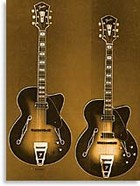
    The Montego I and Montego II, from the ’70 catalog.

    This article originally appeared in VG‘s Feb. ’99 issue. All copyrights are by the author and Vintage Guitar magazine. Unauthorized replication or use is strictly prohibited.
  • Fender’s Ltd and Montego

    Jazz Guitars

    The Ltd was introduced as CBS Fender’s entry into the archtop jazz guitar market. It was to be a prestigious example of Fender’s ability to produce a highly crafted, handmade, unique jazz guitar to stand up to the long-established archtops of the day, particularly the Gibson Citation. The Ltd was the most expensive guitar Fender was making at the time.

    Roger Rossmeisl began his career at Fender designing and producing the acoustic King and Concert guitars in 1962. When production of acoustics was transferred to Babe Simoni, Roger became the head of R&D for acoustic guitars, ca. ’66. His job was to design a jazz guitar line with several models to fill the market needs. Roger hired me in 1964 as a production worker in the acoustic guitar division. I continued there after Roger was transferred to R&D and we lost touch for about a year and a half during that period.

    After CBS purchased Fender in ’65, a 120,000-square-foot building was erected adjacent to the original nine Fender buildings. The entire acoustic division was moved to the new plant, including the banjo department headed by Dean Markel.

    The employee entrance to the main plant was at the rear of the building. As you entered through one of the two sets of glass doors, there was a spacious lobby with the personnel offices to one side and several security people guarding the entrance. There were hundreds of people working there at the time. One morning, in the entrance lobby, there was a large glass case on a pedestal housing Roger’s first carved archtop sunburst jazz guitar. It was a beautiful sunburst with all gold-plated parts. I thought, “So that’s what you have been doing all this time, Roger!”

    The guitar was on display because it did not have a name yet. The idea was to ask employees for suggestions. Although I could have submitted as many names as I wanted, I only submitted one – Carousel. The guitar was eventually called the Ltd.

    Soon after, I got a call from Roger. He knew I was going to college at night and majoring in metallurgy. He had questions about aging, a metallurgical term. I did not understand why he would call me, perhaps he was just making contact because shortly after he asked me to visit his otherwise-off-limits R&D department. He had just finished designing the Ltd and the Montego jazz guitar, and asked if I would like to be his assistant in the department. I had been honing my skills as a production worker for five years, so this was a great opportunity. In two days I had my own parking space next to Roger, Freddie Tavares, Seth Lover (who shared space in Roger’s building), Harold Rhoads, Gene Fields, and others. This was ca. 1968.

    The department was housed in Building 3, one of nine original buildings. Roger had constructed a nice woodworking facility with all the machines necessary for manufacturing the Ltd. There were two large imported German workbenches with 5″ thick solid maple tops with huge built in vices, specially made for violin, cello, guitar making, etc. Fender still has them. We had a buffer, edge sander, shaper, jointer, spray booth, band saw, table saw, and a host of hand tools, many of them Roger’s. There was also a Northstar machine for carving tops and backs for Ltds. We also had carte blanche on any machine in the production department, like the wide-belt sander.

    The R&D department was actually titled “Acoustic Guitar Research and Development.” But the department actually did much more than that and was used for any prototype woodwork – electric or acoustic. The main focus was Ltd and Montego production, but we always seemed to have a special project going on the side.

    Roger was finishing a project called the Zebra guitar and bass. The Beatles and Stones were major forces, and two groups began to form in London around two styles of music, known as the mods and rockers. These were the names given to the Zebra guitar and bass, the Mod bass and Rocker guitar. The guitars were never produced, only prototyped by Roger. A photograph of Roger talking to Wes Montgomery in front of Roger’s workbench in R&D shows a Zebra guitar prototype on the workbench. The body was solid zebrawood carved like the Ltd jazz guitar. Wes and his brother, Monk, used to visit occasionally.

    When I arrived, Roger was ready to begin the production aspects of the Montego and Ltd. He was having the Montego bodies made in Germany. They came in completely glued up with binding installed. They were well-crafted with European woods, spruce and flamed maple that was whiter than American varieties. Montego bodies had arched tops of select laminated spruce. The backs and rims were white European flamed maple, bodies were unfinished, and all painting was done in R&D.

    The LTD was a carved archtop with the same rim shape as the Montego. Top and back carving was uniquely Roger’s and was used by his father. The arch shape took place in an area 2″ from the edge of the rim. From the binding the top dipped down .150″, then curved up .350″ all within 2″ from the rim, leaving the raised portion of the top flat. The f holes were machined but not bound, to show the top was solid spruce. The back was carved in a similar manner. Rough carving was done on the Northstar machine, a typical method for rough-carving archtop guitars. The machine has two stations, one for holding the work and one for holding a pattern. The operator controls a hand-held stylus arm that moves around the pattern. A motorized cutter mounted to another arm is connected to the stylus arm. As the stylus arm is moved, the cutter arm responds in exactly the same manner. So a pattern of the top of the guitar would be installed on the stylus side and the wood block for the top appropriately beside it. The operator holds the stylus with two hands, guiding it over the pattern, and the cutter responds, carving the top exactly like the pattern.

    My problem was that we had no carving patterns. Roger made the prototype by hand, and making the carving patterns (inside and outside) was a particularly challenging project because of the tolerances. There was also a set made for the back. We would make a batch of about six at a time. The tops would be carved, then sanded. The f holes would be routed, then two independent spruce braces would be glued in and shaped. The top would be glued to the rim. Ltd rims were exactly like the Montego and were imported as rims for the Ltd. The backs would be carved, sanded, and glued to the rim. Just before gluing, Roger would sign and date the label for the inside of the back. The binding was five separate strips installed simultaneously. Roger enjoyed doing the binding and did a great deal of it.

    After binding, we prepped the bodies for painting. This was a long, slow process, feathering the contours to perfection. Then the neck slot would be routed and the body was ready for paint. Roger developed a blended transparent color that would be sunburst on after the seal coat. Then the center portion was shot with yellow and a thin coat of clear Fullerplast. All the color would be scraped from the binding, then clear topcoats applied with sanding in between. After drying, sanding, and buffing, Roger would finish the body.

    We also made the necks for the Ltd and Montego. The necks were similar except for the head face cap and an inlay strip in the fingerboard of the Ltd. Both head face caps were made in Germany. The Ltd cap had a mother of pearl Fender logo and three mirror image Fs as a design. The Montego logo design was inspired by the marquis at the Tropicana hotel in Las Vegas. The Ltd fingerboard had white binding along the edge and a black/white/black inlay in the fingerboard, just inside the edge. The Montego only had white binding on the edges. The necks were flamed or blister maple with a center strip of padauk, Indian rosewood, or east Indian rosewood. Roger used a double-expanding truss rod in both necks. Scale length was 25.5″ with a medium fret. Mother of pearl position markers were inlaid into the fingerboard.

    Freddie Tavares designed the pickups and circuitry for both models. The pickup was a specially developed humbucker developed for a jazz sound. It was attached to the end of the neck and suspended above the top. A beautiful flamed celluloid pickguard material Roger ordered from Italy was made into pickguards, then bound with a multilayered black/white binding. The circuitry was one tone, one volume control, and a miniature jack all in a small brass frame mounted to the pickguard.

    We produced only 36 Ltd jazz guitars. Natural finish was offered in the catalog but none were ever made. I saw all 36 but haven’t seen one since I left Fender. I signed a few inside the top, so the only way to see my name is with a mirror. Throughout the time we produced jazz guitars, we were visited by many well-known musicians – Wes and Monk Montgomery, Joe Pass, Jimmy Stewart, Cannonball Adderly, Toots Thielmans. These and others providing many memorable moments and entertainment.

    Many other projects came along during the three years the jazz guitar department existed.

    Roger left the company in ’71 and moved back to Germany, where he set up his own workspace and getaway. This was where he kept much of his personal property. He took as much as he could then sold and gave me the rest. The jazz guitar department was closed after I finished the last guitars. I was issued one last project at the request of Gene Fields in R&D – the first Starcaster guitar. But that’s another story.

    Phil Kubicki began his career in the music industry when he was hired by Roger Rossmeisl, of Fender Musical Instruments, in 1964. His nine-year stay included serving as Rossmeisl’s associate in Fender’s Research and Development department. Currently, he is the manufacturer of the Factor series of four and five-string basses in Santa Barbara, California, and runs a service center making custom guitars and doing restorations and repairs.


    The Montego I and Montego II, from the ’70 catalog.

    This article originally appeared in VG‘s Feb. ’99 issue. All copyrights are by the author and Vintage Guitar magazine. Unauthorized replication or use is strictly prohibited.
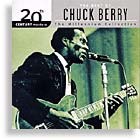
  • Chuck Berry – The Millennium Collection

    The Millennium Collection

    MCA has released a treasure trove of “millennium collection” greatest hits discs just in time for the new century. This guitar hero gets his due recognition with single-CD package that do justice in a dozen or so cuts. There’s nothing new here – no previously unreleased versions or alternate takes – just the classic recordings of the classic songs.


    This article originally appeared in VG‘s May ’00 issue. All copyrights are by the author and Vintage Guitar magazine. Unauthorized replication or use is strictly prohibited.